Horror Film Review: It Comes At Night (dir by Trey Edward Shults)


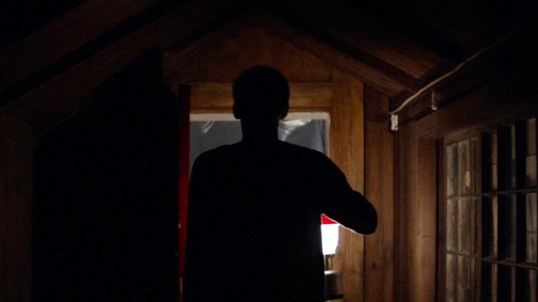
It Comes At Night is yet another film about people waiting for the end of the world.  In this case, the end is due to the outbreak of a mysterious disease.  It Comes At Night is a film that I meant to see in theaters when it originally released but I never got a chance.  It Comes At Night was acclaimed by critics but generally hated by audiences.  (Some of the comments on twitter, from people who had just returned from seeing the film, were incredibly angry.)  To be honest, it’s really not surprising that audiences didn’t embrace the film.  Having recently watched the film myself, I can tell you that It Comes At Night is one of the most depressing movies ever made.

Seriously, remember how depressing the Arnold Schwarzenegger/Abigail Breslin zombie film Maggie was?  Well, compared to It Comes At Night, Maggie might as well have been a musical comedy.

It Comes At Night opens with a former school teacher named Paul (Joel Edgerton) executing his father-in-law.  Paul’s wife, Sarah (Carmen Ejogo), and his teenage son, Travis (Kelvin Harrison, Jr.) understand that Paul had no choice.  There’s been an outbreak of a disease and the old man was infected.  The only way to keep everyone else in the family safe was to kill him and burn his body.

Paul and his family live in an isolated cabin.  At all times, the front door remains locked.  Only Paul and Sarah are allowed to carry the key.  No one is allowed to leave the house at night and under no circumstances are strangers allowed to enter the house.  Sometimes, after the sun goes down, Travis thinks that he can hear sounds in the surrounding woods.  It’s a reminder that people are out there but the majority of them are either slowly dying from the disease or scavengers trying to survive.

Paul ruthlessly enforces the rules but then, one night, a man named Will (Christopher Abbott) attempts to break into the house.  Will swears that he’s not infected.  He was just trying to find food for his wife, Kim (Riley Keough) and his son, Andrew (Griffin Robert Faulkner).  After Paul determines that Will does not have the disease, he agrees to let Will and his family stay with them.  If the house is ever attacked, Paul and Sarah figure, Will and Kim will provide an extra layer of defense.

And, for a few weeks, everything is fine.  The two families bond.  But Travis is still having vivid nightmares in which he sees men and women who have been infected and who are living in the woods.  And he is still hearing sounds at night…

The inevitability of death hangs over minute of It Comes At Night.  From the film’s first scene, you know that things are probably not going to end well.  When the two families do start to surrender to their paranoia, it’s upsetting but not particularly shocking.  It’s depressing because it all seems very plausible.  I think we all know that, if the world really was ending, it wouldn’t bring about peace or reflection.  Instead, people would keep fighting until the final second.  That’s just human nature.  What makes It Comes At Night so sad and disturbing is that there are no traditional heroes or villains.  There’s just six people trying to live their lives in a world that’s rapidly coming to an end.  They think they can beat the darkness surrounding them but the audience knows better.

I know, I know.  You just read that paragraph and you thought, “Yeah, Lisa, that sounds like a really fun movie.”

And you’re right.  It’s not a fun movie.  I would seriously warn anyone struggling with depression to be careful about watching It Comes At Night.  It’s definitely not going to cheer you up.  I spent the first half of thid 90 minute film convinced that I was probably going to stop watching because it was just too dark.  But I ended up watching it to the end because, even if it was depressing, it was also a very well-made film.  It sucks you in, even though you might not want it to.  The entire cast does a good job but special praise has to be given to Kelvin Harrison, Jr., who gives a searingly vulnerable performance as Travis.

It Comes At Night is a well-made, disturbing, and heartbreakingly sad movie and probably not one that I’ll have any desire to watch again for quite some time.
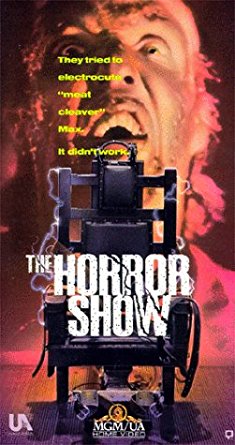
A Movie A Day #269: The Horror Show (1989, directed by James Isaac and David Blyth)


For the crime of having murdered over a 100 people, “Meat Cleaver Max” Jenke (Brion James) is sentenced to death and sent to the electric chair.  Even though everyone thinks that Max was electrocuted, his electricity-fueled spirit is still alive and pissed off.  If this sounds familiar, that is because it is the exact same premise that was used in Destroyer.  The only difference is that Max is not haunting a prison and killing a film crew.  Instead, he is living in a basement and seeking revenge on Lucas McCarthy (Lance Henriksen), the cop who arrested him.

Lucas is already tightly wound.  There is a scene where Lucas is watching as his family laughs uproariously at a late night comic who is telling a not very funny joke about then-Vice President Dan Quayle.  When Lucas thinks that he sees Max on TV, he pulls out his gun and shoots the screen.  His wife, son, and daughter will probably never laugh at another joke about any vice president.  Soon, Lucas is seeing and hearing Max everywhere.  Max says that he is going to tear Lucas’s world apart and he means it.

That The Horror Show is going to be a mess is obvious from the opening credits, where the screenplay is credited to Alan Smithee.  The credited director is visual effects specialist James Isaac but most of the film was reportedly directed by David Blythe.  Isaac stepped in when Blythe was fired by producer Sean S. Cunningham.  Full of false scares and scenes where people go down into the basement for no reason other than to become Max’s latest victim, The Horror Show is usually boring, except for when it is violent, gory, and mean-spirited.  There are moments of strange attempts at humor that do not seem to belong.  In the middle of all the carnage, there is a subplot about McCarthy’s son (Aron Eisenberg) ordering case after case of Nestle Quick.  Did Nestle pay for the product placement?  Were they happy to be associated with a movie where Lance Henriksen has a nightmare that his daughter (played by DeeDee “sister of Michelle” Pfieffer) is pregnant with Max Jenke’s baby?

The Horror Show provided both Lance Henriksen and Brion James with rare starring roles and they did their best what they had to work with.  Also keep an eye out for veteran tough guy Lawrence Tierney as the warden who supervises Max’s execution.

Horror Scenes That I Love: A Scene From Nosferatu


Today’s horror scene that I love comes from the absolutely terrifying 1922 silent film, Nosferatu.

Directed by F. W. Murnau and featuring Max Schreck as Count Orlock, Nosferatu is often cited as being the first vampire film.  That’s actually not true.  There were apparently film adaptations of Dracula that were produced years before Murnau gave the world his “unauthorized” adaptation.

However, I do think it can be argued that Nosferatu is the most influential vampire film ever made.  Every vampire movie released over the past 95 years has been a direct descendant of Nosferatu and it remains a truly nightmarish work of horror art.  One need only compare it to Universal’s first Dracula film to see how well Nosferatu has aged.

Enjoy this terrifying scene!

Horror Film Review: Alien: Covenant (dir by Ridley Scott)


Why did Alien: Covenant fail?

It’s a legitimate question.  Alien itself is such an iconic horror film that, 38 years after it was first released, blatant rip-offs like Life are still being produced and, in many case, are still doing pretty well at the box office.  When John Hurt died earlier this year, he left behind a long and distinguished filmography but almost every obituary opened by discussing his role in Alien.  

Alien: Covenant received a good deal of pre-release publicity, mostly centering on the fact that Ridley Scott was not only the filming the latest installment of the franchise but that this was going to be a true Alien film, as opposed to a strange hybrid like Prometheus.  Personally, when I first saw the trailer, I thought it looked like something was a little off about it.  The spaceship looked way too clean and, for that matter, so did all the humans.  Whereas Alien and Aliens were all about sweaty, profane men and women stuck in dark and cramped locations, the humans in Alien: Covenant just looked too damn perky.  In at least one of the trailers, they were all smiling.  No one smiles in space, at least not in an Alien movie.  Still, everyone else seemed to be super excited about the trailer so I figured that maybe I was just being overly critical.

Then the movie came out.  It got some respectful but somewhat restrained reviews, though it did seem like quite a few critics were more interested in praising the longevity of the series as opposed to actually talking about the film itself.  At the box office, it performed a bit below expectations during the first week but then again, that’s pretty much been the story for almost every film that’s been released in 2017.  But then, during the second week, it plunged from being the number one movie in America to being the number four movie in America.  In the third week, it plunged again and, in the fourth week, it left first-run theaters and headed for the dollar cinemas.  When a widely anticipated film like that — especially one that is part of a historically popular franchise — heads to purgatory after only four weeks, the only thing you can blame is word of mouth.

Why did Alien: Covenant fail?

Well, there’s several reasons why this film failed to connect with audiences.

First off, the plot is rather familiar.  In the future, the crew of a spaceship picks up a radio transmission for a nearby planet and the captain (played, in this case, by Billy Crudup) sends down an expedition to investigate.  Of course, it turns out that the planet is full of facehuggers and xenomorphs and all the other stuff that audiences typically expect from an Alien film.  Also on the planet is David (Michael Fassbender), the replicant who is the sole survivor from Prometheus.  (Fassbender actually plays two roles in Covenant.  He also plays Walter, another replicant.  One is bad and one is good.)  Basically, Covenant takes the plots of Alien and Aliens and mashes them together.  But it never answers the question of why audiences wouldn’t be better off just watching the originals.

The humans themselves are rather blandly written and somewhat interchangeable.  There’s no one who is memorably quirky like Bill Paxton or Harry Dean Stanton.  Katherine Waterston makes for a bland substitute for both Sigourney Weaver and Noomi Rapace.  Usually, I like Danny McBride but he seems out of place in an Alien film.  Genuinely interesting actors, like James Franco, Amy Seimetz, and Carmen Ejogo, are all dispatched far too early.  Probably the best performance in the film comes from Michael Fassbender but, for anyone who has any knowledge of what usually happens with replicants in the Alien franchise, there’s no surprises to be found in either of his characters.

But ultimately, the main problem with Alien: Covenant is that it just wasn’t scary.  Some might say that this is due to the fact that we’re no longer shocked by the sight of aliens bursting out of people’s chests.  However, I recently watched Alien.  I watched it with the full knowledge that, as soon as John Hurt sat down to eat, that little bugger was going to burst out of his chest and that blood and bones were going to fly everywhere.  I also knew that Harry Dean Stanton was going to end up walking right underneath the alien.  I knew that Tom Skerritt’s radio was going to go dead.  I knew that the alien would be waiting for Sigourney Weaver in the escape pod.  I knew all of this and Alien still scared the Hell out of me, as it has every time that I’ve watched it.

And I also had the same reaction when I recently watched Aliens.  Yes, I knew that the space marines weren’t going to be able to fight the aliens.  I knew what was going to happen to Paul Reiser.  I knew that Bill Paxton was going to end up chanting, “Game over, man!”  I knew that aliens were going to be bursting off of chests all over the place.  I knew it was all going to happen and yet, turning out all the lights and watching Aliens still left me feeling shaken.

The difference between those two films and Alien: Covenant is that the first two films felt authentic.  The ships felt lived in.  The characters felt real.  Both films were full of rough edges and small details that invited you to try to look closer.  You could watch those films and imagine yourself on those ships and talking to those characters.  You got scared because you knew that there was no way you’d be one of the survivors.  Everyone pretends that they would be Sigourney Weaver but most of us know that, in reality, we’re going to be Veronica Cartwright, sobbing and useless.

Alien: Covenant, on the other hand, is a very slick movie.  Nothing about it feels real and there’s no real emotional impact when the aliens show up and start killing people.  You never feel as if you know the characters, beyond whatever feelings you may have toward the actors involved.  “Oh,” you say, “the alien just burst out of Billy Crudup’s chest.  Well, he’s got another movie coming out so he’ll be fine…”

For all of the technical skill that went into making it, Alien: Covenant has no soul.  And, for that reason, it’s never scary.  (Sadly, Life felt like a better Alien movie than Covenant did.)  Hopefully, if there is another Alien film, that soul will be rediscovered.

A Blast From The Past: Case Study: LSD


Though it’s been a while since we last did so, we occasionally like to share old educational and promotional films here at the Shattered Lens.  For some reason, we always seem to end up sharing quite a lot of them in October.  Something about the over-the-top educational format just tends to bring out the ghoulish melodrama in some aspiring filmmakers.

Take Case Study: LSD, for instance!  This 3 and a half minute film is from 1969.  It was made to dissuade viewers from experimenting with LSD but I get the feeling that I probably just mostly inspired people to try to recreate the infamous hot dog scene.

It’s a good film for October, though.  Plus, I like looking at all the hippies in their hippie clothes.  GET A HAIRCUT, YOU HIPPIES!

Believe it or not, Case Study: LSD has a page over at the IMDb but no director is listed.  Judging from the film’s use of still frames, I’m going to guess that it was directed by Chris Marker.

Enjoy!

4 Shots From 4 Films: Special Mario Bava Edition


4 Shots From 4 Films is just what it says it is, 4 shots from 4 of our favorite films. As opposed to the reviews and recaps that we usually post, 4 Shots From 4 Films is all about letting the visuals do the talking.

This October, I am going to be using our 4 Shots From 4 Films feature to pay tribute to some of my favorite horror directors, in alphabetical order!  That’s right, we’re going from Argento to Zombie in one month!

Today’s director is Mario Bava, the maestro of Italian horror and one of the most influential and important filmakers of all time!

4 Shots From 4 Films

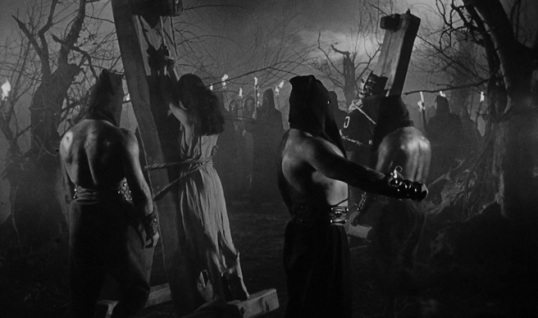
Black Sunday (1960, dir by Mario Bava)

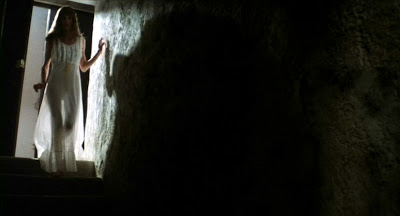
Black Sabbath (1963, directed by Mario Bava)

Kill, Baby, Kill (1966, directed by Mario Bava)

Shock (1977, dir by Mario Bava)


Horror on the Lens: Scream of the Wolf (dir by Dan Curtis)


For today’s horror on the lens, how about a little werwolf action?

In the 1974 made-for-TV movie, Scream of the Wolf, Peter Graves is a writer who is asked to help solve a series of mysterious murders.  The fact that both human footprints and wolf tracks have been found at each murder scene has led some people to assume that the killer must be a werewolf!  Will Graves be able to prove them wrong or will it turn out that they are right?  Graves calls in a famous hunter (Clint Walker) to help track down the killer but it turns out that the hunter has secrets of his own.

I’m going to guess that, like Baffled!, Scream of the Wolf was a pilot disguised a movie.  I assume that the hope was that the movie would lead to a series where Peter Graves would solve a different paranormal mystery every week.

Well, that series never materialized by Scream of the Wolf is still an enjoyable film.  The screenplay was by none other than Richard Matheson while made-for-TV horror specialist Dan Curtis sat in the director’s chair.

In the end, Scream of the Wolf is only 72 minutes long and I know for a fact that you don’t have anything better to do right now.  I watched this movie two months ago with Patrick Smith and the Late Night Movie Gang and we had a blast.

Have fun!

Horror on TV: Suspense 1.2 “Suspicion” (dir by Robert Stephens)


For tonight’s excursion into televised horror, we present to you an episode of Suspense!

What was Suspense?  It was an anthology show that ran from 1949 to 1954.  Each episode dealt with ordinary people who found themselves in not-so ordinary situations.  As well, each episode was broadcast live and the entire show was sponsored by the Autolite Corporation.  They make spark plugs.

Out of the over 250 episodes of Suspense, only 90 still survive.  Suspicion, the second episode of the first season, originally aired on March 15th, 1949.  It details what happens when a doting husband comes to suspect that his housekeeper may be a notorious arsenic poisoner!

And yes, it does start with a commercial for spark plugs.

Enjoy!

The TSL’s Horror Grindhouse: A Cat In The Brain (dir by Lucio Fulci)


Oh, A Cat In the Brain.

What a frustrating film!

Listen, as someone who loves Italian horror and who feels that Lucio Fulci made some of the best (if most misunderstood) horror films of all time, I certainly wish A Cat In The Brain was a great film.  Every time I watch it, I find myself hoping that it will turn out to be better than I know it’s going to be.  Don’t get me wrong.  I don’t necessarily think that A Cat In the Brain was a terrible film.  Especially when compared to some of the other films that Fulci directed towards the end of his career, A Cat In The Brain is competently made and it certainly proves that Fulci had a better sense of humor than many critics give him credit for.  It’s not really a bad film.  It’s just a disappointing one.

To understand why, you have to understand just who Lucio Fulci was and why horror fans hold him in such high regard.  Fulci was an Italian director, one who was responsible for some of the most visually impressive horror films of all time.  Even though Fulci did not start his career working in the horror genre, it’s those films that for which he is best remembered.  Many of his films, like Zombi 2, City of the Living Dead, The House By The Cemetery, and The Beyond, are rightfully remembered as classics.  By design, these movies often felt like filmed nightmares and they remain influential to this very day.  Literally every zombie film that has been released over the past few decades owes a debt to Fulci and The Beyond trilogy is perhaps as close as any director has ever gotten to truly capturing the feel of H.P. Lovecraft on film.

Unfortunately, many critics refuses to look past the violent content of Fulci’s films.  In some countries, his movies were banned outright.  In America, Fulci’s masterpiece, The Beyond, was released in a butchered, compromised form.  Following the release of his controversial and disturbing slasher film, The New York Ripper, Fulci’s career went into decline and, suffering from ill-health and often in desperate need of money, he found himself directing low-budget films that were unworthy of his considerable talents.  It’s one of the sadder stories in the history of Italian horror.

A Cat In The Brain was one of Fulci’s final films and it stars none other than … Lucio Fulci!  Fulci plays a horror director named Lucio Fulci.  Fulci is concerned that all of his recent work in the horror genre is starting to mentally damage him.  For instance, after editing a scene about cannibalism, Fulci goes to a nearby restaurant and orders a steak.  However, whenever he starts to eat his steak, Fulci flashes back to the movie that he’s just directed.  When he goes home, the sound of the handyman using a chainsaw causes Fulci to think about a scene that he filmed, one that involved a killer chopping up a body.  When a frustrated Fulci kicks a bucket of red paint, he visualizes blood.  Meeting a German reporter causes Fulci to fantasize about a Nazi orgy.  Is Fulci losing it?  Could it be that violent movies really do cause violent urges?

Worried about his mental health, Fulci goes to see a psychiatrist, Professor Egon Schwarz (David L. Thompson).  Schwarz puts Fulci order hypnosis and tells Fulci that, over the next few weeks, he will think that he has “done terrible things.”  It turns out that Professor Schwarz is an aspiring serial killer.  Schwarz wants to go on a killing spree and have Lucio Fulci take responsibility for it…

To be honest, the plot description probably makes A Cat In The Brain sound like it’s a lot more subversive than it actually is.  It has all the ingredients to be a great satire but, unfortunately, Fulci’s heart never seems to really be in the movie.  Oddly, considering that the movie is literally about his life, Fulci directs A Cat In The Brain in a rather detached and clinical fashion.  There’s none of the visual poetry that distinguished Fulci’s best work.

Even worse, probably over half of this film is made up of clips that were lifted from other Fulci films.  Unfortunately, the scenes don’t come from Fulci’s good films.  Don’t go into A Cat In The Brain expecting to see anything from Zombi 2 or Don’t Torture A Duckling.  Instead, all of the clips come from stuff like Touch of Death and The Ghosts of Sodom, films that largely represent Lucio Fulci’s declining years.

However, there is one good thing about A Cat In the Brain (beyond the title, which I think is adorable): the film ends with Fulci happy and literally sailing into the sunset.  Considering both Fulci’s lasting influence as a filmmaker and the sad details of his final years, it’s hard not to feel that A Cat In The Brain gave Fulci the final scene that this talented director deserved.