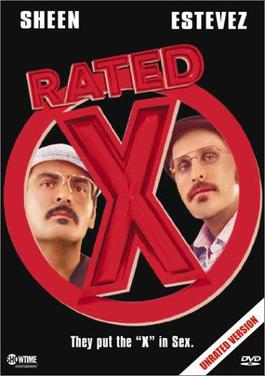
Rated X (2000, directed by Emilio Estevez)


In Rated X, two real-life brothers play another set of real-life brothers.

Emilio Estevez and Charlie Sheen play, respectively, brothers Jim and Artie Mitchell.  Two pot-smoking entrepreneurs who found fame and fortune during the so-called Golden Age of Pornography (Behind the Green Door was their most famous film), Jim and Artie owned the O’Farrell Theater in San Francisco and became famous for their numerous legal troubles and their advocacy for freedom of speech.  While Jim became a semi-respectable figure who hobnobbed with the city’s elite, Artie became known for his consumption of cocaine.  In 1991, Jim drove over to Artie’s house and shot him twice.  Jim, who claimed Artie had threatened to kill him, was convicted of manslaughter and sentenced to six years in prison.  Jim was released after serving three years.  (He died in 2007, long after this film aired on Showtime.)

Rated X tells the story of the Mitchell Brothers in a flat and perfunctory manner.  Emilio Estevez not only plays Jim but he also directs.  He doesn’t bring much visual style or storytelling style to the film, despite a few scenes that appear to have been cribbed from Boogie Nights.  Estevez doesn’t seem to be sure what he wants to say about the Mitchell Brothers and they come across as being the most boring pornographers in history.  What’s really strange is that Estevez and Sheen are not believable as brothers, despite both wearing matching bald caps.  There’s nothing about their performances that would lead you to believe that they grew up with each other.  Casting Sheen as an out-of-control drug addict seems like a no-brainer but he’s not even believable when he’s snorting coke and handing out cheerleader uniforms.  In fact, the film probably would have worked better if Sheen and Estevez had switched roles.  Estevez was always better at showing emotion than Charlie.  In Rated X, Jim is always intense while Artie always has the wide-eyed stare that Oliver Stone made such good use of in Platoon.

I can understand the casting, though.  Jim and Artie were brothers so it makes sense to cast brothers to play them.  Because Charlie has always been best-known for his flamboyant life off-screen, it probably seemed to the obvious decision to cast him as the wild brother while Estevez, who has always come across as being a stable guy offscreen, seemed right for Jim.  But onscreen, Estevez is always better as an unpredictable outlaw and Charlie is always better as someone who tries to keep his real emotions bottled up.  This film was cast based on Estevez and Sheen’s off-camera personas and they’re both miscast as a result.

There’s an interesting movie to be made about the Mitchells.  Their rise and fall mirrored the rise and fall of the 6os counterculture.  (A year before he killed his brother, Jim even tried to launch a Ramparts-style magazine for the 90s.)  Unfortunately, the Showtime-produced Rated X is not it.
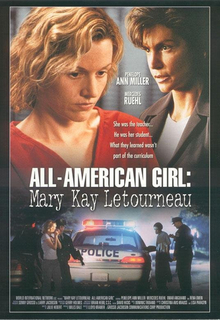
Retro Television Review: All-American Girl: The Mary Kay Letourneau Story (dir by Lloyd Kramer)


Welcome to Retro Television Reviews, a feature where we review some of our favorite and least favorite shows of the past!  On Sundays, I will be reviewing the made-for-television movies that used to be a primetime mainstay.  Today’s film is 2000’s All-American Girl: The Mary Kay Letourneau Story!  It  can be viewed on YouTube.

In 1996, a 34 year-old teacher named Mary Kay Letourneau decided that she had fallen in love with someone who was not her husband.

A 34 year-old deciding that they are no longer happy in their marriage and subsequently deciding that that they’ve found love with someone else is hardly an unusual or even surprising occurrence.  What made Mary Kay Letourneau’s case a national scandal was that the person that she decided that she was in love with was a 12 year-old student named Vili Fualaau.  Mary Kay started her affair with Vili when she was his sixth grade teacher.  When she was arrested and charged with two counts of second-degree rape of a child, Letourneau was pregnant with Vili’s child.  Even after being arrested, Letourneau insisted that she and Vili were soulmates.  After giving birth to Vili’s child, Letourneau was sentenced to six months of prison and somehow managed to avoid having to register as a sex offender.  After serving her sentence, Letourneau was promptly arrested again with Vili and was sent back to jail, where she gave birth to Vili’s second child.

All-American Girl opens with Mary Kay Letourneau (Penelope Ann Miller) in jail, insisting that everything that happened between her and Vili was consensual and that their love is real.  The majority of the film is shown in flashbacks.  Some of those flashbacks deal with Mary Kay, her husband (Greg Spottiswood), and Vili (Omar Anguiano).  Watching the flashbacks, I couldn’t help but notice that the film really did seem to be on Mary Kay’s side, to an almost ludicrous extent.  Her husband is portrayed as being a soulless sociopath, even before Mary Kay starts sneaking around with Vili.  As for Vili, he is presented as being the one who initiated his relationship with Mary Kay, flirting with her in class and comforting her when she starts crying in a school hallway.  The actor playing Vili looked, acted, and sounded considerably older than just 12 years old.  At times, he appeared to be nearly as old as Penelope Ann Miller.  And I’ll admit that it’s totally possible that Vili could have looked older than his age and maybe he did have a surprisingly mature vocabulary.  But still …. he was 12 years old!  Apparently, Letourneau cooperated with the film’s producers and that’s pretty obvious from the first minute we see Vili giving Letourneau a wolfish smile in the 6th grade.

The flashbacks dealing with Letourneau’s childhood are a bit more interesting, if just because Letourneau was the daughter of a congressman who ran for president in 1972.  (One of her brothers served in the first Bush White House.  Another served as an advisor to the 2016 Trump campaign.)  At one point, she taunts a group of protestors that have gathered outside of her family’s home and her father praises her courage.  The film hints that it was the twin traumas of her brother’s death and the discovery that her beloved father had fathered two children with a mistress that led to Letourneau’s subsequent instability.  Perhaps that’s true, though I think the film is a bit too eager to accept that as an all-purpose explanation.

You may have guessed that I had mixed feelings about this film.  Penelope Ann Miller gave an excellent performance as Mary Kay but the film’s attempts to portray May Kay as being even more of a victim that Vili were undeniably icky.  

As for the real Mary Kay, she married Vili four years after being released from prison.  They separated a year before Mary Kay died in 2020.  Their relationship inspired several films, most recently May/December.

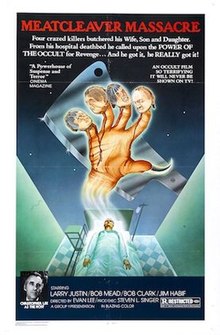
October Hacks: Meat Cleaver Massacre (dir by Edward D. Wood, Jr.)


Filmed, reportedly over the course of a few days, in 1974 but not released until 1977, The Meatcleaver Massacre is known for two things.

First off, it’s known for opening and ending with on-screen narration for Christopher Lee.  The distinguished-looking Lee begins the film sitting in what appears to be his own personal office.  He talks to us about the history of the supernatural and the paranormal and he suggests that the story that we’re about to see, may very well change someone like me from being a skeptic into a believer.

Secondly, Meat Cleaver Massacre is known for being one of the last films to be directed by the infamous Edward D. Wood, Jr.  Now, it should be understood that Wood didn’t have anything to do with writing or producing the film.  And when filming started, the director was a guy named Ken Burns who I assume is not the famed documentarian.  Unfortunately, Burns was judged not to be up to the role of directing and he was fired.  Edward D. Wood, Jr., who by this point was living in alcoholic squalor in Los Angeles and making his money through writing pornographic books, was brought in as his replacement.  When the film was released, the director was credited as being “Evan Lee.”  It wasn’t until 2022 that the film’s cinematographer (who was not paid for his work on the film) posted on Facebook that Ed Wood was the director.  The cinematographer’s claim was backed up by the film’s editor.

Now, my immediate reaction to learning this was to think: “Oh my God, Ed Wood directed Christopher Lee!”

Well, sorry …. no.  All the evidence points to Wood directing Meat Cleaver Massacre.  It’s an Ed Wood film, even if it doesn’t feature Wood’s trademark obsession with angora.  But the two scenes with Christopher Lee were apparently filmed for a different project, one that was abandoned.  In 1977, the distributors of Meatcleaver Massacre purchased the footage of Christopher Lee and inserted it into their film, which was promptly sold as a Christopher Lee film.  But the truth of the matter is that Lee’s footage was obviously meant for a far “classier” film than Meatcleaver Massacre and, judging from how dismissive Lee tended to be of the work that he did strictly for the money, it’s totally possible that he didn’t even know that he had become the star of Meatcleaver Massacre.  

As for Ed Wood, he died a year after this film was released.  At the time of his death, he had been evicted from his apartment and his landlord apparently threw away all of his scripts and movie memorabilia.  Sorry, everyone.  The first half of Ed Wood’s life story may be popular and funny but it definitely did not lead to a happy ending.

But what about Meat Cleaver Massacre, you may be asking.  Well …. actually, it’s not terrible.  It’s definitely a low-budget affair and none of the actors are particularly impressive but there are a few scenes that work when taken on their own terms.

James Habif stars as Professor Cantrell, who is first seen teaching a class on how to summon an Irish demon and then returning home to his family.  Unfortunately, that night, one of this students, Mason (Larry Justin), orders his gang to break into Cantrell’s house.  Mason says that he just wants to play a prank on the professor but instead, he and his idiot friends murder Cantrell’s family and leave Cantrell in a paralyzed state.  That said, Cantrell may be paralyzed but he can still summon the demon Morak to hunt down and kill all of Mason’s friends, one-by-one.  The deaths are grisly, with Mason’s home invasion bringing to mind the crimes of the Manson’s family and the demon’s acts of vengeance ranging from a disembowelment in the desert to an accident in a garage to an exploding movie projector.

As with most of Ed Wood’s film, the pacing is a bit off and the film is edited in such a way that it’s sometimes difficult to keep track of how much time has passed between scenes.  The acting isn’t great, though it’s really not any worse than the acting you would expect to find in a low-budget 70s horror film.  The scene in which one of Mason’s gang meets his fate in the desert is actually rather well-done and intentionally surreal.  To be honest, there’s not much about the film that would make you think it was an Ed Wood production.  As I said before, there’s no references to angora.  There’s no Kelton the Cop.  Criswell doesn’t make an appearance.  By most accounts, Ed spent the final decade of his life broke and doing whatever he had to do to scrounge up enough cash to pay his rent and keep drinking.  Doing whatever he had to do included directing films like Meatcleaver Massacre.  I wonder how many other films were secretly directed with Ed Wood?

Anyway, if you’re a Christopher Lee or Ed Wood completist, Meatcleaver Massacre is currently available on Tubi.

Horror on TV: Suspense 1.2 “Suspicion” (dir by Robert Stephens)


For tonight’s excursion into televised horror, we present to you an episode of Suspense!

What was Suspense?  It was an anthology show that ran from 1949 to 1954.  Each episode dealt with ordinary people who found themselves in not-so ordinary situations.  As well, each episode was broadcast live and the entire show was sponsored by the Autolite Corporation.  They make spark plugs.

Out of the over 250 episodes of Suspense, only 90 still survive.  Suspicion, the second episode of the first season, originally aired on March 15th, 1949.  It details what happens when a doting husband comes to suspect that his housekeeper may be a notorious arsenic poisoner!

And yes, it does start with a commercial for spark plugs.

Enjoy!