Horror Film Review: Angel Heart (dir by Alan Parker)


First released in 1987 and set in 1955, Angel Heart tells the story of Harry Angel (Mickey Rourke).

With a name like Harry Angel, it’s perhaps not surprising that Harry is a private investigator.  Harry operates out of New York.  He’s got a shabby apartment.  He wears wrinkled clothes.  He rarely shaves.  He smokes almost constantly.  (In a rare moment of comedy, the camera catches Harry blithely emptying a full ashtray in the middle of the street.)  Harry looks like he reeks of tobacco, beer, sweat, and lost dreams.  And yet, it’s difficult not to like Harry.  He’s got a charming smile, even if his face is often bruised from his latest beating.  He speaks in a low whisper and it’s hard not to get the feeling that Harry is actually kind of shy.  He’s incredibly sleazy but there’s something about him that just makes the viewer want to take care of him.

Harry is hired by a mysterious man named Louis Cyphere (Robert De Niro, cheerfully overacting).  Louis wants Harry to track down a singer named Johnny Favor.  As Cyphere explains it, he did a favor for Johnny and Johnny has yet to pay Cyphere what he owes.  Johnny has been suffering from PTSD ever since he served in World War II.  When last seen, Johnny was receiving electroshock treatment in an upstate hospital.

Harry’s search for Johnny leads him into an increasingly complex and disturbing conspiracy.  He meets a doctor who is addicted to morphine and, when the doctor turns up dead, Harry coolly uses the dead man’s shoe to light his match.  Eventually, Harry’s investigation leads him to New Orleans, where he meets both Johnny’s wife (Charlotte Rampling) and Johnny’s unacknowledged daughter, Epiphany (Lisa Bonet).  As Harry searches for Johnny, he deals with strange visions of his own mysterious past.  He sees himself wandering around Times Square shortly after the attack on Pearl Harbor.  Harry also finds himself having to deal with the fact that almost everyone that he talks to ends up being brutally murdered.  Every time that Harry tries to quit the case, Cyphere offers him more money.  (Cyphere tends to show up whenever Harry finds himself on the verge of abandoning his search.)

Angel Heart moves at its own deliberate pace.  In fact, the first hour can feel a bit slow but that first hour definitely pays off during the second half of the film.  By the time that Harry starts to truly uncover what has happened to Johnny, the audience actually cares about Harry and is actually worried about what’s going to happen to him when he reaches the end of the case.  Mickey Rourke was (and is) an eccentric actor but he’s at his most effective in Angel Heart.  A lesser actor would have just played Harry as being a typical hardboiled detective.  Rourke plays Harry as being a lost soul, a vulnerable man who is often as confused and scared as the people that he’s looking for.  By the end of the film, Harry realizes that the answer to the mystery was right in front of them and his look of despair is surprisingly powerful.  If De Niro gives a good performance that is almost totally on the surface, Rourke gives the type of performance that allows the audience to explore what’s going on beneath the surface of a character who many would initially view as being a cliché.  Mickey Rourke’s Harry Angel is right up there with Bogart’s Sam Spade and Jack Nicholson’s Jake Gittes.  He’s a familiar character who also seems to be a human being.

Full of sex, violence, and increasingly disturbing imagery, Angel Heart is not for everyone.  Alan Parker’s direction emphasizes the darkness of Harry’s world and the bleakness of his situation.  The film ends with a twist that may not be totally unexpected but which is still undeniably disturbing.  The more you think about it, the most disturbing it gets.  Angel Heart is an atmospheric and intelligent chiller.  It’s existential horror at its most nightmarish.

AMV Of the Day: Another (Scary Song)


Halloween is almost here!  And to celebrate, here is an AMV Of The Day!

Anime: Another

Song: Scary Song (by Nightcore)

Creator: Animemixedit (please subscribe to this creator’s channel)

Past AMVs of the Day

Horror on TV: Halloween Is Grinch Night (dir by Gerard Baldwin)


So, we all know that the Grinch once tried to steal to Christmas and then his heart grew a few sizes but did you know that apparently, the Grinch also tried to steal Halloween?

Until a few years ago, I did not.  I was going through YouTube, searching for horror films that I could share here on the Shattered Lens, and guess what I came across?

A TV special from 1977 entitled Halloween is Grinch Night!

Unlike How The Grinch Stole Christmas, Halloween is Grinch Night apparently never became a holiday classic.  Perhaps that’s because Halloween is Grinch Night is not exactly the most heart-warming of holiday specials.  Whereas How The Grinch Stole Christmas tells us about how the Grinch learned the true meaning of Christmas, Halloween is Grinch Night gives us a Grinch who has no redeeming features.  There is no hope for this Grinch.  This Grinch will steal your soul and probably drink your blood.  This Grinch is pure Grinchy evil.

This is the Grinch of our nightmares.

Check out Halloween is Grinch Night below and hope the Grinch doesn’t capture you this Halloween….

The TSL’s Horror Grindhouse: Teenage Caveman (dir by Roger Corman)


Who is the Teenage Caveman?

Believe it or not, he’s Robert Vaughn.  Vaughn, who would later go on to appear in The Magnificent Seven, The Man From UNCLE, Bullitt, The Towering Inferno, and Hustle, was 26 years old when he played a nameless caveman in Roger Corman’s 1958 film, Teenage Caveman.  At the age of 26, Vaughn looked like he was closer to 35 and he certainly didn’t resemble a teenager.  Despite wearing a loin cloth, he also didn’t appear to be a caveman.  If he was a caveman than he was certainly a well-groomed caveman and perhaps the only caveman to understand how to use hairspray.  Seriously, his hair is perfect in this film.

As for the film itself, it’s about a primitive tribe of people who live in a rocky wasteland.  However, just across the river, there’s a land that’s full of plants and animals.  It would obviously be a much better place to live and Vaughn’s teenage caveman is totally annoyed that the older folks on the tribe refuse to cross the river.  They claim that a monster lives in the river and that it will kill anyone who tries to cross.  Being a rebellious teenager, Vaughn decides to cross the river anyway.  He convinces a group of friends to go with him.  When they reach the river, they meet and fight the monster and they also discover that the monster was doing more than just guarding the river.  It all leads to a plot twist that feels as if it was added at the last possible second.

In a later interview, Robert Vaughn referred to Teenage Caveman as being the worst film in which he ever appeared.  He went on to suggest that it was the worst film ever made.  Those are bold words coming from someone who appeared in as many bad films as Robert Vaughn did.  That said, I do think that Vaughn was being a bit too hard on Teenage Caveman.  For what it is — an extremely low-budget film that barely runs over an hour — Teenage Caveman is entertaining if you’re in the right mood for it.  It’s hard not to smile at the cavepeople, with their modern haircuts and their very American accents.  As well, the film features the same stock footage of dinosaurs fighting that appeared in countless other B-movies of the time and, again, it’s hard not to smile at the actors valiantly trying to pretend that there are dinosaurs fighting just a few feet away from them.  And while that final plot twist may come out of nowhere, it’s just random enough to be interesting.  Worst film of all time?  With all respect to the teenage caveman, I have to disagree.  It’s a B-movie and, if you enjoy B-movies, you’ll enjoy this one.  And let’s give some credit to Robert Vaughn.  He gives an earnest performance, even though he later said that he felt foolish every time he stepped out on the set.  Add to that, his hair is perfect.

Claws (1977, directed by Richard Bansbach and Robert E. Pearson)


After a group of hunters wound a grizzly bear in Alaska, the bear mauls a logger named Jason Monroe (Jason Evers).  Both the bear and Jason survive their initial meeting.  For the next six years, the bear attacks people in the woods and Jason tries to move on from his experience.  The indigenous people call the grizzly, “Satan Bear” and it seems like no one can stop it.  But when Satan Bear dares to attack a group of boy scouts (including Jason’s son), Jason decides that it’s time to enter the woods and track down the bear.

Claws is like Jaws except the monster has claws.  Actually, despite the similarity of their names, Claws isn’t really a rip-off of Jaws as much as it’s a rip-off of Grizzly, which was a rip-off of JawsClaws is a rip-off of a rip-off, complete with the all the usual characters who appear in revenge of nature films.  Jason is the grizzled hunter.  There’s an idealistic college student who knows all about bears.  There’s a wise old native man who talks about spirit animals.  What sets Claws apart from both Jaws and Grizzly is its heavy use of badly tinted stock footage and all of the flashbacks.  The movie starts with a group of hunters shooting at two bears but it’s obvious that the actors playing the hunters were nowhere near the two bears that are featured in the stock footage.  The flashbacks are used to fill in everyone’s backstory but none of them have anything to do with the bear so I’m not sure what the point of them was supposed to be.  The movie would not be exciting even if it only focused on the bear attacks but adding all those dull flashbacks transforms Claws from being merely mediocre to a real challenge to sit through.

Claws was a flop when it was first released but, a year later, it found success when it was rereleased and retitled Grizzly 2.  I guess the film’s distributor figured that they should just go ahead and admit it.

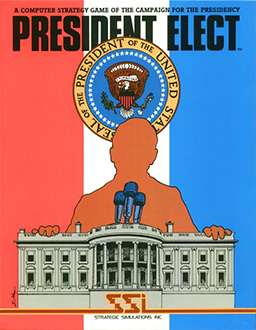
President Elect: Nixon vs Frankenstein’s Monster


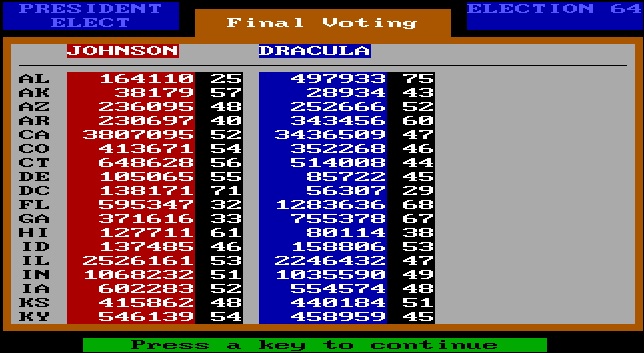
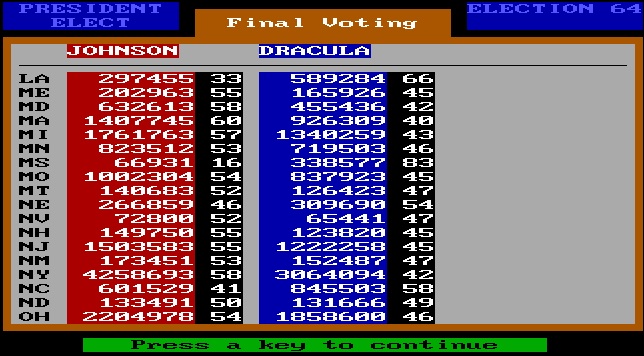
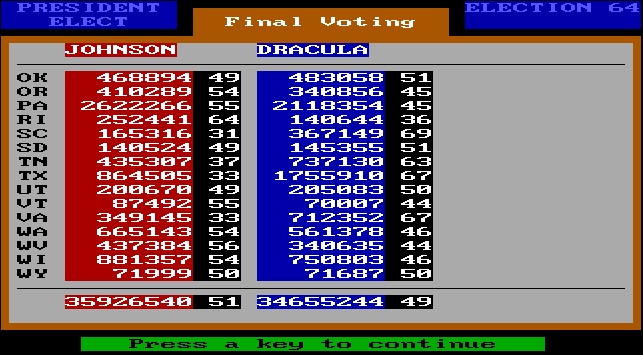
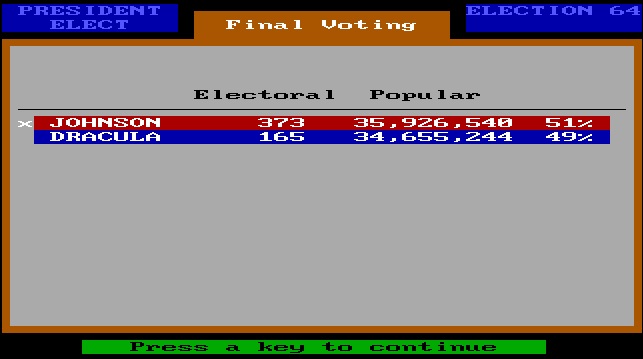
Yesterday, I used the old President Elect simulator to determine who would win a presidential election between Frankenstein’s Monster, Dracula, and The Mummy.  Dracula crushed both of his opponents, mostly because neither Frankenstein nor The Mummy could really speak.

Today, I decided to see if Frankenstein’s Monster would have had better luck if the Democrats had nominated him to run against Richard M. Nixon in 1960.  In the real world, John F. Kennedy narrowly defeated Nixon, despite the popularity of Dwight Eisenhower.  (Kennedy had some extra help in Illinois.)  Nixon had the experience and the depth of policy knowledge but Kennedy had the charisma that Nixon lacked.  After logging into President Elect, I imagined a situation in which the Democrats of 1960 turned not to Kennedy but to Frankenstein’s Monster.  Just as he had with Dracula, I imagined that Frankenstein would run on a largely non-partisan platform that put strong emphasis on fire prevention.  As well, I had to give Frankenstein low scores on his speaking ability and his ability to stay cool under pressure.  But he did get a high personal magnetism score because people have been interested in him for over 200 years.  Would that be enough to beat the similarly challenged Nixon?

No, it would not.

Just as with the campaign against Dracula, it was obvious who was going to win from the start.  Frankenstein’s Monster barely campaigned and, unlike Kennedy, he refused to debate Nixon.

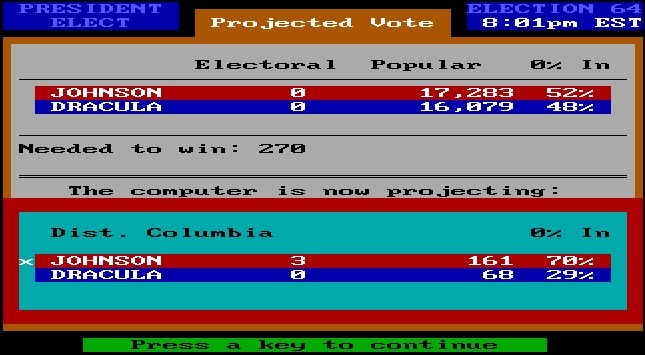
On election night, the first result told the story.

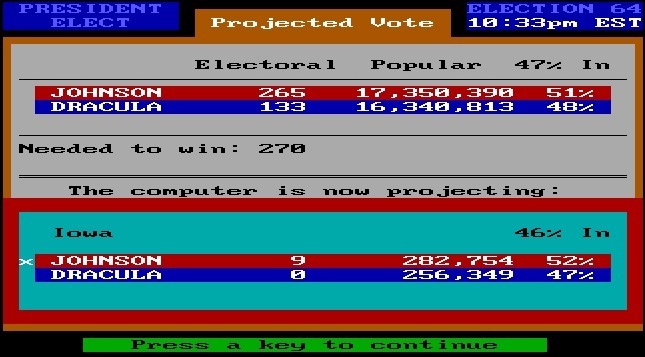
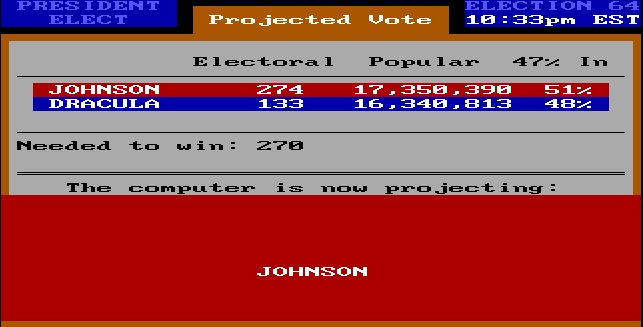
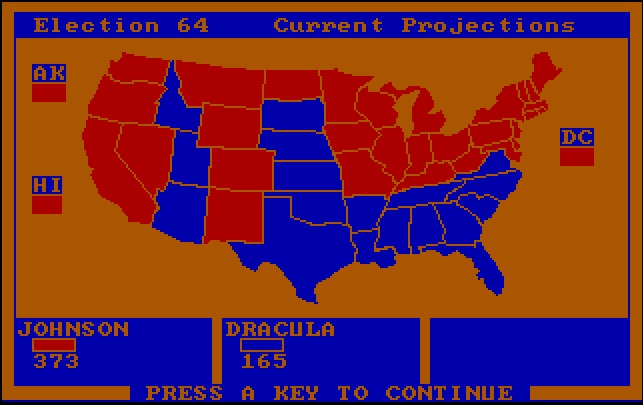
The good news is that, unlike when he ran against Dracula, Frankenstein’s Monster actually did manage carry a state.  In fact, he carried two.  He won both Mississippi and Georgia, receiving 51% of the vote in both.  Every other state, he lost to Nixon.

The final vote tally:

Managing to win 43% of the vote while being unable to speak or be around fire is actually pretty impressive.  But Frankenstein’s Monster still could not beat Richard Nixon.

Book Review: Truth or Dare by R.L. Stine


In this 1995 book from R.L. Stine, a group of wealthy teenagers decide to take a vacation from Fear Street and Shadyside High.  They decide to spend the weekend skiing but, once they reach their mountain lodge, they end up getting hit by a blizzard.  They’re going to be trapped inside for a day or two.  Because the storm took out all the phone lines (and since this book is from the age when everyone was dependent on a landline), they are cut off from the world.  If anything bad happens in the cabin, there will be no way to get help.  If anyone is driven to kill someone else, there will be no way to call the police.

Now, if I was in that situation, I would probably try to pass the time in the safest and least dramatic way possible.  I mean, if you’re going to be stuck with a group of people for a day or two, you should probably try not to do anything that could cause anyone to lose their temper.  The best thing to do is try to have fun and not obsess on the situation.  However, since this is an R.L. Stine book, everyone decides to play Truth or Dare.

Great idea!  Nothing bad has ever happened as a result of playing Truth or Dare!

Though I played it a few times and I always managed to survive, Truth or Dare is still a strange game to me.  First off, why wouldn’t you just automatically take the dare?  But, beyond that, there’s this weird assumption that everyone is just automatically obligated to follow the rules of Truth or Dare, even if it means hurting someone.  Inevitably, anyone playing Truth or Dare is going to have at least one deep dark secret that they are going to get asked about, something like: “Did you cheat on your partner?”  And instead of just saying, “No,” even if the answer is “Yes,” they always reply, “I’ll take a dare instead.”  Well, just the fact that you took a dare at that point is pretty much the same thing as answering yes.  There’s really no way to win this game, other than to lie whenever you’re asked a question that could potentially lead to you being murdered.  But that would mean breaking the rules of Truth or Dare!  It would apparently be better to die.  I guess it’s all about ethics.

Anyway, not surprisingly, the game of Truth or  Dare does lead to someone being murdered.  They get a hatchet in the back and the killer leaves it there to be discovered by the rest of the group.  AGCK!  This killer isn’t messing around.  Anyway, you can probably guess where all this leads.  The initial suspect looks guilty but is actually innocent.  The killer is the person that most people would least expect.  Stine mentions that chair lift enough times that you just know it’s going to be the setting for the climax of the story.  It’s a typical R.L. Stine novel but it is one that teaches an important lesson.  For the love of all things good and decent, do not play Truth or Dare!

Book Review: Spooky Texas by S.E. Schlosser


If you’re going to be in Texas this Halloween and you want to spend the holiday at a location that might be haunted …. well, as I’ve said many times on this site, I don’t believe in ghosts, werewolves, vampires, or anything else so I won’t be of much help there.  Probably the best recommendation that I can make is that you drive out to Marfa, set up a lawn chair in the desert, and wait for the Marfa Lights to appear.  The Marfa Lights have been appearing for decades, hovering over the town of Marfa.  Boring, reality-based people claim that it’s just an atmospheric phenomena.  Others claim that it’s either ghosts or maybe a UFO visitation.

Marfa itself is in the desert of west Texas.  (Giant was filmed in Marfa.)  As of late, it’s become as well-known for being an artists colony as for its paranormal reputation.  A few years ago, 60 Minutes did a breathless story on all the artists who were moving to Marfa and not once were the Marfa Lights mentioned.  Several minutes were devoted to Prada Marfa but not a single second to the Marfa Lights.  Don’t get me wrong, of course.  I would much rather the town be known for its artists than its UFOs but still, you have to wonder how a show could spend twelve minutes talking about Marfa without mentioning the lights.  Am I suggesting that there’s some sort of government cover-up going on?  No, I’m not.  That would be dumb.  I’m just suggesting that 60 Minutes, which is apparently a show that only exists so that elderly reporters have something to do after they lose their nightly news gig, might be out-of-touch.

Fortunately, the book Spooky Texas has chapters on the Marfa Lights and twenty-four other paranormal stories that take place in Texas.  Admittedly, some of the detail mentioned in the stories did seem a bit odd to me.  (For some reason, the author of this book seems to be under the impression that it snows a lot in west Texas.)  But, despite that, it’s a fun read and it’s full of inspiration for both the aspiring horror writer and the Texan who is just looking for some place creepy to hang out on Halloween.  If you can’t go to Marfa and if you can’t find any of the ghosts that are rumored to haunt the Alamo, I would suggest going to Fort Worth and searching for the Gray Lady.  Or, if you really want to live dangerously, go down to Laredo and listen for a crying woman.  Just don’t get too close!

International Horror Review: The Werewolf and the Yeti (dir by Miguel Iglesias Bonns)


This 1975 Spanish film is known by several titles.  In Spain, it was called La Maldicion De La Bestia.  In some other European countries, it was released as either Night of the Howling Beast or Hall of the Mountain King.  In the United States, it was released under the title The Werewolf and the Yeti.

Regardless of which title you see the film under, this is the eighth of 12 films in which Paul Naschy starred as Waldemar Danisky.  Waldemar was a Polish nobleman who, in film after film, transformed into a werewolf so that he could battle some other monster.  What set the Danisky films apart from other horror franchises is that each film was totally unrelated to the one that came before it.  Every film featured Danisky getting transformed into a werewolf for the first time and the majority of them ended with Danisky dying.  Even though Naschy was playing the same character, each film seemed to take place in a separate universe.  Apparently, regardless of the reality that he found himself in, Danisky was always destined to become a werewolf.  Talk about rotten luck!

Despite their bizarre lack of continuity, Naschy’s werewolf films were popular across Europe and, to a lesser extent the United States.  Of course, in America and the UK, they were only released in badly dubbed versions.  Indeed, the plot was often changed during dubbing depending on where the film was set to be released.  As a result, it’s difficult to fairly judge both Naschy and his films.  Paul Naschy had a definite physical presence but it’s rare that anyone ever heard his real voice.  In most of the Danisky films that I’ve seen, Naschy seems to play Danisky as if he is in a permanently bad mood.  But, I guess if your entire existence revolved around getting turned into a werewolf every year or so, you’d be in a bad mood too.

In this film, Waldemar Danisky is an explorer who is romantically involved with the daughter of Professor Lacombe (Josep Castillo Escalona).  Lacombe is planning on leading an expedition into the Himalayas, despite the presence of pirates, warlords, and Yeti!  Danisky warns Lacombe against attempting it but, in the end, he still agrees to serve as the expedition’s guide.  Unfortunately, this film’s version of Waldemar Danisky isn’t very good at his job and he soon gets separated from the expedition.  The professor and his daughter are captured by a group of mountain pirates who torture them and make plans to sell them into slavery.  Meanwhile, Danisky stumbles across a cave that is inhabited by two women who also happen to be …. WEREWOLVES!  It’s not long before Danisky gets bitten and finds himself transformed into a werewolf.  He uses his new werewolf powers to kill the women in the cave and then he heads off to rescue the professor.  It’s a good thing that Waldemar’s a werewolf because it turns out that the pirates have a …. YETI!

Yes, this is a weird and incoherent film.  Of course, that’s the main reason why it’s hard not to enjoy this silly little film.  It’s quickly paced and, like many of Naschy’s film, it operates on its own strain of dream logic.  The most interesting thing about the film is that no one is particularly shocked to discover that Waldemar Danisky has been transformed into a werewolf and Danisky himself seems to accept it as having been inevitable.  One gets the feeling that the expedition watched a few Paul Naschy films before heading to the Himalayas and, as a result, they knew exactly what to expect.  As I mentioned above, it’s hard to judge Naschy as an actor because his films were so poorly dubbed.  But, you can judge him as a werewolf and he really puts his heart into fighting that Yeti.  Waldemar Danisky is the werewolf that you want on your side.

¡Viva Naschy!