In this scene from Robert Altman’s 1975 masterpiece, Nashville, Julie Christie plays herself as a famous visitor to the city for which the film is named. She is introduced to Haven Hamilton (Henry Gibson), Haven’s lawyer, Delbert Reese (Ned Beatty), political advance man John Triplette (Michael Murphy), and country music star Connie White (Karen Black). Julie Christie may be a star in Hollywood but Connie is the star of Nashville.
Karen Black improvised her dismissive line about Julie Christine not even being able to comb her hair. It was a moment that reportedly shocked the rest of the cast and the crew but it was also a line that perfectly summed up both Connie as a character and Altman’s version of Nashville.
The Blues Brothers! They’re on a mission from God.
Jake (John Belushi) and Elwood Blues (Dan Aykroyd) are two Chicago orphans who love the blues and committing crime. After Jake is paroled from Joliet Prison, he’s picked up by Elwood in an old police car. Elwood traded the original Bluesmobile for a microphone. Jake understands, even if he still doesn’t like being seen in a police car. When they visit the orphanage where they were raised, Sister Mary Stigmata (Kathleen Freeman) beats them with a ruler and tells them that the orphanage is going to close if she can’t pay a $5,000 tax bill. Jake and Elwood set out to reform their band, raise $5,000, and save the orphanage. Jake and Elwood may be two career criminals who never take off their dark glasses but they’re on a mission from God.
Along the way to putting the band together and raising $5,000, Jake and Elwood meet characters played by everyone from James Brown to Ray Charles to Aretha Franklin. You never know when a big production number might break out. Jake and Elwood also step on a few toes. Soon, the Blues Brothers being chased by the police, the national guard, Jake’s parole officer (John Candy), Charles Napier’s country-western band, and a group of Illinois Nazis (led by Henry Gibson). There’s also a mysterious woman (Carrie Fisher) who wants to kill them. She has an impressive array of weapons but terrible aim.
The Blues Brothers was the first comedy to be based on a Saturday Night Live bit. Unlike most other SNL movies, The Blue Brothers develops its plot far beyond what was originally seen on television. Jake and Elwood get a full backstory and they also get personalities that go beyond the black suits and the dark eyewear. The Blues Brothers features Belushi at his most energetic but it’s also one of the few films to actually know what to do with Dan Aykroyd’s eccentric screen presence. If Belushi’s Jake is all about earthly pleasures, Aykroyd’s Elwood almost seems like a visitor for another world. Aykroyd’s performance of the Rawhide theme song is one of the film’s highlight.
The Blues Brothers has its share of funny lines and its famous for the amount of pointless destruction that it manages to fit into its storyline (with the “unnecessary violence” being authorized by the Chicago police to stop the Blues Brothers) but it’s also as surprisingly sincere tribute to the blues. It’s a movie that can balance Ray Charles shooting at a shoplifter and a massively destructive car chase in a suburban mall with Cab Calloway playfully performing Minnie the Moocher and Aretha Franklin bringing down the house (or diner, as the case may be). The movie can feature both a jump over an open drawbridge and Steven Spielberg as the clerk at the tax office. It’s one of the strangest comedies ever made and it features all the excesses that would bring an end to 70s Hollywood but when Jake and Elwood say they’re on a mission from God, you believe them.
1989’s The ‘Burbs takes place in …. well, it’s right there in the title.
Welcome to the suburbs! It’s place with big houses, green lawns, and neighbors who often don’t have much to do other than watch each other and gossip. Ray Peterson (Tom Hanks) lives with his wife, Carol (Carrie Fisher), and is friends with Art Weingartner (Rick Ducommun) and Mark Rumsfield (Bruce Dern). Ricky Butler (Corey Feldman) is the local teenager. It’s a nice neighborhood …. at least, until the Klopeks move in.
The Klopeks are viewed with suspicion from the minute they show up. They’re from a different country, they always seem to be burying something in their backyard, and Dr. Werner Klopek (Henry Gibson) is oddly stand-offish. When Walter Seznick (Gale Gordon) disappears and the the Klopeks are seen around Walter’s house and with Walter’s dog, Ray and his friends start to suspect that their new neighbors might be ritualistic murderers!
Oh, how I love The ‘Burbs. The film’s portrait of the suburbs as being a hotbed of paranoia may be a familiar one but it doesn’t matter when you’ve got actors like Tom Hanks and Bruce Dern throwing themselves into their roles. As always, Hanks is the glue that holds the film and its disparate parts together, giving a likable performance as a man who goes from being the voice of reason to being convinced that his neighbors are cannibals. Bruce Dern gleefully sends up his own image as a paranoid Vietnam vet but there’s also a sweetness to Dern’s performance that really makes it stand out. Dern’s character might be a little crazy but he does truly care about his neighbors.
Just as he did with Piranha and The Howling, Dante balances humor with suspense. He does such a good job of telling the story and getting good performances from his cast, that even the film’s big twist works far better than one might expect. It’s an 80s film so, of course, a few things explode towards the end of it. The film’s character-based humor is replaced with some broader jokes but no matter. The Burbs is an entertaining trip to the heart of suburban paranoia.
As the saying goes, just because you’re paranoid, that doesn’t mean that they aren’t out to get you.
So, we all know that the Grinch once tried to steal to Christmas and then his heart grew a few sizes but did you know that apparently, the Grinch also tried to steal Halloween?
Until about 9 years ago, I did not. I was going through YouTube, searching for horror films that I could share here on the Shattered Lens, and guess what I came across?
A TV special from 1977 entitled Halloween is Grinch Night!
Unlike How The Grinch Stole Christmas, Halloween is Grinch Night apparently never became a holiday classic. Perhaps that’s because Halloween is Grinch Night is not exactly the most heart-warming of holiday specials. Whereas How The Grinch Stole Christmas tells us about how the Grinch learned the true meaning of Christmas, Halloween is Grinch Night gives us a Grinch who has no redeeming features. There is no hope for this Grinch. This Grinch will steal your soul and probably drink your blood. This Grinch is pure Grinchy evil.
This is the Grinch of our nightmares.
Check out Halloween is Grinch Night below and hope the Grinch doesn’t capture you this Halloween….
Oh no! Halloween might be canceled because people just aren’t scared of the old monsters! Dracula (Judd Hirsch) calls all of the classic creatures to a meeting in his castle (where they all happen to be freeloading) and give them an ultimatum. Be more scary! It turns out to be easier said than done.
This originally aired in 1979 but, for people of a certain age, it achieved a certain immortality thanks to regular airings on the Disney Channel. It’s a cute show. It might seem a little bit corny today but that’s a large part of its appeal. It’s a reminder of a more innocent time.
Warren the Werewolf, by the way, was named after Warren “Werewolves of London” Zevon.
Though the Academy of Motion Picture Arts and Sciences claim that the Oscars honor the best of the year, we all know that there are always worthy films and performances that end up getting overlooked. Sometimes, it’s because the competition too fierce. Sometimes, it’s because the film itself was too controversial. Often, it’s just a case of a film’s quality not being fully recognized until years after its initial released. This series of reviews takes a look at the films and performances that should have been nominated but were, for whatever reason, overlooked. These are the Unnominated.
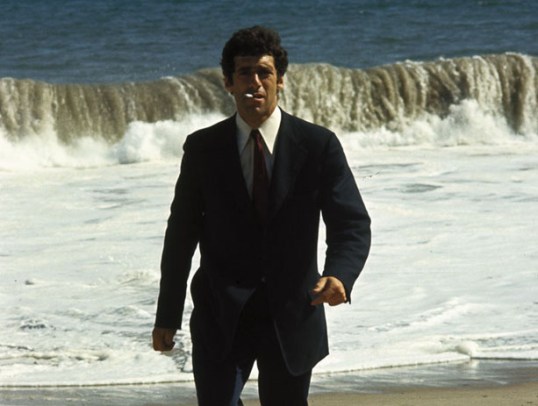
Elliott Gould is Phillip Marlowe!
If I had to pick one sentence to describe the plot of 1973’s The Long Goodbye, that would be it. Robert Altman’s adaptation of the Raymond Chandler detective novel loosely follows Chandler’s original plot, though Altman did definitely make a few important changes. Altman moved the story from the 50s to the then-modern 70s, replacing Chandler’s hard-boiled Los Angeles with a satirical portrait of a self-obsessed California, populated by gurus and hippies. And Altman did change the ending of the book, taking what one could argue is a firmer stand than Chandler did in the novel. In the end, though, the film really is about the idea of Chandler’s tough detective being reimagined as Elliott Gould.
Rumpled, mumbling, and with a permanent five o’clock shadow, Gould plays Marlowe as being an outsider. He lives in a shabby apartment. His only companion is a cat who randomly abandons him (as cats tend to do). With his wardrobe that seems to consist of only one dark suit, Marlowe seems out-of-place in the California of the 70s. When Marlowe’s friend, Terry Lennox (Jim Bouton), asks Marlowe to drive him to Mexico, one gets the feeling that Lennox isn’t just asking because Marlowe’s a friend. He’s asking because he suspects Marlowe would never be a good enough detective to figure out what he’s actually doing.
After Terry’s wife is murdered, Marlowe is informed that 1) Terry has committed suicide and 2) Marlowe is now a suspect. Convinced that Terry would have never killed himself, Marlowe investigates on his own. He meets Marty Augustine (Mark Rydell), a gangster who demands that Marlowe recover some money that he claims Terry stole. Marty seems like an almost reasonable criminal until he smashes a coke bottle across his girlfriend’s face. (One of Marty’s bodyguards is played by a silent Arnold Schwarzenegger.) Meanwhile, Terry’s neighbors include an alcoholic writer named Roger Wade (Sterling Hayden) and his wife, Eileen (Nina van Pallandt). Like Marlowe, Roger is a man out-of-time, a Hemingwayesque writer who has found himself in a world that he is not capable of understanding. Henry Gibson, who would later memorably play Haven Hamilton in Altman’s Nashville, appears as Wade’s “doctor.”
Marlowe, with his shabby suits and a cigarette perpetually dangling from his mouth, gets next to no respect throughout the film. No one takes him seriously but Marlowe proves himself to be far more clever than anyone realizes. Elliott Gould gives one of his best performances as Marlowe, playing him as a man whose befuddled exterior hides a clear sense of right and wrong. Gould convinces us that Marlowe is a man who can solve the most complex of mysteries, even if he can’t figure out where his cat goes to in the middle of the night. His code makes him a hero but it also makes him an outsider in what was then the modern world. The film asks if there’s still a place for a man like Phillip Marlowe in a changing world and it leaves it to us to determine the answer.
Frequently funny but ultimately very serious, The Long Goodbye is one of the best detective films ever made. Just as Altman did with McCabe & Mrs. Miller, he uses the past to comment on what was then the present. And, just as with McCabe & Mrs. Miller, The Long Goodbye is a film that was initially released to mixed reviews, though it would later be acclaimed by future viewers and critics. Whereas McCabe & Mrs. Miller received an Oscar nomination for Julie Christie’s performance as Mrs. Miller, The Long Goodbye was thoroughly snubbed by the Academy. Altman, Gould, Hayden, and the film itself were all worthy of consideration but none received a nomination. Instead, that year, the Oscar for Best Picture went to The Sting, a far less cynical homage to the crime films of the past.
The Long Goodbye (1973, directed by Robert Altman)
Today’s song of the day comes from the soundtrack of Robert Altman’s 1975 masterpiece, Nashville.
Written and performed by Henry Gibson (who played the role of Haven Hamilton in Altman’s film), 200 Years was meant to be a satire of patriotic country music. But apparently, Gibson did such a good job capturing the feel of those songs that several patriotic singing groups actually added 200 Years to their repertoire.
Myself, I find the song to be just as heavy-handed in its satire as the song itself is meant to be heavy-handed in its patriotism. But, perhaps that’s the point. It’s definitely effective in its way and it certainly fits in with Altman’s stylized portrayal of American culture. I guess this song is a real Rorschach test. Some will see it as a commentary on jingoism. Others will hear it and say, “He’s right, we must be doing something right.”
My mother’s people came by ship And fought at Bunker Hill My daddy lost a leg in France I have his medal still My brother served with Patton I saw action in Algiers Oh we must be doin’ somethin’ right To last 200 years.
I pray my sons won’t go to war But if they must, they must I share our country’s motto And in God I place my trust We may have had our ups and downs Our times of trials and fears But we must be doin’ somethin’ right To last 200 years.
I’ve lived through two depressions And seven Dust Bowl droughts Floods, locusts and tornadoes But I don’t have any doubts We’re all a part of history Why Old Glory waves to show How far along we’ve come ’til now How far we’ve got to go.
It’s been hard work but every time We get into a fix Let’s think of what our children faced In two – ought – seven – six It’s up to us, to pave the way With our blood and sweat and tears For we must be doin’ somethin’ right To last 200 years.
Oh no! Halloween might be canceled because people just aren’t scared of the old monsters! Dracula (Judd Hirsch) calls all of the classic creatures to a meeting in his castle (where they all happen to be freeloading) and give them an ultimatum. Be more scary! It turns out to be easier said than done.
This originally aired in 1979 but, for people of a certain age, it achieved a certain immortality thanks to regular airings on the Disney Channel. It’s a cute show. It might seem a little bit corny today but that’s a large part of its appeal. It’s a reminder of a more innocent time.
Warren the Werewolf, by the way, was named after Warren “Werewolves of London” Zevon.
So, we all know that the Grinch once tried to steal to Christmas and then his heart grew a few sizes but did you know that apparently, the Grinch also tried to steal Halloween?
Until a few years ago, I did not. I was going through YouTube, searching for horror films that I could share here on the Shattered Lens, and guess what I came across?
A TV special from 1977 entitled Halloween is Grinch Night!
Unlike How The Grinch Stole Christmas, Halloween is Grinch Night apparently never became a holiday classic. Perhaps that’s because Halloween is Grinch Night is not exactly the most heart-warming of holiday specials. Whereas How The Grinch Stole Christmas tells us about how the Grinch learned the true meaning of Christmas, Halloween is Grinch Night gives us a Grinch who has no redeeming features. There is no hope for this Grinch. This Grinch will steal your soul and probably drink your blood. This Grinch is pure Grinchy evil.
This is the Grinch of our nightmares.
Check out Halloween is Grinch Night below and hope the Grinch doesn’t capture you this Halloween….
In this scene from Robert Altman’s 1975 masterpiece, Nashville, Julie Christie plays herself as a famous visitor to the city for which the film is named. She is introduced to Haven Hamilton (Henry Gibson), Haven’s lawyer, Delbert Reese (Ned Beatty), political advance man John Triplette (Michael Murphy), and country music star Connie White (Karen Black). Julie Christie may be a star in Hollywood but Connie is the star of Nashville.
Karen Black, who was born on this date in 1939, improvised her dismissive line about Julie Christine not even being able to comb her hair. It was a moment that reportedly shocked the rest of the cast and the crew but it was also a line that perfectly summed up both Connie as a character and Altman’s version of Nashville.


 Through the Shattered Lens