14 Days of Paranoia #6: The Player (dir by Robert Altman)


1992’s The Player tells the story of Griffin Mill (Tim Robbins).

It’s not easy being Griffin Mill.  From the outside, of course, it looks like he has the perfect life.  He’s a studio executive with a nice house in Hollywood.  He’s young.  He’s up-and-coming.  Some people, especially Griffin, suspect that he’ll be the president of the studio some day.  By day, he sits in his office and listens to pitches from respected screenwriters like Buck Henry.  (Henry has a great idea for The Graduate II!)  During the afternoon, he might attends dailies and watch endless takes of actors like Scott Glenn and Lily Tomlin arguing with each other.  Or he might go to lunch and take a minute to say hello to Burt Reynolds.  (“Asshole,” Burt says as Griffin walks away.)  At night, he might go to a nice party in a big mansion and mingle with actors who are both young and old.  He might even run into and share some sharp words with Malcolm McDowell.

But Griffin’s life isn’t as easy as it seems.  He’s constantly worried about his position in the studio, knowing that one box office failure could end his career.  He fears that a new executive named Larry Levy (Peter Gallagher) is after his job.  Two new screenwriters (Richard E. Grant and Dean Stockwell) keep bugging him to produce their downbeat, no-stars anti-capitol punishment film.  His girlfriend (Cynthia Stevenson) wants to make good movies that mean something.  Even worse, someone is sending Griffin threatening notes.

It doesn’t take long for Griffin to decide that the notes are coming from a screenwriter named Dave Kahane (Vincent D’Onofrio).  Griffin’s attempt to arrange a meeting with Dave at a bar so that Griffin can offer him a production deal instead leads to Griffin murdering Dave in a parking lot.  While the other writers in Hollywood mourn Dave’s death, Griffin starts a relationship with Dave’s artist girlfriend (Great Scacchi) and tried to hide his guilt from two investigating detectives (Whoopi Goldberg and Lyle Lovett).  Worst of all, the notes keep coming.  The writer, whomever they may be, is now not only threatening Griffin but also seems to know what Griffin did.

After spend more than a decade in the industry wilderness, Robert Altman made a critical and commercial comeback with The Player.  It’s a satire of Hollywood but it’s also a celebration of the film industry, featuring 60 celebrities cameoing as themselves.  Everyone, it seems, wanted to appear in a movie that portrayed studio execs as being sociopathic and screenwriters as being whiny and kind of annoying.  The Player both loves and ridicules Hollywood and the often anonymous men who run the industry.  Largely motivated by greed and self-preservation, Griffin may not love movies but he certainly loves controlling what the public sees.  In the end, only one character in The Player sticks to her values and her ideals and, by the end of the movie, she’s out of a job.  At the same time, Griffin has a social life that those in the audience can’t help but envy.  He can’t step out of his office without running into someone famous.

The Player is one Altman’s most entertaining films, with the camera continually tracking from one location to another and giving as a vision of Hollywood that feels very much alive.  Tim Robbins gives one of his best performances as Griffin Mill and Altman surrounds him with a great supporting cast.  I especially liked Fred Ward as the studio’s head of security.  With The Player, Altman mixes melodrama with a sharp and sometimes bizarre comedy, with dialogue so snappy that the film is as much a joy to listen to as to watch.  That said, the real attraction of the film is spotting all of the celebrity cameos.  (That and cheering when Bruce Willis saves Julia Roberts from certain death.)  Altman was a director who often used his films to explore eccentric communities.  With The Player, he opened up his own home.

Previous entries in 2025’s 14 Days Of Paranoia:

  1. The Fourth Wall (1969)
  2. Extreme Justice (1993)
  3. The Lincoln Conspiracy (1977)
  4. Conspiracy (2007)
  5. Bloodknot (1995)

The Los Angeles Film Critics Association Honors …. Small Axe!?


Small Axe: Mangrove

The Los Angeles Film Critics Association met earlier today and announced their picks for the best of 2020.  In the past, the LAFCA has been considered to be one of the more reliable of the Oscar precursors.  For the past decade, the LAFCA’s pick for best film has gone on to pick up several Oscar nominations.

Well, that streak came to an end today.  In a totally unexpected but still rather nice twist, the LAFCA selected Steve McQueen’s Small Axe as Best Picture.  Small Axe, of course, is the umbrella title for five films that McQueen produced for the BBC and which are currently streaming on Prime.  I’ve reviewed two of them — Mangrove and Red, White, and Blue I’ll watch and review the other three this week.

Whether or not Small Axe is Oscar eligible has long been an open question.  Both Mangrove and Red, White, and, Blue were selected to premiere at Cannes and to play at other festivals before making then airing on the BBC and streaming on Prime.  Due to the pandemic, the Academy also changed the rules this year to make it easier for streaming films to compete.  However, Steve McQueen has said that Small Axe was always intended to be a television miniseries and that, despite the films being accepted to Cannes and other festivals, there was never any plan to release any of them theatrically.  For its part, Amazon has submitted Small Axe to the Golden Globes as a Limited Series and was apparently planning on mounting an Emmy campaign next year.  With the exception of documentaries, films nominated for Emmys are not eligible to be nominated for Oscars and vice versa.  The rule, even in this odd year, is that you have to pick one or the other.

So, by all those standards, none of McQueen’s five films nor Small Axe as a whole are Oscar-eligible.  Will that change?  Will Amazon decide to forgo the Emmys and instead go for an Oscar campaign?  Eh …. probably not.  But who knows — with this year blurring the lines between theatrical and television films like never before, anything could happen.  (But probably won’t.)

Anyway, here are the LAFCA winners!

Best Film
Small Axe
Runner-Up: Nomadland

Best Foreign Film
Beanpole
Runner-Up: Martin Eden

Best Director
Chloé Zhao – Nomadland
Runner-Up: Steve McQueen – Small Axe

Best Actress
Carey Mulligan – Promising Young Woman
Runner-Up: Viola Davis – Ma Rainey’s Black Bottom

Best Actor
Chadwick Boseman – Ma Rainey’s Black Bottom
Runner-Up: Riz Ahmed – Sound Of Metal

Best Documentary Film
Time
Runner-Up: Collective

Best Screenplay
Promising Young Woman
Runner-Up: Never Rarely Sometimes Always

Best Animated Film
Wolfwalkers
Runner-Up: Soul

Best Supporting Actress
Youn Yuh-jung – Minari
Runner-Up: Amanda Seyfried – Mank

Best Editing
The Father
Runner-Up: Time

Best Production Design
Mank
​Runner-Up: Beanpole

Best Supporting Actor
Glynn Turman – Ma Rainey’s Black Bottom
Runner-Up: Paul Raci – Sound Of Metal

Best Music/Score
Soul
Runner-Up: Lovers Rock

Best Cinematography
Small Axe
Runner-Up: Nomadland

New Generation Award
Radha Blank – The Forty-Year-Old-Version

Career Achievement Award
Hou Hsiao-Hsien and Harry Belafonte

Legacy Award
Norman Lloyd

The Douglas Edwards Experimental Film Prize
John Gianvito – Her Socialist Smile

John Boyega in Small Axe: Red, White, and Blue


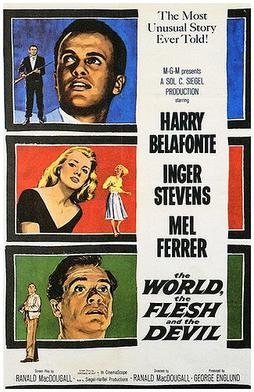
Film Review: The World, the Flesh, and the Devil (dir by Ranald MacDougall)


The 1959 film, The World, the Flesh, and the Devil, opens with a mine cave-in in Pennsylvania.  Trapped in the cave-in is a mine inspector named Ralph Burton (Harry Belafonte).  Despite being trapped underground, Ralph remains in surprisingly good spirits.  (In fact, as the movie progresses, Ralph’s tendency to joke when faced with bleak reality will become a recurring theme.)  Ralph sings to himself.  Ralph tells jokes.  Ralph listens to the sound of the men who are digging a tunnel to rescue him.  Except, one day, Ralph can no longer hear anyone digging.  Realizing that he’s going to have to save himself, Ralph manages to dig his way out of the cave.  Once again above ground, Ralph discovers that he’s alone.

The world has changed.  Cars and buildings sit deserted.  Everything that was made by mankind is still there but it’s all now empty.  Confused but understanding that something huge has happened, Ralph makes his way from Pennsylvania to New York.  During his journey, he comes across old newspapers and a recording in a radio station and he’s able to piece together what’s happened.  Some country — no one was ever sure which one — released a radioactive isotope into the atmosphere.  For five days, the air was poisoned.  Everyone who didn’t get to shelter died.  The only reason Ralph survived was because he was trapped underground.

At first, New York appears to be as deserted as Pennsylvania.  (The film was shot on location in Manhattan, reportedly in the early morning hours before rush hour, when there was no one on the streets.  The visuals of the empty city are often hauntingly bleak.)  Struggling to maintain his own sanity, Ralph steals two mannequins and spends his days talking to them.  He comes up with projects to pass the time.  He’s able to get the power flowing in Times Square.  And he even meets another survivor!

Sarah Crandall (Inger Stevens) was one of three friends who hid in a bunker when the world started to end.  Sarah’s two friends left the bunker after two days and were killed by the radioactive cloud.  Sarah waited the entire five days and survived.  Though we don’t learn much about her background, it’s heavily suggested that Sarah was rich and didn’t have a care in the world before society collapsed.  Now, she and Ralph are just happy to have found each other.

Sarah and Ralph quickly become friends.  Sarah has obvious romantic feelings towards Ralph but, to her frustration, he keeps his distance.  When Sarah asks why they don’t just live together instead of maintaining separate apartments, Ralph nervously jokes that if they got a place together, people would talk.  Sarah is white and Ralph is black.  When Sarah says that doesn’t matter anymore, Ralph tells her that it does matter and that she has no idea what his life was like before the world ended.  When a frustrated Sarah says that she can move in with Ralph because she’s “free, white, and 21 and I can do whatever I want,” Ralph looks like she’s just slapped him.  Later, Ralph tells her that, because she’s white, she will never be able to understand the pain that her words caused him.  I can only imagine how audiences in 1959 reacted to this scene.

Eventually, Ralph discovers that there are scattered survivors across the world.  One of them, Benson Thacker (Mel Ferrer), even comes to New York and joins Ralph and Sarah.  With the arrival of the white Thacker, Ralph suddenly finds himself being treated like a servant.  Thacker not only attempts to take over the group but he also tells Ralph that Sarah belongs to him.  When Thacker, a self-described “former idealist,” tells Ralph, “I have nothing against Negroes,” Ralph coldly replies, “That’s mighty white of you,” and again, the modern viewer cannot help but wonder how audiences in 1959 reacted to hearing those words uttered on a movie screen.

The World, the Flesh, and the Devil is a frequently fascinating film.  Belafonte brings a lot of charm and wit to the role of Ralph but he also doesn’t shy away from portraying Ralph’s anger at still being limited by the conventions of a society that, for all intents and purposes, has destroyed itself.  Ralph brings New York back to life, just to watch as Thacker moves in and claims it for himself.  Significantly, Thacker doesn’t view himself as being a racist.  Instead, in his mind, he’s simply living the way that he’s always lived.  By treating Ralph like a second class citizen, he’s keeping society alive.  Sarah, meanwhile, is torn between her desire to create a new world and the temptation to return to her spoiled and privileged upbringing.  While the film is dominated by Belafonte’s performance, both Inger Stevens and Mel Ferrer bring some shadings to characters that, in lesser hands, could have been extremely flat and predictable.

The film falls apart a bit during the third act.  The World, the Flesh, and the Devil spends a good deal of time building up to a rather downbeat climax just to suddenly reverse itself.  The film ends on a hopeful note that just doesn’t feel realistic after everything that we’ve just seen.  The film’s conclusion brings a promise of renewal that feels like it was tacked on at the last moment.  Still, up until that moment, it’s a compelling and intelligent film and one that’s feels ever more relevant today than it probably did in 1959.

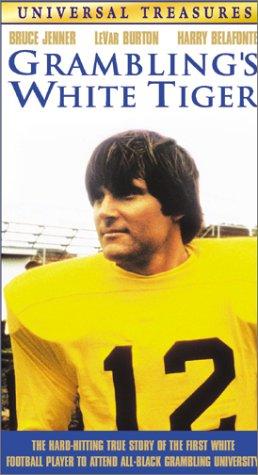
Grambling’s White Tiger (1981, directed by Georg Stanford Brown)


The year is 1968 and Jim Gregory (played by Caitlyn Jenner, back when she was still credited as Bruce) is a hotshot high school quarterback who has just been offered a scholarship to play at Grambling University.  With their star quarterback in his final year, Grambling needs a good backup.  Meanwhile, Jim dreams of playing in the NFL and is excited to play for a program that’s known for producing professional football players.  Grambling’s legendary head coach, Eddie Robinson (Harry Belafonte), is eager for Jim to join the team.

The only problem is that Grambling is a historically black college and Jim Gregory is very much white.  In fact, Jim will not only be the first white player to ever join the Grambling Tigers but he will also be the only white student enrolled at the school.  From the minute that Jim arrives on campus, he discovers that he’s not wanted.  The rest of the team sees him as an interloper and they resent that he took a scholarship that could have gone to a black player.  Meanwhile, the local whites distrust Jim because he’s a student at a black college.

Based on a true story, this is a football film that doesn’t feature much football.  Jim doesn’t get to play in a game until the very end of the season and, even then, he’s only on the field for a few minutes.  He doesn’t win the game or even lead a scoring drive.  Instead of focusing on the usual sports movie clichés, Grambling’s White Tiger instead explores Jim experiencing, for the first time, what it’s like to be a minority.  Jim eventually wins over his teammates through his hard work but he still remains an outsider for the entire film.  When he goes into town, a saleswoman and her boss initially offer him a discount on a pair of boots until they discover that he plays football not for Louisiana Tech but instead for Grambling.  When he first meets the parents of his new girlfriend, he’s told that an interracial relationship will never last and is advised to move on.  When the funeral of Martin Luther King is broadcast on television, all Jim’s teammates walk out of the room one-by-one until Jim is left sitting alone.

In typical made-for-network-TV fashion, Grambling’s White Tiger explores important issues without delving into them too deeply.  (For instance, the fact that Jim’s spot on the team is potentially coming at the expense of a black student is an intriguing issue that is mentioned at the start of the film but never really dwelled upon.)  Harry Belafonte is perfect as the stern but compassionate Coach Robinson while LeVar Burton is likable as the only member of the team to initially welcome Jim.  Jenner, however, is thoroughly miscast and several years too old to play a college freshman.  As an actor, Jenner is stiff and awkward but the true story of Jim Gregory is interesting enough that the film will hold the attention of any football fans in the audience.

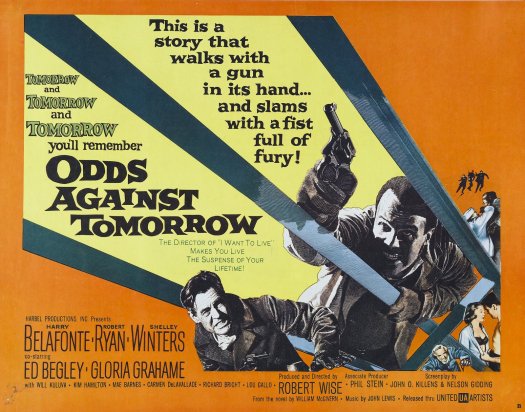
Blues On The Downbeat: ODDS AGAINST TOMORROW (United Artists 1959)


gary loggins's avatarcracked rear viewer


Desperate men commit desperate acts, and the three protagonists of ODDS AGAINST TOMORROW are desperate indeed in this late entry in the film noir cycle. This is a powerful film that adds social commentary to the usual crime and it’s consequences plot by tainting one of the protagonists with the brush of racism. Robert Wise, who sharpened his skills in the RKO editing room, directs the film in a neo-realistic style, leaving the studio confines for the most part behind, and the result is a starkly lit film where the shadows of noir only dominate at night.

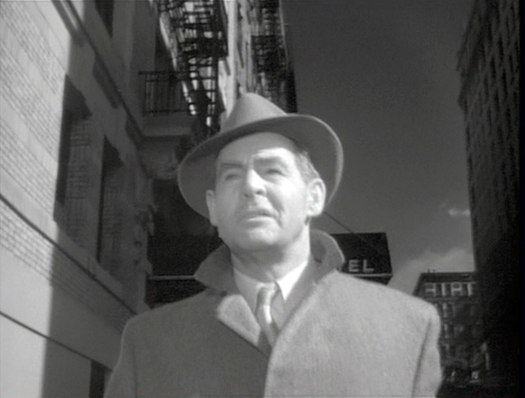
But more on Wise later… first, let’s meet our three anti-heroes. We see Earle Slater (Robert Ryan ) walking down a New York street bathed in an eerie white glow (Wise used infra-red film to achieve the effect). Slater’s a fish out of water, a transplanted Southerner drifted North, a loser and loose cannon…

View original post 665 more words

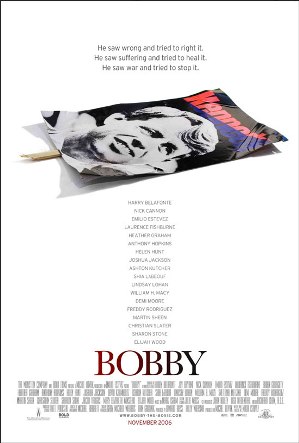
Shattered Politics #80: Bobby (dir by Emilio Estevez)


Bobby_poster

A few years ago, I was on twitter when I came across someone who had just watched The Breakfast Club.  

“Whatever happened to Emilio Estevez?” she asked.

Being the know-it-all, obsessive film fan that I am, I tweeted back, “He’s a director.”

Of course, I could not leave well enough along.  I had to send another tweet, “He directed a movie called Bobby that got nominated for bunch of Golden Globes.”

“Was it any good?” she wrote back.

“Never seen it,” I wrote back, suddenly feeling very embarrassed because, if there’s anything I hate, it’s admitting that there’s a film that I haven’t seen.

However, Shattered Politics gave me an excuse to finally sit down and watch Bobby.  So now, I can now say that I have watched this 2006 film and … eh.

Listen, I have to admit that I really hate giving a film like Bobby a lukewarm review because it’s not like Bobby is a bad film.  It really isn’t.  As a director, Emilio Estevez is a bit heavy-handed but he’s not without talent.  He’s good with actors.  Bobby actually features good performances from both Lindsay Lohan and Shia LaBeouf!  So, give Estevez that.

And Bobby is a film that Estevez spent seven years making.  It’s a film that he largely made with his own money.  Bobby is obviously a passion project for Estevez and that passion does come through.  (That’s actually one of the reasons why the film often feels so heavy-handed.)

But, with all that in mind, Bobby never really develops a strong enough narrative to make Estevez’s passion dramatically compelling.  The film takes place on the day of the 1968 Democratic California Presidential Primary.  That’s the day that Robert F. Kennedy won the primary and was then shot by Sirhan Sirhan in the kitchen of the Ambassador Hotel.  However, it never seems to know what it wants to say about Kennedy or his death, beyond the fact that Estevez seems to like him.

(Incidentally, it’s always interesting, to me, that Dallas is still expected to apologize every day for the death of JFK but Los Angeles has never had to apologize for the death of his brother.)

Estevez follows an ensemble of 22 characters as they go about their day at and around the Ambassador Hotel.  As often happens with ensemble pieces, some of these characters are more interesting than others.

For instance, Anthony Hopkins plays a courtly and retired doorman who sits in the lobby and plays chess with his friend Nelson (Harry Belafonte).  It adds little to the film’s story but both Hopkins and Belafonte appear to enjoy acting opposite each other and so, they’re fun to watch.

Lindsay Lohan plays a woman who marries a recently enlisted soldier (Elijah Wood), the hope being that his marital status will keep him out of Vietnam.  The problem with this story is that it’s so compelling that it feels unfair that it has to share space with all the other stories.

Christian Slater plays Darrell, who runs the kitchen and who spends most of the movie talking down to the kitchen staff, the majority of whom are Hispanic.  Darrell is disliked by the hotel’s manager (William H. Macy) who is cheating on his wife (Sharon Stone).

And then, you’ve got two campaign aides (Shia LaBeouf and Brian Geraghty) who end up dropping acid with a drug dealer played by Ashton Kutcher.  Unfortunately, Estevez tries to visualize their trip and it brings the film’s action to a halt.

Estevez himself shows up, playing the husband of an alcoholic singer (Demi Moore).  And Estevez’s father, Martin Sheen, gets to play a wealthy supporter of Kennedy’s.  Sheen’s wife is played by Helen Hunt.  She gets to ask her husband whether she reminds him more of Jackie or of Ethel.

(Actually, Martin Sheen and Helen Hunt are cute together.  Much as with Lohan and Wood, you wish that more time had been devoted to them and their relationship.)

And there are other stories as well.  In fact, there’s far too many stories going on in Bobby.  It may seem strange for a girl who is trying to review 94 films in three weeks to say this but Emilio Estevez really tries to cram too much into Bobby.

At the same time, too much ambition is better none.  Bobby may have been a misfire but at least it’s a respectable misfire.