“This world fits you, Bangley. Wake up, defend, survive.” — Hig
Ridley Scott’s The Dog Stars has the scenery of an epic and the energy of someone still deciding whether to get out of bed. There is something potentially compelling about that mismatch: the world has ended, the survivors are exhausted, and being alive no longer means having much to live for. But Scott leans so heavily into melancholy that the film gradually becomes underwhelming. Even when violence interrupts the quiet, it rarely shakes the movie out of its mournful drift. What should feel like a journey through a frightening new world often plays more like a post-apocalyptic travelog, with beautiful views and occasional armed interruptions.
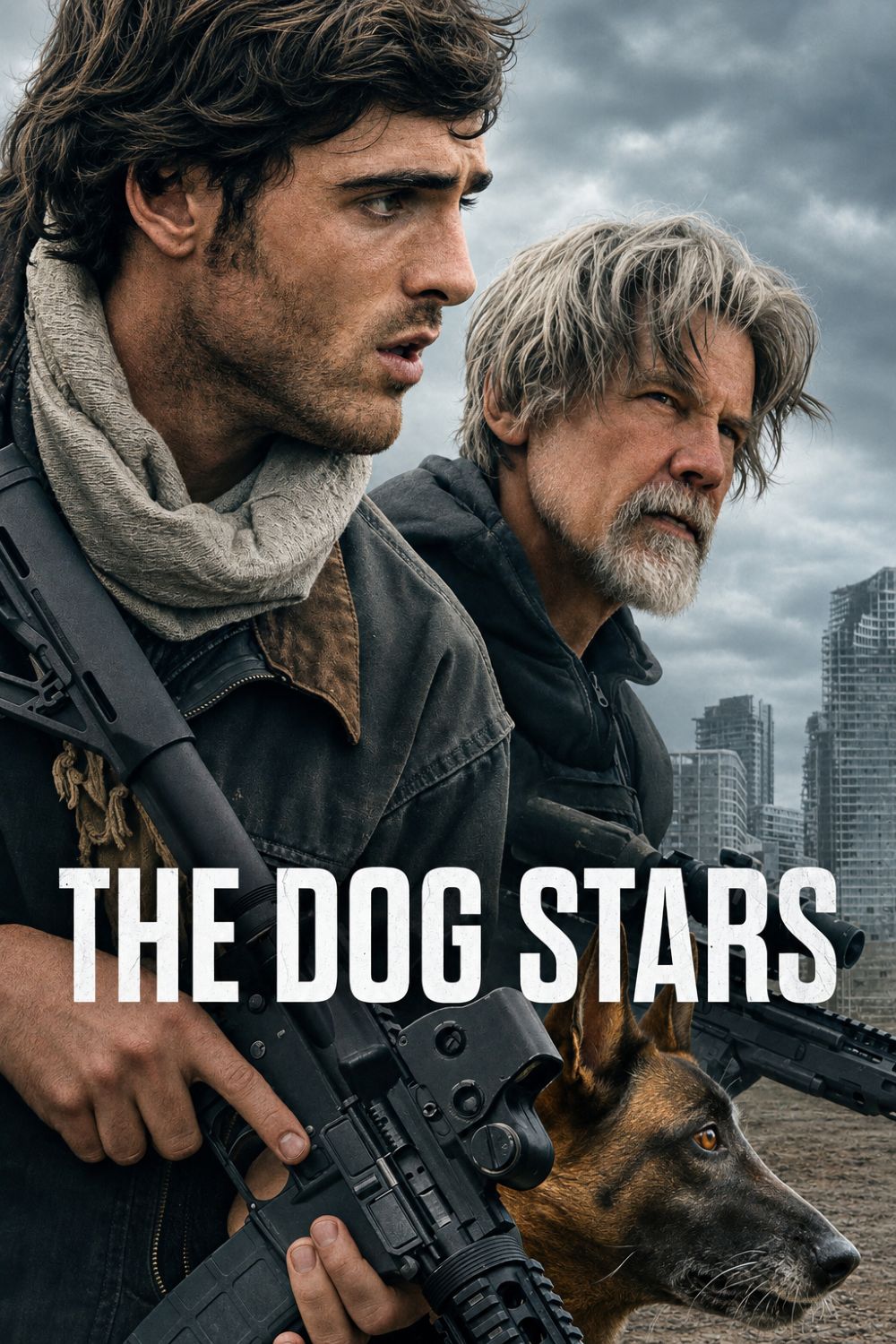
Adapted by screenwriter Mark L. Smith from Peter Heller’s 2012 novel The Dog Stars, the film follows Hig, played by Jacob Elordi, a pilot and mechanic living in Colorado after a pandemic has wiped out most of humanity. His wife is gone, and his remaining companions are his dog, Jasper, and Bangley, a heavily armed former military man played by Josh Brolin. Together, they occupy an abandoned airfield, where practical survival has replaced anything resembling a normal life. Hig eventually follows the possibility of a radio transmission toward other survivors, hoping there might be something beyond the routine of scavenging and keeping strangers at gunpoint.
That setup gives the film a useful emotional conflict. Bangley considers their arrangement a success because they have food, shelter, weapons, and a defensible position. Hig sees the same situation as a slower version of dying. Brolin’s hardened survivor and Elordi’s wounded optimist represent two different responses to catastrophe: shut everyone out, or risk getting hurt by reaching for someone. The problem is that the movie makes this contrast clear fairly early and then struggles to deepen it. Hig’s dissatisfaction supplies a reason to leave, but Scott’s languid treatment makes the journey feel less urgent than the decision behind it ought to be.
Elordi fits the film’s mood, giving Hig the presence of someone carrying grief through every ordinary task. His youth also makes the character’s emotional exhaustion potentially affecting: this is a man who should have decades ahead of him but cannot imagine what those years would contain. Still, the movie relies too much on the appeal of a handsome, sorrowful figure moving through picturesque emptiness. There is a difference between showing a character who feels hollow and allowing that hollowness to become the film’s dominant dramatic quality. Too often, Hig’s sadness is the atmosphere rather than something the story meaningfully tests.
Visually, Scott certainly understands the attraction of a world that has started growing over humanity’s leftovers. The landscapes are expansive, and the production uses Italian locations to stand in for Colorado, with the Dolomites taking the place of the Rockies. Yet the beauty creates its own problem. The more inviting the countryside becomes, the harder the film has to work to make its underlying danger feel immediate. Scott keeps reaching for the scale of an epic, but scale alone cannot make a succession of lonely vistas emotionally expansive. Sometimes the apocalypse looks less like a catastrophe than an unusually exclusive outdoor getaway.
There is also the unavoidable resemblance to HBO’s The Last of Us. The overgrowth, decaying infrastructure, wary survivors, and uneasy movement through abandoned spaces belong to a familiar visual vocabulary by now. The Dog Stars seems eager to exploit the appeal of that look without finding enough fresh perspective to make it distinctive. That is an aesthetic criticism, not a claim that Scott literally copied the series; Heller’s novel has its own history. But the film arrives in a crowded genre, and its lush decay too often prompts recognition rather than discovery. You know the scenery, and you can usually guess the emotional weather.
The violence should complicate that prettiness, and occasionally it does. Raiders and hostile survivors puncture Hig’s wandering with reminders that an empty world is not necessarily a peaceful one. But these bursts of brutality often feel like interruptions rather than pressure building naturally inside the story. Scott alternates reflective stretches with sudden threats, yet the two modes do not consistently strengthen each other. The action briefly wakes the movie up, then the prevailing sadness settles back into place. Instead of making the quieter passages more tense, the attacks can feel like scheduled reminders that this is still supposed to be a dangerous survival thriller.
The arrival of Margaret Qualley’s Cima, a widow living with her protective father, played by Guy Pearce, gives the film a more intimate direction. Hig’s search stops being purely geographical and becomes a question of whether he can permit himself another attachment. There is a genuinely appealing idea here: after civilization collapses, rebuilding might begin with something as small as admitting what you miss. A scene involving remembered pleasures and the rediscovery of recorded music points toward a warmer, more specific film. These moments work because they give loss a recognizable shape rather than treating sadness as a general condition.
Unfortunately, the tenderness never fully resolves the film’s unevenness. Its late detour involving Allison Janney pushes toward a much stranger, more extravagant register, making the surrounding restraint feel even more conspicuous. A movie can certainly contain romance, grief, savage violence, and grotesque eccentricity, but those elements need a stronger dramatic connection than they receive here. Harry Gregson-Williams’s acoustic guitar-laden score reinforces the reflective mood, though that gentleness also contributes to the sense that the film is cushioning experiences that should leave sharper marks. Scott wants contemplation and danger to coexist; too often, they simply take turns.
What makes The Dog Stars frustrating is not its refusal to turn the apocalypse into nonstop combat. Its interest in companionship, grief, and the possibility of hope is welcome. The disappointment is that Scott gives those ideas such a uniformly subdued treatment that they lose force. This should be a story about discovering reasons to live in a world organized around staying alive. Instead, it too often settles for attractive desolation, familiar threats, and sadness presented as depth. There are touching moments and striking landscapes along the way, but the journey promises a greater emotional destination than it finally reaches.