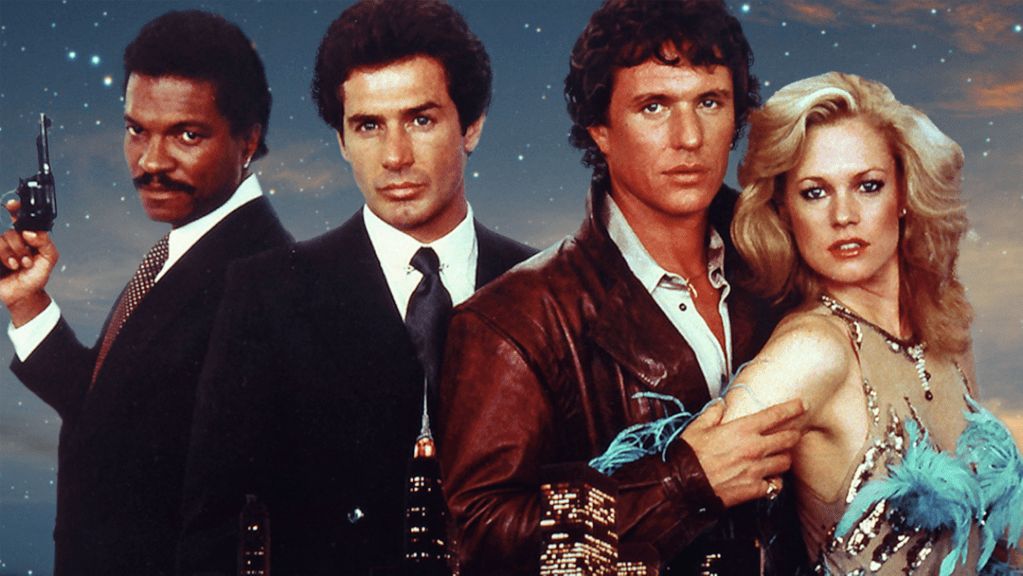
Every Monday night at 9:00 Central Time, my wife Sierra and I host a “Live Movie Tweet” event on X using the hashtag #MondayMuggers. We rotate movie picks each week, and our tastes are quite different. Tonight, Monday January 27th, we’re watching FEAR CITY starring Tom Berenger, Billy Dee Williams, Jack Scalia and Melanie Griffith.
So why did I pick FEAR CITY, you might ask?
I’m a huge fan of Tom Berenger. SOMEONE TO WATCH OVER ME (1987 with Mimi Rogers), SHOOT TO KILL (1988 with Sidney Poitier), MAJOR LEAGUE (1989 with Charlie Sheen), and LAST OF THE DOGMEN (1995 with Barbara Hershey) are some of my very favorite films. He’s an outstanding actor and screen presence. Tom Berenger is one of those actors who I always enjoy seeing on screen.
FEAR CITY is directed by Abel Ferrara. Abel Ferrara is one of those directors who makes movies about the very worst in society. His films MS. 45 (1981), KING OF NEW YORK (1990), and BAD LIEUTENANT (1992) are all movies that intrigued me greatly as I was trying to discover who I was growing up in the 80’s and early 90’s.
The sleaze is off the charts in FEAR CITY, with so many big-time stars, and set in New York City of the 1980’s. From everything I’ve read, this a time capsule of a place that no longer exists. If I ever make it to New York City, I’ll be greeted with a place that’s designed more like Disney World. I think it’s interesting to see the city as presented here!
I also think it will be interesting to see what it’s like to experience a movie like FEAR CITY as part of a group. I discovered this film as a teenager in the 80’s. I remember being a little embarrassed as I watched the film, especially with its large serving of nudity (from big stars) and graphic violence. I’ve watched films in groups with the most extreme graphic violence imaginable and no one batted an eye. I’m looking forward to seeing how this plays out.
So join us tonight to for #MondayMuggers and watch FEAR CITY! It’s on Amazon Prime.
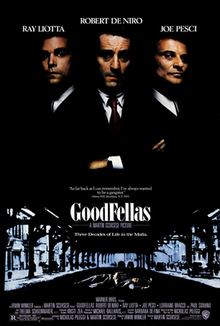
First released in 1990 and continuously acclaimed ever since, Goodfellas did not win the Oscar for Best Picture.
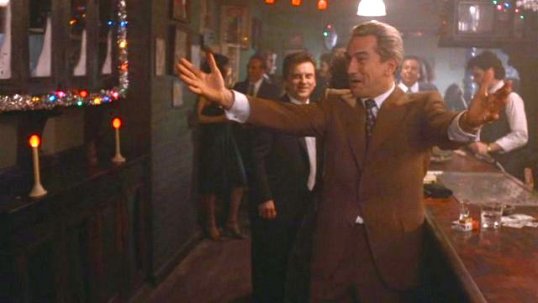
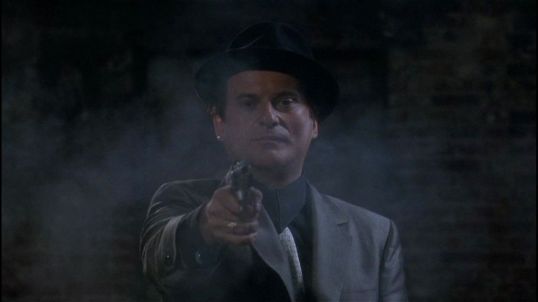
I’m always a bit surprised whenever I remember that. Goodfellas didn’t win Best Picture? That just doesn’t seem right. It’s not the other films nominated that year were bad but Goodfellas was so brilliant that it’s hard to imagine someone actually voting for something else. Seriously, it’s hard to think of a film that has been more influential than Goodfellas. Every gangster film with a soundtrack of kitschy tunes from the 6os and 70s owes huge debt to Goodfellas. Every actor who has ever been cast as a wild and out-of-control psycho gangster owes a debt to Joe Pesci’s performance as Tommy DeVito. When Ray Liotta passed away two years ago, we all immediately heard him saying, “I always wanted to be a gangster.” Robert De Niro’s Jimmy Conway remains the epitome of the ruthless gangster. For many, Paul Sorvino’s neighborhood godfather redefined what it meant to be a crime boss. Lorraine Bracco made such an impression as Karen Hill that it somehow seemed appropriate that she was one of the first people cast in The Sopranos, a show that itself would probably have not existed if not for Goodfellas. Frank Sivero, Samuel L. Jackson, Tobin Bell, Debi Mazer, Vincent Gallo, Ileana Douglas, Frank Vincent, Tony Sirico, Michael Imperioli, Tony Darrow, Mike Starr, Chuck Low, all of them can be seen in Goodfellas. It’s a film that many still consider to be the best of Martin Scorsese’s legendary career. Who can forget Robert De Niro smoking that cigarette while Sunshine of Your Love blared on the soundtrack? Who can forget “Maury’s wigs don’t come off!” or “Rossi, you are nothing but whore!?” Who can forget the cheery Christmas music playing in the background while De Niro’s Jimmy Conway grows more and more paranoid after pulling off the biggest heist of his career?
Plus, it’s a Christmas movie!
And yet, it did not win Best Picture.
Myself, whenever I’m sitting behind a garbage truck in traffic, I immediately start to hear the piano coda from Layla. For that matter, whenever I see a helicopter in the sky, I flash back to a coke-addled Henry Hill getting paranoid as he tries to pick up his brother from the hospital. Whenever I see someone walking across the street in the suburbs, I remember the scene where Henry coolly pistol-whips the country club guy and then tells Karen to hide his gun. I always remember Karen saying that she knows that many of her best friends would have run off as soon as their boyfriend gave them a gun to hide but “it turned me on.” It would have turned me on as well. Henry might be a gangster and his friends might be murderers but he doesn’t make any apologies for who he is, unlike everyone else in the world.
But it did not win Best Picture.
How many people have imitated Joe Pesci saying, “How am I funny?” How many times did Pesci and Frank Vincent have to listen to people telling them to “go home and get your fucking shinebox?” A lot of people remember the brutality of the scene where Pesci and De Niro team up to attack Vincent’s crude gangster but I always remember the sound of Donavon’s Atlantis playing on the soundtrack.
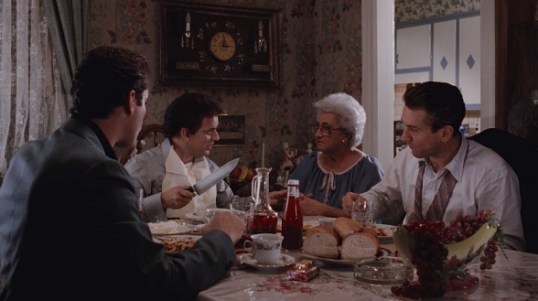
And then there’s Catherine Scorsese, showing up as Tommy’s mom and cooking for everyone while Vincent struggles to escape from the trunk of a car. “He is content to be a jerk,” Tommy says about Henry Hill. Just a few hours earlier, Tommy was apologizing to Henry for getting blood on his floor.
Goodfellas is a fast-paced look at organized crime, spanning from the 50s to the early 80s. Ray Liotta plays Henry Hill, who goes from idolizing gangsters to being a gangster to ultimately fearing his associates after he gets busted for dealing drugs. It’s a dizzying film, full of so many classic scenes and lines that it feels almost pointless to try to list them all here or to pretend like whoever is reading this review doesn’t remember the scene where the camera pans through the club and we meet the members of the crew. (“And then there was Pete The Killer….”) Goodfellas is a film that spend two hours showing us how much fun being a gangster can be and then thirty minutes showing us just how bad it can get when you’re high on coke, the police are after you, and you’ve recently learned that your associates are willing to kill even their oldest friends. No matter how many times I watch Goodfellas, I always get very anxious towards the end of the film. With the music pounding and the camera spinning, with Henry looking for helicopters, and with all of his plans going wrong over the course of one day, it’s almost a relief when Bo Dietl points that gun at Henry’s head and yells at him, revealing that Henry has been captured by the cops and not the Gambinos. Karen desperately running through the house, flushing drugs and hiding a gun in her underwear, always leaves me unsettled. It’s such a nice house but now, everything is crashing down.
There’s a tendency to compare Goodfellas to The Godfather, as their both films that re-imagine American history and culture through the lens of the gangster genre. I think they’re both great but I also think that they are ultimately two very different films. If The Godfather is sweeping and operatic, Goodfellas is the film that reminds us that gangsters also live in the suburbs and go to cookouts and that their wives take care of the kids and watch movies while the FBI searches their home. If The Godfather is about the bosses, Goodfellas is about the blue collar soldiers. The Godfather represents what we wish the Mafia was like while Goodfellas represents the reality.
Goodfellas is one of the greatest films ever made but it lost the Best Picture Oscar to Dances With Wolves, a film that left audiences feeling good as opposed to anxious. To be honest, Martin Scorsese losing Best Director to Kevin Costner feels like an even bigger injustice than Goodfellas losing Best Picture. One can understand the desire to reward Dances With Wolves, a film that attempts to correct a decades worth of negative stereotypes about Native Americans. But Scorsese’s direction was so brilliant that it’s truly a shame that he didn’t win and that Lorraine Bracco didn’t win Best Supporting Actress. It’s also a shame that Ray Liotta wasn’t nominated for playing Henry Hill. At least Joe Pesci won an Oscar for redefining what it meant to be a gangster.
Goodfellas is proof that the best film doesn’t always win at the Oscars. But it’s also proof that a great film doesn’t need an Oscar to be remembered.
Howard Hansen (Ted Prior) is a best-selling horror writer who is suffering from writer’s block. With his agent, Murray (Frank Sivero), pressuring him to get something written, Howard decides to seek inspiration in Chinatown. When he steps into a curio shop and sees a grotesque, one-eyed blob floating in a jar of formaldehyde, Howard buys it. He hopes that the blob will give him an idea for a great book but instead, it just causes him to have nightmares and violent sex with his wife, Peggy (Sandahl Bergman).
Meanwhile, Murray is in debt with loan shark Scott Lindsey (Henry Silva) and Scott’s number one debt collector, Gus (Chad McQueen). Murray needs money and he needs it quickly. Murray sends his “secretary,” Carol (Shannon Tweed), to live with the Hansens and steal an unpublished romance novel that Howard wrote when he was just starting out as a writer. However, the one-eyed blob possesses Carol and she is soon climbing onto both Howard’s workout equipment and Howard! Soon everyone is under the influence of the one-eyed blob, Carol is forcing Howard and Peggy to make love while she holds the gun on them, and both Gus and Murray are sneaking around the house, trying to find the manuscript.
A movie that was once very popular on late night Cinemax, Possessed By The Night is a sometimes awkward but frequently entertaining horror/thriller hybrid from B-auteur Fred Olen Ray. Along with giving Frank Sivero a rare leading role (Sivero is best known for playing Frankie in Goodfellas and providing the inspiration for the Simpsons character of the same name), Possessed By The Night proves that no movie can be that bad when featuring both Sandahl Bergman and Shannon Tweed. When you watch a Fred Olen Ray/Shannon Tweed collaboration from 1994, you know what you’re getting and Possessed By The Night delivers.
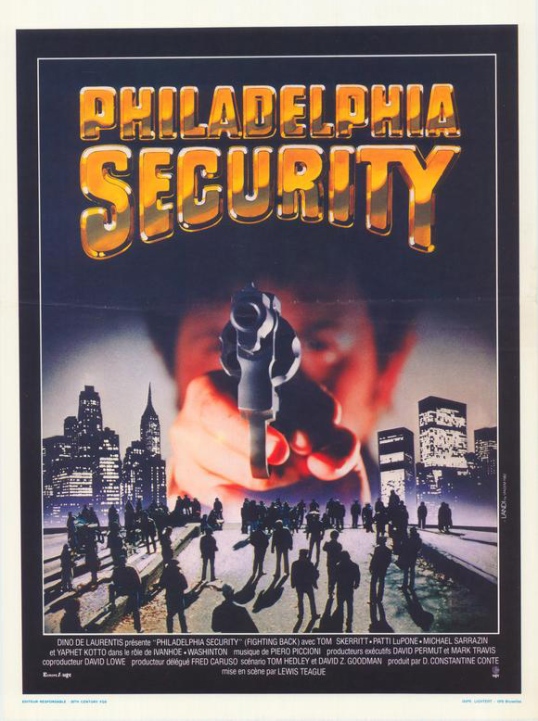
The time is 1982. The place is Hell on Earth, also known as Philadelphia. Crime is out of control and the police are powerless to stop it. When deli owner John D’Angelo (Tom Skerritt) and his wife, Lisa (Patti LuPone), confront a pimp named Eldorado (Pete Richardson), he rams his car into the back of their car, causing the pregnant Lisa to lose her unborn child. At almost the exact same time, John’s mother (Gina DeAngles) is mugged by two thugs who chop off her ring finger.
In the grand tradition of Charles Bronson, John decides to fight back. But he doesn’t go it alone. With his best friend, a police officer named Vince (Michael Sarrazin), John starts the People’s Neighborhood Patrol. The PNP is going to clean up Philadelphia, one street at a time. The media (represented by David Rasche) make John into a celebrity. The black community (represented by Yaphet Kotto) suspect that John and the PNP are guilty of racial discrimination. The Mafia wants to bring John over to their side. John runs for city council but he still has time to drop a grenade in a pimp’s car.
Fighting Back was one of the many urban vigiliante films to come out after the success of Death Wish. Fighting Back‘s producer, Dino De Laurentiis, also produced Death Wish but made the mistake of later selling the rights to Cannon. Fighting Back was not the box office success that either Death Wish or its sequels were, even though Fighting Back is actually the better movie. That’s because Fighting Back was directed by the underrated Lewis Teague. Teague does a good job of making Philadelphia look like a war zone and the scenes of vigilante justice are enjoyable but, overall, Teague takes a far more ambiguous approach to vigilantism than Michael Winner did when he directed Death Wish. As vile as Philadelphia criminals may be, John D’Angelo isn’t always that likable himself. When Kotto accuses John and the all-white PNP of being racially prejudiced, Teague suggests that he has a point. Tom Skerritt gives a good performance, playing John as a proud, blue collar guy who wants to do the right thing but gets seduced by his newfound celebrity.
Better acted than Death Wish and smarter than The Exterminator, Fighting Back is an underrated vigilante gem.
Fighting Back is also known as Philadelphia Security and Death Vengeance.
Believe it or not, The Trial of Billy Jackwas not the only lengthy sequel to be released in 1974. Francis Ford Coppola’s The Godfather Part II was released as well and it went on to become the first sequel to win an Oscar for best picture. (It was also the first, and so far, only sequel to a best picture winner to also win best picture.) Among the films that The Godfather, Part II beat: Chinatown, Coppola’s The Conversation, and The Towering Inferno. 1974 was a good year.
Whenever I think about The Godfather, Part II, I find myself wondering what the film would have been like if Richard Castellano hadn’t demanded too much money and had actually returned in the role of Clemenza, as was originally intended. In the first Godfather, Clemenza and Tessio (Abe Vigoda) were Don Corleone’s two lieutenants. Tessio was the one who betrayed Michael and was killed as a result. Meanwhile, Clemenza was the one who taught Michael how to fire a gun and who got to say, “Leave the gun. Take the cannoli.”
Though Castellano did not return to the role, Clemenza is present in The Godfather, Part II. The Godfather, Part II tells two separate stories: during one half of the film, young Vito Corleone comes to America, grows up to be Robert De Niro and then eventually becomes the Godfather. In the other half of the film, Vito’s successor, Michael (Al Pacino), tries to keep the family strong in the 1950s and ultimately either loses, alienates, or kills everyone that he loves.
During Vito’s half of the film, we learn how Vito first met Clemenza (played by Bruno Kirby) and Tessio (John Aprea). However, during Michael’s half of the story, Clemenza is nowhere to be seen. Instead, we’re told that Clemenza died off-screen and his successor is Frankie Pentangeli (Michael V. Gazzo). All of the characters talk about Frankie as if he’s an old friend but, as a matter of fact, Frankie was nowhere to be seen during the first film. Nor is he present in Vito’s flashbacks. This is because originally, Frankie was going to be Clemenza. But Richard Castellano demanded too much money and, as a result, he was written out of the script.
And really, it doesn’t matter. Gazzo does fine as Frankie and it’s a great film. But, once you know that Frankie was originally meant to be Clemenza, it’s impossible to watch The Godfather Part II without thinking about how perfectly it would have worked out.
If Clemenza had been around for Michael’s scenes, he would have provided a direct link between Vito’s story and Michael’s story. When Clemenza (as opposed to Frankie) betrayed Michael and went into protective custody, it would have reminded us of how much things had changed for the Corleones (and, by extension, America itself). When Tom Hagen (Robert Duvall) talked Clemenza (as opposed to Frankie) into committing suicide, it truly would have shown that the old, “honorable” Mafia no longer existed. It’s also interesting to note that, before Tessio was taken away and killed, the last person he talked to was Tom Hagen. If Castellano had returned, it once again would have fallen to Tom to let another one of his adopted father’s friends know that it was time to go.
Famously, the Godfather, Part II ends with a flashback to the day after Pearl Harbor. We watch as a young and idealistic Michael tells his family that he’s joined the army. With the exception of Michael and Tom Hagen, every character seen in the flashback has been killed over the course of the previous two films. We see Sonny (James Caan), Carlo (Gianni Russo), Fredo (John Cazale), and even Tessio (Abe Vigoda). Not present: Clemenza. (Vito doesn’t appear in the flashback either but everyone’s talking about him so he might as well be there. Poor Clemenza doesn’t even get mentioned.)
If only Richard Castellano had been willing to return.
Clemenza and Vito
But he didn’t and you know what? You really only miss him if you know that he was originally meant to be in the film. With or without Richard Castellano, The Godfather, Part II is a great film, probably one of the greatest of all time. When it comes to reviewing The Godfather, Part II, the only real question is whether it’s better than the first Godfather.
Which Godfather you prefer really depends on what you’re looking for from a movie. Even with that door getting closed in Kay’s face, the first Godfather was and is a crowd pleaser. In the first Godfather, the Corleones may have been bad but everyone else was worse. You couldn’t help but cheer them on.
The Godfather Part II is far different. In the “modern” scenes, we discover that the playful and idealistic Michael of part one is gone. Micheal is now cold and ruthless, a man who willingly orders a hit on his older brother and who has no trouble threatening Tom Hagen. If Michael spent the first film surrounded by family, he spends the second film talking to professional killers, like Al Neri (Richard Bright) and Rocco Lampone (Tom Rosqui). Whereas the first film ended with someone else closing the door on Kay, the second film features Michael doing it himself. By the end of the film, Michael Corleone is alone in his compound, a tyrant isolated in his castle.
Michael’s story provides a sharp contrast to Vito’s story. Vito’s half of the film is vibrant and colorful and fun in a way that Michael’s half is not and could never be. But every time that you’re tempted to cheer a bit too easily for Vito, the film moves forward in time and it reminds you of what the future holds for the Corleones.
So, which of the first two Godfathers do I prefer? I love them both. If I need to be entertained, I’ll watch The Godfather. If I want to watch a movie that will truly make me think and make me question all of my beliefs about morality, I’ll watch Part Two.
Finally, I can’t end this review without talking about G.D. Spradlin, the actor who plays the role of U.S. Sen. Pat Geary. The Godfather Part II is full of great acting. De Niro won an Oscar. Pacino, Gazzo, Lee Strasberg, and Talia Shire were all nominated. Diane Keaton, Robert Duvall, and John Cazale all deserved nominations. Even Joe Spinell shows up and brilliantly delivers the line, “Yeah, we had lots of buffers.” But, with each viewing of Godfather, Part II, I find myself more and more impressed with G.D. Spradlin.
Sen. Pat Geary doesn’t have a lot of time on-screen. He attends a birthday party at the Corleone Family compound, where he praises Michael in public and then condescendingly insults him in private. Later, he shows up in Cuba, where he watches a sex show with obvious interest. And, when Michael is called before a Senate committee, Geary gives a speech defending the honor of all Italian-Americans.
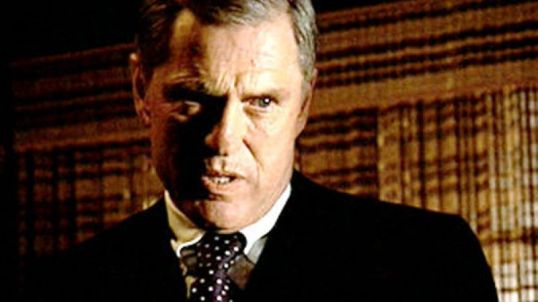
G.D. Spradlin as Sen. Pat Geary
But the scene that we all remember is the one where Tom Hagen meets Sen. Geary in a brothel. As Geary talks about how he passed out earlier, the camera briefly catches the sight of a dead prostitute lying on the bed behind him. What’s especially disturbing about this scene is that neither Hagen nor Geary seem to acknowledge her presence. She’s been reduced to a prop in the Corleone Family’s scheme to blackmail Sen. Geary. His voice shaken, Geary says that he doesn’t know what happened and we see the weakness and the cowardice behind his almost all-American facade.
It’s a disturbing scene that’s well-acted by both Duvall and Spradlin. Of course, what is obvious (even if it’s never explicitly stated) is that Sen. Geary has been set up and that nameless prostitute was killed by the Corleones. It’s a scene that makes us reconsider everything that we previously believed about the heroes of the Godfather.
For forcing us to reconsider and shaking us out of our complacency, The Godfather, Part II is a great film.
(Yes, it’s even better than The Trial of Billy Jack.)
“I got something for your mother and Sonny and a tie for Freddy and Tom Hagen got the Reynolds Pen…” — Kay Adams (Diane Keaton) in The Godfather (1972)
It probably seems strange that when talking about The Godfather, a film that it is generally acknowledged as being one of the best and most influential of all time, I would start with an innocuous quote about getting Tom Hagen a pen.
(And it better have been a hell of a pen because, judging from the scene where Sollozzo stops him in the street, it looked like Tom was going all out as far as gifts were concerned…)
After all, The Godfather is a film that is full of memorable quotes. “Leave the gun. Take the cannoli.” “I’m going to make him an offer he can’t refuse.” “It’s strictly business.” “I believe in America….” “That’s my family, Kay. That’s not me.”
But I went with the quote about the Reynolds pen because, quite frankly, I find an excuse to repeat it every Christmas. Every holiday season, whenever I hear friends or family talking about presents, I remind them that Tom Hagen is getting the Reynolds pen. Doubt me? Check out these tweets from the past!
But all that love also makes The Godfather a difficult film to review. What do you say about a film that everyone already knows is great?
Do you praise it by saying that Al Pacino, Robert Duvall, James Caan, Diane Keaton, Marlon Brando, John Cazale, Richard Castellano, Abe Vigoda, Alex Rocco, and Talia Shire all gave excellent performances? You can do that but everyone already knows that.
Do you talk about how well director Francis Ford Coppola told this operatic, sprawling story of crime, family, and politics? You can do that but everyone already knows that.
Maybe you can talk about how beautiful Gordon Willis’s dark and shadowy cinematography looks, regardless of whether you’re seeing it in a theater or on TV. Because it certainly does but everyone knows that.
Maybe you can mention the haunting beauty of Nina Rota’s score but again…
Well, you get the idea.
Now, if you somehow have never seen the film before, allow me to try to tell you what happens in The Godfather. I say try because The Godfather is a true epic. Because it’s also an intimate family drama and features such a dominating lead performance from Al Pacino, it’s sometimes to easy to forget just how much is actually going on in The Godfather.
The Godfather tells the story of the Corleone Family. Patriarch Vito Corleone (Marlon Brando) has done very well for himself in America, making himself into a rich and influential man. Of course, Vito is also known as both Don Corleone and the Godfather and he’s made his fortune through less-than-legal means. He may be rich and he may be influential but when his daughter gets married, the FBI shows up outside the reception and takes pictures of all the cars in the parking lot. Vito Corleone knows judges and congressmen but none of them are willing to be seen in public with him. Vito is the establishment that nobody wants to acknowledge and sometimes, this very powerful man wonders if there will ever be a “Governor Corleone” or a “Senator Corleone.”
Vito is the proud father of three children and the adopted father of one more. His oldest son, and probable successor, is Sonny (James Caan). Sonny, however, has a temper and absolutely no impulse control. While his wife is bragging about him to the other women at the wedding, Sonny is upstairs screwing a bridesmaid. When the enemies of the Corleone Family declare war, Sonny declares war back and forgets the first rule of organized crime: “It’s not personal. It’s strictly business.”
After Sonny, there’s Fredo (John Cazale). Poor, pathetic Fredo. In many ways, it’s impossible not to feel sorry for Fredo. He’s the one who ends up getting exiled to Vegas, where he lives under the protection of the crude Moe Greene (Alex Rocco). One of the film’s best moments is when a bejeweled Fredo shows up at a Vegas hotel with an entourage of prostitutes and other hangers-on. In these scenes, Fred is trying so hard but when you take one look at his shifty eyes, it’s obvious that he’s still the same guy who we first saw stumbling around drunk at his sister’s wedding.
(And, of course, it’s impossible to watch Fredo in this film without thinking about both what will happen to the character in the Godfather, Part II and how John Cazale, who brought the character to such vibrant life, would die just 6 years later.)
As a female, daughter Connie (Talia Shire) is — for the first film, at least — excluded from the family business. Instead, she marries Sonny’s friend Carlo Rizzi (Gianni Russo). And, to put it gently, it’s not a match made in heaven.
And finally, there’s Michael (Al Pacino). Michael is the son who, at the start of the film, declares that he wants nothing to do with the family business. He’s the one who wants to break with family tradition by marrying Kay Adams (Diane Keaton), who is most definitely not Italian. He’s the one who was decorated in World War II and who comes to his sister’s wedding still dressed in his uniform. (In the second Godfather film, we learn that Vito thought Michael was foolish to join the army, which makes it all the more clear that, by wearing the uniform to the wedding, Michael is attempting to declare his own identity outside of the family.) To paraphrase the third Godfather film, Michael is the one who says he wants to get out but who keeps getting dragged back in.
And finally, the adopted son is Tom Hagen (Robert Duvall). Tom is the Don’s lawyer and one reason why Tom is one of my favorite characters is because, behind his usual stone-faced facade, Tom is actually very snarky. He just hides it well.
Early on, we get a hint that Tom is more amused than he lets on when he has dinner with the crude Jack Woltz (John Marley), a film producer who doesn’t want to use Johnny Fontane (Al Martino) in a movie When Woltz shouts insults at him, Tom calmly finishes his dinner and thanks him for a lovely evening. And he does it with just the hint of a little smirk and you can practically see him thinking, “Somebody’s going to wake up with a horse tomorrow….”
However, my favorite Tom Hagen moment comes when Kay, who is searching for Michael, drops by the family compound. Tom greets her at the gate. When Kay spots a car that’s riddled with bullet holes, she asks what happened. Tom smiles and says, “Oh, that was an accident. But luckily no one was hurt!” Duvall delivers the line with just the right attitude of “That’s my story and I’m sticking to it!” How can you not kind of love Tom after that?
And, of course, the film is full of other memorable characters, all of whom are scheming and plotting. There’s Clemenza (Richard S. Catellano) and Tessio (Abe Vigoda), the two Corleone lieutenants who may or may not be plotting to betray the Don. There’s fearsome Luca Brasi (Lenny Montana), who spends an eternity practicing what he wants to say at Connie’s wedding and yet still manages to screw it up. And, of course, there’s Sollozzo (Al Lettieri, playing a role originally offered to Franco Nero), the drug dealer who reacts angrily to Vito’s refusal to help him out. Meanwhile, Capt. McCluskey (Sterling Hayden) is busy beating up young punks and Al Neri (Richard Bright) is gunning people down in front of the courthouse. And, of course, there’s poor, innocent, ill-fated Appollonia (Simonetta Stefanelli)…
The Godfather is a great Italian-American epic, one that works as both a gangster film and a family drama. Perhaps the genius of the Godfather trilogy is that the Corleone family serves as an ink blot in a cinematic rorschach test. Audiences can look at them and see whatever they want. If you want them and their crimes to serve as a metaphor for capitalism, you need only listen to Tom and Michael repeatedly state that it’s only business. If you want to see them as heroic businessmen, just consider that their enemies essentially want to regulate the Corleones out of existence. If you want the Corleones to serve as symbols of the patriarchy, you need only watch as the door to Michael’s office is shut in Kay’s face. If you want to see the Corleones as heroes, you need only consider that they — and they alone — seem to operate with any sort of honorable criminal code. (This, of course, would change over the course of the two sequels.)
And, if you’re trying to fit a review of The Godfather into a series about political films, you only have to consider that Vito is regularly spoken of as being a man who carries politicians around in his pocket. We may not see any elected officials in the first Godfather film but their presence is felt. Above all else, it’s Vito’s political influence that sets in motion all of the events that unfold over the course of the film.
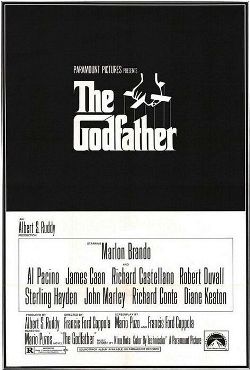
The Godfather, of course, won the Oscar for best picture of 1972. And while it’s rare that I openly agree with the Academy, I’m proud to say that this one time is a definite exception.
 Howard Hansen (Ted Prior) is a best-selling horror writer who is suffering from writer’s block. With his agent, Murray (Frank Sivero), pressuring him to get something written, Howard decides to seek inspiration in Chinatown. When he steps into a curio shop and sees a grotesque, one-eyed blob floating in a jar of formaldehyde, Howard buys it. He hopes that the blob will give him an idea for a great book but instead, it just causes him to have nightmares and violent sex with his wife, Peggy (Sandahl Bergman).


 Through the Shattered Lens