Trash TV Guru — “Gotham” Episode 1, “Pilot”


4GothamCity-610x343

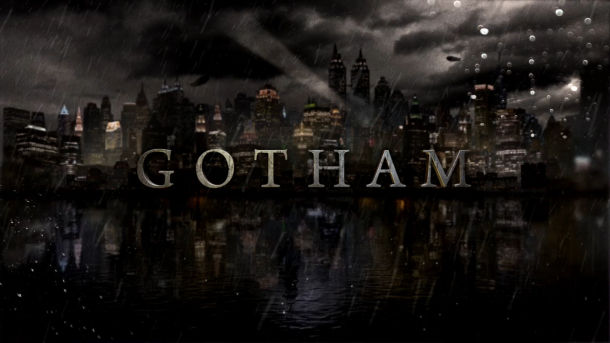
Okay, fair enough, I’m kinda late to the party here since Arleigh has already chimed in with his thoughts on the rather unimaginatively-titled first episode of Fox’s new Gotham TV series, Pilot, but as  the closest thing to a “Bat-fanatic” here at TTSL, I thought I’d go ahead and offer a second opinion — even if it’s not terribly different from the first one you fine folks have read here.

Let’s start by stating the obvious — between Year OneEarth OneZero Year, and Batman Begins, the origins of the Dark Knight detective have been done to death on the printed page and the silver screen over the last couple of decades, so only the venue is really “new” here, the basic outlines of the story this show is going to present are already well-known — aren’t they?

Well, yes and no. We all know how the series “ends,” whenever that happens to be — Bruce Wayne dons the cape and cowl and becomes Batman. Similarly, we all know how the story begins — wealthy socialites Thomas and Martha Wayne are gunned down in the notorious “Crime Alley” neighborhood of Gotham City in front of their young-at-the-time son, (here played by David Mazouz) and his life is, obviously, forever changed.

It’s what happens in between those well-established “bookends” that  events in Gotham will be playing out, and there does seem to be ample room for either whole-cloth invention, or creative re-interpretation, within the confines of that territory, and this pilot episode shows that, as was done with Smallville over the course, of — what,  ten seasons? — the principal creative minds at work here, most notably executive producer (and writer of this opening salvo) Bruno Heller, will be doing a little of both.
gotham-ben-2

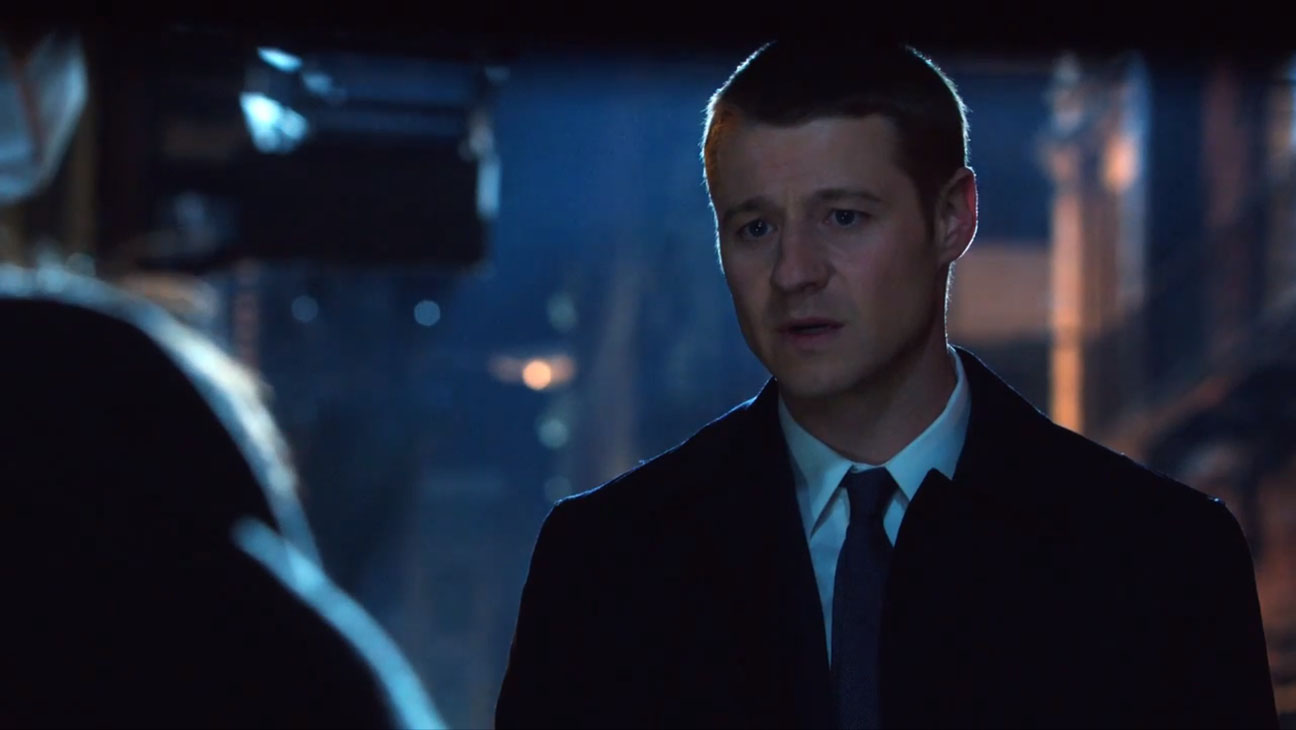
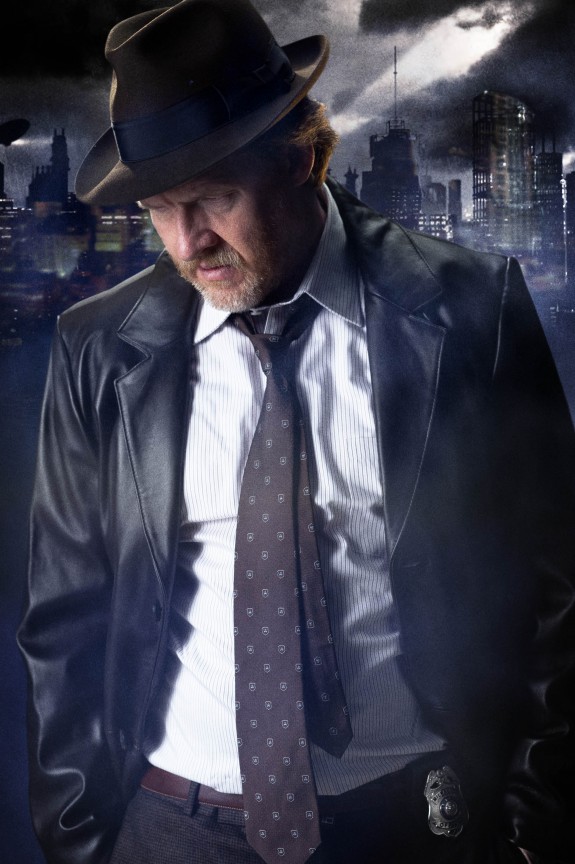
Apparently the main plot thread, at least running through the first season, will see clean-cut rookie detective Jim Gordon (Ben McKenzie) and his crooked partner, Harvey Bullock (Donal Logue), investigating the Wayne murders, and this initial episode largely focuses on them chasing a red herring in the form of a small-time hood named Mario Pepper (Daniel Stewart Sherman) , who they end up killing while he’s trying to escape, to the equal parts relief and despair of his wife and young plant-loving daughter, Ivy (Clare Foley). There’s some painfully strained dialogue that will probably make long-time Bat-fans cringe interspersed here and there, and a couple of scenes that are downright painful to watch, but by and large the story moves along at a reasonable enough little clip, the twists and turns our two protagonists encounter are generally involving, and the stage seems to be set for at least a modestly entertaining yarn as things progress.

Was the episode a great intro to the series? Not by any stretch of the imagination. Was it good enough? Sure, what the hell — I’ll be back next week for more, at any rate, and we’ll see where it goes from there.

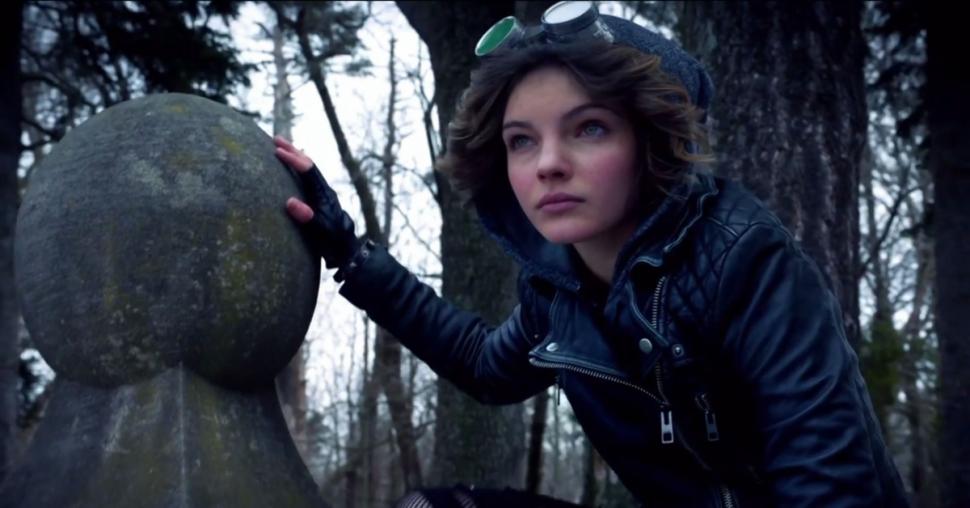
So, how about a rundown of what Heller and director Danny Cannon get right, and what they get wrong, shall we? First, the good stuff : Mazouz is excellent as the pre-pubescent Bruce Wayne, and shows  pretty remarkable acting range for a kid. He’s by turns heartbroken, sullen, withdrawn, and determined. Good show all around. McKenzie displays a requisite amount of “regular-guy charm” as the show’s ostensible lead. Logue is a magnificent casting choice for a gruff and cynical veteran detective who’s definitely on the take — probably from more than one source — but may not be completely beyond redemption. Camren Bicondova largely lurks behind the scenes as a young Selina Kyle, but she exudes mysterious charisma to spare and you’ll definitely want to see more of her. John Doman seems intent on giving crime boss Carmine Falcome a whole new layer of depth and a set of complex motivations that really have me interested in finding out just what makes him tick. Cory Michael Smith is the perfect blend of genius and creepy in his role as police scientist Edward Nygma, who will “grow up” to become, of course, The Riddler. And Robin Lord Taylor as Oswald Cobblepot delivers his lines — and performs his physical actions — with a kind of just-beneath-the-surface insanity that shows that if and when he does become The Penguin, he’ll probably be more of the Danny DeVito ilk than the Burgess Meredith one.

The real show-stealer, though, is Jada Pinkett Smith as new character Fish Mooney, a second-tier — for now — player in the local mob scene who has brains, ambition, cunning, and sex appeal to spare. She seems to be having the time of her life sinking her teeth into the role, and it certainly shows. And if she’s not enjoying herself, well then — guess her acting is even better than I’m giving it credit for.

Oh, and just as a quick aside : does anyone else think the scene where she’s auditioning a struggling young stand-up comic for her club might be the first appearance in this series of, well — you-know-who? Maybe I’m over-thinking things, but I had to put it out there regardless.
harvey-bullock-gotham

It’s not as if Heller isn’t prone to offering other subtle hints in this episode’s script, either — one of Gordon’s superior officers just happens to be named Sarah Essen (Zabryna Guevara), and folks who have read Frank Miller and David Mazzuchelli’s Batman : Year One know that name well. Likewise, fans of the Gotham Central comics series will already be well familiar with the names Crispus Allen and Renee Montoya (played by Andrew Stewart-Jones and Victoria Cartagena, respectively), who pop up here as GCPD internal affairs agents. They’re not given much to do, admittedly, but a word of warning to Heller and all other series writers as far as this subject goes : Renee Montoya, in particular, is someone with a lot of hard-core fans, being that she represents one of the few positive portrayals of strong, independent, lesbian women of color anywhere in mainstream comics. Treat her right, or ignore her altogether, but don’t get this one wrong. There are some lurid hints dropped that she has “a past” with Gordon’s fiancee, Barbara (Erin Richards), but I wouldn’t suggest playing Montoya for pure soap opera value — it would be tremendously disrespectful to a character that was truly groundbreaking on the printed page.

Which brings us to what Gotham, at least so far, seems to be getting wrong (apart from some occasionally dodgy set design and CGI work and the script flaws previously mentioned) : Sean Pertwee (son of my second-favorite Doctor to Tom Baker) is a good casting choice as Alfred, and his protectiveness of his young charge certainly shows through, but Heller writes him as a semi-militaristic hard-ass in a move that seems to be a direct nod to the risible work of writer Geoff Johns in his limp Batman :Earth One graphic novel (please note I’m only singling out Johns’ script for criticism, as Gary Frank’s art on that book was superb). I hope they don’t go too far down that road with the world’s most famous fictional butler. Poison Ivy appears to be the victim of a radically different “re-imagining” that, so far, looks a lot less than promising. The overall tone of the proceedings appear overly concerned with shoe-horning in too many specific Bat-elements and not doing enough to establish the city as an entity separate from its most famous vigilante crime-fighter. And having Barbara be a well-heeled, glamorous socialite is a bit of a betrayal of the working-class roots of Jim Gordon and his family that we’ve all come to know — he just doesn’t look right lounging around in her fashionable penthouse apartment.
gotham

All in all, then, what we’ve got  is a case of “some good, some bad.” By the time the episode was over I was reasonably optimistic that, despite the “mix n, match” approach to re-invention and outright invention that I mentioned earlier,  we’re not looking at another Smallville clone here — i.e. a show that amounts to little more than Beverly Hills, 90210 with super-powers. The jury is still out, though,  on whether or not this show’s creators have enough of a different spin to add to the Bat-mythos to make this a worthwhile project. They’re borrowing influences from a wide range of sources, some of which I would’ve preferred having them ignore altogether, but it’s probably safe to assume that only some of those things will prove to be major factors in the series going forward. How far forward I go along with it remains to be seen, as there was nothing in the pilot episode to make me say “alright, awesome, I’m all in!” — nor was there enough to make me throw up my hands and walk away in disgust. We’ll call how I feel about things “cautious optimism” for now, with the greater emphasis being on “cautious.” Heller and co. have me interested — not it’s time to impress me.

Trailer #2: Sin City: A Dame To Kill For


SIn City 2

To be honest, I wasn’t a huge fan of the first Sin City.  I thought the movie, as a whole, dragged and all of the hard-boiled narration didn’t really work as an homage or a parody.  I appreciated the film’s unique look and respected the fact that Robert Rodriguez and Frank Miller really did succeed in creating a very real cinematic world but, on the whole, the film just didn’t work for me.  It was a movie that failed to leave me excited, offended, enthralled, exhilarated, or angry.  Instead, I was just bored.

Judging by how excited people online seem to be about Sin City’s upcoming sequel, I am very obviously in the minority.

And, I have to admit, I’ll probably end up watching Sin City: A Dame To Kill For.  After all, Joseph Gordon-Levitt is in it.  I just hope that, unlike just about every character in the first film, he doesn’t end up getting disemboweled or shot in the head.

Here’s the 2nd trailer for Sin City: A Dame To Kill For.

(Also, if somebody doesn’t create a parody called Sim City: A Dame To Kill For, I will end up losing all faith in the internet….)

Trailer: Sin City: A Dame to Kill For (Official Teaser)


Sin City A Dame to Kill For

Hard to imagine it’s been 9 years since the original Sin City hit the big screen. It was a comic book adaptation that many thought wouldn’t work, especially how Rodriguez envisioned it to be slavishly loyal to not just Miller’s dialogue but also his unique art style.

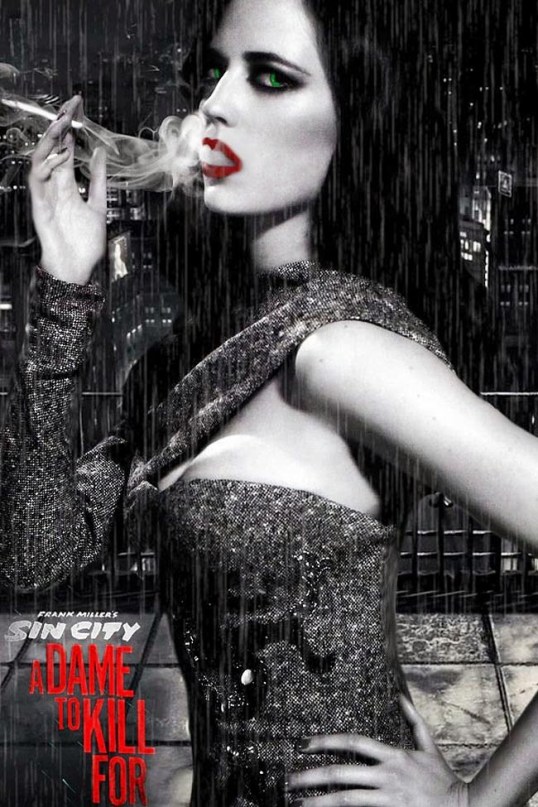
The original film’s success quickly ramped up rumors that a sequel was already being planned using the second graphic novel in the Sin City series. Rodriguez himself stated he wanted Angelina Jolie for the role of Ava Lord, the titular “Dame to Kill For”, but after years and years of delay the role finally landed on Eva Green‘s lap (not a bad choice and one I fully support).

So, we’re now going back to Basin City for more tales of booze, broads and bullets in this hyper-noir film that should be loved or hated in equal measures by those who have followed Frank Miller’s career. Once again the directing duties have been split between Rodriguez and Miller. Here’s to hoping that Miller has learned how to be a much better directer after his last film, The Spirit, tanked.

Sin City: A Dame to Kill For is set for an August 22, 2014 release date.

Trailer: The Wolverine (CinemaCon Exclusive)


TheWolverine

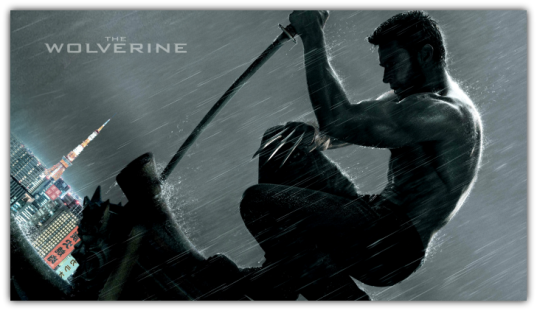
First we had the WonderCon Exclusive trailer for Pacific Rim drop a couple days ago. Now we have the CinemaCon Exclusive trailer for the upcoming The Wolverine which looks to be an improvement from this film’s first trailer.

This trailer for The Wolverine looks to emphasize the action in the film instead of the film’s story. We get many scenes of Wolverine doing what he does best. For fans of the character this storyline and setting should be recognizable as being based off of the Chris Claremont and Frank Miller mini-series about the character that helped create one of this character’s better backstory.

The Wolverine drops in the theaters on July 26, 2013.

Source: AMC Theaters

Which Way Forward For The “Batman” Movie Franchise? Take Fourteen : The “Return” Of Bruce Wayne


Okay, I’m cheating a bit this time around, by starting this post with the sort of image I’d ideally like to end the segment of our hypothetical Batman I movie that we’ll be discussing today with, but whatever. It’s a cool screencap from DC’s quite-nicely-done animated version of Frank Miller and David Mazzuchelli’s classic Batman : Year One, and it speaks to the profound emptiness that Bruce Wayne still feels at the center of his life as a result of the cold-blooded murder of his parents. Simple, somber, and reflective, it’s a pretty powerful little image.

And is exactly the opposite of how I’d like this whole little return-that-isn’t-really-a-return-because-Wayne-has-been-sneaking-in-and-out-of-Gotham-to-construct-his-batcave-and-establish-Batman-as-a-presence-in-the-city-prior-to-his-official-arrival-for-some-time-now part of the movie to begin.

The arrival gate at Gotham International airport should be literally packed with reporters, photographers, flashbulbs going off and the like — maybe even a couple of rather presumptuous young ladies with flowers — and a press aide/PR flak informing all and sundry that “Mr. Wayne will be sitting down with the media on Monday morning to address any and all questions as to his past activities and future plans.” The throng should literally begin pushing in towards Wayne as he smiles and good-naturedly holds his hand in front of his face while he offers some lame line like “please, friends, I’m flattered by all the attention, and it’s great to be home, but trust me when I say my travels have been exhausting and right now there’s no such thing as a good angle from which to photograph me.” A quick “Key To The City”-type presentation from the Mayor and a couple other local dignitaries before he exits the airport might even be in order, though it should be quick and Wayne should be both engaging yet totally non-specific if he’s called upon to, as the old expression goes, “say a few words.”

The bedlam should continue unabated as Bruce heads to his waiting limousine, Alfred assuming chauffeur’s duties in the front, and by the time he’s reached the car he should look truly, well, not so much exhausted as just plain bored with the attention already. Message to the audience : this is a guy on a mission, who is by nature uncomfortable with the limelight but won’t let that sort of thing distract him from his ultimate aims, one of which is,  he already understands to his sometimes-chagrin, presenting an upstanding public image for himself as a responsible civic leader. In other words, the “front” of being a “playboy” that we’re used to seeing from him in other iterations of the character is definitely not going to be a part of this series.

Which is not to say that he’s going to be all business, either — humanizing the Bruce Wayne persona is a big part of what this little imaginary trilogy of mine is all about, and my hope is that, as further details unfold, how I intend to portray this “more human” side will become readily apparent. If it’s not, then I won’t have done my job properly.

Anyhow, after exchanging the briefest of pleasantries with the ever-faithful Mr. Pennyworth, an exchange that ends with an admittedly predictable “just take me home, Alfred,” the last image we’ll be left with as far as this whole early segment of the film goes will ideally be one very much like the picture we started things out with here — Bruce Wayne, silent and alone, brooding over his parents’ tombstones on the “stately Wayne Manor” grounds. The media interview mentione a moment ago that he’ll be giving, and that we hinted at in an earlier post in this series, will be the focus of our attention when I return to this (go ahead, say it — never-ending) series in a few days’  (that’s the plan, at any rate) time!

Review: 300 (dir. by Zack Snyder)


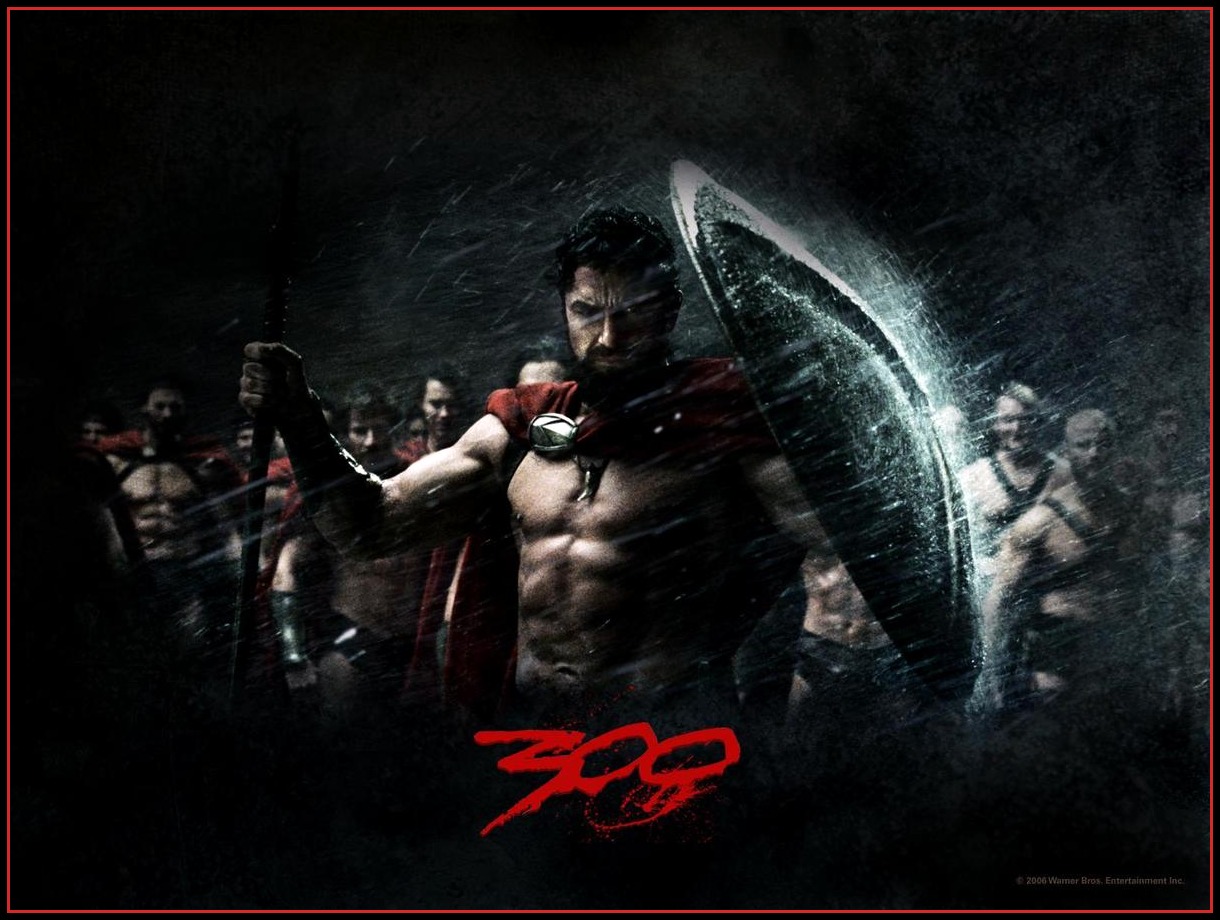
I will get it out of the way and say that this was not and was not meant to be a historically accurate depiction of Ancient Greece. It was never meant to be even when it was still just an Eisner-Award winning graphic novel from the mind of iconic graphic novelist and artist Frank Miller. With that out of the way I was able to watch and enjoy Zack Snyder’s film adaptation on its own terms without the criticism of historical accuracies looming dangerously over my head. 300 deserves the label of being an event film. From start to finish, Snyder’s film practically screams blockbuster and popcorn and I wouldn’t have it any other way.

Frank Miller’s 300 was at its time an interesting depiction of one of history’s greatest military last stands. Miller already known for hyperstylizing the look and feel of the noir genre with his Sin City graphic novels, takes the same approach with his depiction of King Leonidas and his 300 Spartans taking a final last stand against Persian God-King Xerxes at a narrow mountain pass called Thermopylae (literally meaning Hot Gates in Greek). Zack Snyder took this graphic novel and painstakingly stayed true to the visuals Miller and his colorist wife, Lynn Varley put on paper. Looking back at my memory of some of the panels and images from the graphic novel. Snyder and his crew of art directors, cinematographers and CGI-artists were successful in translating almost every page of the graphic novel onto the screen.

Like Robert Rodriguez’s adaptation of Miller’s Sin City, Zack Snyder’s 300 pretty much brings the graphic novel to moving life. This means he stuck to the source material quite literally which limits his own take on the graphic novel. Like Rodriguez, Snyder doesn’t really put his own signature stamp as a director to the film. It’s not too much of criticis since he does a great job of translating Miller’s work onto film, but one wonders what sort of personal touches he could’ve added to the finished look that wasn’t lifted from Miller’s style and whether it would’ve changed the overlook look and feel of the film.

The story is quite simple and just takes the basic summary of the historical event itself. Spartan King Leonidas (played with visceral gusto and machismo by Scottish thespian Gerard Butler) makes a decision to go to war and confront the encroaching and fast approaching massive Persian Army led by Xerxes (Rodrigo Santoro) intent on conquering the Hellenic city-states of the Greek Peninsula. Persian ambassadors ride forth to demand oaths of fealty from those city-states ahead of the army’s path. Sparta is one such city-state, but different from the rest of its Hellenic brethrens. Sparta has gone down in history as a word synonymous with unbending dedication to a strict, ascetic warrior code. Warfare and battle were what Spartans were born and trained to do from an early age. Weakness and physical imperfections weeded out from the time of birth (the film explains just what happens to male newborns with physical imperfections and deformities). The answer Leonidas gives the Persian delegation could be seen as somewhat extreme, but not contrary to his nation’s warrior-culture of never surrendering and seeing death in battle the greatest glory for a Spartan to achieve. From this sequence right up to the end of the film we get to see just how much of a warrior culture the Spartans were in extreme detail.

It’s during the prolonged battle scenes between Leonidas’ Spartans and Xerxes army which will have everyone chomping at the bit. If you have to see this film for any particular reason outside of watching superbly-trained underdogs slaughtering and endless supply of enemy troops then you will most likely be disappointed by the slower scenes away from Thermopylae. Indeed, this film an its original source material would’ve worked even better without the extra filler Snyder and his writers added to give the film more depth. I’m all for more emotional depth and characterization in my films but when a movie is all about a bloody and heroic last stand of a few against the many, scenes which slow the story down does more to break the rhythm and tone of a film than add to it. Othe than a deeper understanding of the kind of partnership Leonidas had with Gorgo, his Spartan Queen, most of the subplots added by Snyder and his writers could easily have been left out and still ge a kick ass action epic.

It’s the action scenes which reall stand out visually. Some people might see the style tricks of speed ramping certain action sequences then slowing it down considerably to show the minute detail of the battle scene as being to gimmicky, but I would disagree and say it actually gives the movie a mythical quality in its storytelling. One thing I have to say about Zack Snyder as a director (his remake of George A. Romero’s Dawn of the Dead better than what detractors have made it out to be) is that he knows how to film action and with special mention to bloody and gory action. He makes these scenes of dismemberments, decapitations, and disembowlments look like a piece of performance art.

These scenes of carnage would be considered extremely gratuitious if it didn’t look so made up good. Even the way the blood flows, spurts and splashes look like something Jackson Pollock would take interest in. The speed up and slow down of the sequences also gives the fight scenes a certain rhythm that once an audience picks up on will follow it through to the end. This is why the scenes back in Sparta with a duplicitous politician and his powerplay to assume control and power seem such a downer instead of enhancing the sacrifice of Leonidas and his men. Those scenes just feel tacked on and completely superfluous. Luckily, there’s not enough of them to slow down the frantic pace developed by the battle itself.

The performances by all actors involved really doesn’t require too much criticism or reflection over. Gerard Butler does a great and convincing job as the Spartan King and his conviction in confronting Xerxes and his army with so few seem very believable. It’s not a star-making performance but it does show that Butler can add a bit of gravitas to a character and role so basic in characterization. Lena Hedley is radiant as his partner and Queen. Despite the weird sounding name of Gorgo, Hedley plays the strong-minded and equally influential wife to Butler’s Leonidas. It’s only her scenes back in Sparta as she tries to rally her people to support their king which keeps these slower sequences from fully pulling down the film. The performances were good enough to keep the acting in the film from becoming too campy or too serious. It’s an action film and with enough action going on in the movie I could forgive the writers (both Miller and the screenwriters) from scrimping on character build up.

All in all, Zack Snyder’s film adaptation of Frank Miller’s 300 succeeds in bringing the book to moving life. Throughout the run of the film it was hard not to get lost in the beautiful visuals. Whether it was the muted color pallette which puts most of the scenes in an almost sepia-tone look to over-emphasizing certain colors to set a certain mood. From oversaturation of reds in one sequence to one where everything seem to be tinted with the many shades of blues at night. This is what 300 will be best remembered for. It’s technical use of CGI to paint the environment in unrealistic but beautiful ways which gives the scenes a lyrical and mythical look to them once the actors were superimposed over them. The film really was a painting come to life and it shows once again how computer and digital filmmaking technology have now afforded directors in making what used to be impossible technically to something that could be done with the limit being the artist’s imagination.

This film will not win many acting, directing and even screenwriting awards (which it didn’t once award season rolled around), but it doesn’t have to for people to enjoy it. It will entertain and pull its audience into a living and modern retelling of a legend. Whether all that happened on the screen was exactly as it happened in 480 B.C. doesn’t matter. What it does show is that through retelling down the years even all the embellishments added to the story of Leonidas and his men doesn’t diminish the fact that what they did and accomplished was how legendary heroes were made and remembered.

Review: 100 Bullets Vol. 1 – First Shot, Last Call


I missed out on the initial release for 100 Bullets, but I’ve since rectified that problem.

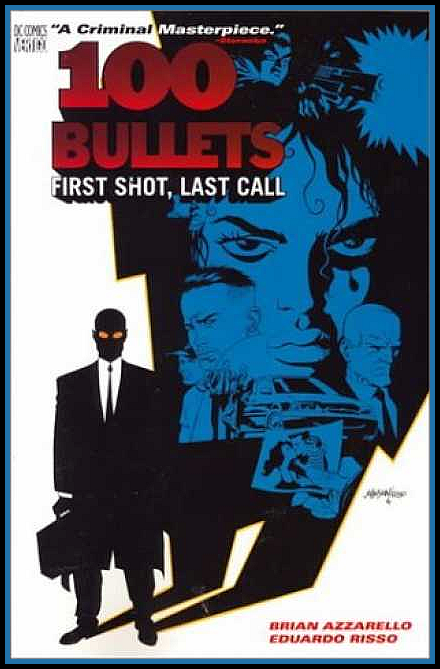
Brian Azzarrello’s 100 Bullets continues the long line of excellent mature comic titles from DC Comic’s Vertigo line. Azzarrello’s hardboiled, crime-thriller noir series brings to mind classic detective-noir works by Hammett, Spillane and Chandler. It’s a more complex continuation of the hyper-noir series Frank Miller began with his Sin City series. I’ve heard people say that this series was better than Sin City and to some respect it was. The stories in each issue contained in this first volume (issues 1 through 5) were abit more complex in nature and execution than Miller’s more simple noir tales. The five stories in this collected volume also laid the basic groundwork for what’ll turn out to be one long-running series lasting exactly 100-issues. Where Sin City‘s simplicity in its storytelling and artwork lay its strength, it’s in the complexities in the tales and the detailed, but economical artwork that 100 Bullets shined through.

In First Shot, Last Call we’re introduced to the gamemaster of the tale: Agent Graves. Looking like an ever-present government agent who has seen all that life has thrown at him and ready for more, Agent Graves picks a recently paroled Latino lass by the name of Dizzy Cordova with a proposition. He offers Dizzy an attache case with a gun and 100 bullets that’re untraceable and definite proof that certain individuals caused her heartache and grief that has ruined her life. He only offers her the attache case, its content and the proof within. The choice is Dizzy’s to make on what she should do with what’s offered her. This set-up and premise is the beauty of 100 Bullets. The story’s basically a morality tale of choices offered to the characters. Will they use the offer to exact vengeance and get away with it scott-free, or will they refuse the offer and live on with their life. The choice of revenge really doesn’t bring back lost time and loved ones and only feeds the need for retribution. Agent Graves doesn’t really force Dizzy’s hand, but a supporting character knowledgable of the offer does — for his own agenda not yet known — prods, pushes and guides her to picking the more primal choice. Dizzy’s choice in the end was both understandable and in the end inevitable.

The second story arc deals with Lee Dolan who also has had his life turned upside-down by people unknown to him. His life and family taken away by the stink of a child pornography accusation in the past. Agent Graves makes him the same offer of the attache case and its untraceable 100 bullets. Dolan’s reaction to this offer is different from that of Dizzy’s, but in the end his ultimate choice doesn’t give him the same resolution and new life path that Dizzy made. It’s a tribute to Azzarrello’s great writing that the decision both Dizzy Cordova and Lee Dolan made were understandable when taken into context of their personalities and yearning to fix the problem that led them to their current state in their lives.

To complement Azzarrello’s words perfectly were Eduardo Risso’s artwork. It would be a misnomer to say that Risso’s art style was minimalist like those of Frank Miller’s woodcut-engraving style for Sin City or Mike Mignola’s chiasroscuro-style for his Hellboy series. There’s a sense of the cinematic in Risso’s work. The scenes were always drawn with a mind for action even when it’s just people standing around. Risso has quite the filmmaker’s eye in how he’s drawn 100 Bullets which just adds to its noirish feel. The characters and environment were drawn not to scale and real-world proportion, but just enough not to look cartoonish. I would agree that there’s an abundance for cleavage on the women drawn, but Risso doesn’t do it gratuitously. Instead he uses this detail to showcase the sexuality of the strong female characters. It paints the female characters like Dizzy Cordova and Megan Dietrich with a sense of both strength and sensuality without pandering to the teenage boy demographic. Plus, he gives these ladies their own personality and character with how he draws them. Dizzy truly has the Latina sensual curves while Megan has the icy-cold Aryan beauty that serves her well.

100 Bullets: First Shot, Last Call was a great discovery and a wonderful beginning to a very mature, intelligent and hardhitting comic series. Congratulations must got to its creator Brian Azzarrello for writing such great characters and memorable stories. I can’t forget the work of his artist and partner-in-crime, Eduardo Risso. Risso’s artwork has stamped themselves in my mind as the only way to see 100 Bullets in. Both Azzarrello and Risso complement each other well and their continued collaboration right up to the end of the series helped make this series one of the best of the past decade.