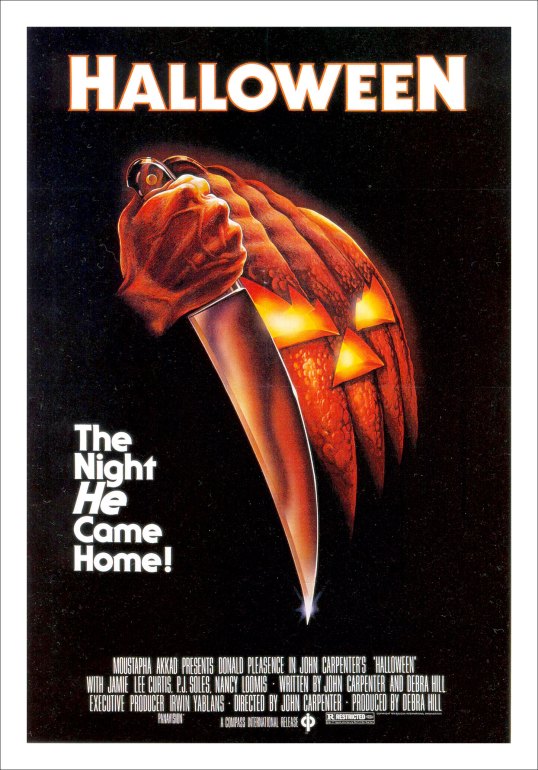
Horror Scenes That I Love: Dr. Loomis Explains Michael Myers in the original Halloween


We’ve talked a bit about Donald Pleasence today.  Pleasence is one of my favorite actors, an intense performer with an eccentric screen presence who always gave it his all, even in films that didn’t always seem like they deserved the effort.  Pleasence was a character actor at heart and he appeared in a wide variety of films.  He’s absolutely heart-breaking in The Great Escape, for instance.  However, it seems that Pleasence is destined to be best-remembered for his horror roles.  For many, he will always be Dr. Sam Loomis, the oracle of doom from the original Halloween films.

In this scene from the original Halloween, Dr. Loomis (Donald Pleasence) attempts, as best he can, to explain the unexplainable.  I’ve always felt that Pleasence’s performance in the first film is extremely underrated.  People always tend to concentrate on the scenes where he gets angry and yells or the later films where an obviously fragile Pleasence was clearly doing the best he could with poorly written material.  But, to me, the heart of Pleasence’s performance (and the film itself) is to be found in this beautifully delivered and haunting monologue.

In this scene, we see that Dr. Loomis is himself a victim of Michael Myers.  Spending the last fifteen years with Michael has left Loomis shaken and obviously doubting everything that he once believed.  Whenever I watch both Halloween and its sequel, I always feel very bad for Dr. Loomis.  Not only did he have to spend 15 years with a soulless psychopath but, once Michael escapes, he has to deal with everyone blaming him for it.  Dr. Loomis was literally the only person who saw Michael for what he was.

Incidentally, Donald Pleasence nearly turned down the role of Sam Loomis.  He didn’t think there was much to the character.  (The role had already been offered to Christopher Lee and Peter Cushing, neither of whom were interested.)  It was his daughter, Angela Pleasence, who persuaded Donald to take the role.  At that year’s Cannes Film Festival, Angela saw John Carpenter’s Assault on Precinct 13 and she assured her father that Carpenter was a talented filmmaker.  Taking his daughter’s advice, Donald Pleasence accepted the role and, by all accounts, was a complete gentleman and a professional on set.  After making horror history as Dr. Sam Loomis, Pleasence would go on to appear in two more Carpenter films, Escape from New York and Prince of Darkness.

October True Crime: Dr. Crippen (dir by Robert Lynn)


Dr. Hawley Harvey Crippen

In 1910, a homeopath named Dr. Hawley Harvey Crippen was executed by hanging in the UK.

An American by birth, Dr. Crippen had come to London in 1897 with his second wife.  (His first wife died of a stroke and Crippen sent his only son to live with his grandparents.)  Cora Crippen was a former music hall singer who hope to continue her career in London and who did manage to make friends with several prominent members of the city’s theatrical community.  Dr. Crippen was widely regarded as a meek man who was dominated by his rage-prone wife.  Crippen struggled to hold down a regular job and eventually ended up as a manager at the Druet Institute for the Deaf.  By at least 1905, Dr. Crippen was having an affair with a young typist named Ethel Le Neve.

Cora disappeared in early 1910.  When her friends stopped by the house to ask for her, Dr. Crippen said that his wife had left him for another man and had returned to America.  Later, he claimed that Cora had subsequently died in California.  When Ethel was spotted wearing Cora’s jewelry, the London police launched their own investigation into Cora’s disappearance.  After Crippen was interviewed by the police, he and Ethel fled to Brussels and then boarded an ocean liner heading for Canada.  After Crippen and Ethel disappeared, the police searched Crippen’s home and found a torso buried in the basement.  It was assumed that the torso was all that was left of Cora.

(As some have pointed out, it didn’t seem to make much sense for Crippen to dispose of Cora’s head, legs, and arms but to keep her torso.  Apparently, at that time, it was common for human torsos to show up in the Thames, the result of people jumping in the river and then having their body split apart by the current.  As such, the Thames also became a popular place to dump murder victims.  One wonders why Crippen wouldn’t have done the same.)

Meanwhile, on the ocean liner heading to Canada, the captain noticed that one passengers looked like a freshly shaven Dr. Crippen and that the “boy” he was traveling with was obviously a young woman in disguise.  The captain sent a wireless telegram to London.  Chief Inspector Walter Dew boarded a faster liner and actually managed to reach Canada before Crippen.  When Crippen and Ethel arrived in Canada, Walter Dew was waiting for them.

Fate simply wasn’t on Crippen’s side.  If Crippen had bought third class tickets instead of sailing first class, it’s probable the captain would have never seen him during the voyage.  If Crippen had taken a boat to his native United States instead of Canada (which was then still a British dominion), Dew would not have been able to take him back to the UK without an extradition hearing and it’s entirely possible that the evidence would have been ruled insufficient.  Instead, Crippen was promptly returned to London and put on trial for murdering his wife.

During the heavily-covered four-day trial, Crippen’s defense was that Cora had returned to America and that there was no way to prove that the torso was Cora’s.  Though the jury found Crippen guilty in just 22 minutes and he was hanged a month later, there were many who felt that Crippen was innocent or, at the very least, that his guilt had not been proven.  I imagine that one reason why so many people doubted Dr. Crippen’s guilt was because he just didn’t look or act like a murderer.  He wasn’t Jack the Ripper, a shadowy figure moving through the night.  Instead, he was a short, balding, and rather owlish looking man who wore glasses and who, in most photographs, has a quizzical expression on his face.

In short, Dr. Crippen seems as if he was literally destined to eventually be played by Donald Pleasence.

The 1963 film, Dr. Crippen, takes a rather straight-forward approach to telling the story of the doctor.  It opens with Crippen (Donald Pleasence, naturally) on trial for the murder of his wife and it largely tells the story through flashbacks.  Cora (Coral Browne) is portrayed as being a no-talent narcissist who regularly cuckolds her husband while Ethel Le Neve (Samantha Eggar) is portrayed as being a naive young woman who truly loves Dr. Crippen.  The film leaves open the question of whether or not Crippen killed his wife, though it seems to strongly suggest that Crippen was innocent of the crime and the only reason he fled London was because he wanted to be with Ethel.  Donald Pleasence is excellent as Dr. Crippen, playing him with just enough ambiguity that the viewer is left to wonder whether he did it or not.  Pleasence turns Crippen into a sympathetic figure while still holding back just enough to suggest that emotional darkness that could have led even the meek Dr. Crippen to becoming a murderer.  Nicolas Roeg’s black-and-white cinematography captures both the harshness of Crippen’s life in prison and the fleeting romance of his brief time with Ethel.

As for the real life Crippen, both his guilt and his subsequent execution continue to be controversial, with some claiming that DNA testing proved that the torso did not belong to Cora.  (Other have quite reasonably pointed out that the sample used had degraded quite a bit over a hundred years.)  There have been many attempts to win Dr. Crippen a posthumous pardon but all have failed and will probably continue to fail unless Cora’s remains are somehow discovered in a grave somewhere in California.

Shortly before his execution, in his final letter to Ethel Le Neve, Crippen wrote, “Face to face with God, I believe that facts will be forthcoming to prove my innocence.”  After Crippen was hung, Ethel spent three years in Canada before returning to London.  She changed her name, worked as a typist, and eventually married and had two children.  She died in 1967, fifty-seven years after Dr. Crippen.
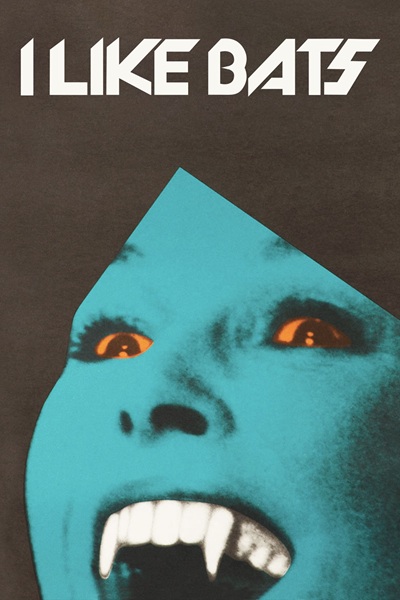
Horror Film Review: I Like Bats (dir by Grzegorz Warchoł)


In this 1986 Polish film, Katarzyna Walter stars as Iza, a young woman who lives in a small village and who appears to be happy with her quiet life.  Despite the efforts of her aunt (Małgorzata Lorentowicz) to set her up with a local bureaucrat (Edwin Petrykat), Iza says that she is happy being single.  Even though there’s a “sex murderer” on the loose, Iza still prefers to walk alone at night.  She is happy taking care of her bats and making pottery.

Iza, however, has a secret life that not even her aunt knows about.  Sometimes, she puts on dark glasses and a brunette wig and she goes to a nearby town.  She presents herself as being as prostitute but, once she’s alone with a man, she grabs him, bites his neck, and drinks his blood.  Iza is a vampire!

Iza seems quite happy with being a vampire or, at least, she does until she meets Dr. Rudolf Jung (Marek Barbasiewicz), a psychiatrist who visits her aunt’s shop and buys a tea set.  Jung is handsome and single and Iza’s aunt thinks that he would be a perfect match for her.  For once, Iza agrees.  When Iza sees Dr. Jung being interviewed on television about an experimental asylum that he operates out of an ancient castle, Iza goes to the castle and asks to be admitted as a patient.  The bemused Jung replies that there are no vacancies.  Iza replies that she’s a vampire and she wants Dr. Jung to cure her.  Jung, assuming that Iza is merely delusional, take her on as a patient.

Iza proves to be a difficult patient.  For one things, she’s immune to hypnotism, which is apparently Dr. Jung’s main technique.  Secondly, she doesn’t really seem to want to stop being a vampire.  Instead, she just seem to be attracted to Dr. Jung.  Why she’s so attracted to Dr. Jung is another question all together.  Dr. Jung is a condescending jerk who doesn’t really seem to care about any of his patients.  Just as Iza drinks the blood of her victims, Dr. Jung seems to thrive off of the delusions of his patients.  The main thing that Jung and Iza have in common is a belief that they were both destined to be forever alone.  Dr. Jung explains that he never had room for a wife or a family because he was too busy going to school and making a name for himself.  Iza, meanwhile, has always assumed she’ll be alone because she’s a vampire.

(Interestingly, even though the film clearly establishes that Iza is a vampire, none of her victim come back as vampires and she has no problem going out during the day.)

I Like Bats is an intriguing vampire film, one that mixes a creepy atmosphere with a liberal dose of dark humor.  The story itself meanders a bit and is not always easy to follow.  The motivations of Iza and Jung are often rather unclear.  Like a lot of films that were made in Eastern Europe during the period of communist domination, the most interesting thing about the film is the contrast between the beauty of old Europe, with its castles and its green countryside, and the brutal ugliness of the dominant Marxist-Leninist culture.  Though I Like Bats is not explicitly political, there’s still a healthy dose of paranoia running through the film, the type of paranoia that goes along with living in or near an authoritarian state.

I Like Bats is not always easy to follow but the dark ending carried a punch and it’s a film that will stick with you.

Horror Film Review: The Godsend (dir by Gabrielle Beaumont)


In The Godsend, a married couple, Alan and Kate Marlowe (played by Malcolm Stoddard and Cyd Hayman), have a chance meeting with a pregnant stranger (Angela Pleasence).  While Alan suspects that there is something wrong with the mysterious woman, Kate insists on allowing her to come have dinner with them.  At their rural home, the Stranger spends most of her time glaring at Alan and, when she’s left alone, she cuts the phone line.  When the Stranger goes into labor, Alan and Kate deliver her daughter.  The next morning, the Stranger has disappeared and Alan and Kate end up taking the baby — now named Bonnie — into their household.

Alan and Kate already have four other children but that soon starts to change.  First, baby Matthew is found dead in his crib.  As Bonnie grows up, the other children die.  Little Davey drowns in a creek and Bonnie is found with scratches on her hands.  Davey’s brother Sam says that he is scared to be left alone with Bonnie.  Alan and Kate tell him that he’s being silly.  Later, Sam is found dead in the barn.

With their neighbors flat-out accusing Alan and Kate of murdering their children and Bonnie doing strange things like attempting to give her father the mumps, Kate starts to have a nervous breakdown.  Meanwhile, Alan comes to fear that Bonnie may be the one responsible for the death of the other children and that she may now be targeting that last remaining child, Lucy (Angela Deamer).

First released in 1980 and based on a novel by Bernard Taylor, The Godsend is a British horror film that moves at its own deliberate pace.  The action unfolds slowly, with an emphasis on atmosphere and ambiguity.  While it certainly seems that Bonnie is responsible for the death of the other children, the first half of the film leaves room for doubt.  The viewer is left to wonder whether it’s possible that Alan himself is just being paranoid.  As the film progresses, one becomes aware that Bonnie is not only evil but she also has far greater powers than even Alan realizes.  The film ends on a properly dark note.  There really is no future in England’s dreaming.

The Godsend was a bit too slow.  As is so often the case with British horror films from the early 80s, the film was so determined to prove that it was better than the old Hammer bodice rippers that it allowed itself to get a bit too self-serious and stately.  That said, The Godsend is also undeniably creepy.  Viewers have been conditioned to believe that, no matter what else happens in a film, the children will survive.  Even though the children might very well be traumatized for life, it’s still generally accepted that they will somehow manage to make it to the end of the film.  The Godsend breaks that unofficial rule and it actually gets a bit depressing to watch.  Alan and Kate are going through the worst experience that a parent can can suffer.  Alan blames Bonnie while Kate clings to her as being one of the few things that she still has left.  It’s a sad movie that captures a very primal fear.

For the most part, the cast does a good if not spectacular job with the material.  The best performance comes from Angela Pleasence in the role of The Stranger.  Angela Pleasence was the daughter of Donald Pleasence, an actor who will always be best-remembered for playing Dr. Sam Loomis in the original Halloween films.  Dr. Loomis would have identified Bonnie as being evil from the start.  Unfortunately, no one would have listened to him until it was too late.

Horror Film Review: Teenage Monster (dir by Jacques R. Marquette)


The 1958 film Teenage Monster opens in the late 1800s.  Gold prospector Jim Cannon (Jim McCullough) has got a nice little home with his wife, Ruth (Anne Gwynne) and their young son, Charlie.  One day, Jim and Charlie are out looking for gold when a meteor falls from the sky and crashes right in front of them.  Jim is killed, which I guess is an occupational hazard for anyone who works outside.

(Seriously, you never know when a meteor might crash on top of you.  There might be one about to slam into your home right this minute.  Read quickly.)

Charlie survives the meteor crash but he’s still bathed in radiation.  Ruth takes Charlie home and she keeps him locked up in a back room for his own safety.  Seven years pass and Charlie (Gilbert Perkins) is now a teenager.  Unfortunately, he’s a very old-looking teenager.  Standing nearly seven feet tall, he has long hair and a full beard and he can’t really speak beyond a few grunts.  Occasionally, Charlie manages to get out of the back room and Ruth has to look for him.  She understands that the 19th Century is no place for a radioactive mutant boy.

When Ruth discovers gold, she’s able to buy a house in town.  Unfortunately, living in town means that Charlie notices a young woman named Kathy North (Gloria Castillo).  Smitten with her, Charlie kills her jerk of a boyfriend and decides to bring her home.  Ruth pays Kathy to keep silent about Charlie but it turns out that Kathy has other plans.  Realizing that Charlie is in love with her and will do anything that she commands, she tells him to start killing people around town.

Teenage Monster may seem like an odd title for a western about a boy who gets mutated by a radioactive space rock.  Charlie is technically a teenager but he looks like he’s nearly 60.  The film uses the radiation as an excuse for Charlie’s rapid aging and his grown spurt.  Randomly blaming everything on radiation is one thing that B-movies of the 50s and the 60s definitely all had in common.  I suppose if space radiation could have brought the dead back to life in Night of the Living Dead, it could have also transformed Charlie into a teenage monster.  As far as B-movies were concerned, J. Robert Oppenheimer had a lot to answer for.  Of course, if this movie were made today, Charlie’s transformation would have somehow been due to climate change.

As for the film itself, it’s short and that’s definitely a good thing.  The idea of combining B-horror and the old west is an intriguing one but the movie doesn’t really do that much with it.  Yes, there are gunmen and deputies but they could have just as easily been modern-era outlaws and lawmen without really changing much about the film.  Director Jacques Marquette was a former cinematographer who went into directing so it’s a bit odd that the film has a flat, rather bland look to it.  On the plus side, Anne Gwynne gives a better performance than the material deserved.

Keep your kids away from radiation, everyone.  Other than cheap, clean energy and countless advances in medicine and science, nothing good ever seems to come from it.

Horror On The Lens: The Horror of Party Beach (dir by Del Tenney)


Everybody do the zombie stomp!

Featuring the music of the Del-Aires, a motorcycle gang led by a guy wearing a beret, teenagers who appear to be in their 30s, and monsters that simply have to be seen to be believed, 1964’s Horror of Party Beach is a true classic.  It’s a film as immortal as the cloudy New Jersey sky under which it was filmed.

I always feel bad for Tina (Marilyn Clarke).  Tina is a rebel, a force of chaos who has grown tired of being tied down by the rules of conventional society.  Perhaps symbolically, she becomes the first victim of the horror of Party Beach and all because she wanted to have some time to herself.  It’s a tragedy to which I can relate.

The other thing that I like about this movie is that, even though people are dying left-and-right, it never seems to occur to anyone to just not go to Party Beach.  The Del-Aires continue to perform, no matter who dark things may seem.  Indeed, I’d argue that the Del-Aires are the true heroes of this film.

For your viewing pleasure, here is The Horror of Party Beach!

Godzilla Film Review: Godzilla: Tokyo S.O.S. (dir by Masaaki Tezuka)


A direct sequel to Godzilla Against Mechagodzilla, 2002’s Godzilla: Tokyo S.O.S. begins with the Shobijin, those two little annoying girls who hang out with Mothra, appearing to a Japanese scientist and his family and explaining to them that Godzilla won’t stop attacking Japan until the government does away with their Mechagodzilla, Kiryu.  Kiryu was constructed using the bones of the original Godzilla and, as a result, the current Godzilla is drawn to him.

Instead, the Shobijin suggest that the Kiryu should be tossed in the ocean.  In return, the latest incarnation of Mothra will serve as Japan’s champion whenever Godzilla attacks.

So, to make clear, Japan can either be protected by a badass cyborg that was created out of the skeletal remains of the original Godzilla or it can be protected by a giant moth that has to spend time in a cocoon before it can even become an effective monster.  And, along with the whole cocoon thing, Mothra also comes with two annoying little sidekicks who are constantly popping up and going on and on about how stupid humanity is.

Now, I don’t know about you but, if I was in charge, I would probably just stick with the cyborg.  If nothing else, the cyborg looks like a badass and it can destroy just as much property as Godzilla.  The cyborg exists to say, “Hey, Godzilla — you’re not the only pointlessly destructive monster on this planet!”  Add to that, the cyborg can be piloted and controlled by humans.  The cyborg doesn’t talk back.  The cyborg doesn’t tell humanity that everything is their fault.  The cyborg can be shut down whenever there’s not a monster attack going on.  In other words, get lost, Mothra!

In Tokyo S.O.S., The government of Japan agrees with me, which of course leads to a huge fight between Godzilla, Kiryu, and eventually Mothra.  Mothra does that thing where she wraps Godzilla up in string and also where she appears to sacrifice her life.  The problem is that, after you see enough of these films, you know that Mothra is always going to sacrifice her life and she’s always going to be reborn.

So, the story isn’t that spectacular.  It’s pretty much just Godzilla Against Mechagodzilla all over again.  But here’s the important thing: the fights are really cool.  Yes, the fights are a bit familiar and there’s nothing about them that will really take you by surprise but, if you just want to watch Godzilla destroy stuff, this film delivers plenty of that.

Tokyo S.O.S. is unique amongst the Godzilla films of its era in that it was a direct sequel as opposed to be a reboot.  In fact, it was only the direct sequel of the so-called Millennium Era.  The next Godzilla film, Godzilla: Final Wars, would be a reboot and a spectacular one at that.  We’ll take a look at it next week.

Previous Godzilla Reviews:

  1. Godzilla, King of the Monsters (1958)
  2. Godzilla Raids Again (1958)
  3. King Kong vs Godzilla (1962)
  4. Mothra vs. Godzilla (1964)
  5. Ghidorah: The Three-Headed Monster (1964)
  6. Invasion of the Astro-Monster (1965)
  7. Godzilla vs. The Sea Monster (1966)
  8. Son of Godzilla (1967)
  9. Destroy All Monsters (1968)
  10. All Monsters Attack (1969)
  11. Godzilla vs Hedorah (1971)
  12. Godzilla vs Gigan (1972)
  13. Godzilla vs Megalon (1973)
  14. Godzilla vs Mechagodzilla (1974)
  15. The Terror of Mechagodzilla (1975)
  16. Cozilla (1977)
  17. Godzilla 1985 (1985)
  18. Godzilla vs. Biollante (1989)
  19. Godzilla vs King Ghidorah (1992)
  20. Godzilla vs. Mothra (1992)
  21. Godzilla vs Mechagodzilla 2 (1994)
  22. Godzilla vs SpaceGodzilla (1994)
  23. Godzilla vs. Destoroyah (1995)
  24. Godzilla (1998)
  25. Godzilla 2000 (1999)
  26. Godzilla vs Megaguirus (2000)
  27. Godzilla, Mothra, and King Ghidorah: Giant Monsters All-Out Attack (2001)
  28. Godzilla Against Mechagodzilla (2002)
  29. Godzilla (2014)
  30. Godzilla: Planet of the Monsters (2017)
  31. Godzilla, King of the Monsters (2019)
  32. Godzilla vs Kong (2021)
  33. Godzilla Minus One (2023)

Horror Insomnia File #73: Don’t Kill It (dir by Mike Mendez)


What’s an Insomnia File? You know how some times you just can’t get any sleep and, at about three in the morning, you’ll find yourself watching whatever you can find on cable or streaming? This feature is all about those insomnia-inspired discoveries!

Last night, if you were having trouble getting to sleep, you could have gone to either YouTube or Tubi and watched the 2016 horror film, Don’t Kill It!

Don’t Kill It! takes place in a small Mississippi town.  After a hunter shoots his suddenly viscous dog and then murders his wife and children, the hunter is gunned down by another man.  That man then proceeds to kill his own family.  FBI agent Evelyn Pierce (Kristina Klebe) thinks that it was a case of domestic terrorism.  Demon hunter Jebediah Woodley (Dolph Lundgren) disagrees.  Woodley explains that there’s a demon on the loose.  The demon jumps from host to host.  Killing one host means becoming possessed yourself.  As Woodley explains it, the only way to avoid becoming possessed is not to kill it but then you run the risk of being killed yourself.

At first, everyone is skeptical of Woodley’s claims.  But as Evelyn investigates the case (and we watch a lot of slow motion flashbacks that appear to have been included to pad out the running time), she comes to realize that Woodley is correct.  There is a demon and it is possessing people.  But how can it be stopped?

Don’t Kill It may be a low-budget film but it gets the most out of that budget, making good use of the country atmosphere of its setting and getting generally good performances from the cast.  (The possession scenes are simple but still very well-done and creepy.)  The main appeal here is Dolph Lundgren, playing his role with just the right amount of self-awareness to let the viewer know that Lundgren knows exactly what type of film he’s appearing in and that he’s going to do his best to keep things entertaining.  It’s a film that’s perfect for late night horror season viewing.

Admittedly, I watched the film with a group of friends, some of whom dropped out during the opening massacre.  I could understand their feelings but I think the important thing to consider is, for all the bad things that happened, a hero still showed up to put things right.  Indeed, one could argue that the film’s theme of murder leading to more murder is actually a plea for peace.  “Don’t kill it!” Woodley says and it’s a message for everyone watching.

Previous Insomnia Files:

  1. Story of Mankind
  2. Stag
  3. Love Is A Gun
  4. Nina Takes A Lover
  5. Black Ice
  6. Frogs For Snakes
  7. Fair Game
  8. From The Hip
  9. Born Killers
  10. Eye For An Eye
  11. Summer Catch
  12. Beyond the Law
  13. Spring Broke
  14. Promise
  15. George Wallace
  16. Kill The Messenger
  17. The Suburbans
  18. Only The Strong
  19. Great Expectations
  20. Casual Sex?
  21. Truth
  22. Insomina
  23. Death Do Us Part
  24. A Star is Born
  25. The Winning Season
  26. Rabbit Run
  27. Remember My Name
  28. The Arrangement
  29. Day of the Animals
  30. Still of The Night
  31. Arsenal
  32. Smooth Talk
  33. The Comedian
  34. The Minus Man
  35. Donnie Brasco
  36. Punchline
  37. Evita
  38. Six: The Mark Unleashed
  39. Disclosure
  40. The Spanish Prisoner
  41. Elektra
  42. Revenge
  43. Legend
  44. Cat Run
  45. The Pyramid
  46. Enter the Ninja
  47. Downhill
  48. Malice
  49. Mystery Date
  50. Zola
  51. Ira & Abby
  52. The Next Karate Kid
  53. A Nightmare on Drug Street
  54. Jud
  55. FTA
  56. Exterminators of the Year 3000
  57. Boris Karloff: The Man Behind The Monster
  58. The Haunting of Helen Walker
  59. True Spirit
  60. Project Kill
  61. Replica
  62. Rollergator
  63. Hillbillys In A Haunted House
  64. Once Upon A Midnight Scary
  65. Girl Lost
  66. Ghosts Can’t Do It
  67. Heist
  68. Mind, Body & Soul
  69. Candy
  70. Shortcut to Happiness
  71. Dallas Cowboy Cheerleaders
  72. Dallas Cowboy Cheerleaders II

October Positivity: Broken Church (dir by Michaux Muanda)


Eric Roberts is in this film!

That, in itself, is perhaps not a surprise.  Roberts, by his own admission, is an actor who will appear in just about any production that is willing to pay him a relatively modest fee.  As a result, this Oscar nominee and industry veteran has appeared in a countless number of low-budget movies, many of which would be considered far outside of the Hollywood mainstream.  For example, Broken Church, which was released earlier this year, is an evangelical religious film and, hence, about as far outside of the Hollywood mainstream as you can get.

That said, Eric actually gets to a do a bit more than usual in this film.  He plays John Parker, the father-in-law of Rev. James Logan (Art Parsells).  When the Rev. Logan is released from prison after being wrongfully convicted of embezzling from his church, Logan and his wife, Beverly (Jennifer Adams) move in with Parker.  John Parker is running for the U.S. Senate and the last thing he wants or needs bad publicity about his son-in-law.  It leads to a tense relationship between Parker and Logan.  Luckily, by the end of the film, Logan has become a faith healer (the type who inspires the crippled to toss down their crutches and then run around the churchyard) and this leads to Parker moving up in the polls.  The same demon that framed the Rev. Logan also tries to frame Parker but Parker’s too smart to accept any campaign donations from her.  In a film that is full of all sorts of implausible plot contrivances, a politician refusing money may be the biggest.

Broken Church is a low-budget film that features a few familiar faces, like Robert and Bill Cobbs and Kevin J. O’Connor.  It’s portrayal of a church divided by rumor and accusations will undoubtedly ring true for some, just as its portrayal of politics will leave most people rolling their eyes.  John Parker may be running for the Senate but he seems to be spend most of his time hanging out in his suburban home.  Where are the campaign aides?  Where are the reporters?  Why is the phone not ringing nonstop?  With his campaign falling apart, Parker goes on vacation with his wife and declares he doesn’t want to hear anything else about the election.  That attitude won’t get anyone to the White House!

This is a bit of a silly film, really.  But at least Eric Roberts is in more than just one scene.

Previous Eric Roberts Films That We Have Reviewed:

  1. Paul’s Case (1980)
  2. Star 80 (1983)
  3. Runaway Train (1985)
  4. To Heal A Nation (1988)
  5. Best of the Best (1989)
  6. Blood Red (1989)
  7. The Ambulance (1990)
  8. The Lost Capone (1990)
  9. Best of the Best II (1993)
  10. Love, Cheat, & Steal (1993)
  11. Voyage (1993)
  12. Love Is A Gun (1994)
  13. Sensation (1994)
  14. Dark Angel (1996)
  15. Doctor Who (1996)
  16. Most Wanted (1997)
  17. Mercy Streets (2000)
  18. Raptor (2001)
  19. Rough Air: Danger on Flight 534 (2001)
  20. Strange Frequency (2001)
  21. Wolves of Wall Street (2002)
  22. Border Blues (2004)
  23. Mr. Brightside (2004)
  24. Six: The Mark Unleased (2004)
  25. We Belong Together (2005)
  26. Hey You (2006)
  27. Depth Charge (2008)
  28. Amazing Racer (2009)
  29. The Chaos Experiment (2009)
  30. In The Blink of an Eye (2009)
  31. Bed & Breakfast (2010)
  32. Enemies Among Us (2010)
  33. The Expendables (2010) 
  34. Sharktopus (2010)
  35. Beyond The Trophy (2012)
  36. The Dead Want Women (2012)
  37. Deadline (2012)
  38. The Mark (2012)
  39. Miss Atomic Bomb (2012)
  40. Assault on Wall Street (2013)
  41. Bonnie And Clyde: Justified (2013)
  42. Lovelace (2013)
  43. The Mark: Redemption (2013)
  44. The Perfect Summer (2013)
  45. Self-Storage (2013)
  46. Sink Hole (2013)
  47. A Talking Cat!?! (2013)
  48. This Is Our Time (2013)
  49. Bigfoot vs DB Cooper (2014)
  50. Doc Holliday’s Revenge (2014)
  51. Inherent Vice (2014)
  52. Road to the Open (2014)
  53. Rumors of War (2014)
  54. Amityville Death House (2015)
  55. Deadly Sanctuary (2015)
  56. A Fatal Obsession (2015)
  57. Las Vegas Story (2015)
  58. Sorority Slaughterhouse (2015)
  59. Stalked By My Doctor (2015)
  60. Enemy Within (2016)
  61. Hunting Season (2016)
  62. Joker’s Poltergeist (2016)
  63. Prayer Never Fails (2016)
  64. Stalked By My Doctor: The Return (2016)
  65. The Wrong Roommate (2016)
  66. Dark Image (2017)
  67. The Demonic Dead (2017)
  68. Black Wake (2018)
  69. Frank and Ava (2018)
  70. Stalked By My Doctor: Patient’s Revenge (2018)
  71. Clinton Island (2019)
  72. Monster Island (2019)
  73. The Reliant (2019)
  74. The Savant (2019)
  75. Seven Deadly Sins (2019)
  76. Stalked By My Doctor: A Sleepwalker’s Nightmare (2019)
  77. The Wrong Mommy (2019)
  78. Exodus of a Prodigal Son (2020)
  79. Free Lunch Express (2020)
  80. Her Deadly Groom (2020)
  81. Top Gunner (2020)
  82. Deadly Nightshade (2021)
  83. The Elevator (2021)
  84. Just What The Doctor Ordered (2021)
  85. Killer Advice (2021)
  86. Megaboa (2021)
  87. Night Night (2021)
  88. The Poltergeist Diaries (2021)
  89. The Rebels of PT-218 (2021)
  90. Red Prophecies (2021)
  91. A Town Called Parable (2021)
  92. Bleach (2022)
  93. Dawn (2022)
  94. My Dinner With Eric (2022)
  95. 69 Parts (2022)
  96. The Rideshare Killer (2022)
  97. D.C. Down (2023)
  98. Aftermath (2024)
  99. Bad Substitute (2024)
  100. Devil’s Knight (2024)
  101. The Wrong Life Coach (2024)
  102. When It Rains In L.A. (2025

Icarus File No. 24: Express to Terror (dir by Dan Curtis)


The year was 1979 and Fred Silverman, the president of NBC, had an idea.

How about a television series in which each week’s episode would depict a different group of passengers going on a trip?  The passengers would all be dealing with their own stories, some of which would be dramatic and some of which would be humorous.  With any luck, some of them might even fall in love over the course of their journey!

To keep the audience interested, the show would also feature a cast of regular characters, the crew.  Edward Andrews would play the captain, a sensible and by-the-book type.  Robert Alda played Doc, the doctor who was also a bon vivant.  Patrick Collins was the goofy purser.  Nita Talbot played Rose, the perky director of entertainment.  Michael DeLano was the bartender who always had the best advice for the passengers….

Does this sound familiar?

If you think that it sounds like Fred Silverman just ripped off The Love Boat …. well, you’re wrong.  The Love Boat took place on a boat.  Supertrain took place on a train.

At the time that Supertrain went into production, it was the most expensive television production of all time.  Before the pilot film was even shot, NBC had spent ten million dollars on the Supertrain sets.  Not only was a fake train built but two models were also constructed for the shots of the train moving through the countryside.  At the time, the assumption was that the costs would be easily covered by the money that NBC stood to make from broadcasting the 1980 Summer Olympics.  Unfortunately, Jimmy Carter decided that the U.S. would be boycotting the Olympics as a way to protest Russia’s invasion of Afghanistan.  The only thing that kept NBC from going bankrupt was that the BBC was apparently run by someone even more incompetent than Fred Silverman.  The BBC paid $25,oo per episode for the rights to air Supertrain in the UK.  Supertrain proved to be such a disaster that the BBC never actually aired the episodes that they had purchased.

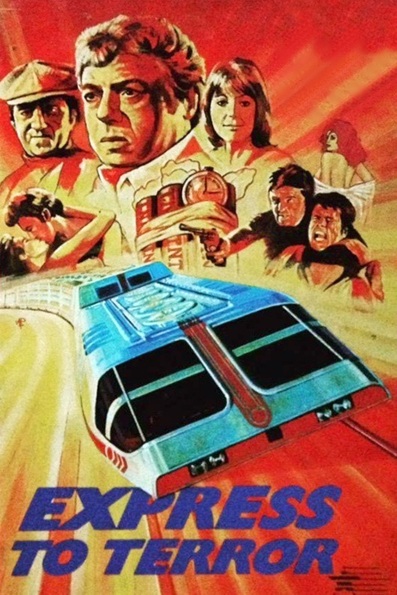
1979’s Express to Terror was the pilot to Supertrain.  (It was later released in some territories as a stand-alone film.)  Directed by horror impresario Dan Curtis (who was also brought in to produce the series), Express to Terror opens with an apparently drunk Keenan Wynn playing the role of railway baron Winfield Root.   Winfield loudly announces to a group of nervous investors that he has created ” an atom-powered steam turbine machine capable of crossing this country in 36 hours!”  A few months later, Supertrain sets off from New York to Los Angeles.

The main thing that one notices about the train is that it’s incredibly tacky.  For all the money that Winfield Root (not to mention NBC) poured into the thing, it looks awful.  The cabins are bland and also seem to be constantly shaking as the train rumbles over its tracks.  Whereas The Love Boat featured glorious shots of passengers enjoying themselves on an open-air deck, Express to Terror features a lot of shots of passengers trying to squeeze their way through narrow and crowded hallways.  There’s a disco car, which sounds like fun but actually looks like a prom being held in a locker room.  There’s a swimming pool but you can’t really lay out by it because it’s on a train.  Winfield is among the passengers and he continually refers to the train as being “Supertrain” in conversation, which just sounds dumb.  “The next person who stops Supertrain,” he announces “will be walking to L.A!”

The main drama features Steve Lawrence as Mike Post, a Hollywood agent with a gambling problem who thinks that someone on the train is trying to kill him.  Actually, the assassin is after a different Mike Post (Don Stroud) but that Mike Post is a criminal who, after entering the witness protection program, changed his name to Jack Fisk.  The criminal Post is hoping that the agent Post will be killed by mistake.  The criminal Mike Post has a girlfriend named Cindy (Char Fontane) who falls in love with the agent Mike Post.  Fred Williamson appears as a football player-turned-assassin.  George Hamilton plays a Hollywood executive.  Don Meredith is the alcoholic best friend of the agent Mike Post.  Stella Stevens is on the train as a diva.  So is Vicki Lawrence, playing a naive innocent.

Express to Terror tries to mix comedy and drama but it doesn’t really work because the “Good” Mike Post doesn’t really seem to be worth all the trouble.  Steve Lawrence gives a mind-numbingly bad performance in the role and, as a result, “Good” Mike Post really isn’t any more sympathetic than “Bad” Mike Post.  The main problem is that “Good” Mike Post comes across as being a coward and there’s only so much time that you can watch a coward act cowardly before you lose sympathy for him.  Being scared is one thing.  Being so dumb that accidentally gets your fingerprints on a knife that’s just been used to kill a man is another thing.

As for the members of the crew — the captain, the doctor, the bartender, and such, they take a back seat to the drama of the two Mike Posts.  It’s a bit odd because no one on the train — not even Winfield Root — seems to be that upset by the fact that one of their passengers is murdered while the train is going through a tunnel.  You would think that everyone would be worried about the future of Supertrain at that point.  A murder is not good for publicity but Winfield Root is oddly unconcerned about it.  I swear, light rail people are almost as heartless as bicyclists!

Of course, the worst thing about Express to Terror is that it promises terror but it doesn’t deliver.  When I see a the word “terror” in a film directed by Dan Curtis, I expect a little terror!  Other than Steve Lawrence’s overacting, there really wasn’t anything particularly terrifying about Express to Terror.

As for Supertrain, it ran for nine episodes and was promptly canceled.  Fred Silverman left NBC and spent the rest of his career as an independent producer.  Supertrain’s tracks got too close to the sun and they nearly took down a network.

Previous Icarus Files:

  1. Cloud Atlas
  2. Maximum Overdrive
  3. Glass
  4. Captive State
  5. Mother!
  6. The Man Who Killed Don Quixote
  7. Last Days
  8. Plan 9 From Outer Space
  9. The Last Movie
  10. 88
  11. The Bonfire of the Vanities
  12. Birdemic
  13. Birdemic 2: The Resurrection 
  14. Last Exit To Brooklyn
  15. Glen or Glenda
  16. The Assassination of Trotsky
  17. Che!
  18. Brewster McCloud
  19. American Traitor: The Trial of Axis Sally
  20. Tough Guys Don’t Dance
  21. Reach Me
  22. Revolution
  23. The Last Tycoon