Film Review: Ghost in the Shell (dir by Rupert Sanders)


Last night, I finally saw Ghost in the Shell.

Now, before I start in on this review, I should admit that I’m hardly an expert on the manga on which Ghost in the Shell was based.  (In fact, as soon as I wrote that previous sentence, I called my boyfriend over and had him read it, just to make sure that I was using the term manga correctly.)  A few years ago, I did watch Mamoru Oshii’s 1995 film version.  And while I don’t remember a whole lot about the animated Ghost in the Shell, I do remember that I was never bored while watching it.  I wish I could say the same about the live action Ghost in the Shell.

Don’t get me wrong.  The live action, Westernized Ghost In The Shell is truly a visually impressive film.  It takes place in the near future, in the fictional Japanese city of New Port City.  New Port City basically looks like the city from Blade Runner, just with a somewhat more colorful visual scheme.  Everywhere you look, there are gigantic holographic advertisements and sleek, neon buildings.  But, as advanced as New Port City may look at first sight, it’s also full of dark allies, cramped apartments, and gray cemeteries.  Visually, it’s a perfect mix of  outlandish science fiction and brooding film noir.

Or, at least, it is the first time that you see it.  Unfortunately, director Rupert Sanders has a habit of using the visuals as a crutch.  It seemed as if, every time a new plot point was clumsily introduced, we would suddenly cut to another shot of New Port City at night, as if the film was saying, “Don’t worry about narrative coherence!  Look at the city!”

After about 15 minutes, I decided to take the film up on its suggestion.  I stopped paying attention to the slow-moving story and I focused almost exclusively on the visuals.  That’s a shame really because, from what I understand, both the manga and the original film are deeply philosophical works that balance style with thematic depth.  Unfortunately, since there’s no real depth to the live action Ghost in the Shell, you really have no choice but to focus almost exclusively on the style.

Ghost in the Shell takes place in a world where the line between human and machine has become blurred.  Everyone is getting cybernetic upgrades done.  One character, Batou (Pilou Asbæk), even gets new eyes halfway through the film.  Major (Scarlett Johansson) is unique because, while her brain is human, her body is totally cybernetic.  She is a member of Section 9, an anti-terrorism task force.  Major has only vague flashes of memory of who she used to be.  She’s been told that her parents were killed by terrorists but she doesn’t know if that’s true or if that’s just more manipulation from Cutter (Peter Ferdinando).  (It’s no spoiler to say that Cutter turns out to be a not nice guy.  He’s the CEO of a Hanka Robotics and when was the last time you saw a movie where a robotics CEO didn’t turn out to be a not nice guy?)  After Section 9 thwarts a cyberterrorist attack against Hanka Robotics, Major starts to wonder who she is and who she can trust.  Everyone tells her that, because she has a human brain, she’s also a human.  But Major still feels lost and without an identity.  When she starts to get too close to discovering her past, Cutter sets out to not only destroy her but all of Section 9 as well…

There’s a really good movie in which Scarlett Johansson plays a lost soul looking for her identity in Japan.  It’s called Lost in Translation.  Or, if you just want to see Scarlett playing someone who is learning more and more about herself and what she’s capable of, you could go watch Lucy.  (I don’t care much for that movie but some people seemed to like it.)  Or, if you want to see Scarlett play an enigmatic being who explores the world while hiding her true form in a human shell, you can always go watch Under the Skin.

(I highly recommend Under the Skin, which is as thought-provoking as Ghost in the Shell is shallow.)

This is what’s frustrating.  Scarlett Johansson gives a really good performance in Ghost in the Shell but she’s continually let down by a script that refuses to take the time to really explore anything.  We get a scene or two of Major wondering what it means to be truly human but the movie is always more interested in getting to the next action scene.  There’s a lot of talk about what it means to be human but there’s no real exploration.  Ghost in the Shell has all the depth of one of those old sci-fi shows where aliens (and, occasionally, androids) approach bemused humans and ask, “What is this thing that you call laughter?”

Ghost in the Shell ends with the hint of more films to come.  Personally, I’d rather see Scarlett Johansson in a Black Widow solo film.  When is that going to happen, Marvel Studios!?  Let’s get to it!  As for the live action Ghost in the Shell, it’s just frustrating and forgettable.

But the city looks really good!

4 Shots From 4 Films: Tween Two Loves, The Poor Little Rich Girl, Through the Back Door, Secrets


Happy 125th birthday to America’s first movie star, Mary Pickford!

4 Shots From 4 Films

Tween Two Loves (1911, directed by Thomas Ince)

The Poor Little Rich Girl (1917, dir by Maurice Tourneur)

Through the Back Door (1921, dir by Alfred Green and Jack Pickford)

Secrets (1933, dir by Frank Borzage)

Film Review: Fatal Defense (dir by John Murlowski)


Last night’s Lifetime premiere, Fatal Defense, opens with a nightmare scenario.  Arden Walsh (Ashley Scott) is attacked in her home by a masked intruder.  While her daughter, Emma (Sophie Guest), sleeps upstairs, Arden is bound and gagged in the living room.  Fortunately, the intruder is scared off before he can do anything else but both Arden and her daughter are haunted by nightmares afterward.

What can Arden do to reclaim her safety?

Get a gun.

That was my immediate reaction.  Just go out and buy a gun.  The next time you think that you see someone wandering around in the back yard, fire a warning shot.  If that doesn’t work, aim for the head.  See, that’s one reason why I love my sister.  I may be terrified of guns but she’s a great shot.

However, Arden doesn’t get a gun.  Even though her totally kickass sister, Gwen (Laurie Fortier), suggests that Arden take advantage of her constitutional rights, Arden doesn’t want a gun in the house.  Maybe she doesn’t trust Emma.  Then again, she does live in the People’s Republic of California and it would probably be a lot more difficult for her to get a gun than it would be for me to get a gun here in Texas.  Who knows?

So, since Jerry Brown won’t let her defend herself with a gun, what ever can Arden do?

She and Gwen do a google search for self-defense classes and they come across an old Geocities site for Logan Chase (David Cade).  Logan not only knows how to break someone’s arm but he looks good without a shirt as well!  Plus, he apparently teaches his self-defense class in a tiki bar.  Gwen enrolls and, one montage later, she can now kick ass with the best of them!

(While I understand that you can learn how to do practically anything in a montage, I was still impressed.  My knowledge of self-defense is basically either use mace or, if you can’t get to your mace, yell, “I don’t know you!  That’s my purse!”  and then kick like a Rockette.)

Unfortunately, Logan has some issues.  He seems like a nice guy and a good teacher and it’s kind of sweet in a creepy way when he suddenly shows up at the Los Angeles Arboretum, where Arden is apparently one of two employees.  However, Logan is soon talking about how his ex-girlfriend was murdered because she didn’t know to fight back.  He also has a habit of suddenly yelling about how, if Arden doesn’t learn how to defend herself, she’ll never be able to fight off psychos like him.  That may seem like a red flag but he is kind of cute and that GeoCities web site of his was pretty impressive.  But then Logan suddenly puts handcuffs on Arden’s wrists and locks her in the trunk of his car.  Things kind of go down hill after that…

My twitter friends and I had a lot of fun last night, watching and snarking on Fatal Defense.  It was a fun and entertaining Lifetime film, one that mixed over the top melodrama with some real-world concerns.  (I mean, let’s be honest.  We all need to know how to defend ourselves.  It’s a scary world.)  This is one of those films where it’s best not to worry too much about whether or not the plot totally makes sense.  Myself, I was amazed that Arden could afford such a nice and big house.  I guess the Los Angeles Arboretum pays well.  But, at the same time, that’s why we watch Lifetime movies!  We don’t want to see the cramped apartments that most people live in.  We want to see big beautiful houses and big beautiful melodrama.  On both counts, Fatal Defense delivered.

That said, it’s still hard not to feel that Arden could have avoided a lot of trouble if she had just got a gun.

The only defense you need.

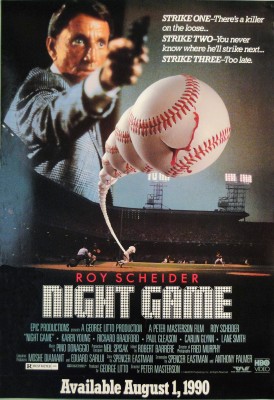
The TSL’s Grindhouse: Night Game (dir by Peter Masterson)


Apparently, today is the opening day of the 2017 baseball season.  The only reason that I know that is because of my sister Erin.  I don’t know much about baseball, to be honest.  I know that my city’s team is the Texas Rangers and they were once owned by George W. Bush.  I know that Houston has a team called the Astros.  But, really, the main thing that I know about baseball is that my sister absolutely loves it.

So, when Erin asked me to review a baseball movie today, how could I say no?  I mean, I may know next to nothing about baseball but I certainly know something about movies!

For that reason, I’m going to take a few minutes to tell you about a 1989 film called Night Game.  Night Game is many things.  It’s a movies that features a lot of baseball, even though it’s not really a sports film per se.  It’s a police procedural, though the film itself suggests that the police often don’t have the slightest idea what they’re actually doing.  It’s a serial killer film, though its killer is never quite as loquacious as we’ve come to expect in this age of Hannibal Lecter and Dexter Morgan.  At times, it’s a slasher film, though it’s never particularly graphic.  Mostly, Night Game is a Texas film.

Directed by native Texan Peter Masterson, Night Game is like the original Texas Chainsaw Massacre in that it is one of those rare films that not only takes place in Texas but was actually filmed on location.  To be exact, Night Game was filmed in both Galveston and Houston.  The entire film has a friendly and quirky Texas feel to it.  Masterson may not have been a great visual director (If not for some language and nudity, Night Game could pass for a TV movie) but Night Game is a movie where the plot is less important than capturing the little details of a time. a location, and the people who lived there.  Though Night Game is 28 years old, it’s portrait of my home state still seemed very contemporary to me.  I guess Texas hasn’t really changed that much over the past few decades.

As for the film’s plot, someone is murdering young women in Galveston and leaving their bodies on the boardwalk.  Obviously, that’s not going to be good for attracting Spring Break revelers.  The film doesn’t make any effort to keep the murderer’s identity a secret.  We see his face fairly early on.  We also see that he has a hook for a hand.  Eventually, we do learn the murderer’s motives.  They’re pretty silly but then again, individual motives rarely make sense to anyone other than the guy with the hook for a hand.

Detective Mike Seaver (Roy Scheider) has been assigned to solve the case.  One thing that I really liked about Night Game was that Mike was pretty much just a normal guy with a job to do.  He wasn’t self-destructive.  He wasn’t always drunk.  He wasn’t suicidal.  He wasn’t always lighting a cigarette and staring at the world through bloodshot eyes while the lighting reflected off of his artful stubble.  He was just a detective trying to do his job and get home on time.  After sitting through countless films about self-destructive cops and criminal profilers, the normalcy of Mike was a nice change of pace.

Mike does have a backstory.  He used to play baseball and he still loves the game.  He goes to every Astros home game in Houston.  He’s in love with Roxy (Karen Young), who works at the stadium.  Things are only slightly complicated by the fact that Mike had a previous relationship with Roxy’s mother (Carlin Glynn).  Don’t worry, Mike’s not secretly Roxy’s father or anything like that.  It’s not that type of movie.

Anyway, Mike is such a fan of baseball that he realizes something.  The killer only strikes on nights that the Astros win a game.  And he only strikes if a certain pitcher was throwing the ball.  The obvious solution would be to shoot the pitcher in the arm and end his athletic career.  However, Mike’s too nice a guy to do that.  Instead, he just tries to track down the killer…

And, as I said, Night Game actually isn’t a bad little movie.  Make no mistake, it’s a very slight movie.  At no point are you going to say, “I’m going to remember that scene for the rest of my life!”  That said, it’s a surprisingly good-natured film and Roy Scheider’s performance is likable and unexpectedly warm.  With all that in mind, Night Game is an entertaining and (mildly) bloody valentine to my home state.

Plus, it’s a baseball movie!  I don’t know much about baseball but, if my sister loves it, it has to be a good thing!

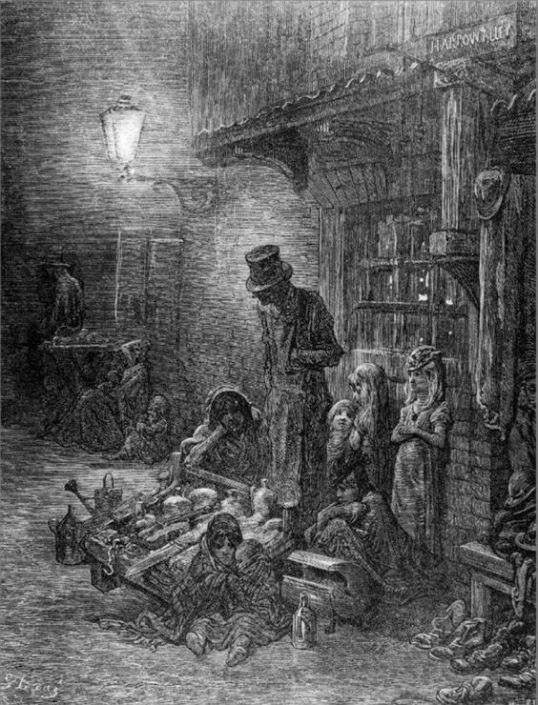
Harrow Alley, A Film That Never Was


Harrow Alley (1880, Gustave Dore)

Originally, I was thinking that, since it’s April Fools Day, I would write a 2,000-word review of an “obscure” Italian horror film and then, after I gotten everyone all enthused about tracking down this masterpiece, I would go “April Fools!”

But you know what?

I freaking hate it when people do stuff like that.  Seriously, that’s a really awful way to treat your loyal readers.  If any of the blogs that you follow pull anything like that on you today, I suggest you unfollow them and instead, switch your allegiance over to us.  We love you.

But anyway!  Since I won’t be writing about a fictional film, I thought I might take this opportunity  to tell you about Harrow Alley, a screenplay that has frequently been described as the best script to never be produced.

(Now, I should admit that one of the people who said that was a writer for The Huffington Post and usually, disagreeing with The Huffington Post is point of honor for me.  But, seriously, Harrow Alley sounds so intriguing that I’m willing to make an exception to this rule.)

Harrow Alley was written, in 1970, by a screenwriter named Walter Brown Newman.  It’s a historical film, one that is set in the 17th century.  The Bubonic Plague is ravaging London but the citizens of the Harrow Alley neighborhood are simply trying to survive from day-to-day without sacrificing their humanity.  Harry is a well-meaning alderman who, after every other official flees the city, finds himself as the unofficial leader of Harrow Alley.  He’s an optimist who provides strength to the entire neighborhood but the demands of being positive in the face of death start to wear on him.  His wife is pregnant and, much like Rick Grimes in The Walking Dead, he has to wonder whether it’s right to bring a child into this Hellish world.  As the film progresses, he watches as his friends and neighbors die of the plague.  He’s even forced to kill his beloved dog.

Harry befriends Ratsey, a thief who survived the plague when he was a child.  With everyone wrongly convinced that Ratsey is now immune to the plague, the former thief becomes one of the most respected men in the neighborhood.  (Because of his “immunity,” he is also one of the few people who can help dispose of the dead.)  With Harry as his mentor, Ratsey becomes respectable.  Ratsey starts out as a cynical opportunist but, in the middle of the Great Plague of London, he discovers his humanity.  Even when Ratsey learns that no one is immune to the plague, even if they’ve had it before, he does not flee.  He continues to help dispose of the dead.

But even as Ratsey becomes stronger, Harry grows weaker.  When his wife and child die, Harry vanishes.  Ratsey steps into his place.  Ratsey becomes the new leader of Harrow Alley.  And, months later, when Ratsey arrests a beggar who has just killed a man, he is shocked to discover that the beggar is Harry.

And so the film ends.

Sounds like a really happy movie, doesn’t it?

And did I mention that the script is apparently 180 pages, which would translate to three hours of screen time?

It’s easy to see why Harrow Alley has never been produced.  Can you imagine being the advertising genius who has to make a three-hour film about the Bubonic Plague into a box office success?  That said, the film still sounds incredibly intriguing to me.  Maybe it’s because I’m a history nerd, but the story just fascinates me.  From what I’ve heard, this is a script that literally has everything: tragedy, romance, and even a little dark comedy.

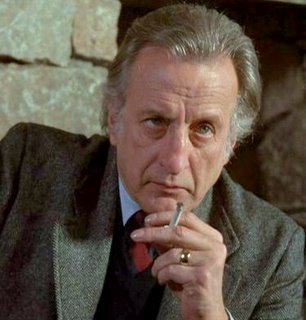
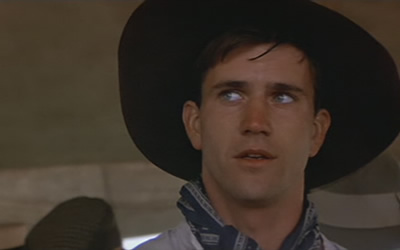
Interestingly enough, Harrow Alley apparently came close to being produced in the 80s.  In this projected version, Harry would have been played by George C. Scott while a young Mel Gibson would have played Ratsey.  It sounds like brilliant casting to me.

Harry?

Ratsey?

If they produced the film today, I could just easily imagine Gibson in the role of Harry and maybe Tom Hardy as Ratsey.

(Bring the Mad Maxes together!)

Harry?

Ratsey?

Though Walter Brown Newman died in 1993, his script is still out there.  Maybe, someday, it will be produced.  If it is, I’ll definitely be there to watch it.

All three hours of it.

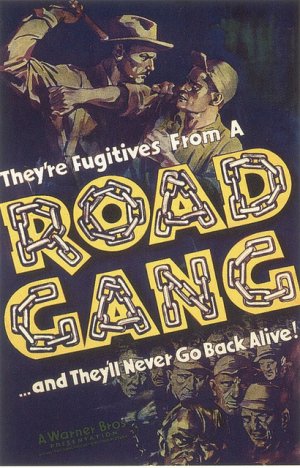
Lisa Cleans Out The DVR: Road Gang (dir by Louis King)


I was going to start this review with a quote from Gandhi: “A nation’s greatness is measured by how it treats its prisoners.”  That was something that I first heard from a perpetually stoned ex-seminarian who used to live in a trailer park in Lake Dallas.  I always figured that, being as stoned as he usually was, he probably knew what he was talking about but, upon doing research for this review, I have discovered that Gandhi actually didn’t say that.  What Gandhi said was, “A nation’s greatness is measured by how it treats its weakest members.”  Fortunately, it’s the same basic idea and, regardless of how you phrase it, it’s a quote that perfectly encapsulates the message of the 1936 film, Road Gang.

Road Gang tells the story of Jim (Donald Woods) and Bob (Carlyle Moore, Jr.).  Bob is fun-loving.  Jim is more serious and engaged to marry heiress Barbara Winston (Kay Linaker).  Jim and Bob live in an unnamed Southern state (though I’m going to assume that the state is supposed to be Georgia, just because).  Jim has just written an article that exposes the corruption of political boss, J.W. Moett (Joe King).  The article is so good that both Jim and Bob have been offered jobs in Chicago!  There’s a lot of corrupt political figures who can be exposed in Chicago!

However, while driving up north, Jim and Bob are arrested on trumped-up charges.  At first, Jim and Bob laugh off Moett’s desperation but, unfortunately, another criminal happens to be breaking out of jail at the same time that Jim and Bob arrives for booking.  That criminal kills the arresting officer and then forces Jim and Bob to drive him across the state.  Eventually, the police recapture the three of them.  However, the escaping criminal is killed and Jim and Bob are arrested as accessories.  Under the advice of their lawyer, Mr. Dudley (Edward Van Sloan), they plead guilty and accept a deal.  What they don’t know is that Dudley works for Moett and that, as a result of pleading guilty, they are going to be sentenced to five years in a prison camp.

Okay, so the film gets off to a pretty melodramatic start.  And, to be honest, the entire film is extremely melodramatic.  A lot of time is devoted to Barbara trying find evidence that Jim and Bob were set up, something that is made difficult by the fact that Barbara’s father, like Mr. Dudley, works for Moett.  Fast-paced and not-always-logical, this is a B-movie, in every sense of the term.

And yet, as melodramatic as it is, Road Gang is deadly serious when it comes to portraying the brutality of the prison camp.  From the minute that Bob and Jim arrive, they find themselves at the mercy of the corrupt warden and his sadistic guards.  The prisoners are largely used as slave labor and subjected to punishments that are often arbitrary and extreme.

Road Gang doesn’t flinch when it comes to portraying why prison often not only fails to rehabilitate but also helps to transform minor offenders into hardened criminals.  There’s a disturbing scene in which Jim, Bob, and the other prisoners are forced to listen as another prisoner is whipped.  The crack of the whip and his howls of agony explode across the soundtrack in a symphony of pain and sadism.  Jim and Bob have two very different reactions to being in prison.  One survives.  One allows himself to be killed rather than take one more day in confinement.

Road Gang is often compared to I Am A Fugitive From A Chain Gang.  Actually, beyond the theme of a fatally compromised justice system, there is no comparison.  The angry and fact-based I Am A Fugitive From A Chain Gang is a hundred times better and, quite frankly, Donald Woods was no Paul Muni.  However, Road Gang still has its moments of power.  Decades after it was made, the issues it raises continue to be relevant.  Do we send people to prison to rehabilitate them or to punish them and are the two goals mutually exclusive?  And how can we say that someone has “paid his debt to society” when, even after a prisoner serves his time, the stigma of having been imprisoned closes and locks most doors of opportunity?

Road Gang shows up occasionally on TCM.  There’s where I recorded it on January 23rd of this year.

Watch The Trailer For The Book of Henry!


The thing I like about this trailer is that it starts out looking like the type of cutesy bullshit that I usually hate (just check out my review of Pay It Forward) and then suddenly, it gets all weird and twisted and stuff.

Naomi Watts and Jacob Tremblay star in The Book of Henry, which is due to released in June.  Most films released in June suck but hopefully, The Book of Henry will be an exception.

(By the way, if the bald guy is actually abusing his daughter, I’ll be disappointed.  This film will work far better if Henry really is just a manipulative little sociopath.)