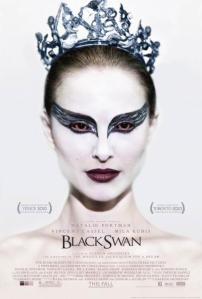
The Golden Globes nominations were announced today and, as usual, they were a strange combination of the expected nominees and a few that seem to have literally come out of thin air. (Check out that Best Picture nomination for The Tourist.) The Golden Globes are awarded by the Hollywood Foreign Press Association, an organization that seems to be about as shadowy and obscure as an Illumnati splinter group. That said, I’ve always wanted to be nominated for Golden Globe just so I could get in front of a tv camera, thrust out my boobs, and say, “I’ll show you a pair of Golden Globes!”
Anyway, as I looked over the nominations earlier today, three things came to mind.
First off, the Walking Dead was nominated for Best Dramatic Television Series. Yay!
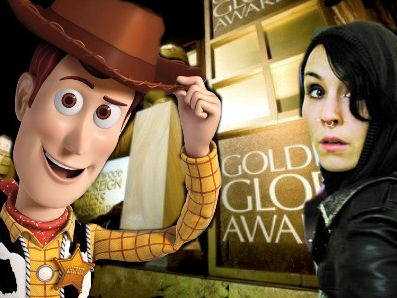
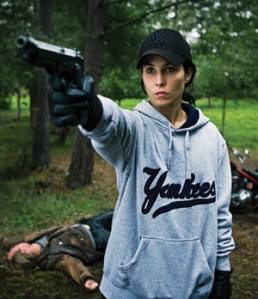
Secondly, I was kinda hoping that Noomi Rapace might be able to sneak in as one of the Best Actress nominees. There is a small campaign going on to win her an Oscar nomination for The Girl With The Dragon Tattoo and she was nominated for best actress by yet another shadowy group, the Broadcast Film Critics. Unfortunately, a Golden Globe nod was not to be.
Third, I was a little bit surprised to discover that Toy Story 3 was not nominated for Best Picture (Comedy). In the past, the Hollywood Foreign Press has been far more willing than the Academy to nominate animated films and Toy Story 3 seemed like a far more likely choice than The Tourist. In fact, not even the film’s theme song picked up a nomination. Of course, Toy Story 3 did pick up a nomination for best animated film but I still wonder if maybe this could be evidence of a Toy Story 3 backlash. Up until a week ago, I would have said that Toy Story 3 is guaranteed an Oscar nomination for best picture. Now, I’m starting to have my doubts.
BLACK SWAN
Protozoa Pictures & Cross Creek Pictures & Phoenix; Fox Searchlight Pictures
THE FIGHTER
Paramount Pictures and Relativity Media; Paramount Pictures and Relativity Media
INCEPTION
Warner Bros. Pictures UK LTD.; Warner Bros. Pictures
THE KING’S SPEECH
See-Saw Films and Bedlam Productions; The Weinstein Company
THE SOCIAL NETWORK
Columbia Pictures; Sony Pictures Releasing
BEST PERFORMANCE BY AN ACTRESS IN A MOTION PICTURE – DRAMA
HALLE BERRY
FRANKIE AND ALICE
NICOLE KIDMAN
RABBIT HOLE
JENNIFER LAWRENCE
WINTER’S BONE
NATALIE PORTMAN
BLACK SWAN
MICHELLE WILLIAMS
BLUE VALENTINE
BEST PERFORMANCE BY AN ACTOR IN A MOTION PICTURE – DRAMA
JESSE EISENBERG
THE SOCIAL NETWORK
COLIN FIRTH
THE KING’S SPEECH
JAMES FRANCO
127 HOURS
RYAN GOSLING
BLUE VALENTINE
MARK WAHLBERG
THE FIGHTER
BEST MOTION PICTURE – COMEDY OR MUSICAL
ALICE IN WONDERLAND
Walt Disney Pictures; Walt Disney Studios Motion Pictures
BURLESQUE
Screen Gems; Sony Pictures Releasing
THE KIDS ARE ALL RIGHT
Antidote Films, Mandalay Vision, Gilbert Films; Focus Features
RED
di Bonaventura Pictures; Summit Entertainment
THE TOURIST
GK Films; Sony Pictures Releasing
BEST PERFORMANCE BY AN ACTRESS IN A MOTION PICTURE – COMEDY OR MUSICAL
ANNETTE BENING
THE KIDS ARE ALL RIGHT
ANNE HATHAWAY
LOVE AND OTHER DRUGS
ANGELINA JOLIE
THE TOURIST
JULIANNE MOORE
THE KIDS ARE ALL RIGHT
EMMA STONE
EASY A
BEST PERFORMANCE BY AN ACTOR IN A MOTION PICTURE – COMEDY OR MUSICAL
JOHNNY DEPP
ALICE IN WONDERLAND
JOHNNY DEPP
THE TOURIST
PAUL GIAMATTI
BARNEY’S VERSION
JAKE GYLLENHAAL
LOVE AND OTHER DRUGS
KEVIN SPACEY
CASINO JACK
BEST ANIMATED FEATURE FILM
DESPICABLE ME
Universal Pictures, Illumination Entertainment; Universal Pictures
HOW TO TRAIN YOUR DRAGON
DreamWorks Animation; Paramount Pictures
THE ILLUSIONIST
Django Films, Ciné B and France 3 Cinéma; Sony Pictures Classics
TANGLED
Walt Disney Animation Studios; Walt Disney Studios Motion Pictures
TOY STORY 3
Disney * Pixar; Walt Disney Studios Motion Pictures
BEST FOREIGN LANGUAGE FILM
BIUTIFUL
(MEXICO/SPAIN)
Menageatroz, Focus Features International; Roadside Attractions
THE CONCERT
(FRANCE)
An Oï Oï Oï Productions, Les Productions Du Tresor, France 3 Cinema, Europacorp, Castel Films, Panache Productions, RTBF (Belgian Television), BIM Distrubuzione Co., Canal +, Cinecinema and France 3; The Weinstein Company
THE EDGE (Kpaй)
(RUSSIA)
Teleshow/Rock Films; Central Partnership (Russia)
I AM LOVE (IO SONO L’AMORE)
(ITALY)
First Sun; Magnolia Pictures
IN A BETTER WORLD (Hævnen)
(DENMARK)
Zentropa Entertainment; Sony Pictures Classics
BEST PERFORMANCE BY AN ACTRESS IN A SUPPORTING ROLE IN A MOTION PICTURE
AMY ADAMS
THE FIGHTER
HELENA BONHAM CARTER
THE KING’S SPEECH
MILA KUNIS
BLACK SWAN
MELISSA LEO
THE FIGHTER
JACKI WEAVER
ANIMAL KINGDOM
BEST PERFORMANCE BY AN ACTOR IN A SUPPORTING ROLE IN A MOTION PICTURE
CHRISTIAN BALE
THE FIGHTER
MICHAEL DOUGLAS
WALL STREET: MONEY NEVER SLEEPS
ANDREW GARFIELD
THE SOCIAL NETWORK
JEREMY RENNER
THE TOWN
GEOFFREY RUSH
THE KING’S SPEECH
BEST DIRECTOR – MOTION PICTURE
DARREN ARONOFSKY
BLACK SWAN
DAVID FINCHER
THE SOCIAL NETWORK
TOM HOOPER
THE KING’S SPEECH
CHRISTOPHER NOLAN
INCEPTION
DAVID O. RUSSELL
THE FIGHTER
BEST SCREENPLAY – MOTION PICTURE
DANNY BOYLE, SIMON BEAUFOY
127 HOURS
LISA CHOLODENKO, STUART BLUMBERG
THE KIDS ARE ALL RIGHT
CHRISTOPHER NOLAN
INCEPTION
DAVID SEIDLER
THE KING’S SPEECH
AARON SORKIN
THE SOCIAL NETWORK
BEST ORIGINAL SCORE – MOTION PICTURE
ALEXANDRE DESPLAT
THE KING’S SPEECH
DANNY ELFMAN
ALICE IN WONDERLAND
A.R. RAHMAN
127 HOURS
TRENT REZNOR, ATTICUS ROSS
THE SOCIAL NETWORK
HANS ZIMMER
INCEPTION
BEST ORIGINAL SONG – MOTION PICTURE
“BOUND TO YOU” — BURLESQUE
Music by: Samuel Dixon
Lyrics by: Christina Aguilera, Sia Furler
“COMING HOME” — COUNTRY STRONG
Music & Lyrics by: Bob DiPiero, Tom Douglas, Hillary Lindsey, Troy Verges
“I SEE THE LIGHT” — TANGLED
Music by: Alan Menken
Lyrics by: Glenn Slater
“THERE’S A PLACE FOR US” — CHRONICLES OF NARNIA: THE VOYAGE OF THE DAWN TREADER
Music & Lyrics by: Carrie Underwood, David Hodges, Hillary Lindsey
“YOU HAVEN’T SEEN THE LAST OF ME” — BURLESQUE
Music & Lyrics by: Diane Warren
BEST TELEVISION SERIES – DRAMA
OARDWALK EMPIRE (HBO)
Leverage, Closest to the Hole Productions, Sikelia Productions and Cold Front Productions, HBO Entertainment
DEXTER (SHOWTIME)
Showtime, John Goldwyn Productions, The Colleton Company
THE GOOD WIFE (CBS)
CBS Television Studios
MAD MEN (AMC)
Lionsgate Television
THE WALKING DEAD (AMC)
AMC
BEST PERFORMANCE BY AN ACTRESS IN A TELEVISION SERIES – DRAMA
JULIANNA MARGULIES
THE GOOD WIFE
ELISABETH MOSS
MAD MEN
PIPER PERABO
COVERT AFFAIRS
KATEY SAGAL
SONS OF ANARCHY
KYRA SEDGWICK
THE Closer
BEST PERFORMANCE BY AN ACTOR IN A TELEVISION SERIES – DRAMA
STEVE BUSCEMI
BOARDWALK EMPIRE
BRYAN CRANSTON
BREAKING BAD
MICHAEL C. HALL
DEXTER
JON HAMM
MAD MEN
HUGH LAURIE
HOUSE
BEST TELEVISION SERIES – COMEDY OR MUSICAL
30 ROCK (NBC)
Universal Media Studios in association with Broadway Video and Little
Stranger Inc.
THE BIG BANG THEORY (CBS)
Warner Bros. Television
THE BIG C (SHOWTIME)
Showtime, Sony Pictures Television, Perkins Street Productions, Farm Kid, Original Film
GLEE (FOX)
Ryan Murphy Television, Twentieth Century Fox Television
MODERN FAMILY (ABC)
Twentieth Century Fox Television
NURSE JACKIE (SHOWTIME)
Showtime, Lionsgate Television, Jackson Group Entertainment, Madison Grain Elevator, Inc. & Delong Lumber, Caryn Mandabach Productions
EST PERFORMANCE BY AN ACTRESS IN A TELEVISION SERIES –COMEDY OR MUSICAL
TONI COLLETTE
UNITED STATES OF TARA
EDIE FALCO
NURSE JACKIE
TINA FEY
30 ROCK
LAURA LINNEY
THE BIG C
LEA MICHELE
GLEE
BEST PERFORMANCE BY AN ACTOR IN A TELEVISION SERIES – COMEDY OR MUSICAL
ALEC BALDWIN
30 ROCK
STEVE CARELL
THE OFFICE
THOMAS JANE
HUNG
MATTHEW MORRISON
GLEE
JIM PARSONS
THE BIG BANG THEORY
BEST MINI-SERIES OR MOTION PICTURE MADE FOR TELEVISION
CARLOS (SUNDANCE CHANNEL)
Film En Stock and Egoli Tossell Film, Sundance Channel
THE PACIFIC (HBO)
Playtone and DreamWorks in association with HBO Films
PILLARS OF THE EARTH (STARZ)
Starz, Tandem Communications, Muse Entertainment Scott Free Films
TEMPLE GRANDIN (HBO)
A Ruby Films, Gerson Saines Production, HBO Films
YOU DON’T KNOW JACK (HBO)
Bee Holder, Cine Mosaic and Levinson/Fontana Productions, HBO Films
BEST PERFORMANCE BY AN ACTRESS IN A MINI-SERIES OR MOTION PICTURE MADE FOR TELEVISION
HAYLEY ATWELL
PILLARS OF THE EARTH
CLAIRE DANES
TEMPLE GRANDIN
JUDI DENCH
RETURN TO CRANFORD
ROMOLA GARAI
EMMA
JENNIFER LOVE HEWITT
THE CLIENT LIST
BEST PERFORMANCE BY AN ACTOR IN A MINI-SERIES OR MOTION PICTURE MADE FOR TELEVISION
IDRIS ELBA
LUTHER
IAN MCSHANE
PILLARS OF THE EARTH
AL PACINO
YOU DON’T KNOW JACK
DENNIS QUAID
THE SPECIAL RELATIONSHIP
EDGAR RAMIREZ
CARLOS
BEST PERFORMANCE BY AN ACTRESS IN A SUPPORTING ROLE IN A SERIES, MINI-SERIES OR MOTION PICTURE MADE FOR TELEVISION
HOPE DAVIS
THE SPECIAL RELATIONSHIP
JANE LYNCH
GLEE
KELLY MACDONALD
BOARDWALK EMPIRE
JULIA STILES
DEXTER
SOFIA VERGARA
MODERN FAMILY
BEST PERFORMANCE BY AN ACTOR IN A SUPPORTING ROLE IN A SERIES, MINI-SERIES OR MOTION PICTURE MADE FOR TELEVISION
With the Golden Globe nominations set to be announced on Tuesday, I figured now would be a good time to recap which films and performances have already been honored by the various critics groups.
One thing that I discovered as I researched this is that there are a lot of critics groups out there! I don’t know who half these people are and most of them probably won’t have any bearing at all on who is actually nominated come Oscar time. But since I’m a lover of trivia and lists, there you go.
The following films and performances were honored by either The National Board of Review, the D.C. Film Critics, the Boston Society of Film Critics, The New York Film Critics Online,The Los Angeles Film Critics, The Indiana Film Journalists, The Southeastern Film Critics, The New York Film Critics Circle, or the San Francisco Film Critics.
Best Picture:
The Social Network (All. That’s right, it’s a clean sweep for an above average film.)
Best Director:
Darren Aronofsky for Black Swan (S.F)
Olivier Assayas for Carlos (LAFC)
David Fincher for The Social Network (BSFC, DC, NBR, NYFCC, NYFCO, SEFC, S.F.)
Christopher Nolan for Inception (IFJ)
Best Actor:
Jesse Eisenberg (BSFC, NBR)
Colin Firth for The King’s Speech (DC, LAFC, NYFCC, SEFC, S.F.)
James Franco for 127 Hours (IFJ, NYFCO)
Best Actress:
Annette Bening for The Kids Are All Right (NYFCC)
Kim Hye-ja for Mother (LAFC)
Jennifer Lawrence for Winter’s Bone (DC)
Lesley Manville for Another Year (NBR)
Natalie Portman for Black Swan (BSFC, IFJ, NYFCO, SEFC)
Michelle Williams for Blue Valentine (S.F.)
Best Supporting Actor:
Niels Arestrup for A Prophet (LAFC)
Christian Bale for The Fighter (BSFC, DC, IFJ, NBR, NYFCO)
John Hawkes for Winter’s Bone (S.F.)
Mark Ruffalo for The Kids Are All Right (NYFCC)
Geoffrey Rush for The King’s Speech (SEFC)
Best Supporting Actress:
Melissa Leo for The Fighter (DC, NYFCC, NYFCO)
Juliette Lewis for Conviction (BSFC)
Hailee Steinfeld for True Grit (IFJ, SEFC)
Jacki Weaver for Animal Kingdom (LAFC, NBR, S.F.)
Best Documentary:
Exit Through The Gift Shop (DC, IFJ, NYFCO)
The Inside Job (NYFCC, SEFC)
Last Train Home (LAFC)
Marwencol (BSFC)
The Tillman Story (S.F.)
Waiting For Superman (NBR)
Best Animated Feature:
How To Train Your Dragon (IFJ)
The Illusionist (NYFCC)
Toy Story 3 (BSFC, DC, LAFC, NBR, NYFCO, SEFC, S.F.)
Best Adapted Screenplay:
The Social Network (BSFC, DC, IFJ, LAFC, NYFCO, SEFC, S.F.)
Part two of this week’s bonus-sized edition of Lisa Marie’s Favorite Grindhouse and Exploitation trailers actually kinda sorta has a theme or two. One unintentional theme is that most of the movies highlighted here have not been released on DVD in the U.S. However, the other intentional theme is that, to quote the old song, “the female of the species is deadlier than the male.”
“They swore never again to let a man hurt them…” See, the grindhouse has a lot more to teach us than many realize. The Female Bunch was released in 1969 but it was actually filmed a year earlier at the Spahn Movie Ranch which was also the home of Charles Manson and his followers at the time. It’s rumored that members of the Manson Family can be spotted in the film as extras. It was directed by Al Adamson who, 30 years later, would be murdered and buried in cement.
Is it even necessary for me to state that this film came out in the 60s? 1969 to be exact. Some girls do? I certainly know I do.
3) Danger Girls
Yes, this one is from 1969 too. It was directed by the one and only Rene Cardona, Jr. For those keeping track, this one is about a “sinister organization of beautiful girls … driven by a lust for blood.”
4) Scorpions and MiniSkirts
This (as opposed to The Graduate or Bonnie and Clyde) was apparently the most surprising production of 1967. It says so right in the trailer. I just like the title, perhaps because I’m a Scorpio who likes to show off her legs.
By 1968, scorpions were no longer in fashion but the miniskirt was still très chic. “They ride hard…no matter what they’re mounted on!”
6) 7 Golden Women Against Two 007
This is from 1966 and I really don’t know what to say about it other than … well, 1966. If any of you men out there want to know why the female of the species became deadlier than the male, the answer is to be found in this trailer here. Call it self-defense. That said, this trailer fascinates me because, seriously, what the Hell’s going on? I fear I may never know as this film has apparently never been released on DVD.
Since it’s the holiday season, I’m going to do a bonus-sized, two-part edition of Lisa Marie’s Favorite Grindhouse and Exploitation Film Trailers this week. So, assuming that I’m not upset by who wins the Amazing Race and that Julia Stiles survives tonight’s episode of Dexter, I’ll put together and post part two sometime later tonight. And if I am upset, expect to see it sometime Monday.
Anyway, here’s the first part of our special, pre-holiday edition of Lisa Marie’s Favorite Grindhouse and Exploitation Trailers. Just a quick note, three of these films are apparently not available on DVD or even on VHS! To be honest, I imagine their trailers are probably a lot more fun than the actual movie.
1) Wicked Wicked
What is Anomorphic Duovision? Well, I did some research last night and I’ll explain it all after the trailer.
Duovision, it turns out, is a fancy way of saying, “Split screen.” Like you remember in 24 whenever Keifer Sutherland would start purring in that sexy voice of his, “Dammit! CHLOE!” and Chloe would go, “Get off my ass, Bauer!” Well, more often than not, that was shown in Anomoprhic Duovision. Brian DePalma also used it in Carrie when Sissy Spacek sets the prom on fire. In other words, none of that would have been possible if not for Wicked Wicked. Apparently, in Wicked Wicked, one half of the screen featured Tiffany Bolling singing and the detective guy investigating and the other half featured the killer doing his thing.
I give this trailer mad props for resisting the temptation to be all like, “And she makes house calls…”
3) Zaat
Believe it or not, this is not, as I originally assumed, a parody trailer. I did actual research (yes, believe it or not, I do try to verify these things) and I discovered that this was a real movie from 1972 and apparently, it made a lot of money playing the drive-in circuit (a.k.a. the grindhouses of the South).
4) Angel, Angel, Down We Go
From 1969 — His name is Bogart Peter Stuyvesant and he’s hot!
This little “shocker” from 1970 was directed by Andy Milligan, who was infamous for making movies that were so bad that they often ended up being effective despite themselves.
I’ve never actually seen this film but I’ve certainly heard about it. It has a reputation for being one of the worst horror films but I have to admit, I think the trailer has an oddly dream-like power. A Night To Dismember was the last film to be directed by Doris Wishman, who — when she first started making early “nudie” flicks (the best known of which was the Nude on the Moon) in the 50s — was one of the first women to ever actually direct a theatrically released film. After her husband died, Doris’s films changed from being rather innocent and campy stories about dorky guys trying to discreetly ogle nude women to being dark and puritanical tales of the sexually active being punished. A Night To Dismember was her final film and its troubled production has become legendary. I found it on DVD once and nearly bought it but, at the last minute, put it down and bought a copy of Larry Cohen’s God Told Me To instead. The next week, when I went back to buy A Night To Dismember, I discovered that the store had been shut down and permanently closed the day after I made my last purchase. That’s just freaking typical, isn’t it?
I went to see Harry Potter and the Deathly Hallows, Part One earlier today and, before the film started, I saw the trailer for the upcoming Red Riding Hood. The trailer itself gives off a definite Twilight vibe, which isn’t surprising since both films were directed by Catherine Hardwicke and, regardless of what we may think of them, the Twilight films have made a lot of money. So, it makes sense that the trailer would be designed to bring in as many Twilight fans as possible…
Still, I’m looking forward (though admittedly, with a certain amount of caution) to Red Riding Hood. Why? Well, first off, Gary Oldman’s in it and Gary Oldman would have made Twilight a lot better as well. Plus, both of the leads are pretty to look at. (And, it should be noted, if Amanda Seyfried could give a good performance in a terrible film like Chloe than she can probably give a good performance in anything.) And finally — Catherine Hardwicke made her debut with Thirteen back in 2003 and I love that film so much that I can even forgive her for a hundred Twilights.
Do critics (specifically, professional film critics) matter? In a word, no.
This is something I’ve been thinking about for a while now, ever since I came across an article by “professional” critic Sasha Stone in which she asked the exact same question and came to the exact opposite conclusion. Her argument boiled down to one quote: “You see things differently when you’re 20 than when you’re 30.”
And she’s right. I see things differently at 25 than I did when I was 13. And I imagine that when 30 comes around, I’ll have a whole new set of opinions. For that matter, I’m sure that as a Texan I probably see some things differently than how a native of California would see them. As I mentioned in my previous review of Black Swan, a lot of my reaction to that film was due to my own history and experiences. Would someone who has never had those same experiences have the same reaction? Probably not.
So, yes, Sasha is right. People see things differently.
And I’m even more right when I say that a 30 year-old critic matters about as much as a 20 year-old critic.
At the heart of professional film criticism is this elitist notion that somehow, Roger Ebert’s opinion is more worthy of consideration than some guy who actually had to spend money to get a ticket so he could watch the movie in theater surrounded by strangers while he eats rancid move theater nachos.
Ultimately, criticism is just an opinion and the only opinion that matters is yours. Just because I hated Avatar doesn’t mean that Avatar is a terrible movie. It just means that from my point of view, it sucks. And, as much fun as I have explaining why I felt it sucked, that’s ultimately just my opinion. Whether or not Avatar is a good film or if Black Swan is a great film , the only person that can answer that question is you.
When it comes to film (and really, all art) I think we would do best to remember the words of Aleister Crowley: “Nothing is true. All is permitted.”
This has been on my mind a lot recently as we went Oscar season and so many critics are now taking it upon themselves to announce which films are the best and we’re all expected to follow along with their opinions like lemmings going over a cliff. Around this time, the old school film critics start to get paranoid about all of us bloggers who have the nerve to offer up our opinions on film as if our opinion matters. That’s because most of these critics are a part of that generation that was raised to believe that only certain people were allowed to speak and that they only had the right as long as what they said was safe and predictable. Independent bloggers scare them because it proves what we all know: that anyone can provide an opinion.
Perhaps that’s why they’ve been so enthusiastic about embracing The Social Network, a film that suggests that blogging was the invention of sociopaths.
But ultimately, a critic is just another person providing their opinion. And maybe you respect that opinion enough that you’ll allow it to influence what you chose to see or not to see. And there’s nothing wrong with that. To me, the best thing that a critic can do — and what I hope I can do on occasion — is make the viewer aware of a film that he or she might otherwise not be aware of. If you see a film because I recommended it, I thank you and I hope you enjoyed the film as much (or as little) as I did. And if you didn’t, that’s cool too. I’m just a viewer with an opinion.
But when it comes to the movie itself, critics do not matter. The only thing that matters is the individual viewer. Art is the eye of the beholder.
At this time of year, we’re reminded that so much of so-called “professional” film criticism is simply about building a bandwagon and hopping on. Here’s hoping that in the future, we set that bandwagon on fire and let it burn.
The final 15 minutes or so of Black Swan are so intense and exhilarating that, after I watched them, I ended up having an asthma attack. The movie literally left me breathless.
I saw this movie last Saturday at the Plano Angelika and I’ve been trying to figure out just how exactly to put into words my feelings about this movie. Why is it so much easier to talk about movies we hate than the movies we love? Perhaps it’s because we all know what a bad movie looks like but a great movie is something unique and beautiful. I fear that any review I write it going to cheapen this experience.
However, I’m going to try. And if my words can’t convince you then just see the movie yourself. You’ll either love it or you’ll hate it. As with all great works of art, there is no middle ground. Unfortunately, I don’t see any way for me to talk about this film without talking about a few key plot points that could be considered spoilers. So, if you haven’t seen the movie yet, read on with caution.
This year, there’s been two types of filmgoers. There’s been those who have spent 2010 waiting for The Social Network and then there are people like me who have been waiting for Black Swan. There’s a lot of reasons why I had been so looking forward to seeing this movie. First off, it’s directed by Darren Aronofsky, one of my favorite directors. Requiem for a Dream is a personal favorite of mine and I thought The Wrestler was one of the best films of 2008. Secondly, the movie stars Natalie Portman, a great actress who rarely ever seems to get parts worthy of her talent.
However, the main reason was a personal one. Black Swan takes place in the world of ballet and, for several years, ballet was literally my life. My family used to move around a lot but whether we were living in Ardmore, Oklahoma or Carlsbad, New Mexico or Dallas, Texas, ballet always remained my constant. Every town we ended up in, my mom tracked down the closest dance studio and enrolled me. I’ve loved all types of dance (and still do) but ballet is what truly captured my heart. It provided structure for my otherwise chaotic life. Ballet was something that I knew not everyone could do and when I danced, I felt special. I felt like I was something more than just an asthmatic girl with a big nose and a country accent. I felt beautiful and strong and special. When I danced, I felt alive.
As much as I dreamed of being a prima ballerina, I always knew that I wasn’t really that good at it. I’ve always danced with more enthusiasm than technique and, if forced to choose between perfect execution and just having fun, I almost always chose to have fun. My body also conspired me against me as I’ve been a D-cup since I was 14 and while boobs don’t necessarily make ballet impossible, they don’t exactly help. Of course, my main problem was that I was (and still am) a klutz. When I was 17 years old, I tripped, fell down a flight of stairs, and broke my ankle in two places. And so ended my ballet career.
To a certain extent, falling down those stairs is the best thing that ever happened to me because it forced me to explore a life outside of the idealized fantasy of ballet. It forced me to consider ambitions that don’t necessarily have to end the minute one turns 30. It allowed me to realize how much I love to write and how much I love to watch movies. Still, I do miss ballet. While I still love to dance, it’s just doesn’t feel the same. I still have fun but it no longer makes me feel special.
I guess I was hoping that Black Swan would remind me of that feeling that I had lost. And it did.
But enough about me. Let’s talk about Black Swan.
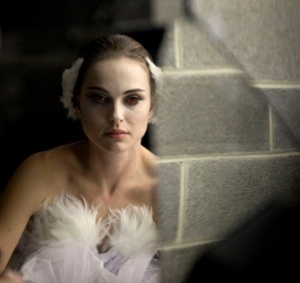
Natalie Portman plays Nina, a veteran ballerina who, despite being young enough to still live with her mother (and, it’s hinted, to still be a virgin), is also approaching the age when she’ll be considered too old to ever be a prima ballerina. She is a member of a struggling New York dance company that is run by Thomas (Vincent Cassel, turning up the sleaze level to 11). Thomas has decided that the company’s next show will be Tchaikovsky’s Swan Lake and that it’s time to replace the company’s prima ballerina, Beth (played by Winona Ryder), with a younger dancer. Nina begs for the chance to be Beth’s replacement but Thomas rejects her, claiming that her dancing is technically perfect but has no passion. He then attempts to kiss her which leads to Beth biting his lip and, apparently, convincing him that she has passion after all. Thomas soon announces that Nina will dance the lead in Swan Lake.
Unfortunately, even before winning the role, Nina is obviously unstable. Whether she’s obsessively stretching in her hideously pink bedroom, forcing herself to vomit up the contents of her stomach, or seeing shadows down every corridor, Nina’s every action and thought seems to be obsessed with finding the idealized perfection that ballet demands and life seldom affords. No matter how much she and her controlling mother (Barbara Hershey) cut her nails, she still wakes up with mysterious scratch marks across her back. Even worse, as she gets deeper and deeper into the role, she finds herself strangely drawn to and fearful of Lilly (Mila Kunis), a younger, free-spirited dancer who may, or may not, have her eye on taking Nina’s place.
Along with being an homage to such classic films as Repulsion, Suspiria, and All About Eve, Black Swan is also a modern-day reinterpretation of Swan Lake. Swan Lake tells the story of Odette, a princess who has been cursed by an evil sorcerer. As a result of the curse, Odette is only allowed her human form at night. During the day, she exists only in the form of a white swan. A prince named Siegfried meets Odette in her human form and falls in love with her so Rothbart tricks the prince by transforming his own daughter, Odile, into the Black Swan, a seductress who looks just like Odette except she wears black. One reason why the lead role in Swan Lake is so coveted is because the same ballerina plays both the innocent and fragile White Swan and the seductive and uninhibited Black Swan. As such, the two roles are presented as opposite sides of the same coin. (I’ve always thought of the White Swan as representing what men idolize and the black swan representing what men actually desire.) The challenge is to be convincing in both roles while still perfectly executing the idealized movements of ballet.
Over the course of Black Swan, Nina is continually told (by Thomas) that she is perfect for the role of the innocent and sheltered White Swan but that she doesn’t have what it takes to be the sexy and uninhibited Black Swan. At one point, Thomas gives her a homework assignment for the role, ordering her to go home and touch herself. (Nina eventually does so just to suddenly realize, right when she’s on the verge of bringing herself to climax, that her mother is sleeping in the exact same room. This sudden shot of Barbara Hershey sleeping in that chair both made me jump and laugh at the same time.)
Thomas also suggests that Nina study that way that Lilly dances. In many ways, Lilly appears to be the exact opposite of Nina. (Though wisely, Aronofsky emphasizes how much Portman and Kunis — not to mention Ryder and Hershey — all resemble each other physically, therefore creating the feeling that we’re seeing four different versions of the same basic human being.) Whereas Nina’s every dance move appears to be the product of rigorous training, Lilly dancing follows her emotions. While Nina’s expression while dancing is always one of a grimly obsessive dedication, Lilly smiles and enjoys the moment. Whereas Nina is scared of sex and can barely bring herself to look a man in the eye, Lilly is openly flirtatious with both men and women. In short, Lilly is Nina’s Black Swan.
Even as Nina studies Lilly, Lilly starts to pursue Nina, even showing up at her apartment and inviting Nina out for a night on the town. Desperate to escape her controlling mother (whose goal seems to be to keep Nina as the innocent White Swan for the rest of her life), Nina goes out with Lilly. They hit the clubs, Lilly convinces Nina to drink a spiked drink, and soon Nina is making out with random men in corners and eventually with Lilly in a taxi cab.
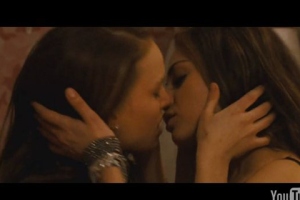
Now, I know this is something that a lot of people are wondering about so I’ll just confirm it. Yes, Mila Kunis does go down on Natalie Portman in this film. And yes, it’s hot. But even more importantly, it works as something more than just a juvenile male fantasy of what we girls do when you guys aren’t around. When Nina touches Lilly, she is reaching out for and accepting the side of her personality that she’s previously tried to deny. She’s accepting what she knows could destroy her.
(SPOILERS BELOW READ CAREFULLY)
And sure enough, after her encounter with Lilly (which Lilly subsequently claims never happened), Nina’s world grows more and more distorted. She looks at the paintings that line her mother’s room and she sees a hundred faces laughing at her. On the subway, men leer at her. And suddenly, Thomas seems to be paying more attention to Lilly (who is named as her alternate) than to her. Lilly visits Beth in the hospital where Beth is recovering from a car accident. Beth responds to Lilly’s presence by mutilating herself with a fingernail file. And so things go until the film reaches its climax in a dizzying mix of dance and blood.
Much like ballet itself, Black Swan presents a very stylized view of existence and, in order for the film to work, the performances have to be perfect. I’m happy to say that everything you’ve heard about Natalie Portman in this film is correct. She gives a brilliant performance. The film doesn’t provide a definite explanation as to what lies at the root of Nina’s mental instability but the clues are all there in Portman’s subtle but effective performance. Perhaps even more importantly, Portman is convincing in the ballet sequences. She captures perfectly the rigorous and often times painful dedication that ballet demands. In the movie’s finale, as she dances on stage while her fragile world collapse around her, she was suddenly creating my own fantasy of what it would be like to be a true prima ballerina. Watching her, I felt her every move as if I was on the stage dancing the role. It left me exhausted and breathless and I have to admit that after the movie, I foundd myself crying for a solid hour as I realized that would truly be as close as I would ever get to living my old teenage fantasy.
Portman pretty much dominates the entire film but still leaves room for Hershey, Cassell, and especially Mila Kunis to give impressive performances. Alternatively loving and spiteful, Hershey is the stage mother from Hell. Cassell’s character is almost too sleazy for his own good but Cassell still has fun with the role and even adds a few notes of ambiguity. However, Mila Kunis is the true standout among the supporting players. Playing a role that requires her to be both likable and vaguely threatening, Kunis holds her own with Portman and proves here that she actually can act. Her character also provides the film with a few much-needed moments of humor. Lilly gets all the best one-liners and Kunis delivers them flawlessly.
So, I’m sure many people might be saying at this point, “That’s great that you loved it, Lisa Marie. But you’re like all convinced that this film is actually about you. What about us normal people who don’t really care about ballet? Is there anything here for us?”
That’s not an easy question for me to answer precisely because I do love ballet and I did relate a lot of this film to experiences — both good and bad — from my own life. It’s also an issue that Aronofsky acknowledges in a rather clever scene where Nina and Lilly flirt with two frat boy types who react to Nina’s talk of ballet with boredom. However, I do think that this film can be seen and appreciated by those who aren’t into ballet for the exact same reason why I loved The Wrestler despite being interested in professional wrestling like not at all.
I’ve always felt that ballet — and by that, I mean the whole experience of both the dancing and all the stuff that goes on before and after the actual dance — was in many ways the perfect metaphor for life.
For instance, in my experience, there were always two separate cliques in any dance school or company.
There was the group of dancers who had spent their entire lives preparing for the one moment they would become a prima ballerina. These were the girls who spent hours obsessing over their technique and who minutely examined every performance for the least little flaw. These were the girls who risked their health to maintain perfect dancer bodies. They obsessed over everything they ate, which struck me as strange since they usually just threw it all back up a few minutes later anyway. They had parents who not only spent the money to make them the best but who, unlike the rest of us, actually had the money to spend in the first place. These were the girls who knew every move they were supposed to make but they never knew why.
And then, there was the group that I was always a part of. We were the girls who never worried about perfect technique. We would laugh when we missed a step and we joked about our mistakes. When we danced, we followed our emotions and if that meant breaking a rule, so be it. The perfect girls hated us because, for the most part, we were more popular than they were because we allowed ourselves to be real as opposed to perfect. And we hated the perfect girls because we knew that they would eventually have the life that we fantasized about.
I used to think that was unique to ballet and certainly, in Black Swan, it’s clear that Portman would be one of the perfect girls and Kunis would be one of us. However, once my life was no longer solely about ballet, I realized that everyone was either a part of the perfect group or a part of the real group. It wasn’t just ballet. It was life, the conflict between those who try to create an idealized fantasy and those who simply take advantage of the randomness of everyday life. And, when I watched Black Swan, it was obvious that Aronofsky recognizes this as well.
Ballet is all about creating perfection, of telling a story through exactly choreographed movements. As the film progresses, it become obvious that the root of Nina’s psychosis is that the reality has not lived up to her idealized worldview. Nina hides from the real world because the real world, unlike ballet, is not messy. Movement in ballet is controlled but movement in reality is random and often frightening. However, by submerging her identity into ballet, Nina has fallen into another trap because, as a prima ballerina, her every movement has to be perfect. There’s no room for error. There’s no room for her to break free of Thomas’s choreography. Her every move has been dictated for her and not a single mistake can be tolerated.
And I guess that’s truly why this film got to me because who hasn’t felt like that? Who hasn’t felt as if the world is watching and waiting to pounce on you for failing to live up to their ideal? While I’m not suggesting that men don’t face unique pressures of their own, this theme especially hit home for me as a woman. Everyday, I wake up knowing that I’m being expected to live up to some sort of societal concept of perfection that was set up long before I was born by people I’ll never actually meet. Every day, I wake up knowing that I’m always look my best without flaunting it in a way that would suggest that I know I look my best, to find a husband and devote my life to the agonizing pain of childbirth, to suffer my period in respectful silence, to always be weak when I want to be strong, and certainly to never, ever view sex as anything other than a duty. It’s the type of expectation that leads every woman to consider embracing her own black swan. Some of us are brave enough to do it. And others, scared of being rejected as imperfect, simply try to pretend that they never saw it in the first place.
For me, that’s what Black Swan is truly about. It’s not about ballet and it’s not about Mila Kunis bringing Natalie Portman to orgasm. It’s about finding the courage to live life regardless of how scary it might be. Much as Aronofsky used pro wrestling to tell the story of everyone who ever refused to be anonymous and forgotten, Black Swan is the story of every one who ever struggled to reconcile the demands of society with the realities of existence.
Since this is an Aronofsky film, viewers will either love it or hate it. As exhilarating as I found that film’s finale to be, I can already hear other viewers saying, “What!?” As a director, Aronofsky has always been willing to walk that thin line between art and excess and you’re reaction to him will probably depend a lot on where you personally draw that line. Throughout the film, Aronofsky comes close to going over the top. However, he also directs the film in such a way as to make it clear that we’re not meant to be watching an exact recreation of reality. Instead, we view most of the film’s events through the prism of Nina’s own unstable mind and both the film’s grainy cinematography and the deliberately odd camera angles perfectly capture the feel of a mind losing its grip on reality.
Again, I should admit that I’m bipolar and, as such, I reacted very sympathetically to Nina’s struggle to distinguish the real world from the world created by her own paranoid fears because I recognized much of it from my last major manic episode. Now, would I have had a different reaction if not for my own personal experiences? The honest answer is that I don’t know. All I know is that Darren Aronofsky gets it right.
The film’s ending will surely be the root of not a little controversy. (Again: MAJOR SPOILER WARNING) Much like the end of the The Wrestler we’re left to wonder whether our main character has truly triumphed or if she’s been defeated. Is Aronofsky celebrating self-destruction or is he celebrating the individualistic impulse that leads people to pursue their passions no matter what the end result? Has Nina found true perfection and freedom or has she been destroyed by her own demons?
Aronofsky leaves it up to the viewer to decide and a lot of people won’t like that.
However, for me, Black Swan is the best film of 2010.
So, I’m currently still working on my review of Black Swan, which I saw this weekend and loved so much that I ended up having an asthma attack at the end of it. But anyway, as we wait for me to discover articulation, why not check out 6 more of my favorite grindhouse and exploitation film trailers?
Now, this is an interesting debut film from the prolific Canadian director Bob Clark (the man who later gave the world both Black Christmas and A Christmas Story). A young soldier is killed in Viet Nam and shows up back in his hometown one night later without a soul. The allegory is pretty obvious but it’s still effectively done and crawls under your skin. This film was also one of Tom Savini’s early films. The soldier’s father is played by John Marley who later appeared in The Godfather with a horse’s head in his bed.
Director Lucio Fulci made this film around the same time he was making his more famous zombie films but it never got the same attention, despite starring David Warbeck. I love the cat — he’s so cute and he reminds me of my own cat. Plus, he’s quite effective at killing people.
Apparently, this is a nunsploitation film from Japan! That nunsploitation was a very popular genre in Italy, Spain, and Ireland makes sense when you consider that those are three of the most Catholic countries on the planet. But Japan?
The trailer for the 1971 Italian lesbian vampire film goes on for a bit too long but I think it has nice atmospheric feel to it (the same can be said of the film itself).
Since we started with a zombie film, let’s end with one as well. The Dead Pit is pretty silly but I enjoyed it and would happily star in a remake. Plus, the trailer’s line about “the thickness of the door” just amuses me on so many levels.
The rather enigmatic National Board of Review announced their selections for the best films of 2010 today. The NBR is traditionally considered to be the first precursor to how the actual Oscar race will shape up. Typically, those honored by the NBR are, at the very least, nominated by the Academy. Strangely, nobody seems to be sure just who exactly makes up the membership of the NBR. As far as I can tell, it appears to be a collection of film professors and cable tv executives. It wouldn’t surprise me to discover that the NBR is actually some sort of Illuminati conspiracy or MK-Ultra experiment designed to keep American filmgoers from thinking for themselves.
Anyway, as I look over this year’s award winners, all I can say is that I give up. If my reaction to Avatar indicated to me that I’m totally out-of-step with mainstream opinion, then the current Pavlovian acclaim of the Social Network proves it. I will never be a part of the mainstream and it’s not by choice. It’s just I am apparently thoroughly incapable of understanding how the mainstream brain works.
So, that’s what the National Board of Review taught me today. I am destined to always be alone, railing against the dying of the light. Thank you for the insight, assholes.
Anyway, here’s this year’s award winners:
Best Picture: The Social Network (Don’t get me wrong, the Social Network is a good movie. It’s just not that good.)
Best Director: David Fincher, The Social Network
Best Actor: Jesse Eisenberg, The Social Network (I am so sick of hearing that this is Jesse’s “breakthrough” role. Jesse’s breakthrough was in Adventureland, long before the mainstream ever decided to embrace him.)
Best Actress: Lesley Manville, Another Year (Haven’t seen it yet)
Best Supporting Actor: Christian Bale, The Fighter (Another movie that I will see when it opens later this month. Still, Bale should have been nominated for American Psycho back in the day.)
Best Supporting Actress: Jacki Weaver for Animal Kingdom (Yay! This award gives me hope.)
Best Animated Feature: Toy Story 3 (yay!)
Best Documentary: Waiting For Superman (Yes, my favorite movie of the year —Exit Through The Gift Shop — was totally ignored.)
Best Ensemble Cast: The Town (Bleh. So I guess that would include Jon Hamm, who gave such an amazingly bad performance in this film?)
Breakthrough Performance: Jennifer Lawrence, Winter’s Bone (Another yay but you know all the mainstream is going to offer her is a role in a Twilight rip-off and maybe a Maxim cover shoot.)
Best Adapted Screenplay: Aaron Sorkin for The Social Network (Fuck Aaron Sorkin and his elitist, sexist, technophobic script.)
Best Original Screenplay: Chris Sparling for Buried (which I didn’t see, mostly because I’m claustrophobic and the movie is called Buried.)
Ten Best Films Of The Year (in alphabetical order):
Another Year
The Fighter
Hereafter (which sucked!)
Inception (yay!)
The King’s Speech (I’m actually really looking forward to seeing this)
Shutter Island (kinda bleh but enjoyable)
The Town
Toy Story 3
True Grit (another one I can’t wait to see)
Winter’s Bone (yay!)
Yep, you read that right. No awards for such presumed favorites as James Franco and 127 Hours, Black Swan, or The Kids Are All Right. But you better believe they found room to honor a shallow, pandering film like Hereafter.
Finally, here are the Top Ten Independent Films of 2010, according to the toadsuckers at the National Board of Review:
Animal Kingdom (yay!)
Buried (Now I guess I have to see it)
Fish Tank (yay!)
The Ghost Writer (yay — kinda)
Greenberg (bleh)
Let Me In (another kinda yay)
Monsters (shrug)
Please Give (yay!)
Somewhere (going to see it when it opens down here, Sofia Coppola is my role model)
Youth in Revolt (shrug, it’s neither bleh nor yay)
You can read the full list of winners at The Wrap.
Anyway, in order to show just how exactly I feel when confronted with mainstream thought and opinion, here’s an old picture of me with a tampon stuck up my nose.
Last weekend, I went down to one of my favorite movie theaters, the wonderful Plano Angelika, and I saw one of the best — if unheralded — independent films of 2010, Welcome To The Rileys.
Kristen Stewart plays Alison, a 16 year-old runaway who, as the movie opens, is working as a stripper and prostitute in New Orleans. One day, while at work, she meets a middle-aged businessman named Doug Riley (James Gandolfini). Doug is in New Orleans attending a convention and he reluctantly accepts Alison’s offer of a private dance. As soon as they’re alone together, Alison immediately offers to have sex with Doug for money. Doug turns her down, Alison angrily accuses him of being an undercover cop, and a flustered Doug leaves the club. Later that night, Doug happens to run into Alison again and, looking to make amends with her, he gives her a ride back to her “home,” which turns out to be an apparently abandoned and condemned row house. Doug ends up sleeping over at the house (though again, he refuses to have sex with Alison). The next day, Doug offers to pay Alison a hundred dollars a day if he can stay in her house while he’s in New Orleans. Alison, who is always on the look out for extra money, agrees. After a rough start, Doug and Alison settle into a bizarre sort of domesticity with the paternalistic Doug teaching Alison how to make a bed and Alison calling on Doug when one of her clients refuses to pay her for her services.
What Alison doesn’t know is that Doug has a wife in Indiana. Lois Riley (played by Melissa Leo) hasn’t stepped outside of their suburban home in years. Ever since the tragic death of their 16 year-old daughter, Lois has cut herself off from the world and her husband (even to the extent of tolerating Doug’s affair with a local waitress). However, when Doug calls her from New Orleans and announces that he won’t be coming home for a while, Lois forces herself to leave the house. While Doug is busy trying to escape from reality, Lois is driving down to New Orleans to try to bring him back.
When Lois reaches New Orleans, Doug introduces her to Alison and, to his surprise, the two of them almost immediately start to bond. Lois tells Alison about how their daughter and Alison responds by telling the story (which, the film hints, might not be true) of how her own mother also died in a car accident. Soon, both Doug and Lois have — for all intents and purposes — adopted Lois as their own daughter. However, what neither has considered is that Alison might not want to a part of the Riley family…
Welcome To The Rileys is ultimately a touching and low-key exploration of grief, guilt, and the struggle to accept the occasionally unpleasant realities of life. It’s also a portrait of three lost souls struggling to connect with the existence around them. Jake (son of Ridley) Scott’s direction is properly low-key and manages to be affecting without indulging in any of the obvious tricks that one might expect to see in a film like this. However, what makes this film ultimately work is a strong trio of lead performances from Gandolfini, Leo, and Stewart.
Playing Doug (a character that both I and the film had mixed feelings about), James Gandolfini gives a performance that’s so good that I never once found myself tempted to make any “Soproano”-related asides under my breath. Though his Southern accent comes and goes, Gandolfini brings the perfect combination of warmth, concern, self-pity, and stubbornness to his role and he makes Doug an understandable and sympathetic — if not always likable — character. A part of me feels that the film’s screenplay is a bit too quick to let Doug off the hook for some of his actions but, as an actor, Gandolfini never makes the same mistake.
Playing Alison, Kristen Stewart proves that it’s time to forgive her for starring in Twilight. Her performances in Into The Wild and The Runaways provided hints that she’s actually a very talented actress but her performance here proves it. She not only captures Alison’s sadness but, even more importantly, she doesn’t shy away from the anger that feeds off that sadness. She never sentimentalizes her performance, there’s no moment where she pauses to let the audience know that she’s a good girl at heart. Instead, she dares us to reject her while revealing just enough of her inner pain to make it impossible for us to do so.
However, for me, the film really belongs to Melissa Leo. Whether she’s struggling to figure out how to drive her husband’s car or primly introducing herself to Alison (who, at the time, is dressed for work), Leo is simply amazing. When Lois first appeared in the film, I was worried because it felt as if the filmmakers were using her agorophobia to justify Doug’s adultery. However, Melissa Leo subtly and surely starts to peel away the layers of Lois’ outward repression until, by the end of the movie, Lois is the most vibrant character in the film. Just check out the scene where Lois responds to a flirtatious man in a truck stop with a combination of pride, amusement, and surprise and you’ll see what great acting is all about.
When Lois finally ends up in New Orleans, she seems to bring a whole new life to the movie. What previously seemed to simply be a meditation on loss and sadness is instead revealed to be a celebration of life and love. For a film that originally seemed to be about an errant husband and an angry runaway, Welcome To The Rileys eventually turns out to be a tribute to one woman who turns out to be far stronger than anyone gave her credit for.
With all the current Oscar hype surrounding films like The Social Network and The Kids Are All Right, Welcome To The Rileys is the type of low-key, subtle movie that will probably be forgotten in the rush to jump on all the more obvious bandwagons. That’s a shame because it’s one of the best films of 2010 and one that deserves to be seen over the years to come.