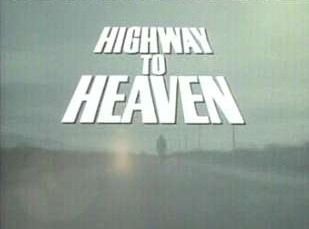
Welcome to Late Night Retro Television Reviews, a feature where we review some of our favorite and least favorite shows of the past! On Thursdays, I will be reviewing Highway to Heaven, which aired on NBC from 1984 to 1989. The entire show is currently streaming on Tubi and several other services!
This week, it’s Halloween!
Episode 4.5 “I Was A Middle-Aged Werewolf”
(Dir by Michael Landon, originally aired on October 28th, 1987)
The Devil (Michael Berryman) makes his second appearance on the show, this time selling Mark a submarine sandwich on Halloween night. Mark eats the sandwich while watching I Was A Teenage Werewolf on television. (“Hey, this guy kind of looks like you!” he tells Jonathan. Michael Landon, of course, starred in I Was A Teenage Werewolf.) Mark is then haunted by nightmares in which Jonathan turns into a werewolf. (And yes, Landon is made up to look like he did in the film.)
Meanwhile, in the waking world, Jonathan helps a lost trick-or-treater go home and he briefly turns into a werewolf so that he can scare the kid’s mean older sister. I’m not really sure what the rules were about angels pulling Halloween pranks but it should be noted that Jonathan is actually a fairly nice werewolf and he allows the kid to be a hero by pretending to be scared of him.
The episode ends with Mark once again yelling in fear as Jonathan turns into a werewolf, just for Michael Landon to look straight at the camera, break character, and say, “Happy Halloween.”
Awwww, what a sweet episode!
After a few weak and heavy-handed episodes, it was nice to see HighwaytoHeaven return to its earnest roots. This was a likable episode, one that showed that Landon was willing to laugh at himself and one that, to me, seemed to indicate a genuine love for the Halloween holidau. This was a fun 60 minutes and watching it has left me even more eager about the approaching horrorthon season.
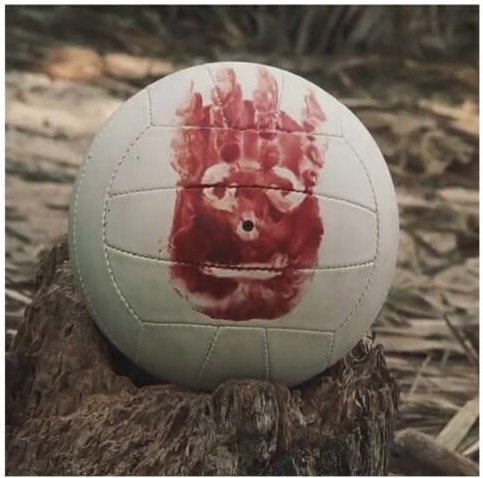
Seriously, I’m usually pretty well-behaved when I watch a movie but every time I see the 2000 film Cast Away, I find myself thinking, “Protect Wilson! You must protect Wilson!” And then, every time, I feel the sting of tears in my eyes as Wilson, with that red-face and that understanding attitude, goes floating away.
Wilson is a volleyball. When a FedEx executive named Chuck Noland (played by Tom Hanks) finds himself stranded on a desert island, Wilson becomes his only companion. A stain from Chuck’s bloody palm creates something that resembles a face on Wilson’s rubber surface and Chuck spends a lot of time talking to Wilson. It’s how Chuck maintains his sanity, even as he loses weight, sheds most of his clothes, and grows a beard.
Chuck learns how to make fire. He learns how to catch fish. He is able to survive due to the supplies that he gathers from the FedEx packages that were being carried on the plane that crashed into the island. But Chuck never stops dreaming of returning home to his girlfriend (Helen Hunt). Eventually, Chuck finds the courage to try to make the journey back to civilization. He brings Wilson with him but ultimately, this is something that Chuck is going to have to do on his own. Of course, Chuck has failed to consider that he’s been gone for years. He is presumed dead. On the Island, time seemed like it was frozen. For the rest of the world, life has continued.
CastAway is a film that a lot of people, especially online film commentators, tend to criticize. The complaint is usually that the film is essentially a commercial for FedEx, that it’s not believable that Tom Hanks could survive on that island for as long as he did, and that the film itself has a weak ending. I’ll concede that the film does make FedEx look like the nicest corporation on Earth. (FedEx’s CEO appears as himself, which should tell you something about how the company is presented.) And I will admit that the film’s time-advancing jump cut, which abruptly takes Hanks from being clean-shaven and husky to being thin and bearded, does leave a lot of unanswered questions. But I will always defend the film’s ending. The film ends on a note of ambiguity but how else could it have ended? Everyone thought Chuck Noland was dead. His girlfriend had every right to get on with her life and, in fact, it would have been psychologically unhealthy for her if she hadn’t. As for that final shot, it’s an acknowledgment that Chuck doesn’t know what lies ahead of him in the future. All he knows is that he life isn’t over yet. It’s a melancholy ending. It’s a frustrating ending. But it’s also the only way the film could have ended and therefore, it’s a perfect ending.
CastAway is a film that I will always defend and it’s also a film that really only could have worked with Tom Hanks in the lead role. He plays Chuck as being the ultimate everyman, an affable guy who was just trying to do his job and whose survival of the initial plane crash was largely due to luck. Hanks is one of those actors who is instantly sympathetic and CastAway uses his screen persona to good effect. You want him to survive because he’s Tom Hanks. He may be playing a character named Chuck Noland but ultimately, he’s Tom Hanks. He survived being trapped in space. Surely, he can survive being stranded on an island. The majority of the film is just Hanks talking to himself. This would have brought out the worst in so many actors but Tom Hanks makes it work. And yes, he’ll bring tears to your eyes as he watches Wilson float away. That’s the power of a good actor.
As for Wilson, I like to think that he washed up in Pensecola. Recently, I played a little volleyball on a beautiful Florida beach. Was that you, Wilson?
The first official trailer for the return of Daredevil to the small screen has finally been released by Marvel Television (a part of Marvel Studios). Daredevil: Born Again will finally and officially be the homecoming of the live-action Daredevil character that many fans have been clamoring for. Disney is finally embracing the Netflix Marvel shows as part of the MCU (they ignored the ABC/Netflix Marvel shows like they were something one found under their shoes).
Charlie Cox is back as Matt Murdock aka Daredevil, The Man With No Fear. Vincent D’Onofrio is also back as his arch nemesis Wilson Fisk aka The Kingpin. Pretty much the rest of the cast of the Netflix Daredevil show and its many spin-offs are back, as well.
There was some major fears and trepidations from fans of those shows that Disney will water down the mature-aspect of those shows in order to have them on Disney+. The fact that Kevin Feige and his braintrust at Marvel Studios made a major overhaul of the shows creative team six-episodes in of the shows production to start anew tells me that the initial plan to make the show more lighthearted didn’t so well when reviewed by the powers-that-be. So, after some many months of major reshoots, change in showrunner and directors, we now see a taste of that pivot away from the studio’s original plan.
Daredevil: Born Again trailer channels the original Netflix series’ serious and mature tone. Even the fear that the violence of the original series would be water-downed could be put to rest. Daredevil: Born Again definitely is for mature-audiences only.
The Marvel Cinematic Universe hasn’t has many hits since the end of Avengers: End Game, but this trailer (hopefully just a hint of what to expect when the show comes out) is a right step in the direction of righting the MCU ship, because the pop-culture landscape is much better when its tentpole franchises are working perfectly on all cylinders rather than not.
How many different ways can Ashton Kutcher fuck up time and space?
That’s the question asked in the gloriously silly The Butterfly Effect, a film that was a minor hit back in 2004. Ashton plays Evan Treborn, a disheveled college student who is studying how memory works. All through his life, Evan has suffered from seizures that are triggered by stress. Evan has a lot of stress because apparently, there’s not a single bad thing that didn’t happen to him when he was a child.
Crazy father who tried to strangle Evan before being gunned down in front of his son’s terrified eyes? Yep.
Sexual molestation at the hands of a suburban drunk? Yep.
A best friend who blew up not only a mailbox but also a mother and a baby? Yep.
A dog that was set on fire by a neighborhood bully? Yep.
Another friend who was driven into a catatonic state by all the madness around him? Yep.
A girlfriend who, due to family tragedy, had to move away? Yep.
However, things seem to be getting better for Evan. Now, he’s a psychology major with a bright future. His professors love him. He’s even got a roommate named Thumper (played, somewhat inevitably, by Ethan Suplee). And, as he’s soon to discover, he possesses a special power. All he has to do is read his old journals and, for a limited time, he can go into the past and change his history.
Of course, it turns out that changing history is a lot more complicated than it looks. Evan goes back into the past and confronts the pervy suburban drunk. He then goes back to the present and discovers that he’s now a shallow frat boy who is hated by both his professors and Thumper! Even worse, he eventually ends up in prison for killing a man. Going back into the past and saving his dog leads to his friend Lenny (Elden Hansen) spending the rest of his life imprisoned. Another trip to the past results in Evan waking up as a double amputee. Depending on what Evan does, his friend Kayleigh (Amy Smart) either becomes a shallow sorority princess or a drug-addicted prostitute. Meanwhile, Kayleigh’s brother (William Lee Scott) goes from being a psychotic murderer to a clean-cut religious guy.
Thumper never changers, though. Thumper endures.
This, of course, is a lot of pressure to put on any character played by Ashton Kutcher and soon, Evan is having nosebleeds and migraines. Every time he changes the past, his brain is flooded with 20 years worth of new memories. His brain might explode before he can fix all the damage that he’s done….
Watching The Butterfly Effect is an odd experience because, on the one hand, the premise is genuinely intriguing but, on the other hand, the film stars the reliably goofy Ashton Kutcher. Ashton grows a beard and doesn’t wash his hair for the first half of the movie, which is the film’s way of letting us know that we’re meant to take him seriously but it doesn’t change the fact that he’s still Ashton Kutcher. Even when playing the most dramatic of scenes, Ashton tends to deliver every line as if it’s the set up for a punch line. It’s not surprising that the best part of The Butterfly Effect is when Ashton wakes up and discovers that he’s now a frat boy. Those scenes are intentionally funny and they take advantage of what Ashton Kutcher is actually good at.
At the same time, it’s hard not to get into The Butterfly Effect. It’s a mess but it’s a likable mess and it’s undeniably enjoyable to see how everyone’s life changes as a result of Ashton’s constant meddling. (William Lee Scott especially has fun, switching between being full-blown psycho and full-blown religious.) The Butterfly Effect may be dumb but it’s fun. It’s a film that’s best watched with your snarkiest friends.
(Lisa is currently in the process of cleaning out her DVR! This could take a while. She recorded the 2001 high school film O off of Cinemax on July 6th.)
Tell me if this sounds familiar.
O (Mekhi Phifer) is one of the only black students attending an exclusive high school in South Carolina. Despite a past that involves petty crime and drugs, O appears to have his life on the right track. As the captain of school’s basketball team, O is the most popular student at his school. Everyone looks up to him. Everyone wants to be him. He’s even dating Desi (Julia Stiles), the very white daughter of the school’s very white headmaster (John Heard). At a school assembly, Coach Duke Goulding (Martin Sheen) describes O as being like a son to him. When O is awarded the MVP trophy, he shares it with his teammate, Michael Cassio (Andrew Keegan).
Watching all of this with seething jealousy is Hugo Gaumont (Josh Hartnett). Hugo is a teammate of O’s. In fact, he even thought that he was O’s best friend. That was before O shared his award with Michael. Making Hugo even more jealous is that he happens to be the son of the coach. For every kind word that Duke has for O, he has a hundred petty criticisms for Hugo. Whereas O has overcome drug addiction and is proclaimed as a hero for doing so, Hugo is secretly doing steroids, trying to do anything to improve himself as a player and hopefully win everyone’s love.
So, Hugo decides to get revenge. Working with a nerdy outcast named Roger Calhoun (Elden Hansen), he manipulates O into thinking that Desi is cheating on him with Cassio. He also tricks Cassio into getting into a fight with Roger, leading to Cassio getting suspended from the team. To top it all off, Hugo gets O hooked on drugs, once again. Finding himself consumed by a violent rage that he thought he had under control, O starts to obsess on determining whether or not Desi has been faithful to him…
If that sounds familiar, that’s because O is basically Othello, transported to modern times and involving privileged teenagers. Even though the whole modernized Shakespeare thing has become a bit of a cliché, it actually works pretty well in O. Hugo’s obsessive jealousy of the “cool kids” feels right at home in a high school setting and director Tim Blake Nelson and writer Brad Kaaya do a fairly good job of transporting Shakespeare’s Elizabethan melodrama to the early aughts.
(Actually, O was filmed in 1999 but it sat on the shelf for two years. After a spate of school shootings, distributors were weary about releasing a film about high school students trying to destroy each other.)
Admittedly, O has its share of uneven moments. Martin Sheen, playing the type of role that always seems to bring out his worst instincts as an actor, goes so overboard as the coach that he threatens to sink almost every scene in which he appears and Rain Phoenix is miscast as Hugo’s girlfriend. Even Julia Stiles struggles a bit in the role of Desi. However, both Mekhi Phifer and Josh Hartnett are perfectly cast as O and Hugo. Phifer brings just the right amount of arrogant swagger to the role while Hartnett is a sociopathic marvel as Hugo. Tim Blake Nelson’s direction is occasionally overwrought, relying a bit too heavily on a groan-inducing metaphor about taking flight and claiming the spotlight. However, both Nelson and the film deserve some credit for not shying away from directly confronting and portraying the source material’s cultural and racial subtext.
O is hardly perfect but it is always watchable and, at its best, thought-provoking.
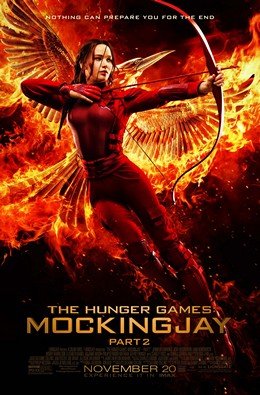
It probably sounds like I’m really excited that the final Hunger Games adaptation has been released. It may sound like I’m happy that the saga of Katniss Everdeen and her life in Panem has finally come to an end. And, to a certain extent, I am. After everything that Katniss has been through, she deserves some peace and, fortunately, the series has ended before Jennifer Lawrence got bored with playing the role. (To see what happens when actor gets bored with an iconic role, check out Daniel Craig in Spectre.) Even though I think it can be argued that Mockingjay Part Two is the weakest of all the Hunger Games films, it still allows both Katniss and the actress who brought her to life to go out on a high note.
There’s a part of me that cringes a little when I think about all of the films that were released as a direct result of the success of The Hunger Games. The Giver, The Maze Runner, Divergent, Tomorrowland, the list goes on and on. I’ve reached the point where I can now say that I am officially sick of sitting through adaptations of Young Adult dystopian fiction. And yet, I was still excited to see The Hunger Games: Mockingjay Part Two (even if that title is way too long and unwieldy). Regardless of the number of mediocre films that it may have inspired, The Hunger Games franchise has always remained compelling.
So, how was Mockingjay Part Two? Obviously, it doesn’t work as a stand-alone film. The pacing is totally off, characters appear and disappear almost at random, and it’s all rather confusing. If you haven’t seen the film that came before Mockingjay Part Two, I imagine that you would be totally confused by this film. But, when viewed as the fourth part of one gigantic epic story, the whole thing is rather brilliant.
When the film opens, Katniss is still being used a prop in Alma Coin’s (Julianne Moore) revolution. The majority of the film deals with her journey into and through the capital. She wants to track down and assassinate President Snow (the wonderfully evil Donald Sutherland) whereas Coin just wants to use her as a symbol to solidify her authority. As Katniss quickly realizes, there’s not much difference between Snow and Coin. However, it takes one great tragedy for Katniss to truly understand the truth about the Alma Coin and her revolution. If you’ve read the book, you’ll already know about and be prepared for that tragedy but it’s still a heart-breaking moment.
It’s also the most important moment in the franchise, one that reminds us that The Hunger Games has always been far more politically sophisticated (and thematically darker) than all of the films, books, and fan fic that has been inspired by it. This is a seriously dark and, some would say, cynical movie and, as a student of history, I appreciated that. I appreciated that Mockingjay didn’t try to force a happy ending on us and I also appreciated the fact that Mockingjay didn’t buy into the simplistic Manichaen worldview that is currently ruining worlds both real and cinematic. The film’s final scene may be hopeful but it’s never naive.
It’s a bit unfortunate that Mockingjay had to be split into two separate films. Mockingjay Part Two is full of exciting moments but there’s also a lot of scenes that feel like filler. You get the feeling they were included to make sure that Mockingjay Part Two’s running team was equal to the other films in the franchise. This is a film that features a lot of genuinely exciting action and some truly emotional moments. It’s also a film that features a lot of speeches. If only both parts of Mockingjay could have been released as one six hour film. I would have watched it!
The film also features the final performance of Philip Seymour Hoffman, playing the rule of Plutarch. Hoffman is not in many scenes and reportedly, he died before filming two of his biggest scenes. Those scenes were rewritten and his dialogue given to other actors. At one point, Woody Harrelson starts to read a letter that was written by Plutarch and it’s a sad scene because you’re aware that, originally, Hoffman was meant to deliver those lines in his trademark style. As it is, Hoffman only appears in a few minutes of Mockingjay Part Two and he doesn’t do much. But, when the film briefly features his bemused smile, you’re reminded of what a great actor the world lost when Philip Seymour Hoffman died.
Of course, the entire Hunger Games franchise has been full of great actors. Jennifer Lawrence brought Katniss to wonderful and empowering life and one of the joys of Mockingjay Part Two is getting to see her bring the character’s story to a close. But even beyond Jennifer Lawrence’s rightly acclaimed work, the entire cast of the franchise deserves a lot of credit. I’ve always loved Donald Sutherland’s interpretation of President Snow and he’s at his best here.
For that matter, if there ever is another Hunger Games film or a Hunger Games spin-off, why not make it about Jena Malone’s Johanna Mason? The way that Malone delivered her angry and frequently sarcastic dialogue was definitely one of the film’s highlights.
Regardless of whether there are any future films, The Hunger Games: Mockingjay Part Two is a worthy conclusion to a great story.
(By the way, as you may have guessed from the title of this post, December is science fiction month here at the Shattered Lens! We hope you enjoy it!)
“I accept your conviction. The lone man who thinks he can make a difference.” — Wilson Fisk
Today we saw the release of the official trailer for Netflix and Marvel Television’s first of five series based on characters from the Marvel Universe. Daredevil will be the first out of the gate and it looks to darken things a bit in the Marvel Cinematic Universe by bringing to the small screen one of it’s street-level heroes.
Daredevil (aka Matt Murdock) will soon be joined by Jessica Jones, Luke Cage and Iron Fist in their own web series on Netflix before teaming up for the Defenders series.
Under the guiding hands of showrunner (and Whedon alum) Stephen S. DeKnight, Daredevil will soon be available for bingewatchers everywhere on April 10, 2015.
“Bless me father for I have sinned.” — Matt Murdock
Marvel has pretty much been dominating the big-screen with it’s yearly event offerings. 2015 will not be an exception with Avengers: Age of Ultron set for a summer release expected to rake in the box-office by the money bins. Now, Marvel has set it’s site on the small-screen with it’s first Netflix Original Series that will be the first link in a five series set that will culminate in a team-up series called the Defenders.
This first link will be a new, and hopefully better take, on the street-level superhero Daredevil aka the Man With No Fear. The blind lawyer by day and vigilante by night whose blindness since childhood has helped him developed the rest of his senses beyond human levels. We shall not speak of the film adaptation starring Ben Affleck over ten years ago.
Marvel’s Daredevil will release all 10-episodes on Netflix this April 10, 2015.
Of the three The Hunger Games films released so far, Mockingjay Part One is definitely the weakest. That does not, however, mean that it’s a bad film. It’s just that it doesn’t quite reach the grandeur of the first film, nor does it have the same political immediacy as the second one. However, there’s a lot of good things to be said about Mockingjay. Julianne Moore is perfectly cast as the charismatic but faintly sinister Alma Coin. Philip Seymour Hoffman’s performance reminds us of what a towering talent we lost earlier this year. Donald Sutherland continues to transform President Snow into a villain for the ages. Even though he’s only in the film for a few minutes, Stanley Tucci is perfectly vapid as Caesar Flickerman.
In fact, the only real problem with Mockingjay is that it’s so obviously a prologue to something bigger. Much as with The Maze Runner, we watch Mockingjay with the knowledge that it’s only part one and that the majority of the issues raised by the film will not be settled until next year. The film itself knows this as well and, as such, it lacks the immediacy and much of the excitement of the first two Hunger Games films.
But yet, with all those flaws in mind, Mockingjay still works and it’s largely because of Jennifer Lawrence’s performance as Katniss Everdeen. Whereas the first two Hunger Games films featured a Katniss who was always at the center of the action and always taking charge of any situation that she found herself in, Mockingjay features a Katniss who has far less control over her fate. (One of the neater ironies of the series is that Katniss was actually more independent as a prisoner of President Snow than as a “guest” of Alma Coin.) In Mockingjay, Katniss finds herself forced — with more than a little reluctance — to become the figurehead for the entire revolution and the film’s best moments are the ones in which others debate how to best “market” her. These scenes are all about how Katniss — who is now not only a celebrity but a political icon as well — deals with losing control over her own public image. Considering that Jennifer Lawrence’s rise to fame and acclaim occurred just as abruptly as Katniss’s, it’s probable that — even more so than in the previous films — the actress brought a lot of herself to the character.
So, yes, I would argue that Jennifer Lawrence does perhaps deserve some awards consideration for her performance in Mockingjay. However, she truly deserves it for the consistent quality of her performance throughout the entire Hunger Games franchise. From the very first film, Jennifer Lawrence’s performance has been iconic. Fiercely independent without giving into the usual cinematic clichés that come with that, Katniss Everdeen has provided an alternative role model for a generation of girls who, otherwise, might have only had the likes of Bella Swan to look up to.
If that’s not worthy of being honored, then I don’t know what is.
“When you’re 17, every day is war.” — Tagline of The Battle of Shaker Heights (2003)
Anyone here remember Project Greenlight? It’s a show that used to be on HBO and Bravo, in which Matt Damon and Ben Affleck would arrange for a director and screenwriter to get a chance to make their low budget feature film debuts. The catch, of course, is that a camera crew would then follow the director as he (and all of the Greenlight “winners” were male) struggled to get the film made. Mistakes would be made. Money would be wasted. Producer Chris Moore would randomly show up on set and start yelling. In short, it was typical reality show drama with the catch being that the film itself would then be released in a theater or two.
Well, after being consigned to footnote status for the past nine years. Project Greenlight is coming back for a fourth season and a lot of people are pretty excited about it. And why not? I own the first two seasons of Project Greenlight on DVD and I’ve watched the third season on YouTube. It’s a lot of fun, mostly because all of the directors, with the exception of season 3 winner John Gulager, turned out to be so incredibly inept. (Gulager is one of the few Project Greenlight success stories — not only did his movie, Feast, come across as being made by a professional but he’s actually had a career post-Greenlight.) It all makes for good televised drama.
However, it doesn’t necessarily make for a good movie.
Case in point: 2003’s The Battle of Shaker Heights.
The Battle of Shaker Heights is about a creepy 17 year-old named Kelly (played by the reliably creepy Shia LaBeouf). His mother (Kathleen Quinlan) is an artist. His father (William Sadler) is a former drug addict who, despite having been clean for 6 years, still has to deal with his son’s constant resentment. Kelly is a high school outcast who spends all of his spare time thinking and talking about war. Every weekend, he takes part in war reenactments. At night, he works in a 24-hour grocery store where he doesn’t realize that he’s the object of Sarah’s (Shiri Appleby) affection.
(Why Sarah has so much affection for Kelly is a good question. Maybe it’s the scene where he throws cans of cat food at her…)
At a reenactment of the Battle of the Bulge, Kelly meets and befriends Bart (Elden Hansen), which leads to him meeting Bart’s older sister, Tabby (Amy Smart). Tabby is an artist, because the film isn’t imaginative enough to make her anything else. (We’re also told that she’s a talented artist and it’s a good thing that we’re told this because otherwise, we might notice that her paintings are the type of uninspired stuff that you can buy at any county art fair.) Kelly decides that he’s in love with Tabby but — uh oh! — Tabby’s getting married. Naturally, she’s marrying a guy named Minor (Anson Mount). Imagine how the film would have been different if his name had been Major.
As a film, the Battle of Shaker Heights is a bit of a mess. It never establishes a consistent tone, the dialogue and the direction are all way too heavy-handed and on the nose, and Shia LaBeouf … well, he remains Shia LaBeouf. In some ways, Shia is actually pretty well cast in this film. He’s an off-putting actor playing an off-putting characters but the end of result is an off-putting film.
Of course, if you’ve seen the second season of Project Greenlight, then you know that The Battle of Shaker Heights had an incredibly troubled production. Neither one of the film’s two directors were particularly comfortable with dealing with the more low-key human aspects of the story. Screenwriter Erica Beeney was not happy with who was selected to direct her script and basically spent the entire production whining about it to anyone who would listen. (Sorry, Erica — your script was one of the film’s biggest problems. When you actually give a character a name like Minor Webber, it means you’re not trying hard enough.) Finally, Miramax took the completed film away from the directors and re-edited it, removing all of the dramatic scenes and basically leaving a 79-minute comedic cartoon.
So, in the end, Battle of Shaker Heights is not a very good film. But season two of Project Greenlight is a lot of fun!




 Through the Shattered Lens