Brad reviews REGARDING HENRY (1991), starring Harrison Ford!


I noticed that today is Harrison Ford’s 83rd birthday. Like most people born in the early 1970’s, I’m a big fan of Harrison Ford. My formative years included the Star Wars movies, the Indiana Jones movies, and many other great films like BLADE RUNNER (1982) and WITNESS (1984). He would go on to make more classics like THE FUGITIVE (1993) and AIR FORCE ONE (1997) as I got older and moved into adulthood, but one of my personal favorite films starring Harrison Ford is REGARDING HENRY (1991).

In REGARDING HENRY, Harrison Ford stars as Henry Turner, a ruthless bastard, who also happens to be a hugely successful and cutthroat attorney in New York City. This horrific approach to being a human being does seem to provide plenty of money for his wife Sarah (Annette Bening) and his daughter Rachel (Mikki Allen), but you don’t get the feeling there’s that much actual love being shared between the three. Then one night, after another successful day of sticking it to the masses, Henry’s world is turned upside down when he’s shot in the head at the corner convenience store by a guy sticking up the place (John Leguizamo). The bullet to the brain doesn’t kill Henry, but it does leave him with severe brain damage and extremely impaired motor skills. This turns out to be a nice turn of events for Henry, and his family, for several reasons. First, he meets Bradley (Bill Nunn), his physical therapist and all around nice guy, who really helps him get headed back in the right direction in health, and in life, again. Second, he begins to reconnect with his wife who likes this more thoughtful, caring and affectionate version of Henry that seems to be emerging. Finally, he starts to show his daughter some much needed love and attention, rather than just wanting to ship her off to boarding school as quickly as possible. Wouldn’t you know it though, just when things are going so perfect, the sweet, innocent Henry stumbles up some very uncomfortable truths about his former life. Will these revelations upend his new life, or will he be able to move forward with a fresh start and a household filled with love?!!

There are two main reasons that I love REGARDING HENRY. The first reason is undoubtedly the feel-good story at the heart of the film. This is J.J. Abrams second writing credit and his screenplay takes Henry from being an arrogant, selfish jerk who is only interested in his own glorification, to a sweet-natured man of integrity who elevates his wife and his daughter to the prominent positions they rightfully deserve. Is this transformation grounded in reality… no, but I love movies because I want to escape reality and live vicariously through the heroes on the screen. Henry may not be a hero in the same way as Superman, Charles Bronson, or Chow Yun-Fat, but he is someone that I can relate to. I want to be a better dad. I want to be a better husband. I want to be a man of principle and integrity in the workplace. I may not always be perfect, but watching Henry navigate his life and correct past wrongs is very satisfying and uplifting to see. I love the look in the eyes of his wife and daughter as they are so proud of him. I want my family to look at me in that same way. This movie just makes me feel good. When I want realism, I’ll go visit a shrink and watch documentaries about men and women dealing with traumatic brain injuries. 

The second reason I love REGARDING HENRY stems from the performances of several of the cast members. Harrison Ford is so good in the title role. His transformation from a cold hearted lawyer to a simple-minded family man is one of those things that could be really bad with the wrong actor, but I’ll gladly follow Ford through the process. He’s believable on both sides, and he has to be for the movie to work. Annette Bening is also great as his wife, Sarah. Her transformation isn’t a physical transformation, but an emotional transformation, and she’s just as convincing. The love she conveys toward Henry as he embraces his new life, followed by the way she plays the scenes when Henry uncovers some of the painful truths of their former life, are actually some of the strongest moments in the film. Finally, I want to give an extra shoutout to Bill Nunn as Bradley, possibly the greatest physical therapist on earth. If dictionaries had pictures, the word “likable” should have a picture of Bill Nunn from REGARDING HENRY. Nunn was a fine character actor, with many credits to his name, but I will never see him in a role that doesn’t take me back to his performance in this film. 

Overall, I highly recommend REGARDING HENRY to any person who enjoys a well-made and well-acted feel good story. It’s not the most realistic film in the world, but it’s one that I truly love. 
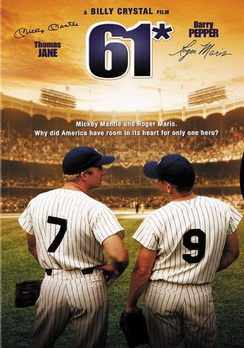
I Watched 61* (2001, Dir. by Billy Crystal)


61* is about two baseball player and two friends who couldn’t seem to be more different.

Roger Maris (Barry Pepper) is an introverted family man who doesn’t like it when reporters show up at his house in search of a story or a quote.  He’s a good ball player, one of the best, but he doesn’t want to be a celebrity.  Mickey Mantle (Thomas Jane) is a larger-than-life personality, a beloved figure on the field and in the dugout.  Mickey loves being famous and the fans love him.  Both Maris and Mantle are members of the New York Yankees.  Because Mantle is struggling with his drinking, he becomes Maris’s roommate when they’re on the road.  In 1961, the two friends both go after Babe Ruth’s record of 60 home runs in a season.  The press presents their season as a battle, a race to see who will be the first to hit the sixty-first home run of the season.  Mantle and Maris, though, are just swinging the bat and making plays.

I really enjoyed 61*, which is a baseball film made by and for people who love baseball.  I liked the contrast between the quiet Maris and the charismatic Mantle.  Even though Maris is a hard worker and a good ballplayer, Mantle is the fan favorite and the one that people actually want to break the record.  I appreciated that Maris and Mantle remained friends even when the press tried to turn them into rivals.  That’s what teamwork is all about.  Barry Pepper and Thomas Jane were great as Maris and Mantle and the movie showed how each man dealt with the stress of possibly breaking Babe Ruth’s record.

(Why is there an asterisk in the title?  Babe Ruth set his record in a season that only had 154 games.  The 1961 baseball season was 8 games longer.  The asterisk was added as a reminder that Maris and Mantle had 8 more games than Ruth did to try to break the record.  Baseball fans understand how important accurate statistics are to a player’s career and a team’s season.)

61* celebrates the way baseball used to be, a game played by athletes who had to depend on skill and teamwork instead of performance enhancing drugs.  The movie opens with Maris’s family watching as Mark McGuire closes in on breaking the record.  McGuire would only briefly hold the record.  He would lose it, for 48 minutes, to Sammy Sosa and then, three years after winning it back, he would lose it a second time to Barry Bonds.  Of course, Roger Maris won the record without using steroids so, as far as I’m concerned, it still belongs to him.

If you’re a baseball fan, 61* is a film that you have to see.

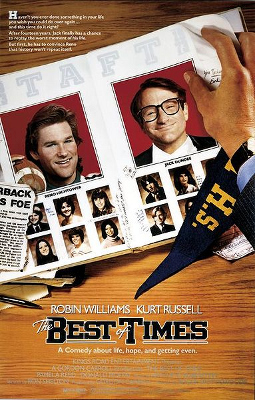
The Best Of Times (1986, directed by Roger Spottiswoode)


For years, banker Jack Dundee (Robin Williams) had been haunted by a pass that he dropped in high school.  The pass was perfectly thrown by quarterback Reno Hightower (Kurt Russell) but Jack couldn’t bring it in and, as a result, Taft High lost to its rival, Bakersfield.  Adding to Jack’s humiliation is that he now works for The Colonel (Donald Moffat), a confirmed Bakersfield fan who also happens to be Jack’s father-in-law.  When Jack visits a “massage therapist” (Margaret Whitton) and tells her about his problems, she suggests that he needs to replay the game.  Getting everyone interested in replaying the game is not easy.  No one wants to be humiliated a second time and Reno, who now fixes vans for a living, fears the he’s lost his edge.  Jack dresses up in the Bakersfield mascot’s uniform and vandalizes the town.  Finally, everyone is ready for the game.  Now, it’s a matter of town pride.

The Best of Times is a likable comedy about getting older and wishing you could have just one more chance to be young again and to have your entire future ahead of you.  Jack is haunted by that one dropped pass, feeling that it has cast a cloud over his entire life.  Reno is still a town hero but he’s struggling financially and in debt to Jack’s bank.  Replaying the game isn’t going to fix their lives but it is going to give them one last chance to relive their former glory and maybe an opportunity to learn that, even if they are getting older, they’re still living in the best of times.  The world that these two men live in is skillfully drawn and believable, with character actors like Moffat, M. Emmet Walsh, R.G. Armstrong, and Dub Taylor adding to the local color.  Jack and Reno’s wives are played by Holly Palance and Pamela Reed and they are also strong and well-developed characters.  Finally, Robin Williams and Kurt Russell are a strong comedic team.  Russell is perfectly cast as the aging jock and Williams gives one of his more restrained performances as Jack, allowing us to see the sadness behind Jack’s smile.

The stakes aren’t particularly high in The Best Of Times.  It’s just a football game between some middle-aged men looking to regain their youth.  But the story sticks with you.

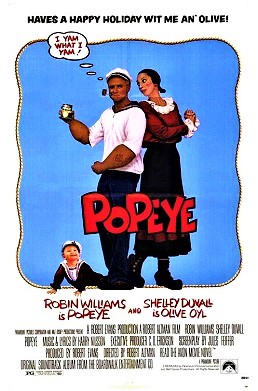
Popeye (1980, directed by Robert Altman)


I like Popeye.

Sometimes, I feel like I’m the only one.  Popeye got such bad reviews and was considered to be such a box office disappointment that director Robert Altman didn’t make another major film for a decade.  Producer Robert Evans, who was inspired to make Popeye after he lost a bidding war for the film rights to Annie, lost his once-sterling reputation for being able to find hits.  This was Robin Williams’s first starring role in a big screen production and his career didn’t really recover until he did Good Morning Vietnam seven years later.  Never again would anyone attempt to build a film around songs written by Harry Nilsson.  Screenwriter Jules Fieffer distanced himself from the film, saying that his original script had been ruined by both Robert Evans and Robert Altman.  Along with Spielberg’s 1941 and Michael Cimino’s Heaven’s Gate, Popeye was one of the box office failures that signaled the end of the era in which directors were given a ton of money and allowed to do whatever they wanted to with it.

I don’t care.  I like Popeye.  I agree with the critics about Nilsson’s score but otherwise, I think the film does a great job of capturing the feeling of a comic strip come to life.  Altman was criticized for spending a lot of money to construct, from scratch, the seaside village that Popeye, Olive Oyl (Shelley Duvall), Bluto (Paul L. Smith), Wimpy (Paul Dooley), and everyone else called home but it does pay off in the movie.  Watching Popeye, you really are transported to the world that these eccentric characters inhabit.  If the film were made today, the majority of it would be CGI and it wouldn’t be anywhere near as interesting.  Featuring one of Altman’s trademark ensemble casts, Popeye create a world that feels real and lived in.

Mumbling the majority of his lines and keeping one eye closed, Robin Williams is a surprisingly believable Popeye, even before he’s force fed spinach at the end of the movie.  Paul L. Smith was an actor who was born to play the bullying Bluto and there’s something very satisfying about seeing him (literally) turn yellow.  As for Shelley Duvall, she is the perfect Olive Oyl.  Not only does she have the right look for Olive Oyl but she’s so energetic and charmingly eccentric in the role that it is easy to see what both Popeye and Bluto would fall in love with her.  Though the humor is broad, both Williams and Duvall bring a lot of heart to their roles, especially in the scenes where they take care of their adopted infant, Swee’Pea.  Popeye may be a sailor but he’s a father first.

Popeye deserves a better reputation than it has.  It may not have been appreciated when it was originally released but Popeye has a robust spirit that continues to distinguish it from the soulless comic book and cartoon adaptations of today.

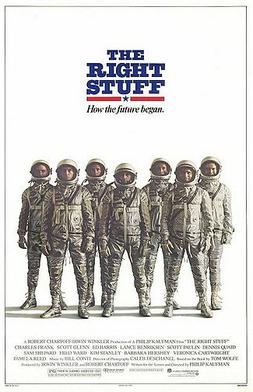
Lisa Marie Reviews An Oscar Nominee: The Right Stuff (dir by Philip Kaufman)


There’s a brilliant scene that occurs towards the end of 1983’s The Right Stuff.

It takes place in 1963.  The original Mercury astronauts, who have become a symbol of American ingenuity and optimism, are being cheered at a rally in Houston.  Vice President Lyndon Johnson (Donald Moffat) stands on a stage and brags about having brought the astronauts to his supporters.  One-by-one, the astronauts and their wives wave to the cheering crowd.  They’re all there: John Glenn (Ed Harris), Gus Grissom (Fred Ward), Alan Shephard (Scott Glenn), Wally Schirra (Lance Henrisken), Deke Slayton (Scott Paulin), Scott Carpenter (Charles Frank), and the always-smiling Gordon Cooper (Dennis Quaid).  The astronauts all look good and they know how to play to the crowd.  They were chosen to be and sold as heroes and all of them have delivered.

While the astronauts are celebrated, Chuck Yeager (Sam Shepard) is at Edwards Air Force Base.  Yeager is the pilot who broke the sound barrier and proved that the mythical “demon in the sky,” which was whispered about by pilots as a warning about taking unnecessary risks, was not waiting to destroy every pilot who tried to go too fast or too high.  Yeager is considered by many, including Gordon Cooper, to be the best pilot in America.  But, because Yeager didn’t have the right image and he had an independent streak, he was not ever considered to become a part of America’s young space program.  Yeager, who usually holds his emotions in check, gets in a jet and flies it straight up into the sky, taking the jet to the edge of space.  For a few briefs seconds, the blue sky becomes transparent and we can see the stars and the darkness behind the Earth’s atmosphere.  At that very moment, Yeager is at the barrier between reality and imagination, the past and the future, the planet and the universe.  And watching the film, the viewer is tempted to think that Yeager might actually make it into space finally.  It doesn’t happen, of course.  Yeager pushes the jet too far.  He manages to eject before his plane crashes.  He walks away from the cash with the stubborn strut of a western hero.  His expression remains stoic but we know he’s proven something to himself.  At that moment, the Mercury Astronauts might be the face of America but Yeager is the soul.  Both the astronauts and Yeager play an important role in taking America into space.  While the astronauts have learned how to take care of each other, even the face of government bureaucracy and a media that, initially, was eager to mock them and the idea of a man ever escaping the Earth’s atmosphere,  Chuck Yeager reminds us that America’s greatest strength has always been its independence.

Philip Kaufman’s film about the early days of the space program is full of moments like that.  The Right Stuff is a big film.  It’s a long film.  It’s a chaotic film, one that frequently switches tone from being a modern western to a media satire to reverent recreation of history.  Moments of high drama are mixed with often broad humor.  Much like Tom Wolfe’s book, on which Kaufman’s film is based, the sprawling story is often critical of the government and the press but it celebrates the people who set speed records and who first went into space.  The film opens with Yeager, proving that a man can break the sound barrier.  It goes on to the early days of NASA, ending with the final member of the Mercury Seven going into space.  In between, the film offers a portrait of America on the verge of the space age.  We watch as John Glenn goes from being a clean-cut and eager to please to standing up to both the press and LBJ.  Even later, Glenn sees fireflies in space while an aborigines in Australia performs a ceremony for his safety.  We watch as Gus Grissom barely survives a serious accident and is only rescued from drowning after this capsule has been secured.  The astronauts go from being ridiculed to celebrated and eventually respected, even by Chuck Yeager.

It’s a big film with a huge cast.  Along with Sam Shepherd and the actors who play the Mercury Seven, Barbara Hershey, Pamela Reed, Jeff Goldblum, Harry Shearer, Royal Dano, Kim Stanley, Scott Wilson, and William Russ show up in roles both small and large.  It can sometimes be a bit of an overwhelming film but it’s one that leaves you feeling proud of the pioneering pilots and the brave astronauts and it leaves you thinking about the wonder of the universe that surrounds our Earth.  It’s a strong tribute to the American spirit, the so-called right stuff of the title.

The Right Stuff was nominated for Best Picture but, in the end, it lost to a far more lowkey film, 1983’s Terms of Endearment.  Sam Shepard was nominated for Best Supporting Actor but lost to Jack Nicholson.  Nicolson played an astronaut.

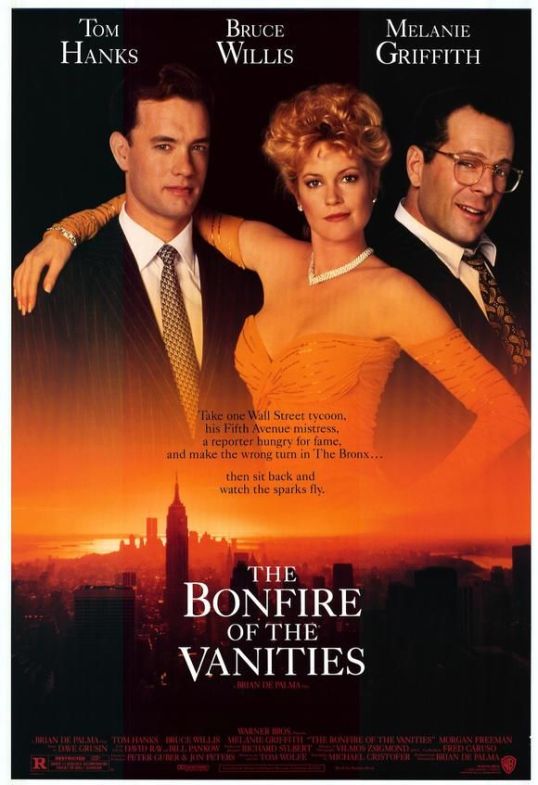
Icarus File No. 11: The Bonfire of the Vanities (dir by Brian De Palma)


In 2021, I finally saw the infamous film, The Bonfire of the Vanities.

I saw it when it premiered on TCM.  Now, I have to say that there were quite a few TCM fans who were not happy about The Bonfire of the Vanities showing up on TCM, feeling that the film had no place on a station that was supposed to be devoted to classic films.  While it’s true that TCM has shown “bad” films before, they were usually films that, at the very least, had a cult reputation.  And it is also true that TCM has frequently shown films that originally failed with audiences or critics or both.  However, those films had almost all been subsequently rediscovered by new audiences and often reevaluated by new critics.  The Bonfire of the Vanities is not a cult film.  It’s not a film about which one can claim that it’s “so bad that it’s good.”  As for the film being reevaluated, I’ll just say that there is no one more willing than me to embrace a film that was rejected by mainstream critics.  But, as I watched The Bonfire of the Vanities, I saw that everything negative that I had previously read about the film was true.

Released in 1990 and based on a novel by Tom Wolfe, Bonfire of the Vanities stars Tom Hanks as Sherman McCoy, a superficial Wall Street trader who has the perfect penthouse and a painfully thin, status-obsessed wife (Kim Cattrall).  Sherman also has a greedy mistress named Maria (Melanie Griffith).  It’s while driving with Maria that Sherman takes a wrong turn and ends up in the South Bronx.  When Sherman gets out of the car to move a tire that’s in the middle of the street, two black teenagers approach him.  Maria panics and, after Sherman jumps back in the car, she runs over one of the teens.  Maria talks Sherman into not calling the police.  The police, however, figure out that Sherman’s car was the one who ran over the teen.  Sherman is arrested and finds himself being prosecuted by a power-hungry district attorney (F. Murray Abraham).  The trial becomes the center of all of New York City’s racial and economic strife, with Sherman becoming “the great white defendant,” upon whom blame for all of New York’s problems can be placed.  Bruce Willis plays an alcoholic journalist who was British in the novel.  Morgan Freeman plays the judge, who was Jewish in the novel.  As well, in the novel, the judge was very much a New York character, profanely keeping order in the court and spitting at a criminal who spit at him first.  In the movie, the judge delivers a speech ordering everyone to “be decent to each other” like their mothers taught them to be.

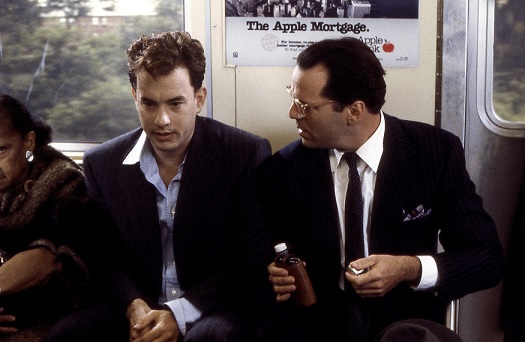
Having read Wolfe’s very novel before watching the film, I knew that there was no way that the adaptation would be able to remain a 100% faithful to Wolfe’s lacerating satire.  Because the main character of Wolfe’s book was New York City, he was free to make almost all of the human characters as unlikable as possible.  In the book, Peter Fallow is a perpetually soused opportunist who doesn’t worry about who he hurts with his inflammatory articles.  Sherman McCoy is a haughty and out-of-touch WASP who never loses his elitist attitude.   In the film, Bruce Willis smirks in his wiseguy manner and mocks the other reporters for being so eager to destroy Sherman.  Hanks, meanwhile, attempts to play Sherman as an everyman who just happens to live in a luxury penthouse and spend his days on Wall Street.  Hanks is so miscast and so clueless as how to play a character like this that Sherman actually comes across as if he’s suffering from some sort of brain damage.  He feels less like a stockbroker and more like Forrest Gump without the Southern accent.  There’s a scene, written specifically for the film, in which Fallow and Sherman ride the subway together and it literally feels like a parody of one of those sentimental buddy films where a cynic ends up having to take a road trip with someone who has been left innocent and naïve as result of spending the first half of their life locked in basement or a bomb shelter.  It’s one thing to present Sherman as being wealthy and uncomfortable among those who are poor.  It’s another thing to leave us wondering how he’s ever been able to successfully cross a street in New York City without getting run over by an angry cab driver.

Because the film can’t duplicate Wolfe’s unique prose, it instead resorts to mixing cartoonish comedy and overwrought melodrama.  It doesn’t add up too much.  At one point, Sherman ends a dinner party by firing a rifle in his apartment but, after it happens, the incident is never mentioned again.  I mean, surely someone else in the apartment would have called the cops about someone firing a rifle in the building.  Someone in the press would undoubtedly want to write a story about Sherman McCoy, the center of the city’s trial of the century, firing a rifle in his own apartment.  If the novel ended with Sherman resigned to the fact that his legal problems are never going to end, the film ends with Sherman getting revenge on everyone who has persecuted him and he does so with a smirk that does not at all feel earned.  After two hours of being an idiot, Sherman suddenly outthinks everyone else.  Why?  Because the film needed the happy ending that the book refused to offer up.

Of course, the film’s biggest sin is that it’s just boring.  It’s a dull film, full of good actors who don’t really seem to care about the dialogue that they are reciting.  Director Brian De Palma tries to give the film a certain visual flair, resorting to his usual collection of odd camera angles and split screens, none of which feel at all necessary to the story.  In the end, De Palma is not at all the right director for the material.  Perhaps Sidney Lumet could have done something with it, though he would have still had to deal with the less than impressive script.  De Palma’s over-the-top, set piece-obsessed sensibilities just add to the film’s cartoonish feel.

The film flopped at the box office.  De Palma’s career never recovered.  Tom Hanks’s career as a leading man was momentarily derailed.  Bruce Willis would have to wait a few more years to establish himself as a serious actor.  Even the normally magnanimous Morgan Freeman has openly talked about how much he hated being involved with The Bonfire of the Vanities.  That said, the film lives on because  De Palma allowed journalist Julie Salomon to hang out on the set and the book she wrote about the production, The Devil’s Candy, is a classic of Hollywood non-fiction.  (TCM adapted the book into a podcast, which is how The Bonfire of the Vanities came to be featured on the station.)  Thanks to Salomon’s book, The Bonfire of the Vanities has gone to become the epitome of a certain type of flop, the literary adaptation that is fatally compromised by executives who don’t read.

Previous Icarus Files:

  1. Cloud Atlas
  2. Maximum Overdrive
  3. Glass
  4. Captive State
  5. Mother!
  6. The Man Who Killed Don Quixote
  7. Last Days
  8. Plan 9 From Outer Space
  9. The Last Movie
  10. 88

The TSL’s Horror Grindhouse: The Terminal Man (dir by Mike Hodges)


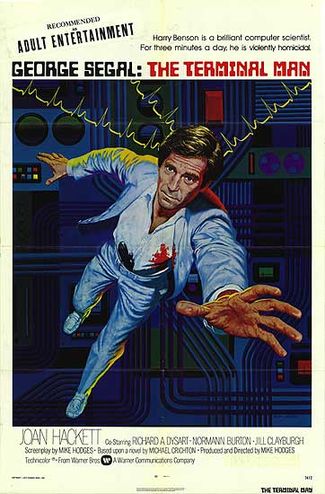
Check out the poster for 1974’s The Terminal Man.

Look at it carefully.  Examine it.  Try to ignore the fact that it’s weird that George Segal was once a film star.  Yes, on the poster, Segal has been drawn to have a somewhat strange look on his face.  Ignore that.  Instead, concentrate on the words in the top left corner of the poster.

“ADULT ENTERTAINMENT!” it reads.

That’s actually quite an accurate description.  The Terminal Man is definitely a film for adults.  No, it’s not pornographic or anything like that.  Instead, it’s a movie about “grown up” concerns.  It’s a mature film.  In some ways, that’s a good thing.  In some ways, that’s a bad thing.

Taking place in the near future (and based on a novel by Michael Crichton), The Terminal Man tells the story of Harry Benson (played, of course, by George Segal).  Harry is an extremely intelligent computer programmer and he’s losing his mind.  It might be because he was in a serious car accident.  It may have even started before that.  Harry has black outs and when he wakes up, he discovers that he’s done violent things.  Even when he’s not blacked out, Harry worries that computers are going to rise up against humans and take over the world.

However, a group of scientists think that they have a way to “fix” Harry.  It’ll require a lot of brain surgery, of course.  (And, this being a film from 1973, the film goes into excruciating details as it explains what’s going to be done to Harry.)  The plan is to implant an electrode in Harry’s brain.  Whenever Harry starts to have a seizure, the electrode will shock him out of it.  The theory is that, much like Alex in A Clockwork Orange 0r Gerard Malanga in Vinyl, Harry will be rendered incapable of violence.

Of course, some people are more enthusiastic about this plan than others.  Harry’s psychiatrist (Joan Hackett) fears that implanting an electrode in Harry’s brain will just make him even more paranoid about the rise of the computers.  Other scientists worry about the ethics of using technology to modify someone’s behavior.  Whatever happens, will it be worth the price of Harry’s free will?

But, regardless of the risks, Harry goes through with the operation.

Does it work?  Well, if it worked, it would be a pretty boring movie so, of course, it doesn’t work.  (Allowing Harry’s operation to work would have been like allowing King Kong to enjoy his trip to New York.)  Harry’s brain becomes addicted to the electrical shocks and, as he starts to have more and more seizures, Harry becomes even more dangerous than he was before…

The Terminal Man is a thought-provoking but rather somber film.  On the one hand, it’s a rather slow movie.  The movie does eventually get exciting after Harry comes out of surgery but it literally takes forever to get there.  The movie seems to be really determined to convince the audience that the story it’s telling is scientifically plausible.  On the other hand, The Terminal Man does deal with very real and very important issues.  Considering how threatened society is by people who cannot be controlled, issues of behavior modification and free thought will always be relevant.

Though the film may be slow, I actually really liked The Terminal Man.  Judging from some of the other reviews that I’ve read, I may be alone in that.  It appears to be a seriously underrated film.  As directed by Mike Hodges, the film is visually stunning, emphasizing the sterility of the white-walled hospital, the gray blandness of the doctors, and the colorful vibrancy of life outside of science.  Though he initially seems miscast, George Segal gives a good and menacing performance as Harry.

The Terminal Man requires some patience but it’s worth it.

A Movie A Day #92: Love, Cheat, & Steal (1993, directed by William Curran)


Paul Harrington (John Lithgow) is a wealthy banking consultant who has just married a sexy, younger woman, Lauren (Madchen Amick).  Paul thinks that Lauren is perfect but then her brother, Donald (Eric Roberts), shows up.  What Paul does not know is that Donald is not actually Lauren’s brother.  Instead, Donald is Reno, Lauren’s first husband who she never actually divorced. Reno has just escaped from prison where he was serving time for a crime for which he believes Lauren framed him.  While Paul tries to save his father’s failing bank, Reno starts to plan a bank robbery and Lauren tries to balance her old life with Reno with her new life with Paul.
Mild neo noirs like Love, Cheat, & Steal were a dime a dozen in the 1990s.  Love, Cheat, & Steal was made for Showtime and, throughout the 1990s, it used to tempt kids like me with its promise of “Brief Nudity” and “Adult Situations.”  The only thing that makes it memorable is the presence of Madchen Amick, who was always the most beautiful of all of the Twin Peaks starlets, even if she often was overshadowed by Sherilyn Fenn and Lara Flynn Boyle.  Madchen Amick has the right combination of girl next door innocence and enigmatic sultriness to make her perfect for movies like Love, Cheat, & Steal.  Other than the presence of Madchen Amick, Love, Cheat, & Steal is best remembered for being your only chance to see Eric Roberts do a Jack Nicholson imitation.

One final note: Irish actor Dan O’Herlihy has a small role.  Though he is best known for playing Conal Cochran in Halloween 3, he also co-starred with Amick during the second season of Twin Peaks.

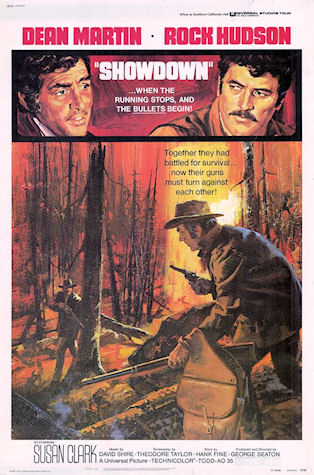
A Movie A Day #63: Showdown (1973, directed by George Seaton)


showdown_1973_film

Stop me if you’ve heard this one before.

The time and the place is the old west.  Growing up, Chuck Jarvis (Rock Hudson) and Billy Massey (Dean Martin) were best friends.  When the lovely Kate (Susan Clark) chose Chuck over Billy, the two of them go their separate ways.  Billy becomes a notorious train robber.  Chuck becomes the sheriff of their hometown.  After Billy returns home, it is up to Chuck to not only capture him but to also protect him from not only his former partners but a gang of vigilantes as well.

There’s nothing surprising about Showdown, a strictly by the numbers western that, if not for a few bloody gunshot wounds and some dialogue about cattle “humping,” could have just as easily been released in 1953 as 1973.  The only thing that makes Showdown special is that it was the last western made by both Rock Hudson and Dean Martin.  Dino is his usual fun-loving, half-soused self but Rock Hudson looks absolutely miserable here.  If Rock’s role had been played by Frank Sinatra (or even Peter Lawford), Showdown would probably be remembered as a minor classic.  As it is, it’s for Dean Martin completists only.


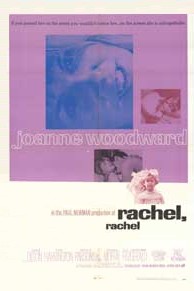
Embracing the Melodrama Part II #31: Rachel, Rachel (dir by Paul Newman)


Original_movie_poster_for_the_film_Rachel,_RachelI recently saw the 1968 best picture nominee Rachel, Rachel on TCM and I have to say that, at first, I was rather underwhelmed by it.  Don’t get me wrong.  I thought it was well-acted.  I thought it managed to capture a lot of details of small town life.  I thought that, for a film made in 1968, it was surprisingly mature and nonjudgmental when it came to exploring feminine sexuality.  I was even more surprised to see a nearly 50 year-old movie that actually featured a sympathetic portrayal of a lesbian.  Just consider that the homophobic The Sweet Ride was released at the same time and you can see just how unusually progressive Rachel, Rachel was as far as this was concerned.

And yet, when I first watched Rachel, Rachel, it was difficult for me to connect with it.  And I really wasn’t sure why.  I mean, it is true that Rachel, Rachel is one of those films that moves at a very deliberate post but, trust me, I’ve seen and enjoyed many films that were a helluva lot slower than Rachel, Rachel.  But, for whatever reason, it took me two viewings to really appreciate Rachel, Rachel as a surprisingly sensitive character study.

The film is about Rachel (Joanne Woodward), a 35 year-old virgin who lives with her mother in a small Connecticut town.  Since the death of her stern and overbearing father, Rachel has lived with her mother.  She’s a withdrawn and meek woman who has frequent fantasies that veer between unrealistic happiness and nightmarish morbidity.  Her best friend, another unmarried teacher named Calla (Estelle Parsons), invites Rachel to a revival meeting and, for the first time in her life, Rachel actually allows herself to be openly passionate.  After the meeting, Calla suddenly kisses her.  Shocked, Rachel temporarily ends their friendship.

Even before the revival meeting, Rachel has run into Nick (James Olsen), a friend from high school who is in town to visit his family.  After getting kissed by Calla, Rachel ends up turning to Nick and losing her virginity to him.  Rachel believes that she’s in love with Nick and is soon fantasizing about their future children.  However, it’s obvious to everyone (except for Rachel) that Nick doesn’t quite feel the same way…

When I first saw Rachel, Rachel, I had a hard time relating to the character of Rachel.  I watched and, as much as I tried to be sympathetic, I still found myself wondering how anyone could possibly still be a virgin at the age of 35.  I mean, I understand that times were different and all but seriously!  I guess back then, people actually were serious about the whole “no sex before marriage” thing.  (That probably explains why people used to get married when they were 17.)  The film is full of largely silent flashbacks to Rachel’s youth and we see that she was raised in an emotionally repressed environment.  She was raised to wait for the right man to come along and, when he didn’t, Rachel eventually found herself as a 35 year-old virgin.

And, without getting too TMI here, let’s just say that I couldn’t relate to Rachel’s situation.

But, when I watched the film for a second time, I discovered that even if I don’t know what it’s like to be a 35 year-old virgin, a lot of Rachel’s experiences were, in their way, universal.  Consider the scene at the start of the film where Rachel fantasizes that everyone in town is staring at her as she walks down the sidewalk, all because her slip is showing.  Who hasn’t, at some point in their life, felt like everyone was staring at her and judging?  And, for that matter, who hasn’t had a Nick in their life?

Interestingly enough, Rachel, Rachel was the directorial debut of the iconic actor Paul Newman.  One thing that I’ve noticed about films directed by actors (especially first films) is that the actor-turned-director often seems to feel that he has to prove himself by indulging in as much showy cinematic technique as possible.  (And if you don’t understand what I mean, check out George Clooney’s Confessions of a Dangerous Mind.)  And, as much as I hate to admit it because I’ve never read one negative word about Paul Newman, I have to admit that Newman’s direction was one of the reasons why, at first, I found myself feeling detached from the film.

While Newman tells most of Rachel’s story in an admirably straight-forward way, he also included just a few too many arty flashbacks and fantasies.  Some of the fantasies — like the one at the start of the film that I mentioned two paragraphs ago — are handled well but others are distracting and they remind the viewer that they’re watching a film.  And Rachel, Rachel is a film that works best when it’s naturalistic.  Whenever it gets too self-consciously cinematic, it takes the viewer a few minutes to get sucked back into Rachel’s story.

But, and this is the important thing, Paul Newman also gets some great work out of his actors.  Judging from some other films in which I’ve seen him, James Olson was not a particularly good actor but he was great in Rachel, Rachel.  Estelle Parsons has been an overdramatic presence in a few films and a lot of tv shows but she’s great in Rachel, Rachel.  And then there’s Joanne Woodward, who was great in a lot of films, including Rachel, Rachel.  Newman and Woodward were married when they made Rachel, Rachel and were still married when Newman died 40 years later.  Newman reportedly directed Rachel, Rachel because he wanted Woodward to have a great role.  Woodward is on-screen throughout the entire film and Newman’s love for her is obvious in every frame.

Rachel, Rachel is a flawed and imperfect film but it’s still worth catching the next time that it shows up on TCM.

rachelrachel2