A Blast From The Past: Peter Cushing — A One Way Ticket To Hollywood


I’m not sure if you can be a true fan of horror (especially British horror) without loving Peter Cushing.

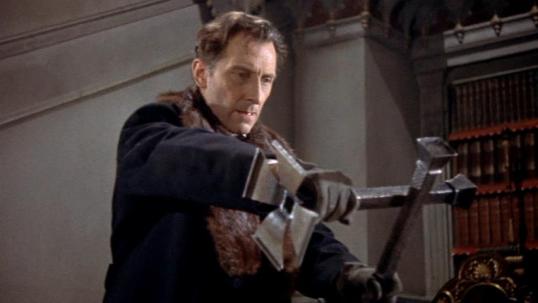
The actor played many roles over the course of his long career.  In fact, the first film in which he and Christopher Lee both appeared was not a horror film but instead Laurence Olivier’s 1948 production of Hamlet.  (They both also appeared in 1952’s Moulin Rouge.)  However, Cushing will probably always be best known for his Hammer roles and, of course, his villainous performance in Star Wars.  Peter Cushing was not only the virtuous Prof. Van Helsing but also the far less virtuous Baron Frankenstein.

According to almost every interview that I’ve read, Peter Cushing was a genuinely nice and professional person, one who didn’t personally care for horror films but who never took it personally when he was recognized for appearing in them.  Though they regularly played rivals on screen, he was close friends with Christopher Lee.  I once read an interview with Lee where he said that, decades later, he still hadn’t recovered from Cushing’s death in 1994.

Below, you’ll find a documentary from 1989.  It was called Peter Cushing — A One-Way Ticket To Hollywood.  It’s basically just Peter Cushing talking about his life and career for 49 minutes but it’s a charming little documentary.  Peter Cushing comes across as being very nice and very British.  He discusses not only his horror films but also his work in Star Wars and his performance as Winston Smith in a 1954 production of 1984.

It’s a nice documentary and I offer it up on Halloween as a tribute to one of horror’s gentlemen.

(Thank you to VintageTreats for uploading this!)

Film Review: Guerrilla: The Taking of Patty Hearst (dir by Robert Stone)


“Death to the fascist insect that preys upon the life of the people!”

— Patty “Tania” Hearst

2004’s Guerrilla is not the first movie that I’ve reviewed about the kidnapping of heiress Patty Hearst.  Previously, I took a look at Abduction, a grindhouse film that was released while Hearst was still missing, and 1988’s Patty Hearst, which was based on Hearst’s own book about her ordeal.  However, Guerrilla is different from those two films in that it’s a documentary and it features interviews with people who actually knew Patty and her kidnappers.

It’s a strange and complicated story, the type that you would probably be dismissed as implausible if not for the fact that it actually happened.  In 1973, Oakland school superintendent Marcus Foster was gunned down in a parking lot.  Because Foster was the first black man to held the position of superintendent, it was originally assumed that he had been gunned down by a racist paramilitary group.  However, a neo-Marxist group known as the Symbionese Liberation Army (SLA) soon took responsibility for the murder, claiming that Foster had been tried in a people’s court and sentenced to death for his crimes.  (Foster’s “crime” was apparently trying to introduce ID cards in Oakland schools.)

Who were the SLA?  They were a small group of self-styled revolutionaries.  Though their leader was a black, escaped convict named Donald DeFreeze, the other members of the SLA were white and largely middle class.  They enjoyed sending out portentous political announcements and they went out of their way to try to portray themselves as being a highly disciplined and regimented military organization.  Donald DeFreeze changed his name to “Field Marshal Cinque.”  According to the interviews in Guerrilla, most of their fellow radicals viewed the SLA as being a joke.  (One contemporary expresses his disappointment in meeting the SLA and discovering that they were all very boring and middle class.)  No one could understand the logic behind murdering Foster, who was viewed as being a progressive educator.

If not for what happened in the months after Foster’s murder, the SLA probably would have faded into the same obscurity that has swallowed up so many activist groups.  After two members of the group were arrested, the SLA retaliated by kidnapping Patty Hearst.

At the time that she was abducted, Patty Hearst was a nineteen year-old student at Berkeley.  She was also the granddaughter of William Randolph Hearst, the publishing magnate whose life famously inspired the film Citizen Kane.  With the entire world now watching, the SLA announced that Patty would be executed unless the Hearst family arranged for every poor person in California to receive $70 worth of food.  As is portrayed in cringe-inducing detail in the documentary, the Hearst family actually attempted to meet the SLA’s demands, just to watch the food distribution program descend into chaos.  As for the SLA, they were not impressed by the Hearst family’s effort.  Even more tellingly, Patty was not impressed.  In a recording sent to the press, Patty complained that her family hadn’t made enough of an effort and assured everyone that the SLA was treating her in accordance to international law.

Shortly afterwards, the SLA released another recording.  In this recording, Patty announced that she had been given the option of either returning to her family or joining the SLA.  She had decided to join the SLA and take the new name of Tania.  Soon, Patty Hearst was robbing banks and declaring “death to the fascist insect.”

Was Patty sincere in her conversion or was she brainwashed?  That’s the question that Guerrilla explores, while leaving it to the audience to decide for themselves what was actually going on in Patty’s mind.  Though Patty is not interviewed in the film, we do get to hear the recordings that she made during her time with the SLA.  We listen as she goes from being a sacred abductee to a self-declared “urban guerrilla.”  Listening to her dull, flat voice, you get the feeling that she didn’t have much of an individual identity before she was kidnapped and she had even less of one after she converts to the SLA cause.  When she talks about how much she loves the other members of the SLA, she sounds like an actress giving a bad audition.  Before she was kidnapped, she was a Hearst.  After she was kidnapped, she was a revolutionary.  At no point do you get the feeling that she was ever just Patty.

It’s an interesting story and Guerrilla is a fascinating documentary, one that explores how idealism can sometimes be just as dangerous as cynicism.  It’s also a film that explores how the kidnapping of an heiress received more attention than the murder of a teacher.  It’s interesting to note that, while the other members of the SLA eventually ended up either dead or in prison, Patty Hearst ended up getting a full pardon from Bill Clinton.  It’s hard not to feel that the story would have been much different if the SLA had kidnapped Jane Smith instead of Patty Hearst.

Here Are The 15 Semi-Finalists For The Best Documentary Oscar!


Yesterday, the Academy announced the 15 semi-finalists for the Best Documentary Feature Oscar.

I’ve seen quite  a few documentaries this year but I haven’t seen any of the films listed below.  Quite a few of them are on Netflix.  Abacus: Small Enough to Jail can be found on YouTube.  I have a feeling that An Inconvenient Sequel will win, just because Al Gore will probably trash Trump during his acceptance speech.

Anyway, here are the semi-finalists:

Abacus: Small Enough TO Jail,

Chasing Coral,

City of Ghosts,

Ex Libris — The New York Public Library,

Faces Places,

Human Flow,

Icarus,

An Inconvenient Sequel,

Jane,

LA 92,

Last Man in Aleppo,

Long Strange Trip,

One Of Us,

Strong Island,

Unrest


Cleaning out the DVR: Burn Motherf**ker, Burn! (dir by Sacha Jenkins)


(Lisa is currently in the process of cleaning out her DVR!  She has got over 170 movies to watch and she is determined to get it all done by the end of the year!  She recorded the 2017 documentary Burn Motherfucker, Burn! off of Showtime on April 22nd!)

I should note that the title of this film actually doesn’t contain any asterisks.  Burn, Motherf**ker Burn! may be how it was listed in the guide but the opening credits proudly and loudly proclaim: BURN MOTHERFUCKER, BURN!

It’s an appropriate title because there’s actually not a subtle moment to be found in Burn, Motherfucker, Burn!  Burn, Motherfucker Burn probably will not change anyone’s opinion about anything but that doesn’t really seem to be the film’s goal.  This is an angry and outspoken documentary, one that deals with the long history of conflict between the LAPD and the black community of Los Angeles.  Starting with cell phone footage of the 2015 killing of Charley Keunang before flashing back to the 1965 Watts riot and ending with the 1992 Los Angeles uprising, Burn, Motherfucker, Burn! is pure agitprop.

How you react to the documentary will largely depend on how you view race in America.  If you go into this film thinking that issues of police brutality and systemic racism are overstated, you’ll probably think Burn, Motherfucker Burn is one-sided propaganda.  If you go into the film thinking that America is still struggling to overcome the effects of systemic racism and that the police unfairly target minorities, Burn, Motherfucker Burn will confirm your every suspicion and might even inspire you to take a stand.  If the viewer doesn’t already agree with Burn, Motherfucker Burn‘s outlook, then Burn, Motherfucker Burn doesn’t have much use for that viewer.

I have to admit that I probably would have had a stronger reaction to Burn, Motherfucker Burn! if I hadn’t finally watched O.J.: Made In America a few weeks ago.  Quite a bit of the more infuriating footage used in Burn, Motherfucker Burn! — such as Bill Parker, the chief of the LAPD in the 60s, casually dismissing the concerns of the black community on a talk show — also appeared in O.J.: Made in America.  In fact, there’s very little in Burn, Motherfucker Burn! that wasn’t previously dealt with in the first two parts of the O.J. documentary.

That said, speaking as a self-confessed history nerd, there are a few interesting things to be learned from Burn, Motherfucker Burn.  For instance, before watching this documentary, I didn’t know that the infamous gangs of Los Angeles — which have been the subject of so many movies and tv shows — were started largely to provide neighborhoods with protection from the police.  The film shows how a vibrant artistic and cultural movement came about as a result of people rebelling against endless oppression.  For me, those were the most interesting parts of the film.

Charlie Beck, the current LAPD chief, is also interviewed.  He suggests that, as long as everyone does what they’re told to do, no one should worry about a thing.  He doesn’t bother to mention what Charley Keunang did to get gunned down at the start of the documentary.

Film Review: Portrait of Jason (dir by Shirley Clarke)


The 1967 film, Portrait of Jason, is one of the most fascinating documentaries that I’ve ever watched.  It’s also one of the most exhausting.

Directed by Shirley Clarke and filmed over the course of 12 hours in Clarke’s apartment, Portrait of Jason is, at its most basic, an interview with a self-described “hustler” who goes by the name of Jason Holliday. Holliday starts things off by explaining that he was born Aaron Payne but that he was renamed Jason Holliday by a friend of his in San Francisco.

“Jason Holliday was created in San Francisco,” he explains, “and San Francisco is a place to be created.”

The entire film is Jason either standing or sitting in front of a fireplace and talking about his life as a gay black man in America in the 1960s.  (Occasionally, voices are heard off camera, asking him questions.)  From the start of the film, it’s obvious that Jason is a great talker.  He has a way with words and it’s almost impossible not to get swept up in his stories, even if they are frequently hard to follow and sometimes contradict themselves.  As Holliday admits from the start, he is a man playing a role.  Over the course of the film, he smokes, he drinks, and he gets stoned.  He talks about being both a cabaret performer and a prostitute.  He wraps a feather boa around his neck and, when he sings, he takes on a totally different persona.  In fact, it can be argued that the entire film is about Jason taking on different personas.  Over the course of his marathon interview, he is sometimes happy, sometimes angry, sometimes sad, sometimes manipulative, and sometimes defiantly honest.  He admits to using people but, at the same time, when he suddenly very coldly announces, “I can make you feel like the most desirable human being on Earth,” you can’t held but admire his honesty.

In the beginning, Jason laughs.  Jason’s high-pitched giggle almost becomes a separate character, we hear it so often.  He uses the laugh in the way that some people use a period to end a sentence.  The laugh comes out when a story is over.  And yet, over the course of the film, we come to realize that the laugh is Jason’s left defense.  Whenever he feels that the story is getting too personal or that he might be revealing too much of what’s underneath the surface, Jason laughs.  The laugh is what Jason Holliday uses to keep Aaron Payne from coming out.

And yet, as the film progresses, the laugh is heard less and less.  Drunk and stoned, Jason starts to let down his defenses just a little bit.  The off-screen voices, which originally had been so encouraging of Jason, starts to become vaguely hostile.  They ask him about specific instances that Jason has used all of the unseen people in the room.  And Jason starts to change.  His tone becomes sarcastic.  When he breaks down crying, the camera gives us a close-up of his face and it’s hard to watch.  You realize not only how exhausted Jason is but also how exhausted you are as well.  And yet, at the same time, you wonder if Jason is really crying or if this is just a part of his extended performance.

To be honest, this is one of those documentaries that raises all sorts of ethical questions.  Jason’s a fascinating character but it’s obvious that he was set up by the filmmakers.  Much as the film will leave you with mixed feelings about Jason Holliday, it will also leave you with mixed feelings about the people who got him drunk and then filmed his subsequent breakdown.

At the end of the film, we hear Shirley Clarke telling Jason, in almost comforting tone, “That’s it, that’s the end.”  When I first saw this film, I was happy to hear that it was over because I didn’t how much more of Jason’s breakdown I could take.  However, at the same time, I found myself looking forward to the next time that I would watch Portrait of Jason so that I could search for more clues as to just who Jason Holliday actually was.

Long thought to be a lost film, Portrait of Jason occasionally shows up on TCM Underground.  Keep an eye out for it.  It’s not always an easy film to watch but it’s worth the effort.

Classic Film Lovers Rejoice! Here’s The Trailer for Five Came Back!


If you love classic movies, you’re going to love this trailer for the new Netflix documentary, Five Came Back!

Based on Mark Harris’s brilliant non-fiction book, Five Came Back takes a look at the work that five great directors — Frank Capra, William Wyler, John Huston, George Stevens, and John Ford — did during World War II.  It’s a fascinating story and it was a fascinating book.  I just hope this documentary does it justice.

We’ll find out on March 31st!

(Incidentally, Five Came Back is narrated by Meryl Streep so expect to see her nominated for Best Actress next year…)

Here’s The Best Documentary Feature Shortlist!


oj

I’m really late with this news but better late than never!

Last week, the Academy’s Documentary Branch announced the 15 semi-finalists for the Best Documentary Feature Oscar!  Five of the films below will be nominated.  This has been a brilliant year for documentaries, as you can tell from looking at the titles below!

I’m especially happy to see that The Witness — which can currently be seen on Netflix — made the shortlist.

Not making the list?  Leonardo DiCaprio’s Before The Flood.  If nothing else, this means that we no longer have to worry about sitting through another rambling, if well-intentioned, Leo lecture.

(Or maybe not.  Leo is also involved with The Ivory Game, which is on the shortlist.)

Anyway, here are the 15 semi-finalists!

“Cameraperson,” Big Mouth Productions
“Command and Control,” American Experience Films/PBS
“The Eagle Huntress,” Stacey Reiss Productions, Kissiki Films and 19340 Productions
“Fire at Sea,” Stemal Entertainment
“Gleason,” Dear Rivers Productions, Exhibit A and IMG Films
“Hooligan Sparrow,” Little Horse Crossing the River
“I Am Not Your Negro,” Velvet Film
“The Ivory Game,” Terra Mater Film Studios and Vulcan Productions
“Life, Animated,” Motto Pictures and A&E IndieFilms
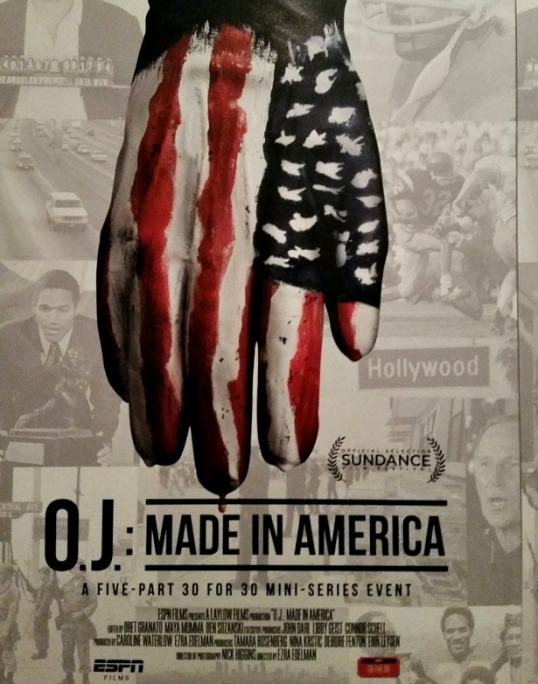
“O.J.: Made in America,” Laylow Films and ESPN Films
“13th,” Forward Movement
“Tower,” Go-Valley
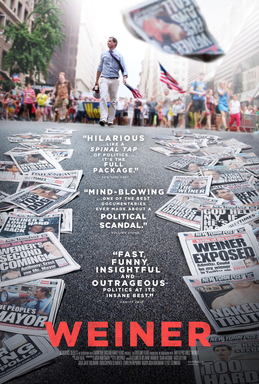
“Weiner,” Edgeline Films
“The Witness,” The Witnesses Film
“Zero Days,” Jigsaw Productions

Weiner_(film)

The International Documentary Association Honors O.J.: Made in America!


Here’s what won at the International Documentary Association Awards!  This has been a really good year for documentaries, as is evident from the list below!

Best Feature Award
“O.J.: Made in America”
Director: Ezra Edelman
Producers: Deirdre Fenton, Libby Geist, Nina Krstic, Erin Leyden, Tamara Rosenberg, Connor Schell and Caroline Waterlow

Best Short Award
“The White Helmets”
Director: Orlando von Einsiedel
Producer: Joanna Natasegara

Best Curated Series Award
“DR2 Dokumania”
Executive Producer: Mette Hoffmann Meyer

Best Limited Series Award
“Making a Murderer”
Executive Producers: Moira Demos and Laura Ricciardi

Best Episodic Series Award
“Last Chance U”
Executive Producers: Joe LaBracio, Dawn Ostroff, Lucas Smith, James Stern and Greg Whiteley

Best Short Form Series Award
“Field of Vision”
Executive Producers: Charlotte Cook, Laura Poitras and AJ Schnack

David L. Wolper Student Documentary Award
“4.1 Miles”
Director: Daphne Matziaraki (UC Berkeley Graduate School of Journalism)

ABC News VideoSource Award
“13TH”
Director: Ava DuVernay

Pare Lorentz Award
“Starless Dreams”
Director: Mehrdad Oskouei

Best Cinematography
“Fire at Sea”
Cinematography by: Gianfranco Rosi

Best Editing
“Cameraperson”
Edited by: Nels Bangerter

Best Writing
“I Am Not Your Negro”
James Baldwin material compiled and edited by Raoul Peck

Best Music
“The Bad Kids”
Original Score by: Jacaszek

Playing Catch-Up With Two Documentaries: 3 1/2 Minutes 10 Bullets and The Wolfpack


312 minutes

3 1/2 Minutes Ten Bullets (Dir by Marc Silver)

On November 23rd, 2012, an SUV pulled up to a gas station in Jacksonville, Florida.  Inside the SUV were four teenage boys, all of whom were black.  A car pulled up next to the SUV.  Inside the car was a man and his girlfriend.  They were both white.

The man was named Michael Dunn and reportedly, he was annoyed by the loud rap music that was being played in the SUV.  He told his girlfriend that he hated “thug music.”  He got out of his car and asked them to turn down the music.  What happened next depends on who you ask.  The driver of the SUV says that he turned down the music but then his friend, Jordan Davis, turned it back up.  Michael Dunn claims that Jordan Davis opened a door and pointed something at him that looked like a shotgun.

What everyone agree on is that Dunn grabbed his own gun and proceeded to fire it into the SUV, killing Jordan Davis.  Everyone also agrees that no shotgun was ever found in the SUV.

Michael Dunn was tried for the murder of Jordan Davis and the attempted murder of the other three teenagers.  Dunn claimed he was acting in self-defense.  He was “standing his ground.”  Dunn’s first murder trial ended in a mistrial.  His second trial ended with his conviction.

3 1/2 Minutes Ten Bullets was filmed during the two trials and it is infuriating.  Though Michael Dunn was not interviewed for the film, we do hear recordings of some of the calls he made to his girlfriend while he was in prison and it is chilling to listen to him as he continues to insist that he did nothing wrong.  Even when confronted by the fact that no shotgun was found in the SUV, Dunn continues to insist that the four teenagers had to have been armed.  After all, he says, they were listening to “thug music!”  If you had any doubt about the type of person Michael Dunn was before watching this documentary and hearing his voice, that doubt will be gone after watching 3 1/2 Minutes.

Even more importantly, 3 1/2 Minutes features extensive interviews with Jordan’s friends and family, all of whom express their sadness and anger with such articulation that it’s impossible not to get infuriated when Dunn and others casually dismisses them as being “thugs.”

3 1/2 Minutes is a powerful and moving documentary that should be seen by anyone who is interested in taking a serious look at race in America.

Wolfpack_film_poster

The Wolfpack (dir by Crystal Moselle)

I had mixed feelings about The Wolfpack.

On the one hand, The Wolfpack is a fascinating story about seven siblings who — after spending 14 years locked away in a New York apartment — finally start to enter the real world.  Everything that the siblings know about the world, they learned through the movies.  Inside the apartment, they obsessively recreate their favorite movies, with an elaborate production of Pulp Fiction being a definite highlight.  When they go out into the real world, they do so dressed like the characters from Reservoir Dogs.

(Except, of course, for the one time that one of them goes out while dressed like Michael Myers from Halloween.  That leads to some trouble with the authorities…)

Watching these brothers (and one sister) as they talked about their unconventional childhood and as they discovered what the world was like outside of their apartment, it was impossible for me not to be moved.  I was touched by their love for each other and I related to their obsession with the movies.  I hoped that they would survive in the outside world.  I was happy for them but, at the same time, I was scared for them.  I knew that their new opportunities would come with a certain loss of innocence.

At the same time, it frustrated me that less time was spent on the circumstances that led to them never leaving that apartment for 14 years.  Or, perhaps, I should say that it angered me that they didn’t seem to be as angry as I was.  The father was obviously mentally ill and, while it would be easy to just dismiss him as a monster, I couldn’t help but feel that the truth was perhaps a bit more complex.

The Wolfpack is a fascinating documentary and it’s currently available on Netflix!

Playing Catch-Up With 6 Documentary Reviews: Packed In A Trunk: The Lost Art of Edith Lake Wilkinson, Requiem For The Dead: American Spring 2014, A Symphony of Summits: The Alps From Above, The Thread


Here are reviews of 6 documentaries that I saw in 2015:

Packed In A Trunk: The Lost Art of Edith Lake Wilkinson (dir by Michelle Boyaner)

In 1924, painter Edith Lake Wilkinson was committed to an insane asylum and lived the rest of her life in sad obscurity.  As a result of Edith’s commitment, her artwork never received the recognition it deserved.  That’s the idea behind this documentary, which follows Edith’s great-great niece as she researches Edith’s life and tries to get the art world to acknowledge Edith’s talent.  As an art history major, I really wanted to like this documentary but, unfortunately, it focused more on the self-important niece than on the artwork.  Matters were not helped by a lengthy visit with a psychic who claimed to have “contacted” Edith’s spirit.  For the most part, this was a missed opportunity.

Requiem for the Dead: American Spring 2014

This film takes a look at the hundreds of people who were murdered by someone using a gun during the Spring of 2014.  Some of the cases are examined in detail while other victims only appear for a second or two, quickly replaced by another tragedy.  The cases are recreated through 911 calls, news reports, and occasionally interviews.  It makes for sobering and sad viewing though, at the same time, it works better an indictment of our sick culture than as a call for greater gun control.

Southern Rites (dir by Gillian Laub)

Photographer Gillian Laub comes down to Montgomery County, Georgia, in order to take pictures of the town’s first integrated prom.  She sticks around to film the trial of an old white man who shot and killed a young black man.  The film has good intentions and it’s obvious that Laub is convinced that she has something important to say that hasn’t been said before but, especially when compared to the superior and thematically similar 3 1/2 Minutes, it quickly becomes obvious that neither she nor the film can offer up any new insight as far as racism in America is concerned.

A Symphony of Summits: The Alps From Above (dir by Peter Bardehle and Sebastian Lindemann)

A Symphony of Summits, which is currently available on Netflix, is basically 94 minutes of aerial footage of the Alps.  A Symphony of Summits was originally made for German television and the English-language narration track has a blandly cheerful, touristy feel to it that often doesn’t go along with the imposing images and the occasionally bloody events being discussed.  (The history of the Alps is not necessarily a peaceful one.)  My advise would be to turn down the sound, put on your favorite music, and just enjoy the beauty of the images.

Thought Crimes: The Case of the Cannibal Cop (dir by Erin Lee Carr)

Thought Crimes tells the story of Gilberto Valle, a New York Cop who, in 2013, was convicted, on the basis of comments that he made online about plotting to kidnap and eat a woman.  Valle claimed that he was just sharing a fantasy and that he had no intention of following through.  Eventually, a judge agreed with him and his conviction was overturned.  This disturbing and creepy documentary features extensive interviews with Vallee (who literally made my skin crawl) and examines some of the darkest corners of the internet.  Many times in the documentary, Vallee claimed that he would never actually hurt anyone and I didn’t believe him for a second.  (As a cop, Vallee accessed the police database to look up info on a woman he was fantasizing about abducting and cannibalizing.)  That said, Thought Crimes still raised some interesting issues about the internet as an outlet for fantasy and how seriously we should take it as an indicator for real world actions.  There are no easy answers.

The Thread (dir by Greg Barker)

The Thread is a 61 minute documentary about the Boston Marathon Bombing and how a group of wannabe detectives used Reddit and twitter to wrongly accuse a missing graduate student of being one of the bombers.  It’s interesting and occasionally cringe-inducing viewing experience, even if it really doesn’t offer up much original insight.  (Documentarians are always quicker to bemoan the rise of new media than to seriously investigate why old media collapsed in the first place.)  Among those interviewed about the rush to find a suspect is Sasha Stone, the founder and editor of AwardsDaily and yes, she is just as annoying and smugly self-important as you would expect.  (Thankfully, they did not interview Ryan Adams.)