Lisa Reviews An Oscar Winner: Gentleman’s Agreement (dir by Elia Kazan)


Earlier today, as I was watching the 1947 film, Gentleman’s Agreement, I found myself thinking about a conversation that I had in 2006.

This was when I was in college.  I was having lunch with some friends from one of my classes.  As we were eating, the conversation turned to the war in Iraq.  That, in itself, was not surprising because, in 2006, it seemed like every conversation somehow turned to what was happening in the Middle East.

One of the people with whom I was having lunch was Olivia, self-styled intellectual who fancied herself as the most knowledgeable person on campus.  To be honest, I can’t think of anyone who liked her that much but she had a skill for subtly weaseling her way into almost every conversation.  She was one of those incredibly pretentious types who started every sentence with “Actually….” and who had embraced Marxism with the shallow vapidness of someone who had grown up in Highland Park and who would never have to struggle to pay a bill.

On that day, Olivia announced to us all that the only reason we were in Iraq was because we were doing the bidding of Israeli lobbyists and then she went on to talk about how 9-11 was an inside job.  She repeated the old lie about Jews calling in sick on 9-11 and claimed that five MOSSAD agents were arrested in New York for celebrating after the collapse of the Twin Towers.

After Olivia said this, there was the briefest silence as everyone else tried to figure out how to react.  Finally, someone tried to change the subject by making a joke about our professor.  Realizing the no one was going to openly disagree with Olivia and risk an argument, I said, “That’s not true.”

“What’s not true?” Olivia asked.

“About Jewish people calling in sick on 9-11 and celebrating after the Towers fell.  That’s not true.”

Olivia looked a little bit surprised that she was being openly challenged.  Finally, she said, in a surprisingly sincere tone of voice, “I’m sorry.  I didn’t realize you were Jewish.”

I’m not Jewish.  I’m Irish-Italian-Spanish and pretty much all of my immediate ancestors were Catholic.  But, as far as Olivia was concerned, I had to be Jewish because why else would I object to her repeating an anti-Semitic conspiracy theory?  When she apologized (and, make no mistake, there was not a hint of sarcasm in her tone when she said she was sorry), it wasn’t for being a bigot.  Instead, it was for being a bigot in front of the “wrong” person.  It didn’t occur to her that I was upset because what she said was bullshit.

Anyway, I wish I could say that I threw a drink in Olivia’s face or that I stood up on the table and delivered an impassioned speech but, once again, the other people at the table hastily changed the subject.  Anything to avoid a conflict, I suppose.  That was the last time I ever had a conversation with Olivia.  For the rest of the semester, I ignored her and I felt pretty proud of myself for shunning her.  It’s only been recently that I realized that Olivia also didn’t really make any effort to really talk to me after that conversation.  I shunned her because of her bigotry and I can only assume that she shunned me because of her misconception about my ancestry.

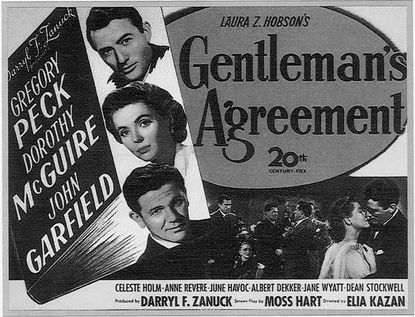
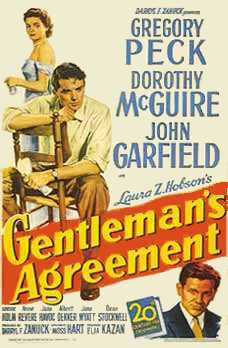
Gentleman’s Agreement is about a Gentile reporter named Phillip Green (Gregory Peck) who, while researching a story about anti-Semitism, poses as a Jew and discovers that the world is full of people like Olivia.  His own fiancee, a self-declared liberal named Kathy (Dorothy McGuire), reacts to Phil’s plan by asking him, “But you’re not really Jewish …. are you?”  By the simple act of telling everyone that his last name is actually “Greenberg,” Phil discovers that he suddenly can’t get a hotel reservation.  People stop returning his calls.  When he and Kathy have an engagement party in a wealthy community in Connecticut, many of Kathy’s friends stay away.  (Kathy, meanwhile, begs Phil to let her tell her family that she’s not actually engaged to a Jew.)  When Phil’s son, Tommy (Dean Stockwell), is harassed at school, Phil is shocked to hear Kathy tell Tommy that he shouldn’t listen to the bullies not because they’re a bunch of bigots but because “you’re not actually Jewish.”

Meanwhile, Phil’s friend, Dave Goldman (John Garfield), has returned from serving in World War II, just to discover that he can’t even rent a home for his family because many landlords refuse to rent to Jews.  When Phil learns that Katy owns a vacant cottage, he suggests that she rent it out to Dave.  Despite her sympathy for Dave, Kathy is shocked at the suggestion.  What will the neighbors think?

Gentleman’s Agreement was produced by Darryl F. Zanuck, who took on the project after he was refused membership in the Los Angeles Country Club because the membership committee assumed that Zanuck was Jewish.  It was considered to be quite a controversial film in 1947, as it not only dealt with American prejudice but it also called out two prominent elected anti-Semites — Sen. Theodore Bilbo and Rep. John E. Rankin — by name.  Zanuck often claimed that the other studio moguls asked him to abandon the project, saying that a film would only inspire more of what it was trying to condemn.  Still, Zanuck stuck with the project and it was not only a box office hit but it also won the Oscar for Best Picture.

Seen today, Gentleman’s Agreement has its flaws.  In the lead role, Gregory Peck is a bit of a stiff and Elia Kazan’s directs in an efficient but bland manner.  Because this film was made in 1947 and a happy ending was a must, Kathy is given a rather convenient opportunity at redemption.  The film’s most compelling performers — John Garfield, Celeste Holm, and June Havoc (playing Phil’s Jewish secretary, who had to change her last name before anyone would even consider hiring her) — are often underused.

And yet, with all that in mind, Gentleman’s Agreement is still a very effective film.  Gentleman’s Agreement understand that there’s more to prejudice than just the morons who go to rallies or the degenerates who shout slurs across the street.  Gentleman’s Agreement understands that, for prejudice to thrive, it also needs people like Kathy or Olivia, people who have that prejudice so ingrained in their system that they don’t even think twice about it and Dorothy McGuire does a very good job of playing a self-satisfied liberal who is blind to her own prejudice.  Gentleman’s Agreement understands that bigotry isn’t just about the openly hateful.  It’s also about the people who silently tolerate it and who refuse to stand up against it.  It’s about the people who respond to prejudice not with outrage but who instead attempt to change the subject.

In the UK, one of the two major political parties has basically surrendered itself to anti-Semitism.  Here in the US, Congress can’t even bring itself to condemn the frequently anti-Semitic comments of two of its members.  Elected leaders and pundits only offer up the weakest of condemnation when Jewish people are viciously attacked in the streets.  When a man attacked a group of Jews on Hanukkah, many excused the man’s attack by trying to say that he was just upset about  gentrification.  For many reasons, Gentleman’s Agreement is still relevant and important today.

Horror on the Lens: The Failing of Raymond (dir by Boris Sagal)


Raymond (Dean Stockwell) has just escaped from a mental hospital and he has only one thing on his mind.  Raymond wants revenge.  Having looked over the past events of his life, Raymond has figured out that things started to go downhill for him when he failed a test in high school.  He blames his failure on his old teacher, Mary Bloomquist (Jane Wyman).

At the same time that Raymond is escaping, Mary is planning her retirement.  She’s decided that she no longer wants to teach.  The job just doesn’t seem worth it anymore.  But Raymond has other ideas.  Raymond wants her to give him the same test that he failed ten years before.  And this time, Raymond wants her to pass him or else.

The Failing of Raymond is a made-for-TV movie from 1971 and it features a good performance from Jane Wyman and a great one from Dean Stockwell.  The film ultimately hinges on one question.  Did Raymond really fail that test or did Mary fail Raymond?

Enjoy!

Film Review: Tracks (1977, dir by Henry Jaglom)


The 1977 film, Tracks, opens somewhere in America.

Jack Falen (Dennis Hopper) sits on a bench, waiting for a train.  He’s wearing a military uniform.  He claims that he’s a 1st sergeant.  He claims that he’s just returned from Vietnam.  He’s traveling with a flag-draped coffin.  He says that the coffin contains the remains of his best friend from Nam.  Jack is accompanying the coffin back to his friend’s hometown.  Jack says that he’s going to make sure that his friend gets a proper burial.

From the minute we meet Jack, we get the feeling that there’s something off about him.  He’s a little bit too quick to smile and, when he laughs, it’s the guttural sound of someone who has learned how to show joy by watching other people but who has perhaps never felt it himself.  Sometimes, he’s quiet.  Sometimes, he is loquacious and verbose.  When he does speak, he rarely looks anyone in the eyes.  Jack is jumpy, as if he’s constantly afraid that he’s about to be exposed as a liar.

Soon, Jack is riding a train across the country.  While the rest of the passengers look out the windows and takes in the American landscape, Jack nervously wanders around the train.  He gets involved in a regular chess game.  He befriends a mysterious man named Mark (Dean Stockwell).  He starts a tentative relationship with a student named Stephanie (Taryn Power).  He tells anyone who will listen that he’s traveling with the body of his best friend.  When a black Korean war vet complains that Jack is acting like he’s the only person who lost a friend in a war, an offended Jack replies that his friend was black.

Jack sees things.  When he sees that the other passengers are assaulting Stepanie, he pulls out a small gun and aims it at the back of the train, just to suddenly realize that Stephanie is sitting unbothered at the back of the train.  While we know that Jack was hallucinating the attack on Stephanie, we still wonder if he really pulled out that gun.  If he did, no one else seems to have noticed.

Sometimes, the passengers say things to Jack that don’t seem to make any sense, leaving Jack staring at them in confusion.  Other times, Jack sees dark figures walking through the train.  At night, he wanders around naked.  Jack spends the trip watching the other passengers with a slightly dazed look on his face.  He plays chess with a man who later insists that he’s never played chess with Jack.  Sometimes, he thinks that he and Stephanie are outside of the train.  When Mark approaches Jack and asks for help, Jack explains that he can’t help anyone.  While a soundtrack of old World War II propaganda songs thunders in the background, Jack struggles to keep track of what’s real and what isn’t.

And so does the audience.  As we watch, it occurs to us that Jack’s stories about Vietnam don’t really seem to add up.  Add to that, we never actually saw Jack board the train.  Instead, we saw him sitting on a bench and waiting for the train.  We’re left to wonder if the train’s real or if the whole movie is just a figment of Jack’s damaged imagination.  And what about the coffin?  Tracks is full of unanswered questions but, in the film’s incendiary final moments, we do learn the truth about that coffin … maybe.

Henry Jaglom has been making independent films for several decades now.  Tracks is one of his better films, if just because Jaglom’s loose, seemingly improvised style actually works well at communicating Jack’s own struggle to keep up with what’s really happening and what he’s imagining.  As deceptively random as the film’s collections of scenes may appear, it’s all anchored by Dennis Hopper’s wonderfully unhinged performance.  Hopper brings a method actor’s intensity to Jack’s struggle to not only keep straight what’s real and what isn’t but also to keep his fellow passengers from understanding that he’s deeply unbalanced.  This film was made during Hopper’s drug-fueled lost years and he plays Jack like a man who is desperately trying to keep the world from seeing that he’s in the throes of withdrawal.  Unlike Hopper, Jack’s addiction isn’t to drugs.  Instead, Jack’s addicted to war, or at the very least his obsession with war.  (By the end of the movie, you have your doubts about whether Jack’s ever been to Vietnam or not.)  The use of World War II propaganda songs on the soundtrack may occasionally get annoying but they actually play up the contrast between our often simplistic view of war and the far more complex reality.

If nothing else, I would recommend Tracks for Hopper’s performance.  As well, since he co-stars with Dean Stockwell, it’s easy to imagine Tracks as being a bit of a prequel to Blue Velvet.  Who’s to say that Jack Falen didn’t change his name to Frank Booth?

Guilty Pleasure No. 36: The Legend of Billie Jean (dir by Matthew Robbins)


Two weeks ago, while I was sick in bed, I watched The Legend of Billie Jean, a deeply silly movie from 1985.

Okay, get this.  Billie Jean (Helen Slater) and her younger brother, Binx (an incredibly young Christian Slater), live in Corpus Christi, Texas.  Binx has always wanted to go to Vermont.  That right there should tell you just how silly this movie is.  Not only does it feature a character named Binx but it also features Texans wanting to go to Vermont.  I’m a native Texan who loves to travel but I can tell you right now that the last place I would ever want to go would be Vermont.  In fact, down here, we tend to assume that Vermont’s just a place that was made up by the media.  Bernie Sanders?  He’s just an actor.  Seriously, there’s no way that Vermont actually exists.

Anyway, after Binx throws a milkshake in the face of local bully, Hubie Pyatt (Barry Tubb), Hubie steals Binx’s scooter.  (If you’re stuck with a name like Hubie Pyatt, it seems kinda predestined that you’re going to grow up to be a bully.)  After getting nowhere with the police, Billie Jean returns home to discover that Binx has been beaten up and his scooter has been dismantled.  Billie Jean goes to Hubie’s father (Richard Bradford) to demand some money to get the scooter fixed.  Mr. Pyatt responds by attempting to assault Billie Jean, which leads to Binx shooting Mr. Pyatt in the shoulder.

So now, Billie Jean and Binx are on the run.

Joining them in their flight are two idiot friends (Martha Gehman and Yeardley Smith) and Lloyd (Keith Gordon), the son of the local district attorney.  Because this is a movie, Billie Jean quickly becomes a media superstar.  Everyone wants to meet Billie Jean.  Everyone wants to help Billie Jean.  A sympathetic police detective (Peter Coyote) is determined to capture Billie Jean without violence but that might be difficult with the media constantly getting in the way.

While hiding out in a motel, Billie Jean turns on the TV and watches the classic 1928 silent film, The Passion of Joan of Arc.  (I have to say that I’ve stayed in a few motels around Corpus Christi and never once did I turn on the TV and just happen to come across a classic silent movie.)  Moved by Renee Falconetti’s performance in the lead role, Billie Jean decides to cut her hair really, really short (though not as short as Falconetti’s).  I guess Billie Jean is supposed to be a 1980s version of Joan of Arc, which really doesn’t make any sense.  I mean, Joan of Arc heard the voice of God and led the French to victory over the British.  Billie Jean is just trying to get some money to get her brother’s scooter fixed and pay for a trip to the imaginary state of Vermont.

Meanwhile, Mr. Pyatt has recovered from his wounds and is now selling Billie Jean merchandise in his store.  The detective mentions how weird that is but Mr. Pyatt is just out to make some money.  Can you blame him?  The entire country is obsessed with Billie Jean!

As you might have guessed, The Legend of Billie Jean is incredibly silly but likable.   Despite having an inconsistent Texas accent, Helen Slater does a good job in the lead role of Billie Jean and it’s interesting to actually see Christian Slater before he developed the sarcastic style that, for better or worse, has come to define pretty much all of his performances.  Never for a second do you believe that Billie Jean would actually become a media superstar.  (Nor do you ever believe that she’s the type who would have the patience to watch a silent movie.)  I mean, when you get right down to it, it’s a pretty dumb movie.  But, when you’re sick in bed, The Legend of Billie Jean is a perfectly acceptable way to pass the time.

Previous Guilty Pleasures

  1. Half-Baked
  2. Save The Last Dance
  3. Every Rose Has Its Thorns
  4. The Jeremy Kyle Show
  5. Invasion USA
  6. The Golden Child
  7. Final Destination 2
  8. Paparazzi
  9. The Principal
  10. The Substitute
  11. Terror In The Family
  12. Pandorum
  13. Lambada
  14. Fear
  15. Cocktail
  16. Keep Off The Grass
  17. Girls, Girls, Girls
  18. Class
  19. Tart
  20. King Kong vs. Godzilla
  21. Hawk the Slayer
  22. Battle Beyond the Stars
  23. Meridian
  24. Walk of Shame
  25. From Justin To Kelly
  26. Project Greenlight
  27. Sex Decoy: Love Stings
  28. Swimfan
  29. On the Line
  30. Wolfen
  31. Hail Caesar!
  32. It’s So Cold In The D
  33. In the Mix
  34. Healed By Grace
  35. Valley of the Dolls

Halloween Havoc!: THE DUNWICH HORROR (AIP 1970)


gary loggins's avatarcracked rear viewer

THE DUNWICH HORROR is another film I saw when it was first released, on a double bill with the Spaghetti Western GOD FORGIVES, I DON’T. Unfortunately, this one fails to stand the test of time, with it’s trippy special effects and a somnambulant performance by Dean Stockwell , who was pretty obviously stoned out of his gourd during the shooting.

Professor of the occult Henry Armitage is lecturing on the Necronomicon, a book said to hold the key to the gate to another dimension, where a race of monsters known as “the old ones” dwell. Creepy Wilbur Whateley, great grandson of occultist Oliver, shows an abonrmal interest in the book. In fact, Wilbur wants to possess the Necronomicon to bring “the old ones” back to rule the Earth once again. To achieve this, he pretty much kidnaps and drugs student Nancy Wagner, hoping to use her in a bizarre sex…

View original post 363 more words

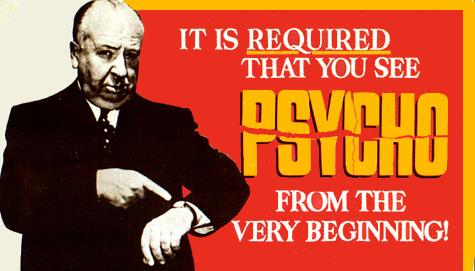
Horror Book Review: Alfred Hitchcock and The Making of Psycho by Stephen Rebello


57 years after it was first released, Alfred Hitchcock’s Psycho remains one of the most influential films ever made.

Certainly, every horror film ever released since 1960 owes a debt to Psycho.  The infamous shower scene has been duplicated so many times that I’ve lost count.  Whenever a big-name actor is unexpectedly killed during the first half of a movie, it’s because of what happened to Janet Leigh in that shower.  If not for Psycho, Drew Barrymore would have survived Scream and that shark would never have eaten Samuel L. Jackson in Deep Blue Sea.  Every giallo film that has ended with someone explaining the overly complex psychological reasons that led to the killer putting on black gloves and picking up a scalpel owes a debt to Simon Oakland’s monologue at the end of Psycho.  Psycho is so influential and popular that, decades later, A&E could broadcast a show called Bates Motel and have an instant hit.

What goes into making a classic?  That is question that is both asked and answered by Stephen Rebello’s Alfred Hitchcock and The Making of Psycho.  Starting with the real-life crimes of Ed Gein, Rebello’s book goes on to examine the writing of Robert Bloch’s famous novel and then the struggle to adapt that novel for the screen.

This book is a dream for trivia lovers.  Ever wanted to know who else was considered for the role of Marion Crane or Sam Loomis or even Norman Bates?  This is the book to look to.  Read this book and then imagine an alternate world where Psycho starred Dean Stockwell, Eva Marie Saint, and Leslie Neilsen?

(That’s right.  Leslie Neilsen was considered for the role of Sam Loomis.)

The book also confronts the controversy over who deserves credit for the shower scene, Alfred Hitchcock or Saul Bass.  And, of course, it also provides all the glorious details of how Hitchcock handled the film’s pre-release publicity.  Ignore the fact that this book was cited as being the inspiration for the rather forgettable Anthony Hopkins/Helen Mirren film, Hitchcock.  This is a fascinating read about a fascinating movie and a fascinating director.

First published in 1990 and still very much in print, Alfred Hitchcock and The Making of Psycho is a must-read for fans of film, horror, true crime, history, Alfred Hitchcock, Anthony Perkins, Janet Leigh, and Psycho.

Turn That Frown Upside Down With ANCHORS AWEIGH (MGM 1945)


gary loggins's avatarcracked rear viewer

anchors1

(Post-election blues got you depressed? Cheer up, buttercup, here’s a movie musical guaranteed to lift your sagging spirits!) 

Gene Kelly  and Frank Sinatra’s first screen pairing was ANCHORS AWEIGH, a fun-filled musical with a Hollywood backdrop that’s important in film history for a number of reasons: it gave Kelly his first chance to create his own dance routines for an entire film, it’s Sinatra’s first top-billed role (he was red-hot at the time), it gives viewers a glimpse of the MGM backlot in the Fabulous 40’s, and it features the iconic live action/animation dance between Kelly and Jerry the Mouse (of TOM & JERRY fame). It’s a showcase of Hollywood movie magic, and was nominated for five Academy Awards, including Best Picture, Actor (Kelly), Color Cinematography (Charles P. Boyle), and Song (Jule Styne & Sammy Cahn’s ” I Fall in Love Too Easily”), winning for George Stoll’s Best Original…

View original post 798 more words

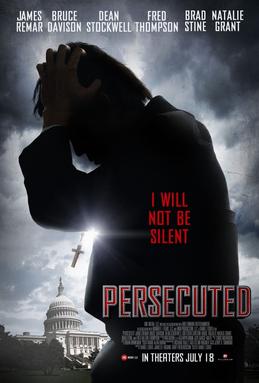
Shattered Politics #94: Persecuted (dir by Daniel Lusko)


Persecuted-2014-poster

It may seem strange that I would choose to end my series of reviews of films that feature politics and politicians by reviewing Persecuted, an obscure film from 2014.  After all, Shattered Politics started out with D.W. Griffith’s Abraham Lincoln.  Over the past three weeks, I’ve reviewed everything from Mr. Smith Goes To Washington to The Phenix City Story to Dr. Strangelove to The Godfather to Nashville to Once Upon A Time In America to The Aviator.  I have been lucky enough to review some of the greatest films ever made.  And now, at the end of this series, I find myself reviewing Persecuted, a film that has a score of 0% over on Rotten Tomatoes.

Consider that for a moment.

As I sit here typing out this sentence, not a single critic has given Persecuted a good review.  And I will admit right now that I’m not going to be the first.  Persecuted is cheap-looking, heavy-handed, melodramatic, histrionic, foolish, silly, preachy, predictable, strident, and just about every other possible criticism that comes to mind.  If the film is redeemed by anything, it’s that it is full of good actors who do the best that they can with characters that are either seriously underwritten or ludicrously overwritten.

Persecuted takes place in the near future.  Sen. Donald Harrison (Bruce Davison) has written something called the Faith and Fairness Act, which would basically require churches to provide equal time to other religions and would make it illegal to suggest that only one religion has all the answers.  How exactly that would work, I’m not sure.  However, a big part of Harrison’s bill is that, in exchange for giving up any claim to having all the answers, churches will now get money from the federal government.  As a result, a lot of church leaders have sold out and announced their support for the bill.

However, evangelist John Luther (James Remar) refuses to support the bill.  As we’re told when Luther first appears, he’s a recovering alcoholic and drug addict who used to be a professional gambler.  But then he found faith and he’s now the most popular man in the country.  Or, at least, he is until he’s drugged by the government and framed for murdering a prostitute.

So now, Luther is on the run.  He has to evade capture, prove his innocence, and reveal the truth about Harrison and his shadowy backers.  Helping Luther out is his father, an Episcopalian priest who is played by former real-life Presidential candidate Fred Thompson.  (Thompson, incidentally, is a very good actor and brings a lot of conviction and authority to his role.)  Not helping Luther are the former leaders of his church, one of whom is played by character actor Dean Stockwell.

I’ll admit right now that, as familiar and talented as all four of them may be, James Remar, Bruce Davison, Fred Thompson, and Dean Stockwell are hardly big stars and you really can’t blame any of them for presumably taking a job strictly for the money.  That said, it’s still odd to see such good actors appearing in a film like Persecuted and they all deserve at least a little bit of credit for doing their best with the material that they had to work with.  However, my favorite performance came from Brad Stine, who plays glib preacher who betrays Luther.  Stine is just so sleazy and hyperactive that he’s a lot of fun to watch.

Now, while Persecuted is obviously a faith-based film, it’s plot actually has more in common with the paranoia movies of the 70s than it does with Left Behind.  John Luther is a guy who knows the truth and has been framed as a result and he spends nearly the entire film on the run.  If anything, this is a film that will probably appeal more to conspiracy theorists than to Christians.  But, judging from the film, the conspiracy that’s trying to destroy John Luther doesn’t appear to be very competent.  How else do you explain that John Luther — the most famous man in the world — manages to easily evade capture despite the fact that he spends most of the film wandering around in broad daylight with dried blood on his face.  At one point, he even calls his wife and has a conversation with her.  “Ah!” I thought, “this is where we’ll discover that the conspiracy is listening in on the conversation!”  But no, that didn’t happen.  In fact, his wife talked to him while, in the background, two cops searched their house.  “The police are looking for you,” the wife says but neither one of the police officers seems to hear her.  Apparently, it didn’t seem to occur to any of them that John Luther might call his wife.  For a paranoia film to work, you have to feel like the film’s hero is in constant danger and Persecuted never succeeded in doing that.  How can anyone be scared of a conspiracy that can’t even handle the basics?

Persecuted is not a good film but, in its own unfortunate way, it is a relevant one.  Much as how the first film I reviewed for Shattered Politics, D.W. Griffith’s Abraham Lincoln, told us a lot about America in the 1930s, Persecuted tells us a lot about how America is viewed by its citizens in the 21st Century.  Persecuted is a film that insists that our leaders can’t be trusted, that your friends will betray you if ordered to do so by those in authority, and that everything bad will come disguised as something good.  It’s not exactly an optimistic view of politics or America but then again, these are the times that we live in.  It’s been a long time since Billy Jack went to Washington.  It’s been even longer since Mr. Smith first showed up.

Now, instead, all we have is Bruce Davison telling us, “You thought you were bigger than the system and you’re not!”

And, on that note, Shattered Politics comes to an end!  I’ve had a lot of fun writing this series of 94 reviews and I hope that you’ve enjoyed reading them!  If there’s any conclusion that I think can be drawn from these 94 films, it’s that politicians will always betray you and politics will always depress you but movies will always be there to lift you back up.

If I had to choose between voting and watching a movie, I would pick a movie every time.  Fortunately enough, I live in a country where I am allowed to do both.

Shattered Politics #32: The Werewolf of Washington (dir by Milton Moses Ginsberg)


Werewolf of Washington (1973)

First released in 1973, The Werewolf of Washington is one of those obscure films that always seems to pop up in Mill Creek box sets.  That’s largely because Werewolf of Washington has slipped into the public domain and anyone can release and sell a copy of it.  (It’s also been uploaded to YouTube by a few hundred different users.)  It’s a film that I’ve actually watched quite a few times, largely because it is so easily available.

Which doesn’t necessarily mean that it’s any good.  I have to admit that, in between viewings, I always seem to convince myself that The Werewolf of Washington is a better film than it actually is.  The idea behind the film sounds clever.  The President’s press secretary (played by Dean Stockwell) is a werewolf.  When the full moon shines, he transforms and wrecks havoc on the streets on D.C.  Stockwell still wears his suit, even when he’s a wolfman.  The President (played by Biff McGuire) is a total idiot who spends a lot of time bowling.  The Attorney General (Clifton James) is a paranoid fascist who is quick to blame the werewolf’s murders on outside agitators.  For no particular reason, a dwarf mad scientist (Michael Dunn) shows up.

Yes, the idea is clever but the execution … actually, the execution is not terrible.  Dean Stockwell gives a good performance and there’s a funny scene where he starts to turn into a werewolf while bowling with the President.  Stockwell’s fingers swell up and get stuck in the bowling ball and Stockwell totally freaks out.  And then there’s a scene where the werewolf attacks a woman in a phone booth and it’s actually rather suspenseful and almost scary.  Plus, Biff McGuire is great and all too plausible as the vapid President.

And yet, overall, the film itself is never as good as you want it to be.  I think a large part of the problem is that the film opens with a long voice over from Dean Stockwell, which explains why his character ended up in Budapest (that would be where he gets bitten by the werewolf) and why the President subsequently named him press secretary.  It’s so much backstory that you get the feeling that the opening narration must have been added in post production in order to cover up scenes that either did not work or that the film’s director never got a chance to shoot.

And really, the entire film is like that.  The film is a collection of scenes that never really flow together or establish any sort of steady pace.  And, when it comes to both horror and comedy, pace is key.

The Werewolf of Washington is a clever idea.  I just wish the execution had been just as clever.

And I’ll probably continue to wish that the next time that I rewatch it.

The_Werewolf_of_Washington_FilmPoster


Horror on TV: Night Gallery 3.13 “Whisper”


night-gallery-season-3-13-whisper-sally-field

For tonight’s televised horror on the lens, we have another episode of the Night Gallery.  In Whisper, a mentally unstable woman played by Sally Field believes that she can talk to ghosts.  Her husband, played by Dean Stockwell, spends all of his time driving her to cemeteries and allowing her to commune with the dead.  Is he merely humoring her or does he believe as well?

You’ll have to watch to find out!

Whisper was originally broadcast on May 13th, 1973.