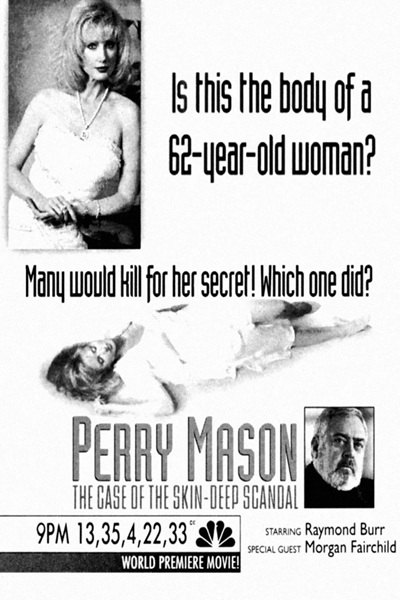
Alana Westbrook (Morgan Fairchild), the ruthless owner of a cosmetics company, is murdered after she announces that she is actually 60 years old and owes her youthful appearance to a miracle skin cream. Her husband (Patrick O’Neal) is charged with the crime but he’s lucky enough to have Perry Mason (Raymond Burr) as his attorney. Perry thinks that the murderer is an eccentric gigolo (David Warner) but, for once, Perry might be wrong. Meanwhile, Ken Malansky (William R. Moses) gets involved with a corporate spy (Lauren Lane) who might know more than she says.
Lisa and I watched this one earlier today. We really enjoyed it! It’s the most soapy of all the Perry Mason films that I’ve watched so far. Morgan Fairchild was great as the murder victim and all of the suspects were enjoyably weird. What I really enjoyed about this movie was that it featured people who appeared, in different roles, in other Perry Mason films. Patrick O’Neal went from being the victim in Perry Mason Returns to being the accused here. David Warner went from being the victim in The Case of the Poisoned Pento being a suspect here. This was also a second Perry Mason film for Jonathan Banks but instead of being a tough guy like he was the first time, he was a skin cream creator this time. This movie understood that people will kill for clear skin.
This was one of the last of Raymond Burr’s Perry Mason films (it aired the same year that he died) and, with the returning actors, it feels like a tribute to Burr and the role that he made his own.
“There are things within a soul that can never be unleashed… They would consume us. We would cease to be, and another would exist in our place, without control, without limits.” — Vanessa Ives
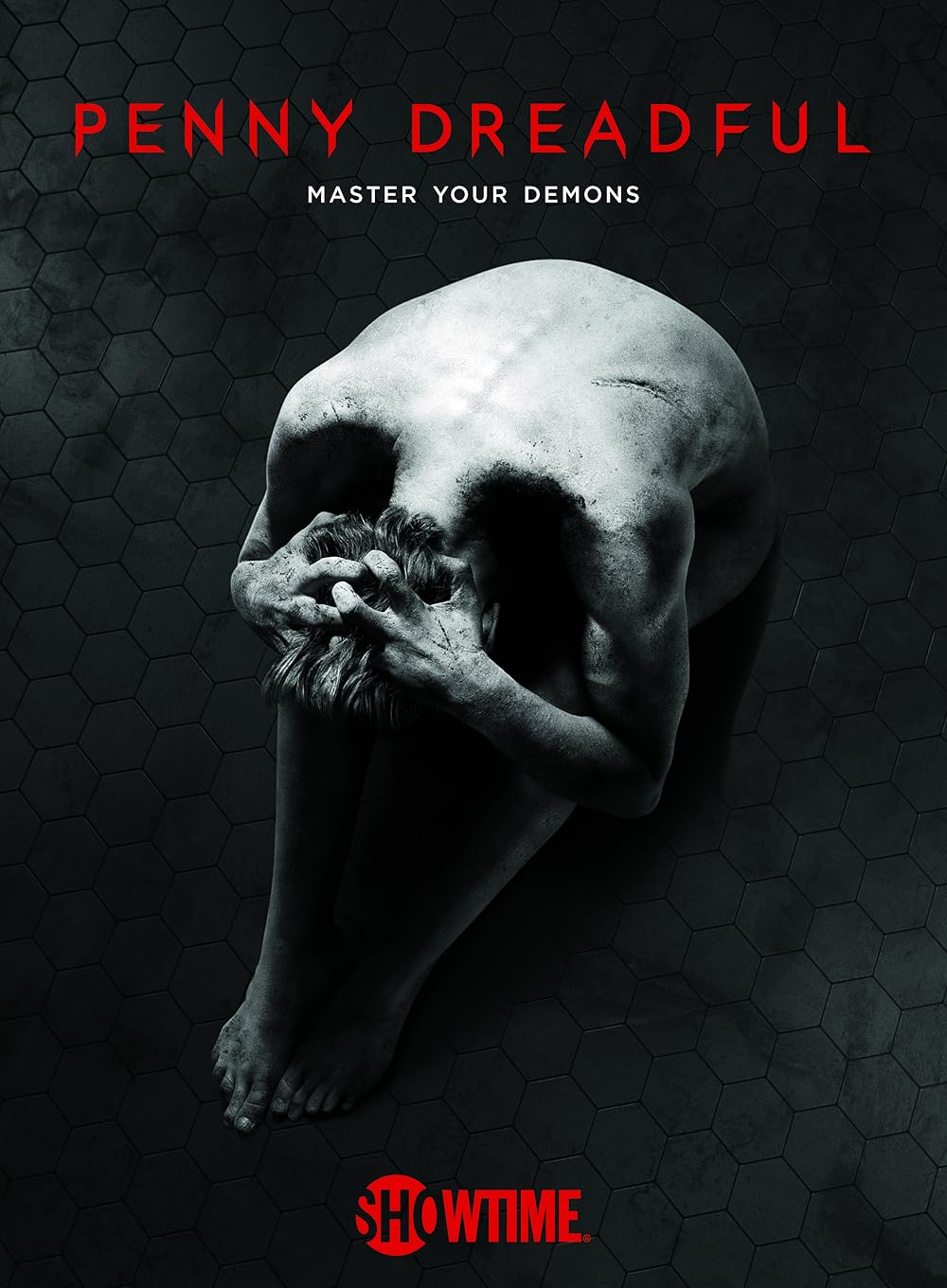
Penny Dreadful remains one of the more distinctive horror dramas of the 2010s, its three-season run on Showtime from 2014 to 2016 offering a rare blend of lush literary homage, character-driven tragedy, and outright Grand Guignol spectacle. Expanding the lens season by season clarifies how the series evolves from a moody, experimental monster mash into a full-blown gothic epic, while also highlighting the structural flaws and uneven pacing that prevent it from being universally accessible, even as standout performances from its ensemble elevate every frame. What emerges is a show that grows richer the more time it spends with its characters—particularly through highlight turns like Eva Green’s ferocious Vanessa Ives, Rory Kinnear’s soul-wrenching Creature, and the magnetic supporting work from Timothy Dalton, Josh Hartnett, and Billie Piper—rewarding patient viewers even as its narrative sometimes strains under the weight of its own ambition.
Season one of Penny Dreadful functions as an origin point and a proof of concept, introducing viewers to a haunted ensemble bound together by secrets, sin, and supernatural forces, with performances that immediately set a bar for emotional and physical intensity. The central plot—Sir Malcolm Murray and Vanessa Ives recruiting American gunslinger Ethan Chandler and tortured scientist Victor Frankenstein to rescue Malcolm’s daughter Mina from a vampiric master—serves less as a conventional quest and more as a framework to explore broken people clinging to purpose, anchored by Timothy Dalton’s commanding Sir Malcolm, whose gravelly authority and haunted eyes convey a lifetime of imperial regrets and paternal failure. Eva Green’s Vanessa is the undeniable highlight here, her ferocious intensity in episodes like Séance and Possession—where glossolalia, contortions, and violent ecstasy erupt—turning demonic outbreaks into raw expressions of guilt, repression, and spiritual crisis, earning her a Golden Globe nomination for a debut season that demands Oscar-level physicality and vulnerability. Josh Hartnett’s Ethan Chandler provides a grounded counterpoint, his brooding sharpshooter evolving from reluctant hero to tormented beast with subtle shifts in posture and gaze that foreshadow his lycanthropic reveal.
The first season also lays the groundwork for the show’s thematic fascination with duality and monstrosity, especially through Harry Treadaway’s brittle Victor Frankenstein—whose twitching desperation humanizes god-like hubris—and Rory Kinnear’s breakout as the Creature, a shambling horror who quickly reveals literate eloquence and bitter pathos, his scarred visage and rumbling baritone making every plea for connection a gut-punch that redefines “monster” from the outset. Season one’s pacing can feel deliberately slow, even theatrical, as it lingers on candlelit rooms, whispered confessions, and philosophical exchanges, and some viewers may find this emphasis on mood over plot progression alienating. Yet that same deliberation allows the show to build a cohesive emotional atmosphere in which every prayer, séance, and bloodletting feels weighted with meaning, amplified by Dalton’s authoritative gravitas and Green’s transcendent torment. Critics generally responded favorably to this opening run, praising these performances and the atmosphere while noting that its heavy tone and self-seriousness would not be to every viewer’s taste.
Season two represents Penny Dreadful at its most confident and cohesive, expanding the mythology while tightening the emotional focus around Vanessa’s confrontation with a coven of witches led by Evelyn Poole, with Helen McCrory’s serpentine Madame Kali emerging as a highlight villain whose purring malice and intimate manipulations steal scenes. By reframing the central antagonist from a shadowy vampire figure to this fully articulated witch—who weaponizes intimacy, religious iconography, and psychological terror—the show raises the stakes, and Green’s Vanessa responds with even greater ferocity, her possession battles now laced with backstory from Patti LuPone’s earthy, heartbreaking Cut-Wife, whose single-episode arc showcases LuPone’s unparalleled ability to blend folk wisdom with maternal ferocity. This season’s central conflict positions Vanessa as the battleground for Lucifer’s desire, giving the main cast a unity of purpose that the first sometimes lacked.
Character work in season two deepens significantly, with Josh Hartnett elevating Ethan into a moral savage whose lupine rampages in No Beast So Fierce blend raw physicality and soul-searching remorse, while Billie Piper’s evolution from fragile Brona Croft to the defiant Lily Frankenstein becomes a revelation—her steely monologues on patriarchal violence delivered with fiery conviction that rivals Green’s intensity. Rory Kinnear’s Creature reaches new pathos pleading for a mate, his rejection scene opposite Treadaway’s increasingly unhinged Victor one of the series’ most devastating showcases of mutual ruin. Reeve Carney’s Dorian Gray adds hedonistic shimmer, though his arc pales next to these powerhouses. Moments like the group’s desperate defense of Sir Malcolm’s home or Ethan’s transformations achieve a rare balance of gore, suspense, and lyrical resolution, with Dalton’s weary patriarch holding the emotional center. Critics frequently cite season two as the show’s peak, with 100% Rotten Tomatoes scores reflecting near-universal praise for these heightened performances and tighter narrative.
Season three is where the series’ strengths and weaknesses collide most dramatically, as it scatters the core ensemble geographically and mythologically while hurtling toward an abrupt conclusion, yet the actors rise to the challenge with career-best work. Eva Green’s Vanessa deepens into despairing isolation, her therapy sessions with Patti LuPone’s returning Dr. Seward (a chilling pivot from folk healer to clinical cutter) and tender courtship by Christian Camargo’s suave Dracula yielding some of her most nuanced work—balancing fragility, resolve, and erotic pull in a finale self-sacrifice that cements her as TV’s ultimate gothic heroine. Josh Hartnett’s Ethan, now grappling with Apache mystic Kaetenay (Wes Studi’s dignified gravitas a welcome addition), delivers visceral Western showdowns that showcase his action-hero chops alongside soulful reckoning. Timothy Dalton’s Sir Malcolm, questing in Zanzibar, brings imperial weariness to poignant closure, his highlight a raw confrontation with past sins.
Standouts continue with Billie Piper’s Lily rallying a feminist uprising, her ideological fire clashing gloriously with Dorian’s jaded ennui in scenes of revolutionary fervor and betrayal that highlight Carney’s subtle decay. Harry Treadaway’s Victor, partnering with Shazad Latif’s oily Jekyll, spirals into ethical abyss with manic precision, while Rory Kinnear’s Creature—rediscovering his identity as John Clare—delivers the series’ most quietly devastating arc, his family reunion a masterclass in restrained grief that rivals Green’s flashier exorcisms for emotional wallop. These performances salvage the fragmented plotting, infusing global detours with humanity even as resolutions feel rushed.
Evaluated across all three seasons, Penny Dreadful delivers a rich, if imperfect, journey elevated by its highlight performances: Green’s transcendent Vanessa as the tormented soul; Kinnear’s Creature as the rejected heart; Dalton’s authoritative patriarch; Hartnett’s brooding beast; Piper’s fiery avenger; and LuPone’s dual folk icons—forming an ensemble that turns gothic pulp into profound tragedy. Season one constructs a dense foundation; season two refines it into peak artistry; season three reaches for epic finality with power even in haste. The end result succeeds more as character-driven gothic poetry than tidy thriller, its actors ensuring unforgettable resonance for horror fans craving depth. In a landscape of sanitized scares, these performances make Penny Dreadful a dark, enduring achievement.
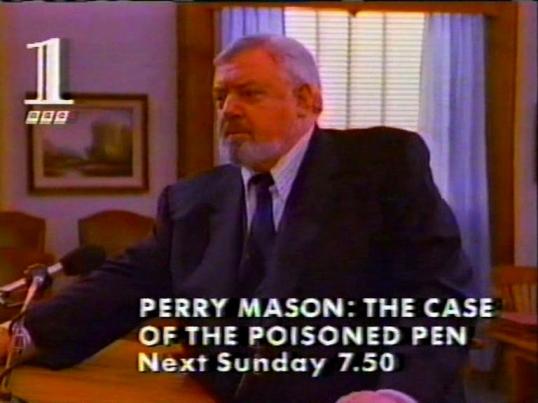
When an arrogant true crime writer named Bradley Thompson (David Warner) is poisoned while attending a writers conference, his ex-wife (Barbara Babcock) is arrested and charged with his murder. Perry Mason (Raymond Burr) and Ken Malansky (William R. Moses), who had their own run-in with Thompson, defend her in court and try to track down the real murderer.
This was a good whodunit. The mystery was pretty easy to solve but all of the suspects were memorable and the supporting cast, which included Cindy Williams, Tony Lo Bianco, and Earl Boen, were entertaining to watch. My favorite character was Max Mulgrew, a tough-guy crime writer who was played by Kiel Martin. When Mulgrew was asked if he hated Thompson enough to murder him, Mulgrew says yes but he would have shot him instead of poisoning him!
Amy Hastings, who Alexandra Paul played in the previous three movies, is not in this movie and nobody says anything about her so, hopefully, her character has moved on. Without Amy around, that means that Della (Barbara Hale) gets to help out with the investigation for once. It was nice to see Della showing why she was the best assistant that Perry could have ever hoped for.
I remember enjoying this movie when I watched it with my aunt a few years ago. I enjoyed it again when I watched it last night.
In 1979’s The Concorde …. Airport ’79, Joe Patroni (George Kennedy) finally gets to fly the plane.
The plane is question is a Concorde, a supersonic airliner that can travel faster than the speed of sound. When we first see the Concorde, it’s narrowly avoiding a bunch of dumbass hippies in a hot air balloon as it lands in Washington, D.C. The recently widowed Joe Patroni joins a flight crew that includes neurotic Peter O’Neill (David Warner), who says that he has dreams in which he’s eaten by a banana, and suave co-pilot Paul Metrand (Alain Delon). Because this is an Airport film, Mertrand is dating the head flight attendant, Isabelle (Syliva Kristel). “You pilots are such men,” Isabelle says. “It ain’t called a cockpit for nothing, honey,” Patroni replies.
(One thing that is not explained is just how exactly Joe Patroni has gone from being a chief technician in the first film to an airline executive in the second to a “liaison” in the third and finally to a pilot in the fourth.)
The Concorde is flying to Moscow with a stop-over in Paris. There’s the usual collection of passengers, all of whom have their own barely-explored dramas. Cicely Tyson plays a woman who is transporting a heart for a transplant. She gets maybe four or five lines. Eddie Albert is the owner of the airline and he’s traveling with his fourth wife. (Of course, he’s old friends with Patroni.) John Davidson is an American reporter who is in love with a Russian gymnast (Andrea Marcovicci). Avery Schrieber is traveling with his deaf daughter. Monica Lewis plays a former jazz great who will be performing at the Moscow Jazz Festival. Jimmie Walker is her weed-smoking saxophonist. Charo shows up as herself and gets kicked off the plane before it takes off.
The most important of the passengers is Maggie Whelan (Susan Blakely), a journalist who has evidence that her boyfriend, Kevin Harrison (Robert Wagner), is an arms trafficker. Harrison is determined to prevent that evidence from being released so he programs a surface-to-air missile to chase the Concorde. Patroni is able to do some swift maneuvers in order to avoid the missile, which means that we get multiple shots of passengers being tossed forward, backwards, and occasionally hanging upside down as Patroni flips over the plane. Oddly no one really gets upset at Patroni about any of this and no one seems to be terribly worried about the fact that someone is obviously trying blow up their plane. Even after the stop-over in Paris, everyone gets back on the Concorde! That includes Maggie, who could have saved everyone a lot of trouble by just holding a press conference as soon as the plane landed in Paris.
A year after The Concorde came out, Airplane! pretty much ended the disaster genre. However, even if Airplane! had never been released, I imagine The Concorde would have still been the final Airport film. Everything about the film feels like the end of the line, from the terrible special effects to the nonsensical script to the Charo cameo and Martha Raye’s performance as a passenger with a weak bladder. The first Airport film was an old-fashioned studio film standing defiant against the “New Hollywood.” The second Airport film was a camp spectacular. The third Airport film was an example of changing times. The fourth Airport film is just silly.
And, really, that’s the main pleasure to be found in The Concorde. It’s such an overwhelmingly silly film that it’s hard to look away from it. For all of its weaknesses, The Concorde will always be remembered as the film that featured George Kennedy opening the cockpit window — while in flight — and shooting a flare gun at another plane. As crazy as that scene is, just wait for the follow-up where Kennedy accidentally fires a second flare in the cockpit. “Put that out,” Alain Delon says while David Warner grabs a fire extinguisher. It’s a silly moment that it also, in its way, a great moment.
The Concorde brings the Airport franchise to a close. At least George Kennedy finally got to fly a plane.
“Violence can be the only answer sometimes.” — David Sumner
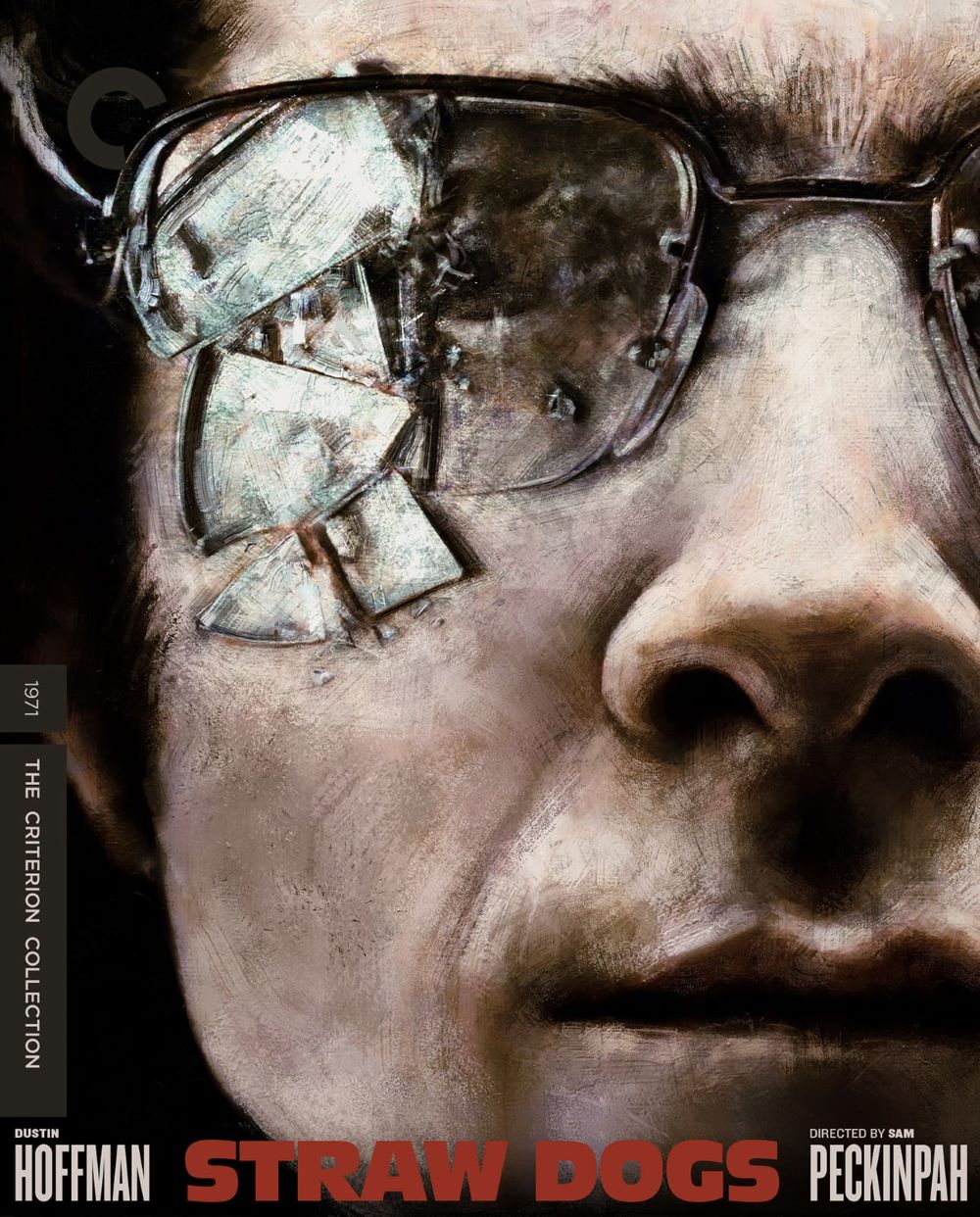
Sam Peckinpah’s Straw Dogs is a raw, compelling dive into the breakdown of civility and the primal instincts bubbling underneath. The story follows David Sumner, a mild-mannered American mathematician, who moves with his wife Amy to her rural English hometown. The couple’s plan for a quiet life takes a sharp turn when tensions with the locals spiral out of control, resulting in a violent showdown. At its core, the film examines how far a person can be pushed before the veneer of civilization peels away, revealing something much wilder underneath.
The tension starts subtly, as David’s intellectual and pacifist nature clashes with the rough, territorial mindset of the local men. This brewing conflict isn’t just about cultural difference but taps into deeper themes around masculinity, power, and identity. Straw Dogs asks difficult questions about what it means to be a man, exploring how fragile male identity can be when confronted with real or perceived threats. David’s journey is less about heroism and more about the psychological and emotional transformation forced upon a man who initially seems ill-equipped for the violence unleashed around him. The whole film operates as a kind of symbolic stage where primal instincts and societal expectations collide, forcing each character to confront their own limits.
Amy’s role in the film is both pivotal and deeply complex. Her experience of assault, handled with subtle but unflinching attention, adds emotional and thematic weight without dominating the narrative. The film portrays her trauma through its impact on her and the shifting dynamics in her relationship with David, inviting reflection on resilience and struggle for control. Amy is depicted not merely as a victim but as a layered character navigating vulnerability and strength amid the hostile environment. This approach challenges viewers to consider the nuanced and often contradictory responses to trauma, avoiding simplistic victim narratives while emphasizing its profound consequences.
The rural setting of Straw Dogs is more than just a backdrop; it becomes a character in its own right. The close-knit, insular community embodies a microcosm where social order teeters and violence hides just beneath the surface. Law enforcement and authority figures seem ineffective or indifferent, which heightens the sense of isolation and lawlessness. The hostility from some village locals, including Amy’s ex-boyfriend Charlie, feeds into a toxic masculinity that sees David as weak and out of place. Peckinpah carefully stages this clash, using tension and silence as expertly as physical violence, making viewers feel the pressure ramping up until it finally snaps.
Dustin Hoffman’s portrayal of David is quietly brilliant in its subtlety. He plays David as a man trapped between worlds—intellectual and physical, passivity and aggression—with a restrained but deeply affecting performance. Hoffman’s ability to convey complex emotions beneath a calm exterior makes David’s eventual transformation all the more gripping. Susan George delivers an equally powerful performance as Amy, capturing the mixture of fear, defiance, and heartbreak her character endures. Their dynamic feels authentic and layered, making the viewer invested in their peril. The supporting cast, including actors like Peter Vaughan, add a layer of authentic menace, embodying the grim rural antagonists with convincing grit and intensity. The performances overall ground the film’s explosive themes in believable, relatable humans.
Themes in Straw Dogs extend beyond just personal violence to address ideas about identity and societal breakdown. The film explores the notion of the “symbolic order”—how individuals fit into and negotiate the rules and roles imposed by society. David’s identity crisis and his uneasy place within the village spotlight questions of power, emasculation, and rebirth. Peckinpah uses psycho-sexual imagery—such as symbols of emasculation and phallic power—to deepen the psychological stakes of David’s journey. The film conveys how deeply fragile human identity is and how violence can act as a brutal yet transformative force pushing individuals to redefine themselves. At the same time, the portrayal of Amy complicates these themes by challenging traditional gender roles, making the film as much about female agency as male dominance.
The film’s violence is famously brutal and unsettling. Peckinpah does not shy away from showing the full consequences of escalating conflict, culminating in an intense and chaotic finale where the line between victim and aggressor blurs. This isn’t violence for spectacle but a narrative and thematic necessity that Peckinpah uses to strip away pretenses and reveal the raw human instincts beneath. It’s this uncompromising depiction that both shocked audiences at the time and continues to provoke discussion about the nature of power and survival. The film is also notable for its innovative editing, with Peckinpah’s use of jump cuts and slow-motion heightening the emotional intensity and pacing the violence with a rhythmic, almost visceral punch.
Ultimately, Straw Dogs is a challenging film that forces viewers to confront disturbing truths about human nature, relationships, and societal order. Its exploration of violence and masculinity is complex and often uncomfortable, presenting no easy answers. The film remains a significant piece of cinema for its bold themes, outstanding performances, and the way it captures the frailty and ferocity of its characters. Peckinpah’s direction melds tension, psychological drama, and physical action into a gripping, unforgettable experience. Though controversial for its content, Straw Dogs endures as a powerful work that asks what truly happens when the thin line between civilization and savagery breaks down.
When he was a young boy, Gregory Tudor was traumatized when he witnessed the gangland-style execution of the neighborhood ice cream man. He was retraumatized when he was sent to an insane asylum. Now, Gregory (Clint Howard) has grown up and he’s the ice cream man! Everyone in the neighborhood loves his ice cream but the local kids suspect that he’s using human body parts to get the flavor just right. It turns out that the kids know what they’re talking about.
Ice Cream Man almost feels like a zero-budget precursor to Stranger Things, with the kids knowing what’s happening in their town while the majority of the adults are too self-absorbed to notice. One of the kids is a Macauley Culkin look-alike known as Small Paul (Mikey LeBeau). He comes to admire Gregory and his murderous devotion to ice cream. The movie’s really stupid but it’s clearly not meant to be taken seriously and Clint Howard really throws himself into his role. One thing that makes Ice Cream Man enjoyable is that you know Ron Howard had to sit through it because his brother’s in it.
The most interesting thing about Ice Cream Man is the number of recognizable actors who appear in tiny roles. David Warner is the town’s reverend. David Naughton is a clueless father who is married to Sandahl Bergman. Jan-Michael Vincent is a detective. Olivia Hussey is Gregory’s former nurse. Former baseball player and future senatorial candidate Steve Garvey plays another parent. With the exception of Vincent, it’s hard not to believe that the members of the cast didn’t have anything better to do. Never underestimate the appeal of a quick paycheck.
Clint Howard has said that a sequel is in pre-production. The Ice Cream Man will return.
Many years ago in Southern Oregon, I had a conversation with friends about some of our favorite films growing up. Movies like The Goonies, The Dark Crystal, Watership Down and The Secret of Nimh were all on the list, as well as Disney’s Tron. In our excitement for all these movies, we ended up renting the films from a local video store to relive our childhood. While the nostalgia was nice, we all ended falling asleep halfway through Tron, despite our love for it.
I guess one’s enjoyment of Tron is based on how it’s viewed. I caught the film two years ago at the Museum of the Moving Image, in 70MM. The first thing that caught my attention was the film grain. I’ve grown so used to the clarity of digital film presented in 4K that I couldn’t help but catch the little flicks and “cigarette burns” in at the start. This was life before digital, and it was beautiful to revisit. In a theatre, the film’s 96 minutes blazed by for me. The early 1980s was basically made up of bike rides and video arcades. The little boedga on the corner of my block back home even had a few arcade machines in the front of the store in the first half of the 80s. The Bodega’s still there, the arcade’s now a deli/hot meal area. Times can and do change.
Tron is the story of Kevin Flynn (Jeff Bridges, Bad Times at the El Royale), a former employee at Encom, a major computing and videogame company. Encom’s made some wonderful strides in technology as of late, by 1980’s standards. Encom performs special matter tests in a specialized lab, while the programmers grind away code in their cubicles. All of their work is overseen by the Master Control Program, an operating system of sorts. Granted, the workforce at Encom isn’t too pleased about having the MCP monitor their applications. Alan Bradley (Bruce Boxleitner, Kuffs) and Lori Baines (Cindy Morgan, Caddyshack) also have programs and projects of their own that are being culled. Alan’s program, Tron (also played by Boxleitner) is of particular interest to the MCP, as it acts an a security threat that could bring some serious problems. Kevin tries to hack his way into Encom with the use of a program he created called Clu (also Bridges), but the MCP and the Senior Vice President of Encom, Ed Dillinger (David Warner, The Omen, Teenage Mutant Ninja Turtles II: The Secret of the Ooze) keep Flynn at bay. When Alan and Lori discover what Flynn’s up to, they confront him at his arcade, where he explains that he was the actual creator of Encom’s top games. He only needs the data as proof. This leads to the team breaking into Encom, where the MCP digitizes Flynn and brings him into the computer world. Can Flynn escape and help liberate the programs enslaved by the MCP and its henchman, Sark (both also played by Warner)? Can Flynn find the proof to exonerate him? And just who is this Tron fellow, anyway?
The plot for Tron inside the machine becomes a bit theological. The programs believe in the Users, and that they were each created for a particular purpose. From Ram (Dan Shor, Bill & Ted’s Excellent Adventure) being an Actuarial Program to Tron being a defense against the MCP, it’s kind of interesting once Flynn shows up. As a User, he doesn’t have much more power than a program, save that he can’t really be derezzed and that he can mimic the neon glow of anyone he touched. I always thought they could have given him something cooler to do, though for 1982, repurposing machines does have some benefits. The story slows down a bit in the middle, feeling like it’s somewhat unsure of itself, but picks up in the final act with Tron vs. Sark and the MVP. Though Flynn is important to the outcome, he’s more like Big Trouble in Little China’s Jack Burton, kind of just watching this happen around him. He does have his moments, though.
When I was little, my dad owned a Commodore 64 and a Floppy Disk Drive. He would regularly pick up magazines like Byte! to catch up on new innovations. In most of these magazines, they’d have a program that you could enter in at home to create various effects like making a balloon fly across your screen. Those programs were usually written over a number of pages with hundreds of lines of code. For Tron, there were 3 teams dedicated for the Visual Effects. According to the behind the scenes documentary on the disc, Information International Inc., known as Triple-I, was brought in to handle the major work along with Mathematic Applications Group Inc. (MAGI), who director Steven Lisberger worked for at one point early in his career. Digital Effects of New York handled some of the responsible for some of the original CGI work used in Michael Crichton’s Westworld (considered one of the first CGI movie uses ever) and it’s sequel, Futureworld. For the time, the effects were groundbreaking. Mind you, most of this was all before we ever hit the 8-bit era of Nintendo, the Commodore Amiga or even the high resolution arcade games of Sega’s heyday like Space Harrier, Outrun or Afterburner. In an actual arcade in 1982 had games like Q-Bert or Dig Dug with the kind of graphics you’d never see on home systems.
Kevin Flynn (Jeff Bridges) and others (including a young Michael Dudikoff to his right) watch Tron fight for the users. This would inspire Dudikoff to become an American Ninja.
The designs for the look and feel of the computer world came from Lisberger himself, with a bit of assistance from both futurist Syd Mead and legendary artist Jean “Mobius” Giraud. Both men were extremely popular. Mead was the equivalent of Apple’s former Chief Design Officer Jony Ive, having created the “V’ger” model for Star Trek:The Motion Picture. Ironically, Mead’s work (both on the set design and the flying cars) would be seen by audiences watching Ridley Scott’s Blade Runner just a month shy of Tron’s release. Having worked on Alien years prior, Giraud helped to design and inspire both the clothing and some of the vehicles, such as the weird cradle for Dumont (Bernard Hughes, The Lost Boys) and the Light Cycles.
A film dealing with computers needed a composer familiar with electronic music.It seemed fitting that Wendy Carlos(A Clockwork Orange, The Shining) took on the challenge. Having built a computer at 14, Carlos’ love for music over the years lead her (with Robert Moog) to help develop the Moog synthesizer system. The Moog would go on to be used by Kraftwerk, Giorgio Mororder, Nine Inch Nails, The Prodigy Daft Punk and even J Dilla, among others. The Tron Soundtrack was a mix of orchestra, choir and electronic music. Although the sound may not be as dark and digital as Daft Punk’s score for Tron: Legacy, I felt it worked for the time and moves well with the film. In addition to Carlos’ score, Journey wrote the song “Only Solutions” for the film, which also happens to be a line uttered by Kevin Flynn.
Overall, Tron is one of those movies I can happily rewatch without much in the way of expectation. I enjoy it for its place in Sci-Fi cinema, and the memories it awakens. I don’t think Disney ever fully recognized the full potential of where they could take the story, though the animated Tron: Uprising was a great part of the saga. I’m just hoping Tron: Ares doesn’t stray too far from the fold.
Welcome to Retro Television Reviews, a feature where we review some of our favorite and least favorite shows of the past! On Saturdays, I will be reviewing The American Short Story, which ran semi-regularly on PBS in 1974 to 1981. The entire show can be purchased on Prime and found on YouTube and Tubi.
This week, we have an adaptation of a Stephen Crane short story.
Episode 1.8 “The Blue Hotel”
(Dir by Jan Kadar, originally aired in 1977)
In the dying days of the Old West, a train pulls into a station in a small frontier town. Getting off the train, a Cowboy (John Bottoms), an Easterner (Geddeth Smith), and a Swede (David Warner) head to the town’s only hotel. A blizzard is coming and the three men are seeking shelter for the night. The owner of the hotel, Scully (Rex Everhart), is happy to provide it. As the men wait for dinner to be served, they play a card game with Scully’s son, Johnnie (James Keach).
At first, the game plays out without incident. The men are all friendly, with the exception of the Swede. The Swede remains quiet and seems distrustful. After a few hands of the game, the Swede accuses Johnnie of cheating. Over the next few hours, as the wind howls outside, the Swede rants and raves. Convinced that the wild west is truly full of outlaws and that it’s all exactly like the dime-store novels that he read before boarding the train, he cannot bring himself to accept that the men mean him no harm. It all leads to violence and tragedy.
This episode made excellent use of the shadowy Blue Hotel and the desolate wind blowing outside. Over the course of an hour, the hotel went from being a friendly shelter to an ominous location that seemed to pulse with paranoia. David Warner gave a strong performance as the unstable Swede and the final act of violence (which was changed slightly from the short story’s original conclusion) comes as a genuine shock as does the final twist in the tale. TheBlueHotel becomes a look at how people unknowingly shape their own destiny, for better or worse.
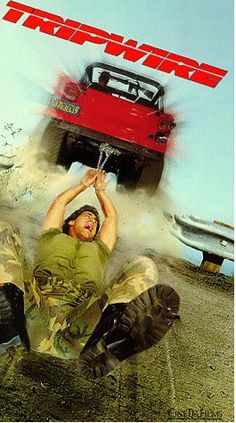
Terrorist Josef Szabo (David Warner) and his team (including Viggo Mortensen, Charlotte Lewis, and Sy Richardson) attempt to hijack a train that’s carrying weapons that they can use in their plans for world conquest. Renegade ATF agent Jack DeForest (Terence Knox) catches them in the act and, in the resulting crossfire, Szabo’s son is killed. Now looking for revenge, Szabo kidnaps Jack’s estranged wife (Meg Foster) and Jack’s son. Even though his supervisor (Yaphet Kotto) claims that Jack is dangerous and out-of-control, fellow ATF agent Anne (Isabella Hofmann) teams up with Jack to rescue his family.
This is a well-done B action movie, featuring villains who have more depth than usual and an interesting opening sequence that plays out with almost no dialogue. Terence Knox is not the most exciting of heroes (he was better served by television than the movies) but the supporting cast makes up for his character’s blandness. Where also can you see Meg Foster, David Warner, Yaphet Kotto, Viggo Mortensen, and Tommy Chong (!) all in the same movie? The mountainous Utah setting gives the film a modern western feel and, though this may be a direct-to-video B movie, the cast gives it their all. Tripwire is cinematic fast food, quick and just satisfying enough to leave you happy.
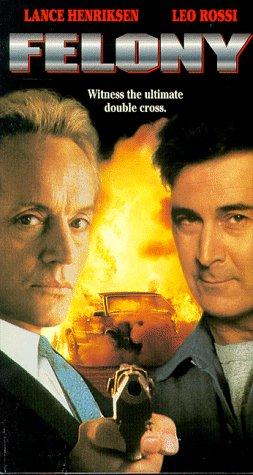
In New Orleans, a drug raid gone wrong leads to eleven cops being gunned down and then blown up. The disastrous raid was being filmed for a Cops-like reality show The show’s producer, Bill Knight (Jeffrey Combs) finds himself being pursued through New Orleans by a collection of rogue intelligence agents, cops, and gangsters, all of whom want the tape of the massacre.
It’s a simple direct-to-video premise and the film’s plot hits every chase film cliche, while keeping the action moving at a decent pace. Bill Knight is not supposed to be a typical action hero. He’s just a television producer who was in the wrong place at the wrong time. Yet Knight proves himself to be as indestructible as any Arnold Schwarzenegger hero. He gets shot, twice. He falls from a great height. He crashes through a window. He repeatedly gets hit over the head. And yet, his injuries never seem to really slow him down or even hurt that much. He does hook up with a nurse (Ashley Laurence) but still, it’s hard to believe anyone could take that much punishment and keep running. Jeffrey Combs, the brilliant star of films like Re-Animator, is miscast as Knight but he’s still always entertaining to watch.
In fact, the cast is the main thing that Felony has going for it. David Prior was able to assemble a true group of B-movie all-stars. Lance Henriksen and David Warner are the evil intelligence agents who are determined to kill Knight. (Warner finally gets to handle a grenade launcher and we’re all the better for it.) Leo Rossi and Charles Napier are the two New Orleans cops who are investigating the drug raid. Joe Don Baker is the rogue intelligence agent who dresses like a cowboy and who is trying to clean up everyone else’s mess. The cast keeps the action moving and there are enough eccentric personalities in this film that it’s always watchable. I think this might be the only film to feature Joe Don Baker and Lance Henriksen performing opposite each other. If nothing else, it deserves to be watched for that!
(The cover for Felony features Lance Henriksen and Leo Rossi but not Jeffrey Combs, even though Combs is the lead in the film and Rossi’s role is actually pretty small. Henriksen also doesn’t have blonde hair in the movie. There are plenty of double crosses in the movie but I can’t think of any that really qualify as the “ultimate double cross.”)
Even with its miscast lead and its cliche-heavy plot, Felony is what direct-to-video action movies should be all about, fact-paced action and a cast unlike any other,



 Through the Shattered Lens