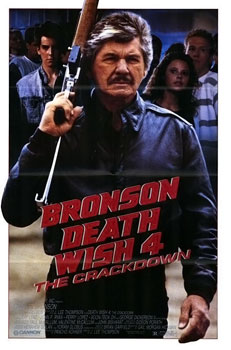
 To quote The Main With No Name, “When a man’s got money in his pocket, he begins to appreciate peace.”
Two years have passed since Paul Kersey (Charles Bronson) last visited and cleaned up New York. He is back in Los Angeles, the president of his own successful architectural firm. Now a rich man, he has retired from killing criminals, though he still has dreams where he shoots muggers in parking garages. Paul has a new girlfriend, journalist Karen Sheldon (Kay Lenz). When Karen’s teenage daughter, Erica (Dana Barron), dies of a cocaine overdose, it’s time for Paul to get his gun out of storage and blow away a drug dealer.
Shortly after shooting that drug dealer, Paul finds a note on his front porch. “I know who you are,” it reads. Paul then gets a call from a mysterious man (John P. Ryan) who identifies himself as being a reclusive millionaire named Nathan White. Nathan explains that his daughter also died of a cocaine overdose. He wants to hire Paul to take out not just the drug dealers but also the men behind the dealers, the bosses. Using his vast resources, Nathan has prepared a file on every major drug operation in Los Angeles. He offers to share the information with Paul.
“I’ll need a few days to think about it,” Paul says but we all know he’s going to accept Nathan’s offer just as surely as we know that Nathan White has an ulterior motive that won’t be revealed until the movie’s final twenty minutes.
For the first time, Paul is no longer just targeting muggers and other street criminals. This time, Paul is going after the guys in charge and trying to bring an end to drug trade once and for all. (The idea that the best way to win the war on drugs was just to kill anyone involved in the drug trade was a very popular one in the late 80s.) L.A.’s two major drug cartels are led by Ed Zacharias (Perry Lopez) and the Romero Brothers (Mike Moroff and Dan Ferro). Along with their own activities, Paul and Young work the turn the two cartels against each other.
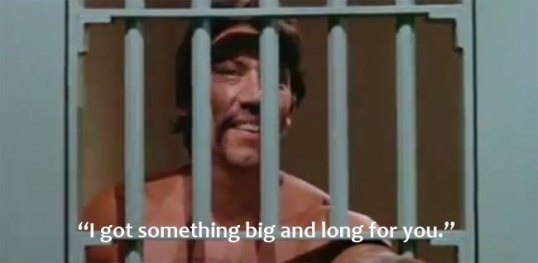
It’s not just the criminals that have changed in Death Wish 4. Paul has changed, too. Paul used to just shoot criminals and run away. In Death Wish 4, he gets more creative. He sneaks into Zacharias’s mansion and bugs the phone so that he can keep track of what’s going down. When it comes time to kill a table full of drug dealers (one of whom is played by Danny Trejo), Paul doesn’t shoot them up. Instead, he sends them a bottle of champagne that explodes when they open it. By the end of the movie, Paul is blowing away the bad guys with a grenade launcher! How many former conscientious objectors can brag about that?
The biggest difference between Death Wish 4 and the films that came before it is the absence of director Michael Winner. Winner and Bronson had a falling out following Death Wish 3 and, as a result, Winner had little interest in returning to the franchise. Instead, Winner was replaced by J. Lee Thompson, who had already directed Bronson in several other Cannon films. As a result, Death Wish 4 is less “heavy” than the previous Death Wish films. Whereas Winner’s direction often felt mean-spirited and exploitive, Thompson plays up the film’s sense of airy adventure.
Though it barely made a profit at the box office and has been dismissed by critics, Death Wish 4 is an enjoyable chapter in Paul’s story. If you’re looking for mindless 80s mayhem, Death Wish 4 gets the job done with admirable efficiency. It would have made a great ending for the franchise but Bronson would return to the role one last time.
Tomorrow: Death Wish V: The Face of Death!

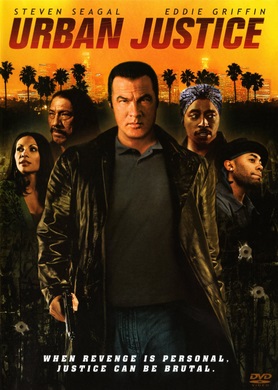 Steven Seagal returns and this time, he’s out for justice! Urban justice!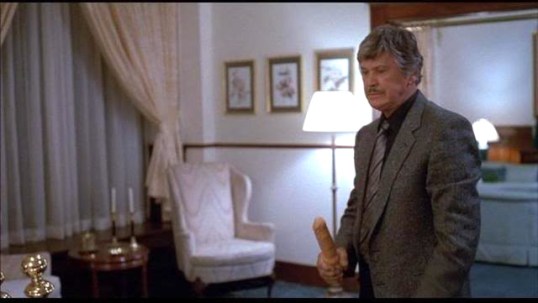

 Edward Furlong is Ron Decker, a spoiled 18 year-old from a rich family who is arrested and sent to prison when he’s caught with a small amount of marijuana. Being younger and smaller than the other prisoners, Ron is soon being targeted by everyone from the prison’s Puerto Rican gang to the sadistic Buck Rowan (Tom Arnold). Fortunately, for Ron, prison veteran Earl Copen (Williem DaFoe) takes him under his wing and provides him with protection. Earl is the philosopher-king of the prison. As he likes to put it, “This is my prison, after all.” If he can stay out of trouble, Ron has a chance to get out early but, with Buck stalking him, that’s not going to be easy.







 Through the Shattered Lens