Horror Film Review: Daughter of Dracula (dir by Jesus Franco)


In a town off the coast of Spain, women are being murdered and their bloodless bodies left on the beach. A journalist named Charlie (Fernando Bilbao) investigates and discovers that the locals are convinced the killings are the work of a supernatural entity. Meanwhile, the aristocratic Karlstein family gathers at a chapel where the dying Countess Karlstein gives her daughter, Louisa (Britt Nichols), the key to the basement. There, Louisa discovers not only Count Dracula (Howard Vernon) but also her vampirized cousin and lover, Karine (Anne Libert).

The Karlstein family is under a vampire curse. Or maybe they’re not. It’s not always easy to follow this film’s logic. The Countess’s personal secretary (played by the film’s director, Jess Franco) is convinced a curse is at work, but Count Karlstein (Daniel White) appears to be not a vampire but simply a typical self-indulgent aristocrat. (Indeed, it’s sometimes hard to figure out how exactly Dracula ended up in the basement to begin with.) Count Karlstein is also a leading suspect in the murders. He has an alibi for at least one of them, but revealing it would mean admitting he’s been having an affair with Ana (Yelena Samarina), the secretary’s wife…

Yes, this is indeed a Jess Franco film. Even if you didn’t already know, the long, languid (and occasionally out-of-focus) shots of the Spanish beach would give it away. This was one of the eight films Franco shot in 1972, and the storyline has that incomplete feeling that often comes from a rushed production. Franco clearly had a few elements he either wanted or was contractually obligated to include: vampires, lesbians, and decadent aristocrats. A coherent plot doesn’t appear to have been a major concern. Daughter of Dracula has an improvised feel, as if Franco was making the story up as he went along. I suspect that’s exactly what he was doing.

And yet, as was often the case with Franco’s work (especially in the early ’70s), the loose structure and nonsensical plot actually work to the film’s advantage. There’s a dream-like quality to the action, one in which everyone seems to be moving either too slowly or too quickly. The atmosphere of ennui is inescapable. The Karlsteins are an aristocratic family trapped in an inescapable state of decay, and one could argue they’re meant as a stand-in for Old Europe, already being challenged by the ’70s counterculture. That decay is mirrored in Howard Vernon’s world-weary Dracula. Both the Karlsteins and Dracula are creatures from a different age who have found themselves in a rapidly changing Europe. When this film was made, Spain was still ruled by General Francisco Franco, but even he seemed to understand that his time was coming to an end.

Daughter of Dracula is ultimately a lesser Franco film. The version I saw ran a little over 70 minutes and still felt a bit too slow for its own good. It never reaches the decadent heights of Female Vampire or A Virgin Among the Living Dead. That said, Howard Vernon is always entertaining, and the film definitely sprang from the mind of Jess Franco. For better or worse, there was no other filmmaker like him.
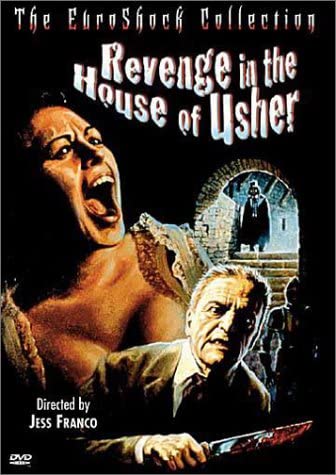
International Film Review: Revenge in the House of Usher (dir by Jess Franco)


In the 1982 Spanish horror film, Revenge in the House of Usher, Antonio Mayans plays Dr. Alan Harker.  Harker receives an invitation to visit the estate of his former mentor, Prof. Eric Usher (Howard Vernon).  Usher is elderly and in poor health.  He’s attended to by several mysterious servants, including his physician, Dr. Seward (Daniel White).  While trying to figure out what has led to Prof. Usher’s current state, Harker discovers that….

Well, here’s where it gets confusing, as things tend to do whenever one tries to discuss the later films of director Jess Franco.  There are actually three different versions of Revenge In the House of Usher and each one of them tells a totally different story.  In the first version, Usher is revealed to have been a decadent, Giles de Rais-style serial killer who has murdered hundreds of women through the years and who is now being haunted by their vengeful ghosts.  Apparently, that version didn’t go over well when it made its debut at the 1983 Festival Internacional de Madrid de Cine Imaginario y de Ciencia-ficción.  The audience booed and laughed and Franco couldn’t convince any distributors to purchase the film from him.

So, Franco filmed thee more scenes that established that Usher wasn’t just a serial killer but that he was also a vampire!  (This explains why two characters in this Edgar Allan Poe adaptation were suddenly given names from Dracula.)  This reception of this version was not considered to be much of an improvement on the reception of the version where Vernon was just a serial killer.

With the backing of Eurocine, Franco then put together a third version of the film.  This time, he turned it into another Dr. Orlof film, though Howard Vernon’s character was still referred to as being Prof. Usher.  In this version, Harker discovers that Usher and his elderly servant Morpho (Olivier Mathot) have spent years abducting women from the village and using their blood to keep Usher’s daughter alive.  This leads to a solid 15 minutes of flashbacks to Usher’s past activities, all of which are taken directly from The Awful Dr. Orlof.  Just as in the other two version of the film, Usher is haunted by the ghosts of his victims.  As his mental state deteriorates, so does his castle.

As far as I know, the third version of the film is the only one that currently exists.  The first version is now considered to be lost.  For his part, Franco claimed that the first version was a misunderstood masterpiece but he was still willing to turn it into another Orlof film so that he could at least make some money off of it.  Franco may have been an often frustrated artist but he was also a pragmatist.

Considering its production history, it’s not surprising that Revenge in the House of the Usher is a bit of a disjointed film.  It’s only 91 minutes long (and 15 of those minutes is taken up with black-and-white footage from The Awful Dr. Orlof) but this film still feels like it has several false endings.  There were so many times that I thought the film had to be over, just for it to keep going.  Watching the film, one can sense that Franco is willing to try almost anything to finally wrap the film’s somewhat incoherent story up.  That said, Howard Vernon brings the right amount of haughty decadence to the role of the decaying Usher and Franco’s decision to film in an actual castle (and to largely utilize natural light) does give the film perhaps a bit more atmosphere than one would expect.  This is a lesser Franco film but it does do a good job of capturing the bizarre logic of dreams.  The film is, at times, so incoherent that it’s actually rather fascinating.

Following this film, Vernon would play Dr. Orloff one final time, in Franco’s surprisingly entertaining Faceless.