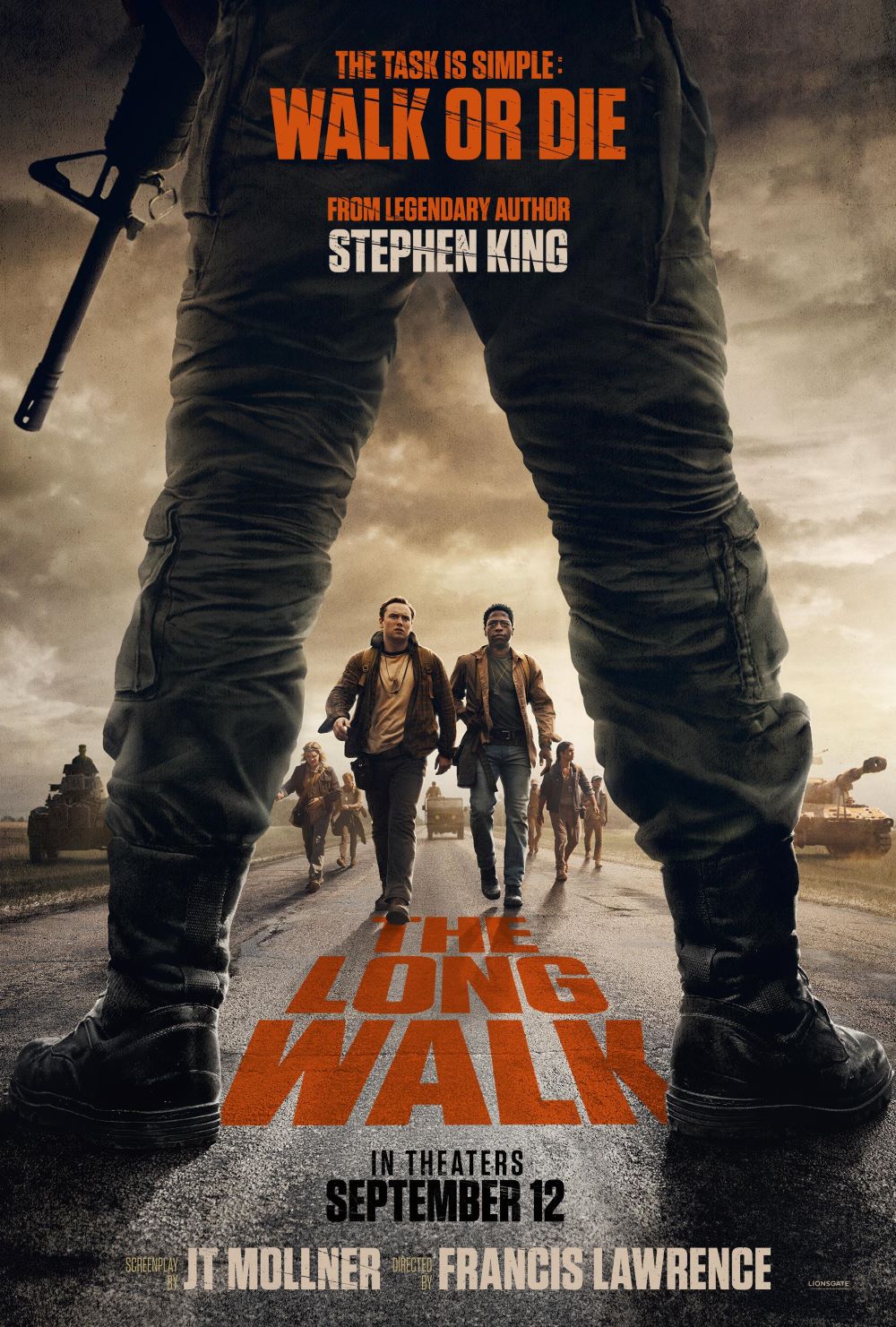
Horror Review: The Long Walk (dir. by Francis Lawrence)


“In this Walk, it’s not about winning. It’s about refusing to be forgotten while the world watches us fade away.” — Peter McVries

Francis Lawrence’s The Long Walk (2025) delivers a relentlessly brutal and unyielding vision of dystopian horror that explores survival, authoritarian control, and the devastating loss of innocence. The film immerses viewers in a grim spectacle: fifty teenage boys forced to participate in an annual, televised event known as the Long Walk. To survive, each participant must maintain a constant pace, never falling below a minimum speed, or else face immediate execution.

At the heart of this bleak narrative is Raymond Garraty, played with earnest vulnerability by Cooper Hoffman. Garraty’s backstory, marked by the tragic execution of his father for political dissent, sets a somber tone from the outset. As the Walk drags on, Garraty forges fragile bonds with fellow contestants, particularly Peter McVries (David Jonsson), whose camaraderie and quiet resilience inject moments of hope and humanity into the harrowing journey. These relationships become the emotional core, grounding the film’s relentless physical and psychological torment in deeply human experiences.

The setting enhances this oppressive atmosphere. The time and place remain deliberately ambiguous, with evident signs that the United States has recently suffered a second Civil War. The aftermath is a landscape ruled by a harsh, authoritarian military regime overseeing a nation economically and politically in decline. Though visual cues evoke a retro, 1970s aesthetic—reflected in military hardware and daily life—the film resists pinning itself to an exact year. This timelessness amplifies its allegorical power, emphasizing ongoing societal collapse and authoritarianism without tying the story to one era specifically. The dystopian backdrop is populated by broken communities and a pervasive sense of hopelessness that mirrors the characters’ internal struggles.

Visually, The Long Walk employs stark, gritty cinematography that traps viewers in the monotonous expanse of endless roads and bleak environments. Lawrence’s direction is unflinching and unrelenting, echoing the merciless march to death and the broader commentary on institutionalized brutality. The atmospheric score complements this oppressive tone, underscoring the emotional and physical exhaustion pacing the narrative.

Performances elevate the film’s emotional stakes significantly. Hoffman’s portrayal of Garraty captures the youth’s evolving vulnerability and determination, while Jonsson’s McVries adds a poignant emotional depth with his steady, hopeful presence. Supporting actors such as Garrett Wareing’s enigmatic Billy Stebbins and Charlie Plummer’s self-destructive Barkovitch bring vital complexity and urgency. Stebbins remains a figure whose allegiance is ambiguous, adding layered mystery to the group dynamics. Judy Greer’s limited screentime as Ginny Garraty, Ray’s mother, stands out powerfully despite its brevity. Each of her appearances is heartbreaking, bringing a wrenching emotional weight to the film. Her panicked, anguished attempts to hold onto her son before he embarks on the deadly Walk amplify the human cost of the dystopian spectacle, leaving a lasting impression of maternal agony amid the surrounding brutality.

Mark Hamill’s role as The Major is a significant supporting presence, embodying the authoritarian face of the regime. The Major oversees the brutal enforcement of the Walk’s rules, commanding lethal squads who execute those who falter. Hamill brings a grim and chilling force to the character, whose cold charisma and unwavering commitment to the ruthless system make him a menacing figure. Despite relatively limited screen time compared to the young participants, The Major’s presence looms large over the story, symbolizing the chilling machinery of power and control that governs the dystopian world.

Yet, the film is stark in its depiction of violence. The executions and suffering are raw and often grotesquely explicit, serving as a damning critique of authoritarian cruelty and the voyeuristic nature of state violence televised as entertainment. This unfiltered brutality can, however, become numbing and exhausting as it piles on relentlessly, occasionally undercutting emotional resonance. The narrative embraces nihilism fully, underscoring the dehumanization and futility within the dystopian world it portrays.

The film’s overall pacing and structure reflect this bleakness but at times suffer from monotony. The heavy focus on walking and survival mechanics leads to a lack of narrative variation, testing the audience’s endurance much like the characters’. There is likewise a noticeable stretch of physical realism—the contestants endure near-impossible physical feats without adequate signs of weariness or injury, which can strain believability.

Character development is another area where the film falters slightly. While Garraty and McVries are well-drawn and immunize emotional investment, other characters tend toward archetypical roles—bullies, outsiders, or generic competitors—diminishing the impact of many deaths or interactions. Similarly, the repetitiveness of the setting and cinematography, relying mostly on basic shots following the walkers, misses opportunities for more creative visual storytelling that might heighten tension or spotlight key emotional beats.

The film’s conclusion, stark and abrupt, offers no real catharsis or closure, reinforcing the overarching theme of unyielding despair. While this resonates with the film’s nihilistic motif, it may alienate those seeking narrative resolution or hope. The visceral shock and bleak tone permeate to the end, leaving the viewer with a lasting impression of relentless suffering and sacrifice.

This demanding yet visually striking and emotionally intense film challenges viewers with its unrelenting bleakness and brutal thematic content. It critiques societal violence, media spectacle, and authoritarianism through starkly powerful performances and an oppressive, immersive atmosphere. Though it excels in evoking emotional rawness in key moments and maintaining thematic consistency, it struggles with pacing, character depth beyond the leads, and occasional narrative monotony. Its ambiguous setting in a post-second Civil War America ruled by a declining authoritarian regime adds a timeless, allegorical layer to its exploration of human endurance and societal collapse.

Ultimately, this film is best suited for viewers prepared for an uncompromising, intense vision of dystopia. It stands as a compelling, if bleak, meditation on youth, survival, and the human spirit under extreme duress, showcasing Francis Lawrence’s aptitude for crafting thought-provoking, provocative horror.
Cooper Hoffman Tries To Survive In The Trailer For The Long Walk


Somehow, I missed that a film version of The Long Walk is on the verge of being released.

The Long Walk is one of Stephen King’s best novels, even if it is one that he wrote under the name of Richard Bachman.  In a dystopian future, a group of young men enter an annual walking contest.  They have to walk a certain number of miles an hour (four in the book but apparently three in the film) and, if they fall behind or stop, they are executed by the soldiers following them.  The Walk continues until there is only one survivor.  The Long Walk feels like a distant cousin to The Running Man (the book, not necessarily the film adaptation).

The film version of The Long Walk was directed by Francis Lawrence, who previous directed The Hunger Games sequels, and has a cast that includes Cooper Hoffman, Charlie Plummer, Judy Greer, and Mark Hamill as the main bad guy.  Who knows if the film will do justice to the book’s bleak tone.  The trailer offers some hints.  The film will be released on September 12th.

Catching Up With The Films of 2024: Saturday Night (dir by Jason Reitman)


Saturday Night, which presents what I assume to be a highly fictionalized account of the 90 minutes before the 1975 premiere of Saturday Night Live, did the impossible.  It made me feel sorry for Chevy Chase.

Don’t get me wrong.  As played by Cory Michael Smith, Chevy Chase is not presented as being a sympathetic character in Saturday Night.  The film acknowledges his talent as a comedian and that he was the first star to come out of Saturday Night Live.  But he’s still presented as being arrogant, self-centered, rude, and often deliberately self-destructive.  The film portrays Chevy Chase in much the same way that most people describe him in real life.  Chevy Chase has apparently always been a difficult person to work with and, I suppose to his credit, it doesn’t appear that Chevy himself has ever claimed anything different.  But Saturday Night so piles on Chevy that even I felt it went a bit overboard.  It’s one thing to present Chevy as being the arrogant jerk that he’s admitted to being.  It’s another thing to fill the movie with moments in which people stop what they’re doing to tell Chevy that his career is going to start strong and then fade due to his bad behavior.  At one point, the NBC executive played by Willem DaFoe comments that Chevy could host his own late night talk show.  We’re all meant to laugh because eventually, Chevy Chase did host a late night talk show and it was such a disaster that it’s still, decades after its cancellation, held up as a prime example of a bad career move.  But, in the context of the film, it feels a bit like overkill.  It’s one thing to be honest about someone being a pain in the ass.  It’s another thing to repeatedly kick someone while they’re down.  Chevy, much like the NBC censor who is chanted down in the film’s cringiest moment, simply feels like too easy of a target.

Of course, Saturday Night is full of moments that are meant to comment more on the future than on whatever was going on in 1975.  The whole point of the film is that Saturday Night Live, a show that the network has little faith in and which is being produced by a hyperactive visionary (Gabriel LaBelle as Lorne Michaels) who seems to be making it up as he goes along, is eventually going to become a cultural phenomenon.  Every time someone tries to convince Lorne Michaels to cancel the premiere or to miss with the format, we’re meant to think to ourselves, “Little do they know that this show is going to be huge for several decades before eventually just becoming another predictable part of the media landscape.” The scenes of Garrett Morris (Lamorne Morris) wandering around the set and asking, “What is my purpose?  Why am I here?” may not feel like something that would have happened in 1975 but they’re there because it’s something that people were asking about in 2024.  Watching the film, it helps if you know something about the history of Saturday Night Live.  It helps to know that Dan Aykryod (Dylan O’Brien), John Belushi (Matt Wood), and Gilda Radner (Ella Hunt) are going to carry the show after Chevy Chase leaves.  It helps to know that Billy Crystal (Nicholas Podany) is going to become a Hollywood mainstay even after he gets dumped from the premiere for refusing to cut any material out of his act.  It helps to know that the mellow, pot-smoking band leader is actually Paul Shaffer (Paul Rust).  It helps to know that Lorne Michael and Dick Ebersol (Cooper Hoffman, giving one of the best performances in the film) are going to become powerful names in American television.  The film may be set in 1975 but it’s actually about all the years to come.

It’s still an entertaining and well-made film, one that I enjoyed watching.  Saturday Night manages to create the illusion of playing out in real time and director Jason Reitman captures the excitement of being backstage before opening night.  It’s an excitement that everyone can relate to, whether their opening night was on television, Broadway, or just a community theater in their small college town.  The backstage chaos of Saturday Night is wonderfully choreographed and, most importantly, it captures the feeling of being young, idealistic, and convinced that you can change the world.  Reitman also gets good performances from his cast, with Cooper Hoffman, Dylan O’Brien, and Rachel Sennott (playing writer Rosie Shuster) as stand-outs.  That said, the film is pretty much stolen by J.K. Simmons, who has a memorably lecherous cameo as Milton Berle and who provides Chevy Chase with a look at what waits for him in the future.  If the film is never quite as poignant as it wants to be, that’s because Saturday Night Live is no longer the cultural powerhouse that it once was.  If Saturday Night had been released just 18 years ago, before SNL became best-known as the place where Alec Baldwin hides out from bad publicity, it would probably be an Oscar front runner right now.  Released today, it’s just makes one feel a little bit sad.  The show that was built on never selling out eventually sold out.

Las Vegas Loves Dune: Part Two


On December 14th, The Las Vegas Film Critics Society announced its picks for the best of 2024!  Dune: Part Two, after being an also-ran with several of the precursor groups, finally picked up the award for Best Picture and a lot of other awards as well!

Best Picture
The Brutalist
Dune: Part Two
A Complete Unknown
Conclave
Wicked

Best Actor
Adrien Brody – The Brutalist
Timothee Chalamet – A Complete Unknown
Colman Domingo – Sing Sing
Ralph Fiennes – Conclave
Hugh Grant – Heretic

Best Actress
Cynthia Erivo – Wicked
Karla Sofia Gascon – Emilia Perez
Angelina Jolie – Maria
Mikey Madison – Anora
Demi Moore – The Substance

Best Supporting Actor
Kieran Culkin – A Real Pain
Clarence ‘Divine Eye’ Maclin – Sing Sing
Edward Norton – A Complete Unknown
Guy Pearce – The Brutalist
Denzel Washington – Gladiator II

Best Supporting Actress
Aunjanue Ellis-Taylor – Nickel Boys
Elle Fanning – A Complete Unknown
Ariana Grande – Wicked
Margaret Qualley – The Substance
Zoe Saldana – Emilia Perez

Best Director
Edward Berger – Conclave
Jon M. Chu – Wicked
Brady Corbet – The Brutalist
RaMell Ross – Nickel Boys
Denis Villeneuve – Dune: Part Two

Best Screenplay Original
Anora
The Brutalist
His Three Daughters
A Real Pain
Saturday Night

Best Screenplay – Adapted
Conclave
Dune: Part Two
Nickel Boys
Nosferatu
Sing Sing

Best Cinematography
The Brutalist
Conclave
Dune: Part Two
Nickel Boys
Nosferatu

Film Editing
The Brutalist
Challengers
Conclave
Dune: Part Two
Nickel Boys

Best Score
The Brutalist
Challengers
Conclave
Dune: Part Two
The Wild Robot

Best Song
El Mal – Emilia Perez
Mi Camino – Emilia Perez
Beautiful That Way – The Last Showgirl
Like a Bird – Sing Sing
Kiss the Sky – The Wild Robot

Best Documentary
Daughters
Music by John Williams
The Remarkable Life of Ibelin
Super/Man: The Christopher Reeve Story
Will & Harper

Best Animated Film
Flow
Inside Out 2
Memoir of a Snail
Wallace & Gromit: Vengeance Most Fowl
The Wild Robot

Best International
Emilia Perez
Flow
I’m Still Here
Kneecap
The Seed of the Sacred Fig

Best Costume Design
Dune: Part Two
Furiosa: A Mad Max Saga
Gladiator II
Nosferatu
Wicked

Best Art Direction
Conclave
Dune: Part Two
Gladiator II
Nosferatu
Wicked

Best Visual Effects
Alien: Romulus
Dune: Part Two
Furiosa: A Mad Max Saga
Kingdom of the Planet of the Apes
Wicked

Best Action Movie
Deadpool & Wolverine
Dune: Part Two
The Fall Guy
Furiosa: A Mad Max Saga
Gladiator II

Best Comedy
Deadpool & Wolverine
The Fall Guy
Hit Man
My Old Ass
Saturday Night

Best Horror/Sci-Fi
Late Night with the Devil
Heretic
Nosferatu
Strange Darling
The Substance

Best Family Film
Inside Out 2
My Penguin Friend
Wallace & Gromit: Vengeance Most Fowl
Wicked
The Wild Robot

Best Animal Performance
Ukai – Arthur the King
Peggy – Deadpool & Wolverine
Dindim – My Penguin Friend
Rat Cast – Nosferatu
Frodo the Cat – A Quiet Place: Day One

Best Ensemble
Anora
Conclave
Dune: Part Two
Emilia Perez
Wicked

Best Action Stunts
Dune: Part Two
The Fall Guy
Furiosa: A Mad Max Saga
Gladiator II
Monkey Man

Breakout Performance (Director)
Jesse Eisenberg – A Real Pain
Anna Kendrick – Woman of the Hour
J.T. Mollner – Strange Darling
Dev Patel – Monkey Man
Sean Wang – Didi

Best Youth Performance – Male (under 21)
Kit Connor – The Wild Robot
Ian Foreman – I Saw the TV Glow
Elliott Heffernan – Blitz
Cooper Hoffman – Saturday Night
Izaac Wang – Didi

Best Youth Performance – Female (under 21)
Cailey Fleming – If
Maisy Stella – My Old Ass
Ingrid Torelli – Late Night with the Devil
Alisha Weir – Abigail
Zoe Ziegler – Janet Planet

William Holden Lifetime Achievement Award
Steve Martin
Demi Moore
Claire Simpson
Isabella Rossellini
Hans Zimmer

Here Are The Nominations Of The Las Vegas Film Critics Society


The Las Vegas Film Critics Society announced its nominees for the best of 2024 today!  The winners will be announced on December 14h.

Best Picture
The Brutalist
Dune: Part Two
A Complete Unknown
Conclave
Wicked

Best Actor
Adrien Brody – The Brutalist
Timothee Chalamet – A Complete Unknown
Colman Domingo – Sing Sing
Ralph Fiennes – Conclave
Hugh Grant – Heretic

Best Actress
Cynthia Erivo – Wicked
Karla Sofia Gascon – Emilia Perez
Angelina Jolie – Maria
Mikey Madison – Anora
Demi Moore – The Substance

Best Supporting Actor
Kieran Culkin – A Real Pain
Clarence ‘Divine Eye’ Maclin – Sing Sing
Edward Norton – A Complete Unknown
Guy Pearce – The Brutalist
Denzel Washington – Gladiator II

Best Supporting Actress
Aunjanue Ellis-Taylor – Nickel Boys
Elle Fanning – A Complete Unknown
Ariana Grande – Wicked
Margaret Qualley – The Substance
Zoe Saldana – Emilia Perez

Best Director
Edward Berger – Conclave
Jon M. Chu – Wicked
Brady Corbet – The Brutalist
RaMell Ross – Nickel Boys
Denis Villeneuve – Dune: Part Two

Best Screenplay Original
Anora
The Brutalist
His Three Daughters
A Real Pain
Saturday Night

Best Screenplay – Adapted
Conclave
Dune: Part Two
Nickel Boys
Nosferatu
Sing Sing

Best Cinematography
The Brutalist
Conclave
Dune: Part Two
Nickel Boys
Nosferatu

Film Editing
The Brutalist
Challengers
Conclave
Dune: Part Two
Nickel Boys

Best Score
The Brutalist
Challengers
Conclave
Dune: Part Two
The Wild Robot

Best Song
El Mal – Emilia Perez
Mi Camino – Emilia Perez
Beautiful That Way – The Last Showgirl
Like a Bird – Sing Sing
Kiss the Sky – The Wild Robot

Best Documentary
Daughters
Music by John Williams
The Remarkable Life of Ibelin
Super/Man: The Christopher Reeve Story
Will & Harper

Best Animated Film
Flow
Inside Out 2
Memoir of a Snail
Wallace & Gromit: Vengeance Most Fowl
The Wild Robot

Best International
Emilia Perez
Flow
I’m Still Here
Kneecap
The Seed of the Sacred Fig

Best Costume Design
Dune: Part Two
Furiosa: A Mad Max Saga
Gladiator II
Nosferatu
Wicked

Best Art Direction
Conclave
Dune: Part Two
Gladiator II
Nosferatu
Wicked

Best Visual Effects
Alien: Romulus
Dune: Part Two
Furiosa: A Mad Max Saga
Kingdom of the Planet of the Apes
Wicked

Best Action Movie
Deadpool & Wolverine
Dune: Part Two
The Fall Guy
Furiosa: A Mad Max Saga
Gladiator II

Best Comedy
Deadpool & Wolverine
The Fall Guy
Hit Man
My Old Ass
Saturday Night

Best Horror/Sci-Fi
Late Night with the Devil
Heretic
Nosferatu
Strange Darling
The Substance

Best Family Film
Inside Out 2
My Penguin Friend
Wallace & Gromit: Vengeance Most Fowl
Wicked
The Wild Robot

Best Animal Performance
Ukai – Arthur the King
Peggy – Deadpool & Wolverine
Dindim – My Penguin Friend
Rat Cast – Nosferatu
Frodo the Cat – A Quiet Place: Day One

Best Ensemble
Anora
Conclave
Dune: Part Two
Emilia Perez
Wicked

Best Action Stunts
Dune: Part Two
The Fall Guy
Furiosa: A Mad Max Saga
Gladiator II
Monkey Man

Breakout Performance (Director)
Jesse Eisenberg – A Real Pain
Anna Kendrick – Woman of the Hour
J.T. Mollner – Strange Darling
Dev Patel – Monkey Man
Sean Wang – Didi

Best Youth Performance – Male (under 21)
Kit Connor – The Wild Robot
Ian Foreman – I Saw the TV Glow
Elliott Heffernan – Blitz
Cooper Hoffman – Saturday Night
Izaac Wang – Didi

Best Youth Performance – Female (under 21)
Cailey Fleming – If
Maisy Stella – My Old Ass
Ingrid Torelli – Late Night with the Devil
Alisha Weir – Abigail
Zoe Ziegler – Janet Planet

William Holden Lifetime Achievement Award
Steve Martin
Demi Moore
Claire Simpson
Isabella Rossellini
Hans Zimmer

Film Review: Licorice Pizza (dir. by Paul T. Anderson)


Age is one of those strange factors when it comes to relationships.

My Dad was 35 when he married my Mom, who was 10 years his junior. Aaron and Sam Taylor-Johnson have a 23 year age difference between each other and they’re doing fine (I hope). Florence Pugh and Zach Braff have a 21 year difference. Anna Nicole Smith was about 27 when she married a near 90 year old J. Howard Marshall. If your mind is totally shutting down on you on the age differences, I’d tell you that maybe Paul Thomas Anderson’s Licorice Pizza may not be for you, but to still give it a chance. The story is so well written that you’ll often forget there any kind of age differences. If that’s not a problem, the movie is more than worth your time.

A Licorice Pizza is another word for a vinyl album. Although I grew up with records (Purple Rain and Jaws were on constant rotation as a kid), I can’t say I’ve ever heard the term before.

Licorice Pizza is a love story at heart, between 15 year old Gary Valentine (Cooper Hoffman, son of the late Phillip Seymour Hoffman, an Anderson regular) and 25 year old Alana Kane (Alana Haim, of the band Haim) set in the early 1970s. Gary’s young, but is both very curious and confident, actively looking for the next opportunity ahead of him (even if he has to create it). Alana’s successful at what she does, is resourceful in her own right and doesn’t hesitate to call someone out on their crap.

I caught Licorice Pizza on the Friday after Thankgsiving at the Village East by Angelika just below 14th Street in Manhattan. which hosts one of the best 70 MM screens in the borough. This was the same theatre I attended for Paul Thomas Anderson’s The Master in 70MM. The place is absolutely beautiful and reminds me of the old Ziegfeld. Think of 70MM as what IMAX was before IMAX ever existed.

By far, Licorice Pizza‘s greatest strengths are the plot and cast. For Hoffman and Haim, these are their first acting performances, but they flow so well in every scene (with Haim the stronger of the two) that it feels completely natural. Hoffman is energetic and smooth, and I hope to see him do more in the future. Haim is a marvel, and if she doesn’t end up with some kind of award for all this, I’d be very shocked. She dances with all of these actors as if she’s done it for years, and in the rare instance where there’s a hiccup – there’s a moment regarding the character’s age – the recovery’s so quick that you have to wonder if that was scripted or not. It reminds me of Michael Mann’s Miami Vice, in that being undercover is basically taking on a persona and throwing yourself fully into it to make it believable. Both leads are the heart of all this.

Jack Holden (Sean Penn) takes Alana Kane (Alana Haim) for a ride in P.T. Anderson’s Licorice Pizza

Of course, it helps to have backup to support the leads. Alana Kane’s family is also Alana Haim’s. Her sisters, Danielle and Este, along with their parents are all on hand here. The film is also peppered with stars like Tom Waits (Bram Stoker’s Dracula), Sean Penn playing a variant on Bill Holden(Milk), Christine Ebersole (The Wolf of Wall Street), Benny Safdie (Uncut Gems) and Maya Rudolph (Bridesmaids, and she’s Anderson’s wife) that help to round out the weirdness of Los Angeles in the 1970s. Of particular note are both George DiCaprio (Father of Leonardo) as a waterbed salesman, and Bradley Cooper as legendary producer Jon Peters (who was responsible for Batman, A Star is Born and Man of Steel). Of all of the supporting cast, Cooper has by far the most positive and zany appearance, with his version of Peters feeling more like a live action Rocket Raccoon. His character here is almost the opposite of the one he plays in Nightmare Alley. I also loved Benny Safdie’s politician here. Each supporting character has a story of their own that Alana & Gary are pulled into.

And then there’s John Michael Higgins, who plays a restaurant owner who makes fun of his Japanese wife’s ability to speak English. He talks to her in a made up broken version of Japanese, which my audience seemed to be okay with. They laughed, mostly. It’s like the Christmas Story Chinese Food scene, where the family has to listen to a broken version of “Deck the Halls”. Depending on who you are, it may come across as cringeworthy, and is honestly the only thing that stumble steps the movie in any way. Then again, one could argue that it’s just the 70s. Things were different. Anyone recollecting what life was life back then is bound to have a relative or someone just like that.

All that aside, I loved the flow of the movie. Between The Master and Inherent Vice, I half expected Licorice Pizza to take some dark turns. While the movie does get a little strange where the effects of the gas shortage plays in (also one of the best scenes), the film is incredibly lighthearted and fun. Like every romantic comedy, you have all of the great elements. Gary pursues Alana, but her attentions are turned towards another. By the time Alana starts to realize that maybe Gary is good for her, he’s kind of moved on. You may find yourself hoping everything works out – it’s hard not to love these characters. All of this is done with a soundtrack from the era that rivals some of the best offerings from Tarantino’s Once Upon a Time in Hollywood or Gunn’s Guardians of the Galaxy. A little Bowie, some Nina Simone, some Paul McCartney and Wings & even Donovan pepper the film. For the score, Radiohead’s Johnny Greenwood is back once again as Anderson’s go-to composer.

Overall, Licorice Pizza is a surprisingly lighthearted tale from Paul T. Anderson. It never overreaches or spends too much time in any one place, understanding that love is a complex thing. Grounded by two talented newcomers, a plethora of supporting heavies, a wonderful soundtrack and a screenplay that’ll make you smile, Licorice Pizza is an easy recommendation.

The National Board of Review Names Licorice Pizza The Best of 2021


The National Board of Review just announced their picks for the best of 2021 and, while many thought they might go with West Side Story or The Power of the Dog, the NBR instead announced that their pick for Best Picture was Paul Thomas Anderson’s Licorice Pizza!

In fact, Power of the Dog went curiously unmentioned by the National Board of Review.  I wouldn’t read too much into that, though.  While the NBR is one of the more prominent of the precursors, they’re also not one of the most reliable.  If the Guilds ignore a film that was considered to be contender, that’s when you might want to start changing your predictions.

Anyway, here are the NBR winners:

Best Film: LICORICE PIZZA
Best Director: Paul Thomas Anderson, LICORICE PIZZA
Best Actor: Will Smith, KING RICHARD
Best Actress: Rachel Zegler, WEST SIDE STORY
Best Supporting Actor: Ciarán Hinds, BELFAST
Best Supporting Actress: Aunjanue Ellis, KING RICHARD
Best Original Screenplay: Asghar Farhadi, A HERO
Best Adapted Screenplay: Joel Coen, THE TRAGEDY OF MACBETH
Breakthrough Performance: Alana Haim & Cooper Hoffman, LICORICE PIZZA
Best Directorial Debut: Michael Sarnoski, PIG
Best Animated Feature: ENCANTO
Best Foreign Language Film: A HERO
Best Documentary: SUMMER OF SOUL (…OR, WHEN THE REVOLUTION COULD NOT BE TELEVISED)
​Best Ensemble: THE HARDER THEY FALL
Outstanding Achievement in Cinematography: Bruno Delbonnel, THE TRAGEDY OF MACBETH
NBR Freedom of Expression Award: FLEE

Top Films (in alphabetical order)
Belfast
Don’t Look Up
Dune
King Richard
The Last Duel
Nightmare Alley
Red Rocket
The Tragedy of Macbeth
West Side Story

Top 5 Foreign Language Films (in alphabetical order)
Benedetta
Lamb
Lingui, The Sacred Bonds
Titane
The Worst Person in the World

Top 5 Documentaries (in alphabetical order)
Ascension
Attica
Flee
The Rescue
Roadrunner: A Film About Anthony Bourdain

Top 10 Independent Films (in alphabetical order)
The Card Counter
C’mon C’mon
CODA
The Green Knight
Holler
Jockey
Old Henry
Pig
Shiva Baby
The Souvenir Part II

Paul Thomas Anderson’s Licorice Pizza Has A Trailer and A Poster


After weeks of hearing about the trailer for Paul Thomas Anderson’s Licorice Pizza, I finally got to see it for myself earlier today.

Just a few thoughts:

  1. The film is obviously a return to the 70s mileu of Anderson’s pervious films, Boogie Nights and Inherent Vice.
  2. Bradley Cooper does appear to be playing the legendary Hollywood producer Jon Peters.
  3. So much of the pre-publicity has centered on Cooper Hoffman that it’s interesting to see that the trailer is pretty much dominated by Alana Haim.
  4. Of course, there’s a scene of Alana walking in Los Angeles.
  5. Licorice Pizza was apparently the name of an actual record store. I prefer the title to Soggy Bottom.
  6. I’m always excited for a new Paul Thomas Anderson movie!
  7. Life on Mars is the perfect soundtrack for the trailer.
  8. I have to wonder if Bradley Cooper, Sean Penn, Tom Waits, and Benny Safdie have large roles or if they’re basically just doing cameos in this film. We’ll find out soon!

Along with the trailer, the film’s poster was also released. Here it is: