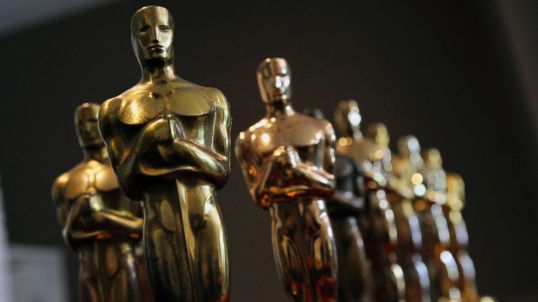
Now that the 2022 Oscars are over with, it’s time to move on to the 2023 Oscars!
Needless to say, there’s probably nothing more pointless than trying to guess which films are going to be nominated a year from now. I can’t even guarantee that all of the films listed below are even going to be released this year. And, even if they are released this year, I can’t guarantee that they’ll actually be any good or that the Academy will show any interest in them. I mean, Martin Scorsese always seems like a safe bet but we all remember what happened with Silence. For months, everyone said Silence would be the Oscar front runner. Then it was released to respectful but not ecstatic reviews. Audiences stayed away. The film ended up with one technical nomination.
My point is that no one knows anything. As much as I hate quoting William Goldman (because, seriously, quoting Goldman on a film site is such a cliché at this point), Goldman was right.
So, you may be asking, how did I come up with the nominees below? For the most part, I guessed. A few of them I went with because of the people who made the film. Though shooting has wrapped, Ferrari might not even be released this year but it’s a Michael Mann film that stars Adam Driver so, for now, I have to include it. Of course, I had to include Scorsese and Killers of theFlower Moon.Asteroid City is there because the Academy embraced Wes Anderson once and it could always happen again. FairPlay and Magazine Dreams‘s Jonathan Majors are listed because the Sundance Film Festival is still a recent memory. Maestro is there because the Academy seems like to Bradley Cooper. Dune Part Two and Oppenheimer are there because Film Twitter is convinced that they will be.
In other words, there’s no real science to these predictions. It’s too early in the year to do anything but guess. And for now, these are my guesses. A year from now, they’ll be good for either bragging rights or a laugh. Hopefully, they’ll be good for both.
In a film full of disturbing and frightening moments, this is the one that always gets to me. I think it’s a combination of how apologetic the clueless Jim is and also just the way those heads pop up when he says, “Hello?”
Listen, I have no idea what films are going to be nominated for this year’s Oscars or next year’s Oscars. I really don’t. I can guess but I certainly am not a 100% certain about anything.
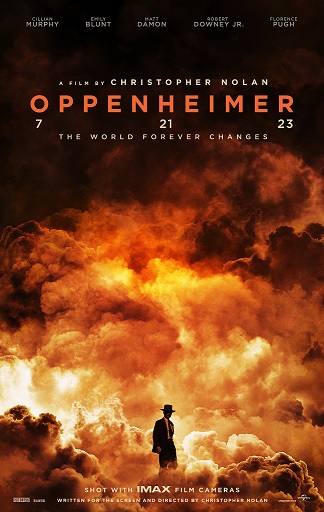
However, I do know that it seems like Christopher Nolan’s Oppenheimer is being set up as next year’s big Oscar bait film. Along with featuring an incredible cast and dealing with an important subject, it’s also directed by a filmmaker who many (especially on Twitter) consider to be overdue for some Oscar love, Christopher Nolan.
Admittedly, of course, it takes more than Twitter excitement to turn a film into a hit and Oppenheimer could be a hard sell when it comes to filmgoers who are less into history and auteurs than the members of Film Twitter are. (Let’s not forget what happened with Damien Chazelle’s First Man a few years ago. Or, for that matter, Nolan’s Interstellar.) Personally, though, I’m rooting for the film. I like Christopher Nolan. I like Cillian Murphy. I like Emily Blunt. I want them all to succeed.
(Of course, I imagine a lot of the coverage will center on Robert Downey, Jr. and Florence Pugh and the phenomenon of two MCU starts appearing in a non-MCU film. Such is the way of most mainstream film coverage nowadays….)
The first poster for Oppenheimer was released today and it leaves little doubt that it’s a film about a man who was at the center of the development of one of the greatest and deadliest weapons ever created. A shadowy J. Robert Oppenheimer stands in the flames of his own creation.
Oppenheimer will arrived in one year, on July 21st, 2023.
If you had told me, ten years ago, that John Krasinski was destined to go from starring in The Office to being an action star, I would have thought you were crazy.
“John Krasinsi’s going to grow a beard and base his acting career around playing soldiers and CIA analysts? No way! He will always be Jim Halpert,” I would have said, “He smirks at the camera and has an adorable relationship with Pam!”
Of course, I was wrong. After The Office ended, John Krasinki went on to play Jack Ryan for Prime and to star in movies like 13 Hours. And yet, as unexpected as that development may have been, what was even more unexpected was that Krasinski would also direct one of the best horror films of the past five years, 2018’s A Quiet Place. Telling the story of a family trying to survive in a post-apocalyptic world in which the Earth has been invaded by aliens who hunt by sound, A Quiet Place was intense, atmospheric, frightening, and actually rather touching. Though the plot itself may have been a bit familiar (because, seriously, how many movies have there been recently about insect-like aliens destroying civilization?) but Krasinski showed true skill as a director, getting heart-breaking performances out of a cast that included himself and his wife, Emily Blunt.
A Quiet Place was such a success that it was was inevitable that it would be followed by a sequel. Though its original release was delayed by the pandemic, A Quiet Place Part II was finally released in May of this year and it became one of the first successful films of 2021. John Krasinki even taped a special greeting for those who saw the film when it was first released, welcoming them back to the theaters. That really is the most John Krasinski thing imaginable.
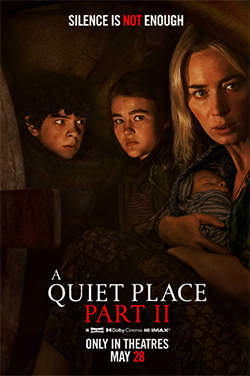
As for A Quiet Place Part II, it’s actually two films in one. The first part of the film serves as a prequel, showing us the initial attack and following Lee (John Krasinski) and his family as they flee for safety while the aliens decimate their hometown. It’s an exciting sequence, even if one gets the feeling that it was largely included so that Krasinski could make an appearance despite his character having been killed off during the first film. After the flashback, A Quiet Place Part II picks up where the first film ended. Lee is dead and his widow, Evelyn (Emily Blunt), does everything she can to protect her surviving children, Regan (Millicent Simmonds), Marcus (Noah Jupe), and her newborn baby. Though Regan has figured out that the aliens are themselves vulnerable to sound (specifically, a high-pitched tone), that doesn’t make the aliens themselves any less dangerous. After eventually meeting up with Emmett (Cillian Murphy), an embittered friend from the old days, Evelyn and her family search for other survivors.
A Quiet Place Part II is a simple but efficient thriller, one that recaptures all of the first film’s strengths without making the mistake of adding any new weaknesses. Much like the first film, it’s dominated by suspenseful scenes of survivors trying to make their way through the wilderness without so much as stepping on a twig. As anyone who has ever tried to sneak into their house after being out later than they were supposed to can tell you, walking without making a sound is not as easy as it seems. One of the film’s most harrowing scenes features a character getting his foot caught in a bear trap and his family struggling to free him while also trying to keep him from screaming out in pain.
Wisely, the film resists the temptation to tell us too much about the aliens. All we really know about them is that they hunt by sound and they kill anything they pounce on. And really, that’s all we need to know. At a time when far too many film franchises end up drowning in their own overly complicated mythology, the Quiet Place films keep it simple. The aliens hunt and they kill and they’re frightening specifically because there is no way to understand their motivations. They’re pure chaos, a reminder that our lives are not ruled by rhyme and reason. The aliens, like all existential threats, don’t care that the Earth is inhabited by families or people who have tried to create a safe life for themselves. They exist only to destroy.
It can be argued that A Quiet Place Part II tells essentially the same story as A Quiet Place, with Cillian Murphy’s Emmett replacing Lee. That’s a legitimate point but then again, it could also be argued that a part of the film’s strength is that it doesn’t attempt to complicate things. The aliens are going to remain just as frightening the second time Evelyn and her family flees from them as the first time. Clocking in at a brisk 97 minutes, there’s not a wasted moment or a trace of filler to be found in A Quiet Place Part II. Featuring an excellent turn from the awesome Emily Blunt and good performances from Simmonds and Murphy, A Quiet Place Part II is a sequel that’s worthy of the film that came before it.
Last night, I saw Free Fire, the latest film from the visionary British directing-and-screenwriting team of Ben Wheatley and Amy Jump.
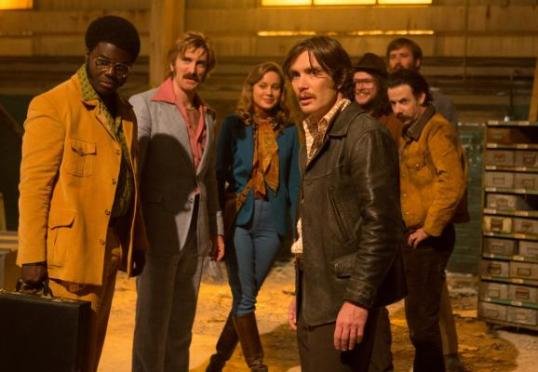
Free Fire takes place in Boston in the 1970s. We know it’s the 70s because of all the wide lapels, the flared jeans, and the impressive facial hair. In short, everyone looks like an extra from Thank God, It’s Friday. Note that I said Thank God, It’s Friday and not Saturday Night Fever. None of the characters in Free Fire could pull off John Travolta’s white suit. As much as they try to pretend otherwise, everyone in this film is low rent. No one is as clever or street smart as they believe themselves to be. Even more importantly, no one is as good a shot as they think.
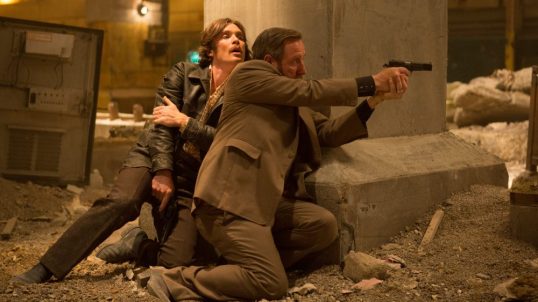
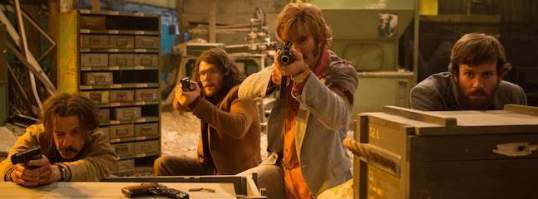
The film takes place in a decrepit warehouse, the type of place that is strewn with rats and hypodermic needles. Chris (Cillian Murphy), Frank (Michael Smiley), Steve-O (Sam Riley), and Bernie (Enzo Cilenti) are members of the Irish Republican Army and they’ve come to the U.S. to purchases weapons. Chris and Frank are no-nonsense professionals. Bernie is a well-meaning moron. Steve-O is a drug addict who, the previous night, got beaten up after he smashed a bottle across the face of a 17 year-old girl.
Working as intermediaries are Justine (Brie Larson) and Ord (Armie Hammer). Justine specializes in keeping jumpy people calm. She and Chris flirt as they wait for the guns to arrive. As for Ord — well, let’s just say that Ord was my favorite character in the film. He’s always calm. He looks really good in a suit. And, whenever things get intense, he’s always quick to light up a joint and make a sarcastic comment. This is probably the best performance of Armie Hammer’s career so far. (Or, at the very least, it’s the best performance of his that I’ve seen. I hear that he gives an excellent performance in the upcoming Call Me By Your Name.) Certainly, this is the first film that I’ve seen, since The Social Network, in which Hammer seemed to be truly worthy of the hype that has surrounded his career.
Finally, there’s the gun dealers themselves. There’s Martin (Babou Ceesay), who seems to be fairly low-key professional. There’s Gordon (Noah Taylor), who is a henchman who looks disconcertingly similar to Chris. And then there’s Vernon, who is from South Africa and who is constantly talking and smiling. Not surprisingly, Vernon is played by Sharlto Copley. Finally, Harry (Jack Reynor) is a driver who desperately wants to impress Ord. Harry loves John Denver and he also loves his cousin. In fact, he loves his cousin so much that, when he recognizes Steve-O as the junkie who smashed a bottle across her face, Harry pulls a gun and starts firing.
The rest of the film deals with the resulting gun fight, which is complicated with two mysterious snipers (Patrick Bergin and Mark Monero) suddenly open fire on both of the groups. Who hired them and why? That’s a mystery that could be solved if everyone stops shooting and yelling at each other. Of course, that’s not going to happen because 1) no one is a good enough shot to actually get the upper hand and 2) almost everyone in the warehouse is an idiot.
At it’s best, Free Fire mercilessly parodies the excessive violence of modern crime cinema. When it comes to crime films, most people just remember the shoot outs so Free Fire takes things to their logical extreme by just being a 90-minute gun fight. At its weakest, Free Fire occasionally becomes exactly what it’s parodying. The film’s structure — one night in one location — proves to be limiting. At times, you find yourself really wishing for a flashback or at least a little exposition to explain who everyone is outside of that warehouse. The cast is full of good actors and they all give good performances but the characters are, at best, thinly drawn. At times, it was difficult to keep track who was who. I especially found myself mixing up Michel Smiley and Sharlto Copely. It was all the facial hair.
About 30 minutes into Free Fire, I was already composing a bad review in my head but, by the final shot (and yes, the double meaning is totally intentional), Free Fire had won me over. It’s an experiment that doesn’t really work but it’s so relentless and dedicated to seeing its story to its conclusion that I couldn’t help but appreciate the film’s efforts. When the guns finally did stop firing and the end credits started, I was shocked to discover that, without even realizing it, I actually had gotten just a little caught up in the film’s story.
Ben Wheatley and Amy Jump previously gave us one of the most memorable films of the decade (so far), A Field in England. Free Fire might not quite work but I’ll always make the time to see the latest from Wheatley and Jump.
When Jeff and I went to see Logan on Thursday night, one of the many trailers that played before the film was this red band one for Free Fire. Free Fire is an action comedy, one that I think is meant to satirize the ultra violent heist films of the 90s and early aughts. Seriously, there are parts of this trailer that should make Guy Ritchie cringe.
That said, this trailer is also about a minute too long. At first, everyone in the theater thought it was kind of funny but then, around the two minute mark, the yawns started to kick in. “Are they just going to shoot at each other for the entire trailer?” someone asked.
The answer is yes. And you know what? The trailer probably doesn’t do Free Fire justice because this movie was directed by Ben Wheatley and I’m still having dreams inspired by his oddly hypnotic A Field in England. I’ll follow him anywhere!
Free Fire has a March 31st release date in the UK and an April 21st release date in the States.
Anyway, here’s the red band trailer for Free Fire!
The full trailer for Christopher Nolan’s latest film, Dunkirk, was recently released.
Focusing on the events surrounding the battle of Dunkirk, the movie looks to be pretty epic from at least a cinematography standpoint. Hoyt Van Hoytema (Spectre, Interstellar, Her) is back for this, which could be fantastic for the 70mm and IMAX Presentations.
Dunkirk – Starring Tom Hardy, Mark Rylance, Cillian Murphy and Kenneth Branaugh, is due to open in theatres next July.
There are A LOT of bad horror films out there and I mean Halloween Resurrection bad, but when you get a truly great one, it sticks with you for your life. This movie is more unique in that the writer Alex Garland really peaked with this film and there are IMDB credits to prove it. Danny Boyle directed the piece and you really feel as though you were inhabiting the after-times of a dead world….well, undead. Danny Boyle did Trainspotting, Slumdog Millionaire, 127 hours, but I know what you’re thinking- Did he write anything besides family films for Disney? Yes, he made this awesome zombie film.
We see shots of terrible violence and realize that monkeys are being forced to watch it. Then, Animal Rights Activists enter heavily armed with guns and sanctimony. The researcher begs them not to release the animals because they are infected with a terribly contagious disease and that the goal of their research is to find a cure for rage. The Animal Rights Activists patiently listen to the scientist instead of acting purely from smug instinct, dooming us all. Just kidding, they release one of the monkeys, it rips the animal rights activist apart, barf bleeds all over her, making her patient zero, and I try really hard not to root for the diseased monkey. The disease is out! Of course, many of us always knew that animal rights activists would lead to the zombie apocalypse. Just read their twitter feeds and you’ll know that they’ll doom us all. Fade to Black and 28 Days Later… appears as a subtitle in the bottom right….BRILLIANT!!!
Jim wakes from a coma to a dead world. Sound familiar? Yes, TWD went beyond homage there. He leaves the hospital to amazing details that really sell a dead London. Empty hospital, empty streets, garbage, worthless cash everywhere, a bus is overturned in front of parliament, and an amazing score reveals a World without people. If you’re looking for the song that plays when he’s walking around dead London during the opening – it’s by Godspeed You! Black Emperor – East Hastings – Long Version.
HOW DID THEY MAKE LONDON EMPTY? MERLIN! This is England, after all. Nah, Danny Boyle got MANY government officials to agree to let the production shutdown huge traffic arteries for 90 seconds at a time. London is one my most favorite cities and I would love to live there and it is Europe’s New York City, therefore, imagine shutting down Times Square for filming.
Jim gets chased by fast-moving zombies and meets Selena and a Red Shirt. He goes with them and realizes very quickly that he was probably better off in a coma. Jim insists on seeing his parents. They agree to take him and he finds them suicided on the bed clutching a note that reads- “With endless love, we left you sleeping. Now, we’re sleeping with you. Don’t wake up.” This is not your dad’s zombie movie. They decide to stay at his house for the night, but are attacked by zombies. Red Shirt gets infected and is dispatched by Selena. Jim and Selena must flee.
Jim and Selena venture forth and find Frank and his daughter Hannah. It hasn’t rained for some time, therefore -no water. For survival, they have to leave the city. Selena doesn’t want to go with Frank and his daughter because she sees them as anchors, but Jim insists and Hannah explains that we actually need each other. Frank plays a radio signal that beckons them to safety and they leave as one tribe. Along the way, there are some intense scenes and some shopping. They arrive at the salvation location, but Frank gets infected and is killed by soldiers.
Right away, you can tell that the soldiers are goofing off too much. I have commanded soldiers and there’s some level of goofing off, but this had an air of creepiness and broken discipline. The soldier’s have taken over a residence as their HQ and have put up defenses to keep zombies out and people in. We quickly learn that the radio message was a trap. Corporal Mitchell harasses Selena and a fight erupts. The Major breaks it up, but it’s clear that Jim, Hannah, and Selena are prisoners. The Major explains that the soldiers could not face a dead world and one attempted suicide. The Major had a plan- lure women to the compound with a radio signal. When they arrived, they would keep them prisoner to breed with his soldiers to restart civilization. He puts it simply: women equal hope. His logic and delivery is truly chilling in its cold mathematics.
They decide to execute Jim and a SGT who gets in their way and keep Hannah and Selena for reproduction. Corporal Mitchell and another Soldier take Jim and the SGT out for execution to a killing field. Corporal Mitchell wants to bayonet Jim, the other Soldier can’t handle that kind of intimate murder, leading to a melee. The SGT is killed and Jim escapes.
The next sequence is truly amazing because we see our hero morph from the sensitive man that he is naturally to a state of feral revenge indistinguishable from the fast-moving zombies. He’s shirtless to further emphasize his lack of civility as he makes short work of many of the soldiers to rescue Hannah and Selena. Corporal Mitchell who wanted to bayonet him and rape Selena becomes the focal point of Jim’s rage- Jim puts his thumbs deep into Corporal Mitchell’s eyes until he’s dead. This is a critical act of monstrosity because it shows not tells in the clearest finality that there is no separation between Jim’s blind rage and the rage that has infected the human population.
I don’t want to totally spoil the ending because this film will remain with you and is a must see. It’s commentary on violence and society is forever salient: Violence is horrific, but forced civilization is worse and will lead to the ultimate act of revenge – THUMBS IN YOUR EYEBALLS or some such equivalent. The other important lesson the film tries to inculcate is to beware of self-certain sanctimonious people because their grandiosity could doom us all.
Marvel Studios’ The Avengershas been the runaway, blockbuster hit of 2012’s summer film season. The film has also become the film which detractors of Christopher Nolan’s third and final entry in his Dark Knighttrilogy put up as the film to beat this summer. I like the fanboy enthusiasm that always comes out of the shadows whenever comic book films battle it out during the summer blockbuster season year in and year out, but I will say that instead of pitting the two mega-hits against each other fans of the comic book genre should embrace both because just around the corner will be the average to awful comic book films.
With just a month to go before the film’s release we get a new trailer (this one a Nokia Exclusive) for The Dark Knight Riseswhich looks to emphasis the action of the film where the previous trailers and teasers concentrated more on keeping the film’s story a secret. I’ve looked at these series’ of trailers and ads for the film like another of Nolan’s previous films with The Prestige. The first trailers and ads I see as the “The Pledge” from the film’s creators that hints at the grandiose event we’re going to be witness to. This latest trailer acts like “The Turn” as we see the magician performing the trick of this latest film giving the audience a bit more flash and pizzazz (maybe some misdirection as well to keep the story secret until the film’s release). For The Dark Knight Risesit will be on opening weekend when we finally see “The Prestige” that closes out (hopefully with critical-acclaim) Nolan’s turn as the caretaker of the Batmanfilm franchise.
The Dark Knight Risesis set for a July 20, 2012 release date.
For decades, the zombie film genre has been defined by the rules established by the grandfather of the modern zombie story, George A. Romero. His 1968 landmark horror film Night of the Living Dead transformed what had once been a gothic creature rooted in the voodoo folklore of Haiti and the Caribbean into an apocalyptic force symbolizing social collapse and human weakness. The film not only terrified audiences but also laid the foundational blueprint for every zombie movie that followed. Romero’s zombies weren’t merely monsters — they were a reflection of humanity’s fears, prejudices, and inner decay. His influence has remained so pervasive that, even today, filmmakers working in horror are inevitably responding to his legacy, whether they realize it or not.
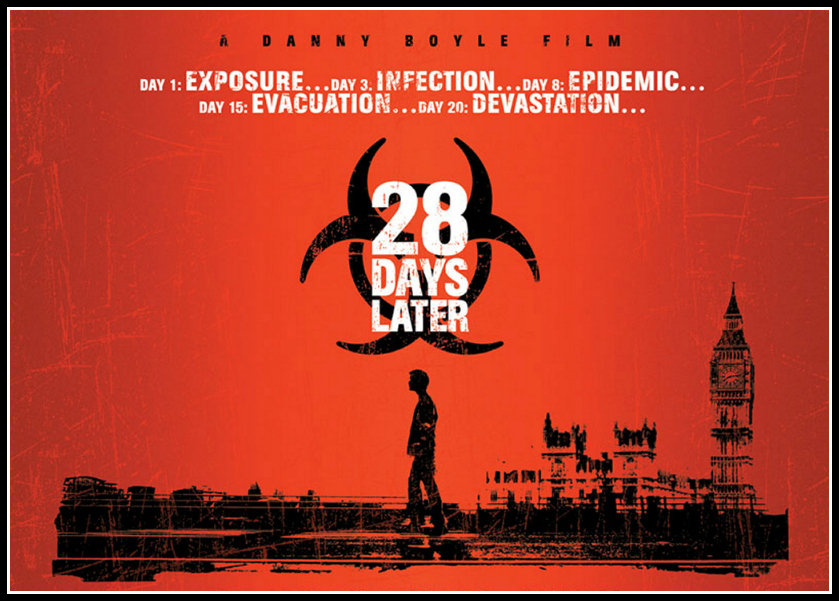
Through the years, there have been numerous attempts to deviate from Romero’s formula. The most prominent early success came in the 1980s with the Return of the Living Dead series — a clever horror-comedy franchise that infused dark humor and punk aesthetics into the genre. Yet even that beloved cult entry eventually lost steam. True reinvention did not arrive until 2002, when British filmmaker Danny Boyle and screenwriter Alex Garland collaborated on 28 Days Later, a project that both revitalized the zombie genre and split its devoted fan base down the middle. Was it truly a “zombie” film, or something else entirely? That very debate remains unresolved more than twenty years later.
Boyle’s film begins not with a supernatural curse or the reanimation of the dead, but with a catastrophic act of human arrogance. A group of naïve animal-rights activists break into a research laboratory to rescue chimpanzees subjected to bureaucratic cruelty. However, they find that these animals have been injected with a rage-inducing virus — the product of bioengineering rather than black magic. One of the activists, horrified by what she witnesses, ignores the pleas of a desperate scientist and frees a chimp, unleashing a pandemic that will decimate Britain within weeks. This opening sequence is both economical and horrifying: the origins of the apocalypse come from compassion twisted into recklessness. Boyle establishes his tone immediately — quick editing, grainy digital video, and an oppressive sense of realism create a world that feels disturbingly possible.
The narrative then leaps forward twenty-eight days. In a now-iconic sequence, the protagonist Jim (played by Cillian Murphy) awakens from a coma in an abandoned London hospital. His disorientation mirrors that of the audience: sterile hallways littered with trash, flickering lights, a haunting silence broken only by the hum of wind through the empty city. When Jim emerges into the sunlight, the camera captures a London entirely devoid of people, its majestic landmarks standing as hollow monuments to civilization’s sudden collapse. This is one of cinema’s most unforgettable depictions of isolation. The haunting score by John Murphy and the use of Godspeed You! Black Emperor’s instrumental “East Hastings” heighten the apocalyptic stillness, transforming London into a ghost metropolis.
Jim’s bewilderment only deepens when he seeks refuge in a church — a setting traditionally associated with salvation — only to find it desecrated by carnage. His presence awakens a horde of infected individuals who charge at him with terrifying speed. Unlike Romero’s slow, lumbering undead, Boyle’s infected are human beings transformed by a virus that amplifies their aggression to animalistic extremes. They move like predators, sprinting at prey with berserk fury. Jim narrowly escapes thanks to two survivors, Selena (Naomie Harris) and Mark (Noah Huntley), who introduce him to the brutal new rules of existence: infection spreads through blood contact, turning victims within seconds, and hesitation means death.
The trio’s uneasy alliance soon crumbles after Mark becomes infected, forcing Selena to kill him without hesitation. This harrowing moment establishes her as one of the film’s strongest and most pragmatic characters — a refreshing departure from the damsel archetype that has long haunted horror cinema. Jim and Selena later encounter Frank (Brendan Gleeson), a good-natured taxi driver, and his teenage daughter Hannah (Megan Burns), who have been surviving in a fortified apartment building. Together they form a fragile surrogate family and travel in search of a military broadcast promising safety and a potential cure.
Boyle deftly blends moments of human warmth amid horror. Scenes like the group’s scavenging trip through an abandoned grocery store — a darkly comic echo of Dawn of the Dead’s consumer satire — offer glimpses of joy and normalcy. The countryside sequences, shot with a painterly eye, contrast the urban decay of London with the serene beauty of a world reclaiming itself from human control. Nature, the film quietly suggests, endures long after people have vanished.
Their journey leads them to a fortified mansion commanded by Major Henry West (Christopher Eccleston), a British officer whose soldiers claim to have “the answer to infection.” The supposed sanctuary quickly reveals a darker truth. West’s band of men have descended into moral depravity, promising their commander that the promise of “women” will restore morale. The film shifts from survival horror to psychological thriller as the real threat emerges — not the infected outside, but the monstrousness within human beings when order collapses. In this descent into militaristic patriarchy and madness, Boyle channels the spirit of Romero’s Day of the Dead, where the military’s illusion of control becomes the true source of terror.
Boyle and Garland’s reinvention of the zombie mythos was revolutionary. Longtime fans of Romero’s shambling undead initially resisted the notion that 28 Days Later even qualified as a zombie movie. After all, its creatures weren’t reanimated corpses but living people overtaken by an uncontrollable virus. Yet their function within the story — relentless, dehumanized embodiments of contagion and rage — served the same thematic role as zombies always had: mirrors for society’s breakdown. The debate over whether the infected “count” as zombies is less important than the fact that Boyle redefined the genre’s emotional and kinetic language. His infected didn’t just pursue victims; they hunted them. Their blistering speed and screams injected pure chaos into what had once been slow, creeping dread.
The technical and artistic choices heightened the film’s intensity. Shot largely on digital video with handheld cameras, 28 Days Later looked raw and immediate, more like found footage than polished fiction. This realism bridged the gap between old-school horror and the new century’s fixation on viral outbreaks and global instability. Coming in the post-9/11 era, its images of deserted cities and military lockdowns felt eerily prescient, foreshadowing later fears of pandemics and authoritarian control.
The performances ground the film emotionally. Cillian Murphy’s portrayal of Jim evolves from bewildered innocence to hardened survivor, serving as the audience’s emotional compass. Naomie Harris delivers one of the genre’s most capable female performances, blending vulnerability with ferocity. Brendan Gleeson, always magnetic, brings compassion and tragedy to Frank — a man whose paternal instincts ultimately lead to heartbreak. Christopher Eccleston’s Major West stands as a chilling embodiment of human corruption in crisis: the soldier who insists he is saving civilization while replicating its worst impulses.
Despite being produced on a modest budget of roughly eight million dollars, Boyle’s film achieved a scale and impact far greater than its resources suggested. The empty London shots — achieved by closing key streets at dawn for only minutes at a time — remain astonishing feats of logistical precision and cinematic audacity. More importantly, the film’s minimalist production enhanced its believability. Everything about 28 Days Later feels lived-in, grimy, and plausible.
Two decades on, 28 Days Later continues to stand as one of the most influential horror films of the 21st century. Its success reinvigorated a genre that had grown stale and inspired a wave of imitators across film, television, and video games, from Zack Snyder’s Dawn of the Dead remake to AMC’s The Walking Dead. Beyond its cultural impact, it remains a haunting meditation on rage — personal, societal, and political. Boyle and Garland transformed horror into a canvas for existential dread, exploring how quickly civility unravels when survival becomes the only law.
Whether one calls it a zombie film or not hardly matters anymore. 28 Days Later breathed new life into the undead myth, shattering old rules and redefining what modern horror could be. The debate it sparked continues, but one truth is undeniable: the genre has never been the same since Jim first walked through that silent, ruined London — a world devoured not by the dead, but by the terrifying rage of the living.



 Through the Shattered Lens