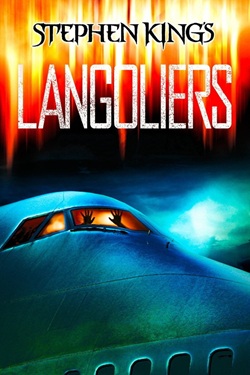
Stephen King’s The Langoliers (1995, directed by Tom Holland)


During a flight from Los Angeles to Boston, ten passengers fall asleep and then wake up to discover the plane is otherwise deserted. Conveniently, one of the passengers (David Morse) is also a pilot and he’s able to fly the plane to Bangor airport, which is as deserted as Graham Platner’s campaign office. As the other passengers try to figure out where they are and what’s going on, bond trader Craig (Bronson Pinchot) worries about the Langoliers, monsters that chase lazy people. Craig’s father told him about the Langoliers and sure enough, it turns out that they’re real and they’re eating time.

There have been a lot of really bad movies made out of the work of Stephen King and this might be the worst. It was actually made for television and it aired over two nights in May of 1995. I can remember everyone watching it and, even among the generally easy-to-please crowd that I went to school with, everyone agreed it was pretty bad. Do you have a friend who claims that Stephen King can do no wrong? Show them all three hours of The Langoliers, which sticks pretty closely to King’s original novella.

The premise isn’t really that bad. It’s the type of thing that shows like The Twilight Zone and The Outer Limits used to work wonders with. The problem is that the movie drags on for a punishing 180 minutes and Bronson Pinchot is the only member of the cast who really shows much energy. In fact, Pinchot shows almost too much energy. I get that Pinchot was trying to show everyone that he wasn’t Serge and he wasn’t Cousin Balki, but his performance as Craig is so Type A that it’s tiring to watch. The movie also suffers because eventually the Langoliers show up and they look like a bunch of demonic Pac-Men.

Sometimes, a picture says a thousand words:

I know that some people now say that The Langoliers is underrated or it’s “so bad that it’s good.” Don’t buy it. Instead, watch one of Tom Holland’s genuinely good horror films, like the original Child’s Play or Fright Night. Don’t subject yourself to this.

October Hacks: Sleepaway Camp (dir by Robert Hiltzik)


So much attention has been devoted to dissecting and discussing the ending of 1983’s Sleepaway Camp, that I think people tend to overlook the bigger issue.  This film is the biggest argument against summer camp over filmed.

Seriously, don’t send your kids to camp!  Don’t get a job working at a camp!  Don’t live anywhere near a camp!  If someone tries to open a camp near your home, gather together a posse and run them out of town!  If you discover an abandoned camp within one hundred miles of your home, set the place on fire!  Camps are bad news.  They attract bullies and tragedy and murder.  If there’s anything that I’ve learned from watching the horror movies of the early 80s, it’s that summer camps mean trouble.

Consider the camp in Sleepaway Camp.  Even before the murders start, the place comes across as being a prison camp.  Seriously, I’ve seen a lot of summer camps in a lot of slasher films and it’s hard to think of any of them that look as shabby and dirty as the camp in Sleepaway Camp.  None of the campers appear to be happy to be there.  No one is allowed to leave.  The campers are divided into two groups, the bullies who rule the place like mini-tyrants and the poor kids who spend the entire summer being beaten up and taunted.  Not even the counselors are worth much.  Counselor Meg (Katherine Kamhi) is best friends with the camp’s main mean girl, Judy (Karen Fields).  Meg is the type who tosses a camper in the lake, just because Judy tells her to.  Meanwhile, the owner of the camp is named Mel (Mike Kellin) and he’s just an old perv who doesn’t want to bothered with anyone’s problems.  What type of horrific world is this?

And then, let’s consider some of the murders at the camp.  The skeevy camp cook get scalded with boiling water.  (It’s debatable whether the cook actually dies or not.)  Kenny, one of the camp’s bullies, get drowned while playing a canoe-related prank.  Another bully is stung to death by bees.  That’s just three of the many deaths here and yet, the camp never closes.  It never occurs to the camp’s owner to send anyone home.  It never occurs to anyone that maybe they should send the campers to another camp.  None of the deaths lead to an increased police presence nor does it lead to any changes with the camp’s schedule.  None of the campers appear to be particularly upset by all the deaths.  It’s a disturbing world.

Everyone who dies at the camp earlier picked on Angela (Felissa Rose), an introvert who ends up getting targeted by Judy.  Angela’s cousin, Ricky (Jonathan Tiersten), is very protective of Angela and, as a result, he becomes the number one suspect.  As the film’s ending reveals, the truth is something much different.  The film ends with a justifiably famous shot and it does stick with you as the end credits role.  It’s tempting to read a lot of meaning into the film’s ending but I imagine that’s giving the filmmakers a bit too much credit.  The film was made for 1983 audiences who were looking for a shock, not 2023 cultural critics.

Even before that ending, though, Sleepaway Camp is a bit more creepy than the average 80s slasher film.  The killer is relentless and ruthless and it’s disturbing that the victimized campers are played by performers who are close to the age of their victims as opposed to the usual 30 year-old who played teenagers in these type of films.  The scene with the curling iron is something that I can only watching through the fingers that I’m holding in front of my eyes.  It’s not a great film by any stretch of the imagination but it does definitely capture the feel of being at the worst summer camp imaginable (seriously, one can hear the flies buzzing and even smell the stale order of stopped-up plumbing) and it does stick with you after you watch it.  It’s nothing to lose your head over, it’s just too bad no one told that to the campers.