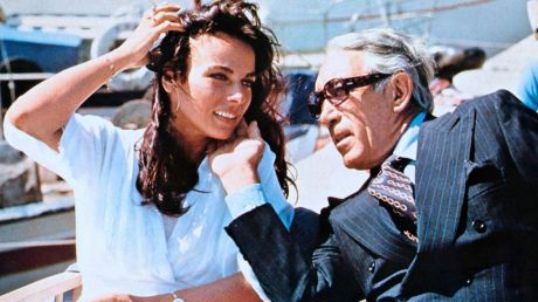
Embracing the Melodrama #30: The Greek Tycoon (dir by J. Lee Thompson)


Theo and Liz: A Love Story

Theo and Liz: A Love Story

“The characters in this film are fictitious and any resemblance to persons living or dead is purely coincidental”. — Completely And Totally False Disclaimer From The Greek Tycoon (1978)

In order to appreciate a film like 1978’s The Greek Tycoon, it helps to be a history nerd like me.

If you are, then you probably know that, 5 years after her husband was assassinated in Dallas, former first lady Jacqueline Kennedy remarried.  Her new husband was Aristotle Onassis, a Greek shipping magnate who was 23 years older than her and who had an unsavory reputation.  Onassis was one of the world’s richest men and was known for both his extravagant life style and for being a ruthless operator.  Depending on which books you read, Onassis is portrayed as either being either one of the world’s greatest villains (and, in fact, there’s a whole school of conspiracy theorists who believed that Onassis was somehow involved in John Kennedy’s assassination) or just a casually amoral rich man who treated his new wife like his latest trophy.  Either way, he was not the sort of person who Americans expected to become the second husband of a widowed first lady.

Of course, the Greek Tycoon is not about Aristotle and Jackie Onassis.  It’s about another Greek shipping magnate with a ruthless reputation who shocks the world by marrying the widow of a martyred President.  And, if you stick with the film all the way through the end credits, you’ll even see a disclaimer to prove it!

Anthony Quinn plays Theo Tomasis.  When we first meet him, he’s content to spend his time making crooked business deals and attending parties on a seemingly endless collection of white yachts.  He is grooming his son (Edward Albert) to take over the family business.  He loves both his wife Simi (Camilla Sparv) and his mistress (Marilu Tolo).  In fact, the only problem he has in his life is his business rival, Spyros (Raf Vallone, who played another Greek tycoon in The Other Side of Midnight).  Spyros happens to be Theo’s brother.  But other than that, Theo is content to spend all of his time dancing and breaking plates because, as the film reminds us every chance that it gets, he’s Greek.

However, things change for Theo when he meets Liz Cassidy (Jacqueline Bisset), the wife of young and charismatic Senator James Cassidy (James Franciscus).  Within minutes of meeting her, Theo is hitting on her but Liz loves her husband.  However, Sen. Cassidy soon becomes President Cassidy and this, of course, leads to Cassidy being assassinated while he and Liz are strolling down the beach.

Liz is soon married to the freshly divorced Theo and proving herself to be far more strong-willed than anyone realized.  Despite the anger and efforts of both Theo’s son and the dead President’s brother (Robin Clarke), Liz and Theo’s love endures and soon, they are such a glamorous and famous couple that its surprising that nobody ever suggests making a movie about them.

The Greek Tycoon is a big mess of a movie but it’s enjoyable if you know what inspired it.  (Of course, if you’re not into history and you don’t know anything about Aristotle and Jackie then you’ll probably find The Greek Tycoon to be one of the most boring movies ever made.)  To be honest, the story is never important in a film like this.  Instead, you watch for the clothes and the sets and they’re all properly glamorous in a 1970s sort of way.  Finally, you can watch this movie for Anthony Qunn’s unapologetically over-the-top performance as Theo.  I don’t know if you could necessarily say that Quinn gave a good performance here but, watching the film, it certainly does look like he was having fun.
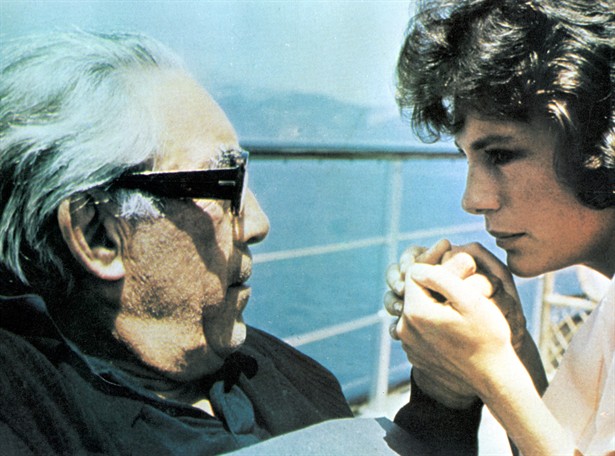
The_Greek_Tycoon_36374_Medium

44 Days of Paranoia #39: The Fury (dir by Brian DePalma)


For our latest entry in the 44 Days of Paranoia, let’s take a look at one of the silliest films ever made, Brian DePalma’s 1978 horror/thriller hybrid The Fury.

The Fury opens on a beach in Israel.  CIA veteran Peter (Kirk Douglas, who grimaces up a storm) is hanging out with his teenage son Robin (Andrew Stevens) and his friend and colleague Ben Childress (John Cassavetes).  Two things quickly become apparent.

First off, Robin has psychic powers.  We know this because Peter is obsessed with protecting him from being captured by a shadowy government agency that wants to use his power as a weapon.

And secondly, Ben is evil.  We know that Ben’s evil because he’s played by John Cassavetes.  As one of the first truly independent filmmakers, Cassavetes would often raise the money to make his fiercely individualistic films by playing villains in bad B-movies, like this one.

Ben, in fact, is so evil that he’s arranged for terrorists to attack the beach.  After Peter is apparently killed in a ludicrously violent gunfight, Ben takes off with Robin.

However, Peter is not dead!  Somehow, despite the fact that both the beach and the ocean were pretty much blown up with him on it, Peter survived and now, he’s looking for his son.  Peter makes his way to Chicago where he calls up his girlfriend, Hester (Carrie Snodgress), and says things like, “I want your body, baby.”

Hester, meanwhile, works at the Paragon Clinic, which is run by Dr. James McKeever (Charles Durning) who, himself, is secretly working for Ben.  The Paragon Clinic is a front to try to discover other teenage psychics and to turn them into weapons as well.  The newest patient is Gillian (Amy Irving), a teenage girl who might be able to help Peter track down his son.

Of course, what Peter doesn’t take into account is that, in his absence, Robin has turned into a power-mad sociopath who spends his time doing things like killing tourists at amusing parks…

Wow, that’s a lot of plot, isn’t it?  And, with all of that, I haven’t even gotten into what happens during the second half of the film!

The Fury is an enjoyably silly film, an awkward attempt to combine DePalma’s previous film, Carrie, with a paranoia-fueled political thriller.  There’s a certain charm to a film that takes itself so seriously and yet, at the same time, manages to be totally over-the-top and ludicrous.

For example, just consider the performances of the high-powered cast and the fact that none of the actors appear to be acting in the same film.  Playing a character who is a bit of a hero by default (because, seriously, how stupid did he have to be to not realize that Ben was evil to begin with), Kirk Douglas grimaces so manfully that Peter’s stupidity almost starts to feel like a satiric comment on hyper-masculinity.  John Cassavetes, on the other hand, is so disdainful of the film that he actually rolls his eyes while delivering some of his more melodramatic lines.  Meanwhile, Carrie Snodgress is forced to say things like, “Here comes the Pony Express!” and Charles Durning brings the full weight of his talent to deliver lines like, “If you’re having your monthlies, I don’t want you near the patient.”

And finally, there’s Amy Irving.  In DePalma’s Carrie, Irving played Sue Snell, the sole survivor of a psychic rampage.  In The Fury, Irving gets to play the psychic and she gives such a dramatic and emotional performance that you almost get the idea that she was trying to challenge Sissy Spacek.  “This is how you play a psychic, Sissy!” she seems to be shouting.  Of course, the big difference is that Carrie was actually a good film whereas The Fury is a bad film that happens to be watchable.

Finally, no review of The Fury is complete without talking about Brian DePalma’s direction.  To put it lightly, Brian DePalma directs the Hell out of The Fury and the effect is something like what an episode of Agents of SHIELD would look like if directed by Martin Scorsese.  The entire film is a collection of tracking shots, zoom lenses, and sweeping overhead shots with the camera only stopping long enough to linger over scenes of violence and spilled blood.  In perhaps the film’s most ludicrous scene, Amy Irving runs away from the clinic in slow motion while the orchestral score plays out on the soundtrack.  We get close-ups of Irving’s face and close-ups of the faces of her pursuers.  One character gets shot multiple times but we don’t hear the gunshots.  Instead, we only hear the music and watch as the character overacts and dies in slow motion.  It’s almost as if DePalma was trying to win a bet by achieving the most counter-productive use of slow motion in film history.

Ultimately, The Fury is so thoroughly silly and over-the-top that it simply has to be seen.

Other Entries In The 44 Days of Paranoia 

  1. Clonus
  2. Executive Action
  3. Winter Kills
  4. Interview With The Assassin
  5. The Trial of Lee Harvey Oswald
  6. JFK
  7. Beyond The Doors
  8. Three Days of the Condor
  9. They Saved Hitler’s Brain
  10. The Intruder
  11. Police, Adjective
  12. Burn After Reading
  13. Quiz Show
  14. Flying Blind
  15. God Told Me To
  16. Wag the Dog
  17. Cheaters
  18. Scream and Scream Again
  19. Capricorn One
  20. Seven Days In May
  21. Broken City
  22. Suddenly
  23. Pickup on South Street
  24. The Informer
  25. Chinatown
  26. Compliance
  27. The Lives of Others
  28. The Departed
  29. A Face In The Crowd
  30. Nixon
  31. The Hunger Games: Catching Fire
  32. The Purge
  33. The Stepford Wives
  34. Saboteur
  35. A Dark Truth
  36. The Fugitive
  37. The Day of Jackal
  38. Z

Film Review: Dog Day Afternoon (dir. by Sidney Lumet)


Last night, as part of my continuing mission to see every film ever nominated for best picture, I watched Sidney Lumet’s Dog Day Afternoon.  Dog Day Afternoon was released in 1975.  Though nominated for best picture, it lost to One Flew Over the Cuckoo’s Nest.

In Dog Day Afternoon, Al Pacino plays Sonny, a nervous Viet Nam vet who, along with the dim-witted and possibly crazy Sal (John Cazale), attempts to rob a bank.  Unfortunately for him, Sonny doesn’t really know what he’s doing and literally within minutes of him first drawing his gun, the bank is surrounded by cops.  The robbery quickly descends into a hostage situation.  As Pacino negotiates with a NYC police detective (Charles Durning), a crowd of onlookers gathers around the bank and starts to cheer with every defiant word that comes out of Sonny’s mouth.  Sonny discovers he likes his new-found fame.  In the film’s most famous scene, he stands outside the bank and leads the crowd in a chant of “Attica!  Attica!”   Eventually, Durning learns that Pacino’s motive for robbing the bank was to steal enough money for his suicidal lover (Chris Sarandon) to get a sex change operation.  However, now that the robbery has failed, Pacino has a new plan.  He demands a flight out of the country.  Meanwhile, the hostages inside the bank start to form their own odd kinship with the two bank robbers and Durning finds himself being challenged by the F.B.I., who have a much more drastic plan for how to end the situation.

Dog Day Afternoon is a remarkable film, a dark comedy of desperation and human nature that, by the final scene, reaches a certain tragic grandeur.  Sidney Lumet (who made his directorial debut in 1957 with 12 Angry Men and whose most recent film, Before the Devil Knows Your Dead, was released 51 years later) was one of the most important (if underrated) filmmakers of the 1970s and he proves it here.  From the opening montage of New York City looking so wonderfully sordid at the height of the grindhouse era to Pacino’s bumbling initial attempt to rob the bank to the film’s violent and abrupt conclusion, Lumet captures your attention and, much like Al Pacino in this movie, he holds it hostage until the movie ends. 

Dog Day Afternoon is probably one of the best acted films that I’ve ever seen.  This is one of those films where every role — regardless of how large or how small — fills like an actual human being.  By the end of the film, you feel as if you know the bank managers and the tellers almost as well as you know Pacino, Durning, Sarandon, and Cazale.  Pacino is simply amazing here, giving a nervous, jittery performance as a character who manages to be both selfish and selfless at the same time.  Durning, meanwhile, is hilarious as the frazzled detective who finds himself steadily overwhelmed by the circus around him.  Much as you can’t help but root for Pacino no matter how self-absorbed he might act, you can’t help but sympathize with During, even if he is a member of the establishment.  As Pacino’s transsexual lover, Sarandon plays his role with a fragile dignity that prevents the role from becoming a stereotype.  However, for me, the film truly belongs to John Cazale who is both scary and oddly child-like as Sal.  As seen below, Cazale improvised one of the best lines in the movie when he replies to Pacino’s question regarding to which country Cazale wants to make his escape.

Now, this is going to be difficult for me to admit but, as thrilling as it was to watch Pacino shout, “Attica!  Attica!,” I honestly had no idea why that phrase was the one he chose to use to work up the crowd.  In fact, if I had written this review right after seeing (or while watching) the film last night, I probably would have doubled embarrassed myself by claiming that Pacino was shouting “Ateka.”  However, for once, I decided to be a responsible reviewer and I actually did some research as opposed to just going with my first conclusion.  So, as a result of this film, I can now say that I know about the Attica Prison Riots of 1971.

But what’s truly significant about that “Attica” chant is that it’s the only part of this film (beyond a few fashion choices) that feels dated.  As I watched the movie, it was easy for me to imagine myself jumping on twitter and seeing “#Attica” as a trending topic.  We’ve all seen the famous “Attica!” scene in countless compilations but what’s often forgotten is how that sequence ends.  When Pacino, obviously a bit star struck by all the attention, goes outside and start chanting a second time, he is suddenly tackled from behind by one of the bystanders who has decided to play hero.  And as Pacino goes down to the ground, the same crowd that was previously cheering him now cheers for the new object of their affection.  If nothing else, Dog Day Afternoon showed why sometimes we all need to escape to Wyoming.