The TSL Horror Grindhouse: The Toolbox Murders (dir by Dennis Donnelly)


In 1979’s The Toolbox Murders, someone is murdering the female tenants of a building in Los Angeles.  The killer, who wears a mask and a leather jacket, uses tools.  One woman is killed by a hammer to the head.  Another is skewered by a power drill.  One is stabbed with a screwdriver.  Another is shot with a nail gun.  The identity of the killer would be a total mystery if not for the fact that we’ve already seen Cameron Mitchell’s name in the cast list.

Indeed, it’s a bit pointless to cast Cameron Mitchell in any sort of whodunit-type of film.  Nine times out of ten, Mitchell being in a movie means that that Mitchell (who, in the early days of his career, originated the role of Death of a Salesman‘s Happy Loman on Broadway) is going to be revealed as the murderer.  In this case, Mitchell plays Vance Kingsley, the owner of the building.  Vance has never recovered from the death of his daughter so he’s punishing women who he considered to be sinful.

The actual toolbox murders are pretty much finished after the first twenty minutes of the film.  The rest of the movie deals with Laurie (Pamelyn Ferdin), a 15 year-old girl who is kidnapped by Vance and his nephew, Kent (Wesley Eure).  Joey (Nicholas Beauvy), who is Laurie’s brother, attempts to find and then rescue his sister and turns out to very much not up to the task.  The film itself ends on a rather sick note, one that is followed by a title card that informs us that the film is based on a true story.  Yeah, sure, it was.

The Toolbox Murders has somehow earned a reputation for being a gory and shocking grindhouse film.  It was among the films that was banned in the UK for several years.  It’s actually not that gory and the use of tools to commit the murders is not quite as clever as the film seems to think it is.  Even the nail gun murder (which is the film’s best known moment) feels rather awkward as the victim (Kelly Nichols) never really makes a run for it despite the fact that Vance has to stop to reload after every nail that he fires.

The scenes with Laurie being held hostage are far more disturbing and weird, largely due to Mitchell’s characteristically over-the-top portrayal of Vance’s psychosis.  When you watch a movie called The Toolbox Murders, you’re probably not expecting a lengthy scene where Laurie — pretending to be Vance’s dead daughter — tells a long story about what it’s like in the afterlife.  In the role of Vance’s nephew, Wesley Eure is even more disturbing than Mitchell.  As opposed to the sinister-looking Mitchell, Eure actually has the look of a nice, young community college student and that makes his actions at the end of the film all the more icky to watch.

The Toolbox Murders doesn’t quite live up to its bloody reputation but it’s still a disturbing film nonetheless.  Did you know that Heaven smells like lollipops?  After this film, you’ll never forget.
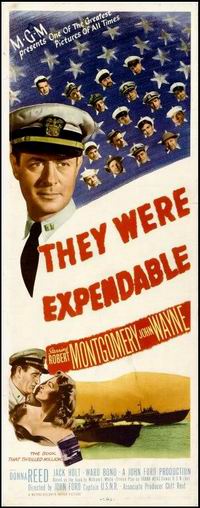
They Were Expendable (1945, directed by John Ford)


In December of 1941, Lt. John Brickley (Robert Montgomery) commands a squadron of Navy PT boats, based in the Philippines.  Brickley is convinced that the small and agile PT Boats could be used in combat but his superior officers disagree, even after viewing a demonstration of what they can do.  Brickley’s second-in-command, Rusty (John Wayne), is frustrated and feels that he will never see combat.  That changes when the Japanese attack Pearl Harbor and then turn their attention to the Philippines.  Brickley gets his chance to show what the PT boats can do but both he and his men must also deal with the terrible risks that come with combat.  Brickley and his men have been set up to fight a losing battle, only hoping to slow down the inevitable Japanese onslaught, because both they and their boats are considered to be expendable.  The hot-headed Rusty learns humility when he’s sidelined by blood poisoning and he also falls in love with a nurse, Sandy (Donna Reed).  However, the war doesn’t care about love or any other plans that its participants may have.  With the invasion of the Philippines inevitable, it just becomes a question of who will be sent with MacArthur to Australia and who will remain behind.

One of John Ford’s best films, They Were Expendable is a tribute to the U.S. Navy and also a realistic look at the realities of combat.  The movie features Ford’s trademark sentimentality and moments of humors but it also doesn’t deny that most of the characters who are left behind at the end of the movie will not survive the Japanese invasion.  Even “Dad’ Knowland (Russell Simpson), the fatherly owner of a local shipyard who does repair work on the PT boats, knows that he’s expendable.  He resolves to meet his fate with a rifle in hand and a jug of whiskey at his feet.  Rusty, who starts out thirty for combat, comes to learn the truth about war.  Ford was one of the many Hollywood directors who was recruited to film documentaries during World War II and he brings a documentarian’s touch to the scenes of combat.

Robert Montgomery had previously volunteered in France and the United Kingdom, fighting the Axis Powers before America officially entered the war.  After the war began, he entered the Navy and he was a lieutenant commander when he appeared in They Were Expendable.  Montgomery brought a hardened authenticity to the role of Brickley.  (Montgomery also reportedly directed a few scenes when Ford was sidelined with a broken leg.)  John Wayne is equally good in the role of the hot-headed Rusty, who learns the truth about combat and what it means to be expendable.  The cast is full of familiar faces, many of whom were members of the John Ford stock company.  Keep an eye out for Ward Bond, Cameron Mitchell, Leon Ames, Jack Holt, and Donald Curtis.

They Were Expendable is one of the best of the World War II movies.  It’s a worthy film for Memorial Day and any other day.

The TSL Grindhouse: Rebel Rousers (dir by Martin B. Cohen)


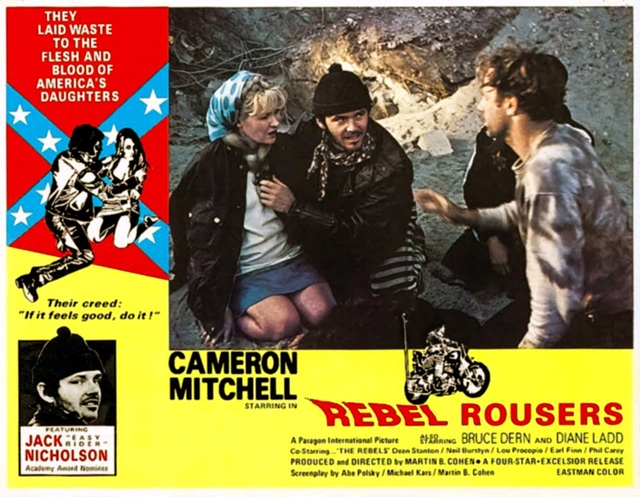
1970’s Rebel Rousers tell the story of what happens when Paul Collier (Cameron Mitchell) arrives in a small desert town, searching for his girlfriend, Karen (Diane Ladd).  Karen ran away when she discovered she was pregnant because she was scared that Paul would attempt to force her to get an abortion.  While Paul talks to Karen in a cheap motel, a motorcycle gang rides into town.  The members of the gang include Randolph (Harry Dean Stanton) and Bunny (Jack Nicholson), who wears striped prison pants and a stocking hat.  The leader of the gang is J.J. Weston (Bruce Dern), who went to high school with Paul.  They even played on the same football team but their lives have since followed differing paths.  (How exactly 30ish Bruce Dern and 50ish Cameron Mitchell could have been in the same high school class is not an issue that the film chooses to explore.)

Paul reunites with Karen and swears his love for her.  However, when Paul and Karen run into the motorcycle gang, Karen is kidnapped.  Bunny wants to force himself on Karen but J.J. wants to set her free.  J.J. challenges Bunny to a series of motorcycle games on the beach.  The winner decides what happens to Karen.  Meanwhile, Paul heads back to the town in search of help but discovers that almost everyone is too much of a coward to help him out.  Only Miguel (Robert Dix), the leader of a rival gang is willing to step up and save the community from the Rebels!

Rebel Rousers was filmed in 1967 but was considered to be so bad that it was put on a shelf and forgotten about until Jack Nicholson suddenly became a star in Easy RiderRebel Rousers was released on the drive-in circuit as a Jack Nicholson movie, even though Nicholson is barely in the film and he gives a pretty one-note performance as Bunny.  The movie’s star is Cameron Mitchell, who usually played villains and doesn’t seem to be too invested in this film.  (Mitchell has such a naturally sinister screen presence that I was actually worried about Paul finding Karen.  Bruce Dern and Diane Ladd are the sole members of the cast who really stand out, with Dern taking on the type of cool rebel role that was usually played by Peter Fonda while Ladd (pregnant at the time with Laura Dern) actually manages to bring some real emotional depth to her character. The movie itself was obviously made for next to nothing and it seems like it was shot in a hurry.  Everything feels like a first take or, even worse, like a rehearsal that was deemed “good enough.”  The competition between Bunny and J.J. ultimately feels mostly like filler than anything else.

Rebel Rousers is one of the more obscure entries in Jack Nicholson’s filmography.  If not for the success of Easy Rider, it never would have been released at all.  By the time Rebel Rousers did come out, Jack Nicholson was too busy establishing himself as one of the best leading men of the 70s to spend too much time looking back.  Today, watching this film can make it easier to understand why Nicholson was considering dropping out of Hollywood all together before he was cast in Easy Rider.  That said, the film today serves as a reminder that everyone started somewhere and sometimes, the somewhere is the second feature at the grindhouse.

On Stage On The Lens: The Andersonville Trial (dir by George C. Soctt)


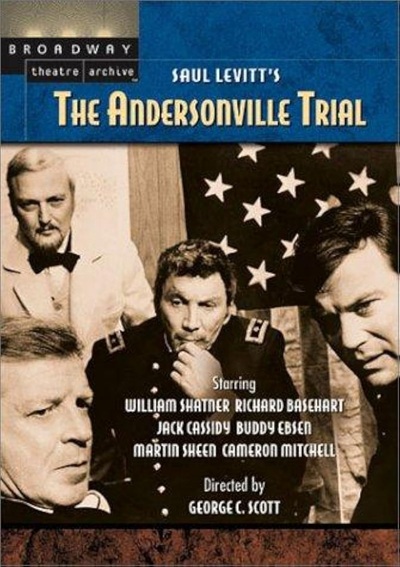
1970’s The Andersonville Trial takes place in one muggy military court room.  The year is 1865.  The Civil War is over but the wounds of the conflict are still fresh.  Many of the leaders of the Confederacy are still fugitives.  Abraham Lincoln has been dead for only a month.  The people want someone to pay and it appears that person might be Captain Henry Wirz (Richard Basehart).

Originally born in Switzerland and forced to flee Europe after being convicted of embezzlement, Henry Wirz eventually ended up in Kentucky.  He served in the Confederate Army and was eventually named the commandant of Camp Sumter, a prison camp located near Andersonville, Georgia.  After the war, Captain Wirz is indicted for war crimes connected to his treatment of the Union prisoners at the camp.  Wirz and his defense counsel, Otis Baker (Jack Cassidy), argue that the prison soon became overcrowded due to the war and that Wirz treated the prisoners as well as he could considering that he had limited resoruces.  Wirz points out that his requests for much-needed supplies were denied by his superiors.   Prosecutor Norton Chipman (William Shatner) argues that Wirz purposefully neglected the prisoners and their needs and that Wirz is personally responsible for every death that occurred under his watch.  The trial is overseen by Maj. General Lew Wallace (Cameron Mitchell), the same Lew Wallace who would later write Ben-Hur and who reportedly offered a pardon to Billy the Kid shortly before the latter’s death.  Wallace attempts to give Wirz a fair trial, even allowing Wirz to spend the trial reclining on a couch due to a case of gangrene.  (Agck!  The 19th century was a scary time!)

The Andersonville Trial started life as a 1959 Broadway production.  On stage, George C. Scott played Chipman, an experience he described as difficult because, even though Chipman was nominally the play’s hero, Wirz was actually a much more sympathetic character.  When the play was adapted for television in 1970, Scott returned to direct.  Admittedly, the television version is very stagey.  Scott doesn’t make much effort to open up the play.  Almost all of the action is confined to that courtroom.  We learn about the conditions at Fort Sumter in the same way that the judges learned about the conditions.  We listen as the witnesses testify.  We listen as a doctor played by Buddy Ebsen talks about the deplorable conditions at Fort Sumter.  We also listen as a soldier played by Martin Sheen reports that Wirz has previously attempted to suicide and we’re left to wonder if it was due to guilt or fear of the public execution that would follow a guilty verdict.  We watch as Chipman and Baker throw themselves into the trial, two attorneys who both believe that they are correct.  And we watch as Wirz finally testifies and the play hits its unexpected emotional high point.

As most filmed plays do, The Andersonville Trial demands a bit of patience on the part of the viewer.  It’s important to actually focus on not only what people are saying but also how they’re saying it.  Fortunately, Scott gets wonderful performances from his ensemble cast.  Even William Shatner’s overdramatic tendencies are put to good use.  Chipman is outraged but the play asks if Chipman is angry with the right person.  With many of the Confederacy’s leaders in Canada and Europe, Wirz finds himself standing in for all of them and facing a nation that wants vengeance for the death of their president.  Wirz claims and his defense attorney argues that Wirz was ultimately just a soldier who followed orders, which is what soldiers are continually told to do.  The Andersonville Trial considers when military discipline must be set aside to do what is morally right.

Admittedly, when it comes to The Andersonville Trial, it helps to not only like courtroom dramas but to also be a bit of a history nerd as well.  Fortunately, both of those are true of me.  I found The Andersonville Trial to be a fascinating story and a worthy production.

The TSL’s Horror Grindhouse: Without Warning (dir by Greydon Clark)


1980’s Without Warning opens with a father (Cameron Mitchell) and his gay son (Darby Hinton) on a hunting trip.  The father taunts his son about not being what the father considers to be a real man.  He says that his son would have no chance of surviving in the wilderness.

“Why does it always have to be like this?” the son asks with a sincerity that will break your heart.

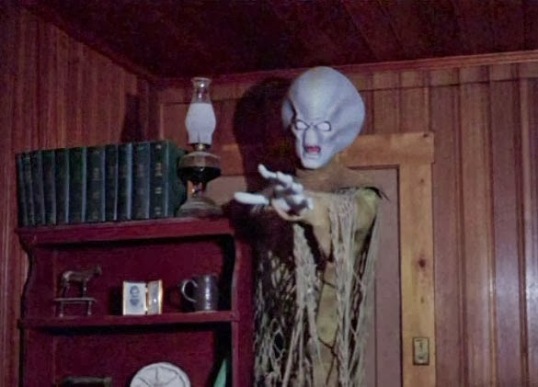
Suddenly, a bloodsucking starfish flies through the air, lands on the father, and starts to suck out his blood with a phallic stinger.  The father dies while his son watches.  The son picks up his rifle and prepares to fight back.  This will be the son’s chance to prove that his father was incorrect.  This is the son’s chance to prove that he can survive in the wilderness and….

Just kidding.  The son forgot to load the rifle and promptly gets a starfish to the eye.

That’s the type of film that Without Warning is.  Characters are introduced.  The majority of them are played by B-actor who have seen better days.  They get a few minutes of character development.  Then, they die and the viewer is left feeling a bit depressed because they all seemed like they deserved just a bit more screentime than they received.  Larry Storch shows up as a boy scout leader who gets a starfish to the back while trying to light a cigarette.  Neville Brand, Ralph Meeker, and Sue Anne Langdon hang out in a bar and refuse to believe that the Earth has been invaded by blood-sucking starfish.  Jack Palance plays a hunter and gas station owner who wants to capture an alien as a trophy.  Martin Landau plays Sarge, an unbalanced Vietnam Vet who has been telling people for years that there are aliens out there.  Everyone laughed at old Sarge but they won’t be laughing for long!  At the time this film was made, Palance was a two-time Oscar nominee.  He finally won his Oscar for City Slickers, a decade after Without Warning.  Martin Landau, for his part, won his Oscar 15 years after Without Warning.  Good for them.  If nothing else, this movie should remind everyone who has dismissed Eric Roberts’s chances that there’s still time!

That said, none of these familiar faces are the stars of the film.  Instead, the majority of the film follows four teenagers on a road trip, Sandy (Tarah Nutter), Greg (Christopher S. Nelson), Beth (Lynn Theel), and Tom (David Caruso).  David Caruso as a sex-crazed teenager sounds more amusing than it actually is.  If anything, the sight of him wearing shorts and t-shirt is almost blinding.  (As a fellow redhead, I sympathize.  We burn but we don’t tan.)  Tom and Beth die early on, leaving Greg and Sandy to try to escape from the alien (Kevin Peter Hall) who is tossing around the starfish.  Both characters are pretty generic but Christopher Nelson is at least likable.

Without Warning has a reputation for being the best film that Greydon Clark ever directed and I would agree that it’s one of his better ones, though I prefer The Forbidden Dance.  Then again, when you consider some of the other films that Clark directed, it’s easy to see that Without Warning didn’t exactly have a huge bar to clear.  Though the script borrows a bit too much from nearly every other horror film ever made, Without Warning is nicely paced and the killer starfish are genuinely frightening and their bloodsucking is almost Cronenbergian in its ick factor.  Just as he would for John Carpenter, cinematographer Dean Cundey gives us some nicely eerie shots of the alien.  Landau and Palance go all out, understanding that subtlety has no place in a film like this.  Without Warning is a dumb B-movie but it’s definitely entertaining.

Without Warning (1980, dir by Greydon Clark, DP: Dean Cundey)

Retro Television Review: Fantasy Island 5.2 “The Devil and Mr. Roarke/Ziegfeld Girls/Kid Corey Rides Again”


Welcome to Retro Television Reviews, a feature where we review some of our favorite and least favorite shows of the past!  On Tuesdays, I will be reviewing the original Fantasy Island, which ran on ABC from 1977 to 1984.  Almost the entire show is currently streaming on Daily Motion, YouTube, Plex, and a host of other sites.

This week is a busy one as Mr. Roarke deals with several guests, a new assistant …. AND THE DEVIL!

Episode 5.2 “The Devil and Mr. Roarke/Ziegfeld Girls/Kid Corey Rides Again”

(Dir by Don Chaffey, originally aired on October 17th, 1981)

The plane lands at the Island, carrying four people in search of a fantasy.  Waiting to greet them are Mr. Roarke, Tattoo, and Julie.  After being told that she wasn’t ready to greet the guests last week, Julie has finally been promoted.  And if you thought that Mr. Roarke and Tattoo occasionally had an awkward chemistry, it’s nothing compared to how awkward things feel with a third person cheerfully taking part in their conversations.  Wendy Schaal is likable enough as Julie but it’s hard to understand why, in-universe, the character is there.

As for our guests, Joan (Barbi Benton in old-age makeup) and Rubi (Audrey Landers, in even more old-age makeup) are former Ziegfeld girls who want to relive their youth.  Joan’s niece, Billie (Betty Kennedy), is appearing in a Ziegfeld-style revue that is being directed by Carl Wagner (Dack Rambo).  Mr.  Roarke agree to make Rubi and Joan young again, with the understanding that it will only be for the weekend and that they can’t tell anyone about their fantasy while they’re experiencing it.  The women agree and are overjoyed when they are transformed into their younger selves.  (I’m going to guess that Benton and Landers were probably even happier to ditch the old age makeup.)  Rubi promptly decides to steal Carl away from Billie.  Joan is shocked by Rubi’s behavior and she has to decide whether to allow her friend to live her fantasy or to tell the truth about what she and Rubi are doing on the island.

Also going into the past is a meek shoe salesman named Ned Plummer (Arte Johnson).  Ned wants to go back to the old west so that he can meet his hero, outlaw Kid Corey.  Corey is famous for disappearing after pulling off a million dollar robbery.  Ned even has an old picture of Corey in which Corey possesses a definite resemblance to Ned himself.  Mr. Roarke warns Ned that, when he goes to the past, the bullets will be real and he won’t be able to return to the present until his fantasy is over.  Given a magic horse, Ned rides into the past and promptly meets Kid Corey (Jack Elam).

It turns out that Kid Corey doesn’t look like Ned.  It also turns out that Kid Corey is not the Robin Hood-type figure that he was made out to be in the history books.  Kid Corey isn’t even a Kid!  He’s an irascible old man who doesn’t lift a finger when Ned is arrested by Sheriff Matt (Cameron Mitchell, naturally enough), taken to jail, and sentenced to hang.  Oh no!  It sound like it’s time for Mr. Roarke to save Ned, right?  Well, Mr. Roarke is busy with another situation so it’s Tattoo who shows up in Ned’s fantasy and, oddly, Tattoo doesn’t seem to be that worried about Ned getting executed.  Maybe Tattoo is planning on blaming it all on Julie.  (That said, it is nice to see Tattoo get to do something more than just as Mr. Roarke questions.  In this episode, Herve Villechaize seems to be enjoying the chance to show off his snarky side.)

What is occupying Mr. Roarke’s attention?  Well, Satan (Roddy McDowall) has returned to the Island.  He claims that he’s just looking for a relaxing weekend but it soon becomes obvious that, once again, he wants Roarke’s soul.  Mr. Roarke warns Julie to be careful what she says around the Devil.  So, of course, Julie promptly offers to give away her soul.

Now, in Julie’s defense, she was trying to save a guest who was drowning in quicksand and what she said is that she would do anything to save the guest’s life.  Satan hears and saves the guest in return for Julie giving him her soul at midnight.  Still, I have to wonder why Julie hadn’t been previously trained on how to pull someone out of quicksand.  I mean, if she’s ready to meet the guests then I would think that Roarke would have given her quicksand training.  That really seems like the first thing that someone should learn when they start working on Fantasy Island.

(For that matter, why is there so much quicksand on a resort!?)

Satan — surprise! — is willing to call off his deal with Julie in return for Roarke giving up his soul at midnight.  Roarke agrees but then he tricks Satan by singing a contract transferring possession of his soul to Julie.  Since Roarke’s soul is now Julie’s, Roarke can’t get give it away.  Because the overly cocky Satan spends too much time gloating and then gets upset over being conned, he loses track of time and the midnight hour passes without Satan taking anyone’s souls.

(I’m not sure if any of this would hold up in court but, to be honest, I don’t really know much about contract law.)

With three stories and a new sidekick to introduce, this was a very busy episode.  The Ziegfeld and the Old West fantasies were nicely done.  The Ziegfeld costumes were to die for and Jack Elam was memorably uncouth in the role of Kid Corey.  That said, as you can probably guess, the main attraction here is Roddy McDowall hamming it up as the Devil.  He and Montalban both seem to be having a lot of fun in this episode and their confrontation is entertaining to watch.  I wish Julie hadn’t been portrayed as being such a naive fool but still, this was an enjoyable weekend on the Island.

Retro Television Review: Thief (dir by William A. Graham)


Welcome to Retro Television Reviews, a feature where we review some of our favorite and least favorite shows of the past!  On Sundays, I will be reviewing the made-for-television movies that used to be a primetime mainstay.  Today’s film is 1971’s Thief!  It  can be viewed on Tubi and YouTube.

Neal Wilkinson (Richard Crenna) would appear to be living a great life.  He has a nice house in the suburbs.  He has a beautiful girlfriend named Jean Melville (Angie Dickinson).  As he heads into middle-age, he is still fit and handsome and charming.  He dresses well, or at least well by the standards of the early 70s.  (By the standards of today, a few of his ties are a bit too wide.)  Everyone believes that Neal has a nice and comfortable job as an insurance agent.

Of course, the truth is far different.

Neal is a veteran con man and a thief.  He’s just recently been released from prison and his deceptively friendly parole officer (played by the great character actor, Michael Lerner) is convinced that Neal will screw up again eventually.  And, of course, Neal has screwed up.  A gambling addict, he is $30,000 in debt.  Can Neal steal enough jewelry from enough suburban homes to pay off his debt?  Can a man like Neal change his ways?

This is a surprisingly somber made-for-TV movie.  Just from the plot description and the film’s first few minutes, you might expect Thief to be a light-hearted caper film in which Neal and Jean work together to pull off one last heist so that Neal can retire.  Instead, Neal spends almost the entire film lying to Jean and there’s hardly a light moment to be found.  Neal says that he wants to retire from his life of crime but, as the film makes clear, that’s a lie that he’s telling himself.  Neal cannot stop stealing and gambling because he’s as much of an addict as the wild-haired junkie (Michael C. Gwynne) who briefly confronts Neal at the parole office.  At one point, Jean tells Neal, “The more I know you, the less I know you,” but the truth of the matter is that Neal is so deep in denial about the futility of his life that he doesn’t even know himself.

It’s not a particularly happy film.  Richard Crenna is ideally cast as Neal, playing him with enough charm that the viewer can buy that he could talk his way out of being caught in a stranger’s backyard but with also with vulnerability that the viewer can see his fate, even if he can’t.  Thief also provides a rare opportunity to see Cameron Mitchell playing a sympathetic role.  Mitchell is cast as Neal’s attorney, who continually tries to get Neal to stop messing up but who ultimately knows that his attempts to reform Neal are just as futile as Neal’s attempts to go straight.

The movie ends on a surprisingly fatalistic note, one that suggests that there’s only one way to truly escape from a life of crime.  I can only imagine how viewers responded in 1971, when they turned on their television and found themselves watching not a light-hearted caper film but instead a bleak examination of criminal ennui.  It’s not a happy film but it is more than worth watching for Richard Crenna’s lead performance.

Retro Television Reviews: Fantasy Island 3.5 “The Chain Gang/The Boss”


Welcome to Retro Television Reviews, a feature where we review some of our favorite and least favorite shows of the past!  On Tuesdays, I will be reviewing the original Fantasy Island, which ran on ABC from 1977 to 1986.  Almost entire show is currently streaming is on Youtube!

What I’ve long-feared has happened.

Tubi has removed the original Fantasy Island from its site.  The recently-canceled Fox version can be viewed but not the original.  Don’t get me wrong.  I liked the new Fox version.  But these are Retro Television Reviews and a show that premiered in 2021 is not yet retro.

Fortunately, quite a few episodes are on YouTube and it’s probable that the original complete series will again end up streaming somewhere.  So, I’m going to try to continue to review this show.  I can’t guarantee that I won’t run out of episodes at some point.  For instance, it doesn’t appear that much of seasons 6 or 7 can be found, even on YouTube.  (Unfortunately, it appears that only the first three seasons of Fantasy Island have been released on DVD.)  But I’m going to do my best!

Episode 3.5 “The Chain Gang/The Boss”

(Dir by Michael Vejar, originally aired on October 19th, 1979)

Tattoo has decided that he wants to be an artist!  Mr. Roarke demands to know why because God forbid Tattoo have a life outside of spotting the plane.  Tattoo admits that he wants to get the island women to pose for him.  Mr. Roarke orders Tattoo to abandon his art career and head down to the docks to meet the plane.

The plane is carrying two guests who hope, much like Tattoo, to change their lives.

Cindy Carter (Donna Mills) is a switchboard operator who has a crush on her boss, Brent Bailey (Brett Halsey).  Her fantasy is to be the boss of her own company.  Mr. Roarke grants her wish and soon, Cindy is in charge of her own multi-national corporation.  In fact, her corporation owns Brent Bailey’s business!  Cindy also gets a executive assistant named Gary Pointer (Roddy McDowall).  Unfortunately, it turns out that Brent isn’t a very nice person and he’s been siphoning money out of the pension fund.  He threatens to frame Cindy to keep her from approving an audit of the fund.  However, with Gary’s support and eventual love, Cindy stands up to Brent and reveals his wrong-doing.  Mr. Atwell (Stacy Keach, Sr.), the presumed-dead head of the company, suddenly shows up at the stockholder’s meeting and announces that he faked his own death to discover who was embezzling from the pension fund.  The stockholders applaud as Brent Bailey is taken away from the police.  It’s all rather silly and melodramatic but the likable presence of Roddy McDowall kept the story entertaining.

Meanwhile, Mike Jenner (Dennis Cole) came to the Island to confront Eddie Collins (Cameron Mitchell), the criminal that Mike believes murdered his father and framed him for a theft.  (There’s a lot of theft in this episode.)  Mr. Roarke reveals that Eddie lives in a nearby fishing village.  Mike goes to the village, spots Eddie, and punches him.  Eddie hits back….

….and both of them are sentenced to spend a year on a chain gang!

Fantasy Island has a chain gang!?  And the chain gang is overseen by a redneck named Captain Hawks (R.G. Armstong)!?  Why has this never been mentioned before?  I mean, is it normal to sentence paying guests to spend a year on the chain gang?

Anyway, Eddie and Mike set aside their difference and break out out the prison camp.  (Fantasy Island has prison camps!?)  During their escape, Eddie gets trapped in quicksand.  Mike does eventually rescue him but only after Eddie confesses to having framed Mike’s father.  As soon as Eddie confesses, Mr. Roarke shows up in his jeep.  Apparently, Mike is now free to leave the Island with his fiancee (Pat Klous) while Eddie is sent to the Fantasy Island prison for the rest of his life.  Much as the other fantasy was saved by the reliable likability of Roddy McDowall, this episode was saved by Cameron Mitchell’s grouchy presence.  One could always trust Mitchell to give it his all while playing a bad guy.

With the fantasies taken care of, Tattoo returns to his art.  When he asks his model to pose naked, she destroys all of his paintings while Mr. Roarke laughs and laughs.  Mr. Roarke really does hate his assistant.

Retro Television Reviews: Hitchhike! (dir by Gordon Hessler)


Welcome to Retro Television Reviews, a feature where we review some of our favorite and least favorite shows of the past!  On Sundays, I will be reviewing the made-for-television movies that used to be a primetime mainstay.  Today’s film is 1974’s Hitchhike!  It  can be viewed on YouTube!

Claire Stevens (Cloris Leachman) is an emotionally vulnerable woman who is dealing with her loneliness and depression by driving to San Francisco to visit her sister.  As she’s driving, she spots a young man named Keith (Michael Brandon).  Keith is standing on the side of the road and holding out his thumb.  At first, Claire does the smart thing and she drives by him without stopping.  However, Claire starts to feel guilty so she turns around and — NO, CLAIRE!  WHAT ARE YOU THINKING!? — offers him a ride.  It turns out that he’s going to San Francisco as well!

At first, the drive is awkward.  Keith says that he doesn’t want to talk and he doesn’t appreciate it when Claire tries to make him listen to the classical music station.  But, as they drive, Keith starts to let down his defenses.  He says that he wishes that he could just sail away on the ocean.  He encourages Claire to embrace life and to just go for it.  They stop at a pier and have lunch.  Claire buys Keith a silly white hat and she places it on his head because, as she puts it, “it’s cute.”  Keith argues with her but he doesn’t take off the hat.  However, when Keith spots some cops, he immediately leads Claire away from them.

The viewer watches all of this with a sense of dread because the viewer knows what Claire doesn’t.  The viewer knows that Keith is the son of a wealthy man.  The viewer knows that Keith had been having an affair with his stepmother, who was only a few years older than Keith.  And the viewer knows that Keith murdered his stepmother with the same weapon that he’s currently carrying in his bag.  The police are looking for Keith and Keith is willing to do just about anything to stay free.

I have to admit that I yelled a little when Claire offered Keith a ride because it was such an obviously stupid thing to do.  Everyone knows that it’s never a good idea to pick up a hitchhiker.  And, if you’re a woman who is driving down an isolated road by yourself, the last thing you should ever do is offer a ride to some strange man standing on the side of the road.  Claire’s actions were foolish but, because she was played by Cloris Leachman, it was still hard not to sympathize with her.  Claire is someone who feels as if she’s been abandoned by the world and, quite obviously, she sees Keith as a kindred spirit.  Over the course of their journey, it becomes obvious that Claire is using Keith as a substitute for what she’s missing in her life.  He becomes both a son and a companion to her.  Unfortunately, Keith tends to go into a rage whenever he sense anyone getting too close to him.

Hitchhike! is a short movie and, for all the dramatic build-up, it ends on a rather anti-climatic note.  Cameron Mitchell shows up as a detective who is looking for Claire and Keith and he gives a mannered performance that is oddly over-the-top by even his generous standards.  That said, Michael Brandon has the blandly handsome look of a generic but charming serial killer while Cloris Leachman gives a credible and sympathetic performance as Claire.  If nothing else, this film can be watched with The Hitcher as a double feature.  Never stop your car for anyone!

Retro Television Reviews: Fantasy Island 2.2 “The Big Dipper/The Pirate”


Welcome to Retro Television Reviews, a feature where we review some of our favorite and least favorite shows of the past!  On Tuesdays, I will be reviewing the original Fantasy Island, which ran on ABC from 1977 to 1986.  The entire show is currently streaming on Tubi!

Smiles, everyone, smiles!  How silly can things get this week?

Episode 2.2 “The Big Dipper/The Pirate”

(Dir by Earl Bellamy, originally aired on September 23rd, 1978)

Pete Raymond (Dan Rowan) and his daughter, Harmony (Jill Whelan), are professional pickpockets who are hiding out from a determined NYPD Detective named Broylan (Cameron Mitchell).  What better place to hide than Fantasy Island?  After stealing a ticket to the island from a reverend, Pete discovers that “his” fantasy is to work on a farm.  Of course, as you probably already guessed, the fantasy is actually Harmony’s.  She wants her father to calm down and live a normal life, away from committing crimes and fleeing the police.  At first, farmwork seems to agree with Pete but then Broylan shows up on the island.

I’ve often wondered about the legal status of Fantasy Island.  Is it an independent nation or is it territory of the United States or a member of the Commonwealth?  Some of the episodes during the first season suggested that Fantasy Island was a territory of the United States.  However, in this episode, Roarke reminds Broylan that the NYPD has no jurisdiction in Fantasy Island and that the island is not required to turn anyone over to America.  Pete is eventually arrested but Mr. Roarke explains that the Fantasy Island magistrate has ruled that Pete and Harmony can stay on the island and work on the farm.  When Broylan demands to know who the magistrate is, Mr. Roarke replies that he is.  So, apparently, we are now back to Fantasy Island being a separate nation where Mr. Roarke makes and interprets all of the laws.

The legal status of Fantasy Island was probably the most interesting thing about this fantasy.  It’s always fun to see Cameron Mitchell playing an obsessed cop but Dan Rowan gives a lousy performance as Pete and it’s never really clear how Harmony was able to set up the fantasy in the first place.  I mean, it obviously took a lot of planning on her part.  Did Mr. Roarke charge her the full price or is she another one of the freeloaders that Tattoo is always complaining about?

The show’s other fantasy is even more ridiculous and, not coincidentally, it’s also a lot more fun.  Painter Ted Cavanaugh (Sonny Bono) is upset that his ex-wife Mary (Diana Canova) is going to be marrying some stuffy rich guy so he asks to be transformed into an 18th century pirate so that he can kidnap Mary and convince her that she’s still in love with him.  WHAT!?  It’s totally completely ludicrous but …. I don’t know.  Sonny Bono is kind of funny as a pirate.  If you’re going to have a silly fantasy, you might as well go out and make it as silly as humanly possible and that’s definitely what happens here.  Fortunately, it all works out in the end.  Who can resist a pirate?