A Blast From The Past: Patriotism


Flag (Erin Nicole Bowman, 2010)

Today is Loyalty Day!

If you haven’t ever heard of Loyalty Day before … well, then you’re probably a subversive or something.  Loyalty Day has been a real holiday since 1955.  That was when President Dwight D. Eisenhower proclaimed May 1st to be Loyalty Day.  (I’m going to guess that this was done largely to provide an alternative to International Workers Day or Communist New Year or whatever May Day was known as back then.)  The official statutory definition reads as follows:

(a) Designation.— May 1 is Loyalty Day.(b) Purpose.— Loyalty Day is a special day for the reaffirmation of loyalty to the United States and for the recognition of the heritage of American freedom.(c) Proclamation.— The President is requested to issue a proclamation—

(1) calling on United States Government officials to display the flag of the United States on all Government buildings on Loyalty Day; and
(2) inviting the people of the United States to observe Loyalty Day with appropriate ceremonies in schools and other suitable places.

So, in honor of Loyalty Day, here’s a short film from 1972.  It’s called Patriotism and it was apparently made to teach school children what it meant to be a patriot.  Apparently, it means working as a crossing guard and wearing a vaguely fascist-looking vest while doing so.  It also means keeping an eye out for weeds and trash in your neighborhood.  My favorite part of this film is when the kid spots the turned over garbage can and gets a look of disgust on his face.  You can just tell he’s thinking, “Those goddamn hippies.”

(For the record, that’s what I always think whenever I can’t find a pen at work.)

Personally, I agree that making a good neighborhood is the first step in making a good country so I definitely applaud the kids for taking the time to clean their neighborhood up.  Still, I have to wonder: where are the adults?  How many grown ups walked past the overturned trash can and just ignored it?  Perhaps all the adults in the neighborhood were so disillusioned by George McGovern dumping Tom Eagleton as his running mate that they just gave up on life.  Who knows?  1972 was apparently a pretty traumatic year for some people.  Myself, I just find it amusing that there was a politician named McGovern.  That’s like a seminarian named McClergy.

Speaking of adults, this short film was hosted by actor Bob Crane, who would be murdered six years later and whose life would serve as the basis for a rather depressing movie called Auto Focus.

Anyway, in the immortal words of Team America: World Police, “America!  Fuck yeah!”  Let’s make this the best Loyalty Day ever!


A Blast From The Past: I Just Don’t Dig Him (produced by The Department Of Mental Health, State of Connecticut)


The haunting opening scene of I Just Don’t Dig Him…

Ah, parents and their children!

It doesn’t matter what year it is or where they live or who they are.  Parents never understand their children and children never understand their parents and, ultimately, there’s always that one friend who ends up nearly chopping his finger off.

At least, that’s the message that I got from watching the 1970 educational film, I Just Don’t Dig Him.

This film was produced by the state of Connecticut’s Department of Mental Health and apparently, it was designed to show that adults and teenagers actually had more in common than they realized.  For instance, in this film, both groups share an intense loathing for each other.

The film is about a father and his son.  The father spends all of his time complaining about his son.  The son spends all of his time complaining about his father.  For some reason, we’re treated to a really gross close-up of the son’s bare feet.  Meanwhile, the father applies aftershave as if the fate of the world depended upon it.  The son’s best friend assures him that his father isn’t so bad.  The father’s best friend assures him that his son isn’t so bad.  And then the son’s friend accidentally chops off his finger while fooling around with a car engine.  The father helps to stop the bleeding while his son stares at him resentfully.  The message appears to be that adults and children need to communicate better but, ultimately, you want an adult around if anyone starts bleeding.

I like films like this, largely because I’m an unapologetic history nerd and I Just Don’t Dig Him is such a product of its time that it might as well be wearing bell bottoms and dropping brown acid.  Watching the film today, it’s hard not to be amused by how intense both the father and the son are about … well, everything.  When the father shaves, you’re first thought is, “That man should not be allowed to handle anything sharp.”  When the son talks on the phone, you feel bad for whoever’s having to listen to him whine.  Generations are at war, this film seems to say, and there’s no hope until the younger generation realizes that they have no business working on cars.

With this being 4/20 and the world currently being caught up in its own increasingly tedious generational war, today seems like the perfect time to share I Just Don’t Dig Him!

A Blast From The Past: Sacheen Littlefeather Crashes The Oscars


The year was 1973 and Marlon Brando was the obvious front-runner to win the Oscar for Best Actor.  His performance in The Godfather had not only provided an important anchor to that sprawling film but it also rejuvenated his career.

No one was surprised when Liv Ullman and Roger Moore announced that Brando had won the Oscar.  The shock came when a young woman named Sacheen Littlefeather approached the stage.  The rest is Oscar history:

Brando had actually given Sacheen a 15-page speech that he wanted her to read from the stage.  However, the show’s producers — realizing what Brando was planning — told Sacheen that, if she stayed on stage for longer than 60 seconds, she would be forcibly removed.  Hence, Sacheen improvised her stage comments and then read Brando’s speech backstage.  As a result of this incident, the Academy banned proxy acceptances.

As for Brando’s Oscar, Roger Moore took it home with him and kept it until, a few days later, armed guard showed up to take it back from him.

A Blast From The Past: You Are The One (dir by Andy Warhol)


Pop artist Andy Warhol wasn’t just a painter and a celebrity.  He was also a filmmaker.

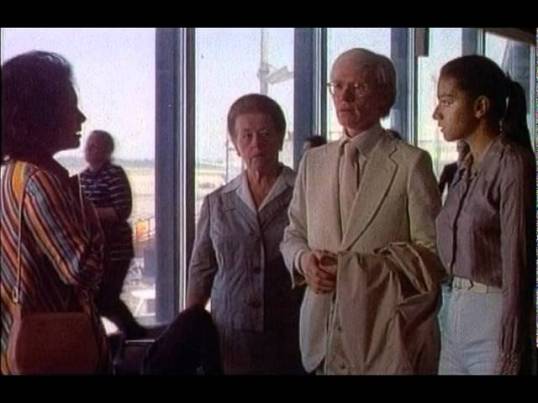
Below, you’ll find Warhol’s final film.  In 1985, using a type of early computer known as an Amiga, Warhol made a 2 and a half-minute movies called You Are The One.  It’s a strange little movie, one that features Marilyn Monroe and a disembodied voice repeating, “You are the one.”  It’s atmospheric and, when viewed under the right circumstances, kind of creepy.

This movie was believed to be lost until 2007, when it was found hidden away in Warhol’s studio.

Here is Andy Warhol’s final film:

A Blast From the Oscar Past: 12 Years A Slave Wins Best Picture


165 years ago today, a slave named Solomon Northup received his freedom.

Solomon hadn’t been born a slave.  He was born a freedman in Rhode Island and settled, with his family, in New York.  He was a man of many trades, though probably best known as a fiddler.  He was 32 when, in 1841, he was kidnapped by two men who, claiming he was a fugitive slave that had been recaptured, sold him into slavery.  He spent 12 year separated from his family, working on plantations across the Deep South.  It was while he was owned by the cruel (even by the standards of the slave trade) Edwin Epps that Northup met a Canadian carpenter named Samuel Bass.  Northup told Bass the truth about his identity and it was with Bass’s help that Solomon Northup was finally reunited with his family.  Northup went on to write the memoir 12 Years A Slave and traveled the country, lecturing on abolition.

His later life is a mystery.  He vanished in 1857, while on a speaking tour in Canada.  At the time, there was speculation that he had once again been abducted and sold into slavery.  Others thought that he may have been murdered by pro-slavery partisans.  Of course, there were other who said that they met Northup in the 1860s and that he was helping slaves escape to the North during the Civil War.  One man, a Rev. Smith, even reported meeting Northup in 1863.

Over a century later, Solomon’s memoir was adapted for the screen.  Directed by Steve McQueen, 2013’s 12 Years a Slave was a powerful and haunting film, one that deservedly won the Oscar for best picture of the year.  Here’s that moment:


A Blast From The Past: Case Study: LSD


Though it’s been a while since we last did so, we occasionally like to share old educational and promotional films here at the Shattered Lens.  For some reason, we always seem to end up sharing quite a lot of them in October.  Something about the over-the-top educational format just tends to bring out the ghoulish melodrama in some aspiring filmmakers.

Take Case Study: LSD, for instance!  This 3 and a half minute film is from 1969.  It was made to dissuade viewers from experimenting with LSD but I get the feeling that I probably just mostly inspired people to try to recreate the infamous hot dog scene.

It’s a good film for October, though.  Plus, I like looking at all the hippies in their hippie clothes.  GET A HAIRCUT, YOU HIPPIES!

Believe it or not, Case Study: LSD has a page over at the IMDb but no director is listed.  Judging from the film’s use of still frames, I’m going to guess that it was directed by Chris Marker.

Enjoy!

A Blast From The Past: Make Mine Freedom


Hi there!

Well, it’s May 1st!  Not only is it International Worker’s Day but, here in the United States, it is also Loyalty Day!

What are you supposed to do on Loyalty Day?  To be honest, I’m not really sure.  I actually didn’t even know there was such a thing as Loyalty Day until about two years ago.  I guess I’ll spend this Loyalty Day as I spent previous Loyalty Days, ironically commenting on the fact that it’s Loyalty Day.

So, with all that in mind, here’s a rather odd blast from the past (1948, to be exact) called Make Mine Freedom.  It’s a cartoon about why America rules and the rest of the world sucks.  Woo hoo!  Praise the Lord and pass the ammunition!  USA!  USA! USA!

As for the cartoon itself, it’s charmingly odd and will be best enjoyed by people who have a sense of humor about their ideology.  (Good luck finding anyone like that in 2017.  Those of us who think that both the left and the right are worthy of ridicule are becoming an endangered species.)  This cartoon was produced by Arkansas’s Harding College and, online, there seems to be some debate over who actually directed it.  Some sources claim that this was one of the first projects on which Joseph Barbera and William Hanna ever worked.  Others insist that this film should be properly credited to either Fritz Freling or Fred Moore.

Well, whoever directed it, did a good job of exposing that mean old Dr. Utopia…

Enjoy Make Mine Freedom and happy May Day!


Twin Blasts From The Past: What To Do On A Date and Dating Do’s and Don’ts (dir by Ted Peshak)


It’s been a while since I’ve shared any old educational films here on the Shattered Lens but I figured now might be the perfect time to share an old movie from 1951, What To Do On A Date.  Produced by the good (or so I assume) people at Coronet Films, What To Do On A Date is … well, the plot is pretty much in the title.

Now, to be honest, this could have just as easily been called What To Do On A Date If You Want To Make Sure That Lisa Never Agrees To A Second Date.  Seriously, this is totally squaresville.  Like real Melvin.  But you know what?  I’m notoriously hard to please and, with Valentine’s Day coming up, this may be helpful to someone.

I don’t know who, exactly.  But hey, it’s on YouTube and that’s the important thing.

(I’m all about helping.  You know that.)

If you still need help after What To Do On A Date, you can watch 1949’s Dating Do’s and Don’ts.  It was directed by the same guy who did What To Do On A Date.  People in the 1940s were notorious for knowing what to do on dates.  The Baby Boom didn’t just happen, y’know.

(Apparently, the version of Dating Do’s and Don’ts uploaded to YouTube is incomplete.  But you’ll get the general point.)


A Blast From The Past: The Making Of It’s A Wonderful Life (dir by Sandra Moiseeff)


Now that you’ve either seen the film or listened to the radio adaptation of It’s A Wonderful Life, how about a documentary about how this classic film came to be in the first place?

The Making Of It’s A Wonderful Life was apparently made for television and was broadcast in 1990.  Hosted by actor Tom Bosley, it’s a warm and appreciative look at a much beloved classic.

And here it is!


Was This The First Horror Film? The Execution of Mary Stuart (dir by Alfred L. Clark)


For the longest time, I thought that George Melies’s The Haunted Castle was the first horror film.

However, as I did my research for my History of Horror series, I discovered a horror film that actually predated The Haunted Castle.  Produced by Thomas Edison and first released in 1895, The Execution of Mary Stuart is an 18-second film that recreates the beheading of Mary, Queen of Scots.

Along with perhaps being the first horror film, this was also the first films to use editing for the purpose of special effects.  There’s an edit about halfway through this film, one that allows Robert Thomae, the actor playing Mary, to be replaced by a mannequin.  That may not seem like a big deal today and the editing is rather obvious to modern eyes but, in 1895, that sort of thing literally had never been done before.

So, with all that in mind, here is the first horror film: 1895’s The Execution of Mary Stuart!