Film Review: Brainstorm (dir by Douglas Trumbull)


It’s hard to imagine that someone could overact while playing a corpse but Louise Fletcher somehow manages to do just that in 1983’s Brainstorm and I think we owe her some respect for that.  The underrated Fletched won an Oscar for playing Nurse Ratched in One Flew Over The Cuckoo’s Nest and she appeared in a handful of other films that I’ve liked (Strange Behavior, the 2012 restoration of Once Upon A Time In America) but, now that I’ve watched Brainstorm, I will always think of her playing a dead character with the biggest, hammiest facial expression ever on her otherwise lifeless face.

In Brainstorm, Fletcher plays Dr. Lillian Reynolds, a chain-smoking scientist who is always upset about something.  When Lillian isn’t lighting a cigarette or yelling, “You sold me out!,” she’s clutching her chest and taking her heart pills.  Working with her partner, Dr. Michael Brace (Christopher Walken), Lillian has developed a brain-computer interface that allows people’s brain waves to be recorded on tape so that others can then experience what they experienced.  In practice, this looks like putting on a helmet and then seeing what appears to be a home movie.  What fun!  Lillian thinks that the interface can be used to change and save the world.  Dr. Brace thinks he can use the interface to discover why his marriage to Karen (Natalie Wood) fell apart.  Their associate, Hal (Joe Dorsey), thinks he can use it to experience his friend screwing the babysitter over and over and over again.  Meanwhile, Alex Taber (Cliff Robertson) thinks that it can be used as a military weapon.

(Hal is probably the one who comes the closest to what people would actually use this technology for.)

Lillian is not happy about her technology being turned over to the military.  She gets upset about it over and over again.  Eventually, she suffers one of the most overdramatic heart attacks ever recorded on film.  Before she dies, she hooks herself up to the machine and records her dying vision.  Michael becomes obsessed with seeing what Lillian saw as she entered the afterlife.  Unfortunately, the mean military folks have the tape so it looks like Michael is going to have to unleash some chaos.  I can’t think of any other film that mixes Christopher Walken having a beatific vision with a bunch of slapstick humor featuring an out-of-control robot and a bunch of soap bubbles.

Today, if Brainstorm is known for anything, it’s as the film that Natalie Wood was shooting when she died.  One popular theory about the circumstances surrounding Wood’s death is that she was having an affair with Christopher Walken.  Watching the two of them in this film should disabuse anyone of that notion as the two of them have absolutely zero chemistry as a couple.  (For the record, I think Wood’s death was an accident and that a lot of self-styled Internet sleuths owe Robert Wagner an apology.)  If there’s anything that this film should be known for, it should be that it features a large number of Oscar nominees and winners and they all end up giving absolutely lousy performances.  Even the usually wonderful Christopher Walken seems to be playing someone imitating himself.  Watching this film, I was never quite sure why anyone was actually doing anything.

Director Douglas Trumbull was best known for designing the Stargate sequence in 2001: A Space Odyssey and, not surprisingly, Brainstorm’s vision of the afterlife is actually pretty effective.  One gets the feeling that Trumbull was more comfortable with the special effects than he was with the human actors.

I have to admit that I always smile a little at films where scientists are shocked — shocked, I tell ya! — to discover that their technology is going to be used for military purposes.  Why did they think the government was funding them in the first place?  Lillian seems to believe that her technology will be used to allow people to experience what it’s like to ride a roller coaster.  That’s what IMAX is for.
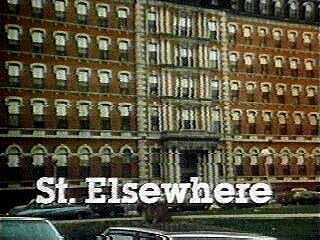
Retro Television Review: St. Elsewhere 2.14 “Drama Center”


Welcome to Retro Television Reviews, a feature where we review some of our favorite and least favorite shows of the past! On Fridays, I will be reviewing St. Elsewhere, a medical show which ran on NBC from 1982 to 1988.  The show can be found on Hulu and, for purchase, on Prime!

This week, things get depressing.

Episode 2.14 “Drama Center”

(Dir by David Anspaugh, originally aired on February 15th, 1984)

This week’s episode opens with a disturbing scene in which a woman, trying to get her car to start on a snowy night, is attacked and raped in the parking lot of St. Eligius.  The rapist is wearing a green jacket and a ski mask.

At first, I assumed that the rapist was a random lowlife, someone who would likely never be seen again.  But then Dr. Cavanero’s wealthy boyfriend tried to force himself on her and I was left wondering if maybe he would be revealed as the man in the ski mask.  However, towards the end of the episode, there was scene featuring Dr. Peter White.  Having been banned from working in the ER and from prescribing medicine, White is now working in the morgue and, needless to say, he spends this entire episode bitching about it.  As the episode ends, we see that Peter is holding a capsule in his hand, suggesting that he is once again abusing drugs.  However, I also noticed that Peter was wearing the same green jacket as the man in the ski mask!

This was a good episode, well-written and well-acted.  It was also pretty depressing.  Dr. Westphall brings his severely autistic, noncommunicative son Tommy (Chad Allen) to St. Eligius so that Dr. Ridley can examine him.  Dr. Ridley warns Westphall that Tommy is aggressive and that Westphall might not be able to continue to care for him at home, despite the fact that Westphall’s daughter (Dana Short) is planning on forgoing her dream college to stick around and help.  Westphall ends his day reading Tommy a book (“Your mom bought you this book.”) and breaking down into tears and it made me cry a little too.

Meanwhile, a TV crew followed around Dr. Craig for a documentary.  Needless to say, they got in the way and they got on Craig’s nerves.  The director was played by Michael Richards, who, of course, is best-known for playing Kramer on Seinfeld and then having a racist meltdown when he got heckled at a comedy club.   In an episode that was, emotionally, pretty dark, it was almost a relief to get some scenes of Dr. Craig losing his temper with the documentary crew.  As someone who knows William Daniels best as the kindly Mr. Feeney from countless Boy Meets World reruns, it’s been a real pleasure to Daniels as the prickly and arrogant Dr. Craig.  Dr. Craig wouldn’t have had much use for the Matthews clan and all of their drama.

This was an intense and sad episode.  It was St. Elsewhere at its most emotional.

Real Men (1987, directed by Dennis Feldman)


Due to a chemical spill that is spreading through the ocean, life on Earth is going to end in five years unless something is done.  A group of friendly alien offer to give Earth either the “Good Package” or the “Big Gun.”  The Good Package can clean up the ocean.  The Big Gun is a big gun.  They both sound good to me!  The aliens only want a glass of water in return and they want that glass to be delivered by CIA Agent Pillbox.

Unfortunately, Pillbox has been killed in the field so the government tracks down a meek office worker named Bob Wilson (John Ritter) who looks just like Pillbox.  Tough and streetwise Nick Pirandello (Jim Belushi) is sent to recruit Bob and take him to the aliens.  Trying to stop Nick and Bob are a group of rogue CIA agents who would rather get the Big Gun than the Good Package.  Nick teaches Bob how to be a “real man” and Bob teaches Nick how to be a real friend.  They also beat up clowns.

A box office failure that did even worse with the critics, Real Men is a movie that was saved by cable.  When I was a kid, Real Men used to show up on HBO all the time.  Whatever flaws the film may have had, the mix of John Ritter’s physical comedy, Jim Belushi’s wiseguy attitude, and the action scenes made it the type of movie that was ideal for home viewing, especially if you had just gotten out of school and wanted to watch something before your parents came home and asked if you had done your homework.  Real Men was fun enough to hold up to repeat viewings but it was also slight enough that it wasn’t a huge tragedy if the channel got changed before the movie ended.

When I rewatched Real Men, I thought the film’s storytelling could have been tighter but it still turned out to be better than I was expecting.  There were a lot of classic buddy movies released in the 80s and while Real Men may not be the equivalent of a 48 Hours or a Midnight Run, John Ritter and Jim Belushi are still an entertainingly mismatched team.  Ritter again shows that he was a master at physical comedy while Belushi provides sarcastic commentary from the side.  A lot of the odd couple-style banter is predictable (Bob doesn’t smoke but Nick does) but Ritter and Belushi deliver their lines with enough conviction to still make it work.  Nick teaches Bob to believe in himself and Bob is able to both save the world and tell off the neighborhood bullies.  The film’s mix of action, science fiction, and broad comedy confounded critics in 1987 but it holds up today.