VGM Entry 39: End of the NES era (part 1)


VGM Entry 39: End of the NES era (part 1)
(Thanks to Tish at FFShrine for the banner)

Games would continue to be made for the NES long after the release of the Super Nintendo, but its glory days had come and gone. Already by 1990, the system was starting to sound a little stale, and even the most impressive compositions faced an enormous burden in keeping pace with video game music at large on a hopelessly outdated system.

Koichi Sugiyama certainly didn’t produce much of interest. The improved rendition of the main theme aside, Dragon Quest IV (Enix, 1990) was not a particularly memorable soundtrack. It has no faults per se. It certainly had nothing approaching the annoyance of the original Dragon Quest‘s combat theme. But no amount of listening to the tracks beyond the main theme here has revealed the slightest hint of anything special. It’s a soundtrack secure in its simplicity. The music is wholly appropriate for an RPG, never clashing with the style of gameplay, but it also adds nothing to the experience save pleasant background music. I’ve heard plenty worse by RPG composers with much more diverse sound systems to work with, but it definitely feels to me as though this one stands out more for the fact that “Dragon Quest” and “Koichi Sugiyama” are attached to it than for its own worth.

Final Fantasy III (Square, 1990) was a somewhat different situation. It’s got a lot more emotion to it, and frankly it might constitute Nobuo Uematsu’s finest compositions on the NES, but in the context of its place in time it can be pretty hard to appreciate. Here’s a track list for the video:

(0:00) Prelude
(0:56) Crystal Cave
(1:54) Jinn the Fire
(2:43) Chocobo Theme
(3:20) The Invincible
(4:11) Battle
(5:06) Last Battle
(5:59) The Boundless Ocean
(6:59) Fanfare

Nobuo Uematsu definitely climaxed as a specifically NES composer on Final Fantasy III. “Battle” and “Last Battle” express a full appreciation for the NES as an instrument, and the rapid-fire accompaniments in both, but especially the latter, are some of the most powerful on the system. The SID-like sound on “Crystal Cave” and “Last Battle” adds a new dimension to the songs which would have been unthinkable for Uematsu a mere three years prior, while “The Invincible” is a practically perfect arrangement. If Final Fantasy might best be defined as lovely compositions poorly arranged, Final Fantasy III was definitely the full package.

The problem, and the reason it took me setting the game aside and coming back to it weeks later to be able to really appreciate it, is that this was 1990. Amidst the Sega Genesis/Mega Drive, the Commodore Amiga 500, and the NEC PC Engine/TurboGrafx-16, the NES just sounded terrible; it was no longer novel and it was way behind the times. Nintendo’s lengthy development paid off, as things turned out, but a lot of early 1990 releases better suited for the SNES suffered from the delay.

Resting somewhere between these two in quality was Castlevania III: Dracula’s Curse (Konami, 1989). I have seen no less than five musicians credited with the composition. Hashing out who all among Hidenori Maezawa, Kenichi Matsubara (Castlevania II), Yoshinori Sasaki, Jun Funahashi, and Yukie Morimoto were really responsible for the music might be a fun task, but I only have the time for so many such projects. For whatever it’s worth, Hidenori Maezawa, Jun Funahashi and Yukie Morimoto are the three most frequently credited names. Consisting of a long list of virtual unknowns, this is one of those scores for which “Konami Kukeiha Club” might be the most appropriate accreditation.

One thing that strikes me as interesting here is how the drums and bass feel like they’ve borrowed from Batman (Sunsoft, 1989) by Nobuyuki Hara and Naoki Kodaka, especially considering I felt Hara an Kodaka themselves might have been inspired in part by the Castlevania series before I ever heard Castlevania III specifically. This connection, or at least the possibility of Batman‘s drum and bass influencing Castlevania III, is virtually impossible. As it turns out both games were actually released on the exact same day: December 22, 1989. (I had originally thought Castlevania III was released in 1990, hence my placing it in this post, but it’s close enough.)

The game has some pretty impressive original tracks, especially “Beginning” (0:00) and “Mad Forest” (1:10), not to mention a new rendition of “Vampire Killer” (5:49). The overall sound is a lot less classical and a lot more peppy than previous Castlevania titles, though I think that can be forgiven in light of the good, consistent job they did with it. Again, the soundtrack only took a while to grow on me due to its historical context. It was most certainly technologically behind the times, but there wasn’t much the Konami sound team could do about that.

VGM Entry 36: Mother, Batman, Goemon


VGM Entry 36: Mother, Batman, Goemon
(Thanks to Tish at FFShrine for the banner)

A lot of solid Nintendo soundtracks were released in 1989, and I can’t touch on all of them, but here are a few other noteworthies I can’t justify passing over.

Ganbare Goemon 2 (Konami, 1989) added a lot to the sound of the original 1986 Goemon titles (Legend of the Mystical Ninja series in the west), maintaining the same style but adding a percussion track and much more complimentary and varied tone selections. I’ve not managed to find a satisfactory answer as to who composed it though. Tomoya Tomita, Koji Murata, and Michiru Yamane have all been credited here an there without any explanation as to their different rolls, and I’m pretty sure at least the latter two were definitely involved in some capacity, but I can’t be sure.

Konami has a long history of botching the names of their video games, and the Goemon series is no exception. For instance, I have seen sites unattentively list authorship credits as: “Goemon: Satoko Miyawaki. Goemon 2: Michiru Yamane”. But not only was there no game in the Goemon series actually titled Goemon or Ganbare Goemon, there were two games titled Ganbare Goemon 2. Different sub-titles sort this out, but I don’t trust the creators of massive composer compilation lists to have attentively adhered to this.

In so far as the original Mr. Goemon was released on arcade and the third Ganbare Goemon title was an MSX port of the first NES game (I’m not sure why it’s listed separately), calling the 1989 instalment Ganbare Goemon 2 was a fair move. The confusion in this instance did not arise until Konami decided to release Ganbare Goemon 2: Kiteretsu Shogun Magginesu in 1993. (If you add them all up, the second “Goemon 2” was the tenth Goemon video game.)

At any rate, you’re hearing Ganbare Goemon 2, no subtitle, and it was released in 1989. Enjoy.

Nobuyuki Hara and Naoki Kodaka composed Batman (Sunsoft, 1989) in the wake of Mega Man 2, when the bar for NES action game soundtracks was through the roof. I certainly don’t think it’s as good as Takashi Tateishi’s historic work, but it demands an honorable mention. Its most famous track, first in this compilation, feels straight out of a Castlevania game, whereas the second song here kicks off with more of a Mega Man vibe. All the while it is consistently driven by a forceful bass which really best defines the soundtrack. It is in large part the consequence of Hara and Kodaka landing on highly complimentary bass and drum tones which seem to mutually emphasize each other. The bass track is also much more complex in a lot of these songs than was typical for Nintendo music, and the dark, punchy vibe is perfectly suited for a Batman-themed action game.

Similarly, the frequent employment of Castlevania-style melodies is less a ripoff than a completely appropriate sound for the game. I mean, it could be a total coincidence that they sound alike at all. What is our hero here supposed to be again? Oh yeah, a bat.

Or it could be the case that Hara and Kodaka were avid fans of contemporary video game musicians and incorporated the best of every world with conscious intent. A lot of amazing works have derived from calculated stylistic fusions, and I would not rule out either possibility.

And then there is Mother (Nintendo, 1989). If you ever played Earthbound on the SNES, its music is etched into your memory whether you like it or not. Earthbound was the sequel, and Mother has still yet to be released outside of Japan today. I was a cool little middle school computer nerd who managed to get his hands on a fan-translated ROM, but having succeeded in acquiring it, I promptly lost all interest in actually playing it. It’s a shame, because now I am completely perplexed as to how these two games overlapped. The gameplay is literally identical to the SNES sequel, and I’m not wholly convinced that the plot is not as well. Likewise, quite a number of the songs of Earthbound first appear in Mother, including a lot of the battle themes. Keiichi Suzuki and Hirokazu Tanaka remained partners for both titles, and there is hardly any break where one lets off and the other begins. The original was certainly one of the most unique compositions on the Nintendo, but the same can be said for its sequel on the SNES despite the music really not changing much.

This compilation is really one of garudoh’s weaker efforts, and I can’t easily provide you with many alternatives, so I may leave most of the Mother discussion for Earthbound when I get to it.

But on a final note, here is one of the revisited battle themes in its original form, just to give you an idea of how effective Keiichi Suzuki and Hirokazu Tanaka’s drum and bass emphasis was even on a system as limited as the NES.

Which Way Forward For The “Batman” Movie Franchise? Take Four : The Power Of Three


There are those who insist that good things come in multiples of three and there are those who will tell you that bad things tend to come in threes — both camps have a Star Wars trilogy they can point to as evidence for their pet theory, and while neither are strictly correct, on a purely rational level, neither side is technically wrong, either.

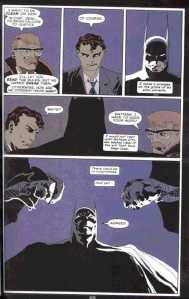
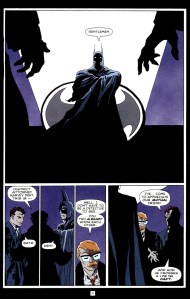
So let’s just face facts here and admit there are some good movie trilogies and some bad ones, that within the good ones some better than others, and that within the bad ones some are better than others. All of which brings us back to that rooftop scene we started this “Rebooting ‘Batman'” series with, from Jeph Loeb and Tim Sale’s The Long Halloween miniseries, the second page of which is reproduced above (and I apologize for its crookedness, it’s the only scan of this particular page I could find online).

Quite clearly, the latest cinematic iteration of the Dark Knight Detective, as helmed by Christopher Nolan, was a trilogy, and flaws aside, I think that by and large structuring the whole thing this way, whether by accident or design, by and large worked, story-wise. We got a beginning, middle, and end to Batman’s career, and a forth installment probably would have been pushing things a bit much (okay, fair enough, folks who didn’t like the Nolan films probably feel like three was too many, but that’s another matter for another time). I guess I’m in the minority on this, but I would have liked to see Tim Burton get a third crack at the bat-franchise, as well. It certainly would have been better than Batman Forever.

And this is the point at which attentive readers will tell me to back the fuck up for just a minute and pick up on that “all of which brings us back to the rooftop scene” bit. Your wish is my command. Quite clearly, the Harvey Dent/Commissioner Gordon/Batman triumvirate that forms the thematic core of The Long Halloween is what I’d like to see at the center of the entirely-hypothetical next Bat-trilogy I’m building in my head, even if I’d take pretty much no other cues from this particular book whatsoever. I mentioned last time around that giving Bruce Wayne and/or Batman a real life that included some actual friends apart from Alfred would be an idea that I. and a lot of fans out there, would be receptive to. And of course, we all know that the story of Harvey Dent is, ultimately, a tragic one that could translate well into a central theme spread out over three flicks. I’m still working out all the details as to how to do it in my head — like I said in a previous post, I’m very much making this up as I go along — but how about this for starters? In our new Bat-trilogy, Dent, Gordon, and Batman start as uneasy allies, and are pretty firm, honest-to-goodness friends by the end of the first flick. Perhaps even to the point where Batman decides to clue them in on his secret identity (although that’s not, strictly speaking, necessary — just something to keep in mind).

If Warner Brothers were to decide to give this hypothetical “soft reboot”‘s director a three-picture guarantee, absolutely not unheard of in the movie business, then that would seem a natural enough relationship to build a trilogy around, and we can get into Harvey’s inevitable turn for the worse as we move into discussions of (the again completely hypothetical) parts two and three. If the first flick were to be a complete and utter flop, then hey, they can always fire everybody, go back to the drawing board, and us fanboys and fangirls can endlessly debate the “great Batman trilogy that never was,” which is always a pretty fun little time-waster in and of itself, as well.

So, to recap, here’s where we are right now — the next Bat-flicks are going to have a shift in tone toward the more heroic, old-school, brains-over-bran interpretation of the character that will result in a bit less “dark” an overall tone; we’ve established Detroit at the central filming location for Gotham City; we’re going the “soft reboot” route by going back to an earlier point in Batman’s career but not obsessing over the details of his origin too explicitly; and we’re planning for a trilogy of films from the outset, one with a genuine story of friendship between Batman, DA Harvey Dent, and Police Commissioner Jim Gordon at its core.

Sound good? Sound bad? Now’s the time to chime in, and I do appreciate all your comments, both good and bad, so far. On a minor “housekeeping” note, I’ll probably be stepping away from this series for the next week or so as I attend to some business on my “main” site (trashfilmguru.wordpress.com, in case you didn’t know), but will be checking, and responding to, comments on here just the same. A guy’s only got so many hours in a day to write, and I’ve been running a series of comic reviews over there that I really want to wrap up in the next few days before showing the love of my life (yes, that would be my wife) a terrific time for her upcoming 30th birthday. Once that’s all taken care of, I’ll be back to the task at hand here with the next entry in our series, which will focus on which details I’d keep, and which I’d scrap, from the Nolan series of Bat-films. Then we can finally get into the plot of the films themselves proper, followed by arguably the most fun part of all, ideal casting choices for all the characters!

Oh, and maybe we should start bandying about some names as to who we’d like to see directing these flicks in an ideal world, as well? But I did say one thing at a time was going to be the order of the day here, didn’t I? Must try to stick with that — if at all humanly possible!

Which Way Forward For The “Batman” Movie Franchise? Take Three : Setting The Tone


They just don’t draw Batman like that anymore, do they? These days, he’s a “ripped” steroid freak in a high-tech suit of armor who’s usually either thrashing someone to within an inch of their life or brooding silently. Ever since Frank Miller’s legendary Dark Knight Returns story — which, I’ll grant you, is still probably the single-best Batman story ever — he’s been getting increasingly somber, morose, and violent. Miller himself even portrayed him, essentially, as a child-abusing psychopath in All-Star Batman & Robin, The Boy Wonder. The films,  Joel Schumacher aberrations aside, have been getting increasingly darker over time, as well. People thought Tim Burton’s Batman flicks were a little too dark, so Warner went to Schumacher for a “course correction” that fell flat on its face, and then Christopher Nolan came along with the most popular, and darkest, cinematic version of Batman yet.

Then came the midnight premier of The Dark Knight Rises in Aurora, Colorado.

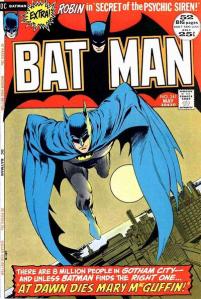
I would argue that even before that tragedy, this whole “increasingly dark” thing had run its course, but now I think a change in tone is positively essential. Which is not to say that Batman should ever go back to the light-hearted goofiness of the 1960s TV series. Modern audiences like a Dark Knight who is — well, dark. But I think the right tone was struck in books like the one pictured above, by the legendary 1970s Batman creative team of writer Denny O’Neil and artist extraordinaire Neal Adams. Their Batman was a serious, determined, perhaps even obsessive guy, but he was as much a man of intellect as of action, and at the end of the day he was a hero first and foremost, and could always be counted on to do the right thing. I think modern audiences are ready for that again after seeing Bruce Wayne essentially degenerate into basket-case status by the beginning of Nolan’s third flick, only to heroically redeem himself at the end. Let’s pick any new series up from that point — not storywise, mind you, but tonally.

To be a bit more specific about what I have in mind — think maybe a little more Michael Keaton and a little less Christian Bale. I liked Keaton’s take on the character — you felt like he was a decent guy at heart who just had this fundamental inability to resolve a gaping hole left in his life by his parent’s murder and had enough money and free time to channel that pain in a really — well — weird  direction, but would give all that up for a normal life in a heartbeat if he could just, ya know, figure out how to. Keaton;s cracking of the Joker’s poison code in Batman was also one of the few instances in any of the 1989-and-onwards Bat-films where we actually saw the Caped Crusader putting to use something that his name has always been, and always should be, synonymous with, namely his detective skills. I think it would be a great step in the right direction to see the next version on Batman on the big screen be just as at home in the Batcave’s crime lab or poring over information on its super-computer as he is kicking ass in a rainy alleyway.

I don’t think there’s any need for Schumacher camp, much less 60s-style uber-camp, but by all means, you can lighten things up a bit and still give us an essentially dark and mysterious character. 1970s Batman was pretty much all about that. And any Batman that’s going to “work and play well with others” in the inevitable Justice League movie DC’s cooking up will have to be at least a little more of a “joiner” than Bale and Nolan’s take on the character was.

To that end, I propose giving Bruce Wayne some actual friends apart from Alfred, a love interest who doesn’t get murdered, and an actual social life that’s not an OTT front from his crime-fighting activities and nothing more. But I promised to stay focused, and will get a bit more into the details of that tomorrow, as I examine the relationship that I think should be at the core of the next bat-series, and how it ties back into the rooftop scene from The Long Halloween that I started this whole thing with. I’ll also be getting into why I think a trilogy should be the plan for the next series from the outset — I know, I know, I said one thing at a time, but trust me, the “two” topics really are one and the same. In the meantime, of course, if you think I’m barking up the wrong tree with those whole “tone down the darkness a notch” stuff, now’s the time to say so!

Which Way Forward For The “Batman” Movie Franchise? Take Two : Building A Better Gotham


If there’s one area (and actually I think there are several, but that’s rather beside the point and I promised to remain focused like a laser beam on each individual subtopic in this “Batman reboot” series of posts) where I think Tim Burton’s Bat-flicks had it all all over Christopher Nolan’s it’s in their depiction of Gotham City. Not only did Burton’s Gotham have a fantastic Metropolis-gone-gothic look thanks to the late Anton Furst, but it felt like an intrinsically different sort of place than a real city, a place where you could sort of actually believe guys might run around in bat costumes and Joker facepaint , while Nolan’s Gotham was just, essentially, New York only a little grimier (even if his first two films were shot in Chicago).

I understand the reasoning behind making Gotham less fantastic, of course, and those reasons do make sense — Nolan’s Batman was supposed to be a more “realistic” character, to the extent that a billionaire who dresses up like a bat can ever be called “realistic,” and Joel Schumacher’s CGI Gotham was such an over-the-top visual disaster that a back-to-basics approach to Bruce Wayne’s hometown was a predictable enough move to make.

Still, I think something was lost, and that Batman works a bit better with at least some level of the fantastic still involved in its primary geographic setting. To that end, I think  there are basically three things any self-respecting Gotham of the potential “soft reboot” of the Bat-franchise we were talking about should have —

1. It should look at least a little bit different than a garden-variety major US city. You needn’t construct anything as elaborate as Furst’s amazing two-city-block long set, but a city that has some fairly spectacular architecture in the form of bridges, tall buildings, etc. that you can focus in on would be a definite plus, especially if they’re all a bit past their prime and have seen better days, since Gotham pretty has to be a grimy place by definition. Some constructed set pieces that could stand in as fictitious local landmarks would be a plus, as well, so to that end it would be helpful if the filming location for future Batman flicks had something of an emptied-out urban core where you could build an Arkham Asylum, or a neat-looking miniature version of Wayne tower, etc. I’m thinking an ideal sort of look would combine elements of New York as depicted in Zack Snyder’s Watchmen combined with a toned-down Gothic feel at least somewhat reminiscent of furst’s Gotham, albeit scaled way the hell back.

2. There should be some ritzy neighborhoods or suburbs where you can find adequate exterior footage for Wayne Manor and its grounds. I don’t think the next Bruce Wayne needs to live in a fucking castle like Bale’s version, but certainly a “stately manor” that exudes old-school wealth and prestige and hearkens back to the city’s more prosperous days before it became Crime Capitol, USA (which Gotham pretty much always  is).

3. As alluded to in the first two points, the majority of the city should be run down, and obviously well past its prime — a city in desperate need of a champion.

Finally, for reasons that will be made more clear as I get into the nuts and bolts of the plot outline I have in mind for this whole “soft reboot” thing, I think it would be essential for the city-to-stand-in-for-Gotham to be close to some wooded and even mountainous areas, since while the focus of this flick is most assuredly not going to be on the minutiae of the Batman’s origins per se, I still think some “flashback”-style sequences that show rugged wilderness survival-type training are going to be in order.

I suppose this is all rather just moot speculation since they’ll probably just film the next flick in Vancouver and it’ll look just fine because it pretty much always does no matter what, but just for the sake of fun speculation, I have something else in mind here — a locale that combines everything we’re looking for in terms of a run-down urban core; some truly spectacular architecture of its own; essentially empty areas that might as well hang a sign up saying “will build to suit;” palatial, ultra-wealthy, “old money” suburban areas; and fairly reasonable access to densely-wooded, geographically rugged forest. Batman Begins was filmed in Iceland, the UK, and Chicago, respectively, in order to capture all these various aspects, but you can do all this in exactly one place here in the good ol’ USA, and the state government is eevn actively engaged in rolling out the red carpet to film production in recent years, seeing the economic boom it’s brought to its northerly neighbor in Toronto.

Yes, folks, I think the next principal filming location for Gotham City — the ideal place to set the geographic tone for a re-launched, re-loaded (even if it’s done “softly”) Bat-franchise — should be (drumroll please) : Detroit!

I assure you, friends, I’m not kidding. Given the kind of place I think would work best for this “sot reboot,” as outlined in my (admittedly makeshift) criteria above, I think the much-maligned Motor City would be absolutely ideal, and bringing the production there would have the added bonus of generating great publicity for the film due to the positive economic impact it would have on an area that sure could use it. A multi-million-dollar Hollywood production setting up shop in Detroit? You can bet the city fathers (and mothers) would positively roll out the red carpet for Warner Brothers, and everything you would need is  literally right there at your fingertips. Honestly, this idea’s almost too damn good. But maybe you’ve got a better one, in which case, please chime in before I move on to step three, which will concentrate on the overall tone of the film itself (now that we’ve — okay, I’ve — established a great location) tomorrow!

Which Way Forward For The “Batman” Movie Franchise? Take One


Bear with me, folks, ‘cuz this is gonna be a looonnnnng one. Not this post in and of itself, mind you — in fact I’m going to do my very best to keep things brief in this and subsequent installments (whoops! I just gave away what’s going on here, didn’t I?) and try, perhaps even desperately, to confine all postings in this series (and if I didn’t give it away before I sure did now!) to one particular aspect of what we’ll be discussing here each time so as not to throw too much out there at once before receiving input from you, dear readers, as to your own thoughts on what I’m talking about before plowing ahead to the next part. I know, I know — all bloggers say they genuinely want the input of their readership on what they’re posting, but in this case I really do mean it with all sincerity. I want this to be an interactive discussion about what we, as fans/movie geeks, want to see happen next with one of the most successful properties, arguably perhaps even the most successful property,  in cinematic history.

I’m speaking, of course, of the Batman. With Christopher Nolan’s beyond-blockbuster trilogy having just wrapped up, speculation is already rife as to what DC Entertainment and its parent company, Warner Brothers, will do next when it comes to the adventures on the Dark Knight Detective on the silver screen. For an initial hint about were I’d take things, please refer to the famous page above from the Jeph Loeb/Tim Sale comic Batman : The Long Halloween. For reasons that will be made clear over this course of this series of postings, however long it may drag on, that scene — the famous “rooftop meeting” between Batman, Commissioner Gordon, and District Attorney Harvey Dent — is at the very heart of where I think the Bat-franchise would go next.

But let’s not get too far ahead of ourselves just yet. First, let’s take stock of where we are now and the three, as I see them anyway, options DC/Warner has going forward. As of this moment, The Dark Knight Rises has taken in just a hair under $420 million dollars at the domestic box office, and just a hair under $1 billion worldwide. It’s a pretty solid bet that it will end up taking in $500 million domestically and will Avatar, Titanic, The Avengers, and The Dark Knight in the over-a-bliion-dollars-in-worldwide-ticket-sales club. That means that of the five highest-grossing films in the world in history, two will be Batman flicks. Clearly, Warner isn’t going to let this property stagnate for too long.

But they need to play their cards exactly right going forward, because this is one golden goose they absolutely need to keep laying eggs. Which brings me back those three options they have going forward, each of which carries some risk, as well as potential rewards. Let’s look at each potential path  forward individually, shall we? Glad you agree.

Option #1 — The direct sequel. Nolan certainly left this possibility wide open with Robin/John Blake’s “inheritance” of the Batcave, and in many ways it’s the easiest and most painless way to go. Blake’s the new Batman (or Robin, or Nightwing, or whoever), some ambitious director would be more than willing to take on carrying things forward from where Nolan left them, and audiences are already primed and ready to accept Joseph Gordon-Levitt as the new man beneath the cowl.

But are they really? Let’s face it — Bruce Wayne is central to the Batman myth. You could argue that DC themselves are working on making him less central to it with the publication of such books as Batman, Incorporated and several storylines in recent years that have seen the likes of Dick Grayson, among others, assuming the Batman role for varying periods of time. Maybe they’re trying to test the waters with this whole someone-else-as-Batman idea on the printed page before going for it on the big screen? It’s possible, but sooner or later they always seem to come back to Bruce Wayne, and it’s easy to see why —

Frankly, it just never really works with anyone else as anything other than a temporary gimmick to boost sales for a few months. Sooner or later, the fans always want to see the “real” Batman back in action. A new guy might be interesting for a movie or two, but the speculation as to if and when Bruce Wayne — and, by extension, Christian Bale and maybe even Chris Nolan — would be back would be a Sword of Damocles hanging over the head of any “direct sequel” flick, no matter how good it was. And that just ain’t gonna happen. Bale’s done. Nolan’s done. These guys have made the studio a fortune. Let them get on with their lives in peace.

Option #2 — The “hard reboot.” This has been done, successfully, with the Bat-franchise before, obviously. Batman Begins is as “hard” a reboot of a character and his origins as you’re going to find. We’re used to seeing Batman reinvented every so often, and it’s never been a dealbreaker before. Every generation flat-out deserves its own iconic take on the character, right? Why go in any other way now? It would free up the next director, producers, and cast from having to do things the “Nolan way,” that’s for sure, and sometimes the best way forward is by taking a few steps back.

And yet — that might necessitate Batman sitting on the shelf longer than Warner wants him to be. The Amazing Spider-Man isn’t that bad a superhero movie by any stretch of the imagination, but even its most fervent partisans would, when pressed, admit that two Spidey origins within a decade is a bit much. And besides, it’s not like Batman Begins is going to appear especially dated within the next five or ten years, nor is it likely to be surpassed in terms of quality as a Batman origin story for the silver screen. Any “hard reboot” story is going to inevitably be compared to it, and any other cinematic origin story is going to come up short, more than likely. Unless, of course, it’s a work of such singular awesomeness that it just comes along and completely blind-sides all of us. But ya know what? Even then, I bet it’s still gonna piss plenty of people off. Plus, there’s the open question of just how necessary a “start-from-scratch”-type story even is. More or less everyone knows at least the basic details of the Batman myth — do we need to see them play out before us yet again to understand and appreciate a new cinematic interpretation of the character?

Which brings us, finally, to Option # 3 — the so-called “soft reboot” option. Admittedly, this hasn’t worked out so well for secondary comic-book-related properties like The Punisher and the Hulk, but they were both coming off first installments that were pretty iffy to begin with, to put things kindly. That”s not the case here by any stretch of the imagination. Even if Nolan’s Batman films weren’t your cup of tea, there’s no denying they’ve been tremendously successful at the box office and generally quite well-regarded by hard-core fans, critics, and more casual audiences alike. Maybe there’s no need to reinvent the wheel here, even if we’re going to go back into Batman’s career chronologically, the cast is going to be entirely different, there will be a new director and screeenwriter(s), etc.

Not that this option isn’t without some risk, too. It would essentially assume at least a rudimentary knowledge of the character on the part of the audience (anyone not know anything about the guy? Bueller? Bueller?), and it would subject the new film,series to more direct comparison with the Nolan flicks than, perhaps, option #2 (although that’s debatable, and flat-out inevitable in any case, anyway), and — well, that’s probably about it.

So — from where I’m sitting right now, that looks like the best bet to me. Let’s have a new take on the Batman franchise with new actors, a new director, a new writer or writers, new everything — but let’s not feel compelled to tell his origin over from the start. Let’s concern ourselves with concentrating on the various elements that have made Batman so appealing and enduring as a cultural icon over the years, tell a story that incorporates and elaborates upon all of those, and maybe throws a few new wrinkles of its own into the mix, and not feel like the wheel needs to be reinvented here. The Nolan films are going to be the standard against which all future films are going to be judged, anyway, so rather than run as far away from them as possible, why not keep what worked about them, and maybe present them in a new way?

If all this sounds just a little bit too abstract for you at this point, I wouldn’t blame you, but stick with me here — at least until you get bored. I hope that as things progress, what I have specifically in mind will become more and more clear. And keep that image from The Long Halloween in mind as we go along, because it’s central to where I’m going — even though I don’t think the comic itself was anything other than a somewhat-above-average Batman story (and yes, I’m hoping that sentence will make a bit more sense to you in the coming days/weeks, as well).

So that’s it for part one of this thinking-it-out as-I-go-along project. I hope to pick things up again tomorrow with some some thoughts on Gotham City — how it’s been presented in the past, how and why it’s central to the Batman mythos, particularly in film, and a really weirdly appealing (in my own twisted mind, at any rate) idea I’ve got as to exactly which major American city would make a great movie Gotham for the future. Until then, please — tear my opinion to shreds! Or agree with it! Or somewhere in between! But let’s see where we agree or disagree and find out where you think I’m right and wrong and why!

Trash Film Guru Vs. The Summer Blockbusters : “The Dark Knight Rises”


At this point, I wonder if it’s even possible to separate today’s tragic events in Aurora, Colorado from any discussion about The Dark Knight Rises and simply analyze the film based on its own merits. If so, it takes a harder heart than mine, so before we even get started here let me say that my heart goes out to all the victims of this completely senseless tragedy, as well as their families and friends. In the days to come we can analyze the motivations, the warning signs that may or may not have been missed, and debate the proper courses of policy action to take in the wake of this absolutely senseless tragedy, and that’s all well and good — we still, and hopefully always will, live in a free society where the open debate and discussion about how best to address any situation, even and perhaps especially tragic ones like this, is not only absolutely appropriate, it’s absolutely necessary. So let’s remember that before we go and start calling people “anti-second amendment gun-grabbing liberal extremists” for merely suggesting that it might be a smart idea to figure out ways for guys like this accused suspect to not get their hands on private arsenals, and before we start suggesting that somehow various Batman-related movies and comics may have “inspired” the killer. If those are your views, fine, express them and have at it, but do respectfully, calmly, and in a mature fashion, please — assuming those who don’t agree with us are somehow “the enemy,” or placing a higher value on ascribing blame for a problem than on finding ways to prevent the situation from happening again, will only guarantee more tragedies in the future. But let’s all take a deep breath and let the police and various other investigative bodies do their work before we assume we know anything, much less that we know everything (or, at the very least, all we need to) about the situation. For now I think we can all agree that this kind of senseless violence represents an unconscionable act of cruelty and that there are no, and never will be, any justifications for it whatsoever.

And speaking of toning down the rhetoric and behaving like adults, can we also all agree that any online critic — be they “professional” or “amateur” — should be free to express reservations, even outright dislike, for this or any film without being subjected to harassment, personal attack, and even death threats? It’s just a movie, people, even if it’s a really big one, and there’s nothing in this world more subjective than one’s own reaction to and/or interpretation of a work of art in any medium. If people who have opposing views from our own on issues like gun control, public safety policy, and any others that may arise in the discussions resulting from today’s  horrific acts in Aurora are not our “enemies” — and, again, they’re not — then surely people who have differing opinions than our own in regards to a goddamn film aren’t, either. If you can’t wake up to what’s really important in life in the wake of an incident like this, then I genuinely feel sorry for you, but please — dial it all back a notch or shut the hell up if you’re absolutely incapable of being reasonable and level-headed. It’s all about perspective, folks — as in, keeping things in it.

All that being said, I don’t mind segueing into discussion of the film itself by stating immediately and for the record that I absolutely loved The Dark Knight Rises. I was, quite frankly, expecting to, but yesterday I got a bit jumpy. I had read various postings online about how the basic premise here amounted to “Batman comes out of retirement to save the 1% from having their wealth redistributed,” and leaving aside the fact that I find the politics behind such a plot conceit completely antithetical to my own, it just sounded like a pretty lackluster way in which to wind up one of the biggest series in film history and like Nolan was sacrificing inspiration for the sake of being overtly topical.

I needn’t have worried. Yes, the film can certainly be read in such a manner if you strain awfully hard to do so, but it can be read with a more progressive leaning, if such in your inclination, as well, to wit : yes, the principal villain of the piece, one ‘roided-out, breathing-apparatus-of-some-sort-wearing pseudo-revolutionary named Bane (superbly portrayed by Tom Hardy with a kind of chilling nonchalance that’s absolutely palpable) does, in fact, set about “giving Gotham back,” as it were, to the dispossessed masses for his own purposes, but it’s what those purposes are, and the way in which they’re revealed, that gives lie, in my view, to the whole “Batman as champion of the 1% taking on a guy who’s suckered the 99% into falling for him”  interpretation of the movie. I shan’t say anything too specific out of respect for those who may be reading this before they actually see it, but I will say this much : the fact that Bane is (apparently) a tool more for a rival to the corporate throne of Bruce Wayne than he is any “champion of the people,” and that even that turns out to be a ruse when it’s revealed that he’s bringing down Gotham for another set of reasons entirely, reasons which tie right back to the first film in Nolan’s series, are enough for me to dismiss both the conservative championing of this movie and the liberal hand-wringing over it with relative ease. In short, maybe we all need to learn to actually see these movies for ourselves before taking to the web and opining on their political content. And yes, I include myself among those I’m (mildly) castigating here.

All of which is not to say that Nolan (who co-wrote the script for this with his brother, Jonathan) doesn’t have an agenda here — it seems to me, quite clearly, that he does. And what, pray tell, would that agenda be? I’m glad you asked (okay, glad I asked) — but first, a bit of background : back when Nolan first arrived on the scene with films like Memento and Insomnia, it was pretty commonplace to hear his work compared to that of fellow Brit-come-to-Hollywood Alfred Hitchcock. Some of that died down a but when he took over the Batman franchise and his career moved squarely into blockbuster territory, but like the so-called “Master Of Suspense” himself, I think our guy Chris has taken a perverse delight in having us all on a bit. Sure, his budgets are a lot bigger now, and he’s definitely able to pack a much bigger wallop, aesthetically speaking, than he used to, but underneath all of that pomp and circumstance, I still think he’s the same guy who lives to confound our expectations and use his work to comment, above all else, on itself.

If I haven’t lost you entirely by this point, and I sincerely hope I haven’t please allow me to explain : true, on the surface, a story that revolves around how Bruce Wayne/Batman (Christian Bale, of course, who turns in a performance here that’s incredibly multi-layered as he goes from broken to redeemed to more broken than ever to quietly triumphant, complete with physical changes to match), against the wishes of mentor/father-figure Alfred (Michael Caine, as always the beating human heart of the film and here displaying the type of range few characters with his limited screen time are ever even given the opportunity to sink their acting teeth into) comes out of a self-imposed eight-year exile spurred on equally by the threat of Bane and the mysterious allure of a fetching costumed cat-burglar (Anne Hathaway, never specifically referred to as “Catwoman,”  who knocks it out of the park here as sex-appeal-with-a-social-conscience — notice how she only steals from the well-off, and is even portrayed as being sympathetic to the surface level of Bane’s machinations, ultimately false as she knows them to be), aided as always by Morgan Freeman’s beleaguered-but-hardly-dead-yet-by-a-long-shot Lucius Fox, Gary Oldman’s ethically-conflicted-but-still-holding-out-hope police commissioner, Jim Gordon, an idealistic young Detective named Blake (Joseph Gordon-Levitt, who embodies a kind of hope for the future every time he’s on screen), and a mysterious ally on his company’s board of directors named Miranda (Marion Cotillard, who’s fetchingly dangerous in her own, non-slinky-suited way), hardly sounds like it has the makings of being a truly personal directorial statement, especially when you consider that it’s got a $250 budget and a remit from the studio to keep hitting us with everything it’s got from start to finish.

And yet, that’s exactly what Christopher Nolan has delivered here. Yes, the action set-pieces are spectacular, the effects are out of this world, Wally Pfister’s cinematography is (as we’ve come to expect by now) absolutely breathtaking, and the metaphorical punches are precisely placed, perfectly executed, and pack one heck of a wallop. It’s all big-scale spectacle on a scale we’ve never seen before and backed up by brains, to boot. In short, this isn’t The Avengers, which can certainly be viewed on an intellectual level and with at least a degree of thoughtfulness involved should you so choose, but where such things aren’t necessary to fully enjoy the film. In a Nolan blockbuster, you’d better put on your thinking cap or you’ll be left in the dust.

It’s what all that thought and action, inextricably linked as they are, is put in service to, though, that really sets The Dark Knight Rises apart and reveals Nolan to be, and I say this with all due respect, a bit of a devious trickster under all that pomp and circumstance. As has been established, this film has more than enough red meat to either appease and/or infuriate both ends of the political spectrum as generally defined, and Nolan indulges himself on a scale so grand that it’s absolutely certain to provide ample fodder for both his detractors and admirers, and now, with all these pieces set, there’s nothing left for him to do but — sit back, laugh, and watch us all have it online, on television, at work, even around the family dinner table. Our reactions to how we view his movie will, in fact have already, mirror the conflict of ideals, as well as the grand-scale physical destruction, shown on screen (although, again, let’s keep it level-headed and in proportion to its actual relevance to our daily existences, please). I don’t think he started out this Batman series with the intention of it becoming The. Biggest. Thing. Ever. To. Happen. In. Movie. History. But, now that it is, he’s making the most of the opportunity and, like his predecessor Hitchcock, whose greatest character was always himself, and whose films ultimately functioned as self-commentary on their own creation and existence, he’s laid a masterfully-prepared, air-tight, $250 million dollar trap here, that once you’ve seen, you have no choice but to play into.

Some may call that cynical, and perhaps they’re right to a certain degree, but it’s cynicism with purpose, executed with almost pristine attention to detail. Even he ending, which I won’t give away, is a supreme act of self-referential commentary on where any future filmmaker could take this series, should they be daring/and or stupid enough to pick up Nolan’s gauntlet. It’s all part of an intricate puzzle designed to do nothing so much as reflect itself back upon itself , and us, once the last piece is in place, and nothing this truly audacious has ever, cinematically speaking,  been attempted on a scale this large before. Think David Lynch’s Inland Empire, only delivered on a level pretty much anyone can understand and appreciate, if not actually and actively like (although early indications are that most audiences really do love this flick), and you’ll have something of an idea of what’s been achieved here.

It may take awhile before everyone is able to fully appreciate what Nolan’s achieved here — hell, we’re still debating Hitchcock’s entire oeuvre decades later — but that’s all part of the plan, as well. This is self-contained, self-propagating, self-constructed, self-sustaining genius (a term I never use lightly) of the highest order, and the most accomplished act of thoughtful pranksterism in movie history. Tomorrow, I’ll be seeing it again — and I bet Chris Nolan isn’t surprised in the least.

 

Trailer: The Dark Knight Rises (3rd Official)


With the North American release of Marvel Studios’ The Avengers just days away it looks like DC Films’ parent company, Warner Brothers Pictures, is playing a little bit of gamesmanship by releasing a brand new trailer for their own superhero blockbuster offering this summer in The Dark Knight Rises .

The third film in Christopher Nolan’s Dark Knight trilogy and one that has much to live up to with the financial and critical success of the previous film, The Dark Knight. With no Heath Ledger to help anchor this third film it looks like the final leg in this trilogy will have to rely on the addition of Bane as Batman’s main antagonist. The film will also see the return of one Selina Kyle aka Catwoman who may or may not be a character Batman has to treat as an enemy as well.

From the previous teasers and trailers released for this film fans of the franchise will have a story that’s much more epic in scope than the previous two, but also one that seem to have the hit-or-miss of the three. Film trilogies rarely finish off as well as it starts with a few exceptions and hopefully Nolan’s final entry in his gritty take on the Dark Knight will be one of those exceptions.

The Dark Knight Rises is set for a July 20, 2012 release.

Source: The Dark Knight Rises Official Website

Trailer: The Dark Knight Rises


There’s nothing much else to say other than 2012 looks to be the year of The Dark Knight Rises.

2005 saw the reboot of the Batman film franchise. This first film in the new trilogy put Christopher Nolan on the map as an action filmmaker. 2008’s The Dark Knight with it being such a huge critical and, more importantly, a mega-blockbuster made Christopher Nolan a filmmaker who could do anything he wants and with whatever budget he asks for. Nolan was able to cash in some of that cred to make 2010’s Inception which was also a runaway success.

2012 is just around the corner and we have the third and final leg to Nolan’s Dark Knight trilogy. With the success and popularity of the two previous films to say that the hype and anticipation for this third film has reached stratospheric levels would be an understatement. This is not to say the film can’t flop, but with Nolan’s track record I am in the camp of highly doubt it.

The Dark Knight Rises is set for a July 20, 2012 release in both regular and IMAX (though not in 3D).

Game Preview: Batman: Arkham City – 10 Minute Gameplay


This may have already been posted on the Shattered Lens, and I apologize if that’s the case (did a search, didn’t see anything on it).

Eidos and Rocksteady are almost ready to bring us the next chapter in their hit Batman: Arkham Asylum with Arkham City, due out this October. With a wider playing around and a bigger story, it’s expected to be a hit. This preview showcases Catwoman as a playable character, along with some of the updates in the gameplay overall. It’s looking very good.