Insomnia File #70: Shortcut to Happiness (dir by Alec Baldwin)


What’s an Insomnia File? You know how some times you just can’t get any sleep and, at about three in the morning, you’ll find yourself watching whatever you can find on cable or streaming? This feature is all about those insomnia-inspired discoveries!

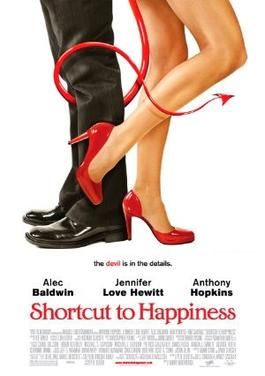
If you’re having trouble getting to sleep tonight, you can always jump over to Tubi and watch Shortcut to Happiness, a.k.a. The Devil and Daniel Webster.

When was Shortcut to Happiness released?  There’s some debate about that.  Though the film’s credited director is Harry Kirkpatrick, it was actually directed by Alec Baldwin.  (Please, no Rust jokes.)  The film was shot in 2001, in New York City.  However, shortly before filming could be completed, the film’s financiers were arrested and charged with bank fraud which led to the film ending up in limbo.  A rough cut of the movie appeared at a few film festivals in 2003.  By that point, Baldwin had started to distance himself from the film, claiming that he wasn’t given a chance to shoot all of the scenes that he needed to and that the film was taken away from him in post-production.  A newly edited version of the film was finally released in 2007, six years after filming began.

Alec Baldwin not only directed the film but starred as Jabez Stone, an aspiring writer who makes a deal with the devil (Jennifer Love Hewitt) to become a successful published author.  Stone gets his wish but it comes with a price.  In ten years, he will have to give up his soul.  Stone becomes rich and successful, writing books that have absolutely no literary merit.  He loses all of his friends and, by the time the ten year deadline rolls around, Stone is miserable.  Stone sues to keep his soul.  He’s defended by Daniel Webster (Anthony Hopkins), a man who Stone thought was just a publisher but who apparently is actually the famed 19th century statesman.  (The film is rather vague on this point.)  In one of the film’s few funny moments, the jury is revealed to be made up of deceased writers, including Ernest Hemingway and Mario Puzo.  The trial plays out and …. well, again, it’s hard to really follow any of the arguments made by either Webster or the Devil.  The film is so tonally inconsistent and poorly directed that I was often left wondering if Hopkins and Hewitt had even been on the set at the same time.

Both Hopkins and Hewitt give good performances.  The problem is that they both seem to be appearing in different films.  Hewitt gives a broadly comedic performance as the Devil, pouting whenever Webster argues with her.  Hopkins, meanwhile, seems to be recycling his dignified and very serious performance from Amistad.  Meanwhile, Baldwin the director totally miscasts Baldwin the actor.  For the film to work, Jabez needs to be young and hungry.  Instead, Baldwin comes across as someone who is already old enough to know better than to make a deal with the Devil.

It’s a true mess of a film but worth seeing just because of the story behind it.  That said, the 1941 version of The Devil and Daniel Webster remains the one to beat.
Previous Insomnia Files:

  1. Story of Mankind
  2. Stag
  3. Love Is A Gun
  4. Nina Takes A Lover
  5. Black Ice
  6. Frogs For Snakes
  7. Fair Game
  8. From The Hip
  9. Born Killers
  10. Eye For An Eye
  11. Summer Catch
  12. Beyond the Law
  13. Spring Broke
  14. Promise
  15. George Wallace
  16. Kill The Messenger
  17. The Suburbans
  18. Only The Strong
  19. Great Expectations
  20. Casual Sex?
  21. Truth
  22. Insomina
  23. Death Do Us Part
  24. A Star is Born
  25. The Winning Season
  26. Rabbit Run
  27. Remember My Name
  28. The Arrangement
  29. Day of the Animals
  30. Still of The Night
  31. Arsenal
  32. Smooth Talk
  33. The Comedian
  34. The Minus Man
  35. Donnie Brasco
  36. Punchline
  37. Evita
  38. Six: The Mark Unleashed
  39. Disclosure
  40. The Spanish Prisoner
  41. Elektra
  42. Revenge
  43. Legend
  44. Cat Run
  45. The Pyramid
  46. Enter the Ninja
  47. Downhill
  48. Malice
  49. Mystery Date
  50. Zola
  51. Ira & Abby
  52. The Next Karate Kid
  53. A Nightmare on Drug Street
  54. Jud
  55. FTA
  56. Exterminators of the Year 3000
  57. Boris Karloff: The Man Behind The Monster
  58. The Haunting of Helen Walker
  59. True Spirit
  60. Project Kill
  61. Replica
  62. Rollergator
  63. Hillbillys In A Haunted House
  64. Once Upon A Midnight Scary
  65. Girl Lost
  66. Ghosts Can’t Do It
  67. Heist
  68. Mind, Body & Soul
  69. Candy

Late Night Retro Television Review: Pacific Blue 1.5 “Out Of The Past”


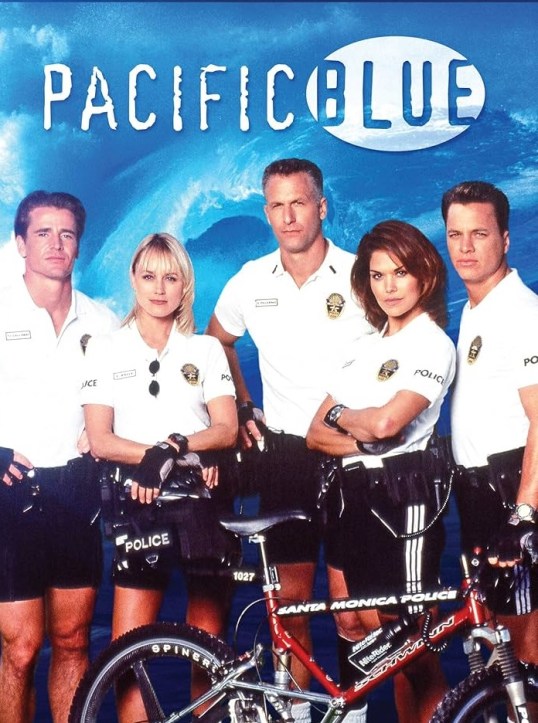
Welcome to Late Night Retro Television Reviews, a feature where we review some of our favorite and least favorite shows of the past! On Tuesdays, I will be reviewing Pacific Blue, a cop show that aired from 1996 to 2000 on the USA Network!  It’s currently streaming everywhere, though I’m watching it on Tubi.

This show is proving difficult to review.

Episode 1.5 “Out of the Past”

(Dir by Terrence O’Hara, originally aired on March 30th, 1996)

Look, I tried.  I really did.

This episode should have fascinated me.  It featured three storylines.  Palermo was told take a vacation when it became obvious that a serial killer known as The Angel (Tim Thomerson) had returned to the beach and was targeting doctors.  Palermo and The Angel had a history, with Palermo failing to capture The Angel during the killer’s previous spree.  This time, The Angel tried to force a journalist (played by Barry Miller) to record his crimes for posterity.

Meanwhile, Chris and TC went undercover as guests at a hotel so that they could catch a thief and a peeping tom.  Chris and TC pretended to be romantically involved and were so dedicated to maintaining the act that they ended up spending a good deal of the episode hanging out together in their underwear.

Finally, both TC and Del Toro were obsessed with catching a speeding biker who continually managed to outrun and outmaneuver them.  Compounding their embarrassment was the revelation that the biker was a woman.

Mystery, empowerment, and lingerie.  Those are three of my favorites things but this episode still managed to thoroughly bore me.  I had to view it three times because I kept getting distracted whenever I tried to sit down and just watch the show.  Admittedly, with my ADHD, my attention span is on the short side but still, this episode of Pacific Blue was remarkable in that, no matter what happened, I just didn’t care.

Why?  Why can’t this show even work in a so-bad-its-good kind of way?  The characters are just boring and interchangeable.  The men are all grim and serious-minded and, physically, they’re all the same type.  They’re all tall and lean and blandly handsome and none of them have any quirks or interests to really make them stand-out.  The women are also bland and spend most of their time smirking at their male co-workers.  Who are these people?  Who cares?

Perhaps the biggest flaw with this episode and the show so far is that the members of the bicycle patrol just look dorky and they peddle around the beach.  The worse thing is when they have to chase a suspect down a flight of stairs and they literally pick and carry their bicycles as they do so.  It’s hard to take bicyclists seriously, even when they’re cops.

Watching the show, I kept thinking about the bicycle cops who used to patrol the campus where I went to college.  No one took them seriously and everyone knew the experience of being yanked over by one of them and being asked, “You been drinking tonight?” when you were totally sober.  It happened to me, one night, when an old ankle injury was acting up and I was walking with a slight limp.  I was already feeling self-conscious about it and getting stopped when all I wanted to do was get home and rest my ankle didn’t help.  The insistence that I must have been drunk or otherwise under the influence and also the assumption that I was obligated to stand around while the cops slowly talked to each other left me feeling violated.  Whenever I see TC or Palermo sitting on their bikes with their oh-so serious “I am a badass” facial expressions, I remember every bad experience that I’ve ever had or I’ve ever seen someone else have with a cop.

My hope is that Pacific Blue, over the course of its run, eventually found a way to make its characters less annoying and more likable.  (For instance, I don’t mind the cops on CHiPs because at least they’re entertaining.)  I guess we’ll find out!

Conspiracy: The Trial of the Chicago 8 (1987, directed by Jeremy Kagan)


The year is 1969 and, in an Illinois courtroom, 8 political radicals stand accused of conspiring to disrupt the 1968 Democratic Convention.  The prosecution is putting the entire anti-war movement on trial while the defendants are determined to disrupt the system, even if it means being convicted.  The eight defendants come from all different sides of the anti-war movement.  Jerry Rubin (Barry Miller) and Abbie Hoffman (Michael Lembeck) represent the intentionally absurd Yippies.  Tom Hayden (Brian Benben) and Rennie Davis (Robert Carradine) are associated with the Students for a Democratic Society.  Bobby Seale (Carl Lumbly) is one of the founders of the Black Panthers while David Dellinger (Peter Boyle) is a longtime peace activist.  John Friones (David Kagan) and Lee Weiner (Robert Fieldsteel) represent the common activists, the people who traveled to Chicago to protest despite not being a leader of any of the various organizations.  Prosecuting  the Chicago 8 are Richard Schulz (David Clennon) and Tom Foran (Harris Yulin).  Defending the 8 are two radical lawyers, Leonard Wienglass (Elliott Gould) and William Kunstler (Robert Loggia).  Presiding over the trial is the fearsome and clearly biased Judge Julius Hoffman (David Opatoshu).

Conspiracy: The Trial of the Chicago 8 is a dramatization of the same story that inspired Aaron Sorkin’s The Trial of the Chicago 7 but, of the two films, it’s Jeremy Kagan’s The Trial of the Chicago 8 that provides a more valuable history lesson.  By setting all of the action in the courtroom and recreating only what was said during the trial, director Jeremy Kagan and his cast avoid the contrived drama that marred so much of Sorkin’s film.  Kagan trusts that the true story is interesting enough to stand on its own.  Kagan includes documentary footage from the convention protest itself and also interviews with the people who were actually there.  While Kagan may not have had the budget that Sorkin did, his film has the authenticity that Sorkin’s lacked.  Kagan also has the better cast, with Michael Lembeck and Barry Miller both making Abbie Hoffman and Jerry Rubin into something more than the mere caricatures that they are often portrayed as being.

The Trial of the Chicago 8 was a film that Jeremy Kagan spent a decade trying to make.  When he first tried to sell the idea behind the film to CBS in 1976, Kagan had Marlon Brando, Walter Matthau, George C. Scott, and Dustin Hoffman all willing to work for scale and take part in the production.  CBS still passed on the project, saying that no one was interested in reliving the 60s.  It wasn’t until 1987 that Jeremy Kagan was finally able to revive the film, this time with HBO.  It actually worked out for the best because, with HBO, there was no need to try to come up with a “clean” version for the language that was used in the courtroom or in the interviews with the actual participants.  The defendants could be themselves.

Though it has been overshadowed by Sorkin’s subsequent film, The Trial of the Chicago 8 is the definitive film about what happened in the aftermath of the the 1968 Democratic Convention.

Embracing the Melodrama Part II #57: Saturday Night Fever (dir by John Badham)


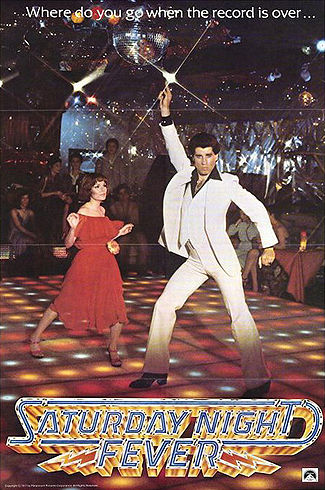
Saturday_night_fever_movie_posterHere’s a little bit of trivia about the iconic 1977 film Saturday Night Fever.

First off, according to the imdb, Saturday Night Fever was the first mainstream Hollywood film to ever use the term “blow job.”  That actually took me by surprise.  I mean, with all of the risks that the major studios took in the 70s, it still took them until 1977 to have someone say “blow job” in a movie?  But somehow, it seems appropriate that it would turn up in Saturday Night Fever.  We tend to think of Saturday Night Fever as being a movie where the soundtrack is nonstop disco and John Travolta dances in that iconic white suit.  But actually, Saturday Night Fever is a film about four guys who neither understand nor respect women.

When Tony (John Travolta), Joey (Joseph Cali), Double J (Paul Pape), and Bobby (Barry Miller) go down to that disco, it’s because they want to get laid.   Joey and Double J take turns having sex with insecure Annette (Donna Pescow) and, afterwards, Tony scornfully ask her if she‘s proud of herself.  When Bobby discovers that his girlfriend is pregnant, he is so terrified of having to be a father that he becomes suicidal.  As for Tony, he looks down on the women who are so eager to dance with him.  When he enters a dance contest with Stephanie (Karen Lynn Gorney), he can’t handle the fact that she wants more out of her life than just being his latest partner.

So, it makes sense that this would be the first mainstream movie to feature someone talking about a blow job because that’s what these boys are obsessed with.  Sexually primitive, hypocritically puritanical, and emotionally repressed, a blow job is all the intimacy that these boys can handle.

Another piece of trivia: while John Travolta was always the first choice for Tony Manero, several actors were seen for the roles of Joey and Double J.  At one point, both Ray Liotta and David Caruso were nearly cast in the role of Tony’s friends.  Imagine this: in some alternative universe, while white-suited John Travolta rules over the dance floor, Ray Liotta and David Caruso are standing in the background and cheering him on.

Of course, if Liotta and Caruso had been cast, it would be a totally different movie.  Whenever you watch Saturday Night Fever, you’re surprised by how much John Travolta totally dominates the film.  Even though the film devotes a good deal of time to Annette, Stephanie, Bobby and to Tony’s brother who has recently left the priesthood, Tony Manero is the only character that you remember.  That’s largely because Travolta is the only one of them who gives a truly memorable performance.

In theory, it’s easy to laugh at the thought of Travolta in that white suit, striking a dramatic pose on that cheap-looking dance floor.  But then you watch the film and you realize that Travolta truly did give a great performance.  And, to your surprise, you don’t laugh at Tony with his white suit because you know that the only time Tony has any control over his life is when he’s dancing.  He may work in a paint store.  He may regularly get slapped around by his family.  He may not be very smart or sensitive.  But when Tony’s dancing, he’s a king and you’re happy that he at least has one thing in his life that he can feel good about.

Even if he is kind of a jerk.

Of course, it helps that Tony is a really good dancer.  There’s actually a lot more going on in Saturday Night Fever than you might think but ultimately, it’s a dance movie and it’s one of the best.

Back to School #23: Fame (dir by Alan Parker)


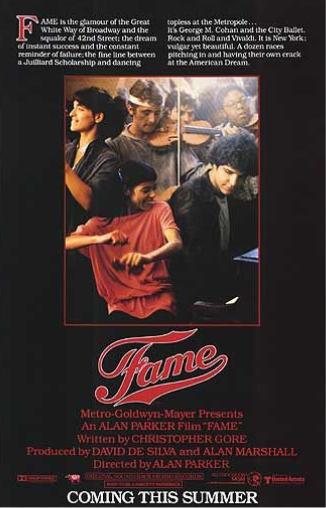
Fameposter

“Fuck it, if I can’t dance I’ll change to the drama department.” — Lisa (Laura Dean) in Fame (1980)

For nearly a week now, we’ve been taking a chronological look at some of the best and some of the worst films ever made about teenagers and high school.  Yesterday, we finished off the 70s with Rock ‘n’ Roll High School.  Today, we start the 80s by looking at yet another musical set in a high school.  That musical is 1980’s Fame.

Taking place at the High School For Performing Arts in New York City, Fame follows a group of students from the beginning of their freshman year to graduation four years later.  Among those students are Bruno (Lee Curreri), a musical prodigy, Coco (Irene Cara), who thinks that she’s the most talented student at the school, insecure Doris (Maureen Teefy), gay actor  Montgomery (Paul McCrane), talented but functionally illiterate dancer Leroy (Gene Anthony Ray), and self-destructive comedian Ralph Garcia (Barry Miller, giving the best performance in the film).  Over the course of four years, they fight, love, sing, and dance.  They especially do a lot of dancing, which is basically the main reason why I enjoyed the film.

Fame is the perfect film to transition into the 80s with because, in many ways, it’s a perfect combination of the 70s and the 80s.  In its use of ensemble and its emphasis on the gritty lives that the kids live outside of the school, the film is truly product of the 70s.  However, whenever the film follows the students inside of the school, it becomes very much an 80s film, the type where the emphasis is on stylistically hyper editing and emotions are just as likely to be expressed through a musical montage as through dialogue.  With its combination of the kids dreaming in the school and then facing the harsh realities outside, Fame feels like a collision of 70s pessimism and 80s optimism.

(Needless to say, pessimism usually makes for a more realistic film but optimism is a lot more fun to watch.)

Not surprisingly, for a film that made and released 34 years ago, a lot of Fame feels very dated.  (What is surprising is that the 2009 remake feels even more dated.)  It’s difficult not to cringe at the sight of all the leg warmers and big hair on display.  The same can be said for the synthesizer-heavy soundtrack but, to be honest, I like 80s music.  It may be cheesy but you can dance to it and really, what more can you ask from music?  If nothing else, Fame serves as a valuable time capsule of the time that it was made and yes, I know that I’ve been saying that about a lot of movies lately but hey, it’s true!  And I happen to love time capsules.  So there.

And besides, dated as the film may be, Fame does get the big things right.  It captures that feeling that we all had in high school, that feeling that you are destined for greater things and that, as long as you believe in yourself, good things will automatically happen to you.  It captures the wonderful feeling of not only being creative and talented but also knowing that you are talented and creative..

The film is full of hints that the majority of the students at the high school will probably eventually be forced to give up on their dreams.  A popular and handsome student is first seen graduating and full of confidence, just to pop up again an hour later, working as a waiter and looking desperate.  Haughty Coco goes to an audition and ends up in tears after a sleazy producer tells her to undress.  Ralph performs his stand-up comedy and, exhausted after going for days without sleep, ends up bombing.  Leroy is offered a chance to dance professionally but first he has to try to talk his English teacher into giving him a passing grade while she mourns for her husband, who died just a few hours earlier.  It’s actually a pretty dark movie but it’s hopeful too because, by the end of it, you realize that not all of the characters are going to make it but at least they’re going to have a chance to try.