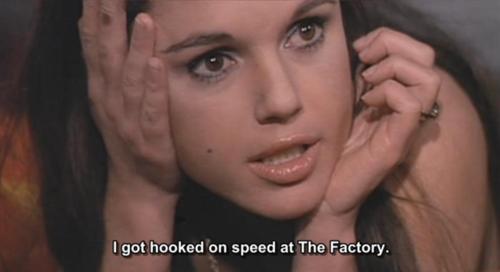
Today’s scene that I love comes to use from an underground 1965 film called Vinyl! Believe it or not, this adaptation of A Clockwork Orange was directed by Andy Warhol and predates the famous Kubrick film by 6 years!
This is a film that I hope to get a chance to review very soon but until then, check this out scene of Edie Sedgwick and Gerald Malanga dancing to Nowhere to Run by Martha and The Vandellas.
Watching her in this scene, it’s sad to think that, in just six years (and at the same time that Stanley Kubrick was releasing his version of A Clockwork Orange), Edie Sedgwick would die at the age of 28. Like all of us, she deserved much better than what the world was willing to give her.
I recently watched the 1972 film Ciao! Manhattan on TCM and it left me with incredibly mixed feelings. The specific reason that I was watching Ciao! Manhattan was because it was the last film to feature the legendary model and actress Edie Sedgwick. Tragically, at the age of 28, she died merely weeks after completing work on Ciao! Manhattan. And while the film is dedicated to her memory and was apparently meant to be a tribute to her, it instead feels incredibly exploitive. Watching the movie, I was aware that Edie was literally dying on screen and, as so often happened in her life, nobody was willing to step forward and help her.
In the late 60s, Edie Sedgwick was a model who was briefly the beautiful face of the underground. Vogue called her a “youthquaker.” She made films with Andy Warhol, she dated the rich and the famous and for a brief time, she was one of the most famous women in America. But a childhood full of tragedy and abuse had left Edie fragile and unprepared to deal with the pressures of being famous. She was fed drugs by those who claimed to care about her, she had numerous mental breakdowns, and, when she was at her most vulnerable, she was pushed away and rejected by the same people who had loved her when she was on top of the world. Edie died because, when she asked for help, nobody was willing to listen.
I guess I should explain something. I don’t believe in reincarnation but if I did, I would swear that I was Edie Sedwick in a past life. Of all the great icons of the past, she, Clara Bow, and Victoria Woodhull are the ones to whom I feel the closest connection. (Edie is the reason why, for the longest time, I assumed I would die when I was 28. But now I’m 29, so lucky me.) When I watched Ciao! Manhattan, I felt as if I was watching myself (or, at the very least, a close relation) on-screen.
Ciao! Manhattan opens with Susan Superstar (Edie Sedgwick), standing topless on a street corner and hitchhiking. She’s picked up by an aimless drifter named Wesley (played by Wesley Hayes). Wesley gives Susan a ride back to the mansion that she shares with her mother (Isabell Jewell) and her servant, a rather disgusting guy named Geoff (Jeff Briggs). Her mother hires Wesley to help take care of Susan. It turns out that Susan used to be a world-famous model but now she spends her time sitting in an empty swimming pool, drinking and doing drugs. While Wesley and Geoff listen, Susan talks about her past in New York. While Susan talks, we see black-and-white footage of Susan (and Edie’s) past.
Ciao! Manhattan began life in 1967 as an underground parody of a spy film. When Edie had a nervous breakdown and was sent to rehab, filming was abandoned. When she was finally released in 1970, filming began again. The 1967 footage was now used for flashbacks to the wonderfully glamorous life that Susan (and Edie) had lost.
And, when viewed as a documentary of how Edie was exploited and then subsequently abandoned by everyone that she cared about, Ciao! Manhattan works. The contrast between the happy and vibrant Edie of 1967 and the barely coherent and visibly unhealthy Edie of 1970 is heartbreaking. Whereas the 1967 footage features an existence that is in constant motion, the 1970 footage shows us an existence that is slow and drenched in sadness. The film makes no effort to pretend that Susan Superstar is anyone other than Edie Sedgwick and, when Edie talks about her past, no names are changed to protect the guilty. And the film shows that, even after surviving a literal Hell, Edie Sedgwick was still a natural-born star. Even when she’s slurring her words and staring at the world with poignantly sad eyes, Edie demands and gets the audience’s attention.
When Ciao! Manhattan allows Edie to tell her own story, it works. But, unfortunately, the film spends too much time with Wesley and Geoff, who are two of the most repulsive characters that I’ve ever seen. Geoff is written to be offensive whereas the character of Wesley is done in by the very bad performance of the guy playing his role. (Wesley Hayes was reportedly not a professional actor and it certainly shows.)
This is a film that provides evidence that, even in her last days, Edie Sedgwick was a talented and unique presence and, for that, I’m glad. But, ultimately, it’s hard not to feel that Ciao! Manhattan was the final case of Edie and her tragic life being exploited for someone else’s profit.
Usually, I would end a review like this by including either a scene or the film’s trailer. But, instead, I’m going to end this review with Edie Sedgwick’s silent Warhol screen test. This is how I prefer to think of Edie Sedgwick — hopeful and curious with the promise of her entire life ahead of her.
Over the past few days, I’ve become obsessed with a four-part video on Youtube. I don’t know who uploaded this video or why she (or he) felt the need to share it with the world. I suppose I could always go to the user’s channel and send a message but I don’t think I will. To be honest, I know that even if I did get a reply, the answers would probably just be a disappointment and certainly no where close to matching what I’ve imagined. Sometimes, the best questions are the ones that are never answered.
Anyway, as for the video itself, it was apparently filmed in 1987. Though it’s never explicitly stated, I think that this video was made in a high school gym. Apparently, the occasion was a fundraiser that was meant to help pay for the senior prom. For nearly 40 minutes, members of the Class of ’87 walked out onto a makeshift stage and showed off some of the tackiest prom dresses in the history of tacky prom dresses. Seriously, with one or two exceptions, the dresses here run the gamut from horrid to hideous. These were dresses from the Gurl, What Were You Thinking? collection.
(If I may say so myself, my prom dress was a 100 times better than anything seen here. It was a black mini with a pleated skirt and a sequined bodice. I was all boobs and legs in that dress and I’m sure some people would say it was too much of both. But so what? I felt like a movie star. I also did that silly thing where you throw your garter and then you dance with whoever catches it. It was fun and all but I never got the garter back and I hate to think of what the guy who caught the garter did with it after the dance.)
So, why does this video obsess me so? Well, admittedly, some of it is the fact that whole thing — from the balloons that decorate the stage to the gift certificates to McDonald’s that are given out as door prizes — is just so amazingly cheap that it actually becomes charming in much the same way that a 50s B-movie or Tommy Wiseau’s The Room. I love listening to the breathless commentary of the two hosts and comparing it to the models who, for the most part, almost seem to know that, 23 years in the future, this whole thing is going to end up on YouTube. I also love how, as the video goes on, the audience goes from being politely attentive to openly talking amongst themselves as the show goes on. Finally, the static camera work and the fact that every model is a star for at least 15 seconds, is reminiscent of the early Factory films of Andy Warhol.
I also like to watch the models and to wonder where they are now and whether they even remember the night and the show that has captivated me. Since they were all high school seniors in 1987, they would be in the 40s now. I wasn’t even 2 years old when this video was made. I don’t know any of them and (unless they’re reading this) they don’t know me but we have a bond in that we’ve all shared the same hour. After watching this video several times, I feel as if I know most of these models. I’ve studied their body language as they walked across the stage. I’ve noticed who smiled and who looked miserable. I’ve created elaborate backstories for them and figured out who has ended up married to who and who ended up getting drunk on prom night and crashing his car (and tragically killing his date) afterward. I’ve figured out what terrible secret links together all the guys wearing the sunglasses at night. At this point, actually meeting or talking to anyone actually in this video could only be a massive disappointment.
However, I think the true appeal of this video is that it’s both a record of an actual event but yet it’s totally devoid of context. The simple act of watching it becomes a search for meaning in which you’re guaranteed to find whatever it is you want to find.
Hi there! Welcome to the first edition of Lisa Marie’s Favorite Grindhouse and Exploitation Trailers for 2011. All 6 of our trailers in this edition are Italian. And, as always, most of them should be watched with caution and definitely not watched at work. (Also, I wouldn’t be surprised if Youtube yanked one or two of them offline within a week or so. So, watch while you can.)
This is actually one of Umberto Lenzi’s not that terrible movies. Which doesn’t mean it’s good. Just means that it’s not that terrible. This is the movie in which Lenzi manages to turn the Jonestown Massacre into a cannibal film. Ivan Rassimov, who looks like a Russian Charlton Heston, plays Jim Jones. Also, you might recognize the music because it ended up being used in about a 100 different Italian exploitation trailers.
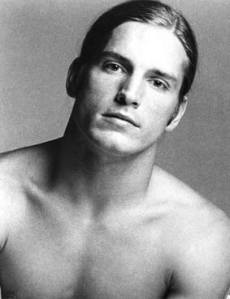
One of the most misleading titles of all time as Warhol had very little to do with this film beyond lending Paul Morrissey and Joe Dallesandro. This is better known as Flesh For Frankenstien. The trailer really doesn’t do justice to the movie but I had to include it because, even if it’s not my favorite trailer, it’s a classic exploitation trailer in just the shameless way that Andy Warhol’s name is used to sell the film.
Believe it or not, this movie is actually a lot of fun. One of the stars is apparently a gay porn star but I’ve never been able to figure out who he’s playing in the film.
I had to finish out this all-Italian edition with a little Lucio Fulci. And I had to go with Murderock because it features a lot of dancing. The trailer is also memorable for revealing the identity of the killer.
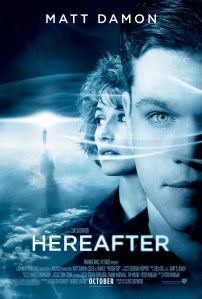
Hereafter is a very serious film about a very serious topic, death. Following three separate but ultimately connected stories, the film attempts to explore death and the question of what happens after death from three different angles — intellectually, emotionally, and spiritually. I really wanted Hereafter to be a great film. So did the film’s makers, which is precisely why Hereafter fails.
The intellectual consideration of death is represented by the character of Marie (Cecile De France), a French journalist who, at the start of the film, drowns in a tsunami and is, for a few minutes, clinically dead. Before she is eventually revived, she has a classic near-death experience: the bright light, the people waiting to greet her, the whole deal. After this experience, Marie is compelled to investigate whether or not there truly is such a thing as an afterlife. As she does so, Marie finds herself shunned by her resolutely secular friends and grows increasingly distant from her skeptical (and rather condescending) boyfriend.
The emotional response to death is represented in the story of twin brothers, Marcus and Jason (played by Frankie and George McLaren). The two boys live in London with their drug-addicted mother and share a strong (and, to be honest, kinda creepy) bond. Jason, while simply trying to return home with some drugs for his detoxing mother, is roughed up by some bullies and ends up running out into the middle of the street. Naturally, since this is a movie, Jason is hit by a truck as soon as he steps off the curb. Jason is killed and Marcus is taken away by social services and put into a foster home. Marcus continues to carry Jason’s cap with him and soon starts tracking down local English psychics in an attempt to talk to his brother again.
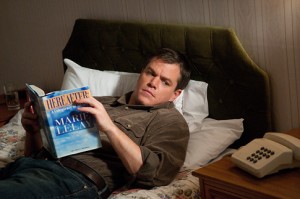
Finally, the spiritual aspect is detailed in the film’s most interesting story. This story features Matt Damon as George Lonegan, a psychic who can speak with the dead. After years of being a minor celebrity, George burned out and went into a self-imposed exile. He now works at a factory while his brother (Jay Mohr, who looks incredibly puffy in this movie) keeps trying to find ways to convince George to get back into the business of talking to dead for fun and profit. After George reluctantly gives a reading to Richard Kind, he finds himself being dragged back into his old life.
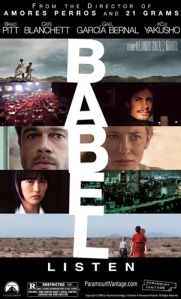
A lot of viewers and critics have compared Hereafter to Alejandro González Iñárritu’s 2006 masterpiece, Babel. Both films follow three separate but connecting stories and both films are concerned with the theme of death and how it connects us all. As well, Babel featured Brad Pitt in a serious role and Hereafter features Matt Damon. The main difference, however, is that Babel was a great film but Hereafter is basically an uneven mess.
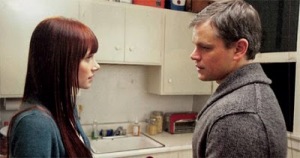
Whereas Babel featured three strong stories, Hereafter features 1 compelling story (that would be Damon’s) which is compelling solely because Matt Damon is a talented enough actor that he can apparently perform miracles. He’s probably about as likable as he’s ever been in the role of George but he also wisely plays the role as being just a little bit off. Even though the film makes the mistake of never really going into the details of just what exactly caused George to give up being a psychic, Damon is so good in the role that you’re willing to take him at his word that he had a good reason. Probably the highlight of the film (and one of the few sections to really inspire any sort of real emotional response) is an extended sequence where Damon befriends and the manages to alienate an insecure, single woman played by Bryce Dallas Howard. Damon and Howard have a scene that involves eating while blind-folded that manages to be both powerfully erotic and wonderfully romantic at the same time. If the entire film had been about them, Hereafter would have been a much better movie.
Unfortunately, we’ve got to slog through two other stories.
Cecile La France gives an excellent performance as Marie and the opening tsunami scene is truly terrifying. For someone like me, who cannot swim and risks having a panic attack if she even stands near the deep end of a swimming pool, the tsunami scene was almost impossible to watch. I had to put my hands in front of my eyes and watch the scene through my fingers. However, once she drowns, Marie sees a vision of the afterlife that — as a harbinger of things to come — is rather dull. I mean, with everything that can supposedly be done in movies today, the best that Hereafter can give us is a bland white light. Once Marie returns to Paris and starts her investigation, La France remains a sympathetic presence and the film actually does a pretty good job of showing just how condescending most supposedly “liberal” men are whenever a woman starts to stray from the established orthodoxy. But, unfortunately, her story is just never that interesting. Marie decides to write a book about the afterlife. As a writer myself, I have to say that there is nothing more boring than watching someone else write.
As for Marcus, I was shocked just how little I cared about him or his attempts to contact his brother. I come from a very close family and I have a very strong bond with all three of my sisters and, among them, I am notorious for crying at any movie that deals with that sort of sibling bonding. Yet I sat through the saga of Marcus and Jason without shedding a tear and I felt terrible about it. I really wanted to cry. I really wanted to have some sort of emotional response to the story but I just never believed it. I hate to say this but honestly, a lot of this was due to the fact that the McLaren twins are such bad actors. Director Clint Eastwood has said that he specifically cast them because they weren’t professional actors and therefore, they wouldn’t introduce any false “sentimentality” into the mix. But dammit, it was a sentimental story. Sentiment is not necessarily a bad thing and just because something is sentimental, that doesn’t make it false.
So, what exactly went wrong with Hereafter? The film opens strongly with a terrifying tsunami and the final 30 minutes are also undeniably touching (if also a bit contrived). It’s everything that happens in between those two points that ruins Hereafter. Director Eastwood, obviously looking to avoid that dreaded curse of being sentimental, keeps the whole film very low-key and realistic. Other than the opening tsunami, there are no big wow moments but to be honest, isn’t that what movies are for? If you’re going to make a movie that specifically shuns the wow moment, you better have something compelling (a perfect script or an entire cast giving a compelling performance as opposed to just a handful of them) to take its place. Hereafter doesn’t and, as a result, the movie drags. This, honestly, has got to be one of the slowest, most boring movies I’ve ever seen. If director Eastwood’s westerns and actions films can all be seen as homages to Sergio Leone and Don Siegel, I think Hereafter must be an homage to some of Andy Warhol’s intentionally dull films. Whereas Warhol, at the very least, gave us Joe Dallesandro to look at, Eastwood gives us Jay Mohr. It’s not a fair trade.
I don’t know how much of Hereafter should be blamed on Eastwood and how much should be blamed on the script written by Peter Morgan. Here’s a quote from Morgan that appeared in The Hollywood Reporter:
“It’s quite spiritual material, and quite romantic, too. It’s the sort of piece that’s not easy to describe and in the hands of different filmmakers could end up as wildly different films. Quite unlike some of my other material, which I think there were only certain ways that you could shoot it. It’s really not just another boring Hollywood movie with the same old boring Hollywood actors, although I see the point that the public and sick of paying $10.00 to see a movie with same old faces and the same gramma of story telling.”
And to that, all I can say is “Shut up, Peter Morgan!”
This is not spiritual material as much as it’s just a bunch of vaguely New Age platitudes being delivered by a mainstream screenwriter who apparently doesn’t have the guts to come down either firmly for or against an afterlife. This is the type of feel-good BS that leads to thousands of people every year giving up their life savings to some fraud who claims he can deliver messages from beyond. Morgan’s script goes out of its way not to actually define the afterlife. Is it heaven or is it Hell? Is there a God? Do the worthy go to Heaven? Are souls saved? Or are they just ghosts who are waiting for us to be willing to let them go? These are all questions that would have been considered by a good film but Hereafter doesn’t consider them. Oh, don’t get me wrong. It pretends to bring them up but only so the movie can shrug and go, “I guess nobody knows.” And to that I say, either take a position or don’t expect everyone else to pay money just to listen to you duck the question because you’re too scared of alienating mainstream critics or audiences.
(Myself, I do believe that those who love us are always with us in some way even if I don’t believe in a literal afterlife. And while I know that answer might seem vague, you should also consider that I’m not the one spending millions of dollars to make a movie celebrating that vagueness.)
Morgan’s script also make its a point to incorporate real-life events into his contrived narrative. As a result, the London Subway bombings and the Thailand Tsunami are both used as convenient plot points in much the same way that The Curious Case of Benjamin Button used Hurricane Katrina. I felt it was ghoulish when Button did it and, the more I think about it, it’s equally ghoulish in Hereafter. It’s hard not to feel that the film’s saying, “Too bad all those real people died but what’s important is how these events impacted the lives of a bunch of fictional characters.”
Hereafter’s main problem is that it simply tries too hard to be great. You get the feeling that every scene and line has been calculated to make you go, “Wow, what genius!” As a result, even the scenes that work still somehow feel very dishonest. The end result is a very insincere film about some very sincere concerns.