Horror Scenes I Love: Alien


Lisa Marie Bowman had chosen her favorite scene from Dario Argento’s Suspiria as her latest “Scenes I Love” post and it’s quite the scene. I will match her choice with a horror scene which remains one of my favorite scenes in film history. It is also a scene from one of the best scifi-horror films ever made and, I would dare to even say, one of the best films ever created. The scene I speak of comes from Ridley Scott’s classic and iconic film Alien.

Anyone who has ever watched this classic scifi-horror will always gravitate towards talking about one particular scene. The scene is the first time the crew of the space tug Nostromo gets together to a meal as a group after the crisis which saw one of their own crew members attacked by an alien creature. This scene started off quite normal. Professionals enjoying food and good company. It’s through Ridley Scott’s direction and the exceptional performances of all involved which elevates the scene to one of the greatest. Through the scene’s depiction of normalcy we start to get a sense that something may not be right even before Kane begins to cough and have convulsions. For me it was a prolonged shot of crew member Ash during the banter around the table. His expression is all subdued smile then for just a split second we see him glance at Kane eating and being merry but he knows something is wrong and about to happen.

Even if people didn’t pick up that moment from Ash it still created a subconscious effect on the audience so that when Kane did begin to cough and convulse uncontrollably the audience was already on the razor’s edge. When the climactic event which punctuates this scene finally occurs the surprise on all the actors, especially that of actress Veronica Cartwright, has gone done as in film history as a classic. It helped that their reactions were quite genuine. Even knowing that the chestburster alien would pop out it was not being told that fake blood would squirt out that made their reaction of surprise and disgust so real. The extended version of this scene even had Cartwright slipping and falling as she screamed in horror at all the blood which had splashed on her.

One last thing which made this scene one I love and also one which I think makes it one of the greatest scenes in film history is that it was done in one take and that single take came out perfectly. This is a scene that has influenced many filmmakers since but its effect has never been fully replicated.
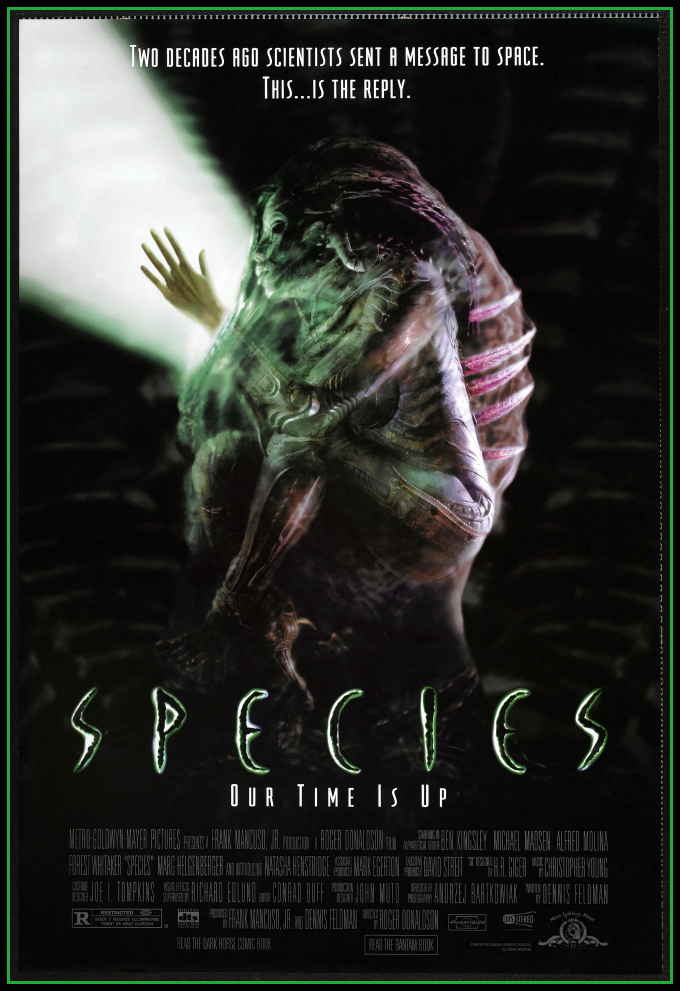

 

Quickie Horror Review: Species (dir. by Roger Donaldson)


1995’s Species was a studio’s attempt to replicate the start of a new sci-fi/horror franchise like the one begun by Ridley Scott’s Alien. Roger Donaldson was tapped to direct this attempt with a cast that included Sir Ben Kingsley, Michael Madsen, Marge Helgenberger, Forrest Whitaker and Alfred Molina. The lucky gal who gets to play the role of Sil — the half-alien, half-human hybrid — fell on the stunning and gorgeous shoulders of Natasha Henstridge.

Species pulls from so many different sci-fi/horror films and shows from the past that it’s hard to find anything original in the story. There’s stuff from Alien, The Hidden, and even some episodes of The X-Files. The one original twist in this derivate film was the plot of an alien race sending over the genetic markers of its race and instructions on how to recombine it with human DNA to create a form of hybrid. Why the scientists decided to go through with such a seemingly dangerous task is known only to the writer who put pen to paper to create the screenplay. The bulk of the film’s story comes from one the creation of one such human-alien hybrid named Sil (the young version played by Michelle Williams in one of her very first roles) and how her creators and handlers begin to realize that she has an almost desperate need to procreate.

The acting by the select group of experts (Madsen, Helgenberger, Molina, Kingsley and Whitaker) were good enough and no one embarrassed themselves in the end. Henstridge does a fine job of being sexy and hot. It helped that she pretty much was naked through most of the film, or at least put herself in situations to be naked. In fact, Henstridge goes beyond just being the naked eye candy in the film, but does a great job playing the naive adult Sil who escapes her lab-prison as her instincts propel her to find the perfect mate. It’s during this search that much of the film’s gore make their appearance and there’s a bit of it.

The art design of Sil as the evolved alien hybrid came courtesy of the great Swiss surrealist, H.R. Giger who also did the design for the alien creature in Alien. Giger’s biomechanical designs have always been disturbing and beautiful at the same time and he didn’t disappoint with his design of Sil. If there was a quibble on Sil’s final design it was that it still resembled a bit too much of the alien design in Ridley Scott’s Alien. But it was still great to see H.R. Giger still creating such wonderful artwork and designs for people to see. His popularity has always been mostly composed of the elite circles of the artworld and those small, loyal art groups with a penchant for the surreal, weird and disturbing.

In the end, Species was a good sci-fi/horror that didn’t bore too much and for those who enjoy their gore this film had its equal share of the red stuff. Gratuitious nudity and sex from Natasha Henstridge as Sil the alien hybrid and the excellent designs from H.R. Giger gives this film enough good things to look at. It doesn’t bring anything new and pretty much reuses alot of other things from other movies, but Species was good enough albeit derivative of better past films and shows.

6 Trailers That Make Lisa Marie Go Yay!


Hi everyone! 

I will be the first to admit that I can occasionally be a little moody but tonight, as I sit here typing, I am in such a good, extremely hyper mood.  Maybe it’s because I’m wearing my beloved black Pirates shirt.  Or it could be because, for once, this house is neither too cold nor too warm.  Then again, it could just be because it’s time for me to bring you another edition of Lisa Marie’s Favorite Grindhouse and Exploitation Trailers!

1) I Dismember Mama/The Blood-Splattered Bride (1974)

This is a trailer for a “double feature of horror,” featuring I Dismember Mama and The Blood-Splattered Bride.  When I’ve spoken with other grindhouse movie fans on the web, this trailer is often cited as being a favorite.  Personally, I think it goes along for about a minute too long but I can understand why it’s so popular.  For one thing, it’s nothing like the trailers that are currently playing in theaters across America in that it’s a short film in itself.  By the way, the trailer for Blood-Splattered bride sans I Dismember Mamma can be viewed here.

2) Killer Nun (1978)

From the wonderful nation of Italy comes this example of the odd little grindhouse genre known as nunsploitation.  I can probably count the number of good nunsploitation films on one hand.  And yet when confronted with a film like this, I cannot look away.  Maybe it’s because I was raised in the Catholic church.  Or it could just be because the totally hot and lickable Joe Dallesandro is in so many of them.  Along with Dallesandro, Killer Nun features Anita Ekberg of La Dolce Vita fame and Alida Valli of Third Man, Suspiria, and Inferno fame.

(Sidenote: Once when I was going to Catholic school, this really mean, fat girl was jealous of me because I was prettier than her so she whacked me in the face with a ruler so hard that it actually broke the skin right over my right eye and I had to get 3 stitches to close the cut and I’ve still got this little scar and sometimes, when I wink or seductively arch my right eyebrow, it still hurts a little.  I hope somebody eventually went all Killer Nun on that girl…)

3) Lady Kung Fu (1972)

When I showed my sister Erin this trailer, she said, “You’re not going to jump up and start trying to do any of that stuff yourself, are you?”  “Uhmmm…no,” I replied but, to be honest, I was totally about to do it.  I don’t know much about Angela Mao but just, on the basis of this trailer, she’s my hero.  This trailer is just infectious and, as I watched, I wondered, “How difficult can it be?”  Well, apparently, it’s very difficult but that’s a story for a different time.

4) The Bullet Machine (1969)

“He can hack it!”  Uhmmm….well, yes, okay then.  At first, I thought I had actually found a trailer that was more violent than the trailer for Massacre Mafia Style but, upon careful reflection, I have to say that Massacre Mafia Style is still the king.  The two hitmen in Massacre Mafia Style may not fire as many bullets but they still manage to kill everyone else in the trailer.  Whereas The Bullet Machine is constantly shooting his gun but doesn’t really seem to accomplish much as a result.  Plus, the mafia hitmen had style whereas the Bullet Machine just seems to be kind of a prick.  If ever I have to prove the thesis that most men use guns as a substitute for their own limp penis, this trailer will be exhibit one.

5) Alien 2 (1980)

I don’t know much about this film other than it’s obviously an Italian attempt to capitalize on the success of the original Alien and it is not — as I originally assumed — the same film as Luigi Cozzi’s Alien Contamination.  One of the things that I love about Italian exploitation cinema is just the pure shamelessness of it all.  I imagine there had to have been about a thousand remakes of Alien in the early 80s but only the Italians would have the balls to actually name a film Alien 2.

As for this trailer, it has its slow spots but seriously, stick with it for the final shot.  And remember — you could be next!

(On the plus side, a young Michele Soavi is in this film.  YAY!)

6) Fascination (1978)

I’m in such a good mood right now that I’m just going to have to end this latest entry with a little Jean Rollin.  Now, just in case anyone out there is unfamiliar with the unique cinematic vision of Jean Rollin, you should understand that this trailer is far more explicit than any of the other trailers featured in this post.  In fact, I’m surprised that Youtube hasn’t taken it down yet.  So, if you’re easily offended, I don’t know why you would be visiting this site in the first place.  But anyways, if you’re easily offended, consider yourself warned.

As for Fascination, it’s actually one of the more accessible of Jean Rollin’s vampire films.  The image — seen towards the end of this trailer — of Brigittie LaHaie with a scythe has become iconic.

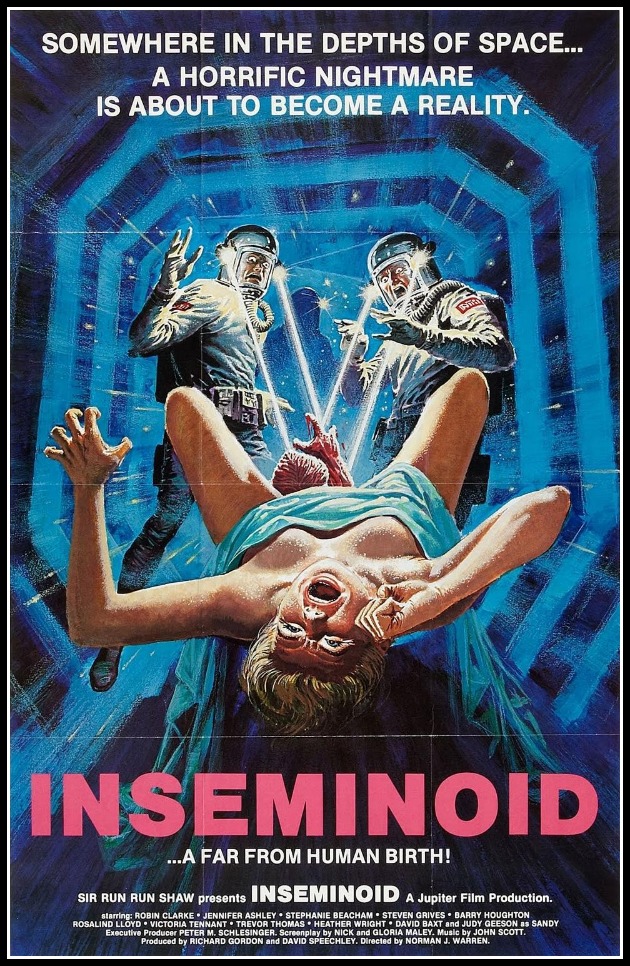
The Daily Grindhouse: Inseminoid (dir. by Norman J. Warren)


The latest daily grindhouse comes straight out of the UK from the early 80’s. It’s a sci-fi horror flick which came about as part of the exploitation wave of Alien rip-offs and imitation of the past several years since Ridley Scott’s scifi-horror masterpiece stormed through Hollywood. While it’s director, Norman J. Warren and it’s producers do not think it’s grindhouse or an exploitation film of any stripe I beg to differ.

Inseminoid (renamed for a U.S. release as Horror Planet) screams grindhouse right from that title alone. It’s a film about a group of scientists landing on an unknown and desolate planet in search of evidence that an alien civilization existed once upon a time on the planet. The whole thing was either filmed inside a studio-built spacecraft set or in a cavern complex near the studio in the UK. It’s once one of the scientists (as always with grindhouse horror it happened to be a female scientists) has become impregnated by a remnant of the planet’s long-dead civilization that the horror truly begins.

It’s that very scene of rape and alien impregnation which got this film labeled as a “video nasty” in the UK which made it’s release on video near-impossible to make without editing out that pivotal scene early in the film. That scene also got the flick compared to another grindhouse scifi-horror released the same year by low-budget auteur Roger Corman called Galaxy of Terror. Outside of both films using a rape scene by alien means the two films really had nothing in common plot-wise so I think the filmmakers of Inseminoid and Galaxy of Terror just happened to think of a similar idea at the same time.

This film is not great or even good, but like all true grindhouse the people involved in the film took their roles and task seriously to try and make the best film their budget allowed them to. It’s not a horrible film and when seen now it’s actually quite a fun little scifi-horror flick that showed a glimpse into an era of cheap, exploitation films that would last well into the late 80’s.

Super 8 (Super Bowl TV Spot)


I’ve always looked at all J.J. Abrams productions with some guarded optimism since so many people seem to hype his stuff. I liked his reboot of Star Trek, but was very so-so on his Mission Impossible 3. I will admit that he does have a good batting average when it comes to tv and now film. His latest film is Super 8.

This Super Bowl tv spot shows more than the teaser trailer with the train wreck and the steel door being pounded at. The film looks to be set sometime around the 1950’s if the set is to be believed. Some have reacted to info leaked about this film as Abrams’ homage on a certain family-friendly Spielberg alien film from the early 80’s.

Super 8 looks like the one film this summer that the less I know about it the better I’ll enjoy it when it finally comes out on June 10, 2011.

Artist Profile: H.R. Giger


Luis Royo inaugurated the artist profile feature and he’s now followed up by Swiss surrealist painter and sculptor H.R. Giger.

Many who follow the heavy metal and the visual effects scenes know who H.R. Giger is. This artist who hails from Switzerland has been responsible for some of the most iconic images in science-fiction film history. Just looking at the samples of his work on this page one has to automatically notice how the designs look very similar to the alien creature in Ridley Scott’s sci-fi/horror classic Alien.

Scott had seen some of Giger’s art pieces from his Necronomicon IV art collection and instantly knew that this Swiss artist was the one to design his alien and the spacecraft it was to be discovered in. Giger’s alien and environment design were so masterful that he won an Oscar for Best Visual Effect in 1980 for his work in Alien. This accolade got him noticed to head the art design for a failed Dune film adaptation by Chilean filmmaker Alejandro Jodorowsky.

It was to great disappointment that when David Lynch finally worked on Dune only the basic designs Giger had created for the production was used. As one watches Lynch’s Dune bits and pieces of Giger’s signature biomechanical design does pop out. This is especially true when the film switched over to focus on scenes dealing with the Harkonnen and Giedie Prime.

Giger would go on to do some art and set designs for such films as Poltergeist II: The Other Side, Alien 3 and Species. Even now he has been tasked by Ridley Scott to work on his latest film, Prometheus, and come up with new creature designs.

H.R. Giger’s style is one of nightmarish and surreal landscapes and figures which some have described as Satanic, perverse and disturbing. He combines biological anatomy with the mechanical to create works of art that have become favorite of certain heavy metal subgenres like industrial metal and death metal. While most of his works were created using airbrushing techniques to create monochromatic pieces he has, of late, switched over to using pastels, markers and inks.

One wonders what sort images goes through such an artists’ mind to come up with some of the artwork Giger has become famous (and in some circles, infamous) for. Maybe the fact that Giger suffers from night terrors and this has led to heavily influencing the images he creates. In the end, H.R. Giger’s work defnitely falls under the old adage of “beauty lie in the eyes of the beholder”.

Official H.R. Giger Website

6 Trailers From 1981


Hi and welcome to the latest installment of Lisa Marie’s Favorite Grindhouse and Exploitation Film Trailers.  I apologize for being a few days late with this installment. 

This week, I’m highlighting trailers from the year 1981.  1981 not only saw the release of Lucio Fulci’s twin classics The Beyond and The House By The Cemetary, it was also the year that my sister Melissa was born.  (Happy birthday, Melissa Anne!) 

You may notice that, despite citing them above, I did not include the trailer for either one of Fulci’s films in this post.  I’m saving them for a future edition.  Instead, let’s start with Alien Contamination and end with Christiane F. and see what waits in the middle.

1) Alien Contamination

Earlier in this series, I featured the trailer for Luigi Cozzi’s Star Wars rip-off, StarcrashThis is the trailer for Cozzi’s attempt to rip-off both Alien and Lucio Fulci’s classic Zombi 2.  The film is pretty dull but I have to give the trailer mad props for actually making this movie look like it might be kinda fun.

2) Scanners

In this trailer, David Cronenberg proves that nothing sells a film like an exploding head.

3) Dead & Buried

I haven’t seen this film but I’ve read several favorable reviews of it.  While the trailer isn’t nearly as graphic as some of the other trailers that I’ve featured in this series, I still like it.  With the ominous narrator and all, it has a nice retro feel to it.

4) The Evil Dead

Speaking of retro, here’s the trailer to the original Evil Dead

5) Copkiller a.k.a. Order of Death

I recently ordered this Italian film off of Amazon but I have yet to sit down and watch it.  The trailer, for me, is memorable just because it’s a chance to see both Harvey Keitel and Johnny Rotten (who were both quite the sexy beast back in 1981) occupying the same space.

6) Christiane F.

Some people, I know, would disagree with me referring to Christiane F. as being an exploitation film.  I’m sure that the film’s award-winning director — Uli Edel — would disagree with me.  However, Europe’s art films were often sold as America’s grindhouse movies and, just from anecdotal evidence, that was often the case with Christiane F.  Besides, I love this trailer if just for the music alone.

Review: The Descent (dir. by Neil Marshall)


Neil Marshall’s follow-up to his cult-favorite werewolf film Dog Soldiers does not disappoint. Marshall’s filmmaking has improved dramatically since his debut—the film not only cements his skill as a director but also signals the horror genre’s return to a darker, meaner, and more exploitative spirit, reminiscent of a time when filmmakers weren’t afraid to push limits.

The Descent begins with tragedy: Sarah (Shauna MacDonald) suffers devastating losses that form the emotional and psychological foundation of the film. Her grief gives the story a weight that elevates it beyond a typical survival-horror narrative, grounding it in raw emotion and human fragility. Surrounding Sarah are her close friends—Beth (Alex Reid), who travels with her to the U.S. at the invitation of their American friend Juno (Natalie Mendoza)—and newcomers to the group: Holly (Nora Jane-Noone), Sam (MyAnna Buring), and Becca (Saskia Mulder). What begins as a healing adventure for six women soon transforms into a descent not only into the depths of a cave system but into the recesses of fear, betrayal, and survival.

Led by Juno, the group embarks on a spelunking expedition in the Appalachian Mountains—Marshall’s deliberate nod to Deliverance. Though the forest scenes were filmed in Scotland, their authenticity never falters. Yet Marshall doesn’t linger long in the open air; safety and sunlight give way to shadow and claustrophobia as the women push deeper underground. The descent itself is drawn out just enough to build tension until the film snaps into full horror mode. When the inevitable cave-in comes, the sequence is nerve-shredding—an expertly shot, suffocating nightmare that will have claustrophobic viewers flinching and gasping for space.

After the collapse, the women find themselves trapped, nerves fraying and panic growing. Juno, initially portrayed as the group’s confident alpha, begins to reveal a brash, reckless streak masking her deeper insecurities. What started as a confident façade becomes a fragile disguise for fear and guilt, and Marshall uses this shift to explore how leadership and trust erode under extreme pressure.

From this point forward, The Descent becomes a masterclass in oppressive atmosphere. Gone is any trace of daylight—the cave becomes an abyss of darkness, amplifying a universal fear of entrapment and the unknown. Marshall layers internal conflict onto external terror, exposing lies, betrayals, and fragilities within the group. The result is as psychological as it is visceral; survival becomes both a physical and moral test. This is no Steel Magnolias—it’s a blood-soaked exploration of human endurance under primal duress.

Marshall, alongside cinematographer Sam McCurdy, crafts a sensory experience that manipulates both light and sound to devastating effect. The pitch-black sequences—where nothing is visible, yet everything is heard—are among the film’s most frightening moments. Every drop of water, every panting breath, every unseen shuffle echoes with menace. The sound design alone makes viewers feel trapped within the cave alongside the characters, scanning the darkness for unseen horrors.

The titular descent takes on a new layer once the film’s monsters, the Crawlers, make their appearance halfway through. Marshall wisely delays their reveal, letting claustrophobia and suggestion torment the audience first. When these pale, feral creatures finally emerge, their raw physicality and relentless hunger confirm every imagined dread. Their attacks are fast, brutal, and chaotic—filmed with a balance of restraint and brutality that gives the violence a strangely poetic rhythm. Fans of gore will be thrilled, but even skeptics of splatter cinema will find the violence purposeful, anchored by the audience’s genuine investment in the characters’ fates.

The Descent succeeds as a terrifying, pulse-pounding revival of hard-R horror. It straddles the line between primal terror and visceral gore without losing its emotional core. Marshall doesn’t reinvent the genre—the DNA of Alien and Predator is evident—but he honors it with craft and vision. The interplay of light and shadow even recalls Argento’s dreamlike intensity, while the cave setting feels nightmarishly tactile.

In an era where horror films trend toward PG-13 softness, The Descent proudly reclaims the genre’s raw, adult intensity. This is horror meant to unsettle, to overwhelm, and to make you feel the walls closing in. Neil Marshall, once known only for Dog Soldiers, proves here that he’s no fluke. The Descent solidifies him as one of the most promising horror filmmakers of his generation—a director unafraid to go deep into the dark.

Review: Slither (dir. by James Gunn)


James Gunn first got his chance to work in the horror-comedy genre with his time in Troma Films. His first contribution to the genre being a send up of Shakespeare’s Romero and Juliet aptly titled as Tromeo and Juliet. He next moved on to penning scripts for the major studios with his first two being the critically-panned, but profitable two Scooby-Doo live-action films. Gunn next moved on to writing a script reimagining George A. Romero’s classic Dawn of the Dead. Despite howls of protest from the original film’s legion of fans, the film went on to be a modest success and helped bring about the renaissance of the current zombie mania in all facet of entertainment. Gunn follows up the success of his Dawn remake by not just writing the script but finally getting behind the camera and directing it himself. I’m glad to say that James Gunn’s first directorial debut with Slither has turned out to be one fun, gross-out, disgustingly hilarious horror-comedy that brings to mind the splatter-comedy films of the 1980’s.

I say that Slither has alot in common with the horror-comedy during the 80’s just for the fact that we’ve not seen a film of this kind since. Slither brings to mind such 80’s B-movie shlock classics like Critters, Return of the Living Dead, and Night of the Creeps. But Gunn also pays some an homage to cult classics like John Carpenter’s The Thing. One of the character’s in the film and a store are even named after The Thing‘s badass antihero, R.J. MacReady. Then there’s the tip of the hat to Romero’s zombies, though this time around I would say that Gunn had more in mind the quickthinking and funny undead from John Russo’s Return of the Living Dead. There’s even a shout out to Invasion of the Body Snatchers as the alien slug-controlled populace are actually part of a much larger organism who thinks for all.

The story Gunn came up with for Slither was pretty straightforward and simple. Intelligent alien organism bent on world domination hitches a ride on a meteor which travel the depths of space until it falls on an unsuspecting planet. Unfortunately, the planet in question for the film happens to be Earth. Right from the get go the comedic aspect of the film begins even as the alien-laden meteor crash lands its way to one Wheelsy, N.C. A podunk town where the most interesting to happen each year is the annual Deer Cheer which signals the start of Deer Hunting season. We get to see the mundane day-to-day life of the townspeople from the pretty high school teacher Starla Grant (adorably played and with a strong sense of marital fidelity by Elizabeth Banks), the town’s obnoxious and foulmouthed Mayor MacReady (Gregg Henry’s performance was hilarious and he gets pretty much all the best one-liners), to its Chief of Police Bill Pardy (Nathan Fillion in Han Solo mode).

The alien soon finds a host in the town’s richest person who also happens to be Starla’s much older husband, Grant Grant. Michael Rooker (Henry: Portrait of a Serial Killer) plays Grant and his performance was both funny and sad. He pretty much starts morphing into a creature somewhere between Jabba the Hutt and a Lovecraftian squid-person. But through it all, Grant’s love for his wife manifests itself by way of the alien’s collective intelligence. When the townspeople all start getting infected by the large, slug-like offsprings of the main alien, it’s hilarious to find that they all share Grant’s love for Starla. It would seem that the alien collective learned abit or two from Grant about marital love and also a love of Air Supply’s syrupy ballad, “Every Woman in the World.” These zombies chant the word “Starla” instead of “brains.” The rest of the film was pretty much Starla, Bill Pardy and a small band of survivors trying to stop the Grant-alien, the slugs and the zombified townspeople from spreading out of Wheelsy and out onto the rest of the planet.

The film balances well between horror and comedy. The horror aspect of Slither comes from the many gory scenes. Trust me when I say that this film has more than its share of blood, gore and splatter. We’re shown dead and gutted pets and farm animals. Not to mention the requisite flesheating performed by the zombies. the great thing about the scenes of horror in Slither was the absence of CGI except for a scene or two and even then it was difficult to pinpoint which was CGI and which was animatronics and make-up effects. Slither‘s monster effect owes alot to the work of Rob Bottin and his crew who did the disgustingly creative effects on Carpenter’s The Thing. I’m glad to see that Gunn decided to forgo CGI for these scenes and went for more realism. Even if such realism were nauseatingly disgusting and gross. Just what a horror movie was suppose to be. The comedy part came not from the aliens and the scenes of horror, but from the characters reactions to the unfolding events around them.

Just like Shaun of the Dead, Slither’s characters stumble, bumble and trip their way through the crisis. Even Fillion’s character of Bill the Chief goes against the stereotypical hero from these type of film. He’s a smartass about his job and how he sees the people he’s suppose to protect, but when the time comes to do his job as protector he tries to do the best he can even though the best he can doesn’t measure up to what we’re suppose to get from our heroes. The dialogue was fast and wickedly sharp which made for alot of hilarious one-liners and most of them coming from the mouth of Slither’s Mr. Pibb-obssessed Mayor MacReady and his penchant for overreacting to everything and also for calling everyone cocksucker.

Slither doesn’t try to be anything but what it set out to be: a funny horror film with a large helping of slapstick, splatter and slime. In that respect, James Gunn succeeded with his writing and directing of Slither. The movie doesn’t bring any originality to the horror-comedy genre. To be honest, there’s not much originality left to bring to the genre, but Slither takes all the usual conventions from those 80’s horror-comedies and gives it a new millenium vibe. The acting by the cast was well-done and showed that they must’ve have fun doing the film. The special effects were done old-school style with nary a CGI-effect to be seen except for a few brief scenes. In the end, Slither was one fun, rollercoaster of a movie that scared the audience into jumping and recoiling in their seats and at the same time making them scream, shout and laugh when doing so. I’ve never had as much fun these last couple years watching a movie like I did with Slither.

Review: The Thing (dir. by John Carpenter)


In what may well be John Carpenter’s finest film—greater even than Halloween and Escape from New York—the director boldly remakes Howard Hawks’ 1950s sci‑fi classic The Thing from Another World and, incredibly, surpasses the original. Unlike Hawks’ version, steeped in Cold War anxiety, Carpenter draws more directly from John W. Campbell Jr.’s short story Who Goes There?, shifting the focus to paranoia festering within an isolated group of men. His setting, an American scientific station buried deep in the frozen desolation of Antarctica, becomes the perfect pressure cooker for suspicion, distrust, and barely contained madness.

Carpenter’s vision announces itself immediately. The film begins with an overhead shot of jagged, snow‑capped mountains—an endless expanse of icy barrenness. This stark imagery is paired with Ennio Morricone’s minimalist score, a low, pulsating bass throb that mimics a heartbeat. In just these opening moments, Carpenter and Morricone establish the film’s defining tone: desolation, unease, and a creeping inevitability. Carpenter never lets this sense of dread relent; the unease initiated in the opening frames lingers throughout, until the final note of the end credits.

Where the 1951 film wasted no time showing an alien in the flesh, Carpenter follows Campbell’s original concept more faithfully: the creature hides, assimilates, and imitates. It kills and replicates members of the Antarctic crew, transforming everyday interactions into moments of terror. This conceit allows Carpenter to stage his film not just as a monster movie, but as a psychological exercise in tension. Each man is a potential threat. Each argument, however trivial, is laced with suspicion. The audience feels trapped alongside the crew, caught in their spiral of mistrust. At its core, the film is less about the monster’s abilities than about what happens when trust is stripped away from a community forced to live in isolation. The most chilling moments often occur not during the creature’s violent reveals, but in quiet exchanges where fear and doubt spread faster than the Antarctic cold.

The special effects remain legendary, an enduring benchmark even decades later. In the early 1980s, CGI was not a viable option, so Carpenter entrusted Rob Bottin, then in his early 20s, with designing the creature effects. Puppetry, animatronics, latex, and rivers of stage blood combined to create some of the most grotesque and imaginative transformations ever put on film. The kennel scene—when the alien first erupts from the body of a sled dog—remains a horrifying pinnacle of practical effects, unsettling in its creativity and biological plausibility. Bottin’s work is still studied in film schools as a triumph of practical ingenuity. The tactile, slimy, unpredictable reality of these effects would be nearly impossible to replicate with CGI. If any film demonstrates why computer graphics can feel cold and weightless compared to visceral practical effects, The Thing is it.

Anchoring the film is Kurt Russell as helicopter pilot R.J. MacReady, equal parts rugged pragmatist and reluctant leader. Russell’s performance gives the film its center of gravity, portraying a man forced into command when order collapses. Keith David brings an equally commanding presence as Childs, his wary, confrontational energy making him a perfect foil to Russell. The ensemble cast is one of Carpenter’s great strengths here. Each character is distinct, each performance meaningful; there are no throwaway roles. Even smaller parts resonate, as every man crumbles at his own pace under the weight of fear. One of the film’s most unsettling turns comes from Wilford Brimley, whose genial, trustworthy persona makes his gradual descent into paranoia and violence all the more disturbing.

The music deserves as much recognition as the visuals. Rather than scoring the film himself, as he had done in his earlier works, Carpenter handed the task to legendary composer Ennio Morricone. The gamble paid off. Morricone’s spare, throbbing motifs mesh seamlessly with Carpenter’s minimalist style, complementing the stark visuals rather than overwhelming them. The score is skeletal, almost primal—music that feels less composed than unearthed, vibrating with dread. It remains one of the finest examples of how sound can serve as a force multiplier for tension.

The Thing is not for the squeamish. The violence is graphic, the gore extreme, and the imagery deeply unsettling. Yet for those who admire masterful filmmaking, it stands as essential viewing: a perfect marriage of vision, execution, and atmosphere. For students of cinema, it offers a lesson in how genre filmmaking can transcend cliché and attain something close to pure, operatic terror. In the end, Carpenter’s The Thing is more than a remake—it is a redefinition. It strips away the veneer of mid‑century optimism and replaces it with a stark meditation on distrust, survival, and the alien within us all. Few horror films hold up this well or manage to stay this scary for fans old and new.