Review: Saving Private Ryan (dir. by Steven Spielberg)


“Someday we might look back on this and decide that Saving Private Ryan was the one decent thing we were able to pull out of this whole godawful, shitty mess.” — Sergeant Horvath

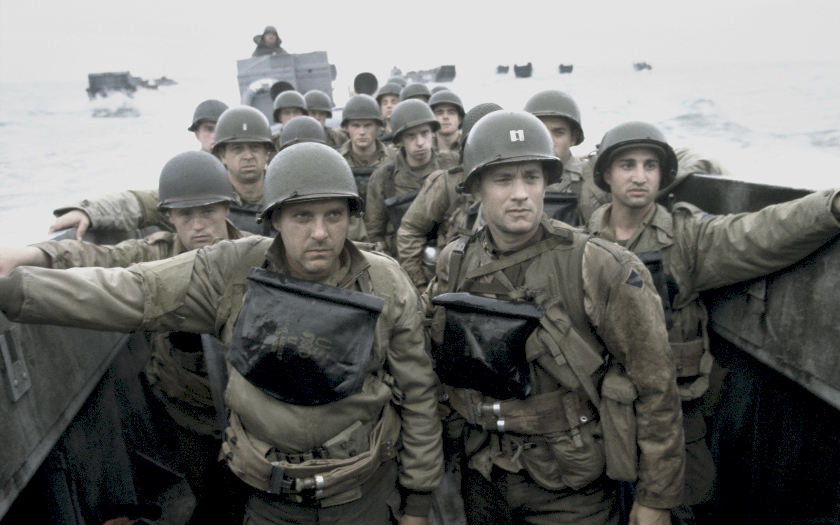
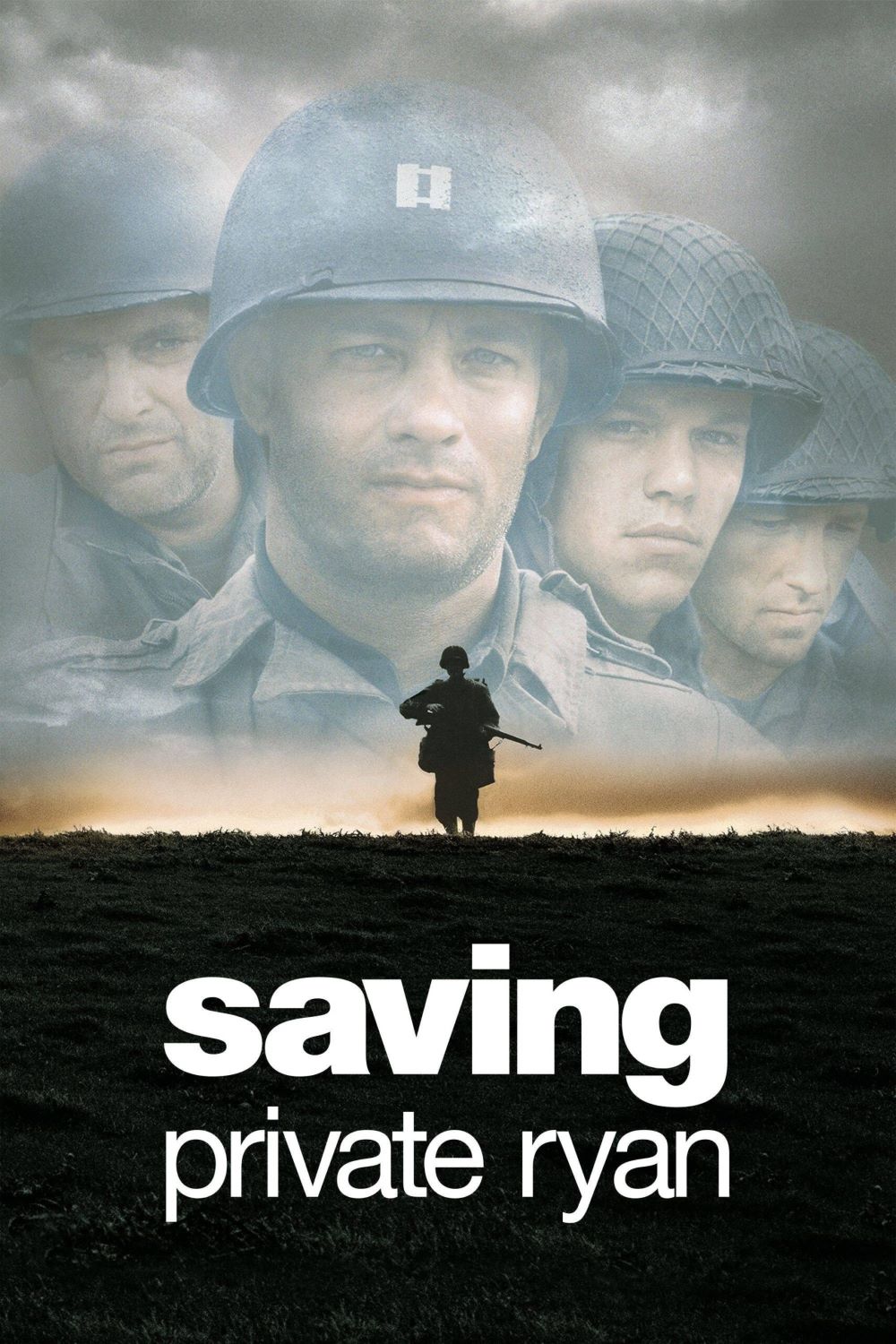
Saving Private Ryan stands as a landmark achievement in war cinema, intricately weaving immersive battle scenes, rich character dynamics, and profound moral themes into a nearly three-hour exploration of World War II’s human cost. One of its most remarkable features is the opening Omaha Beach landing sequence, a meticulously crafted, over 24-minute depiction of warfare’s brutal reality. Spielberg deploys a cinema verité style with handheld cameras capturing disorientation and chaos through the soldiers’ eyes. The sound design envelops the viewer in a sensory onslaught—gunfire, shouting, explosions—creating a visceral experience that immerses audiences directly in the terror and confusion of D-Day.

The filming process drew heavily on historical accuracy, with the production shot on the coast of County Wexford, Ireland, employing amputee actors and practical effects over computer graphics to simulate violent injuries and battlefield horrors. Muted tones evoke wartime photographs, and rapid, shaky editing conveys the disorganized, frantic environment soldiers endured. Consulting WWII veterans and historians, Spielberg created a sequence that reshaped cinematic portrayals of war, influencing how future films would approach the genre’s raw immediacy and emotional weight.

The film’s narrative follows a squad led by Captain Miller on a mission to locate and bring home Private James Ryan, whose three brothers have been killed in combat. The mission is steeped in the real-life tragedy of the five Sullivan brothers who died together aboard the USS Juneau in the Pacific, prompting military policies to prevent similar familial devastation. This historical context frames the story’s ethical heart: risking several men’s lives to save one, raising enduring questions about the value of individual sacrifice within the broader war.

In Saving Private Ryan, sacrifice is portrayed ambiguously—not as the sacrifice of a single hero but as the collective cost borne by the men tasked with rescuing one individual under perilous conditions. As the squad journeys through the war-torn French countryside, the deaths, injuries, and tensions they face underscore war’s randomness and the difficulty of weighing one life against many. The narrative refuses to romanticize or simplify, instead confronting the audience with the tragic truth that countless soldiers lose their lives without recognition or purpose, while some survive against staggering odds.

Duty and camaraderie thread throughout the film, portrayed through the soldiers’ evolving relationships and personal struggles. Each grapples with loyalty not only to their mission but to their fellow men and their own moral codes.

Integral to the film’s power is Tom Hanks’s layered performance as Captain John Miller. Hanks breathes life and emotional depth into Miller, portraying him as a man shaped by civilian life—revealed poignantly when he discloses his pre-war profession as a schoolteacher—now transformed by the relentless demands of war. He embodies an officer who is both composed and vulnerable, carrying the heavy burden of leadership with quiet dignity. Hanks’s portrayal reveals the internal struggles beneath Miller’s stoic exterior: moments of doubt, moral conflict, and fatigue subtly expressed through a trembling hand or a weary gaze. This humanity makes Miller relatable, as a man trying to maintain order and purpose amid chaos.

Hanks skillfully balances Miller’s authoritative presence with warmth and empathy, particularly evident in his paternal interactions with younger soldiers, reinforcing Miller’s role as both a leader and protector. His nuanced acting delivers the complexity of a man constantly negotiating duty and compassion. In scenes of high tension or moral quandaries, Hanks conveys the weight of command while allowing glimpses into Miller’s psychological strain, deepening the film’s emotional resonance.

Following Hanks’s Miller, a standout amongst the supporting cast is Tom Sizemore’s portrayal of Technical Sergeant Mike Horvath, Miller’s steady second-in-command. Sizemore embodies the pragmatic, battle-hardened soldier whose loyalty and experience provide emotional grounding for the squad. Sizemore portrays Horvath’s weariness and quiet commitment, adding layers of realism that deepen the exploration of how war reshapes individuals. The chemistry and shared history between Miller and Horvath are palpable, illustrating the bonds that sustain soldiers through hardship and lending emotional weight to the narrative.

The film wrestles with intense moral ambiguity throughout. The mission’s premise—to risk many lives to save one—compels both characters and viewers to confront complex questions about justice, value, and the cost of war. Scenes presenting difficult choices, such as the decision to spare or execute prisoners, dramatize these ethical dilemmas and highlight the emotional burdens borne by soldiers.

Technically, the film excels, with Janusz Kaminski’s dynamic cinematography capturing both the chaos of battle and intimate moments with evocative clarity. The immersive sound design reinforces the brutal reality, stripping warfare of glamor and confronting audiences with its daunting human costs.

Despite the overwhelming destruction and loss, Saving Private Ryan offers moments of humanity and hope. The rescue mission serves as a fragile symbol of compassion in the midst of devastation, while the film’s closing reflections on memory and legacy emphasize the lasting significance of sacrifice and survival.

Saving Private Ryan stands as a monumental achievement in the war genre, combining visceral combat realism, compelling characters, and moral complexity. Through Hanks’s deeply human Captain Miller and the nuanced supporting performances, especially Sizemore’s grounded Horvath, the film explores themes of sacrifice, duty, and brotherhood with unflinching honesty. Its enduring legacy lies in its unvarnished yet empathetic portrayal of war’s cost and the profound sacrifices made by those who lived it.
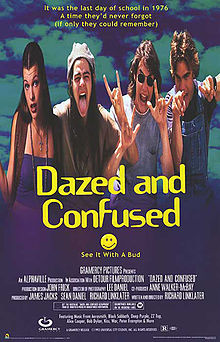
Scenes That I Love: Nicky Katt Meets Adam Goldberg in Dazed and Confused


Rest in peace, the great character actor Nicky Katt.  The details are still sketchy but it’s being reported that he passed away at the age of 54.

Katt was a child actor who transitioned into adult roles.  He appeared in a lot of movies but I’ll always remember him as Clint, the absolutely terrifying bully in 1993’s Dazed and Confused.  Here he is, scaring the heck out of poor Adam Goldberg.

(For a while, there were plans for a Dazed and Confused sequel in which Clint reformed and became a respected businessman while Adam Goldberg’s Mike went insane as he continued to obsess on that fight back in 1976.)

Scenes That I Love: Nicky Katt vs Adam Goldberg in Dazed and Confused


Today, the Shattered Lens wishes a happy birthday to one of my favorite character actors, Nicky Katt!

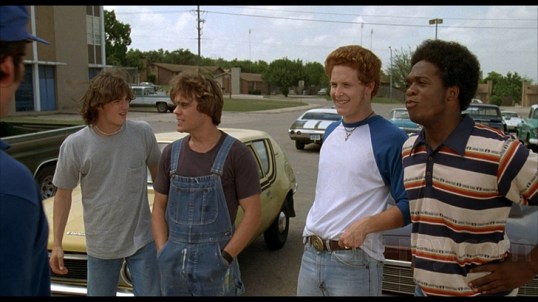
In 1993’s Dazed and Confused, Katt had a small but pivotal role as Clint.  Clint is the guy who loves his car, drinking beer, smoking weed, and beating up people.  Mike (played by Adam Goldberg) runs afoul of Nick at the end of the year party and later decides that he has no choice but to fight back.  Needless to say, Clint is the better fighter of the two but at least Mike got one good punch in!

(For a while, there was talk of a Dazed and Confused sequel, in which Clint would have turned his life around and become both a born again Christian, and a respected member of the community while Mike would still be obsessing about their brief fight in 1976,)

https://www.youtube.com/watch?v=91Udss76k2o&pp=ygUebmlja3kga2F0dCBkYXplZCBhbmQgY29uZnVzZWQg

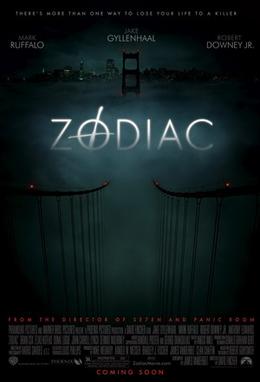
October True Crime: Zodiac (dir by David Fincher)


Who was the Zodiac Killer?

That is a question that has haunted journalists, cops, and true crime fans since the late 60s.  It is known that the Zodiac Killer murdered at least five people in Northern California in 1968 and 1969.  He targeted young couples, though he is also thought to have murdered on taxi driver as well.  What set Zodiac apart from other killers is that he was a prolific letter writer, who sent cards and ciphers to the police and the journalists who were reporting on his crimes.  In one of his ciphers, Zodiac claimed that he had killed 37 people.  Cartoonist Robert Graysmith later wrote two books about his personal obsession with the case.  He estimated that the Zodiac may have been responsible for hundred of murders, up through the 80s.  Of course, reading Graysmith’s first Zodiac book, it’s also easy to suspect that Graysmith reached a point where he saw the Zodiac’s hand in every unsolved murder in the San Francisco area.  Of all the unidentified serial killers in American history, Zodiac is one that most haunts us.  Zodiac was a serial killer who operated in an era when such things were still considered to be uncommon.  Much as Jack the Ripper did during the Victorian Age, Zodiac announced the arrival of a new age of evil.

Zodiac wrote about being a film fan and he was probably happy about the fact that he inspired quite a few films.  1971’s The Zodiac Killer came out while Zodiac was still sending letters to the police and cops actually staked out the theaters showing the film just to see if he  would show up.  Dirty Harry‘s Scorpio Killer was also based on Zodiac, right down to the taunting letters that he sent the mayor and again, one has to wonder if Zodiac ever showed up to watch Clint Eastwood take him down.

And, if Zodiac survived into the 21st Century, one has to wonder if he showed up in the theaters for 2007’s Zodiac.

One of the best true crime films ever made, Zodiac not only recreates the crimes of the Zodiac but it also examines the mental price of obsessing over the one unknown force of evil.  Mark Ruffalo plays Dave Toschi, the celebrity cop who nearly sacrificed his professional reputation in his search for the identity of the killer.  Jake Gyllenhaal plays cartoonist Robert Graysmith, who spends over a decade searching for the Zodiac’s identity and who loses his wife (Chloe Sevigny) in the process.  And Robert Downey, Jr. plays Paul Avery, the crime reporter to whom the Zodiac wrote and who sunk into paranoia and addiction as a result.  This is a film that is less about the Zodiac’s crime and more about how this unknown killer seemed to unleash a darkness that would come to envelope first a city and eventually an entire nation.

As one might expect from a film directed by David Fincher, Zodiac plays out like a filmed nightmare with the starkly portrayed murders being all the more disturbing because they often take place outside, where people would think they would be safe.  (The second murder is especially terrifying, as it plays out without even the sound of background music to allow us the escape of remembering that it’s only a movie.)  Fincher heightens our paranoia but having a different actor play the killer in each scene, reminding us that the Zodiac could literally be anyone.  Indeed, one of the scarier things about Zodiac is that, in the course of his investigation, Graysmith meets so many different people who seem like they could be the killer.  Even if they aren’t the Zodiac, the viewer is left with the feeling that the world is full of people who are capable of committing the same crimes.  The film becomes a journey into the heart of darkness, with the Zodiac becoming both a malevolent force and potentially your next door neighbor.  And with the film’s detailed recreation of the 60s and the 70s, the film becomes a portrait of a country on the verge of changing forever with the Zodaic and his crimes representing all the fear waiting in the future.

Again, as one might expect from a Fincher film, it’s a well-acted film, especially by Robert Downey, Jr.  Zodiac came out a year before Iron Man, when Downey was still better known for his personal troubles than for his talent.  Downey perfect captures his character’s descent into self-destruction, as he goes from being cocky and self-assured to being so paranoid that he’s carrying a gun.  (Paul Avery’s actual colleagues have disputed the film’s portrayal of Avery being mentally destroyed by the Zodiac.)  Ruffalo and Gyllenhaal also do a good job of portraying Toschi and Graysmith’s growing obsession with the case while Charles Fleischer and John Carroll Lynch both make strong (and creepy) impressions as two men who might (or might not) be the killer.

Though the film was not a success at the box office and it was totally ignored by the Academy, Zodiac has built up a strong reputation in the years since its released.  It’s inspired a whole new generation of web sleuths to search for the killer’s identity.  Personally, my favored suspect is Robert Ivan Nichols, an enigmatic engineer who abandoned his former life and changed his name to Joseph Newton Chandler III in the 70s and who committed suicide in 2002.  I think much like Jack the Ripper, the Zodiac’s identity will never be definitely known.  There have been many compelling suspects but most of the evidence seems to be circumstantial.  (That’s certainly the case when it comes to Nichols.)  The Zodiac was thought to be in his 30s or even his early 40s in 1969 so it’s doubtful that he’s still alive today.  In all probability, his identity and his motive will forever remain an unsolvable mystery.

Horror Film Review: From Within (dir by Phedon Papamichael Jr.)


Strange things are happening in Grovetown, Maryland.

Sitting out on the dock, Sean (Shiloh Fernandez) reads from a book while his girlfriend, Natalie (Rumer Willis), waits.  After he finishes reading, he promptly shoots himself in the head.

Natalie staggers back to her father’s dress shop and says that someone is following her.  She then ducks into a backroom and stabs herself in the neck with a pair of scissors.

The next day, Natalie father (Jared Harris) hangs himself in the back of his shop.

And the deaths continue, one after another.  One girl crashes her car while screaming that someone is following her.  Another cuts her wrists on a broken window.  A recovering alcoholic drinks drain cleaner….

Normally, all of this death would be a cause for panic (or, at the very least, a sudden surge of people moving out of town) but the citizens of Grovetown are all confident in their ability to survive.  That’s because almost all of them are members of the same megachurch, led by the charismatic Pastor Joe (Steven Culp).  They believe that the deaths are the results of witch’s curse.  Perhaps all they have to do is kill the witch’s descendants….

Now, the witch’s son, Aidan (Thomas Dekker), is willing to admit that yes, it’s possible that his mother put a curse the town.  And it’s also possible that it was the suicide of his brother Sean that unlocked the curse and activated all of the deaths.  But Aidan still swears that it’s the townspeople themselves who are choosing to commit suicide.  If anything, the curse is just pushing them toward the inevitable….

Of course, complicating things is the fact that Aidan has kind of fallen in love with Lindsay (Elizabeth Rice) and Lindsay is dating Dylan (Kelly Blatz), the fanatical son of Pastor Joe.  Aidan and Lindsay think that they may have found a way to stop the curse but Dylan is more interested in just killing Aidan.  Working with Dylan is a white trash pyromaniac named Roy (Adam Goldberg) and you really haven’t lived until you’ve seen Adam Goldberg play a white trash pyromaniac.

Anyway, From Within is a film about which I have mixed feelings.  On the one hand, the film is full of creepy moments.  On the other hand, it keeps getting bogged down in its attempt to say something meaningful about religious fanaticism.  I mean, we know that Pastor Joe, Dylan, and Roy are all bad news as soon as they start talking about how religious they are because this is a movie and religious people are always evil hypocrites in movies.  At times, this movie comes across as if it thinks it’s the first movie to ever suggest that maybe not all religious people are as perfect as they claim.

Far more effective are the scenes involving the curse.  Whenever someone falls victim to the curse, they find themselves being chased by their own doppelgänger, which leads to some incredibly creepy moments.  (When the doppelgänger appeared in a mirror and compelled one woman to drink bleach, it totally freaked me out.)  These scenes reminded me a bit of It Follows, though it’s important to note that From Within was released in 2008, seven years before It Follows.

From Within is an uneven film, a bit frustrating in its pretensions but undeniably effective in its scares.

Scenes I Love: Saving Private Ryan


SavingPrivateRyan

Today marks the 71st Anniversary of the Normandy Landings on D-Day. As the day winds down I thought it best to share one of my favorite scenes from a film that tried to capture the chaos and death of the fateful day on June 6, 1944. The film in question is Steven Spielberg’s Saving Private Ryan. This is the film which won him his second Best Director Oscar (I still think the film should’ve won Best Picture over Shakespeare In Love) and the film which helped redefine not just how war films were shot from 1998 on, but also de-glorify World War II on film.

This scene showed the opening moments of the D-Day Landings on Omaha Beach in Normandy, France. It’s a scene that’s over 22-minutes in length and shows the utter chaos and destruction heaped on American troops as they attempted to land on the beach to take their objectives. While there have been war film before Saving Private Ryan that depicted war as the hell it truly is they were mostly about the Vietnam War. Rarely did we ever get a World War II-based war film which showed war in realistic fashion. Spielberg broke that taboo by making the battle scenes in his film — especially this extended opening sequence — done as realistic as possible without actually having people killed for real on-screen.

When this film first came out in the summer of 1998 no one knew what to make of it. This opening sequence became the talk of everyone who went to see the film. To say that they were shocked by what they saw was an understatement. Even now with over a decade since the film was released and people having seen this scene over and over again it still retain it’s impact. It’s not even the grand scale of the production required to film this action sequence which made this scene so memorable. It were the little things. Like a mortally wounded American GI crying out to his mother while trying to keep his blown out insides from spilling out. Then there’s the scene of another young soldier praying furiously with his rosary beads as men around him die by the score.

This scene also showed what most World War II films of the past failed to do. It showed both sides behaving barbarically. In the past, only the Germans were shown in a bad light. In Saving Private Ryan, we see that American soldiers were also prone at shooting surrendering troops and/or not mercy-killing enemy soldiers being burned alive (actions that have been well-documented by historians). This scene also showed just how courageous the young men of this generation which Tom Brokaw has called “The Greatest Generation”. Men who went off to war not for material gains, but for an idea that they had to stop evil (Nazi and Hitler) from taking all of Europe and, maybe, the world itself.

There’s a reason why Saving Private Ryan is in my list for greatest films of all-time and why this scene remains one of my all-time favorites.

Back to School #49: Dazed and Confused (dir by Richard Linklater)


Oh my God, I love this freaking movie.

First released in 1993, Dazed and Confused is a classic Texas film.  Taking place in 1976 and following a large and varied group of characters over the course of the last day of school, Dazed and Confused is like American Graffiti with a lot more weed.  In many ways, it’s a plotless film, though things do happen.  The students of Lee High School survive one final day of school before the start of summer.  (Interestingly enough, most of the characters here are incoming seniors and freshman, as opposed to the confused graduates who usually show up in films like this.  This may lower the stakes — none of the students are worrying about whether or not to go to college or anything like that — but it also gives the film a fun and laid back vibe.)  The incoming freshman are all hazed by the incoming seniors.  For the girls, this means being covered in ketchup and mustard and being forced to ask the seniors to marry them.  For the boys, the hazing is a lot more violent and disturbing as they are chased through the streets by paddle-wielding jocks.  A party is planned and then abruptly canceled when the kegs of beer are delivered before the parents leave town.  Another party is held out in the woods.  A high school quarterback tries to decide whether or not to sign an anti-drug pledge.

1993-DAZED--CONFUSED-007

No, not much happens but then again, plot is overrated.  Dazed and Confused is not about plot.  It’s about capturing a specific time and place and showing how different individuals define themselves within their environment.  It’s one of the best high school films ever made, perhaps the best.

Why do I so love Dazed and Confused?  Let me count the ways.

First off, it’s a true Texas film.  This isn’t just because it was directed by Texas’s greatest filmmaker, Richard Linklater.  It was also filmed in Texas, it’s full of Texas actors, and, as a native Texan, I can tell you that it’s one of the few films that gets my homestate right.  Even though the film takes place long before I was even born, there were still so many details that I recognized as being unique to Texas today.  I guess the more things change, the more they remain the same.

dc-3

Perhaps the most Texas scene in the entire film was when quarterback Randy Floyd (Jason London) was talking to the old couple at the minor league baseball game.  Both the old man’s obsessive interest in the high school football team (“We’re countin’ on you boys next year…”) and Randy’s patiently polite answers, were, to me, the epitome of Texas.  And, of course, we can’t forget the store clerk advising the pregnant woman to eat a lot of “green things” while selling her a pack of cigarettes and the guy who reacts to the destruction of his mailbox by running around with a gun.  I suspect I might live a few blocks away from both of those guys.

But, beyond that, just the entire film’s laid back atmosphere epitomized everything that I love about my state.

Secondly, Dazed and Confused is an amateur historian’s dream!  Richard Linklater went to high school in the 70s and he recreates the decade with a lot of obvious care and love.  (It’s also somewhat obvious that both the characters of Randy and incoming freshman Mitch (Wiley Wiggins) are meant to be autobiographical.)  Now, me, I’ve always been obsessive about history and I’ve always somewhat regretted that I was born long after the 70s ended.  Dazed and Confused is probably about as close as someone like me will ever get to having a time machine.

dazed-and-confused

I’m also something a political history junkie so how excited was I to see that, during one scene, all of the candidates for the 1976 Democratic presidential nomination were listed on a bulletin board.  How many other movies have featured a reference to the Fred Harris presidential campaign?  Admittedly, I know nothing about that campaign.  I just think it’s neat that somebody with as common a name as Fred Harris once ran for President.

Finally, if you look really carefully, you’ll notice that Lee High School is located right next to a movie theater that, according to its marquee, is showing Family Plot, Alfred Hitchcock’s final film.  Just imagine the fun that I could have had going to Lee High.  I could have skipped school and gone to a movie!

Third, this film has a great soundtrack!  The low rider gets a little higher … hey, I think there’s a double meaning there…

4594_1

But, really, the main reason I love this film is because I love great ensemble work and Dazed and Confused has a wonderful cast.  Some members of the cast went on to become famous and some did not, but all of them give great performances.  In fact, the entire cast is so great that it’s difficult to know who to single out so I’m just going to name a few of my favorites.

First off, there’s the jocks.  Some of them, like Jason London’s Randy “Pink” Floyd are surprisingly sensitive.  Some of them, like Don Dawson (Sasha Jenson), remind me of the type of guys that I, despite my better judgment, would have totally been crushing on back in high school.  And then the others are just scary, running around with their cars full of beer and obsessively paddling freshman.  Benny (Cole Hauser), for instance, really does seem like he has some issues.  (Perhaps it’s because he lives in Texas but still has such a strong Boston accent…)

ben-affleck-1-435

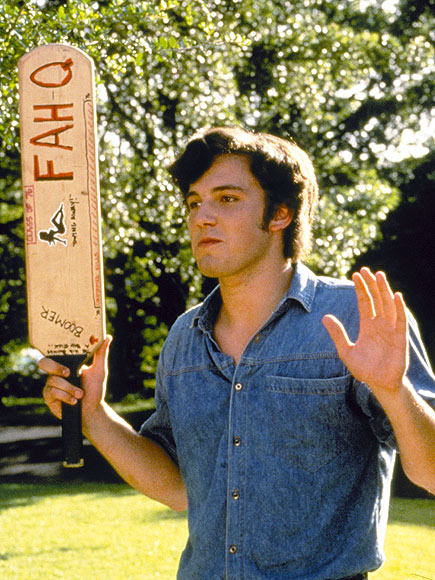
However, the scariest of the jocks is, without a doubt, Fred O’Bannion (Ben Affleck). A complete and total moron who has actually managed to fail his senior year,  (“He’s a joke,” says Randy, “but he’s not a bad guy to have blocking for you…”)  O’Bannion is such a total idiot that, not only is it fun to see him eventually get humiliated, but it’s even more fun to watch him and think, “That’s Ben Affleck!”  And, it must be said, Affleck is totally convincing playing a complete and total dumbass.  That’s not meant to be an insult, by the way.  Future multiple-Oscar winner  Affleck does a really good job.

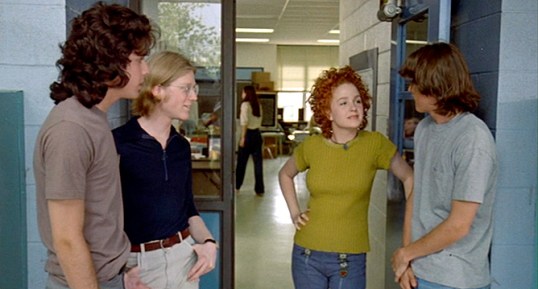
And then there’s the three self-styled intellectuals, Tony (Anthony Rapp), Mike (Adam Goldberg), and red-headed Cynthia (Marissa Ribisi), who spend the whole day driving around and discussing what it all means.  These are actually three of my favorite characters in the entire film, just because I’ve known (and, I must admit, loved) the type.  Plus, Cynthia has red hair and we redheads have to stay united!

dazed3

There’s the two incoming freshman who get to spend a night hanging out with the older kids — Mitch (Wiley Wiggins) and Sabrina (Christin Hinojosa).  Mitch is adorable while Sabrina gets to ask Tony to marry her.  Of course, Sabrina is covered in ketchup, mustard, and flour at the time.  (“She probably looks really good once you get all the shit off her,” Mike offers.)

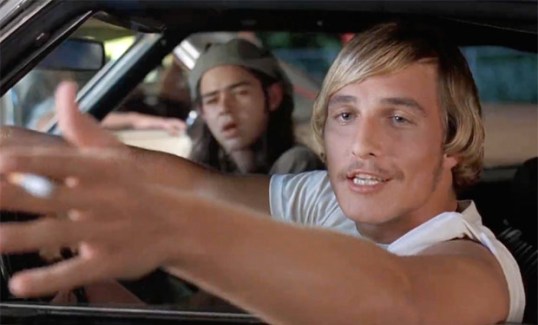
And, of course, you can’t forget Wooderson (Matthew McConaughey).  In many ways, Wooderson is a truly creepy character.  He’s the older guy who still hangs out with the high school kids.  When he asks Mitch what the incoming freshman girls look like, you get the disturbing feeling that he’s not joking.  (“I get older but they stay the same age,” Wooderson says about his underage girlfriends, “yes, they do.”)  And yet McConaughey gives such a charismatic performance that Wooderson becomes the heart and soul of the entire film.  In the end, you’re happy that Randy has a friend like Wooderson.

042712-dazed-and-confused

And there’s so many other characters that I love.  There’s the hilarious stoner Slater (Rory Cochrane).  There’s Mitch’s older sister, Jodi (Michelle Burke), who is the type of cool older sister that I would have liked to have been if I actually had a brother and wasn’t the youngest of four.  There’s Randy’s girlfriend, Simone (Joey Lauren Adams) and Don’s occasional girlfriend, Shavonne (Deena Martin) who, at one point, refers to Don as being “Mr. Premature Ejaculation.”  Even the characters that you’re supposed to hate are so well-played and so well-written that it’s a pleasure to see them.  Parker Posey is hilarious as head mean girl Darla.  In the role of car-obsessed Clint, Nicky Katt is dangerously hot — even if he does eventually end up kicking Mike’s ass.  (“You wouldn’t say I got my ass kicked, would you?” Mike says.  Sorry, sweetie, you did. But everyone watching the movie totally loved you!)

(And let’s not forget that future Oscar winner Renee Zellweger shows up for a split-second, walking past Wooderson during his “that’s why I love high school girls” monologue.)

Dazed and Confused is a great film.  If you haven’t seen it, see it.  And if you have seen it, see it again.

220px-DazedConfused

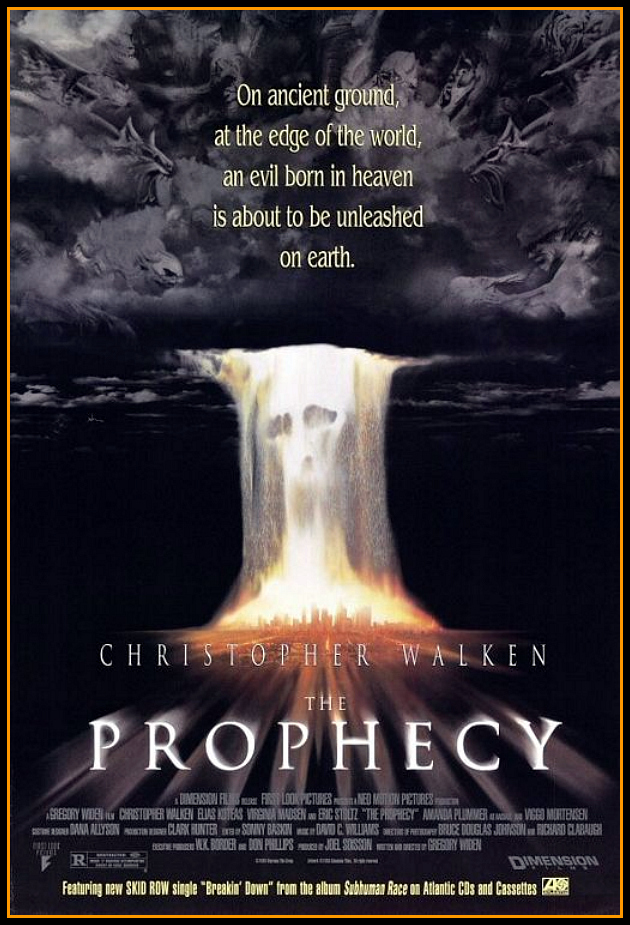
Film Review: The Prophecy (dir. by Gregory Widen)


I first found out about this little cult film starring the very awesome Christopher Walken around 1993 or so when I was at the local Waldenbooks (yes there used to be bookstores not named Barnes & Noble or Borders back in the day) looking at the latest issue of Fangoria. Inside the magazine they were doing a brief feature on an upcoming horror film tentatively called God’s Army. All I saw was that it was to star Christopher Walken and it had gore and angels in it. That alone peaked my interest and I was looking forward to seeing it in the theaters. Almost two years passed and nothing about it was ever heard again until I visited the video rental place near my house and saw a VHS tape (yeah, those big videocassette thingies) with the title of The Prophecy and starring Christopher Walken.

This was the film I was so hyped to seeing in the theaters. The title had changed from it’s earlier (and much cooler) one of God’s Army. It would seem that it’s film distributor had little to no faith in the box-office potential of the film and just delayed it’s release to the point that when it did come out no one knew about it barely anyone saw it. It was a real damn shame since filmmaker Gregory Widen made such a good film that was able to mash-up horror, angels and a detective story all in one without creating a mess of things.

The Prophecy was about the war in heaven we were never taught about in Sunday school. We all know about the war in heaven where Lucifer and the rebel angels who followed him tried to overthrow God. That didn’t go over so well for Lucifer and he and his band of fallen angels were cast out into Hell by God and his right-hand man the Archangel Michael. This film talks about the second war in heaven soon thereafter which no one outside those who wrote little-known apocryphal texts about it (and being apocryphal they never were included in the Bible). This war now had a new group of angels led by the Archangel Gabriel rebelling against God for choosing humans (talking monkeys as these new rebels called them) above all living creatures including the angels themselves for God’s love. This war was now in a state of stalemate after countless millenia, but a prophecy about a soul so dark and evil was to be the tipping point for either side. This particular soul was to be found on Earth and whoever acquires it would break the stalemate and finally bring this second war to an end.

With this in mind we have Walken as the Archangel Gabriel coming down to Earth to look for this soul so he can finally win the war for his side (which also means the end of mankind). It’s the angel Simon (played by Eric Stoltz) who comes down to stop him from getting this soul or, at the very least, hide it from Gabriel. With these two factions of angels vying to acquire this soul we have a Detective Thomas Daggett smack in the middle of the case investigating all the weird happenings and deaths surrounding the battle between these two factions. The dead bodies of angels begin to appear on morgue slabs looking like eyeless, hermaphroditic specimens and angelic script found in crime scenes brings Daggett back to his time studying to be a priest before images of angels warring amongst themselves breaks him down and he quits the seminary to become a cop instead.

It would come down to these three factions racing against time to acquire this dark soul.

The film is not as gory as it’s feature in Fangoria made it out to be, but it is quite violent and bloody that I understand why it got the horror label attached to it. It’s more a dark fantasy thriller more than horror. It’s rare in today’s film that we see angels portrayed as the bloodthirsty beings that the really are. The film even points out this oft-ignored detail of God’s messengers. Angels are always the ones God sends to punish or send a very serious message to his chosen beings that is Man. The Prophecy shows this aspect of angels in full light and how their attitudes about humanity might lead some of them to hate God for raising Man above even them.

Christopher Walker does a great job conveying Gabriel’s hate and contempt for humans. His Gabriel is like one of those pundits always on tv (both liberal and consevative) who are so into their sides’ message that they never see the other side as anything but the enemy. One could almost say that Walken’s Gabriel is like then apocalypse-hungry version of Glenn Beck and Keith Olbermann in one body. This is not to say that Walken goes over-the-top with his performance. In fact, he’s quite subdued in how he uses those many tics and voice mannerisms a whole cottage industry has grown around in.

Walken’s portrayal of Gabriel infuses what could’ve become a one-note villain with lots of layers and complexities that the rest of the cast were able to play off from. His character would be terrifying one moment then smoothly switch over to being funny and charming then back to terror. It’s due to his great performance that the other cast members like Stoltz as the weary, loyal angel Simon and Koteas as the fallen religious cop Daggett were able to bring their own performance to another level. This is quite a feat since the dialogue in the film was a mixed bag of horror cliches and interesting Biblical-speak about secret wars, apocryphal books and prophecies. The film even has a nice appearance of the first fallen angel himself and none other than Viggo Mortensen plays Lucifer.

The Prophecy does have a feeling that it was always one misstep away from becoming an awful film. This had happened with 2010’s Legion and did that film about angels and the apocalypse turn out to be a huge steaming pile of shit-turd. But while Dimension Film saw the film fall over on the side of bad for myself and those who have come to admire and love this cult classic the film stayed balance between good and bad. Widen’s film never went over to the side of becoming a truly great film, but it also never fell on the side that Legion ended up on. What Prophecy ended up becoming was a film that was almost grindhouse in nature, but even then it still looked too good with too many good performances to be given that label. The fact that it contains one of Christopher Walken’s best performances speaks well of a film that many critics during it’s early days had dismissed as just another bad horror film.

In the end, this film became just one of the many little-gems that got lost in film studio money politics. I definitely would recommend this cult film to people who haven’t seen it, but I would tell them to stop at just this film and not even go near the four sequels which came after it.