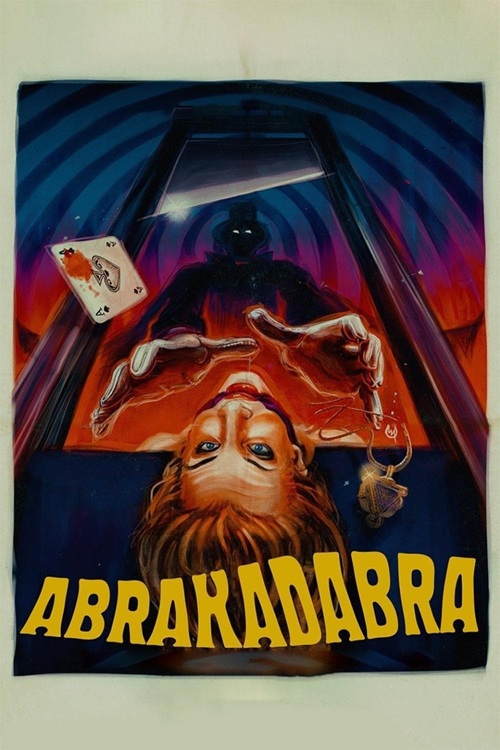
First released in 2018, the Argentine film Abrakadabra is a sweet, loving, short, and wonderfully bloody tribute to the giallo genre.
When he was a little boy, Lorenzo Manzini (German Baudino) watched as his magician father was shot while demonstrating a magic trick. Despite having seen magic go terribly wrong, Lorenzo grows up to be a traveling magician. Accompanied by his mysterious companion, Antonella (Maria Eugenia Rigon), Lorenzo travels from one Italian town to another. His stage is notably macabre, featuring a guillotine amongst other things. It’s obvious that Lorenzo has grown up to be obsessed with death. He also appears to be an alcoholic who doesn’t have much impulse control. His demons have made him self-destructive, but have they turned him into a murderer? After a woman is found dead with her head in one of Lorenzo’s magic boxes, that’s what the police would like to know.
The majority of the film is shown from Lorenzo’s point of view and, visually, the film does a great job of putting us in the middle of Lorenzo’s paranoid mind. Is the bald man with the cigarette who keeps showing up a true threat, or is Lorenzo just letting his own fears and traumas get the better of him? When Antonella appears to be watching him, is her stare really that intense, or is it just Lorenzo’s imagination? Lorenzo makes his living fooling other people and tricking them into seeing things that aren’t really there, but what if he’s the one being tricked? What if he’s the victim of the illusion?
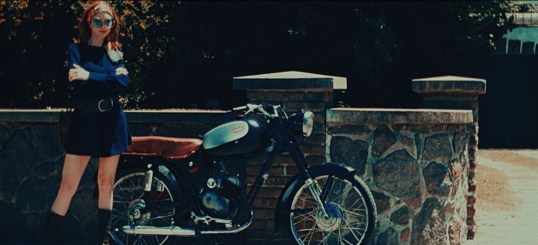
Clocking in at a brisk and enjoyably sordid 65 minutes, Abrakadabra is ultimately more of an experiment than a traditional film. Luciano Onetti and Nicolas Onetti set out to pay tribute to the great giallo films of the past, and they did exactly that. It’s not just the film’s twisty story that captures the feel of a great giallo. It’s also the film’s visual style, from the unsettling close-ups to the use of color to the imagery that is frequently sordid in the way that only someone from a Catholic background can fully appreciate. It’s in the fact that, like the best giallo films, the majority of the dialogue was dubbed, and occasionally the words we hear do not quite fit with the movement of the lips that are saying them. Yes, the film carries hints of Mario Bava, Dario Argento, and Lucio Fulci. But the film also pays tribute to Sergio Martino, Luciano Ercoli, Umberto Lenzi, Luigi Cozzi, and all of the other directors who brought the genre to life. This is a film made by people who clearly appreciate all giallo, even the films that haven’t been “rediscovered” by critics looking to prove their cult bona fides.
Abrakadabra ends with a clever twist, one that is just flamboyant enough to feel true to the film’s giallo heritage. German Baudino does a good job as the paranoid magician, and my fellow redhead Maria Eugenia Rigon is perfectly cast as the assistant. This Argentine film is a perfect homage to a quintessential Italian genre.