Retro Television Review: The American Short Story #12: The Man That Corrupted Hadleyburg


Welcome to Retro Television Reviews, a feature where we review some of our favorite and least favorite shows of the past!  On Saturdays, Lisa will be reviewing The American Short Story, which ran semi-regularly on PBS in 1974 to 1981.  The entire show can be purchased on Prime and found on YouTube and Tubi.

This week, we have an adaptation of a Mark Twain novella.

Episode #12: The Man That Corrupted Hadleyburg

(Dir by Ralph Rosenblum, originally aired in 1980)

In this loose adaptation of one of Mark Twain’s darkest novellas, Robert Preston stars as The Stranger.  When we first meet The Stranger, he’s looking down on the small town of Hadleyburg and it’s hard not to notice that he looks a lot like Mark Twain.  The Stranger explains that the people of Hadleyburg consider themselves to be honest and free of sin.  The town’s motto is “Lead us not into temptation!”  The Stranger has a plan to test them.

Riding into town, the Stranger stops at the home of Edward and Mary Richards (Tom Aldredge and Frances Sternhagen).  The Stranger gives them a sack that he claims is filled with $40,000 worth of gold bars.  The Stranger says that he was once a poor man and someone in Hadleyburg gave him $20 and some meaningful advice.  Now that’s he rich, he wants to pay back the person who helped him.  The Stranger explains that there is an envelope inside the sack.  In the envelope, the Stranger has written out the advice he was given by his benefactor.  The Stranger’s instruction is for the man who helped him to write out that advice and give it to Rev. Burgess (Fred Gwynne), who recently lost his church when the citizens of Hadleyburg tired of him calling them out for their hypocrisies.  The honest man who remembers the advice he gave the Stranger will be very rich as a result.  The Stranger then leaves.

News of the sack and the gold travels throughout town and eventually the rest of the nation.  The most powerful families in Hadleyburg, including the Richards family, receive a letter telling them that the advice given to the stranger was “You are far from being a bad man, go and reform.”  Burgess is soon swamped by notes, all featuring that same phrase.  At the town meeting, Burgess reads each note, revealing that everyone wrote down the same phrase and that none of the town leaders is as honest as they claim.

The Man That Corrupted Hadleyburg is one of Twain’s most stinging satires, featuring an ending that is surprisingly dark.  This adaptation takes a much lighter approach to the material, altering Twain’s ending to something much more gentle and friendly.  Unfortunately, changing the ending causes the adaptation to lack the bite of the original short story.  Twain’s portrayal of greed and guilt instead becomes a mild story about a quirky town that learns a lesson.  It’s well-acted, especially by Fred Gwynne, but this adaptation doesn’t honor Twain’s intentions.  It just doesn’t add up to much.

Freddy’s Nightmares Late Night Retro Television Review: Freddy’s Nightmares 1.5 “Judy Miller, Come on Down”


GUEST REVIEWER ALERT!!! Welcome to Late Night Retro Television Reviews, a feature where we review some of our favorite and least favorite shows of the past! On Fridays, I will be reviewing Freddy’s Nightmares, a horror anthology show which ran in syndication from 1988 to 1990. The entire series can be found on Plex! 

Judy (Siobhan McCafferty) is living a very terrible life. Tom (John DeMita), Judy’s husband, is a spoiled manchild hiding out in school to avoid working. Tom’s parents live with Judy and Tom and they treat Judy like an indentured servant. Judy’s only escape for a better life is to buy lottery tickets and apply to appear on gameshows. Like all Freddy’s I’ve seen, the initial story was not bad and should have remained 22 minutes. However, I will say that in NO WAY was this a horror script at all. It was meant to be a mediocre Twilight Zone script or that should’ve been where it was pitched. In fact, the only real blood was at the very end of the episode where Freddy squeezed a fake heart with blood in it. Really, that was it!

Back to the show, Judy gets called to be contestant on a gameshow, but it gets…weird. Not scary weird, but weird. The game show became a “Pit and the Pendulum” knock off where the host asked Judy personal questions and every answer led to her family members being NOT KILLED, but scratched. They could’ve had the deaths off screen. The show goes on and she wins the gameshow, but instead of the show allowing her to evolve and leave her abusive husband and in-laws, the story continues into ….. time travel. For real, the story took a turn into time travel, which is impossible. Look, I’m an applied physicist- let time travel go because It does not work. Let it go! You can’t save Kennedy! LET IT GO!

Once again, the story ached to end at the 22 minute mark, but had to keep going and where did it go? Time travel. Judy gets the money, stays married, and spends a lot. Then, her older -self time travels by “I went a long way”… so like Trader Joe’s and back because that is difficult with the small-ass parking spaces! Anyway, the older Judy warns her that her husband will cheat on her and she’ll stab him to death. Her older self advises her to give the money away and she’ll be happy. THIS IS STUPID! She was poor at the beginning of the story and miserable! Hey writers, weren’t you there?!!! Simple solution: just get a divorce – California is a no-fault state- Move on!

The problem with this show is that instead of doing re-writes, they took 22 minute stories and doubled them in the stupidest ways possible.

Retro Television Review: St. Elsewhere 2.12 “Hearing”


Welcome to Retro Television Reviews, a feature where we review some of our favorite and least favorite shows of the past! On Fridays, I will be reviewing St. Elsewhere, a medical show which ran on NBC from 1982 to 1988.  The show can be found on Hulu and, for purchase, on Prime!

This week, Peter White faces the judgment of the medical board.

Episode 2.12 “Hearing”

(Dir by Charles Braverman, originally aired on February 1st, 1984)

At his disciplinary hearing for giving a controlled substance to an undercover officer, Dr. White lies to protect Shirley Daniels.  Even though Shirley tossed him the keys to the drugs on that night, White says that he took the keys without Shirley noticing.  It’s a rare case of Dr. White actually trying to help someone else.  It gets Shirley off the hook but it leads to Dr. White receiving a two-year suspension from working in an ER or prescribing medicine.  Westphall and Auschlander both agree that Dr. White’s career is probably over but Westphall, who has been White’s biggest supporter since he returned from rehab, says that they’ll find a place for him in the hospital.

The new X-ray tech, Lee Tovan (Robert Daniels), cannot hear.  His supervisor (Raymond Singer) claims that Lee is too difficult to work with.  Westphall pledges to support Lee, no matter how much his supervisor complains.

Victor meets Roberta’s wealthy parents and, to everyone’s shock (especially his), he manages to charm them.  Victor also asks Dr. Craig if he can use his house for the wedding.  Dr. Craig misunderstands and thinks that Victor is asking him to be his best man.  Victor explains that he’s already asked his friend, “Dogger,” to be best man.  Craig rolls his eyes but agrees to let Victor use the house.

Finally, Dr. Auschlander asks Fiscus to help him get some marijuana to help with his chemo side effects.  Fiscus tries and fails to call his old college weed guy and then asks Luther if he knows anyone who deals drugs.  Luther rightly points out that Fiscus is stereotyping him but he still manages to get Auschlander a baggie of joints.  Auschlander gets high.  For a first time smoker, he gets REALLY high!  He also ultimately decides that marijuana is not for him.

This episode was a bit uneven.  I liked the irony of White saving Shirley, just to potentially lose his own career as a result.  (Saying that he stole the keys probably didn’t help his case.)  Victor’s wedding storyline has been kind of dragged out more than it needs to be but it’s still entertaining to watch Dr. Craig get frustrated with him.  Norman Lloyd was adorable playing stoned.  But the storyline about the deaf x-ray tech was sabotaged by some very bad acting and some very heavy-handed writing.  That was a shame.

Next week, Victor Ehrlich gets married!


Late Night Retro Television Review: Highway to Heaven 4.10 “A Dream of Wild Horses”


Welcome to Late Night Retro Television Reviews, a feature where we review some of our favorite and least favorite shows of the past!  On Thursdays, we will be reviewing Highway to Heaven, which aired on NBC from 1984 to 1989.  The entire show is currently streaming on Amazon Prime, Tubi and other services!

Episode 4.10 “A Dream of Wild Horses”

(Dir. by Michael Landon, originally aired on December 2nd, 1987)

In this episode, traveling angel Jonathan Smith (Michael Landon), and his companion Mark Gordon (Victor French) arrive at a struggling ranch where the widow Billie Harwood (Gail Strickland) is trying to keep her late husband’s legacy alive while caring for her young son Richie (Jason Horst) and aging father Jet Sanders (Richard Farnsworth). It seems that Jet, the patriarch of the family, sort of lost his will to live when he lost his wife and then his son in law, a man he truly thought of as a son. As Jonathan and Mark arrive on the scene, the family members are all at a breaking point. Jet wishes he would just die and quit being a burden. Billie is completely overwhelmed with the ranch, and you get the feeling she’s never truly mourned the loss of her husband. And Richie, who needs someone to love him and pay attention to him, instead is mostly ignored by his family. Jonathan, Mark, a pack of wild horses, and some divine compassion turn out to be just what the family needs to find the inspiration to start putting the pieces of their lives back together. 

Directed by Michael Landon, “A Dream of Wild Horses” is everything I would expect from this series. Considering this episode was in season 4, it’s possible the formula was starting to wear thin with viewers back in 1987, but I thoroughly enjoyed it. For a man like me who loves a good western, I especially enjoyed the ranch setting, the wild horses, and the presence of veteran, Oscar nominated actor Richard Farnsworth as Grandpa Jet Sanders. He’s believable as the man who’s lost his purpose in life, but he’s even better when he turns things around at the end. One of the things I like about this series is the way Jonathan always knows exactly what buttons to push to get the characters going in the right direction. From bluntly telling Grandpa that he needs to quit feeling sorry for himself, to offering the widow a shoulder to cry on, and helping both of them see how much Richie needs their love and guidance, Jonathan’s genuine compassion is something this world really does need. Skeptical viewers may even roll their eyes, but I choose to accept the episode’s inspiring messages at face value. There have been times in my own life when I just needed someone else to care, and this series leans into those types of interactions. This family was broken, and Jonathan and Mark helped turn things around for them by simply caring. Things may be more complex and nuanced in the real world, but the simple act of caring will always be powerful. 

Retro Television Review: Coming to America 1.1 “Pilot”


Welcome to Retro Television Reviews, a feature where we review some of our favorite and least favorite shows of the past!  On Thursdays, I will be reviewing Coming to America, which aired on CBS in 1989.  Almost the entire show is currently streaming on YouTube!

Fresh off the success of the film Coming To America, Eddie Murphy served as executive producer of a series based on the film.  How did that work out?  Read on to find out!

Episode 1.1 “Pilot”

(Dir by Tony Singletary, originally aired on July 4th, 1989)

The pilot for Coming to America begins with the story already in progress.  We get an overhead shot of New York while Prince Tariq (Tommy Davidson, speaking with an unconvincing accent) explains that he and his minder, Omar (Paul Bates), have been sent to America so that Tariq can attend college.  (Tariq is established as being the younger brother of the character that Eddie Murphy played in the original film.)  Tariq and Omar have rented a room from diner owner Carl Mackey (John Hancock).  Carl is a curmudgeon.  Tariq expects everyone to treat him like royalty.  Carl grumbles about not getting to eat unhealthy food before a doctor’s visit.  Tariq does an extended Stevie Wonder impersonation.

Uh-oh, Tariq’s out of money!  In just nine months, he spends all of his money on movies and clothes.  What can Tariq do?  Maybe he and Omar can work in Carl’s diner!  Uh-oh, Tariq’s started a dance party in the diner and he orders Omar to join the fun!  Carl shows up at an inopportune time and Omar is fired.  Can Tariq take responsibility for his actions?

“I’m a Beverly Hills Cop, you’re a Beverly Hills cop too and in 48 hours, we’re Trading Places.” Tariq says at one point and seriously, you have to wonder why they didn’t toss a reference to The Golden Child in there.  Tariq is royalty so it certainly would have made more sense for him to refer to himself as being a Golden Child as opposed to being a Beverly Hills Cop.  That’s the type of show this is, though.  The humor is heavy-handed but it also misses way too many opportunities.

My friend from Australia, Mark, sent me the link for this pilot (it’s on YouTube) and he dared me to see how much I could watch before turning it off in disgust.  I managed to get through the entire thing but it wasn’t easy.  To be honest, I nearly stopped this thing as soon as Tariq’s opening narration began.  When that much exposition is stuffed into the opening narration, you know that you’re about watch a disjointed mess of a program.  Indeed, one could argue that calling this program disjointed is a case of me being charitable.  In the end, the main problem is that, after all the build-up of Tariq being a prince, the plot itself could just as easily been the plot of a thousand other mediocre sitcoms.  How many times did Lisa and Kelly have to take jobs at the Max in Saved By The Bell?  Both Malibu CA and One World suggested that working at a restaurant was the best — perhaps the only! — way to learn responsibility.  The Coming to America diner looks almost exactly like the City Guys diner.  How is this not a Peter Engel production?

Coming to America aired once.  There was never a second episode.  Hence, today, we’ve started and ended a series!  Next week, something new will premiere in this time slot.  Hopefully, it will be better than both Malibu CA and Coming to America.

Late Night Retro Television Review: 1st & Ten 1.6 “You Are Who You Eat”


Welcome to Late Night Retro Television Reviews, a feature where we review some of our favorite and least favorite shows of the past! On Wednesdays, I will be reviewing 1st and Ten, which aired in syndication from 1984 to 1991. The entire series is streaming on Tubi.

This week, Diana makes history!

Episode 1.6 “You Are Who You Eat”

(Dir by Bruce Seth Green, originally aired on December 30th, 1984)

Coach Denardo has a heart attack and is laid up in the hospital.  It looks like Diane is going to have to coach the team!

Wait?  What?

Listen, I’ll be the first to admit that I don’t know a lot about football but I do know that there is such a thing as an assistant coach.  And there’s also coordinators.  There’s a lot of coordinators and a lot of assistants and I imagine that a part of their job entails coaching whenever the head coach is in the hospital.  So, I’m not really sure how this episode went from “Coach Denardo can’t coach this weekend” to “The owner is going to have to do it!”

Still, Diana ends up on the sidelines as the “first female head coach in history!”  I remember that a few Super Bowls ago, they made a big deal about one of the teams having a female assistant coach and I was like, “Well, they better win or they’re never going to hire another woman.”  I think the team lost.  I don’t really follow football.

Anyway, Coach Denardo is on the phone with Diana for most of the game but, towards the end of the game, the connection goes down.  Denardo runs out of his hospital in his hospital gown and takes a taxi to the stadium.  Luckily, even without his help, Diana knew exactly which play to call and the Bulls win another game.

Yay, I guess.  This episode was pretty dumb.  If I was coaching a football team, I would just be like, “Have that guy run to the touchdown area and then throw him the ball.”  I think we would win easily.

Retro Television Review: The Love Boat 6.13 “The Christmas Presence”


Welcome to Retro Television Reviews, a feature where we review some of our favorite and least favorite shows of the past!  On Wednesdays, I will be reviewing the original Love Boat, which aired on ABC from 1977 to 1986!  The series can be streamed on Paramount Plus!

This Week, Captain Stubing is unimpressed by proof that God exists…

This episode had surgery, singing, and supernatural beings who did not impress Captain Stubing. I assume Stubing runs into angels on earth just on his way back from shuffleboard- they’re just old hat to him. There is a sexist and abusive husband Jim Markham (Donny Osmond) married to Lori Markham (Maureen McCormick- He wishes!). Henry Beemus (Henry Gibson) and Charlie Dobbs (Keenan Wynn) are two crooks who want to smuggle gold using nativity figurines and Nuns to unknowingly move the stolen gold through customs – this plot annoyed/tired me; it tannoyed me A LOT. The Nuns were traveling with a choir of Dominican children one of whom was deadly ill, requiring surgery!!! Lastly, an Angel with limitless powers was played by Mickey Rooney.

Jim wanted a traditional wife, but Lori wanted to keep her career. He was abusive even by 1970s standards because everyone wanted to hit him. He kept this bitter storyline going until Lori helped Doc Bricker cut into a Dominican Choir Boy’s throat to allow him to breathe! Yes, The Love Boat became The Mercy Ship!

Questions: why was there no blood on any of the scrubs after the surgery? They cut a hole in a kid’s throat! Then, Jim’s heart was changed because he found out that his wife helped save the Dominican Boy’s life. Hold on, did he not know she was a surgical nurse?! If Jim thinks this was something, wait until your wife tells you about the multiple gang related GSWs she has to treat every Wednesday night!

The Dominican boy’s plotline was interminable and there were great lamentations that his tracheotomy was going to prevent him from singing. Duh! He has a hole in his throat! Along with the throat hole plotline, there were the two thieves Henry and Charlie. These storylines just annoyed me. Mostly, they were just weird foils for Mickey Rooney to work his divine powers.

Speaking of powers, Mickey Rooney’s powers were endless: he healed the Dominican boy, allowing him to sing, he created ornaments out of thin air, he transported matter with his mind, he remade people’s thoughts, and spoke to planets! A fair number of these miracles were witnessed by Captain Stubing and he was as casually impressed as I am when I get a 5 dollar off promotion for Civilization VI on Steam. Captain Stubing barely shrugged.

The episode ended with Mickey Roony’s disembodied animated head atop the ship’s Christmas tree. It was just his head and it winked and smiled at them! Save yourselves! RUN!

There was a lot going on in this episode, but overall it was enjoyable if not hyper-strange.

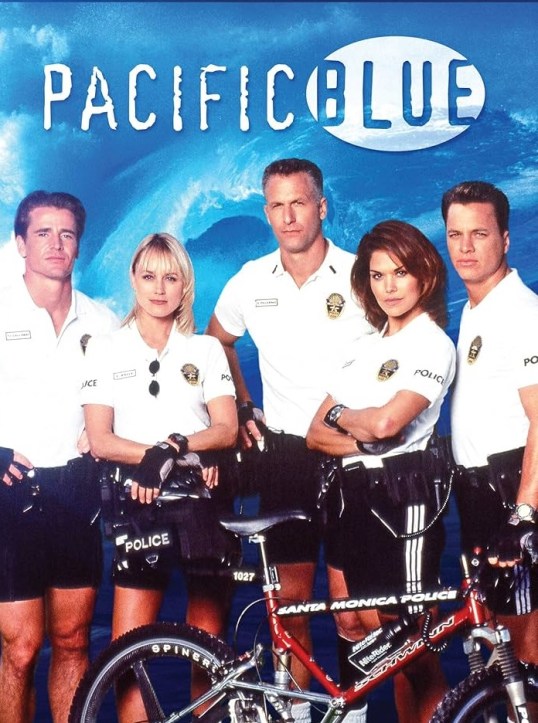
Late Night Retro Television Review: Pacific Blue 2.16 “Soft Targets”


Welcome to Late Night Retro Television Reviews, a feature where we review some of our favorite and least favorite shows of the past! On Tuesdays, I will be reviewing Pacific Blue, a cop show that aired from 1996 to 2000 on the USA Network!  It’s currently streaming everywhere, though I’m watching it on Tubi.

This week, a crazed gunman takes over the beach.  Good thing the Bike Patrol’s there….

Episode 2.16 “Soft Targets”

(Dir by Ron Satlof, originally aired on January 12th, 1997)

Zack Torrance (Terence Knox, a.k.a. St. Elsewhere‘s Dr. White) is a former soldier who claims that he has information about the CIA smuggling drugs into the U.S. as a way to help raise money to defeat the communists in Central America.  This is a conspiracy theory that I’m very familiar with.  I don’t quite buy it because it assumes a bit too much competence on the part of the CIA.  That said, it’s a popular conspiracy theory amongst some.  All I know is that communism sucks.

Kind of like this show!

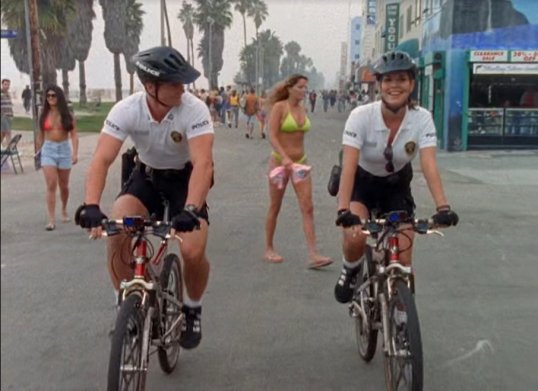
Anyway, Zack opens fire on a beach and holds everyone hostage because he wants to get his story out.  For some reason, the job of securing the beach and negotiating with Zack falls to these dorks:

The CIA shows up in the form of Franklin Quill (Sherman Howard).  Quill takes over the negotiations and, while TC and Chris glower in the background, he proceeds to shoot and kill Zack.  Zack dies and the story doesn’t get out.  TC looks upset but he doesn’t really do anything to stop Quill so you know what?  Get bent, TC.

Seriously, this episode …. ugh.  First off, hostage episodes are boring to begin with.  There’s only so many times you can watch some sweaty guy barking out orders before you get bored with the whole thing.  Pacific Blue makes things worse by bringing in the Bike Patrol.  We’re supposed to dislike Quill but actually, Quill shows up, takes charge of the situation, and brings things to a close.  The fact that TC spends the whole episode standing around with an annoyed expression on his face doesn’t make Quill any less effective.  For this entire episode, TC whines and bitches about Quill’s tactics but TC never actually develops any tactics of his own.  If anything, the Bike Patrol is kind of superfluous in this episode.

Terence Knox was believably desperate as Zach.  Holly Robinson Peete showed up as a woman who was wounded by Zach’s initial attack on the beach.  She survived and then married a lifeguard (Robert Joseph).  Palermo was not in this episode.  Instead, he left to train a Bike Patrol in another country and left TC in charge of the Santa Monica’s Bike Patrol.  Big mistake, if you ask me.

If there was any pleasure to be found in this episode, it came from just how poorly the Bike Patrol came across.  Seriously, they couldn’t catch Zach.  They couldn’t control the beach.  What exactly do we need these people for?  Bike Patrol, what is it good for?  Absolutely nothing.

Retro Television Review: Fantasy Island 7.6 “Second Time Around/Three’s A Crowd”


Welcome to Retro Television Reviews, a feature where we review some of our favorite and least favorite shows of the past!  On Tuesdays, I will be reviewing the original Fantasy Island, which ran on ABC from 1977 to 1984.  Unfortunately, the show has been removed from most streaming sites.  Fortunately, I’ve got nearly every episode on my DVR.

This week, the Island is kind of dull.  Tattoo is missed.

Episode 7.6 “Second Time Around/Three’s A Crowd”

(Dir by Philip Leacock, originally aired on November 19th, 1983)

Love is in the air again at Fantasy Island!  Remember when this show used to feature mermaids and Greek Gods and ghosts and gothic mansions and stuff like that?  Those were good times!

Kate Tucker (Cristina Ferrare) comes to the Island to confront her husband, Gary Tucker (Geoffrey Scott, the quarterback from 1st and Ten), about his infidelity.  Roarke decides to bring Gary’s mistress, Helen (Michelle Phillips, who once played the mermaid on this very show), to the Island as well!  It’s all a part of Roarke’s plan to show both women that Gary’s not worth all the trouble.  Kate realizes she doesn’t want Gary and Helen doesn’t want him either.  Kate leaves the Island a single woman.  Good for her!

Meanwhile, widowed Joan (Dorothy McGuire) comes to the Island and falls for handsome Alan Reynolds (Craig Stevens).  Joan’s son (Stuart Damon) is upset at the idea of Joan marrying someone else.  Eventually, he comes to see the error of his ways and smiles as Joan and Alan find happiness.

This may have been an episode of Fantasy Island but it felt more like The Love Boat.  Roarke helped everyone find true love and Lawrence …. Lawrence was just kind of there.  At this point, I kind of feel that, if they were determined to get rid of Tattoo, they should have just had Roarke running the Island by himself.  Lawrence’s presence doesn’t accomplish anything beyond making the viewer miss Tattoo.

This was a pretty forgettable trip to the Island.

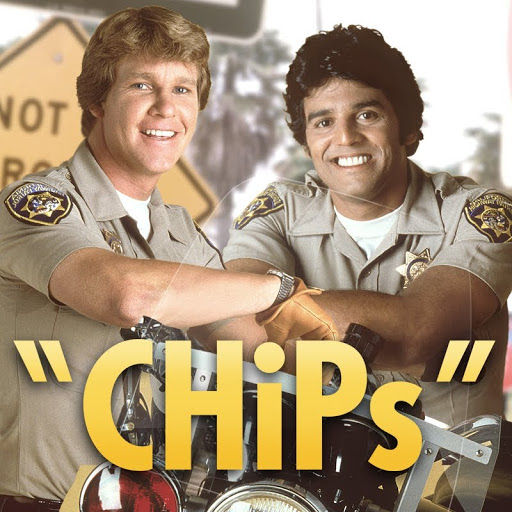
Late Night Retro Television Review: CHiPs 4.9 “Crash Course”


Welcome to Late Night Retro Television Reviews, a feature where we review some of our favorite and least favorite shows of the past!  On Mondays, I will be reviewing CHiPs, which ran on NBC from 1977 to 1983.  The entire show is currently streaming on Prime!

A recently released thief and a bank error are no match for the smiley charisma of Erik Estrada!

Episode 4.9 “Crash Course”

(Dir by Phil Bondelli, originally aired on January 4th, 1981)

Former getaway driver Sonny Matson (Don Stroud) has just been released from prison and he’s fallen back into his old habits.  Everyday, he steals a different car and then robs a different business.  His crimes are getting progressively more bold and Baker is determined to catch him.

Meanwhile, Ponch notices that he has an extra $4,000 in his bank account.  Trying to do the right thing, Ponch reports the discrepancy.  The bank accidentally drains all the money from his account.  With his checks bouncing all over town, Ponch tries to get the bank fix their error.  Good luck with that, Ponch!  Luckily, when one of Sonny’s associates tries to rob the bank, it gives Ponch a chance to play the hero….

It’s The Ponch Show!  Baker may be the one with a personal stake in capturing Sonny but Ponch is the one with big grin and the majority of this episode’s screentime.  Whether he’s thwarting a bank robbery or recruiting all of his co-workers to help him find proof of the bank’s error, Ponch dominates.  Poor Baker.

The best thing about this episode was Don Stroud’s performance as Sonny Matson.  Stroud played a lot of low-level criminals over the course of his career.  With his quick but unfriendly smile, his paranoid eyes, and his cocky attitude, Stroud is actually rather intimidating as Sonny.  Whenever Stroud is onscreen, CHiPs actually feels a little bit dangerous!  That this episode was memorable was largely due to Don Stroud and the hideous 70s decor of Ponch’s bank.  Tacky and dangerous, that’s our CHiPs!