SOV Horror Review: The Groundhog’s Day Massacre (dir by Harold Olminsky)


1986’s The Groundhog’s Day Massacre takes place in Ohio. Someone who is apparently known as Baggyface is obsessed with saws and killing people. He does indeed wear a bag over his face and he goes around with an electrical saw, though I’m not really sure how he keeps it running. Maybe he has a really long extension cord. Despite the danger of Baggyface, a couple still decide to have a nice romantic picnic outside. They eat, they frolic, and they toss around a frisbee. Eventually, Baggyface shows up.

The Groundhog’s Day Massacre is only 26 minutes long. About twenty minutes into the action, the screen is suddenly filled with static and we hear someone off-camera saying, “Technical difficulties.” The static goes on for about three minutes and then we get back to what passes as the action. I have to admit that I actually did smile when the static started and that “technical difficulties” line made me laugh. It’s film nerd humor and, more specifically, it’s horror nerd humor. Any true horror fan has seen countless low-budget films that suffered from at least one technical difficulty. (If you don’t know what I’m talking about, I can only assume you’re one of those “I love American Horror Story” snobs.) Tossing it into the middle of this film is a reminder that we’re not meant to take any of this seriously.

Shot on video, The Groundhog’s Day Massacre is semi-legendary amongst SOV fans, both because of its “so bad it’s good” reputation and the fact that, for years, it wasn’t easy to find. (It’s on YouTube now.) The title was obviously meant to poke fun at the slasher habit of trying to co-opt popular holidays. The footage is grainy, there’s next to zero dialogue, and three cast members were clearly amateurs. Heavy metal music drones in the background. Watching two people play frisbee is not made any more exciting by playing an 80s hair band.

(One thing that people forget about the early days of the Internet is that people would beg you to check out their “extreme sports” videos and then it would inevitably turn out to be just like twelve minutes of some douchebag with a manbun trying to steer a unicycle while Pantera played in the background. That’s what the frisbee scenes reminded me of.)

The Groundhog’s Day Massacre is not very good, but I imagine the people who made the film would probably agree with me on that. It does have a certain charm that comes from watching it and knowing that, one weekend, four or five people got together and filmed it and now, 40 years later, it can still be viewed on YouTube. The man and the woman who get chased by Baggyface are probably in their 60s now! I wonder if they know people are watching them on YouTube? That said, The Groundhog’s Day Massacre is only 26 minutes long and it really makes you feel every one of those 26 minutes. There were plenty of technical difficulties with The Groundhog’s Day Massacre and I certainly don’t plan on watching it again.

And yet, I’m still glad it was made. I’m glad that it’s still being watched. I’m glad people are still laughing at the moments that they were meant to laugh at. I’m happy for the people who made this movie, wherever they may now be.
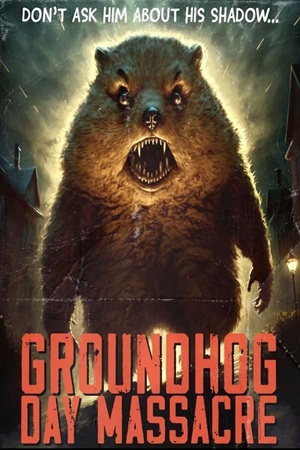
This poster, which I got off of Letterboxd, has nothing to do with the movie and I imagine it was probably made years after the film’s initial release. You’ll notice that they corrected the name of the movie. As someone who still cringes at the typos in her 2010n reviews, I understand.
The TSL Horror Grindhouse: Sisters (dir by Brian De Palma)


1972’s Sisters begins by introducing us to a likable ad executive named Philip Woode (Lisle Wilson). Woode is the victim of a prank show and, for his trouble, he wins dinner for two at a nice Manhattan restaurant. Daniele Breton (Margot Kidder), the model/actress who set him up for the show, agrees to be his date. They have a lovely night that ends at Daniele’s apartment. In the morning, Daniele explains that it’s not only her birthday but also the birthday of her twin, Dominique. Philip, being a nice guy, goes not only to refill Daniele’s prescription but also to pick up a birthday cake. He then comes back to the apartment and, in true Psycho fashion, is promptly stabbed to death by one of the sisters.

Across the street, journalist Grace Collier (Jennifer Salt) looks out her window just in time to see Philip getting stabbed and then using his own blood to write “help” on the apartment window. Director Brian De Palma makes good use of his trademark split-screen technique. On one side of the screen, we watch Philip dying. On the other side, we explore Grace’s apartment and see that, in the past, she’s written an editorial headlined “Why We Call Them Pigs.” We know that Grace is the only person who has witnessed Philip’s murder, and we also know why the police are not going to be inclined to believe her.

And indeed, by the time the police arrive, Daniele and her creepy ex-husband, Emil (William Finley), have already hidden Philip’s body in a couch. With the police proving to be of no help, Grace hires a private detective named Joseph Larch (Charles Durning) to break into Daniele’s apartment and search for clues. Durning doesn’t have a huge role in Sisters, but he definitely makes an impression as he proceeds to follow that couch across the country. De Palma’s dark sense of humor is evident as the couch eventually ends up in the wilds of Canada, where Durning uses his binoculars to keep an eye on it.

Sisters was an early De Palma film, one that gives him a chance to show off both his ability to generate suspense and the style that would become his trademark. It’s an effective film, one that has a plot that is full of twists but which can still easily be followed by the audience. Indeed, I doubt anyone will be shocked to discover the truth about Daniele and Dominique, but Margot Kidder gives such a good performance and De Palma directs with such confidence that the story still holds your attention. As for Jennifer Salt, she’s playing the type of radical journalist who probably would have identified with the politics of Greetings and Hi, Mom! while ultimately rejecting both films for their casual misogyny. It undoubtedly says something about De Palma’s worldview that, while he obviously sympathized with Grace’s politics, he still ultimately portrayed her as being an ineffectual investigator.

In the end, Grace is as much of a sister to Daniele as Dominique is. They’ve found themselves being manipulated by the same society, and they’ve both been forced to the fringes—Daniele by her past and Grace by her politics. In typical De Palma fashion, this film ends with the audience knowing more than the majority of the characters. We know what happened but, for everyone else, the truth is still hidden in a couch that’s sitting in the middle of nowhere.

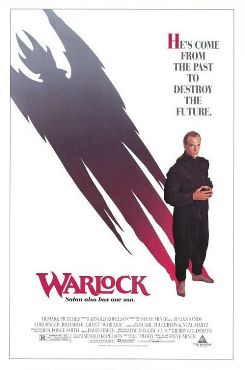
Warlock (1989, directed by Steve Miner)


Before he can be executed in the late 17th century, an unnamed warlock (Julian Sands) is propelled through time by Satan. He ends up in 20th-century Los Angeles, where he seeks the three pieces of the Grand Grimoire, a legendary spellbook that, when reassembled, can undo creation. The Warlock is pursued by Giles Redferne (Richard E. Grant), a witch hunter whose wife was previously killed by the Warlock and who manages to make it through the Warlock’s time portal. Helping Giles navigate the modern world is Kassandra (Lori Singer), a woman who made the mistake of taking the Warlock in and got hit by an aging spell for her trouble. Giles and Kassandra pursue Warlock across the the country as he searches from the three pieces of the book. It’s a quest that takes them from Los Angeles to a Mennonite community and finally to modern-day Massachusetts where the final piece of the Grimoire turns out to be in a very unexpected location.

Warlock definitely benefits from David Twohy’s clever script and Steve Miner’s no-nonsense, energetic direction, but the real secret of its success was the performance of Julian Sands as the Warlock. If you were of a certain age in 1991, Julian Sands will always primarily be the Warlock to you. With his coldly self-amused manner and his unapologetic cruelty, Sands was the epitome of cool evil. The first time I saw Warlock, I was surprised at just how far the film’s villain was willing to go in his quest. Warlock is one of those films where the characters who usually survive do not. No one is safe from the warlock.

The film also benefits from Richard E. Grant taking his role seriously. As for Lori Singer, she’s stuck with a lot of bad old-age makeup and delivers her lines with a lack of enthusiasm. Her performance, though, still doesn’t distract from this surprisingly entertaining film. When I recently rewatched, I recognized Mary Woronov in the role of a psychic. As always when it comes to Mary Woronov, I wished her role had been larger.

Warlock was released in Europe and Australia in 1989 but, because of the financial difficulties of New World Pictures, it didn’t get an American release until 1991. The film did moderately well at the box office and went on to become, for a while, a mainstay on HBO and Cinemax. Julian Sands, who had mostly played young romantic up until that point, was subsequently typecast as a cool, Continental villain. It was followed by two sequels.

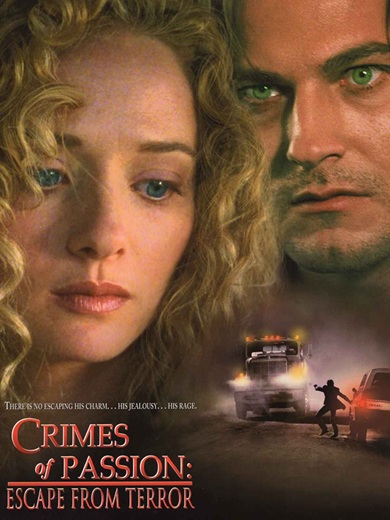
October Truer Crime: Escape From Terror: The Theresa Stamper Story (dir by Michael M. Scott)


First aired in 1995, Escape From Terror stars Maria Pitillo as Theresa Stamper. When the film begins, Theresa is a naive 23-year-old woman who lives in Oklahoma with her mother (Cindy Williams). She gets a job working as a secretary for Paul Stamper (Adam Storke), the owner of Stamper Oil Company. She soon becomes more than just Paul’s secretary. At first, Paul is charming. He’s a little rough around the edges and he’s quick to get jealous, but Theresa just tells herself that Paul is under a lot of stress and that she can fix whatever’s wrong with him.

Paul and Theresa get married in Las Vegas and things quickly go downhill. Paul becomes physically abusive, along with being emotionally manipulative. He fires her from her job because no wife of Paul Stamper is going to work, especially not where other men can look at her. Theresa continues to tell herself that Paul is just under stress. Everyone else tells her that Paul is clearly on drugs and they point out that he always wears long sleeves, even in the Oklahoma heat. When Theresa eventually catches Paul hanging out at a bar and shooting up heroin in the bathroom, he proceeds to beat her badly enough to send her to the hospital. When Theresa takes her daughter and leaves Paul, Paul goes crazy and shoots her new boyfriend.

Paul goes on the run. Eventually, he’s arrested and convicted, but he manages to escape from prison and then he disappears. Five years later, Theresa starts to get threatening calls and realizes that, wherever he is, Paul is still obsessed with her. What can Theresa do?

How about telling her story to Unsolved Mysteries?

Escape From Terror was produced by Unsolved Mysteries, so it shouldn’t be a surprise when a good deal of the film’s final moments is dedicated to showing just how efficiently the show and its audience were able to track down Paul Stamper. Sheriff Bill Douglas (Brad Dourif), who has been manning the Unsolved Mysteries phone lines, tells everyone in the studio to quiet down after word comes in that Paul has been arrested. “I’ve got one more call to make,” he says.

And yes, it would be tempting to call this movie out for mythologizing the people who produced it, but the fact of the matter is that it is a true story and the real Paul Stamper actually was arrested (and subsequently sentenced to 35 years in prison) after Unsolved Mysteries aired a story about him, so the show is probably justified in patting itself on the back. It’s kind of like America’s Most Wanted. As easy as it was to occasionally make fun of the show, it did work.

As for the movie, it’s actually not bad. I’ve spent enough time in rural Oklahoma that the film seems very familiar to me. Maria Pitillo and Adam Storke gave good performances as Theresa and Paul, with Adam Storke doing an especially good job of capturing Paul’s manipulative nature. It was also nice to see Brad Dourif playing a sympathetic character. Dourif may have made his name playing bad guys, but in this film, he’s the ideal small-town lawman.

I might binge Unsolved Mysteries after Horrorthon is over. Who knows? Maybe one of my older neighbors has been on the run since the ’90s. There’s really only one way to find out!

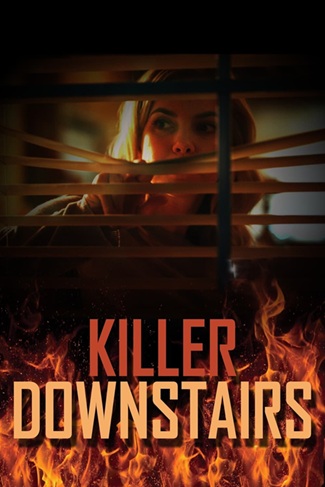
October On Lifetime: The Killer Downstairs (dir by Tony Dean Smith)


In this 2019 Lifetime film, Cindy Busby stars as Allison. Allison spent a lot of money on law school, but she hasn’t been able to get a job with a top-rated firm. Instead, she’s working at a grocery store that is definitely not meant to be Target, despite the fact that it looks like Target and all of the employees appear to be wearing blue versions of the Target uniforms.

Despite having a low-paying job and what one can only assume is a mountain of student debt, Allison lives in a mansion. One of the most comforting things about Lifetime films is that, no matter how bad life gets, everyone can still always afford to live in a giant house with a really impressive kitchen. (This is why I’m a capitalist.) Still, Allison could use a little extra money to help pay the bills, so she puts her basement up for rent on MiCassaSuCasa.com.

Soon, she gets a tenant. James (Marcus Rosner) is handsome, sensitive, and in need of companionship after his divorce. James is the type of guy who will show up at work and save you from your obnoxious boss while still finding time to make you a fabulous dinner. He seems like he’s perfect, but, of course, this is a Lifetime film, so no one has any excuse to be shocked when James starts planting secret cameras all over the house. James is clever enough to worm his way into Allison’s life and to start to win her heart, but he’s not smart enough to turn off his laptop whenever he leaves the basement. Nor does he really seem to be prepared for Allison’s best friend, Sarah (Donna Benedicto), and her skill at doing Google searches. That said, James does manage to kill a few people without anyone noticing him lurking around beforehand, and he also sabotages Allison’s upcoming interview with a law firm. What is James’s plan?

The Killer Downstairs is a typical Lifetime film, in that the plot depended upon Allison being way too trusting and James being way too eager to try to take over her life. If you’ve watched enough of these films, you’ll be able not only to guess exactly who James is going to kill but also when he’s going to do it. Unfortunately, Allison has never watched a Lifetime film and, as such, she’s noticeably slow to consider that maybe it’s the mysterious new guy in her life who is disrupting everything. Maybe it’s due to the fact that I spent several years as an office administrator for an actual attorney, but there’s absolutely nothing about Allison that suggests she would be a particularly good lawyer. Even before James shows up, she seems to be a bit scatterbrained. Ultimately, the message of this film becomes that some people are just meant to work in a grocery store, but that’s okay because they can still live in a mansion with a really nice kitchen. In the end, isn’t that what life is all about?

The Films of Dario Argento: The Card Player


In 2004’s The Card Player, a serial killer is haunting the streets of Rome. He’s abducting women and then taunting the police by demanding that they play online poker with him. If the police win a hand, the woman goes free. If the police lose, the woman is tortured and killed on a webcam. Unfortunately, it turns out that the police are lousy at playing poker. Actually, they’re lousy at just about everything. Whenever I watch The Card Player, I find myself imagining that I’m watching an episode of Law & Order: Remedial Police Unit. That’s a spin-off from the original Law & Order. It features incompetent, poorly trained detectives who are constantly forgetting to Mirandize suspects. I’m surprised that no one else has ever seen it.

There are two cops who are slightly competent. Anna Mari (Stefania Rocca) is the daughter of a man who wrote a book about how to play poker. (Hey, that might be helpful!) John Brennan (Liam Cunningham) is a tough Irish cop who is sent to Italy after the Card Player kills two British tourists. While the rest of the police force stands around and stares at the office computer all day, Anna Mari and Brennan actually try to track the killer down.

Oh, The Card Player. This film is often cited as being Dario Argento’s worst. To be honest, I think that’s a bit of an overreaction. The film’s not so much bad as it’s just kind of boring. It plays out like a police procedural and there’s little of Argento’s signature visual flair. There are way too many shots of people staring at screens with serious expressions on their faces. Like so many other directors before him, Argento struggles to find a way to make watching someone else play an online game interesting. Eventually, the police do win a hand and I cringed as all of the extras in the police station broke out into cheers. It felt corny and a bit silly. It definitely did not feel like Argento.

That said, the murders are memorably gruesome and the scenes where the bodies are recovered and then examined in the morgue are pure nightmare fuel. Argento tosses in a dancing coroner who takes way too much pleasure in discussing things like the cause of death. The sight of the coroner dancing brings to mind the moment in Tenebrae where John Saxon is stabbed in public and none of the witnesses seem to be particularly disturbed. There’s a chilling callousness to the moment and a reminder of why Argento often portrays insects as being more trustworthy and empathetic than humans. Stefania Rocca gives a good performance in a role that was originally meant to be played by Asia Argento. Liam Cunningham is today known more for his political vacuousness than his acting talent but he’s still believably rugged and cynical as Brennan.

Finally, the film’s depiction of online poker is very much a late-90s version of the Internet. Everything loads slowly, the graphics are awkward and stiff, and the whole thing projects a feeling of “Can you believe people actually pay for this?” Seen in 2026, it’s actually kind of charming. The old internet was so dorky that it was impossible not to love it.

The Card Player is pretty forgettable, especially when compared to Argento’s earlier films or, for that matter, a film like Sleepless. It’s not as bad as some say but it’s definitely not top-rate Argento.

The (Reviewed) Films of Dario Argento:

  1. The Bird With The Crystal Plumage
  2. Cat O’Nine Tales
  3. Four Flies on Grey Velvet
  4. Deep Red
  5. Suspiria
  6. Inferno
  7. Tenebrae
  8. Phenomena
  9. Opera
  10. Two Evil Eyes
  11. Trauma
  12. The Stendhal Syndrome
  13. The Phantom of the Opera
  14. Sleepless
  15. Dracula 3D (Reviewed by Brad Crain)

6 Argento Trailers For October 26th


Today’s edition of Lisa Marie’s Favorite Grindhouse Trailers features some of my favorites from Dario Argento!

Deep Red (1975)

Inferno (1980)

Tenebrae (1983)

Phenomena (1985)

Opera (1987)

Trauma (1993)

What do you think, Trailer Kitties?


by Erin Nicole

I agree, Mom Cat!  Those trailers aren’t meant for kittens!

Brad discovers THE OTHER (1972), directed by Robert Mulligan!


I was browsing through my streaming services this morning in search of a scary movie to watch when I came across THE OTHER. The poster featured a creepy-looking kid, and the movie was made in 1972, so I decided I would dig a little deeper. The first thing I saw in the credits was that it was directed by Robert Mulligan, the same guy who directed the classic TO KILL A MOCKINGBIRD, and that it was written by actor Tom Tryon. Now truly intrigued, I decided to go ahead and hit play, because there aren’t that many opportunities these days for me to experience a movie while knowing next to nothing about it. And good grief, I wasn’t emotionally prepared for what I was about to see.

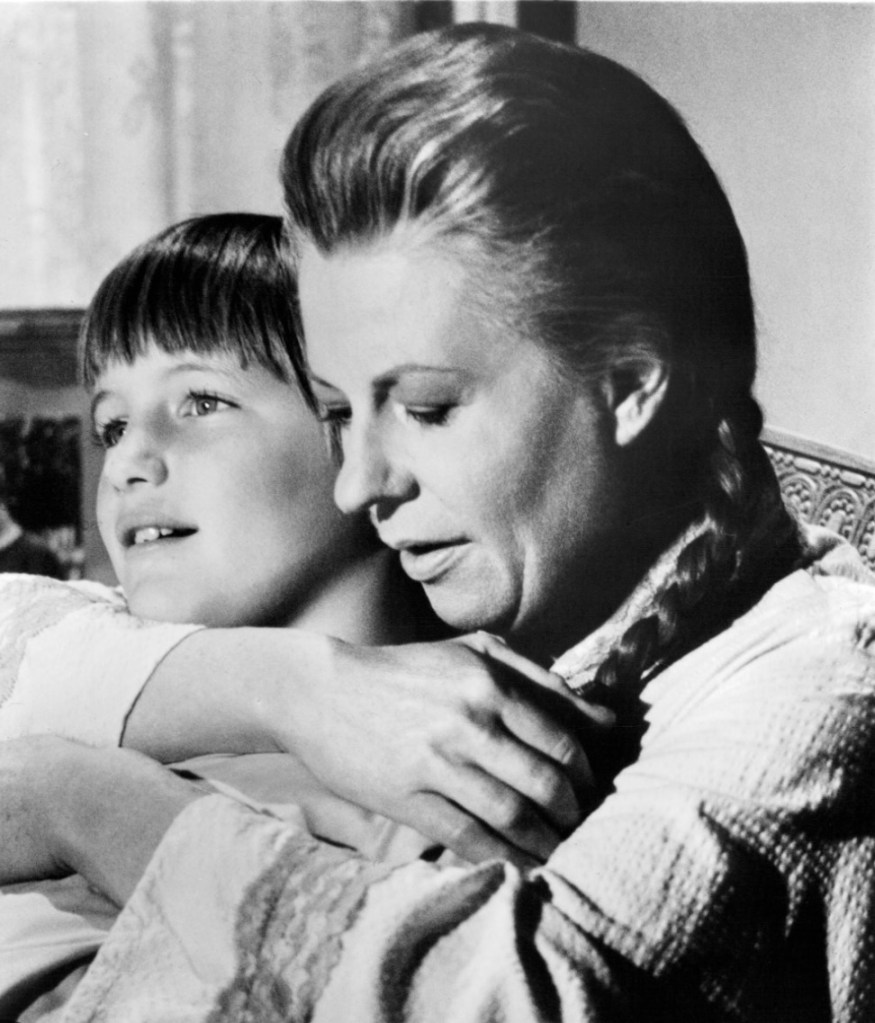
THE OTHER takes place in the summer of 1935, with twin brothers Niles and Holland Perry (Chris and Martin Udvarnoky) spending their days playing, fishing, and swimming on their family farm. At first it seems like we’ve stumbled across one of those perfectly nostalgic movie summers, but as we meet the rest of the family, we learn that there has been a lot of tragedy in their lives. Their father has recently died and their mother Alexandra (Diana Muldaur) seems to be lost in the grip of depression, which leaves their grandmother Ada (Uta Hagen) to give the boys most of the attention that they need. She’s even taught them fun games to play that allow them to use their imaginations. While it may all look innocent enough, it soon becomes clear that something is very wrong as bad things just keep happening.

This is a movie that takes its time building a world that changes dramatically from the beginning to the end as we slowly learn more about what’s really happening. When I was a kid, during the summers my brother and I would play in the woods behind our house. We mapped them, named the creeks our own made-up names, shot at trees with our BB guns, and walked as far as we could until we’d start thinking our mom would be mad at us. If we weren’t doing that, you might find us fishing on the pond behind our house. That’s the kind of stuff that these boys are doing at the beginning of the film and that connection to a simpler time drew me in. But once the initial layer is peeled back, we begin to realize that things aren’t how they appear. With each succeeding frame, I became more and more uncomfortable, and it doesn’t let up. I won’t spoil the movie’s surprises, but it pulls no punches.

Since THE OTHER relies on creeping dread to create its horror, as opposed to gore and jump scares, the performances need to be good, and they are really strong here. This is the only film that the Udvarnoky twins would appear in, and I think they’re very effective, with “Niles” coming off as particularly sweet and innocent. With their blue eyes, there were a couple of times they even reminded me of a young Kurt Russell. The fact that so much of the story revolves around children makes the events that follow that much more disturbing.

I found Uta Hagen to be fascinating as their grandmother Ada, whose extreme love for them comes with a whole bunch of unintended consequences. I didn’t know anything about her before watching this film either. After enjoying her performance here, I read up on her legendary career on the stage where she won multiple Tony awards, as well as a special Lifetime Achievement award. Diana Muldaur doesn’t have a lot to do, but she does have a couple of strong moments as the boys’ mother where she conveys a lot of information without being able to say a word. And while I enjoyed seeing John Ritter and Victor French pop up in various roles, no one is safe from extreme emotional or physical harm in this movie, so I can’t say there was anything fun about their characters.

In some ways, I’m quite surprised that I’d never heard about THE OTHER before now. But that’s been one of the best things about being part of TSL’s Horror-Thon, as I’ve been actively seeking out these types of films. This one stirred up a lot of emotions, with some of its visuals especially disturbing. And the less you know going in, the stronger the impact the film will have. I can just about guarantee that I will never watch it again, but there’s also a very good chance I’ll never forget it either!

Slither Into Halloween With These Snakes!


by Griffith Foxley

Almost everyone I know is scared of snakes but most of them are harmless.  Our cats regularly bring us little grass snakes and drop them at our feet and then act surprised when we say, “No, kitty!  Get that way from me!”  If a snake is really bothering you, you can get rid of it by chopping off its head with a shovel.  That was something that my mom taught me how to do when we were visiting her parents in South Texas and there actually were potentially dangerous snakes around.  Or you can just wait for it to leave.  Most snakes aren’t that bad.  Of the 4,000 known species of snake, 83% are harmless.

The other 17% are like the ones featured in these classic pulp covers!

by Ed Valigursky

Artist Unknown

Unknown Artist

Unknown Artist

by John Pedersen

Unknown Artist

by Rudolph Belarski

by Hans Wesselowski

Artist Unknown

Be careful out there!


Film Review: Body Double (dir by Brian De Palma)


Rumor has it that Brian De Palma’s motivation for directing 1984’s Body Double was that he was angry with the MPAA. After being forced to (unfairly, in his opinion) recut almost all of his previous films to avoid an X-rating, De Palma decided to make a film that was actually worthy of an X. It would feature the bloodiest and most sexually suggestive murder that he had filmed up to that point. Because a good deal of the film would deal with the adult film industry and would co-star Melanie Griffith as an actress named Holly Body, the film would be full of nudity. The film would even feature Frankie Goes to Hollywood performing their then-controversial hit song, “Relax.” De Palma said that the film would be a “real X,” and, indeed, it was rated X when it was first submitted. De Palma later said that he actually only had to cut a few seconds of nudity to get an R-rating, which was quite a contrast to what he went through with his previous films. The nudity was cut. The scene of Deborah Shelton getting murdered by a killer with a very phallic drill was untouched, just in case you were wondering about the MPAA’s priorities.

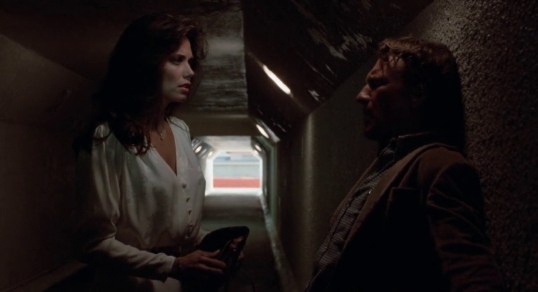
Body Double stars one of my favorite underrated actors, Craig Wasson. Wasson plays Jake Scully, a struggling actor with extreme claustrophobia. When he freezes up while lying in a coffin, Jake is fired from the vampire film in which he’s appearing. Jake’s friend, Sam Bouchard (Gregg Henry), takes some pity on him and arranges for Jake to housesit a luxurious apartment. Sam points out that, every night, Jake’s neighbor appears to dance naked in her apartment. Jake becomes obsessed with Gloria Revelle (Deborah Shelton) and starts to follow her across Los Angeles. (That Jake remains likable even after he watches her shop for underwear is a testament to Wasson’s amiable screen presence.) Jake realizes that he’s not the only one following Gloria. After a man who appears to be extremely scarred snatches Gloria’s purse, Jake chases after him. Jake doesn’t catch the man because his claustrophobia acts up when he has to run through a tunnel. But Gloria shares an impulsive kiss with him before leaving. Later that night, Jake looks into Gloria’s apartment and witnesses her being murdered by the man who earlier stole her purse….

Jake’s investigation into Gloria’s death leads him into the world of adult films and body doubles. In a typical De Palma twist, it also leads to Jake becoming a better actor as he’s forced to take on different identities and lie about his intentions. He meets Holly Body, an actress he’s shocked to discover he’s seen before.

Body Double is one of those De Palma films that seem to divide people. Viewers either love the twisty plot, the elaborate set pieces, and the deliberate homages to Hitchcock or else they find it all to be terribly self-indulgent. This film is De Palma at his most stylish. When Gloria and Jake kiss, De Palma doesn’t just show us the kiss. Instead, the camera spins around them and, for a few moments, De Palma’s thriller becomes a grand romance. There’s a dark sense of humor running through Body Double and, again, how one reacts to it will depend on how much one is already on De Palma’s wavelength. Just as Blow Out ended with Travolta finding the perfect scream, Body Double ends with Jake learning how to stay in the coffin until the director yells “Cut!” Big tragedies lead to small victories.

I have to admit that the first time I saw Body Double, I was a little bit annoyed with it. Every time that I started to get invested in the story, De Palma would launch into another lengthy set piece that ultimately seemed to be designed to remind me that it was just a movie. On repeat viewings, though, I’ve come to appreciate the film’s dark humor and the performances of Wasson, Griffith, and Gregg Henry. Now, I can appreciate the film for what it is, an exercise in glorious style and excess. Body Double is De Palma paying tribute to the masters (like Hitchcock) while also telling an unapologetically sordid story. De Palma’s real X holds up well.