The Take (1974, directed by Robert Hartford-Davis)


Lt. Terrence Sneed (Billy Dee Williams), a tough and suave cop from San Francisco, is sent to New Mexico to help Police Chief Berrigan (Eddie Albert) take down the local crime syndicate.  No sooner has Sneed arrived in town than he’s helping to prevent a prison break and killing gangsters.  Berrigan is impressed and explains to Sneed that the local crime boss is Victor Manso (Vic Morrow).  Even though everyone knows that Manso is crooked, the police haven’t ever been able to put together a case that will stand up in court.  Maybe Sneed is the man who can do it.

What Berrigan doesn’t know is that Sneed is a crooked cop, himself.  As soon as Sneed leaves his meeting with Berrigan, he goes over to Manso’s office and collects his money.  Manso assigns Sneed to work with another crooked cop, Captain Dollek (Albert Salmi).  However, it turns out that Sneed has plans of his own.  While still on Manso’s payroll, Sneed starts to put together a case that might finally take Manso down.

The Take is full of good actors in small roles.  If you have ever wanted to see Billy Dee Williams share a scene with Frankie Avalon, The Take is the film for you.  Avalon plays Danny James, a small-time hood who is arrested and interrogated by Sneed.  At first, Danny is cocky and arrogant but, as soon as Sneed removes his jacket and his watch and makes a fist, Danny starts crying and begging Sneed not to beat him.  Danny is soon turned into an informant and then disappears from the movie.  The beautiful model Kathirine Baumann plays Danny’s girlfriend.  While only wearing a towel, she gives Capt. Dollek the finger and looks amazing doing it.  Sorrell Brooke, who later found fame as Boss Hogg on The Dukes of Hazzard, also has a few good scenes as Sneed’s deceptively respectable money launderer.

The Take can be a confusing film to watch because it’s never firmly established just how corrupt Sneed actually is.  Sometimes, Sneed just seems like he’s trying to make a little extra money and then, other times, he comes across as being a full-blown gangster.  Despite being on Manso’s payroll, Sneed seems to be determined to take him down and the film never makes clear why.  Billy Dee Williams is his usual supremely cool self but he seems almost too cool to play a morally ambivalent cop.  More impressive are Vic Morrow and Eddie Albert, who both shamelessly chew the scenery as two leaders on opposite sides of the law.

The Take is often mistakenly referred to as being a blaxploitation film but it’s really just a cop film with a lead actor who happens to be black.  Unlike the best blaxploitation films, there’s no political subtext to be found in the movie.  Sneed could just as easily be a corrupt white detective and, with the exception of one throwaway line, race is never mentioned.  While this is a minor cop film, it features a few good action scenes and, again, it’s your only chance to see two very different pop cultural icons, Billy Dee Williams and Frankie Avalon, acting opposite of each other.  That’s not a bad pay-off for 91 minutes of your life.

Lisa Reviews An Oscar Nominee: A Star Is Born (dir by Bradley Cooper)


Happy birthday, Bradley Cooper!

Bradley Cooper is 45 years old today.  With all the recent talk about how people’s lives have changed over the past decade, let’s take a minute to appreciate just how spectacularly things have gone for Bradley Cooper, career-wise.  Ten years ago, Bradley Cooper was probably best-known for playing the smarmiest member of The Hangover‘s quartet of friends.  Now, Cooper is known for not only being one of the best actors working today but also for making an acclaimed directorial debut with the 2018 Best Picture nominee, A Star Is Born.

Cooper not only directed A Star is Born but he also starred in it.  He played Jackson Maine, a country musician who has been drinking for as long as he can remember.  He used to drink with his father and when his father died, Jackson continued to drink alone.  (At one point, Jackson says that he was a teenager when his father died.)  Managed by his older brother, Bobby (Sam Elliott), Jackson became a star but his career has been in decline for a while.  For all of his talent and for all of his belief that he has something worth saying, Jackson is drinking his life away.  He stumbles from show to show and is often dependent upon Bobby to tell him what he missed while he was blacked out.

When Jackson stumbles into a drag bar and sees Ally (Lady Gaga, making her film debut) singing a song by Edith Piaf, he is immediately captivated by her talent.  Ally, whose father (Andrew Dice Clay) is a limo driver who once aspired to be bigger than Sinatra, is at first weary of Jackson but he wins her over.  After she punches a drunk and he takes her to a grocery store to construct a makeshift cast for her hand, she sings a song that she wrote and Jackson decides to take her on tour.  Soon, they’re in love and, before you know it, they’re married!

Unfortunately, Jackson’s alcoholism threatens both their happiness and their future.  While Ally’s star rises, his continues to dim.  Will Ally sacrifice her career for Jackson or will Jackson sacrifice his life for Ally?

It’s a familiar story, one that’s been told many times.  The first version was 1932’s What Price Hollywood, which featured aspiring actress Constance Bennett falling in love with an alcoholic director played by Lowell Sherman.  In 1937, What Price Hollywood? was unofficially remade as A Star Is Born, with Janet Gaynor as Esther, the actress who falls in love with faded matinee idol, Norman Maine (Fredric March).  The next version came out in 1954 and featured Judy Garland as Esther and James Mason as Norman.  Significantly, the 1954 version added music to the plot, with Judy Garland singing The Man That Got Away.  

In 1976, the story was told a third time.  This version of A Star is Born starred Barbra Streisand as singer Esther Hoffman and Kris Kristofferson as a self-destructive rock star named John Norman Howard.  The 1976 version was terrible, largely because there was zero chemistry between Streisand and Kristofferson.  And yet, one gets the feeling that the 1976 version is the one that had the most influence on the 2018 version.  Not only does Bradley Cooper’s version of A Star Is Born make the story about aspiring singers but one gets the feeling that Cooper watched the 1976 version, saw the lack of chemistry between Kristofferson and Streisand, and said, “There’s no way that’s going to happen in my movie!”

Indeed, it’s the chemistry between Bradley Cooper and Lady Gaga that makes the latest version of A Star Is Born so compulsively watchable.  I mean, we already know the story.  From the minute that Jackson and Ally meet for the first time, we know what’s going to happen.  But Cooper and Lady Gaga have got such an amazing chemistry, that it almost doesn’t matter whether the movie surprises us or not.  There’s a scene where Ally says that she’s always been told that her nose is too big and Jackson responds by nonchalantly touching her nose and, with that one simple and very naturalistic gesture, the film convinces us that Jackson and Ally are meant to be together, even if just for a while.  It also makes it all the more upsetting when a drunk and jealous Jackson later uses Ally’s insecurities against her.

(Of course, I should admit that I’ve always been insecure about my own nose so, at that moment, I totally understood what Ally was feeling.)

It’s an unabashedly romantic and sentimental film but it works because, as a director, Cooper brings just enough of an edge to the story.  Cooper, who has been sober since 2004, has been open about his past struggle with alcoholism and, as both an actor and director, he’s smart enough not to romanticize Jackson’s addictions.  In many ways, Jackson Maine is a pain in the ass to be around.  We watch as he goes from being a fun drunk to a sad drunk to a mean drunk, all the while lashing out at anyone who gets too close to him.  At the same time, Cooper also captures the spark of genius and the hints of inner goodness that would explain why he is never totally rejected by those that he’s hurt.  Cooper offers up hints of who Jackson could have been if he hadn’t surrendered to pain and addiction.  We understand why Ally and Bobby stick with him, even if we wouldn’t blame either one of them if they refused to have anything more to do with him.

Lady Gaga, meanwhile, gives a performance is that is down-to-Earth and instantly relatable.  Anyone who has ever been insecure or who has ever felt as if she was being punished for being independent or thinking for herself will understand what Ally’s going through.  At some point, we’ve all been Ally and we’ve all had a Jackson Maine in our lives.  Sadly, these stories rarely have happy endings.

For most of 2018, it was assumed that A Star Is Born would be the film to beat at the Oscars.  While it was eventually nominated for 8 Oscars, Bradley Cooper did not receive a nomination for Best Director.  (Cooper, Lady Gaga, and Sam Elliott were all nominated in the acting categories.)  In the end, Green Book won Best Picture while A Star Is Born only won one award, for Best Original Song.

Of course, Bradley Cooper and Lady Gaga’s performance of that song was perhaps the highlight of the entire Oscar ceremony.

That’s the power of good chemistry.


The National Society of Film Critics Honors Parasite and Little Women!


Yesterday, the National Society of Film Critics announced their picks for the best of 2019!

Now, it’s not really a surprise that Parasite won best picture because Parasite has been popular with the critic groups this season.  For me, what’s more significant is just how well Little Women did, coming in second for Best Picture and winning Best Director for Greta Gerwig.  Could this be evidence of a late surge in momentum for Little Women?  Or is it just of one those quirks of the awards season?  There’s always a tendency to read too much into the results of these contests, especially when the guilds are usually the best precursor to go with.

Anyway, here are the NSFC winners!

2019 NSFC Winners:

Best Picture: PARASITE (44 points)
Runners-up: LITTLE WOMEN (27 points); ONCE UPON A TIME… IN HOLLYWOOD (22 points)

Best Actor: Antonio Banderas, PAIN AND GLORY (69 points)
Runners-up: Adam Driver, MARRIAGE STORY (43 points); Adam Sandler, UNCUT GEMS (41 points)

Best Actress: Mary Kay Place, DIANE (40 points)
Runners-up: Zhao Tao, ASH IS PUREST WHITE (28 points) Florence Pugh, MIDSOMMAR (25 points)

Best Supporting Actor: Brad Pitt, ONCE UPON A TIME… IN HOLLYWOOD (64 points)
Runners-up: Joe Pesci, THE IRISHMAN (30 points) Wesley Snipes, DOLEMITE IS MY NAME and Song Kang Ho, PARASITE (18 points each)

Best Supporting Actress: Laura Dern, MARRIAGE STORY and LITTLE WOMEN (57 points)
Runners-up: Florence Pugh, LITTLE WOMEN (44 points) Jennifer Lopez, HUSTLERS (26 points)

Best Director: Greta Gerwig, LITTLE WOMEN (39 points)
Runners-up: Bong Joon Ho, PARASITE (36 points); Martin Scorsese, THE IRISHMAN (31 points)

Best Screenplay: Bong Joon Ho and Han Jin Won, PARASITE (37 points)
Runners-up: Quentin Tarantino, ONCE UPON A TIME… IN HOLLYWOOD (34 points); Greta Gerwig, LITTLE WOMEN (33 points)

Best Cinematography: Claire Mathon, PORTRAIT OF A LADY ON FIRE and ATLANTICS (41 points)
Runners-up: Robert Richardson, ONCE UPON A TIME… IN HOLLYWOOD (29 points); Yorick Le Saux, LITTLE WOMEN (22 points)

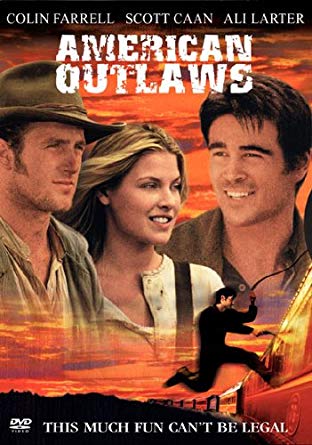
American Outlaws (2001, directed by Les Mayfield)


Returning to their hometown in Missouri in the days following the end of the Civil War, former Confederate guerrillas Jesse James (Colin Farrell) and Cole Younger (Scott Caan) are disgusted to discover that the railroad companies are trying to take over everyone’s land.  After Cole’s cousin and Jesse’s mother are killed by railway thugs, Jesse and Cole take revenge by forming the James/Younger Gang and robbing banks.  Soon, the members of the James/Younger Gang become folk heroes and the railroad company resorts to bringing in Alan Pinkerton (Timothy Dalton) to track the outlaws down.  However, even as they try to remain out of the clutches of Pinkerton’s men, there is growing dissension in the ranks of the James/Younger Gang.  Cole feels like Jesse doesn’t respect his opinions while Jesse is falling in love with Zee (Ali Larter) and it’s hard to court a girl when you’re constantly having to hide out from Alan Pinkertson.  Meanwhile, the other members of the gang wonder why their wanted posters never look as good as Jesse’s and Cole’s.

There have been many movies made about the James/Younger Gang and this is certainly one of them.  What sets this telling apart from other versions of this familiar tale is that American Outlaws is the feel-good version of the story.  Bob and Charley Ford are nowhere to be seen in American Outlaws and Jesse James doesn’t get shot in the back while straightening a picture.  This approach misses the point of what makes the legend of Jesse James so memorable in the first place.  Jesse James was the greatest outlaw in the west but he was ultimately taken down by a coward who shot him in the back.  Take out that part of the story and the story loses all of its power.  Jesse James just becomes another outlaw.

In real life, the James/Younger Gang were reportedly a rough group of outlaws who didn’t hesitate when it came to killing.  In American Outlaws, they come across more like a boy band with a side hustle robbing banks.  Jesse is the soulful leader, Cole is the rebel, and the other members of the gang are the interchangeable backup vocalists.  There’s been many good and even great films made about the James/Younger Game.  American Outlaws is not one of them.  For a good movie about the life and times of Jesse James and his associates, I would suggest checking out Walter Hill’s The Long Riders or Andrew Dominik’s The Assassination of Jesse James by the Coward Robert Ford.

Lisa Reviews An Oscar Nominee: The Barretts of Wimpole Street (dir by Sidney Franklin)


The 1934 best picture nominee, The Barretts of Wimpole Street, takes place largely in one room.

That room is a bedroom located in a mansion that sits on Wimpole Street in London.  The room is occupied by Elizabeth (Norma Shearer), a sickly woman who has spent years in bed and who is barely able to walk.  She is the eldest of 11 siblings and all of them live in the house together, under the watchful eye of their tyrannical father, Edward (Charles Laughton).  Edward has forbidden any of his children from ever leaving home.  None of them are to get married.  In fact, none of them are to have even a relationship.  Even when he hears that a trip to Italy could actually improve Elizabeth’s health, he sternly forbids her from leaving.  Edward is obsessed with sin.  As he explains it, he was once a sinner himself.  In fact, he was such a sinner that he sometimes lost control of himself.  Now that he’s a father and a widower, Edward deals with his less savory impulses through constant prayer and he’s determined to never allow his children to fall into sin as well.

Despite her father’s attempts to keep her isolated from the outisde world, Elizabeth has managed to find an escape.  She’s a poet and her words have won her admirers from around world.  One of those admirers is another poet, a young man named Robert (Fredric March), who frequently writes her letters about his love of her work.  One day, in the middle of a snowfall, Robert shows up at the house on Wimpole Street and requests to see Elizabeth.  Robert tells her that her poetry has not only inspired him but it has also caused him to fall in love with her.  When Elizabeth explains that she is dying and cannot leave the bedroom, Robert says that she’s going to live forever.  After Robert leaves, Elizabeth manages to stand and, for the first time in years, walks over to the window to watch as he departs.

Sounds like a perfect love story, right?  Well, there’s a problem.  Edward has absolutely no intention of allowing Elizabeth to leave the house, regardless of how much her health improves after her initial meeting with Robert.  He is determined to keep her in that bedroom and, this being a pre-code film, it becomes obvious that there’s more to Edward’s behavior than just being an overprotective father.  Though the dialogue may be euphemistic, Edward’s incestuous desires are plain to see.  It’s there every time that he leers as his daughters while also saying that he’ll be sure to pray for their souls.  It’s there in the film’s final moments, when Edward makes a request that’s so dark and cruel that it will take even a modern audience by surprise.  Charles Laughton played a lot of villains over the course of his long career but Edward is perhaps the most monstrous.

As a film, The Barretts of Wimpole Street is undeniably stagy and it’s a bit overlong as well.  Charles Laughton so dominates the film with menace that he threatens to overshadow not just March and Shearer but also Maureen O’Sullivan, who plays one of Elizabeth’s sisters.  But no matter!  I absolutely love The Barretts of Wimpole Street.  The house is gorgeous, the plot is wonderfully melodramatic, and Shearer and March both have a wonderful chemistry.  You can debate whether or not March and Shearer are credible as poets but, ultimately, what matters more is that they are totally believable as soul mates.  From the minute they first meet, you simply buy them as a couple that is meant to be.  Robert’s earnestness is perfectly matched with Elizabeth’s growing strength and it’s impossible not to cheer at least a little when Elizabeth first manages to walk down a staircase without collapsing.

Of course, as any student of literature should be aware, Robert is Robert Browning and Elizabeth is Elizabeth Barrett.  In real life, Robert Browning did arrange a meeting with Elizabeth after having read her poetry and, as well, it’s been said that Elizabeth’s father did not approve of her relationship with Robert.  It’s also apparently true that Edward actually did disinherit any of his children who married.  As for the other details of Edward’s depiction in The Barretts of Wimpole Street, it’s unknown how close to the truth Laughton’s performance may have been.

The Barretts of Wimpole Street is a wonderful historical romance.  It was Oscar-nominated for best picture, though it lost to a far different romance, It Happened One Night.

Cinemax Friday: Extramarital (1998, directed by Yael Russcol)


Traci Lords in Extramarital

Having quit her corporate job, Elizabeth (Traci Lords) has taken a position as an intern at We@r Magazine.  (Yes, that’s how it’s spelled.)  She’s not making much money and she and her husband, Eric (Jack Kerrigan), are really struggling to pay the bills.  However, Elizabeth is getting to work for her college mentor, Griffin (Jeff Fahey), and she’s pursuing her dream.  Unlike Eric, who surrendered his fantasies of being a professional photographer, Elizabeth is determined to make it as a writer.

The only problem is that she can’t seem to get anything published.  Griffin tells her that she’s too repressed and that she doesn’t put enough of herself into her stories.  He orders her to “confront your demons and nail your endings.”  Elizabeth gets a chance to do just that when she meets Ann (Maria Diaz).  Ann says that, like Elizabeth, she spent her youth at a Catholic boarding school and she married the first man that she ever had sex with.  However, Ann is now in an open marriage and she says that it’s the greatest thing that ever happened to her.  Intrigued, Elizabeth decides to write a story about Ann.  But, when Ann disappears, Elizabeth fears that she may have been murdered and she decides to track down Ann’s latest lover, Bob (Brian Bloom), herself.

Extramarital is the type of thriller that used to air on Cinemax, late at night, in the 90s.  In fact, it’s such a 90s film that the entire plot hinges on deciphering a garbled message that was left on a broken answering machine.  Like most of the Cinemax thrillers of the era, the plot borrows a lot from Basic Instinct and no one ever does anything intelligent.  (To cite just one example, after Elizabeth discovers the someone is planning to kill her, she calls everyone but the police.)  The film deserves some credit for actually having the guts to cast Traci Lords as someone who is sexually repressed.  Griffin calls her the “Virgin Adulteress,” which probably would have been a better title than Extramarital.

Because of her background in the adult film industry and the fact that even her non-porn roles usually required her to show a lot of skin, Traci Lords never got much respect as an actress but, as she shows here and in her other 90s direct-to-video films, she had more talent than she was given credit for.  Lords seems to really invest herself in the role of Elizabeth and her performance is often the only thing that holds this film together.  Her best moment is when she discovers that she’s been betrayed and she trashes a room while screaming, “Fucking liar!”  Traci could destroy a room with the best of them.

The film’s ending doesn’t make much sense and you’ll figure out who the main villain is just by process of elimination.  That’s one problem with low-budget whodunits.  There usually aren’t enough people in the cast to really keep you guessing.  But Traci Lords is both sexy and sympathetic as Elizabeth and Jeff Fahey gives another memorably weird performance.  As far as late night Cinemax features from the 1990s are concerned, Extramarital delivers exactly what it promises.

Lisa Reviews An Oscar Nominee: Hope and Glory (dir by John Boorman)


The world is at war and a child is having the adventure of a lifetime.

That’s the idea behind the 1987 best picture nominee, Hope and Glory.  Taking place at the start of World War II, Hope and Glory shows us the Blitz through the eyes of ten year-old Billy Rowan (Sebastian Rice-Edwards).  The world around Billy is on that is full of destruction, death, and often surreal imagery.  It’s a world where school children wear gas masks and the nights are full of explosions and shaking walls.  In the morning, everyone steps outside to see whose house has been destroyed.

Billy’s father, Clive (David Hayman), joins the army, leaving his wife Grace (Sarah Miles) to look after the Billy, Susie (Gerladine Muir), and their rebellious older sister, Dawn (Sammi Davis).  While Dawn falls in love with a Canadian soldier (Jean-Marc Barr) and Grace is tempted to have an affair with her husband’s best friend, Mac (Derrick O’Connor), Billy spends his days exploring the ruins of London and collecting scrap metal.  He and his friends loot bombed-out houses for all that they can find.  When they hear that Pauline’s (Sara Langton) mother was killed in the bombing, they blithely ask her if it’s true.  And while Billy eventually comes to better appreciate the reality of what’s happening around him, the rest of his friends remain cheerfully unconcerned.  “Thank you, Adolf!” one yells to the sky after learning that their school has been bombed.

Hope and Glory is a comedy but it has a very serious core.  Even while we’re watching Billy having his adventures, we’re very aware of what’s happening in the background.  For that matter, so is Billy, even if he doesn’t always immediately understand what he’s seeing or hearing.  Billy may be confused as to why Grace and Dawn have such a strained relationship but, for the observant viewer, the clues are there in every tense line of dialogue, awkward silence, and sidelong glance.  One of the film’s best scenes features Billy pretending to be asleep while listening to Grace and Mac talking about their past together.  As they speak, it becomes obvious that Grace may have married Clive but she’s always loved Mac.  Marrying Clive allowed her to have a family and a home, both of which now seem as if they could all just instantly disappear depending on where the bombs randomly land.  It’s a sweet but rather sad scene, one that’s perfectly played by both Sarah Miles and Derrick O’Connor.

I cried a lot while watching Hope and Glory.  I cried when Clive told his family that he was leaving.  I cried when Billy was forced to confront the reality of war.  I even teared up when Billy, while cheerfully exploring the ruins of a house, caught sight of the house’s former inhabitant watching him with a shell-shocked expression on her face.  But it’s also a very funny film.  About halfway through, Billy’s grandfather (Ian Bannen) shows up and he’s a wonderfully cantankerous and proudly contrary character.  It was also hard not to like little Roger (Nicky Taylor), the pint-sized leader of the gang who swaggers like a mini-James Cagney and delivers his lines with a rat-a-tat combination of innocence and jerkiness.

Not surprisingly, Hope and Glory was autobiographical.  Director John Boorman based this film on his childhood and Hope and Glory is sweetly touching in the way that only a story that comes from the heart can be.  This deeply moving and very funny film was nominated for best picture but it lost to The Last Emperor.

Here Are The Nominations of the Georgia Film Critics Association!


Winners will be announced on January 11th!

PICTURE:
1917
The Farewell
Ford v Ferrari
A Hidden Life
The Irishman
Little Women
Marriage Story
Once Upon a Time… in Hollywood
Parasite
Uncut Gems

DIRECTOR:
Sam Mendes – 1917
Martin Scorsese – The Irishman
Quentin Tarantino – Once Upon a Time… in Hollywood
Bong Joon-ho – Parasite
Benny Safide & Josh Safdie – Uncut Gems

ACTOR:
Antonio Banderas, Pain and Glory
Leonardo DiCaprio, Once Upon a Time… in Hollywood
Adam Driver, Marriage Story
Joaquin Phoenix, Joker
Adam Sandler, Uncut Gems

ACTRESS:
Awkwafina, The Farewell
Scarlett Johansson, Marriage Story
Lupita Nyong’o, Us
Saoirse Ronan, Little Women
Renee Zellweger, Judy

SUPPORTING ACTOR:
Willem Dafoe, The Lighthouse
Tom Hanks, A Beautiful Day in the Neighborhood
Al Pacino, The Irishman
Joe Pesci, The Irisman
Brad Pitt, Once Upon a Time… in Hollywood

SUPPORTING ACTRESS:
Kathy Bates, Richard Jewell
Laura Dern, Marriage Story
Jennifer Lopez, Hustlers
Florence Pugh, Little Women
Margot Robbie, Once Upon a Time… in Hollywood
Shuzhen Zhou, The Farewell

ORIGINAL SCREENPLAY;
The Farewell – Lulu Wang
Knives Out – Rian Johnson
Marriage Story – Noah Baumbach
Once Upon a Time… in Hollywood – Quentin Tarantino
Parasite – Bong Joon-ho & Han Jin-won

ADAPTED SCREENPLAY:
Hustlers – Lorene Scafaria
The Irishman – Steven Zaillian
Jojo Rabbit – Taika Waititi
Joker – Scott Silver & Todd Phillips
Little Women – Greta Gerwig

CINEMATOGRAPHY:
1917
Ad Astra
A Hidden Life
The Lighthouse
Once Upon a Time… in Hollywood
Portrait of a Lady on Fire

PRODUCTION DESIGN:
1917
The Lighthouse
Little Women
Once Upon a Time… in Hollywood
Parasite

ORIGINAL SCORE:
1917 – Thomas Newman
Joker – Hildur Guðnadóttir
Little Women – Alexandre Desplat
Parasite – Jung Jae-il
Uncut Gems – Daniel Lopatin
Us – Michael Abels

ORIGINAL SONG:
“Glasgow (No Place Like Home)” from Wild Rose
“A Glass of Soju” from Parasite
“(I’m Gonna) Love Me Again” from Rocketman
“Into the Unknown” from Frozen II
“Stand Up” from Harriet

ENSEMBLE:
The Irishman
Knives Out
Little Women
Once Upon a Time… in Hollywood
Parasite

FOREIGN LANGUAGE FILM:
The Farewell
Long Day’s Journey Into Night
Pain and Glory
Parasite
Portrait of a Lady on Fire

BREAKTHROUGH AWARD:
Ana de Armas
Awkwafina
Julia Fox
Kelvin Harrison Jr.
George McKay
Florence Pugh
Taylor Russell

ANIMATED FILM:
Frozen II
How to Train Your Dragon: The Hidden World
I Lost My Body
Missing Link
Toy Story 4

DOCUMENTARY:
American Factory
Apollo 11
The Biggest Little Farm
Honeyland
Love, Antosha
Midnight Family

Here Are The 2019 Dorian Award nominations!


GALECA, the Society of LGBTQ Entertainment Critics, have announced their nominations for the best of 2019!

And here they are:

FILM

Film of the Year
Hustlers
Little Women
Once Upon a Time in Hollywood
Pain and Glory
Parasite
Portrait of a Lady on Fire

Director of the Year
Pedro Almodovar, Pain and Glory
Greta Gerwig, Little Women
Bong Joon-ho, Parasite
Sam Mendes, 1917
Celine Sciamma, Portrait of a Lady on Fire

Film Performance of the Year — Actress
Awkwafina, The Farewell
Scarlett Johansson, Marriage Story
Lupita Nyong’o, Us
Alfre Woodard, Clemency
Renee Zellweger, Judy

Film Performance of the Year — Actor
Antonio Banderas, Pain and Glory
Adam Driver, Marriage Story
Adam Sandler, Uncut Gems
Joaquin Phoenix, Joker
Taron Egerton, Rocketman

Supporting Film Performance of the Year — Actress
Laura Dern, Marriage Story
Florence Pugh, Little Women
Jennifer Lopez, Hustlers
Margot Robbie, Bombshell
Zhao Shuzhen, The Farewell

Supporting Film Performance of the Year — Actor
Tom Hanks, A Beautiful Day In The Neighborhood
Al Pacino, The Irishman
Joe Pesci, The Irishman
Brad Pitt, Once Upon a Time in Hollywood
Song Kang-ho, Parasite

LGBTQ Film of the Year
Booksmart
End of the Century
Pain and Glory
Portrait of a Lady on Fire
Rocketman

Foreign Language Film of the Year
Atlantics
Pain and Glory
Parasite
Portrait of a Lady on Fire
The Farewell

Screenplay of the Year
Noah Baumbach, Marriage Story
Bong Joon-ho, Han Jin-won, Parasite
Greta Gerwig, Little Women
Céline Sciamma, Portrait of a Lady on Fire
Rian Johnson, Knives Out

Documentary of the Year (theatrical release, TV airing or DVD release)
American Factory
Apollo 11
For Sama
Honeyland
One Child Nation

LGBTQ Documentary of the Year
Circus of Books
Gay Chorus Deep South
The Gospel of Eureka
5B
Scream, Queen! My Nightmare on Elm Street

Visually Striking Film of the Year (honoring a production of stunning beauty, from art direction to cinematography)
Midsommar
1917
The Lighthouse
Parasite
Portrait of a Lady on Fire

Unsung Film of the Year
Booksmart
Her Smell
Gloria Bell
The Last Black Man in San Francisco
Waves

Campy Film of the Year
Cats
Greta
Knives Out
Ma
Serenity

TELEVISION

TV Drama of the Year
Chernobyl
Euphoria
Pose
Succession
Unbelievable

TV Comedy of the Year
Fleabag
The Other Two
Pen15
Russian Doll
Schitt’s Creek

TV Performance of the Year — Actress
Natasha Lyonne, Russian Doll
Catherine O’Hara, Schitt’s Creek
Mj Rodriguez, Pose
Phoebe Waller-Bridge, Fleabag
Michelle Williams, Fosse Verdon

TV Performance of the Year — Actor
Bill Hader, Barry
Dan Levy, Schitt’s Creek
Jharrel Jerome, When They See Us
Billy Porter, Pose
Jeremy Strong, Succession

TV Current Affairs Show of the Year
Full Frontal with Samantha Bee
The Rachel Maddow Show
Last Week Tonight with John Oliver
The Late Show with Stephen Colbert
Leaving Neverland

TV Musical Performance of the Year
Bradley Cooper, Lady Gaga, “Shallow,” The 91st Academy Awards
Lizzo, “Truth Hurts,” VMAs 2019
Megan Mullally, “The Man That Got Way,” Will & Grace
Annie Murphy, “A Little Bit Alexis,” Schitt’s Creek
Michelle Williams, “Who’s Got the Pain?,” Fosse/Verdon

LGBTQ TV Show of the Year
Euphoria
The Other Two
Pose
Schitt’s Creek
Tales of the City

Unsung TV Show of the Year
Gentleman Jack
On Becoming a God in Central Florida
The Other Two
PEN15
Years and Years

Campy TV Show of the Year
American Horror Story 1984
Big Little Lies
RuPaul’s Drag Race
The Politician
Riverdale

We’re Wilde About You! Rising Star of the Year
Roman Griffin Davis
Kaitlyn Dever
Beanie Feldstein
Florence Pugh
Hunter Schafer

Wilde Wit of the Year (Honoring a performer, writer or commentator whose observations both challenge and amuse)
Dan Levy
Billy Porter
Randy Rainbow
Taika Waititi
Phoebe Waller-Bridge

Wilde Artist of the Decade (Special accolade)
Lady Gaga
Greta Gerwig
Ryan Murphy
Billy Porter
Phoebe Waller-Bridge

The winners will be announced on January 9th!

(h/t to Awards Watch)

The North Carolina Film Critics Association Names Parasite The Best of 2019!


Below are the winners and the nominees from the North Carolina Film Critics Association!  It was another victory for Parasite, which has emerged as the critical favorite during awards season.

Best Film
The Irishman
Jojo Rabbit
Marriage Story
Once Upon a Time in Hollywood
Parasite – WINNER

Best Director
Bong Joon Ho — Parasite – WINNER
Sam Mendes — 1917
Martin Scorsese — The Irishman
Quentin Tarantino — Once Upon a Time in Hollywood
Taika Waititi — Jojo Rabbit

Best Actor in a Leading Role
Leonardo DiCaprio — Once Upon a Time in Hollywood
Adam Driver — Marriage Story – WINNER
Eddie Murphy — Dolemite is My Name
Joaquin Phoenix — Joker
Adam Sandler – Uncut Gems

Best Actress in a Leading Role
Awkwafina — The Farewell
Scarlett Johansson — Marriage Story
Lupita Nyong’o — Us – WINNER
Saoirse Ronan — Little Women
Charlize Theron — Bombshell
Renée Zellweger — Judy

Best Actress in a Supporting Role
Laura Dern — Marriage Story
Jennifer Lopez — Hustlers
Florence Pugh — Little Women – WINNER
Margot Robbie — Once Upon a Time in Hollywood
Zhao Shuzhen — The Farewell

Best Actor in a Supporting Role
Willem Dafoe — The Lighthouse
Tom Hanks — A Beautiful Day in the Neighborhood
Shia LaBeouf — Honey Boy
Joe Pesci — The Irishman
Brad Pitt — Once Upon a Time in Hollywood – WINNER

Best Original Screenplay
Noah Baumbach — Marriage Story
Bong Joon Ho; Han Jin-won — Parasite – WINNER
Rian Johnson — Knives Out
Quentin Tarantino — Once Upon a Time in Hollywood
Lulu Wang — The Farewell

Best Adapted Screenplay
Micah Fitzerman Blue; Noah Hapster — A Beautiful Day in the Neighborhood
Greta Gerwig — Little Women – WINNER
Anthony McCarten — The Two Popes
Taika Waititi — Jojo Rabbit
Steven Zaillian — The Irishman

Best Cinematography
Jarin Blaschke — The Lighthouse
Roger Deakins — 1917 – WINNER
Kyung-pyo Hong — Parasite
Hoyte van Hoytema — Ad Astra
Robert Richardson — Once Upon a Time in Hollywood

Best Use of Music
1917
Jojo Rabbit
Marriage Story
Once Upon a Time in Hollywood – WINNER
Us

Best Use of Special Effects
1917
Ad Astra
Avengers: Endgame – WINNER
The Irishman
Star Wars: The Rise of Skywalker

Best Foreign Language Film
Atlantics
The Farewell
Parasite – WINNER
Pain and Glory
Portrait of a Lady on Fire
Transit

Best Documentary Film
American Factory
Apollo 11 – WINNER
Hail Satan?
Knock Down the House
One Child Nation

Best Animated Film
Frozen II
How to Train Your Dragon: The Hidden World
The Lego Movie 2: The Second Part
Missing Link
Toy Story 4 – WINNER

The Ken Hanke Memorial Tar Heel Award
Best of Enemies – Durham, NC
Jonathan Majors (formerly from UNC School of the Arts) – The Last Black Man in San Francisco
Tyler Nilson & Michael Schwatrz — The Peanut Butter Falcon – WINNER
Joshua Overbay – Luke & Jo