When a gang of outlaws attempt to rob a bank in the small frontier town of Plainview, the local sheriff is one of the first people to get gunned down. It falls upon two local men, George Henderson (Frank Ferguson) and storeowner Jack Wright (Fred MacMurray), to run the outlaws out of town. While most of the gang escapes, Jack and Henderson manage to kill the gang’s leader, Alvin Dennis.
At first, Jack and Henderson are declared to be heroes and Henderson is appointed sheriff. However, when Henderson is found murdered, the town realizes that Alvin’s brother, Bob (Skip Homeier), has returned to get revenge. The inevitable confrontation is delayed by the arrival of a U.S. marshal who stays in town for two weeks to maintain the peace but everyone knows that, once he leaves, Bob is going to be coming after the mild-manned Jack. The townspeople go from treating Jack like a hero to shunning him. They even offer Jack and his wife (Dorothy Malone) money to leave town but Jack refuses to give up his store or to surrender to everyone else’s fear.
At Gunpoint is a diverting variation on High Noon, with Fred MacMurray stepping into Gary Cooper’s role as the upstanding man who the town refuses to stand behind. What sets At Gunpoint apart from High Noon is that, unlike Cooper’s Will Kane, MacMurray’s Jack Wright isn’t even an experienced gunslinger. Instead, he’s a mild-mannered store owner, the old west’s equivalent of an intellectual, who just managed to get off a lucky shot. If he can’t find a way to get the cowardly town to back him up, there’s no way that he’s going to be able to defeat Bob and his gang.
At Gunpoint features an excellent cast of Western character actors, including John Qualen, Irving Bacon and Whit Bissell. Especially good is Walter Brennan, playing one of the only townspeople to have any integrity. While this western may not have the strong political subtext or the historical significance of High Noon, it’s still a well-made example of the genre. It’s a western that even people who don’t normally enjoy westerns might like.
Emily (played by blank-faced model Carrie Otis) is a lawyer who can speak French, Spanish, Portuguese, Chinese, and Italian but who has never spoken the language of love. A high-powered New York firm hires her away from her former employer in Chicago on the requirement that she immediately head down to Rio de Janeiro. Claudia Dennis (Jacqueline Bisset) is trying to close the deal on buying a luxury hotel and she needs a lawyer now!
Claudia, however, has plans for Emily that go beyond real estate. As soon as Emily arrives, Claudia arranges for her to go on a date with the wealthy and mysterious James Wheeler (Mikey Rourke). Wheeler is single but he’s so far refused all of Claudia’s advances. She wants to know if he’s adverse to all women or just her. Wheeler is very taken with Emily but he’s been hurt so many times in the past that he can’t stand to be touched. Instead, he gets his thrills by being a voyeur.
It leads to a trip through Rio, where everyone but Emily is comfortable with their sexuality. When Wheeler isn’t encouraging her to watch a married couple have sex in the back seat of a limo, Claudia is encouraging Emily to disguise herself as a man and enjoy the nonstop carnival of life in Rio. There’s a lot of business double-dealing, many shots of Mickey Rourke riding on his motorcycle, and a final sex scene between Rourke and Otis that is one of the most rumored about in history. For all of the scenes of Wheeler explaining his philosophy of life, Wild Orchid doesn’t add up too much, though it certainly tries to.
Wild Orchid was a mainstay on late night Cinemax through most of the 90s. This was Carrie Otis’s first film and to say that she gives a bad performance does a disservice to hard-working bad actors everywhere. There’s bad and then there’s Carrie Otis in Wild Orchid bad. She walks through the film with the same blank expression her face, playing a genius who can speak several languages but often seeming as if she’s struggling to handle speaking in just one language. She looks good, though, and all the movie really requires her to do is to look awkward while Rourke and Bisset chew up the scenery.
On the one hand, Wild Orchid is the type of bad movie that squanders the talents of actors like Mickey Rourke, Jacqueline Bisset, and Bruce Greenwod (who has a small role as a sleazy lawyer) but, on the other hand, it’s a Zalman King film so it may be insanely pretentious but it’s also rarely boring. Visually, King goes all out to portray Rio as being the world’s ultimate erotic city and the dialogue tries so hard to be profound that you’ll have to listen twice just to make sure you heard it correctly. My favorite line? “We all have to lose ourselves sometimes to find ourselves, don’t you think?” Mickey Rourke says that and he delivers it as only he could.
Wild Orchid may have been a box office bust but it was popular on cable and on the rental market, largely because of that final scene between Rourke and Otis. Mikey Rourke later married Carrie Otis. Neither returned for Wild Orchid II: Two Shades of Blue.
When Sheriff Cal (House Peters, Jr.) both fails to prevent the lynching of the son of Juan Avila (Peter Mamakos) and also manages to shoot off Avila’s hand, Avila swears vengeance. After serving a prison sentence for horse theft, Avila returns to Cal’s hometown. Avila and his two remaining sons enter the local saloon and take everyone hostage. They announce that, until Cal comes down to the saloon, they’re going to kill one person every ten minutes.
Cal, who is still haunted by the death of Avila’s son, knows that if he goes to the saloon, he’ll be killed and then there won’t be anyone left to keep Avila from killing everyone in town. Determined to try to wait Avila out, Cal stays in his office. Avila, however, keeps his promise and starts to kill the people in the saloon one-by-one. With everyone in town hiding behind closed doors, Cal’s son, Johnny (Gary Gray), heads down to the saloon to try to take care of things himself.
This low-budget, independent western was made in 1959 but it wasn’t released until 1962. It was the directorial debut of Richard C. Sarafian, who would go on to direct the cult classic Vanishing Point in 1971. It’s an attempt to create a thinking man’s western, with Sheriff Cal constantly regretting that Avila was turned into an outlaw by circumstances out ofAvila’s control. Most of the towns people are portrayed as being just as bad, and in some cases even worse, than Avila. The first man to die in the saloon, for instance, is a roughneck who angrily objects to a Mexican being allowed to drink indoors. Though the film’s heroes may be Cal and Johnny, its sympathies are with Juan Avila.
Unfortunately, the message of Terror At Black Falls is often obscured by preachy dialogue and amateurish performances. Peter Mamakos, especially, overacts to the extent that it’s hard to take him or his character seriously. Even though it’s barely an hour long, the film is full of slow spots and it’s never a good sign when you need voice-over narration to explain to the audience how they’re supposed to feel about what they’re watching. The story has potential and Sarafian later developed into a good director but Terror at Black Falls never really comes together.
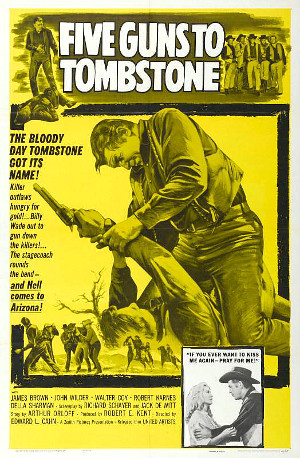
Outlaw Matt Wade (Robert Karnes) escapes from prison and rejoins his old gang. They ride out to Tombstone, Arizona, stopping off at the ranch of Matt’s brother, Billy Wade (James Brown). Billy used to be an outlaw but eventually he hung up his guns, settled down, got married, and now he’s raising Matt’s teenage son, Ted (John Wilder). Ted, who thinks that his father has just been paroled, is excited to see Matt but Billy doesn’t want Ted being led into a life of crime. When Matt and the gang rob a bank, they frame Billy for the crime. With the townspeople looking to lynch him and Ted drifting towards the wrong path in life, Billy has no choice but to pretend to be a part of the gang until he can dig up the evidence to clear his name.
If this sounds familiar, thank you for reading yesterday’s review of Gun Belt. Released seven years after Gun Belt, Five Guns To Tombstone tells the exact same story as Gun Belt and, in many case, it features the exact same dialogue. The only difference is that some of the names have been slightly changed. The gang leader in Gun Belt was named Ike Clinton. In this Five Guns To Tombstone, his name is Ike Garvey. Billy Ringo becomes Billy Wade and Wyatt Earp because Marshal Sam Jennings. Otherwise, it’s pretty much the exact same film.
Which one is the better film, Gun Belt or Five Guns To Tombstone? Both films have plenty of two-fisted, gun-slinging action and a good cast of western character actors but I’d probably have to give the edge to Five Guns To Tombstone because John Wilder is more convincing in the role of the outlaw’s son than Tab Hunter was in Gun Belt. Tab Hunter was young and callow and annoying but John Wilder is the type of confused kid that anyone could relate to.
Five Guns To Tombstone was one of the 9 films that Edward L. Cahn directed in 1960. As with most of Cahn’s films, the action seems rushed but that’s appropriate for the story that Five Guns To Tombstone is telling. (It’s also understandable. When you’re directing 9 films a year, you don’t have the luxury of taking your time.) Like Gun Belt, this is hardly a classic but western fans should enjoy it.
4 Shots From 4 Films is just what it says it is, 4 shots from 4 of our favorite films. As opposed to the reviews and recaps that we usually post, 4 Shots From 4 Films lets the visuals do the talking!
98 years ago today, the British director Guy Hamilton was born. Though Hamilton rarely seems to get as much credit as Terence Young, he was one of the most important of the early James Bond directors. With Goldfinger, he set the template the many subsequent Bond films would follow: an over-the-top villain, nonstop action, and one liners. (“No, Mr. Bond, I expect you to die.” Not to mention, “I must be dreaming.”) Hamilton went on to direct Sean Connery’s final Bond outing and he also directed the first twofilms to star Roger Moore as 007, all three of which are rather underrated in my opinion. Guy Hamilton’s Bond films reminded us that James Bond’s cinematic adventures work best when they’re fun to watch, which is something that I think the modern Bond films would be well-served to consider.
In honor of Guy Hamilton’s contributions to my favorite film franchise, here are….
4 Shots From 4 Films
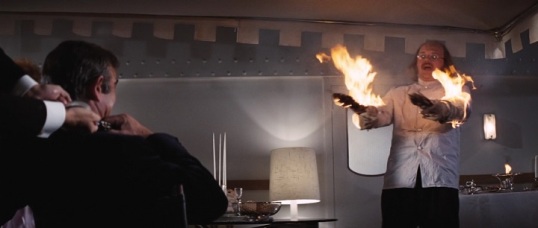
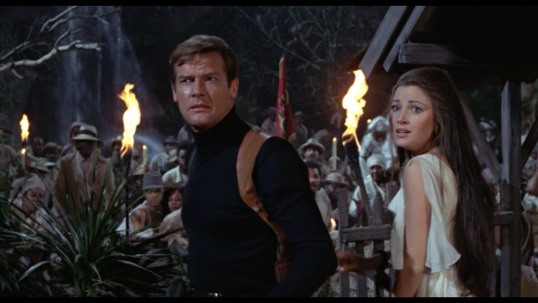
Goldfinger (1964, dir by Guy Hamilton)
Diamonds are Forever (1971, dir by Guy Hamilton)
Live and Let Die (1973, dir by Guy Hamilton)
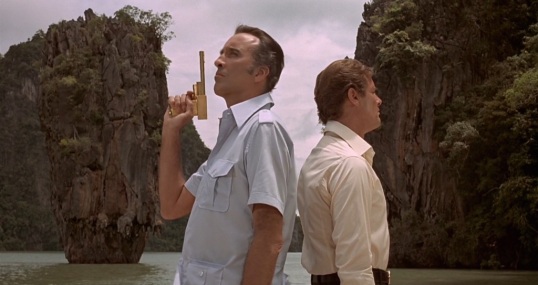
The Man With The Golden Gun (1974, dir by Guy Hamilton)
It’s a monster apocalypse and only Dylan O’Brien can save us!
Listen, I don’t know if the film’s going to be any good or not but we should all be happy that Dylan O’Brien is still with us. After he was seriously injured during the filming of the the last Maze Runner film, a lot of people thought that he might never return to films.
As for this film, Michael Rooker’s in it and that’s often a good sign. It looks like it might be fun. We’ll find out for sure on October 16th!
The Trial of Chicago 7 has been on the Oscar radars of several observers ever since this year began. Not only does it have a big-name cast but some feel that, in telling the story of the trial of a group of protesters, the film is well-positioned to take advantage of the current political zeitgeist.
Or something like that. To be honest, I just like using the word “zeitgeist.”
To be absolutely honest, the fact that Aaron Sorkin is involved in this just makes me cringe. This is exactly the type of project that will probably bring out his worst instincts as both a writer and a director. Will the film feature any prominent female characters and, if so, how much time will be devoted to them being put in their place by the witty men of Sorkin Land? I guess we’ll have to watch to find out.
Anyway, here’s the trailer. The film will be coming out on Netflix sometimes this year.
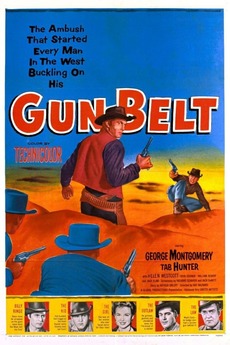
Outlaw Matt Ringo (John Dehner) escapes from prison and reunites with his old gang. Riding out to Tombstone, Matt tracks down his son, Chip (Tab Hunter). Chip is now living with his uncle, Billy Ringo (George Montgomery). Billy was once a member of Matt’s gang but he’s gone straight, he’s given up his guns, and he now has a ranch of his own. Billy tries to keep the naive Chip from idolizing his father but Chip is bored with life on the ranch. Matt not only works to turn Chip against his uncle but he also frames Billy for a bank robbery. With the town convinced that Billy has returned to his outlaw ways, Billy has no choice but to reach out to the most honest lawman in town, Wyatt Earp (James Millican).
The most interesting thing about this western is the way that it blends real people, like Wyatt and his brother Virgil (Bruce Cowling), with characters who were obviously fictionalized versions of the participants in the gunfight at the OK Corral. The Ringos are obviously based on Johnny Ringo who, as anyone who has seen Tombstone has seen you, never went straight in real life. Meanwhile, the head of the gang is named Ike Clinton. Did someone misspell Ike Clanton’s name while writing the script or was the name really changed for some unknown reason? Ike Clanton wasn’t around to sue over the way he was portrayed in the movie.
Beyond the mix of a little truth with a lot of fiction, Gun Belt is a traditional western with bad outlaws and upstanding lawmen and a naive cowpoke who has to decide whether he wants to follow the path of good or evil. George Montgomery has the right presence to be a believable as both a retired outlaw and rancher and James Millican brings quiet authority to the film’s version of Wyatt Earp. Western fans will be happy to see Jack Elam in the role of one of the gang members. The only really false note is provided by Tab Hunter, who comes across as very young and very callow and not believable at all as someone who could work on a ranch or successfully pursue a career as a professional lawbreaker.
Seven years after it was released, Gun Belt was remade as Five Guns To Tombstone.
4 Shots From 4 Films is just what it says it is, 4 shots from 4 of our favorite films. As opposed to the reviews and recaps that we usually post, 4 Shots From 4 Films lets the visuals do the talking!
126 years ago today, the great French film director Jean Renoir was born in Paris! The son of Pierre-Auguste Renoir, Jean would go on to become just as revolutionary a force in the world of cinema as his father was in the world of painting. Today, in honor of the birth and legacy of Jean Renoir, here are….
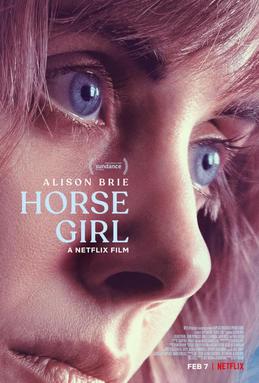
Horse Girl tells the story of a lost woman named Sarah (played, in a bravely committed performance, by Alison Brie).
Sarah is an introvert who works in a craft store, where she can tell the customers exactly the right type of paint to buy and where she’s watched over by her friendly co-worker, Joan (Molly Shannon). During the day, she occasionally visits the grave of her mother, who committed suicide. Sometimes, she might have a conversation with her wealthy stepfather (Paul Reiser). She enjoys going out to the stables and watching a horse named Willow. When she was a little girl, she rode Willow and she still thinks of him as being her horse. The owners of the stable, however, are never particularly enthused to see Sarah hanging around. In one scene, Sarah attempts to give advice to the girl who was just riding Willow, despite the fact that the girl obviously has no idea who Sarah is. Despite her good intentions, Sarah tends to be so awkward in her attempts to socialize that she just leaves people feeling uncomfortable.
When she’s not at work or at the stables or trying to fit in with the other students at her zumba class, Sarah lives in an apartment with her roommate, Nikki (Debby Ryan). While Nikki has a boyfriend, Sarah spends most of her nights in her living room, watching a cheesy sci-fi adventure show called Purgatory. She knows every detail about the show and is always shocked when no one else is as interested in it as she is.
In short, Sarah is a misft but she’s a familiar misfit. We all probably know someone like Sarah. At the very least, we all follow someone on twitter who is like Sarah, someone who always seems to be trying to make a connection but who can never quite get comfortable enough to just relax and be herself.
Strange things start to happen to Sarah. She hears voices in the apartment. She has dreams in which she’s lying on the floor of what appears to be a spaceship. Sarah starts to sleepwalk and is soon waking up to find herself in random locations. When she sees a picture of her grandmother, she wonders if it’s possible that she’s a clone. Strange scratches start to appear on the walls of her apartment. Did Sarah put them there or are they result of something coming after her?
Horse Girl is a surprisingly effective film, one that keeps you guessing as to whether or not what we’re seeing is really happening or if it’s all just occurring in Sarah’s head. Horse Girl was produced by Duplass Brothers Productions and it really does feel like a mumblecore version of Repulsion, with Alison Brie stepping into Catherine Deneuve’s role of the repressed young woman who finds herself a prisoner of her own fears. Whereas Repulsion featured arms growing out of the walls, Horse Girl features alien abductions and clones.
It’s a film that is sometimes heart-breaking and occasionally darkly funny. As much as we care and worry about Sarah, the people around her are interesting as well. The world that Horse Girl creates feels very real and very familiar and even the actors in the smallest roles create an indelible impression. This is one of those rare movies where it actually seems like the characters in the film all have a life even when they’re not in a scene. Every performance and every character feels real and authentic. I particularly liked the performance of Molly Shannon, who brings a very natural and sincere kindness to the role of Sarah’s co-worker. Playing Sarah’s father and Sarah’s gently humorous doctor, Paul Reiser and David Paymer shine in small roles.
That said, the film works best as a showcase for Alison Brie, who is both sympathetic and, eventually, more than a little frightening in the role of Sarah. Brie gives such an emotionally vulnerable performance as Sarah that there are times when you really wish that you could step into the film yourself and assure her that everything’s going to be okay. It’s also a rather brave performance, one that wins our sympathy while also showing why the increasingly manic Sarah might be too much for some people to take.
I have to admit that I wasn’t necessarily expecting much when I started watching a film called Horse Girl but it turned out to be one of my favorite films of 2020 so far.
 When a gang of outlaws attempt to rob a bank in the small frontier town of Plainview, the local sheriff is one of the first people to get gunned down. It falls upon two local men, George Henderson (Frank Ferguson) and storeowner Jack Wright (Fred MacMurray), to run the outlaws out of town. While most of the gang escapes, Jack and Henderson manage to kill the gang’s leader, Alvin Dennis.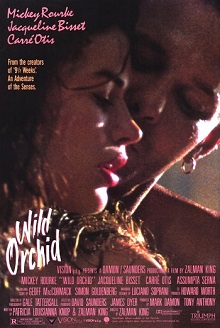





 Through the Shattered Lens