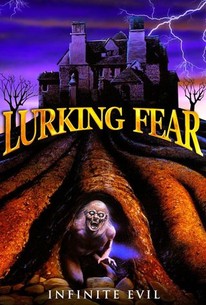
The Lurking Fear (1994, directed by C. Courtney Joyner)


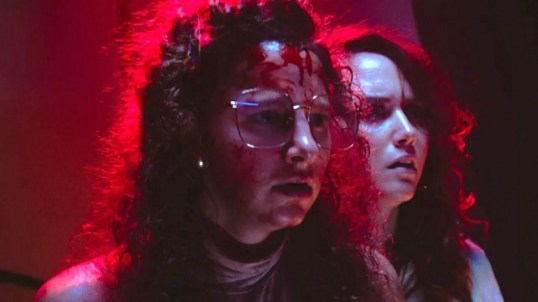
For years, the town of Leffert’s Corners has lived in fear of the criminal Martense family.  The family’s youngest son, John (Blake Bailey), has just been released from prison and now he’s returning home.  He knows that, before he died, his father arranged for a thousand dollars to be buried in the cemetery.  After the town mortician (Vincent Schiavelli, in a too brief cameo) tells him where it is, John heads to the cemetery.  Unfortunately, he’s followed by crime boss Bennett (Jon Finch) and his thugs.

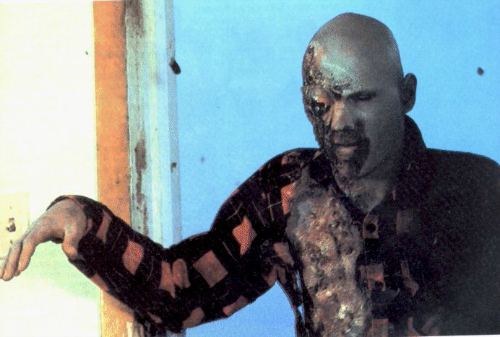
Cathryn (Ashley Laurence) and Dr. Haggis (Jeffrey Combs) are already at the cemetery, though not for the money.  It turns out that subterranean monsters (all of whom are descended from one John’s relatives) are living underneath the cemetery grounds and terrorizing the town.  Cathryn and Haggis are planning on blowing up the graveyard but that plan is put on hold when John and Bennett arrive.  Underground monsters or not, Bennett is planning on getting that money and if that means holding everyone hostage in a church while the monsters prepare to attack, that is exactly what he is going to do.

As is evident by the welcome presence of Jeffrey Combs, The Lurking Fear is another Full Moon production that was loosely adapted from a H.P. Lovecraft short story.  The premise has promise and the cast is full of talent but the film’s direction is flat, the script is shallow, and the monsters themselves look good but there’s nothing that set them apart from a dozen other monsters that have appeared in Full Moon productions.  (The monsters resemble the dungeon dweller from Castle Freak but they are never as scary.)  It’s too bad because The Lurking Fear is one of Lovecraft’s best short stories and it seems like one that would make a great movie.  But, as a movie, The Lurking Fear, like so many other Full Moon productions, doesn’t seem to know what to do with itself whenever the monsters aren’t around.  Hopefully, someday, Lovecraft’s The Lurking Fear will get the film adaptation that it deserves.
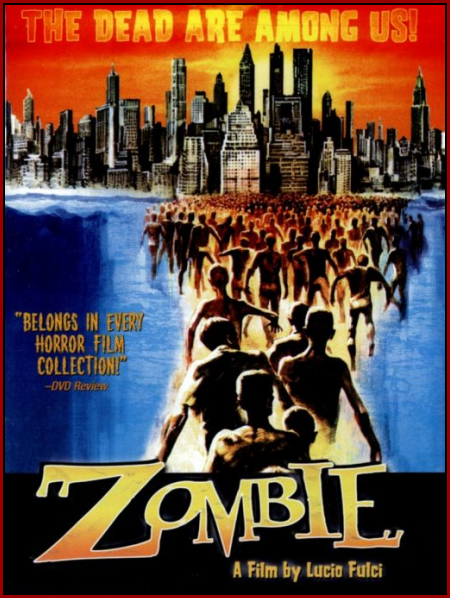
Horror Scenes That I Love: The Hospital Battle from Zombi 2


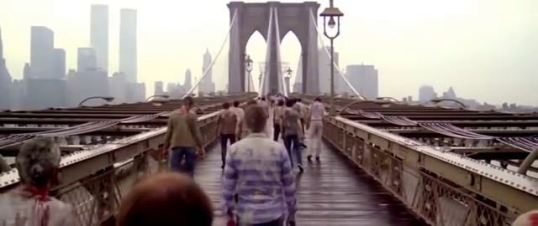
In this scene from 1979’s Zombi 2, a group of humans try to destroy the zombies that are invading a small hospital on an isolated island.  Director Lucio Fulci later pointed out, in many interviews, that he used the same clips of Al Cliver throwing a Molotov cocktail and firing a shotgun multiple times in the scene.

Two things to note about this scene:

First off, it captures what is truly scary about zombies.  They are relentless.  They do not stop coming.  No matter how many you destroy, there’s always another one following behind it.

Secondly, Italian zombies actually looked like decaying walking corpses that are on the verge of falling apart.  That was one huge difference between the Italian zombie films and many of the ones that were made in America.

6 Shots From 6 Horror Films: 1979


4 Or More Shots From 4 Or More Films is just what it says it is, 4 shots from 4 of our favorite films. As opposed to the reviews and recaps that we usually post, 4 Shots From 4 Films lets the visuals do the talking!

This October, I’m going to be doing something a little bit different with my contribution to 4 (or more) Shots From 4 (or more) Films.  I’m going to be taking a little chronological tour of the history of horror cinema, moving from decade to decade.

Today, we take a look at a very important year: 1979.

6 Shots From 6 Horror Films: 1979

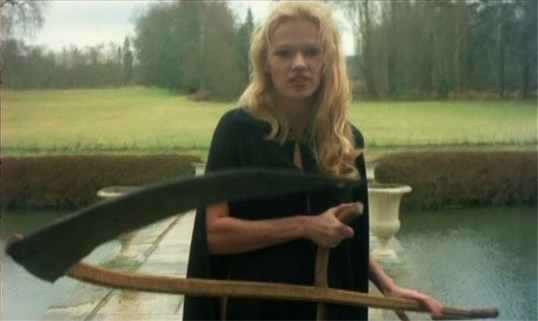
Fascination (1979, dir by Jean Rollin)

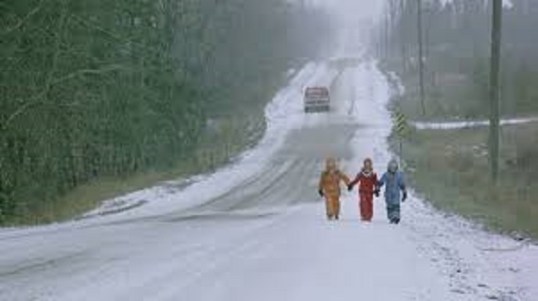
The Brood (1979, dir by David Cronenberg, DP: Mark Irwin)

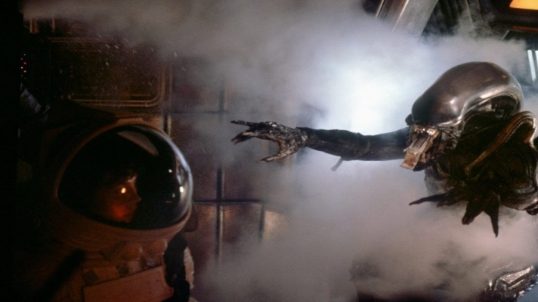
Alien (1979, dir by Ridley Scott, DP: Derek Vanlint)

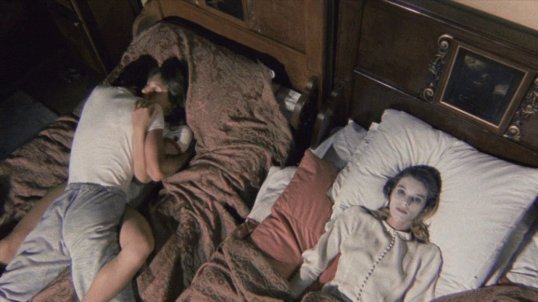
Beyond the Darkness (1979, dir by Joe D’Amato, DP: Joe D’Amato)

Nosferatu The Vampyre (1979, dir by Werner Herzog, DP: Jörg Schmidt-Reitwein)

Zombi 2 (1979, dir. Lucio Fulci, DP: Sergio Salvati)

Horror Film Review: The Little Girl Who Lives Down The Lane (dir by Nicolas Gessner)


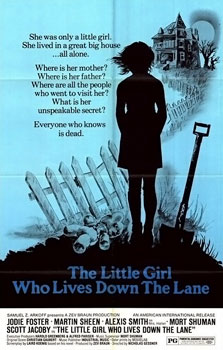
First released in 1976, The Little Girl Who Lives Down The Lane tells the story of Ryann Jacobs (played by Jodie Foster, who was thirteen years old when she made this film).

Rynn lives in a small New England town, in a house that her father has leased for three years.  It’s been a while since anyone has seen Rynn’s father.  Rynn always tells everyone that he’s either out of town or that he’s busy in his study and can’t be disturbed.  When the friendly local policeman (Mort Schuman) expresses some doubt about Rynn’s claim that her father is working, Rynn says that her father is a drug addict, like all of the great poets.

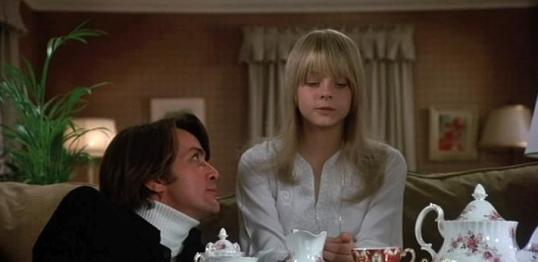
Rynn’s main problem is with the Halletts.  Cora Hallett (Alexis Smith) owns the house in which Rynn is living.  Cora drops by regularly, haughtily demanding to see Rynn’s father.  Her creepy son, Frank (Martin Sheen), also makes a habit of visiting.  He’s not interested in Cora’s father.  Instead, he’s interested in Cora.  Everyone in the town knows that Frank is a perv but no one is willing to do anything about it.  He’s protected by his mother’s money.

One day, when Cora drops by, she insists on going into the basement.  She says she has something down there that she needs to retrieve.  Rynn tells her not to go down there but Cora refuses to listen, which turns out to be a huge mistake.  Cora screams at what she sees down there and then falls to her death.  With the help of her only friend, Mario (Scott Jacoby) an aspiring magician who walks with a limp, Rynn covers up the murder.

Mario turns out to be a very good friend, indeed.  Not only does he tell people that he’s seen Rynn’s father but he even stands up to Frank when he shows up at the house, searching for his mother.  However, as it soon becomes clear, Frank isn’t one to give up so easily….

The Little Girl Who Lives Down The Lane is an interesting hybrid of a film.  It definitely does have elements of horror.  The running theme throughout the film is that Rynn might kill people but it’s all the adults in her life who are truly monstrous.  Frank is truly a monster and Martin Sheen gives a remarkably intense and creepy performance in the role.  Frank is the type who will say that worst things imaginable and then smirk afterward, confident that he’ll never have to face any sort of justice for his crimes.

At the same time, the film is also a coming-of-age-story and a teen romance.  Rynn and Mario are two outsiders who find each other.  You like both of them and you want things to work out for them, even though you spend almost the entire film worried that Rynn might end up poisoning Mario.  Foster and Jacoby share some genuinely sweet scenes.  Things would be just fine, the film seems to be saying, if all of these stupid adults would just mind their own business.

The Little Girl Who Lives Down The Lane is an effectively creepy and sometimes even sweet little film about a girl who occasionally has to kill people.  Keep an eye out for it!

Horror on the Lens: Bride of the Gorilla (dir by Curt Siodmak)


In the 1951 film, Bride of the Gorilla, Raymond Burr plays a plantation manager who commits a murder.  Unfortunately, for him, the murder is observed by a witch who promptly puts a curse of Burr.  Now, every time the sun goes down, Burr transforms into a gorilla and goes wild in the jungle.

Basically, it’s kind of like The Wolf Man, just with a less sympathetic protagonist and a gorilla instead of a werewolf. Just in case we missed the similarities, Lon Chaney, Jr. plays the film’s nominal hero, a police commissioner who suspects that something weird might be happening with Burr.  Apparently, the plan was originally for Chaney to play the gorilla and for Burr to play the policeman but, because Chaney was dealing with a serious alcohol problem at the time, the roles were reversed.

Also in the cast, playing the role of Dina, is Barbara Payton, the tragic actress who is best known for being at the center of a love triangle involving actors Tom Neal and Franchot Tone.  In 195000, Neal attacked Tone and beat him so severely that Tone spent 18 hours in a coma.  Tone was notably shaky onscreen for the rest of his film career while Neal spent a few years in prison.  After the incident between Tone and Neal, Payton could only get roles in B-movies like this one.  Tragically, she would pass away, in 1967, of heart and live failure.  She was only 39 years old.

October Positivity: Time Changer (dir by Rich Christiano)


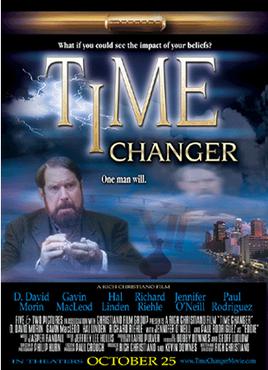
The 2002 movie, Time Changer, tells the story of Russell Carlisle (D. David Morin).  Russell is a bible professor who has written a book called The Changing Times.  The Changing Times encourages everyone to live a good, moral life but it doesn’t specifically state that they should live a good, moral life because Jesus says so.  Dr. Norris Anderson (Gavin MacLeod) argues that the book will actually not lead people to become better but will instead lead them away from Christianity by convincing them that all they have to do is be nice.  Carlisle disagrees.

Luckily, Anderson just happens to have a time machine in his basement!  When Russell comes over to discuss the book, Anderson suggests that Russell go into the future and see just how changed the world has become.  Mostly to humor Anderson, Russell agrees and steps into the machine.

And suddenly, Russell Calirlise is in the year 2002!

What does Russell discover?  He learns that even movies about good people still feature things that he finds objectionable.  He discovers that even people who go to church don’t always live a perfect life.  In 1890, Russell was shocked to learn that the divorce rate was 5% so you can only imagine how he reacts when he goes to 2002 and continually runs into people who talk about their ex-wives.  Russell also gets upset when he hears some teenage girls talking about sneaking out of the house and going on an unchaperoned date.  The horrors!

To be honest, there’s been a lot of movies that have told similar stories to Time Changer.  Someone from the past comes to the “present,” and is shocked to discover how much the world has changed.  Time Changer is unique that it’s totally on Russell’s side and essentially argues that we would all be better off if we still embraced the culture of the 1890s.  If that sounds a bit preachy, that’s because it is a bit preachy.  Interestingly enough, the film has no trouble having Russell explain how he, as someone from 1890, feels about dating, entertainment, and honesty but it leaves out how an 1890 man like Russell would have viewed women or people of color.  Russell is shocked by the casual use of bad language but, conveniently for the film’s efforts to make him a sympathetic character, he doesn’t raise an eyebrow at suddenly finding himself in a multiracial society.  It’s easy to argue for a return to 1890 morality when you ignore everything that was bad about the 1890s.

That said, the film has a few intentionally amusing moments, even if they’re exactly the type of moments that you would expect to see in a film about time travel.  (For example, Russell finds himself fascinated by a light switch.)  D. David Morin gives a likable performance Russell and the scene where Anderson hurriedly explains how time travel works as a nice little satire of the genre.  It’s far too preachy to really be effective but Time Changer is not a total waste of time.  That said, I would far rather live in 2022 than 1890.

The TSL’s Horror Grindhouse: Revealer (dir by Luke Boyce)


Taking place in 1980s Chicago, Revealer tells the story of two seemingly different women.

Angie (Caito Aase) is a stripper who spend most of her day in an incredibly sleazy peep show booth.  The men that she dances for are a collection of grotesque pervs.  (Keep an eye out and you’ll notice a sign warning that “wet dollar bills” will not be accepted.  Ewww!)  Angie is under no illusions about where she’s working or who is paying to watch her but she needs the money.  She’s putting up with a lot of crap in order to giver her nephew the type of stable life that she’s never had and, understandably, she doesn’t have much patience for anyone who would judge her for it.

Sally (Shaina Schrooten) is someone who spends almost all of her time judging.  For weeks, she has been leading protests in front of Angie’s place of employment.  As soon as Angie shows up for an extra shift, she is confronted by Sally.  Sally claims that Angie is “a harlot” who is leading people down the path of sin and damnation.  Angie says that Sally is just jealous because she’s never truly live her life.

Together …. they solve crimes!

No, actually, they don’t.  Instead, they find themselves forced to deal with some theological issues when a horned demon unleashes an army of snakes on the world.  Angie is trapped in her peep show booth, with no way to get out.  Sally, fleeing from the demons, ends up outside the same booth.  Sally is convinced that the apocalypse has begun.  Angie just wants to get back to her nephew.  Despite their differing views and their initially antagonistic relationship, Angie and Sally are going to have to work together in order to survive.  Along the way, hidden truths are revealed.  Angie and Sally learn that they’re not so different and they even start to become friends.  But does that matter, considering that the world apparently ended in 1987?

I had a mixed reaction to Revealer.  On the one hand, there’s something wonderfully subversive about setting a film about the end of the world in the distant past.  If nothing else, it keeps the viewer off-balance.  (I was reminded a bit of how 2001’s Donnie Darko predicted that the world would end in 1988.)  As well, the two leads both did a good job with their characters, adding depth and nuance to two roles that could have easily become clichés.  In the role of Sally, Shaina Schrooten gave an especially good performance.  I wasn’t particularly shocked when Sally revealed her big secret but Schrooten’s performance still made the scene effective.

On the negative side, the snakes were frightening but the demon who controlled them obviously fell prey to the film’s low budget and looked a bit less impressive.  As well, the script itself was often overwritten.  Sally and Angie’s constant debate over religion felt more than a little heavy-handed.  (I mean, it’s easy to win an argument when the screenwriter is on your side.)  Even more importantly, they tended to disrupt the flow of the film.  Too many scenes stopped dead in their tracks so that Sally could quote the Bible and Angie could get upset about it.  Since neither had anything to say about their beliefs that hadn’t already been said in a hundred other movies, their arguments were occasionally a bit dull, despite the best efforts of Caito Aase and Shaina Schrooten.

Revealer was uneven, though the ending was certainly effective and both of the lead actresses did a good job bringing their characters to life.  Watching the film, I wondered if maybe the world did end in 1987 and the rest of us just haven’t noticed yet.

Smiling Woman 2, Review by Case Wright


Well Alex, here we are…again. I guess the demon-lady’s still smiling and will break dance her way into another murder-hug. Why can’t she visit me prior to watching this short? Come and get me!!!

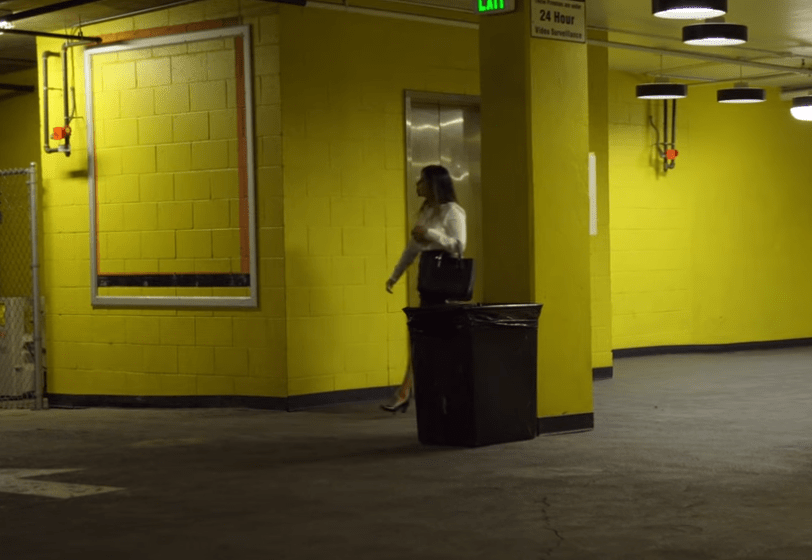
We open with a parking garage and a business woman walking alone. Note: I can’t know this for sure without looking her up on imdb, but the actress seems really short. In fact, she doesn’t look much taller than the wastebasket next to the pillar in the parking garage.

Help me….*she squeaked*

I don’t know why Alex had the wastebasket in the shot; it gave her scale and made her so tiny. I will give Alex credit that he cast Ariel Fullinwider again, but now in the role of the smiling woman because it gives us the lifecycle of the creature. It goes around trying on flesh like “rent a runway”; so, it’s like a “rent a skin suit” *working corporate name*.

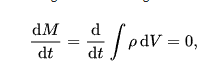
This whole skin suit thing doesn’t work for me in terms of Conservation of Mass, NO. Matter can neither be created or destroyed and this victim is really short; so, I don’t think the skin suit will work. Mathematically, it’s proven from this straight forward differential equation:

row= density, t= time, delta = divergence, and V= fluid velocity.

Basically, you can’t put a normal sized lady into smaller lady without it looking like a Michelin Man.

Depiction

Alex could’ve called and we could’ve worked through these partial derivatives together. Listen, I know what some of you are saying:

Case, you could’ve just shown me a straight-forward integral:

The change in Mass (M) of the monster about absorb short-lady would have to expand in mass and it wouldn’t matter how long you took. Monster Smiling Lady + Short Lady = Bigger Monster Lady because the total mass can’t change. Maybe she pooped the little lady out? No, I tell you, NO because she’s going from big to small; there is NO WAY that little lady could poo that much skin suit wearing monster. It fails in so many ways.

Furthermore, the whole “Breakin 2” monster moves is weird and the second lady gets absorbed with a smile-face with no mathematical proof to undue my clear and exciting explanation above. Alex does not get to break a fundamental law of physics because he’s not good at things. I get it the monster’s gotta eat or whatever, but there’d still be leftovers- an “Ariel Fullinwider To Go bag” if you will. Alex- you’re on notice!

BOOM!

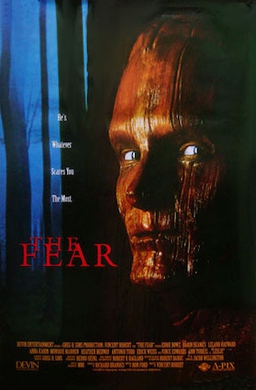
The Fear (1995, directed by Vincent Robert)


Psychology student Richard (Eddie Bowz) wants to conduct a study.  After getting permission from the head of his department, Dr. Arnold (Wes Craven!), Richard gathers together a group of students and takes them to his family’s cottage.  He introduces the group to “Morty,” a life-sized wooden dummy who Richard has had ever since he was a child.  Morty, Richard explains, was carved by a Native American shaman and was then stolen by Richard’s grandfather.  Each member of the group is told to confess their greatest fear to “Morty.”  Even Richard takes part, confessing that he was scared of Morty when he was growing up.

File this one under “it seemed like a good idea at the time,” because the weekend quickly heads south.  Richard’s uncle (Vince Edwards) shows up unannounced with his new girlfriend, Tanya (Anna Karin).  Members of the group start to disappear and one of them is assaulted at a Christmas carnival, leading the group to suspect that one of them might be the rapist who has been attacking women on campus.  Morty starts to show up in an unexpected rooms in cottage and it appears that everyone’s fears are starting to come true!

The Fear is one of those films that used to show up on late Cinemax but I mostly remember it because it was one of those movies that always seemed to be on display at our local Blockbuster.  The VHS cover featured Morty giving someone the side-eye and looking dangerous.  Morty is the best thing about the movie.  Just looking at him is unsettling.  Why would Richard be stupid enough to tell people to confess their fears to Morty?

Morty is creepy but the movie doesn’t seem to know what to do with him.  Sometimes, Morty is evil and can move on his own and even seems to be capable of possessing someone.  Other times, the movie seems to suggests that everything that’s happening is just in Richard’s head and Morty is just a wooden dummy.  The story becomes impossible to follow as every member of the group is revealed to have a secret and Richard is finally forced to admit that there is something that he’s even more scared of than Morty.  (If, as the film suggests, Morty is mostly after Richard, why does Morty first waste so much time on the other members of the group?)  The Fear is not without ambition.  It takes the therapy scenes seriously and Eddie Bowz does seem like he’s trying to give a believable performance as Richard.  It seems like the people involved wanted to make a good movie.  But once everyone’s fears start to come true and the movie moves into a ridiculous subplot about Richard and his stepsister, the movie is too disjointed to work.  It doesn’t help that most of the fears are too mundane to really translate into an imaginative death scene.  By the end of it all, not even Morty’s that scary anymore.

Horror Scenes I Love: The End of The Original Dawn of the Dead


The original Dawn of the Dead, which was released in 1978 and directed by George Romero, is not only one of the most influential horror films of all time.  (Even more so than Night of the Living Dead, Dawn was responsible for inspiring the Italian zombie boom.)  It’s also a rather dark satire of humanity and commercialism.  With the world ending, both humans and zombies head to the mall.  Briefly, the humans manage to form their own peaceful society but, inevitably, they end up screwing it all up.  The Dead may be slow and not particularly intelligent but, as poor old Steve discovered in that elevator, they’re absolutely determined to get what they want.

Dawn of the Dead ends with an apocalytpic combination of bikers, zombies, and one helicopter that has next to no fuel.  Our two remaining survivors head off in search of some place safe but we all know that helicopter isn’t going to stay in the sky for long.  In its way, the ending of Dawn of the Dead is even more bleak than the end of Night of the Living Dead.  The characters in Night of the Living Dead were dealing with a menace no one understood and their inability to work together was largely the result of shock and panic.  In Dawn of the Dead, everyone knows that the Dead are returning to life and everyone knows how to stop them but people still cannot set aside their differences long enough to do so.  Even with the world ending, Peter gets some joy out of shooting one of the (living) bikers.  His smirk suggests that one doesn’t need to be a zombie in order to sacrifice their humanity.

With the end of this film, Romero’s message is clear.  Society gets what it deserves.