A Blast From The Past: The Holy Roman Empire


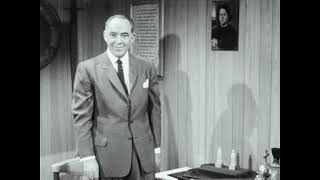
It may seem strange to celebrate the Ides of March by sharing an educational film about The Holy Roman Empire, seeing as how it was famous for being neither holy nor Roman nor an Empire.  But then again, the fact that the name “Roman Empire” was still being appropriated into the 19th century shows you just how powerful a hold the Roman Empire had over people’s imaginations.  Everyone wanted to be Roman and everyone wanted to be a part of an empire.  Of course, there would have been no Roman Empire if not for the Ides of March.

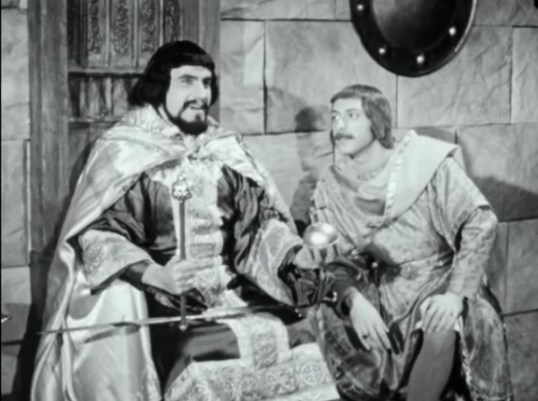
Add to that, this 1961 film features not only a teacher but also historical reenactments.  I love cheap looking historical reenactments!

Here, for your educational viewing, is a blast from the past.  From 1961, it’s a look at The Holy Roman Empire!
4 Shots From 4 Films: Special David Cronenberg Edition


4 Or More Shots From 4 Or More Films is just what it says it is, 4 shots from 4 of our favorite films. As opposed to the reviews and recaps that we usually post, 4 Shots From 4 Films lets the visuals do the talking!

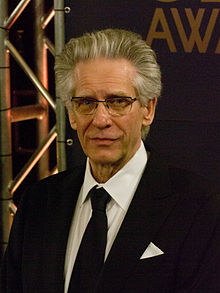
Today, the Shattered Lens wishes a happy birthday to one of our favorite directors, David Cronenberg!  No one has done more to change the way that the world views Canada than David Cronenberg.  Last year, Cronenberg came out of a ten-year retirement to film Crimes of the Future.  Next up, a film called The Shrouds, a film that is described as being a businessman who discovers a way to communicate with the dead.

Here are….

4 Shots From 4 David Cronenberg Films

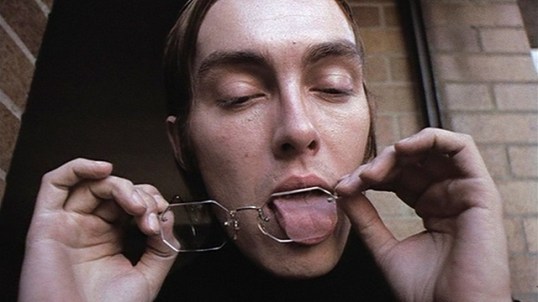
Crimes of the Future (1970, dir by David Cronenberg, DP: David Cronenberg)

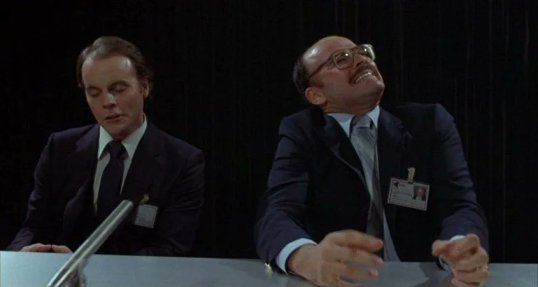
Scanners (1981, dir by David Cronenberg, DP: Mark Irwin)

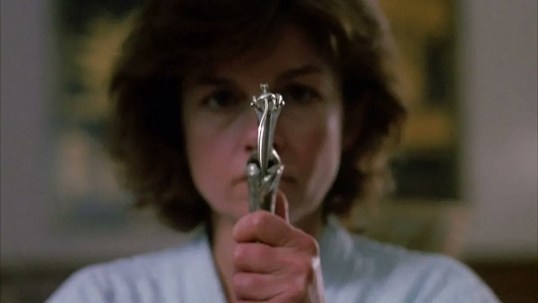
Dead Ringers (1988, dir by David Cronenberg, DP: Peter Suschitzky)

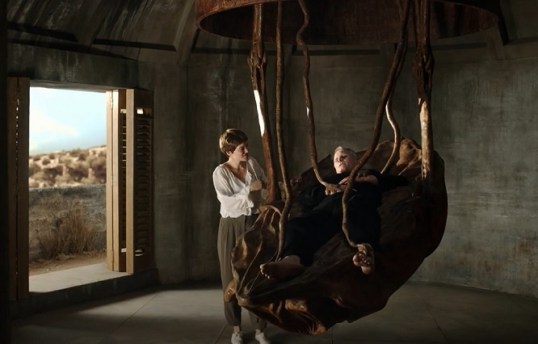
Crimes of the Future (2022, dir by David Cronenberg, DP: Douglas Koch)

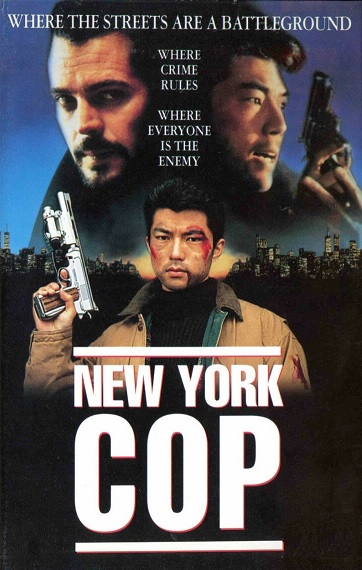
New York Cop (1993, directed by Tôru Murakawa)


Toshi (Tôru Nakamura) is a tough New York cop who is assigned to work undercover in the East Village because, according to his boss, no one will suspect that a Japanese man is actually a cop.  Disguising himself as a homeless gambling addict who has connections with the Tongs, Toshi infiltrates the Brotherhood.  He becomes friends with the gang’s leader, Hawk (Chad McQueen), and he even falls in love with Hawk’s sister, Maria (Mira Sorvino!).  Hawk is buying guns from a mobster named Mr. C (Tony Sirico!!) and Mr. C’s main assassin, Ferrara (Andreas Kastsulas), is driving around New York in a taxi cab and killing undercovers.  Can Toshi take down Mr. C without compromising his relationship with Maria and revealing that he’s actually an undercover cop?  The short answer is no.

New York Cop works best when it focuses on action.  Tôru Nakamura is convincing in the fight scenes but he’s less convincing whenever he has to show emotion or have a conversation with anyone.  The idea that the NYPD would send a Japanese cop undercover to infiltrate a Hispanic gang never makes makes much sense, as Toshi himself points out when the idea is first brought up.  Toshi never makes much of an effort to disguise the fact that he is a cop, which makes Hawk look incredibly stupid for not seeing through him.  The main appeal for most people will probably be the chance to see Tony Sirico and Mira Sorvino in early roles.  Sirico, the former gangster-turned-actor, is convincing as Mr. C and gets all of the film’s best lines.  As for Mira Sorvino, this was only her second or third film role and the script doesn’t give her much to work with.  There are a few scenes where she gets to bring some genuine New York attitude to her character, telling off both her brother and Toshi.  But otherwise, there’s little about her performance that suggests the actress that she would become.  Fortunately, films like Barcelona and Sweet Nothing were right around the corner.

As far as New York cops go, nothing has yet to beat the episode of Barney Miller where Christopher Lloyd vandalizes the station house.

The Eric Roberts Collection: Road to the Open (dir by Cole Claassen)


In 2014’s Road to the Open, Eric Roberts and John Schneider play, respectively, Tim and Rob Gollant.

The Gollant brothers are wealthy, smug, and athletic.  At the local country club, they’re not only the best golf players but also the best tennis players.  They’re the type who taunt their opponents while they’re losing.  No one really likes the Gollant brothers but people put up with them because the Gollant brothers are extremely rich.  When they tell you to get off of their bench at the club, it’s because it really is their bench.  Their names are literally on the bench.

The Gollant Brothers aren’t exactly likeable but they are fun to watch, specifically because they’re played by John Schneider and Eric Roberts.  Roberts and Schneider give perfect performances as two men who have never actually had to grow up.  They’re the type of overage high school bullies who wouldn’t stand a chance in the real world but who, fortunately, can spend all of their time hiding out at their country club.

Of course, the Gollants are not the heroes of Road to the Open.  Instead, they’re the obstacle standing in the way of Jerry McDonald (Troy McKay) and Miles Worth (Philip DeVova).  Jerry and Miles are lifelong friends who enjoy playing tennis together.  Overweight, balding, and mild-mannered, Jerry is not a typical athlete and he knows it.  Haunted by the death of his wife and raising his daughter on his own, Jerry doesn’t so much fear losing as much as he fears letting everyone down.  Miles, meanwhile, is a typical athlete, right down to the anger management issues.  Fortunately, Miles has been seeing a somewhat eccentric therapist (Judd Nelson) and he may have finally learned how to control his temper.

There’s a lot of tennis in Road to the Open but, ultimately, it’s about Jerry and Miles’s friendship and Jerry trying to find the strength to move on with his life.  Even though he meets and falls in love with Sam (Michelle Gunn), Jerry still feels as if he’s betraying the memory of his wife and, at times, he feels guilty for feeling any sort of happiness.  There’s a lot of comedy to be found in Road to the Open but, ultimately, this film is a heartfelt and rather sweet testament to friendship and love.  It’s also a well-acted film, with McKay, DeVova, and Gunn bringing a lot of likable energy to their roles.

I watched Road to the Open on Tubi.  It turned out to be a nice surprise.

Previous Eric Roberts Films That We Have Reviewed:

  1. Star 80 (1983)
  2. Blood Red (1989)
  3. The Ambulance (1990)
  4. The Lost Capone (1990)
  5. Love, Cheat, & Steal (1993)
  6. Love Is A Gun (1994)
  7. Sensation (1994)
  8. Doctor Who (1996)
  9. Most Wanted (1997)
  10. Mr. Brightside (2004)
  11. Six: The Mark Unleased (2004)
  12. Hey You (2006)
  13. In The Blink of an Eye (2009)
  14. The Expendables (2010) 
  15. Sharktopus (2010)
  16. Deadline (2012)
  17. Miss Atomic Bomb (2012)
  18. Lovelace (2013)
  19. Self-Storage (2013)
  20. Inherent Vice (2014)
  21. Rumors of War (2014)
  22. A Fatal Obsession (2015)
  23. Stalked By My Doctor (2015)
  24. Stalked By My Doctor: The Return (2016)
  25. The Wrong Roommate (2016)
  26. Stalked By My Doctor: Patient’s Revenge (2018)
  27. Monster Island (2019)
  28. Seven Deadly Sins (2019)
  29. Stalked By My Doctor: A Sleepwalker’s Nightmare (2019)
  30. The Wrong Mommy (2019)
  31. Her Deadly Groom (2020)
  32. Top Gunner (2020)
  33. Just What The Doctor Ordered (2021)
  34. Killer Advice (2021)
  35. The Poltergeist Diaries (2021)
  36. My Dinner With Eric (2022)

Lisa Marie’s Way Too Early Oscar Predictions For March


Now that the 2022 Oscars are over with, it’s time to move on to the 2023 Oscars!

Needless to say, there’s probably nothing more pointless than trying to guess which films are going to be nominated a year from now.  I can’t even guarantee that all of the films listed below are even going to be released this year.  And, even if they are released this year, I can’t guarantee that they’ll actually be any good or that the Academy will show any interest in them.  I mean, Martin Scorsese always seems like a safe bet but we all remember what happened with Silence.  For months, everyone said Silence would be the Oscar front runner.  Then it was released to respectful but not ecstatic reviews.  Audiences stayed away.  The film ended up with one technical nomination.

My point is that no one knows anything.  As much as I hate quoting William Goldman (because, seriously, quoting Goldman on a film site is such a cliché at this point), Goldman was right.

So, you may be asking, how did I come up with the nominees below?  For the most part, I guessed.  A few of them I went with because of the people who made the film.  Though shooting has wrapped, Ferrari might not even be released this year but it’s a Michael Mann film that stars Adam Driver so, for now, I have to include it.  Of course, I had to include Scorsese and Killers of the Flower Moon.  Asteroid City is there because the Academy embraced Wes Anderson once and it could always happen again.  Fair Play and Magazine Dreams‘s Jonathan Majors are listed because the Sundance Film Festival is still a recent memory.  Maestro is there because the Academy seems like to Bradley Cooper.  Dune Part Two and Oppenheimer are there because Film Twitter is convinced that they will be.

In other words, there’s no real science to these predictions.  It’s too early in the year to do anything but guess.  And for now, these are my guesses.  A year from now, they’ll be good for either bragging rights or a laugh.  Hopefully, they’ll be good for both.

Best Picture

Asteroid City

The Color Purple

Dune Part Two

Fair Play

Ferrari

The Holdovers

Killers of the Flower Moon

Maestro

Oppenheimer

Rustin

Best Director

Chloe Domont for Fair Play

Christopher Nolan for Oppenheimer

Alexander Payne for The Holdovers

Martin Scorsese for Killers of the Flower Moon

Denis Villeneuve for Dune Part Two

Best Actor

Bradley Cooper in Maestro

Colman Domingo in Rustin

Paul Giamatti in The Holdovers

Jonathan Majors in Magazine Dreams

Cillian Murphy in Oppenheimer

Best Actress

Emily Blunt in Pain Hustlers

Carey Mulligan in Maestro

Da’Vine Joy Randolph in The Holdovers

Julia Roberts in Leave the World Behind

Teyana Taylor in A Thousand and One

Best Supporting Actor

Mahershala Ali in Leave The World Behind

Willem DaFoe in Poor Things

Matt Damon in Oppenheimer

Ethan Hawke in Strange Way Of Life

Jesse Plemons in Killers of the Flower Moon

Best Supporting Actress

Emily Blunt in Oppenheimer

Tantoo Cardinal in Killers of the Flower Moon

Taraji P. Henson in The Color Purple

Florence Pugh in Oppenheimer

Tilda Swinton in Asteroid City

Scenes That I Love: Michael Caine in The Dark Knight Rises


Today, the Shattered Lens wishes a happy 90th birthday to Sir Michael Caine.

With 177 acting credits listed on the imdb, Michael Caine has been working regularly since 1956.  (Though he actually made his acting debut, at the age of 10, in a made-for-TV movie in 1946).  There are many great Michael Caine performances and scenes to choose from but, for today, I decided to go for a scene from 2012’s The Dark Knight Rises.  Caine was 79 when he played Alfred in this film and he showed that, after decades of work, he hadn’t lost a step as a performer.  As well, he also showed his ability to take a character who could have been ridiculous — the loyal butler of a superhero — and instead make him surprisingly poignant.

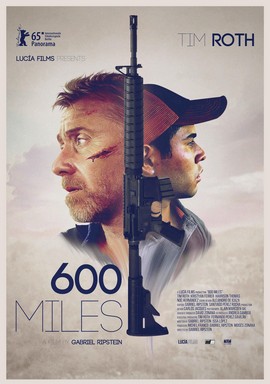
Film Review: 600 Miles (dir by Gabriel Ripstein)


The 2015 film, 600 Miles, tells the story of two people, neither of whom is quite who he originally appears to be.

Arnulfo Rubio (Kristyan Ferrer) is the 18 year-old nephew of the head of one of Mexico’s drug cartels.  Arnulfo’s job is to go across the border, purchases weapons in the United States, and then smuggle them back into Mexico.  Arnulfo likes to think of himself as being an important member of his uncle’s cartel but it’s obvious that no one has much respect for Arnulfo.  The other members of the cartel treat him like a errand boy.  His uncle merely tolerates him, no matter how many times Arnulfo tries to impress him with his loyalty.  His own mother doesn’t seem to want to have Arnulfo around the house.  While Arnulfo takes the weapon smuggling very seriously, his American partner — who is himself just as trashy teenager — treats it all like a game.  Arnulfo talks tough but whenever he’s confronted by the threat of real violence, Arnulfo starts to cry.  Arnulfo may carry a gun and he may be committing crimes but he’s still the type of immature child who draws fake tattoos on his shoulders and who makes mean faces in front of a mirror.

When an ATF agent named Hank Harris (played by Tim Roth) attempts to arrest Arnulfo, Arnulfo’s American partner knocks Hank out and then takes off running.  Not knowing what else to do, Arnulfo puts Hank in his truck and takes him into Mexico.  After Hank mentions the names of the leaders of a rival cartel, Arnulfo decides that Hank could be a good intelligence asset to his uncle’s cartel.  Arnulfo feels that kidnapping Hank will be the perfect way to win his uncle’s respect.

As for Hank, it’s hard not to notice that he doesn’t seem to be that upset about being tied up in Arnulfo’s truck.  Whenever Arnulfo tries to order Hank to do something, Hank comes up with a perfect excuse for why he can’t to do it.  When Arnulfo demands that Hank call his wife and lie about where he is, Hank replies that his wife is dead.  Arnulfo believes Hank and, as they drive to his uncle’s house, the two of them even start to bond.  Arnulfo never considers that his uncle might not want his nephew to give an ATF agent a guided tour of the cartel’s business.  And, for his matter, Hank never tries to escape despite a number of obvious opportunities to do so.

It makes for a very tense film.  The viewer knows that something bad is going to happen once Arnulfo finally reaches his uncle.  The only question is what.  For all of his tough talk, Arnulfo is way too trusting and the audience spends the movie waiting for the moment when it will be revealed whether Arnulfo’s bigger mistake was trusting his uncle or trusting Hank.  Along the way, Arnulfo and Hank’s odd friendship becomes a fascinating metaphor for how the U.S. and Mexico view each other and themselves.  The film was reportedly inspired by Operation Fast and Furious, the misbegotten government operation in which the United States gave guns to the cartels so that they could then prosecute the cartels for the deadly crimes committed with those same guns.  Arnulfo cares about both the cartel and Hank but, in the end, one is left to wonder if any of them actually care about Arnulfo or if he’s just one of many pawns in their game.

Tim Roth and Kristyan Ferrer are both well-cast, with Roth bringing his trademark intensity to the role of Hank and Ferrer making Arnulfo into someone who secretly knows that he will never be the mastermind that he dreams of being.  In the wrong hands, Arnulfo could have been a very annoying character but Ferrer plays him as being someone who knows that he’s in over his head and it’s hard not to feel sorry for him as his wishful thinking comes up against the harsh reality of his situation.  The first 20 or so minutes of 600 Miles are dedicated to Arnulfo believing that he’s on top of the world.  The remaining 60 follow him as he comes to realize that the opposite is true.

600 Miles is as timely today as when it was first released.  It’s a film that I recommend to anyone trying to understand what’s happening down on the border.

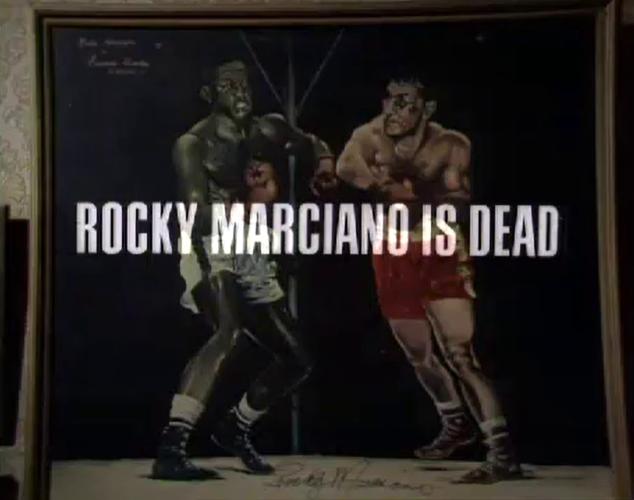
Rocky Marciano Is Dead (1976, directed by Graham Evans)


Harry Marcus (Ron Moody) was once a welterweight boxing champion but that was a long time ago.  Now, Harry is an old man who lives in small London apartment.  His daughter (Yvonne Bonnamy) visits him weekly.  Sometimes, he talks to Sonny (Jeffrey Kissoon), the squatter who is living in the abandoned apartment next to his.  Harry still likes to go back to his old gym and relive the glory days of both boxing and England.  Harry feels that those days are long gone but after he witnesses Sonny fight off a group of muggers, Harry becomes convinced that Sonny could be the next great boxer.

Harry wants to train Sonny but Sonny and his wife (Lesley Dunlop) both think boxing is barbaric.  It’s not until Harry explains that, historically, boxing has been used by the oppressed and marginalized to pull themselves out of poverty that Sonny steps into the ring.  Sonny has the talent but does Harry still have the connections to get Sonny a fight?

Rocky Marciano Is Dead was aired as a part of the BBC’s Play For Today anthology series.  It aired at the same time that Rocky was first setting box office records in the States.  Harry has a lot in common with Mickey Goldmill, the trainer played by Burgess Meredith in the first three Rocky films.  Like Mickey, he’s a former boxer who is trying to make a champ out of someone who is not sure if he has what it takes.  Rocky took place in the slums of Philadelphia while Rocky Marciano Is Dead takes place in a London that is full of abandoned buildings, gangs, and angry graffiti.  This is the London that, one year later, would inspire Johnny Rotten to sing that there was “no future in England’s dreaming.”  Not surprisingly, Rocky Marciano Is Dead is a much darker and cynical look at boxing than Rocky.  Harry is trying to recapture a past that may have never existed.

Along with providing a look at London on the cusp of the Punk Revolution, Rocky Marciano Is Dead is an acting showcase for Ron Moody.  Moody is in almost every scene, as Harry goes from being bitter to hopeful to disillusioned.  Moody makes it clear that Harry sees Sonny as something more than just a good boxer.  To Harry, Sonny is a chance to return to the time when both England and boxing were great.  If he can make Sonny a champ, Harry will be a champ too.  Harry’s mistake is not considering that Sonny might have plans of his own.  Moody was a born performer, as effective on television as in film.  He was also a perennial contender for the role of the Doctor on Doctor Who.  He was even offered the part in 1969 but turned it down, a move that he always said he regretted.  After a long career full of memorable performances in dramas, comedies, and musicals, he died in 2015 at the age of 91.  He gives a good performance in Rocky Marciano Is Dead, making Harry into something more than just an angry old man.

Rocky Marciano Is Dead can be viewed on YouTube.

The TSL’s Grindhouse: Polk County Pot Plane (dir by Jim West)


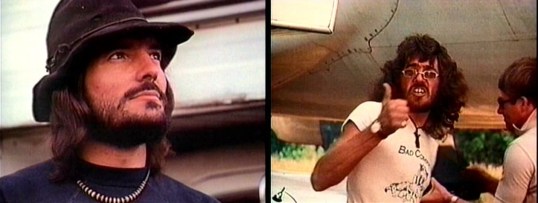
Oosh and Doosh, the stars of Polk County Pot Plane

First released in 1977, Polk County Pot Plane tells the story of Oosh (Don Watson) and Doosh (Bobby Watson), two brothers who have the long hair, country accents, and full beards of two guys who made most of their life decisions at a Lynard Skynard concert and who haven’t looked back since.

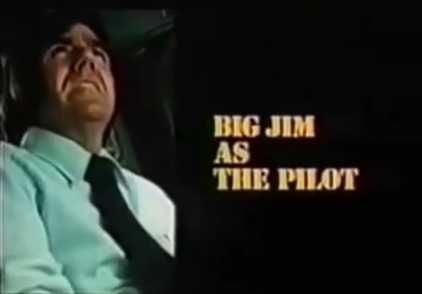
Oosh and Doosh spend most of their time hanging out in the mountains of Northern Georgia.  They pass the time drinking beer, smoking weed, and driving too fast.  Oosh and Doosh do have a job, of course.  The Dixie Mafia pays them to help unload all of the marijuana that is transported on a plane that regularly lands in the mountains.  The plane is nicknamed Big Bird and it even gets its own credit at the start of the film.

The opening credits also inform us that the pilot of Big Bird was played by an actor named Big Jim.

At the start of the film, Oosh and Doosh are unloading the plane but, unbeknownst to them, the cops have followed them out to the landing area.  When the cops finally make their presence known, Big Jim and the plane are able to escape but Oosh, Doosh, and two other hippies are arrested (and their RV practically destroyed) after a long chase.

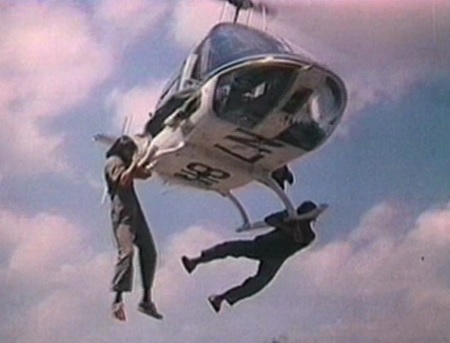
With Oosh and Doosh in the county jail, the word goes out to all the drug kingpins, which is to say that there is a lengthy montage of people picking up the phone and explaining the situation over and over again.  Eventually, a helicopter lands on top of the jail and Oosh and Doosh are able to make their escape.  The helicopter flies over Georgia with Oosh and Doosh literally clinging onto the bottom of it.

This scene was filmed without stunt people.  That really is Don and Bobby Watson hanging onto that helicopter and the scene is also makes it clear that the helicopter really was flying high above a small town with the two actors dangling underneath.  If either Don and Bobby Watson had lost their grip, they would have basically plunged to their death.  On the one hand, you might wonder how the Watsons were convinced to risk their lives for a film called Polk County Pot Plane.  On the other hand, the scene is a hundred times more effective than one might expect precisely because the risk was real.

In fact, not a single professional stunt person was used in Polk Count Pot Plane.  All of the stunts were done by the members of the cast, the majority of whom appear to have been amateurs.  The sheriff who locks up Oosh and Doosh apparently was an actual sheriff.  Big Jim actually was a pilot.  While there isn’t much information available about the Watson brothers, their country stoner vibe feels authentic from the start.  For almost the entire cast, this was their first and only film.  What they lacked in experience, they made up for in authenticity.

There’s not much of a plot to Polk County Pot Plane, though it was reportedly based on a true story.  Oosh and Doosh get out of jail and find themselves being ordered to transport more drugs.  They also rip-off their bosses and, in the end, there’s an attempt to steal the plane itself.  For the most part, the film exists so that the police can chase Oosh and Doosh and several cars can be destroyed in the process.  The minute that we see a group of people trying to transport a house from one location to another, we know that someone’s going to end driving through it and destroying the whole thing.  That’s the type of movie that Polk County Pot Plane is.  It’s low-budget, it doesn’t always make a lot of sense, and it’s definitely amateurish.

And yet, it’s also entertaining and rather likeable.  The amateur vibe helps.  Because the Watson brothers appears to have essentially been playing themselves, the film at times has a documentary vibe.  For all of the silly comedy and the mumbled lines (with the Watsons especially sounding like King of the Hill‘s Boomhauer at times), it’s hard not to feel that this film probably gets close to the truth of what it was like to smuggle marijuana in the Deep South during the 1970s.  The combination of car crashes and the film’ s stoner vibe becomes rather fascinating.

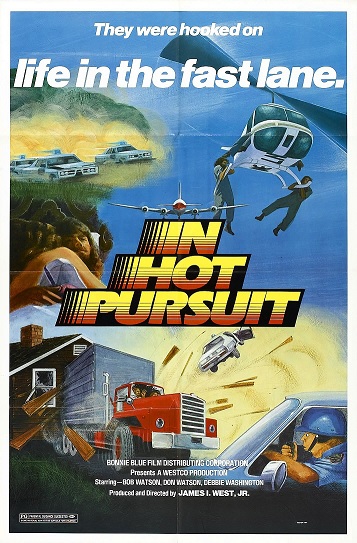
Polk County Pot Plane was also released under the title In Hot Pursuit.  It can be found in several Mill Creek box sets and on YouTube!

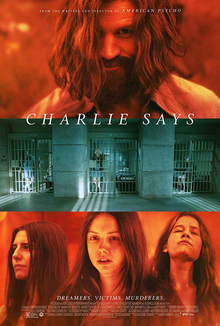
Cleaning Out The DVR: Charlie Says (dir by Mary Harron)


Why does one join a cult?

That’s a question that’s been raised by a lot of different people over the past few years.  Some people claim that MAGA is a cult.  Others claim that Wokeism is a cult.  One need only go on twitter to discover cults devoted to celebrities.  There was a crazy woman named Emma who literally spent 8 years searching twitter for any critical reference to Garrett Hedlund so that she could personally attack whoever made the comment.  I once made a rather mild joke about Jennifer Lawrence’s habit of falling at award shows and, almost immediately, I started getting angry replies from people who had J Law as their profile pick.  Once upon a time, the Beliebers ruled the twitter wastelands.  Then it was the One Direction stans.  Now, people have to be very careful about what they say about Taylor Swift and Timothee Chalamet.  What makes people devote their lives to blindly defending celebrities and politicians who don’t even know (or care) that they’re alive?

In the HBO docuseries, The Vow, Mark Vicente (a former leader of the NXIVM cult) declared that “Nobody joins a cult!”  His point was that no one willingly joins a cult.  Instead, they get involved because they’re looking for something that is missing in their lives and, sometimes, this leaves them vulnerable to being manipulated by whoever is in charge of the cult.  Vicente’s argument was that it could happen to anyone.  The subtext, of course, was that Vicente was saying, “It even happened to me and look how smart I am!”

(It’s the same thing that one tends to hear from former members of Scientology.  “Sure, all of the stuff about Xenu didn’t make any sense and the average child would have seen through it but I fell for it so that means anyone could have fallen for it!”)

My own personal opinion is that most people join cults because they’re incredibly dumb and don’t have the confidence necessary to think for themselves.  That may sound harsh but I really do think that this is a case where it’s helpful to remember the law of parsimony.  It’s tempting to come up with all sorts of complex theories to try to explain why people join cults but the simplest answer is that people joins cult because they’re dumb.  I think sometimes we spend so much time exploring the lives of those who join cults that we tend to forget that the majority of people are smart enough not to.

This was something that I found myself thinking about as I watched the 2018 film, Charlie SaysCharlie Says is one of the many recent films to explore how a grubby ex-con named Charles Manson (Matt Smith) was able to brainwash a group of hippies and turn them into his own personal army of murderers.  Charlie Says opens with Leslie Van Houten (Hannah Murray), Patricia Krenwinkel (Sosie Bacon), and Susan Atkins (Marianne Rendon) already in prison for the Tate-LaBianca murders.  A social worker named Karlene Faith (Merritt Weavers) is assigned to teach them college classes but Karlene is more concerned with trying to break the mental-hold that Manson continues to have over the three women.

The film is full of flashbacks to life at the Spahn Ranch with Charles Manson.  All of the expected details are included.  Charles Manson plays his guitar and talks about letting go of one’s ego.  A dazed Tex Watson (Chace Crawford) wanders around in the background, eager to prove that he truly is a member of the Family.  Blind George Spahn gets a handjob from Squeaky Fromme.  The women search through dumpsters for food.  The orgies give way to violence as Manson realizes that he’s never going to be a rock star.  Everyone at Spahn Ranch is happy until they aren’t.

Both the film and Karlene speculate as to how Charles Manson managed to brainwash the women who lived at the Ranch.  The film suggests that it was a combination of drugs, Manson’s own skills as a con man, and the fact that most of Manson’s followers were so eager to escape the patriarchal system under which they grew up that they didn’t realize that they had wandered right into another.  Of course, it could also be that Manson’s followers were just extremely stupid.  One thing that I have discovered from reading about Manson is that, while there was many people who decided to follow him, there were even more who took one look at him and Spahn ranch and who, much like Brad Pitt in Once Upon A Time In Hollywood, left as quickly as they could.

(One of the more interesting things about the online reaction to Once Upon A Time In Hollywood were the complaints that the film’s finale was misogynistic due to the violent deaths of the Manson followers.  Personally, I’m against the death penalty.  I view it as a classic example of putting too much trust in the government.  However, knowing what was done to Sharon Tate, I had no problem with Leonardo DiCaprio setting Susan Atkins on fire with his flame thrower.)

Mary Harron has directed many good films, including I Shot Andy Warhol, American Psycho, The Notorious Bettie Page, and The Anna Nicole Story.  Unfortunately, Charlie Says often feels like it’s meant to be a parody of all the other films about Charles Manson.  Some of that may have been unavoidable.  The horrific nature of their crimes has often overshadowed the fact that Manson and the Family were a ludicrous group of people.  Take out the crimes and they were essentially the real-life version of those dumbass commune dwellers in Easy Rider, the one who were trying to grow food in the desert.  Indeed, one of the smartest thing that Tarantino did with Once Upon A Time In Hollywood was that he used Manson and the Family sparingly.  As Charlie Says shows, the more time that a film spends with Manson, the more difficult it is to feel that the members of the Family are worth much consideration.  For the most part, the film follows Leslie Van Houten as she goes from being an insecure teenager to being a brainwashed murderer but, despite a strong performance from Hannah Murray, it doesn’t offer up much insight (beyond her own stupidity) as to how and why Leslie was so easily seduced into life at the ranch.

On the plus side, Matt Smith does a good job as Charles Manson, playing him as being a natural born con man.  As played by Smith, Manson is someone who knows how to use his hippie image to his advantage and who also knows how to read people.  The question about Manson has always been whether he believed all of his Helter Skelter nonsense or if he was just a criminal mercenary.  (The author Ed Sanders, who wrote The Family and spent years researching Manson, was of the opinion that Manson was far more well-connected with the leaders of Los Angeles’s organized crime scene that his hippie image might have suggested.)  Charlie Says suggests that Manson was a con man who ultimately made the mistake of believing his own con.

As far as Manson films go, Charlie Says doesn’t add much that hasn’t already been said.  Personally, I could do without anymore Manson films.  There’s nothing left to be learned from his horrific crimes.  Allow Once Upon A Time In Hollywood to be the last word on what the Family was and how they deserved to go out.