Film Review: Take Me Home Tonight (dir. by Michael Dowse)


I missed the 80s retro-themed comedy Take Me Home Tonight when it was released to theater earlier this year.  It was one of those films that I meant to see but then it ended up spending such a short time in theaters that I just never got the chance.  A few days ago, via OnDemand, I finally got a chance to see Take Me Home Tonight in the comfort of my own bedroom.

Plotwise, Take Me Home Tonight feels like a cinematic Frankenstein monster, stitched together from elements from all those old school 80s comedies.  Therefore, it’s appropriate that the film itself is set in 1988.  Matt (Topher Grace) is a recent graduate from M.I.T. who is spending his post-graduate life working at Suncoast Video.  One day, while at work, he happens to run into Tori (Teresa Palmer), his high school crush.  When Tori asks Matt what he’s doing with his life post-high school, Matt quickly replies that he’s working at Goldman Sachs.  Tori then invites Matt to attend a weekend party being held by Kyle Masterson (Chris Pratt), a vaguely insane frat boy type who also happens to be the boyfriend of Matt’s twin sister, Wendy (Anna Faris).  In typical 80s comedy fashion, this leads to Matt and his friend Barry (Dan Folger) stealing a car, coming across a secret stash of cocaine, destroying a suburban neighborhood with a big metal ball, and eventually coming to several heart-warming (but not too heart-warming) conclusions about what they want out of life and what the future holds.

For a film like this to work, you have to care about the characters enough to be willing to stick with them even though they spend the majority of the film acting like complete morons.  Fortunately, the film is very well-cast with nice supporting turns from Folger, Faris, and Michael Biehn (who plays Matt’s father and who gets a great scene where he “arrests” his own son).  Folger is especially good, bringing a hilarious intensity to a familiar role.  From the minute that little baggie of cocaine first shows up on-screen, you know that Folger’s going to end up with a white powder all over his face.  What you don’t expect is just how hilarious a committed comic performer can make even the most familiar of comedic developments.  Dan Folger rubs cocaine on his teeth as if the world depended upon it. 

However, the film really belongs to Topher Grace (who not only stars in but also co-produced and co-wrote the film).  Now, I have to admit that when I was much younger, I used to love That 70s Show and I had the biggest crush on Topher Grace.  (I had an even bigger crush on Danny Masterson but that’s another story.)   As this film was apparently put together by many of the same people who were involved with That 70s Show, it’s not surprising that Take Me Home Tonight almost feels like it could be a sequel to that show.  Much as he did in That 70s Show, Grace provides the anchor here, keeping the film grounded (at times just barely) in reality.  It seems like whenever I see Topher Grace in the movies, he’s always playing some sort of psycho.  So, it was nice to see him back to doing what he does best, playing the sympathetic everyman who spends every day walking the fine line between cool and awkward. 

When Take Me Home Tonight was released in theaters earlier this year, it was greeted with mediocre reviews and poor box office.  But you know what?  It’s really not that bad of a film.  Yes, the plot is predictable and the jokes are more warmly amusing than laugh-out-loud funny.  However, this film is predictable in much the same way a funny but oft-told joke is predictable.  Take Me Home Tonight is a case where familiarity breeds not contempt but comfort.  It’s a type of comfort that’s probably better suited for being watched on a television while multi-tasking as opposed to being seen on the big screen with no other distractions.  Seriously, if Take Me Home Tonight was a weekly sitcom, it would probably end up getting nominated for all sorts of Emmys.

The Most Meh Film of 2011: Cowboys and Aliens (dir. by Jon Favreau)


For about a year now, I’ve been seeing the trailer for Cowboys and Aliens before every single film I’ve gone to see.  And now, finally, the Jon Favreau’s latest film has been released.  I saw it on Friday afternoon with my friend Evelyn and our reaction to it can be summed up in one word:

Meh.

Seriously, this might not be the worst film of 2011 so far (not as long as Priest, The Conspirator, The Beaver, and Sanctum continue to exist in our reality) but it’s definitely one of the most meh films of all time.  Cowboys and Aliens epitomizes everything that we mean when we say “meh.”  It’s not exactly terrible but it’s not good either.  What it is, ultimately, is very forgettable. 

This is one of those films where everything just seems to be a little bit off-track.  It’s like a car that technically runs but the whole time you’re inside of it, you know that there’s a chance the engine’s going to explode and you’re going to be stranded in Oak Cliff* with a dying cell phone.  You’re just happy that it gets you to your destination so you can get out of the car, not because you actually enjoyed the trip.

If you want to get into specifics, I’d point out that:

1) Daniel Craig isn’t all that believable as a notorious gunslinger.

2) Harrison Ford looks annoyed to be there.

3) The cast is full of excellent character actors — like Sam Rockwell — who essentially get to do nothing.

4) The aliens basically look like leftovers from Skyline andBattle L.A. 

5) The action sequences are pretty boring (there’s not one moment that makes you gasp and go, “Wow!”) and are so badly edited that it’s difficult to keep track of who is shooting at who. 

6) For the first quarter of the film, we’re watching a bad western and then, suddenly, we’re watching a boring, uninspired science fiction action film. 

7) A major plot point essentially centers on Daniel Craig (with the aid of some helpful Indians, of course) going on a “spirit quest.”  Seriously, filmmakers today use spirit quests and sweat lodges in much the same way that filmmakers of the 60s used garish acid trips.  It’s all an excuse for a bunch of zoom lenses and bright color filters.

8 ) Finally, and this is most fatal of the film’s flaws, it just takes all of this so seriously.  There’s not even a scene of a brave gunslinger shouting, “Draw, you four-armed bastard!” at an alien.  Seriously, this should have been a fun film.  Instead, it’s just another overproduced, forgettable establishment film.

Jon Favreau is a likable enough actor (even if he does seem to be fated to spend his career competing for roles with Kevin James) and he’s made some likable films (Elf, Iron Man, Zathura)  but Cowboys and Aliens could have been made by just about anyone.  It’s a film that feels like it was put together on an assembly line.  Originally, me and Evelyn swore that, if Cowboys and Aliens sucked, we were going to react by running down to the front of the theater and entertaining everyone by doing the Timewarp.  However, by the time it became apparent just how meh this film was, neither one of us really felt like creating a little sexy civil disobedience.  Quite frankly, we just wanted it to end so we could move on to the next film.

—————

*Oak Cliff, for all you Yankees out there, is a neighborhood of Dallas.  I used to live there but I was only a few months old at the time and I still wouldn’t want to end up stranded out there.


Lisa Marie Considers A Better Life (dir. by Chris Weitz)


I recently had a chance to see A Better Life, the new film from director Chris Weitz that a lot of critics have already predicted will be a major contender for all sorts of awards at the end of the year.

A few critics have said that A Better Life is similar to the classic Italian neorealist film Bicycle Thieves.  Look, let’s be honest.  A Better Life is Bicycle Thieves except Rome has been replaced by Los Angeles and the Italian father-and-son are now an Illegal immigrant and his son (played by Demian Birchir and Jose Julian, both of whom give award-worthy performances).  While Julian struggles to resist the temptation to get involved with gangs, Birchir struggles to pay the bills as a gardener.  Eventually, Birchir manages to purchase a truck even though he knows that just by driving, he’s increasing the risk of being caught and deported back to Mexico.  However, after only one day, the truck is stolen.  Unable (because of their own status as illegal aliens) to turn to the police, Birchir and Julian embark on an increasingly dangerous quest through the shadows of Los Angeles, searching for their truck and everything that it represents (i.e., the better life of the title).

As a director, Chris Weitz takes a low-key, rather subdued approach to the material.  While the cinematography emphasizes the idea of Los Angeles being both seductive and remote at the same time, Weitz focuses our attention on Birchir’s worn, world-weary face.  Each line and wrinkle on that face tells us a different story of struggle and, ultimately, hope for a better life and a better future.  Weitz slips up a little during the film’s final act.  Some of the dialogue gets a bit too heavy-handed, despite the skill with which Bircher and Julian deliver it.  It’s in these scenes that we suddenly start to see the hand of the filmmakers and suddenly, we’re no longer watching the story of a proud man sacrificing so his son can have a better life.  Instead, we’re suddenly reminded that we’re watching a movie. 

I have to admit that, as time has passed, I’ve become a bit less enthusiastic about A Better Life.  It’s one of those films that carries a lot of power when you first see it but then, once you’ve had some time to think about it, it becomes obvious that you’re not so much reacting to what the film is as much as what you wish the film was.  When I first saw A Better Life, much like a lot of critics, I thought I was seeing one of the best films of 2011.  In retrospect, A Better Life is one of the better films (so far) of 2011 but hardly the best.  What it is ultimately is a well-made film that struggles under the weight of its own good intentions.

Still, as I watched A Better Life, I couldn’t help but remember a crowd-pleasing scene from last year’s The Kids Are All Right.  If you’ll remember, that’s the film where Julianne Moore is a professional landscaper who deals with the guilt of having an affair with Mark Ruffalo by yelling at, abusing, and eventually firing Luis, the Mexican who works for her.  You may remember Moore snapping, “What are you looking at!?” and Luis replying with, “I am not looking at anything, that is just my face.”  The line, of course, is delivered in a thick accent and the scene where Moore actually does fire him is largely played for laughs.  We don’t see Luis again for the rest of the movie though Moore does get a throw-away line about how she wishes she hadn’t fired him (probably because she now has to do all dangerous physical labor herself). 

Now. I have to admit that scene bothered me when I saw it and it has bothered me since.  I doubt that the liberal audiences that flocked to see The Kids Are All Right would have found it as hilarious if Julianne Moore had unfairly fired an African-American character who spoke in exaggerated ebonics.  It was as if the audience members were so exhausted from patting themselves on the back for watching a movie that pretended to be about lesbians that they were relieved to have an ethnic stereotype to laugh at. 

To me, it’s because of scenes like that one that we will always need films like A Better Life.

Review: Captain America: The First Avenger (dir. by Joe Johnston)


It is called the “Marvel Cinematic Universe” and it’s a world-building program that’s been in the making for almost half a decade. It first began when Kevin Feige and the powers-that-be at Marvel Entertainment decided to forgo licensing out the rest of their comic book characters to other studios to play with (Spider-Man, X-Men, Wolverine, Fantastic Four, Daredevil, etc.). Marvel Entertainment was getting rich off of these films without having to help finance any of the films, but the results of these films where hit-or-miss and recently they’ve been really misses (X-Men: Last Stand, X-Men Origins: Wolverine, Fantastic Four: Rise of the Silver Surfer, Ghost Rider to name a few). So, the decision was made for Marvel to open up their own film studio, Marvel Studios, and use money from those licensed films to adapt the remaining characters in the Marvel Universe the Marvel way.

The first film to come out with Marvel Studios as the primary company was 2008’s Iron Man which was followed very closely with a reboot of the Hulk with The Incredible Hulk later that same summer. Iron Man 2 arrived in 2010 (though it was a mixed bagged depending on who one asks about this sequel) and in 2011 two more Marvel Studio films arrived to continue building this so-called “Marvel Cinematic Universe”. In early May 2011, the first one was Kenneth Branagh’s Thor hitting the big-screen which was widely-acclaimed to be a good and fun entry to this cinematic universe. The final piece and the second Marvel Studio film to arrive in 2011 is the Joe Johnston-helmed film adaptation of one of Marvel Comics’ most iconic characters. The “Marvel Cinematic Universe” finally finds it’s last piece before 2012’s arrival of Marvel Studios’ superhero team film, The Avengers.

Captain America: The First Avenger was being predicted as a film that could fail because of the character itself. Steve Rogers aka Captain America is the All-American G.I. who was straight-laced and never morally ambiguous. This was a character sure of himself and saw the world through a moral prism of black and white. The film that came out of the work by Joe Johnston and his capable film crew was one which surprised most everyone by it’s retro and nostalgic look at action serials of the past but without becoming to beholden to those tropes and losing all the fun in the story. This film played out like a throwback to those very serial action films of the 40’s and 50’s before cynicism and snark took over Hollywood and most of the entertainment industry.

Joe Johnston and his screenwriters, Christopher Markus and Stephen McFeely (and an uncredited Joss Whedon whose strength with dialogue could be seen in this film), were able to make an origin tale which didn’t seem too rushed in laying out just who Captain America was and his early adventures during World War II. It was a great decision to keep most of the film set in World War II since Captain America’s origins would be the hardest to pull off and even harder to convince audiences too used to conflicted and unsure superheroes in their superhero films.

The film begins in current Marvel times as an expedition finds Captain America’s shield in the frozen ice floes of Greenland in what looks to be the wreck of a giant flying wing-type aircraft. Once the shield’s discovery was made the film quickly transitions back in time to 1942 where we get to see first-hand the evil mastermind Johann Schmitt aka the Red Skull (Hugo Weaving) whose obsession and search for ultimate power finally garners him the Tesseract from Odin’s weapon’s vault (the Cosmic Cube last scene in Thor). He would use this cosmic power to power the superweapons being developed by his Nazi-funded splinter group, HYDRA, and it’s lead scientist in Dr. Armin Zola (Toby Jones).

Both Markus and McFeely actually wrote the film to be two storylines running concurrently with Red Skull and HYDRA running in one storyline and the other with Steve Rogers (Chris Evans) as the 90-lbs Brooklyn-native weakling whose attempt to enlist in the Army gets shotdown each and every time he tries. Rogers is just not the type of man the US Army requires no matter how much courage and heart his asthmatic and weak body may hold within. But this very non-physical quality of Rogers is what gets the attention of the US Army’s own research division headed by German scientist and expatriate, Dr. Abraham Erskine, who believes Rogers is the perfect candidate for his super-soldier serum program.

Much of the Roger’s storyline in the early-going brings much comedic dialogue and scenes which made Captain America such a fun film. While Roger’s appearance and situation was never played off for laughs, it was how those around him outside of a few people whose reaction never get past the weakling standing in front of them. Once Rogers does become Captain America the film continued to have fun with the character as he’s drafted by politicians who sees him as the perfect pitchman for the government’s program to sell war bonds. This entire part of the character’s arc even got the full Busby Berkeley musical dance number reminiscent of Steven Spielberg’s musical number to start off Indiana Jones and The Temple of Doom (this won’t be the first time Johnston would pay homage to the Indiana Jones series).

Once Captain America moves past his war bond selling phase the film’s two concurrent running storylines of the Captain and the Red Skull converge to begin the second-half of Captain America. While the comedic dialogue and sequences take a back seat the film still remains very fun as Johnston ramps up the action. He begins with the Rogers disobeying orders and attacking a HYDRA base to rescue not just his boyhood friend Bucky Barnes (Sebastian Stan) from the clutches of HYDRA, but all the prisoners held in the same weapons manufacturing base. The action sequences were filmed in an almost old-school fashion. There’s no tricks of fast editing and quick cuts to make the battles and action chaotic and real, but brought to mind more the action scenes from the Indiana Jones films of the 80’s which Johnston was a part of. All the action sequences in this film were choreographed to be seen and understood, but at the same time with a sense of fun energy that most action films seem to have lost in the last decade.

Captain America was also the first film in the “Marvel Cinematic Universe” which added to the fun by creating a genuine romantic subplot for it’s main lead. The relationship between Steve Rogers and British agent Peggy Carter was written quite beautifully as one between two people who saw each other as equals. This relationship unfolded very organically and not forced onto the two characters and to the audience. There was no manipulation to create a false couple. Steve Rogers gradually grew to not just admire Peggy Carter as a strong-willed, capable, but still feminine woman who saw beyond his initial weakling appearance, but by film’s end as a person who he truly had feelings for. It wouldn’t have worked if the Peggy Carter was just written to be a damsel in distress which she wasn’t and this character’s own journey to admiring Roger’s courage and tenacity in the face of impossible odds to mutual admiration once he became Captain to full-blown love by the end really added the emotional punch to the film. It’s no wonder that the bittersweet ending to the film between these two characters had such an emotional impact. The audience followed these two characters’ in their growing relationship from sweet beginnings to the tragic and bittersweet climactic finish.

It’s that very writing which made Captain America: The First Avenger more than just another superhero film. This was a film that went beyond just superhero action sequences, but a film which brought to mind not just the retro film of such films as Johnston’s own 1991 retro-futurist superhero film, The Rocketeer, but also the fun inherent in the serialized action films of the 40’s and 50’s which Spielberg did paid homage to with Indiana Jones and The Raiders of the Lost Ark. The action, explosions and witty (though without the snark and cynicism) dialogue didn’t dominate the film but became supports for the well-written characters. Characters that were well-played by it’s cast of exceptional actors.

This film, like any other superhero film of the past quarter century, lives and dies by how it’s hero and villain were played. It’s a great thing to have not just Hugo Weaving playing the Red Skull with such relish (with a voice that sounded like a mash-up of Werner herzog and Klaus Kinski), but the surprise was Chris Evans as Captain America himself. Evans had the tougher role since he was the titular character. He was an actor who was more well-known as playing wiseass and jokester roles, but in this film he plays Steve Rogers straight with a sense of unabashed goodness and confidence that he became Captain America without having to be unsure of his abilities, conflicted about his new role as a hero. Evans showed depth and range that was only hinted at in films such as Sunshine.

Another delight in the film would be Hayley Atwell as Peggy Carter. She could’ve been the weak-link in this film and no one would’ve noticed, but she became the moral anchor and strength for the film as she became not just Steve Rogers’ eventual love interest but also his sounding board whenever doubts creeped in. She kept not just him, but the film on course and it helped that she was just as much as kickass as Captain America. Also, to say that Atwell as Peggy Carter was gorgeous to the point of blinding would be an understatement. It’s no wonder Captain America fell for her.

The rest of the supporting cast were up to the challenge no matter the size of the role. Stanley Tucci and Tommy Lee Jones were great as the compassionate mentor and grizzled commanding officer respectively. Jones’ Col. Phillips actually got some of the best one-liners in the film. When Tommy Lee Jones plays such a character as well as he does it’s no wonder he’s the go-to-guy for such roles. He just lives the part and pulls off the lines with such great comedic timing. Dominic Cooper as the young Howard Stark (father of Tony Stark/Iron Man) brought images of the suave and debonair Howard Hughes while Sebastian Stan as Bucky Barnes did a great job in making the character not just a sidekick, but also show hints of why he would become the Winter Soldier later on in the Captain America stories. It’s Stan’s role as Bucky which gives me hope that future Captain America sequels would tap and mine this character’s own journey from sidekick to potential rival as the Winter Soldier.

Captain America: The First Avenger is Marvel Studios’ last puzzle piece in what would transition into 2012’s The Avengers by Joss Whedon and it more than delivers the goods which was a testament to the creative forces led by Joe Johnston, Chris Evans and everyone involved. This was a fun, rollicking good time which brought back the concept that films were ultimately started as a form of mass entertainment. Not every film had to explore the meaning of life and existence. Not every film had to be a journey into the light and dark of existential themes. Films could be a couple hours spent entertaining and allowing it’s audiences to have a fun and good time. Captain America: The First Avenger was able to deliver this type of experience and do so with not a cynical gene in its code. It’s definitely Marvel Studios’ best film to date and one of the best films of the summer.

(Leonard Wilson’s review of Captain America)

As an added bonus below are some of the character and propaganda-type posters released for the film.

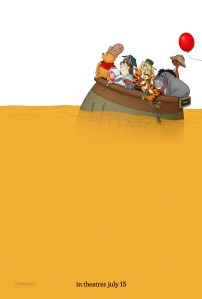
Quick Review: Winnie the Pooh (dir. by Stephen J. Anderson & Don Hall)


With Harry Potter and the Deathly Hallows Part 2 running at full steam, and Captain America: The First Avenger opening this weekend, Winnie the Pooh still remains an option for younger kids who may not be ready for these two films (at least until The Smurfs is released). There’s really very little in the way of negative comments that I can give to Winnie the Pooh, expect perhaps that running at just 69 minutes, it’s very short. It’s for kids.

Working off the original story by A.A. Milne, Winnie the Pooh re-introduces us to the title character, along with his friends from the Hundred Acre Wood – Tigger, Rabbit, Piglet,  Kanga and her son Roo, Owl, and Eeyore. They are the treasured toys of Christopher Robin, who has an active imagination.

One of the cute elements of this story, narrated by John Cleese is how everyone breaks the fourth wall and occasionally has interactions with the paragraphs of the story. Stepping on a few words here, using a few as a ladder, it came across as being quite worthy of a few smiles.

I used to watch “The New Adventures of Winnie the Pooh” on Saturday Mornings, and it was a treat to return to these characters. For the movie, we are given the “Busy Backson” story, where Eeyore has lost his tail and the team come up with ideas on new and interesting ones for him. Each character has their own way of figuring this out. Of course, Pooh has something of a difficult time with his constantly rumbling tummy, but he manages to help in his own way. In their search, Owl misreads a note left behind by Christopher Robin stating that he’ll be busy, but will be back soon. This conjures up the great and terrible “Backson” in everyone’s imagination, responsible for everything from stealing your left socks to making your milk spoil. The team decides to set a trap for the Backson, with wild results. The scenes with the Backson maybe a little frightening to the youngest of viewers, but it’s not that bad. We’re not dealing with Heffalumps or Woozles here.

In the end, as always, everything turns out well. I liked that Friendship was the big factor here. All of Eyeore’s friends tried to help him find his tail, and Pooh even puts his honey chasing ways on hold (as best he can, anyway) to aid his friend. Those familiar with the animated series will instantly recognize Jim Cummings as the voice of both Winnie the Pooh and Tigger. I would have liked to have seen Peter Cullen come back as Eyeore, but he was pretty busy voicing Optimus Prime while the movie was being made. All of the other voice actors are new, including late night tv host Craig Ferguson as Owl. The kids won’t even care.

Musically, there are a few interesting songs. Actress / Singer Zooey Deschanel lends her voice to the title song, along with a few others. Most of the other songs are sung by the cast themselves, and the kids may find themselves singing along (at least I could hear singing in my audience, anyway). The film moves fast, extremely fast. By the time the antsy factor kicks in, the movie’s done, which makes that a treat by itself.

Overall, Winnie the Pooh may not have the magnificence of say a Kung Fu Panda 2 or How to Train Your Dragon, but for very young viewers, it should do just the trick.

Movie Review: Captain America – The First Avenger (dir. by Joe Johnston)


This won’t be the only review for Captain America: The First Avenger here on the Shattered Lens. This may very well be considered an editorial on the film, depending on whether I can stay on topic (I gush a lot in this one). Once they see it, both Arleigh and Lisa Marie will probably make their own posts. Either way, you’ll have more than one perspective on the film.

Addendum: Arleigh’s review is up.

Many years ago, Marvel Comics decided that with all of it’s key franchises spaced around various film production companies, they’d create a series of films that would culminate to one big “Team Up” story. That team is known as The Avengers and it’s members (for the sake of the films, anyway) are Iron Man, Thor, The Incredible Hulk, The Scarlett Witch, Hawkeye and Captain America. The project really went into high gear when Marvel Studios was born and Disney purchased Marvel.

I didn’t have a lot of hope for Captain America: The First Avenger. I know very little about the character save for the comics my older brother used to read. He was an army guy given something to make him super and he had a really cool shield that he’d throw and have return to him.. That was basically the bulk of my knowledge. When taken into account the announcement that Joe Johnston was directing the film, after his somewhat disappointing turn in The Wolfman and that Chris Evans was playing the role, I was certain the film was going to fail. I mean, wasn’t he just playing the Human Torch in The Fantastic Four?

Now, you need to understand that hearing Joe Johnston’s name attached to this left a mixture of feelings. I absolutely love The Rocketeer (1991) and period pieces in general. He was able to give it a nice ‘30s feel, right down to the old war serials that used to be shown before films. Hell, even the poster to that film was something grand. My little brother had a Rocketeer toy and I used to film home movies with it, holding the character just in front of the camera and running around the house as if it were flying. Unfortunately, it didn’t quite work out as well for Johnston or Disney then – but that’s another story.

As for Captain America, the movie floored me. The story isn’t as complex as say, The Dark Knight or as full of itself as Green Lantern, but it’s hands down the best story in the whole Avengers arc that Marvel’s worked on. From my viewpoint, only Iron Man comes close to competing with this film.

The premise of the story is pretty straightforward. Steve Rogers (Chris Evans) is a frail man with just about every problem you can think of. He’s short, he’s asthmatic, and he can’t do a pull up to save his life. Yet, as his parents were in the Army, he felt it was right that he do his part. Every time he tries to enlist, however, he’s told he can’t. This doesn’t sway him from the belief that he can do it, it just forces him to find other ways in. When a scientist overhears Steve’s reasoning behind wanting to join, he gives him a big chance to become the first of many Super Soldiers. The process does indeed work, but a mishap leaves Steve as the only Super Soldier the Allies have, and thus, Captain America is born.

Now, I’m kind of summarizing things there as the story’s just a little bigger than that, but it really needs to be noted just how great a job Chris Evans did in this. He portrays Steve Rogers as one of the most noble characters I’ve seen since Superman. The character never loses that drive or passion, and it came across so well that on reflection, I can’t recall ever thinking once about the Human Torch (something I fully expected to do here). I found myself really wanting this character to succeed, which is more than I could say about Hal Jordan in Green Lantern despite loving the comic. Evans truly was the right person for this film, in my opinion. Again, die hard Captain America fans that have grown up with the character may disagree.

Captain America also has a rich supporting cast. Hayley Atwell, coming over off a great role in the Starz Miniseries The Pillars of the Earth plays Peggy Carter, a tough as nails Army Officer that helps to motivate Rogers toward the path he’s destined to take. Atwell is beautiful, demure at times and responsive at others, every bit as she was when playing Alienna. Also from Pillars of the Earth is Anatole Taubman as one of Johan Schmidtt’s (Hugo Weaving’s) Officers. Tommy Lee Jones’ Colonel has some of the funnier lines in the film. Weaving does a great job as always at playing the villian. There’s really very little I can say on that other than the make up job they gave Weaving’s Red Skull was nice, right down to the visible seams just under his ears. Sebastian Stan has a good role in Rogers’ best friend, Bucky, but I think he could have used a little more. Even Natalie Dormer (Cassanova, The Tudors) and Amanda Righetti (Friday the 13th) have cameos. If the film has two supporting anchors other than Atwell, it would be Stanley Tucci (Easy A) and Dominic Cooper (The Devil’s Double). As Abraham Erskine and Howard Stark, respectively, they both almost steal the show from Evans. They both have a few key moments in the film.

If Captain America suffers from any problems, it may be that it gets from Point A to Point B a little quicker than I’d have liked it to. Some of the pacing is done in Montages, which is okay for showing the audience that the Captain is making progress, but I would have liked to have seen another mission or two before the finale. The buildup to Steve Rogers becoming the Captain is fast, and everything else moves pretty quickly from there on in. The last battle sequence could have been stronger – I’m reminded of the tank sequence in Indiana Jones and the Last Crusade – but considering the era in which the story was told, I wasn’t really expecting lightsabers or anything along those lines. It wasn’t bad, but it was over sooner than I expected. I should also point out that it really does help to have seen the other Avenger related movies. It’s not really a requirement, but the larger puzzle really comes into view on seeing this film.

Visually, the film is great. Johnston really catches that sense of old New York, though it may not be as nuanced as Jackson’s in King Kong. The colors are a little muted in some places, but I’m thinking that’s part of the tone that was set. There’s even a musical number that’s somewhat cute. The 3D effects in this are okay for some scenes. The end credits in particular were nice, but over all it’s really nothing to write home about. I’m still of the notion that 3D should really be restricted to animated features.

Overall, Captain America was a fun film in the vein of Joe Johnston’s earlier film, The Rocketeer and is easily the best of the Marvel Studios Avenger prequels. I’ll be heading back to see it again on Sunday.

And remember, when the movie is done, don’t leave. After the credits comes something definitely worth seeing (at least the yelling and cheers from my audience seemed to deem it so).

6 Trailers To Help Dry Lisa’s Tears


Oh my God, yesterday sucked. 

First off, I was supposed to be seeing Capt. America but when we were standing in line to get our tickets, I started to feel dizzy and then I kinda sorta ended up fainting.  Which I know sounds like something serious but, to be honest, I faint all the time.  I’m like a Tennessee Williams heroine that way.  It’s no big deal except to my sister and my boyfriend who decided that instead of going to the movies, I should go home, lay down, rest, and “take care of myself.”  so, I told them that they were crazy and that I was perfectly fine and they were like, “You’re so full of it, Lisa Marie,” and then I stood up to show them how healthy I was and I guess I didn’t put my feet on the ground correctly because suddenly, I was going down again and anyway, long story short, I ended up being dragged back to the house.

And then once I got back home, one of my longtime twitter followers suddenly decided to unfollow me because apparently, I haven’t been a good enough friend to him.  Which I found interesting considering that I had just spent the past week literally holding his hand while he attempted to get over not one but two girls who never liked him in the first place.  So, yeah, learning that despite my best efforts, I’m apparently just a self-centered bitch who foolishly uses twitter to talk about what I want to talk about as opposed to devoting all of my time to helping some asshole deal with problems that a 12 year-old should be able to freaking handle, well, that kinda sorta hurt my feelings just a little bit.  (Contrary to popular opinion, redheads with big boobs actually do have feelings.  Go figure!) 

However, things are not a complete bust.  First off, as I type this, I’m watching the old episode of Degrassi where Emma and Alex have that huge fight in the school hallway while Paige and Spinner skip school and Ashley gets dressed up like Elvis and then Mr. Simpson finds out his cancer is in remission.  I love that episode.  And, along with watching Degrassi, I’m also putting together the latest edition of Lisa Marie’s Favorite Grindhouse and Exploitation Trailers.

Things are looking up already.

1) Last House On The Left (1972)

Yep, that’s the kind of mood I’m in.  I’m starting things off with the trailer for the evil grindhouse/drive-in movie to end all evil grindhouse/drive-in movies, the original Last House on the Left.  Why?  Because, as the trailer tells us, the road leads to nowhere…

2) Destroy All Monsters (1968)

If I do get out of my present funk, it’ll be due to trailers like this one.  It’s just so goofy! 

3) Cheerleader Camp (1988)

Erin claims that actual cheerleader camp was nothing like the cheerleader camp in this trailer. 

4) The Park Is Mine (1986)

This Canadian action film stars Tommy Lee Jones, who was also apparently in Capt.  America.  Not that I would know.

5) The Undertaker and His Pals (1966)

Believe it or not, I’ve got this one on DVD and this is one of those films that looks a lot more extreme in the trailer than it actually is.  The film itself is a collection of bad performances, juvenile humor, and silly gore effects.  The trailer looks a lot more sick than the actual film, which is why it’s a classic of grindhouse advertising.

6) It’s Alive (1974)

This is yet another trailer from the fertile mind of Larry Cohen.  It’s alive!  What is it?  It can either be your dream or your NIGHTMARE!  Much like me.

Lisa Marie Goes To Rio (dir. by Carlos Saldahna)


Rio is one of those films that I missed when it had it’s initial run at the theaters.  However, last week, I finally got a chance to see it at the “dollar” theater.  Now, I have to admit that I consider the dollar theater to be something like the sixth ring of Hell and, before the movie started, I posted the following to twitter: “Wow, there’s a lot of ugly and obese children in this theater.”  And indeed, that was the case.  What I forgot to mention is that a lot of them were there with equally ugly and obese parents, the types who talked loudly through the film in accents that carried the dual twang of ignorance and stagnation.  Despite the surroundings though, I found Rio to be a perfectly pleasant little animated film.

Rio is the story of Blu (voice by Jesse Eisenberg), a blue macaw who, though originally from Brazil, has grown up in Minnesota and, as a result, has never learned how to fly.  Blu returns to Brazil with his owner (Lesley Mann) so that he can mate with another macaw, Jewel (Ann Hathaway) and keep the species from dying out.  However, things don’t go exactly as planned as 1) Jewel is more interested in escaping captivity than in mating and 2) both Rio and Jewel are abducted by a psychotic Cockatoo named Nigel (Jermaine Clement).  Nigel works for a bunch of poachers and soon Jewel and the flightless Blu find themselves on the run, looking for their owner while the Rio Carnaval goes on all around them. 

As one of my old theater teachers one said about me, Rio “is not without a certain fun charm.”  The film’s storyline of neurotic animals getting lost in an exotic locale and eventually finding the strength to believe in themselves is pretty much standard animation fare but the action moves along quickly and the movie takes full advantage of the whole Rio mystique.  The film’s animators create the Rio de Janeiro that everyone hopes they’ll discover if they ever make it down to Brazil.  Perhaps most importantly, Rio is child-appropraite without ever being so childish as to inspire adults to start drinking while the little ones laugh.

The voice actors all do a pretty good job distinguishing their individual characters.  Jesse Eisenberg is perfectly neurotic as Blu while Anne Hathway’s vocals are properly headstrong as Jewel.   The real stand-out here is Jermaine Clement of Flight of the Conchords. Clement, with his deep, wonderfully dramatic voice, brings a lot of flair to the villainous Nigel and, despite being a psycho Cockatoo, quickly became an audience favorite.  Though the human bird owners don’t get much to do, Leslie Mann and Rodrigo Santoro are so endearing that you actually wish they had more screen time.  On the other hand, if, like me, you found George Lopez to be grating before seeing Rio, this film isn’t going to do much to change your mind.  (Lopez, not surprisingly, plays the know-it-all bird who helps Blu and Jewel make their way through Rio.)

As I watched Rio, I realized just how spoiled we all got last year as far as animated films were concerned.  Last year, I got a chance to see Toy Story 3, How To Train Your Dragon, Shrek Forever After, A Town Called Panic, The Illusionist, Megamind, and Despicable Me.  It was, in many ways, a banner year for cinematic animation.  With the exception of Rango, there haven’t been any animated films so far that can really compare with what we were given last year.  As a result, it’s easy to be dismissive of a straight-forward, relatively simple family film like Rio.  That’s unfortunate because, taken on its own terms, Rio is a perfectly enjoyable way to spend 90 minutes.  Just don’t go into it expecting to see Toy Story 3 and you’ll be fine.

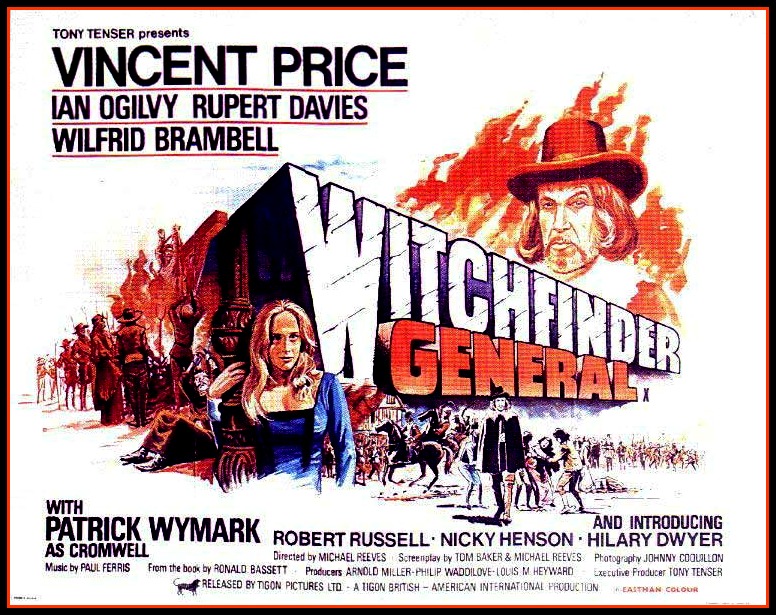
Quickie Review: Witchfinder General (dir. by Michael Reeves)


The late 1960’s saw a major shift in horror films. There have always been horror films which had an inordinate amount of gore and violence, but were always relegated to the niche cinemas which catered to horror exploitation films. In 1968 it all changed with the release of George A. Romero’s Night of the Living Dead. Not only did this film graphically show gore and violence on the screen it also paired it with a well-told story. Another film which became infamous the very same year for it’s portrayal of torture, rape and sadism on the screen was British filmmaker Michael Reeves’ horror film, Witchfinder General.

Witchfinder General starred horror icon Vincent Price in the title role as Matthew Hopkins who was tasked as the Witchfinder General by the Cromwell government during the English Civil War of the 17th-century. His Hopkins would travel the region of East Anglia (Cromwell-controlled territory) rooting out witchcraft and sorcery wherever they might be found. Assisting him in this task is the thuggish, brute Stearne (played by Robert Russell) who relished in torturing suspected witches in towns the two visit. It’s during one such visit to the town of Brandeston, Suffolk that Hopkins and Stearne begin a sequence of events which would pit them against the soldier Richard Marshall (who also happens to fight on the same side as Hopkins and Stearne) whose fiancee and her uncle became the latest victims of the Witchfinder General’s sadistic methods of rooting out confessions.

The film as a horror has less to do with the supernatural, but more of the hypocritical horror which begets a political environment where powerful men contest for more power and uses fear and the superstitious ignorance of a populace to cement their power. In this amoral vacuum comes in the opportunistic Matthew Hopkins who uses the power given to him by his government to not just do his duty to eradicate witchcraft but also abuse it for his own personal (and as seen in the film a way to sate his own personal lusts) gain. It’s this hypocritical nature of who was suppose to be a Puritanical and righteous agent of God which emphasizes the true historical horror of religion and politics becoming one and the same.

Vincent Price as Matthew Hopkins was at the top of his game in Witchfinder General. He gives his role not just an air of superiority over everyone he meets and deals with, but he also makes Hopkins’ truly an amoral character who sees nothing wrong in taking advantage of his position and actually feels like he deserves the desperate attentions of those willing to do anything to save their loved ones from his machinations. Robert Russell as his licentious and sadistic assistant Stearne also does a great job in portraying an individual who might seem brutish and thuggish, but who was also more honest with is situation than his master. It makes for an interesting pair despite their roles being the film’s prime antagonists.

The film more than truly earned the outcry it received upon it’s release in 1968 as scenes of torture and sadism was extreme for a British horror film industry so used to the Gothic sensibilities of the Hammer Films of the era. Graphic depictions of burnings, torture and drowning were done not to seem gratuitious or to cater to the burgeoning gorehound crowd of the era, but done so matter-of-factly that they seem even more horrific.

The Witchfinder General really helped usher in the death of gothic horror which dominated the genre with the Hammer Films in the UK and the Edgar Allan Poe films of Roger Corman in the US. The film continues to impress new generations of horror fans and is still considered by older fans of the genre as one of the best horror films ever made. For some the film might look dated due to the acting (most of the actors of the era were stage actors first and film ones second) and the effects work, but they also fail to look at the film in context of the era and how even by today’s standard it would still shock those not well-versed in the genre of horror. They definitely don’t make horror films like this anymore and that’s a shame on many levels.

6 Trailers of Separation


Hi there!  Welcome to the latest edition of Lisa Marie’s Favorite Grindhouse and Exploitation Trailers.

1) Ghost Town (1988)

Let’s start things out with this film from 1988.  I haven’t seen this film but the trailer has a certain silly charm to it and how can’t you enjoy the use of the fake lightning special effect?  Plus, those finger nails screeching across the car — Agck!  Freaky.

2) Blue Sunshine (1976)

This is one of my favorite movies.  Basically, a bunch of hippies take some really powerful acid in 1968 and then, eight years later, they end up having the worst flashback ever!  To say that Zalman King gives an “interesting” performance as the film’s hero is a bit of an understatement.

3) Road Games (1981)

“Jamie Lee Curtis is…Hitch.”  Well, that would probably explain why she was destined to end up hitchhiking.  Seriously, parents — give it some thought before you give your child any old name.  Anyway, Road Games was director Richard Franklin’s follow-up to Patrick and it’s one of the better slasher films of the early 80s.

4) The Dungeonmaster (1985)

Oh my God, this looks like a bad movie.  The trailer, however, is just so silly and kinda endearing in the way that it seems to desperately be saying, “No, it’s not as bad as it looks!  Look — we have ice people!”

5) Conquest (1983)

All I need to say here is that this film was directed by the one and only, Lucio Fulci.

6) Maniac Cop (1988)

Finally, let’s end this latest edition with Bruce Campbell, shall we?  This is the trailer for William Lustig’s Spinell-free Maniac Cop.