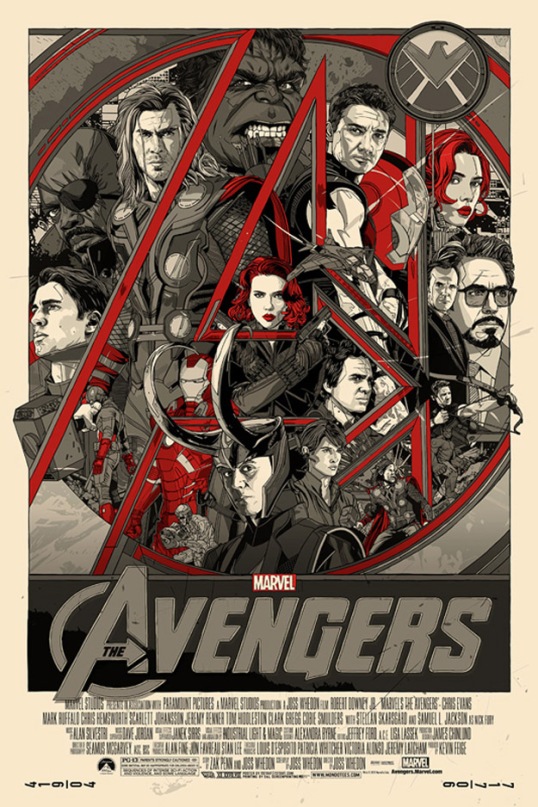
Lisa Marie Does The Dictator (directed by Larry Charles)


For the past year or so, I haven’t been able to go to a movie without seeing the trailer for the new film from the creators of Borat, The Dictator.  The first few times I saw the trailer, I chuckled at a few scenes and I rolled my eyes a few times and I thought to myself, “Maybe I’ll see that.”  And then I had to sit through that trailer another 79 times and I stopped laughing and rolling my eyes because I had reached the point where I could practically recite the entire damn trailer by memory.  For a while there, I told myself, “There’s no way I’m going to waste my time seeing this.”  But, just a week ago, I realized that, after seeing the trailer 139 times, I had no choice but to see it.

I needed closure.

I finally saw The Dictator last Wednesday and my reaction to the film can best be summed up by a mild chuckle and a shrug of my shoulders.  It’s not a bad film by any stretch of the imagination.  It’s just a rather forgettable one.

In the Dictator, Sacha Baron Cohen plays General Aladeen, the ruthless leader of the Middle Eastern country of Wadiya.  Aladeen spends his time playing video games, rewriting the dictionary, ordering executions, and trying to develop a nuclear weapons program.  Aladeen is a pretty bad guy but he’s also strangely likable because 1) he’s more stupid than evil and 2) he’s played by Sacha Baron Cohen.  Anyway, Aladeen goes to New York to deliver a speech to the United Nations and while there, he’s kidnapped by an assassin (a hilarious John C. Reilly) who was hired by Aladeen’s uncle Tamir (Ben Kingsley, who has pretty much cornered the market when it comes to playing evil uncles).  Though Aladeen loses his beard in the process, he manages to escape the assassin and he soon finds himself lost and unrecognized on the streets of New York City.  With the unwitting help of a clueless pro-democracy activist (a very funny Anna Faris), Aladeen attempts to figure out a way to thwart Tamir’s plan to introduce democracy to Wadiya.

Watching The Dictator is something of an odd experience because, while the film itself is full of funny moments and Sacha Baron Cohen shows an admirable willingness to follow his character to the most of logical (and illogical) of extremes, it’s also a strangely forgettable film.  It’s certainly funnier than the typical episode of Family Guy (I hate that freaking show, by the way) but it’s nowhere near as profound as a below-average episode of Community (which was the best show on TV last season, in my always correct opinion).  Director Larry Charles doesn’t seem to be sure whether he’s trying to make a thought-provoking satire or if he’s just trying to make a broad, gross-out comedy that just happens to have an international backdrop.  The end result is a film that is extremely uneven, a film that climaxes with a speech that feels like it was taken straight out of the Occupy handbook despite the fact that the movie has just spent the last 70 minutes poking fun at the Leftist stridency of the Occupy movement through the character played by Anna Faris. 

(Personally, I preferred the film when it was simply content to be funny as opposed to when it tried to be important.)

Watching this film, it became apparent to me that, for all of his comedic talent, Baron Cohen works best when his cartoonish (if well-played) characters are placed in a recognizable reality.  Baron Cohen needs a “straight man” to play off of and unfortunately, The Dictator doesn’t provide him with that.  Everyone’s equally cartoonish in this film and, as a result, the movie makes us laugh but it never really makes us think.

There’s a part of me that always wants to declare that I’m officially “burned out” on Sacha Baron Cohen because, seriously, it’s become rather trendy to claim to be a huge fan of his work.  Seriously, I’m at a point now where if I one more person brags to me about how much they loved Borat (always speaking in a tone as if to suggest that only they have seen and appreciated this “obscure” film), I am going to scream.  However, every time I get close to getting on twitter for the sole purpose of making snarky remarks about the guy, I see him give a surprisingly good performance in a film like Hugo.  The Dictator may not be Sacha Baron Cohen’s best film but I still look forward to seeing what he does in the future.

Okay, So I Saw “The Avengers”


Or should that be “Okay, so I saw Marvel’s The Avengers ?”

In any case, I wasn’t going to. I was determined not to participate in the so-called “biggest event of the summer” because I’m flat-out tired of seeing Marvel (and, by extension, Disney) rake in hundreds of millions, if not billions, of dollars off the fruits of Jack Kirby’s imagination while “The King’s” estate gets more or less nothing (although in fairness — or should that be unfairness — they do get some sort of pittance for anything featuring Captain America in it, since he’s officially recognized as Cap’s co-creator along with Joe Simon). Stan Lee’s recent comments about Jack didn’t do much to up my enthusiasm level for this latest blockbuster either, and basically reaffirmed my opinion that he’s a major-league asshole who was lucky enough to glom onto the works a true creative genius that now he doesn’t even have the decency to acknowledge, much less thank, so yeah — it’s fair to say I was pretty cool to this whole thing and found most of the absolute gushing over it that’s been infecting the internet, Twitter in particular, to be annoying in the extreme.

But then the folks who are trying to put together The Jack Kirby Museum came up with a novel idea — donate the price of your ticket to their brick-and-mortar fund, so that future generations can have an actual, physical place to go and experience first-hand the power of the unfettered creative genius that everyone else but his family has gotten rich off. That sounded good to me, so for the price of a $7.50 admission and a matching $7.50 donation, my conscience was suitably assuaged  — hey, I guess I always knew there was some price at which my principles could be sold out, but it’s rather depressing to think that it could be so cheap. Still, best not to spend too much time dwelling on that —

Anyway, before I kick over the hornet’s nest of fan opinion, let me state for the record that I found The Avengers to be a perfectly fun, generally-well-executed, thoroughly entertaining superhero romp. But (and you knew there was a “but” coming, didn’t you?) — that’s all it is.

Sorry, assembled hordes of fandom, but it’s not “groundbreaking,” it’s far from “the best superhero movie ever,” (hello? The Dark Knight? Batman Begins? Spider-Man 2? Superman :  The Movie?) much less “the best comic book adaptation ever,” (hello again? American Splendor? Ghost World? Sin City? A History Of Violence?) and it doesn’t “prove” that co-writer/director Joss Whedon is a “visionary,” or the “new master of the superhero genre.”

And all those quotes I  pulled are, frankly, just a sampling of some of the less effusive praise I’ve seen bandied about online in regard to this flick. I’ve also seen it called “the new benchmark by which all others will be judged,” “the summer blockbuster to end them all,” “a singular work of astonishing breadth and scope,” and “the defining cinematic statement from the undisputed master of the craft.”

In this armchair critic’s opinion, unpopular as saying so is bound to make me, it’s none of those things. Not even close. Whedon has concocted a nice little script and brought it to life in an appealing and pleasant manner, but this isn’t a movie that bears any authorial signature whatsoever — if the credits were blank and someone told you it was directed by, say, Jon Favreau, you’d believe it, because it plays out pretty much exactly the same, in tone and style, as either of the two Iron Man films, and it doesn’t have anything like the individualistic flair of Kenneth Branagh’s Thor or Joe Johnson’s Captain America : The First Avenger. Hell, it even completely overuses the tedious inside-the-helmet perspective shots of Robert Downey Jr.’s head that Favreau is so annoyingly fond of.

In addition, our guy Joss shows no particularly deft touch with his cast. The acting ranges from surprisingly good (Mark Ruffalo positively nails it as Bruce Banner) to completely lethargic (Scarlett Johansson is completely listless as the Black Widow and is the least-convincing Russian superspy in movie history). Downey plays himself, as always, and the talented Jeremy Renner is criminally underutilized as Hawkeye, while both Chris Hemsworth’s Thor and Tom Hiddleston’s Loki, the central villain of the piece, came off much better in Branagh’s flick. Samuel L. Jackson pretty much owns every scene he’s in as Nick Fury, but I don’t think there was ever really any doubt that he would. All told,  the whole thing has the feeling of a director who just told his cast “okay — have at it” and then let the cameras roll.

In his favor, fandom’s newest and biggest crush does do a nice, pacy job with the action sequences, of which there are many (although even he can’t make the bog-standard CGI alien invaders that attack the Earth at the end and, yawn, double-cross Loki seem interesting), and doesn’t overplay his hand in the pathos department — he gives each and every character a nice little individual “story arc” that never taxes the imagination too much and remains dimly interesting without seeming intrusive vis-a-vis the “bigger picture” — which is, of course, to show all these folks coming together and fighting a menace big enough to require their assembled talents and abilities. And while Whedon has an annoying habit of defusing every potentially tense situation with a pithy little quip of some sort, on the whole the interplay between the various characters is reasonably well-handled and plausible (as far as these things so).

So The Avengers has some pluses in its favor, as well as some minuses working against it. It’s good, solid, mindless summer entertainment with a nifty, if thoroughly uninspired, visual sensibility; it plays to what the fans want in a generally competent manner; and it keeps you at least modestly interested in the proceedings throughout. It doesn’t have the mythic scope of Donner’s Superman, nor does it redefine the possibilities inherent in the superhero genre in the way Nolan’s Batman films do. It doesn’t take the time to examine the gap between what these characters symbolize and who they actually are in the way that Marvel’s two far superior summer blockbusters of last year (again, Thor and Captain America : The First Avenger) did — hell, it doesn’t even have much of anything to say about the human condition, much less the superhuman condition. And while it’s all pretty fun to look at by and large, it doesn’t have the inventive, groundbreaking, downright operatic visual flair of Burton’s forays into Gotham City. So it’s fair to say that even the things this movie does well have been done a lot better in other films of this same genre.

But it is fun. Not as fun, or as immediate, or as dramatic, or as dynamic, as the classic Avengers stories brought to life by Jack Kirby that it’s essentially a modernized (and, frankly, watered-down — proof that “The King” could do more with a pencil than Whedon can with a couple hundred million bucks) rehash of, but a good time nonetheless — and in a society as desperate for diversion and spectacle as the one we live in, I can certainly understand why it’s such a big hit. But please. Let’s stop pretending it’s anything more than what it is — modestly-well-realized, lively,  big-budget summer fun that doesn’t demand anything from its audience apart from kicking back and enjoying the ride. And let’s stop venerating Joss Whedon for what’s essentially a director-for-hire project executed in what’s basically become Marvel’s “house style.” Sure, there’s a good possibility that the financial success of The Avengers means he might be able to write his own ticket in Hollywood from here on out — and more power to him if that’s the case since other projects he’s helmed (most notably the excellent sci-fi TV series Firefly) do indeed show that he’s capable of distinctive, highly imaginative drama — but it’s just as likely that Marvel will replace him on this film’s inevitable sequel with some youthful up-and-comer who can deliver essentially the same product and will work for half the price.

Once the novelty of having all these superheroes on screen together wears off, I predict that we’re going to realize we’ve been had a little bit here — but seeing as how we had a pretty good time in the process, there’s no real harm done.

An Underrated Quickie With Lisa Marie: The Five-Year Engagement (dir. by Nicholas Stoller)


When Jeff and I recently went to see The Five-Year Engagement, we literally had the entire theater to ourselves.  Seriously, that evening, we were apparently the only two people who took a look at the showtimes for the AMC Valley View and say, “Let’s see the Five-Year Engagement.” 

Now, I’m not complaining because, quite frankly, we enjoyed having that theater to ourselves. However, later that night, I found myself thinking about the empty theater and the fact that very few of the film lovers in my circle of friends had expressed much interest in The Five-Year Engagement.  The critics, in general, have been kind to the film but audiences seem to view it as a Netflix film at best. 

That’s a shame because, oh my God, The Five-Year Engagement is such a sweet film!  Seriously, I loved this movie!

Produced by Judd Apatow and directed by Nicholas Stoller, The Five-Year Engagement is a romantic comedy about a chef (played, quite well, by Jason Segal) and a psychologist (played by Emily Blunt, who is apparently destined to star in 65% of the romantic comedies released this year) who get engaged and end up remaining engaged for the next five years as the marriage ceremony is continually delayed by everything from Segal’s best friend marrying Blunt’s sister to the couple moving to Ann Arbor when Blunt gets a job working at the University of Michigan.  Along the way, various relatives die while still waiting for the blessed event and Segal and Blunt’s relationship struggles to survive against the distractions of everyday life.

The Five-Year Engagement isn’t a perfect film.  As often seems to happen with films produced by Judd Apatow, the film is about 20 minutes too long and sometimes the mix of sentimentality and crudeness is a bit awkward.  I could have done without an extended sequence in which Jason Segal (after having settled into life in Michigan) is revealed to have briefly turned into a crossbow-weilding survivalist. 

However, in the end, those flaws don’t matter because the Five-Year Engagement is, at heart, a sincerely sweet movie.  Jason Segal and Emily Blunt have a very real and very likable chemistry.  They make for a cute couple and you really find yourself hoping that they stay together.  Playing, respectively, Segal’s best friend and Blunt’s sister, Chris Pratt and Alison Brie both provide strong comedic support.  One of my favorite moments features Brie attempting to give a toast at Segal and Blunt’s engagement party and quickly dissolving into teary gibberish.  (Admitedly, one reason I loved this scene is because I did the same thing when I attempted to give a toast at my sister Megan’s wedding.)  Brie and Blunt also have another hilarious scene where they find themselves discussing realtionship matters while pretending to be Elmo and Cookie Monster.  It’s an odd but ultimately truthful moment.

Ignore the naysayers.  The Five-Year Engagement is sweet movie that deserves to be seen.

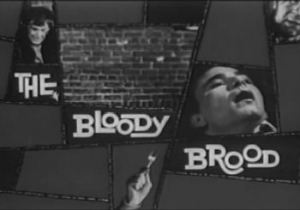
A Canadian Quickie With Lisa Marie: The Bloody Brood (dir. by Julian Roffman)


As part of my ongoing mission to see all of the film’s featured in Mill Creek’s 50 Chilling Classics box set, I watched a 65-minute Canadian film called The Bloody Brood last night.

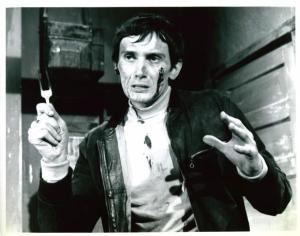
First released in 1959 and filmed in moody, noir-ish black-and-white, The Bloody Brood tells the story of a low-level drug dealer and aspiring beatnik named Nico (Peter Falk).  One night, while hanging out at the local coffeehouse and listening to decadent jazz, Nico witnesses a man drop dead of a heart attack.  Intrigued by the man’s sudden death, Nico and his nervous friend, a tv director named Francis (Ron Hartmann), decide that they want to experience what it would be like to deliberately kill someone.  Before you can say “Leopold and Loeb,” Nico and Francis are feeding a random stranger a hamburger laced with ground glass.  That stranger, a hard-working telegram delivery man named Ricky (George Sperdakous), later dies of an intestinal hemorrhage.

Unknown to Nico and Francis, Ricky has an older brother named Cliff (Jack Betts) and Cliff doesn’t believe that his brother’s death was an accident.  With the covert help of Detective McLeod (Robert Christie), Cliff starts to investigate his brother’s death.  Cliff eventually meets Ellie (Barbara Lord), a disillusioned woman who has fallen in with Nico and his murderous crowd.

The Bloody Brood is an unexpected surprise, a genuinely entertaining B-movie that more than overcomes the confines of its low-budget and limited running time.  While Peter Falk is the obvious center of the picture and steals every scene that he’s in with his coldly charismatic style of evil, the entire film is well cast and well acted with Hartmann and Betts both bringing unexpected nuance to their roles.  However, the real star of the film is director Julian Roffman who gives the film a shadowy and threatening noir-look. 

In many ways, The Bloody Brood represents everything I love about the low-budget, often sordid B-movies of the 50s and 60s.  Working with limited resources and a small cast, director Julian Roffman managed to create a genuinely memorable movie.  Films like The Bloody Brood continue to serve as proof that you don’t need millions of dollars to make a good film.  You just need a strong creative vision and the imagination to make that vision a reality.

A Grindhouse Quickie with Lisa Marie: The Demon (dir. by Percival Rubens)


Last summer, I decided to watch and review all 50 of the films to be found in Mill Creek’s Chilling Classics box set.  Mill Creek, of course, is a company that’s best known for releasing box sets that seem to primarily feature low-budget films that, for whatever reason, have now found themselves in the public domain.  If you’re a fan of old school B-movies in general, then you probably know just how fun it can be to read the back of a Mill Creek boxset and discover what obscure films are waiting inside.  The thing that I especially love about Mill Creek is the fact that — in the best grindhouse tradition — they describe every film that they distribute (whether it’s George Romero’s Night of the Living Dead or something like Las Vegas Bloodbath) as being a “classic.”

So, anyway, I started to watch and review the films in the Chilling Classics box set but, as 2011 drew to a close, things got rather hectic and busy here at the TSL Bunker.  In between covering the Oscar season and keeping the world supplied with weekly trailer posts, I had to set aside my plans to review the entire boxset for another day. 

Well, I’m happy to say that day is here!  Last night, I dug out the old Chilling Classics box set and I watched a South African slasher film from 1981, The Demon.

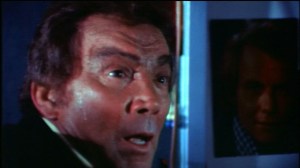
The Demon actually tells two separate but connected stories.  In the first story, a teenage girl is kidnapped from her bedroom by a masked killer.  Her distraught family calls in a tormented psychic who quickly proves himself to so superfluous and useless that you’d forget all about him except he’s played by the late Cameron Mitchell. 

If you’re a fan of old school grindhouse and exploitation films then you’ve undoubtedly seen a handful of films featuring Mr. Mitchell.  A former “legitimate” actor who, early on in his career, appeared in things like Death of a Salesman, Mitchell eventually became better known for appearing in low-budget exploitation films.  Mitchell could always be counted on to shamelessly overemote and, regardless of the film he was appearing in, he was always a lot of fun to watch.  If nothing else, Mitchell always seemed to be rather amused by the films he found himself in.  It’s a shame that Cameron Mitchell died before Quentin Tarantino could engineer a comeback for him. 

In The Demon, Cameron Mitchell spends most of his limited screen time standing on a rocky cliff while staring down at the ocean below and having psychic visions that don’t really seem to have much to do with anything else happening in the film.  Actually, visions is the wrong word.  As Mitchell says, “Sometimes…I get these feelings.  Vibes, as the kids would say.”

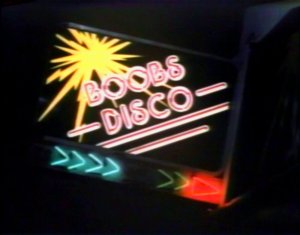
And the kids are in a lot of trouble because our nameless killer has moved on to the city where he spends his time hanging around outside of a place called Boobs Disco and stalking two teachers named Mary (Jennifer Holmes) and Jo (Zoli Markey).  This is the film’s second storyline and it mostly consists of Mary spotting the killer out of the corner of her eye and Jo pursuing a relationship with the most boring man on the planet.

Like quite a few films that seem to pop up in various Mill Creek box sets, The Demon is technically a pretty bad film but, once you accept that fact, it’s also an occasionally entertaining mess that delivers a handful of effectively creepy moment.

The scenes featuring Cameron Mitchell are entertaining for exactly the reason that you think they are.  These scenes are such obvious filler and were so obviously added as an excuse to get a “name” actor to join the cast that it’s impossible not to admire the nerve of the filmmakers.  They weren’t going to let a silly thing like narrative cohesion get in the way of producing a 90 minute film.  Playing the world’s worst psychic, Cameron Mitchell delivers his lines with such a truly unfocused intensity that I actually spent the first half of the movie convinced that he was the murderer.  The final fate of Mitchell’s character is truly shocking (if just because it kind of comes out of nowhere) and Mitchell plays his final scene as if he’s starring in a dinner theater production of some lost Shakespearean play.

If the scenes featuring Mitchell are mostly entertaining for being so bad, the scenes in which the nameless killer stalks Mary and Jo are actually pretty well done and the final confrontation between the final girl and the killer is handled surprisingly well (though I couldn’t help but roll my eyes at the fact that the film contrives to have the final girl fight for her life while topless).  The killer’s lack of personality makes him all the more intimidating and both Jennifer Holmes and Zoli Markey are likable and believable in the roles of Mary and Jo.  If nothing else, The Demon proves that even a really poorly produced horror film can be partially redeemed (if not saved) by a likable cast of potential victims.

Finally, and perhaps most importantly, The Demon — like many forgotten exploitation flicks — serves as a valuable time capsule of the society that produced it.  To offer up just one example:

Burn “The Wicker Tree”


Honestly, friends, sometimes a person just doesn’t even know where to begin. I suppose I could individually list the catalogue of atrocities that make up writer-director Robin Hardy’s The Wicker Tree, but frankly that would mean spending more time talking about this film than I really have the energy to, and besides, our nearest thing to a “star” critic here at Through The Shattered Lens, Lisa Marie Bowman, has already done a pretty damn fine job of performing a blow-by-blow dissection of this thing’s rotted corpse in her capacity as occasional scribe over at HorrorCritic.com, so there’s no real need to duplicate what’s been done before. Allow and/or indulge me, then, as I take a slightly different tack and document my personal journey of despair with Hardy’s exercise in highly confused pointlessness.

To begin with, I should point out that the original Wicker Man is quite likely one of my ten-or-so all-time favorite films. Critics who say it’s “not actually a horror movie” are quite right, of course — it’s a unique — hell, frankly singular — amalgamation of so many different styles that the end product is well and truly unclassifiable. Part horror flick, sure, but also part musical, part (very) black comedy, part clash-of-cultures melodrama, part satire on Christian piousness, and part period-piece-albeit-in-a-then-contemporary-setting, it stands on its own as the only thing quite like it ever made. Screenwriter Anthony Shaffer perhaps put it best when he stated that his main goal was to pen a meditation on the nature of sacrifice, and everything else just sort of took off from there.

Obviously, there are so many elements about the first film that the 2011 “thematic sequel” could never hope to duplicate — songwriter Paul Giovanni is no longer with us, so right off the bat we know the music’s not going to be nearly as good because, quite frankly, it can’t be. Anthony Shaffer has passed away and therefore whatever follow-up material comes about wouldn’t in any way be his vision for how the story could or should  continue. Edward Woodward has likewise left behind this mortal coil, and his character died at the end anyway, so replicating his magnificently anally-retentive performance is probably going to prove to be out of the question, as well.  Christopher Lee is, while still awesome as hell,  also extremely frail and old at this point. And anyway — The Wicker Man still retains all its poignancy and power to this day and has only gained luster over the past 40 years. The abominable Nicolas Cage/Neil LaBute remake proved that revisiting the material was a lost cause, so why bother, five years on from that failed experiment,  with any sort of a sequel, “thematic” or otherwise?

Unfortunately, Robin Hardy wrote a book some years back called Cowboys For Christ that updated some of the concepts from his earlier film and he got the notion that it would make a decent-enough little flick. He was able to scour up $7 million-plus worth of financing, and got the folks at Anchor Bay so interested they promised not only a widespread “home viewing platform” release (and I caught this on a free screener copy that was sent my way so therefore can’t fairly comment on any extras the DVD and Blu-Ray might contain), but a even a little theatrical run, as well. It never made it to my area, and disappeared after a week from the markets it did make it into, but still —the fact that they chose to give this thing some theatrical burn when it seemingly had DTV written all over it was enough for me to, foolishly, get my hopes up.

I guess we believe what we want to believe (which is rather one of the points of the first film, after all), and a steady stream of reviews for this one that placed it at the “embarrassingly bad” end of the spectrum at worst to “maybe not quite as horrible as I’d been fearing but still pretty goddamn awful” at best weren’t enough to dampen my enthusiasm at this point. I figured it just had to be better than most folks were giving it credit for, because there’s just no conceivable way it couldn’t retain, say, at least 1/100th of the darkly charismatic charm of the first film, even if entirely by accident, right? After all, the original director was on board, and Anchor Bay wasn’t so ashamed of his finished product that they tried to hide the thing away at the bottom of some film vault (although given that it’s shot on HD, perhaps a “film” vault wouldn’t be the right place to stick it in, anyway).

It’s certainly fair to say that I wasn’t expecting greatness, or even anything of the sort, but something that still somehow cleaved to even a miniscule fraction of the spirit of the original would have been good enough for me. Unfortunately, what I got was a story about two painfully stereotypical Jesus-lovin’ Texas yokels who have gone on a mission (more typical of Mormons than of born-againers, it must be said) to evangelize in some small Scottish town that apparently has never heard the “good news.” One of our less-than-convincingly-portrayed country bumpkins, Beth Boothby (Brittania Nicol), was apparently a famous country singer with something of a “reputation” before turning her life over to Christ, while the other, her fiancee Steve Thomson (Henry Garrett), is little more just a walking, talking cowboy hat. Once in the “heathen land” of Scotland,  they enjoy the decidedly non-Southern hospitality of local nuke plant owner Sir Lachlan Morrison (Graham McTavish, in something more akin to a respectable performance than his colleagues seem capable of) and his OTT-in-the-deception-deaprtment wife, Delia (Jacqueline Leonard), but of course the dastardly couple, whose power plant has through some unexplained (and probably inexplicable, so it’s just as well Hardy doesn’t even try) means left the entire town sterile, have other plans for their simple-minded God-fearin’ visitors, plans that the Texas two-steppers are apparently too stupid to suss out even as they’re practically being openly prepared for the burning stake and, get this, the dinner table!

Yes, evidently the heathen folk of the United Kingdom’s northern reaches have taken to cannibalism in the four decades or so since our last visit, and while Hardy seems to think this somehow ups the “black comedy” factor of the proceedings, really it just serves as a cop-out by more clearly delineating who are the “good guys” here and who are the “bad guys,” a simple-minded, black-and-white approach that the first Wicker Man never resorted to even when Sgt. Howie was being burned alive (in, it must be said, one of the most visually dramatic sequences ever committed to celluloid).

And that’s a pretty much the problem at the crux of The Wicker Tree in a nutshell — sure, there are numerous and obvious others, ranging from wretched acting to dully-executed visuals to poor pacing to obvious run-time padding to inarticulate (at best) dialogue to recycled-into-a-less-involving-context story ideas to laughably one-dimensional caricatures standing in place of real, actual characters — but at the end of the day, it’s Hardy’s mistrust of his audience’s ability to make up our own collective mind, and the blatantly heavy-handed approach he takes in explaining everything for us that stems from that mistrust, that makes this such a condescending failure. I could live with the far-less-subtle approach to the “clash of cultures” theme that he takes here in comparison with the first film. I could live with the nowhere-near-as-compelling music. I could live with the rather — uhmmm — “broad strokes” with which he paints each and every character . I could live with the pointless and frankly even a bit insulting to the guy Christopher Lee cameo. Hell, I could even live with the Christian turning the tables on her pagan pursuers and winning in the end. But what I absolutely can’t abide is that Hardy thinks we’re all so unsophisticated and beneath the task of understanding his apparently-in-his-mind-quite-complex-and-challenging-themes that we need for him to hammer them home with a with a burning wicker stake through our heads. He’s had 40 years to think about how he wants to follow up a genuine, justly-lauded classic and this is what he comes up with? Set fire to me now, please, before the third installment, which he’s already working on, ever sees the light of day.

Spoilers Assemble!


**PLEASE DON’T READ IF YOU HAVEN’T WATCHED THE AVENGERS** **PLEASE DON’T READ IF YOU HAVEN’T WATCHED THE AVENGERS** **PLEASE DON’T READ IF YOU HAVEN’T WATCHED THE AVENGERS** **PLEASE DON’T READ IF YOU HAVEN’T WATCHED THE AVENGERS** **PLEASE DON’T READ IF YOU HAVEN’T WATCHED THE AVENGERS** **PLEASE DON’T READ IF YOU HAVEN’T WATCHED THE AVENGERS** **PLEASE DON’T READ IF YOU HAVEN’T WATCHED THE AVENGERS**

**PLEASE DON’T READ IF YOU HAVEN’T WATCHED THE AVENGERS** **PLEASE DON’T READ IF YOU HAVEN’T WATCHED THE AVENGERS** **PLEASE DON’T READ IF YOU HAVEN’T WATCHED THE AVENGERS** **PLEASE DON’T READ IF YOU HAVEN’T WATCHED THE AVENGERS** **PLEASE DON’T READ IF YOU HAVEN’T WATCHED THE AVENGERS** **PLEASE DON’T READ IF YOU HAVEN’T WATCHED THE AVENGERS** **PLEASE DON’T READ IF YOU HAVEN’T WATCHED THE AVENGERS**

This post sprang from my desire to discuss the film with my geek brethren and not spoil for the folks that follow me on Twitter or have the misfortune of being my Facebook friend. If you haven’t seen the Avengers movie, please do not read this post.

Things that caused Geekasm (due to be modeled after the much loved Mark Millar & Bryan Hitch run on the Ultimates):

  • The use of the Chitauri (or a version of them) as the invading army was an interesting and unexpected move. This tied the movie universe closer to the Ultimate Universe because they were the first villains that the Ultimates (that reality’s Avengers). I can understand the omission of Herr Kleiser (it relates to the omission of Nazis in Captain America).
  • Clint Barton wearing his Ultimate costume and using this iteration’s bow. His relationship with Black Widow and lethal efficiency further tied things to the Ultimate universe.

Overall Geekasm:

  • The Black Widow wearing and using her Widow’s bite.
  • The brawl between Thor and Hulk, and the continued jock-frat boy relationship that they shared.
  • The Other’s Skrull-like chin because it gave a subtle clue about who the invading army was. It tied to Millar’s Ultimate Fantastic Four because the more Skrull-like Skrull appeared after the Chitauri were defeated.

The Big Bad:

  • Thanos appearing at the end of the Other’s master. I didn’t expect him at all since Loki and Thanos never interacted in the comics.
  • The film iteration of the Mad Titan seems to be a mix of the 616 & Ultimate versions. His obsession with Death and smile when the Other mentioned Challenging them would court death tied him to the 616 iteration. His obsession with The Tesseract (Cosmic Cube), his extradimensional residence and command of a vast army tied him to the Ultimate version.
  • I can only assume that the Mad Titan will attack Asgard in the Thor Sequel or at least send his minions there to acquire the cosmic cube. The fact that Loki was his faithful lapdog despite his ambition and desire to rule, speaks to the power he wields.

AVENGERS ASSEMBLE!


Avengers did what I previously thought was impossible… it Leonidas-kicked Iron Man 1 off its throne and now reigns on my all-time favorite comic inspired movie. Nolan has a tough act to follow. The gauntlet has been dropped. I attribute this remarkable feat to Joss Whedon’s screenplay and the cast for the most part.  I will not spoil the film and simply state what I enjoyed in a vague manner.

What I loved:

  1. The cast embodied the characters that I grew up reading, especially Downey and Pines
  2. The incorporation elements of Mark Millar and Bryan Hitch’s version of Avengers (in my opinion at least) in the film
  3. The revelation of the Other’s Master
  4. The Other’s design and connection of the comic version of Fantastic Four
  5. The nod to the classic Thor and Hulk relationship
  6. Clark Gregg’s Phil Coulson
  7. Tom Hiddleston captured all the resentment, sense of entitlement and bitterness that represents Marvel’s iteration of Loki
  8. The more humane and decent version of Ultimate Nick Fury (he’s a rotten & ruthless so & so on Millar’s book)

Minor quibbles:

  1. The Black Widow’s lack of a Russian Accent (but it didn’t take away from Scarlett’s performance
  2. The lack of a Loki betrayal, he’s the god of evil after all


Movie Review: The Avengers (dir. by Joss Whedon)


I’m almost certain that this won’t be the only review for Marvel’s The Avengers here on the Shattered Lens. Arleigh is watching it as we speak, and while I can give my thoughts on the film, they won’t be from a comic insider’s point of view. It’s not my strong point. You see, I grew up on Spider-Man comics, and totally shunned the Marvel Team Up / Group stories. Never read an X-Men comic until after that film came out and The Avengers overall are new to me. I know who they are, but I can’t tell you if the movie gives you everything the comics were. Keep your eyes open for the other reviews to help build a better picture of things.

What I can say is that the movie easily touches on everything that Disney / Marvel has built upon with the movies before it. Starting in 2008, Iron Man, The Incredible Hulk, Iron Man 2, Thor and Captain America: The First Avenger were all pieces of a larger puzzle. After 4 years, The Avengers does its best to utilize all of it, to a great success. That’s the amazing element of this movie. You aren’t essentially required to watch the other movies to enjoy The Avengers. In 2 hours, you’re given a film that stands completely on it’s own if you’ve never seen the other films, yet is an added bonus if you have. Even better, the characters that didn’t have a chance to get their own films still have moments where we can learn about them and where they get to shine. One could maybe say the same about The X-Men in that you have a group of heroes that have to work together, but you’ve never really had a set up to display all of their abilities and background the way Disney/Marvel did this.

Warner Brothers and DC should be crying right now at the missed opportunity here. All of their comic creations were already under one roof, and they really should have been able to have had a Justice League film by now if they wanted to. I wouldn’t be shocked at all if they tried to mimic Marvel Studios right now.

When I first heard that Joss Whedon was doing the directing, I groaned. I have a love / hate relationship with Whedon’s work. I was never a big Buffy: The Vampire Slayer fan, but I really enjoyed Angel when it went into syndication, seeing all of it’s seasons more than once. Of course, everyone loves Firefly, but the film based on that, Serenity, tanked at the box office (I was there at the first Friday to support it, though). I wrote off the Avengers as something that was destined to fail, because Whedon loves to inject pop culture references at every given and small bits of humor into things that are usually serious. I felt the only saving grace would be that Whedon is something of a master when it comes to ensembles, which is why I figured Marvel Studios went with him. It may work for something like Cabin in the Woods (“When did you start reading science books?!” / “You! I learned it by watching you!”), but for a superhero movie, come on.

And yet, here I sit, feeling I owe Whedon the biggest of apologies. The Avengers has equal parts humor and action and it comes together so well that I’m not sure I know who else could pull this off. Let’s put it this way. The only true lull in the whole movie is at the beginning of the film, because it still needs to set up the big problem for the Avengers to handle. Other than that, the movie moves very well for a film with so many characters.

Previously on The Avengers…

Without giving much away, The Avengers is basically the story of S.H.I.E.L.D. Agent Nick Fury (Samuel L. Jackson), who has to bring a group of heroes together to face a foe that’s too powerful for one good guy to handle on their own (or so that’s how they sell it). However, before they can take on the battle they’re supposed to, they have to find a way to get along with each other and that’s the building point of this tale. The action, when it happens is fresh and fast and there isn’t a slow moment that passes without pushing the story forward. For as long as the movie is, it moves very well.

The Character Study…

Like I said, One of the marvels of The Avengers is that all of the characters are given their time to shine. Since this is the big story we’ve all been waiting for, the film does take it’s time to give the characters brief explanations of where they’re from and how they fit into the entire scheme of things. These summaries give the audience just enough to be satisfied without turning the movie into a set of background dossiers like Watchmen. Of particular note is Mark Ruffalo’s Bruce Banner / Hulk, who may have had the hardest duty here, playing a character that most people associated with Edward Norton in The Incredible Hulk. He makes the role his own, and just like with Bana in Ang Lee’s version of the green guy’s story, Norton’s quickly forgotten (or was for me, anyway). Ruffalo’s version of Banner is very hesitant, almost scared of what he can unleash. Norton pulled this off as well, but I have to admit that I felt a little sad for Ruffalo’s Banner at the start. He keeps his distance because of how dangerous he can be, and I can’t imagine how rough that would be. Still, he and his alter ego get their spotlight moments, too.

None of the characters veer off from how they were established in their own films. Robert Downey, Jr’s Tony Stark is just as much of a wise cracking ass as he was in his movies, and Captain America is just as noble. Chris Hemsworth carries Thor without a problem. If there’s any one character that has a tough time fitting in, it would have to be Jeremy Renner’s Hawkeye. Though he had a blip of a cameo in Kenneth Branaugh’s Thor, and manages to have some presence here, but if he wasn’t in the story I don’t think he’d be terribly missed. The story manages to cushion this by having the Black Widow (Scarlett Johannson) be something of a fighting partner with him. For a character without anything super about her, she holds her own amongst the team, even better in some occasions.

Most superhero movies have gone the route of adding villains as the number of films increase. Superman had Lex Luthor in the first film and then the three Kryptonians. Spider-Man 3 had both Venom and the New Green Goblin to deal with. Even the Dark Knight had Joker and Two-Face. One would think that given the number of superheroes on board, you’d have just about the same number of Arch villains to deal with. The Avengers spins this notion on it’s ear by just giving you one main enemy in Tom Hiddleston’s Loki, and as a demigod, he’s as formidable as one could expect. I thought that was a great touch, considering what we usually get in superhero movies.

One thing about The Avengers that helps it move along is the humor that’s injected throughout the film. It’s not so heavy that you can’t take the film seriously, but there’s just enough to find yourself accidentally chuckling or downright applauding at scenes. Of course, this is classic Whedon. Even his Astonishing X-Men comic line had the same elements. Just when you think everything’s becoming a little too dramatic, the film throws a comedic curveball that breaks the tension. What felt like overuse in Buffy The Vampire Slayer turns out to be really fun here. This doesn’t mean that the film avoids being serious. There are moments where it’s incredibly so. It’s just that the story knows when to laugh at itself. I applauded and laughed out loud too many times during this movie. Were it not for the audience laughing with me, I’m pretty sure I’d be that guy getting shushed down in front. Wow, it was just fun!

…But What about the Kids? 

Can kids go see The Avengers? Of course. It may get a little scary for the littlest of viewers, but overall, it should be a fun ride for anyone who enjoyed the other films in Marvel’s arsenal. There’s no time for anything steamy (unless you want to count a little flirting between two characters anything), but maybe the violence may be something to be wary off. Then again, it may not really be that bad. It’s up to the Parental Guidance and all that. They will probably love the 3D version, which is actually used well in the aerial sequences but can tend to fade as one watches it. It definitely has a great look to it, but the 3D isn’t exactly required here. That’s up to the viewer to choose.

Overall, The Avengers is a wild ride and a great triumph when looking at what was built to reach that point. It’s easily the Inception for me this year, that film that I know I’m going to be running back to a few times before it’s had it’s run, and as of right now, I’m far less excited about Prometheus and The Dark Knight Rises at this point. My movie year’s pretty complete at the moment and the Summer officially starts with this film, the way I see it. I wouldn’t mind seeing another Marvel team up like this.

Oh, one more thing. Stay when the credits roll. There are 2 tidbits that need to be viewed. One just after the credits start and one at the very end.

Happy 71st Birthday, Citizen Kane!


It’s May 1st and do you know what that means? 

Okay, yes, it is May Day and apparently, that’s a big deal to a certain class of political activist.  But, let’s be honest — political causes are forgotten from decade to decade.  However, a great film lives forever.

And, for me, today is all about one of the greatest films ever made.

71 years ago today, on May 1st, 1941, Orson Welles’s masterpiece Citizen Kane was first released to a movie-going public that wasn’t quite ready for it.  And that was their loss because Citizen Kane has proven itself to be one of those rare films that remains just as entertaining and fascinating the 100th time you watch it as it was the first time.

One of my fondest memories is of the first time I saw Citizen Kane in film class.  As I sat there listening to our professor drone on about the historical importance of what we were about to see, I was fully prepared to watch Citizen Kane and dismiss it — as I had so many other critically beloved films — as just being another overrated, academically-embraced movie. 

“After all,” I thought as the movie started, “I already know Rosebud is a sled* and I haven’t even seen the freaking film.  What’s the point?”

And as the film played out in the darkened auditorium, I soon discovered exactly what the point was.  The point was that Citizen Kane is one of the greatest and most watchable films ever made.  It’s that rare “important” film that’s actually fun to watch.  It didn’t matter that I already knew what Rosebud was.  In fact, I didn’t even think about it.  I was too busy enjoying Joseph Cotten’s sly turn as Jedadiah Leland and the sleazy, pragmatic villainy of Ray Collins as “Boss” Jim Gettys.  I was too busy cringing in a combination of sympathy and embarrassment as poor Susan Kane (Dorothy Comingore) made her disastrous operatic debut.  I sat there and I was transfixed by a flawless cast that brought a vibrant life to even the smallest of roles.  (My personal favorite was Paul Stewart’s wonderfully cynical performance as Raymond the Butler.)  But most of all, I sat there in awe of the talent of Orson Welles.  At that time, I knew little about Welles’ subsequent career troubles.  I just knew that I was watching a masterpiece.

I wish I could write more (because there’s so much more to say about this film) but now’s my time to curl up on the couch in front of the TV and watch one of the greatest films ever made…

—

* And don’t you even think of going, “How about a spoiler warning!?” about that whole Rosebud comment.  Seriously, if you didn’t already know that Rosebud was a sled then I have nothing to say to you.