The Raven, a largely disappointing thriller that just opened this weekend, takes place in 1849 in Baltimore, Maryland. A mysterious killer is terrorizing the city and, as Inspector Fields (Luke Evans) quickly deduces, he’s patterning his murders after the works of an alcoholic and disreputable writer named Edgar Allan Poe (played here, in the style of Robert Downey, Jr., by John Cusack). Fields recruits Poe to help catch the killer but the killer has other plans. He kidnaps Edgar’s fiancée Emily(Alice Eve*) and then challenges Edgar to a game. The killer will continue to commit random murders and, with each murder, he’ll include a clue to finding Emily. However, Edgar also has to write a story inspired by the killer’s crimes. Desperate to save Emily, Edgar agrees…
I wouldn’t necessarily say that I had high hopes for The Raven but, on the basis of the trailer, I was hoping that it would at least be an entertaining and self-aware genre piece. Unfortunately, The Raven isn’t even that. Instead, it’s a slowly paced, predictable film that’s not even awful enough to be fun. John Cusack has a few enjoyably over-the-top moments as Edgar Allan Poe and Brendan Gleeson is always fun when he’s being all blustery but the rest of the cast barely seems to be awake. (In particular, poor Luke Evans struggles to look like he’s interested in anything that’s happening on-screen.) Director James McTeigue comes up with a lot of striking images but the film is so oddly edited that the scenes never seem to flow together and the end result is a film that feels oddly static and listless.
—
*Alice Eve has heterochromia, just like me! Yay for both of us!
Recently, I spent the night watching a bunch of commercials for Everest College that had been recorded onto my DVR. Occasionally, the Everest commercials were interrupted by 1994’s made-for-tv movie Saved By The Bell: Wedding in Las Vegas.
Why Was I Watching It?
Back when I was like 10, I used to always watch Saved By The Bell: The New Class every Saturday morning. Even at that age, I knew that show was kinda stupid and that Dustin Diamond’s Screech Powers was one of the most annoying television characters of all time. But I still watched it and occasionally, I would catch a rerun of the Old Class as well. (Quite honestly, up until a few years ago, there was never a time that reruns of Saved By The Bell weren’t being broadcast somewhere.) By the time I was in high school, I appreciated Saved By The Bell as being almost a type of performance art.
As of late, it’s been difficult to find Saved By The Bell reruns on television and that made me a little bit sad because I felt like my childhood was disappearing and that I might be turning into an adult. So, imagine how happy I was when I discovered that MTV2 now shows a two hour-block of Saved By The Bell every afternoon and, thanks to the wonderful thing that is the DVR, I can watch them without having to quit my job to do so. Yay!
Two weeks ago, MTV2 showed the final Saved By The Bell movie, 1994’s Wedding in Las Vegas. Though I knew, of course, that Zack (Mark-Paul Gosselaar) and Kelly (Tiffani Amber Thiessen) had gotten married at the end of the original series, I had never actually seen the wedding. And I have to admit that I really didn’t have much desire to see the wedding until it suddenly showed up on my DVR…
What Was It About?
This is one of those rare cases where the film’s title truly tells you everything you need to know. Zack and Kelly get married in Las Vegas while their friends Screech, Slater (Mario Lopez), and Lisa (Lark Voorhees) have wacky adventures of their own. Zack has $1,200 dollars to try to put on his dream wedding but, as often happens in the world of Saved By The Bell, there are countless complications that are largely the result of Zack being a sociopathic pathological liar. Zack loses all of his money but, instead of telling Kelly the truth, he attempts to win the money by becoming a male escort. Meanwhile, Slater falls in love with a girl who is being pursued by the Mafia and Lisa (Hey, I just noticed that we have the same name! Yay!) ends up flirting with a hot guy who has a pony tail and who, fortunately, happens to be as rich as everyone else that she went to high school with.
What Worked And What Did Not Work?
Normally, I separate this into two separate questions but that’s kind of pointless when you’re dealing with something like Saved By The Bell: Wedding Las Vegas. The main thing that works about a show like Saved By The Bell is that absolutely nothing really works. It’s all very silly, shallow, predictable, dated, occasionally cringe-worthy, and, in its way, very calming. Despite the film’s many flaws, it’s difficult to really justify criticizing it too harshly because you know what you’re getting into when you decide to watch something called Saved By The Bell: Wedding In Las Vegas in the first place.
Almost everyone in the cast is really cute in a 90s kinda way and even the usually horrible Dustin Diamond (who I hated even when I was ten years old and watching him on the New Class) is tolerable in Las Vegas. Though the film — much like the series — is focused on Mark-Paul Gosselaar as Zack, I’ve always felt that Zack was overrated. Mario Lopez, with his confident smile and perfectly chiseled body, was (and still is) the hot one. Whereas Zack always seemed to have an off-putting air of entitlement, Slater knew what he wanted and he took it. That trend continues in Wedding In Las Vegas where Slater won’t even let the Mafia stand in the way of getting a date.
This film is technically a comedy though you don’t so much laugh with it as you laugh at it. However, there was one moment that made me genuinely laugh out loud and that was the scene where “the gang” visits a 24-hour wedding chapel and director Jeff Melman gives us a quick tracking shot of the long line of couples waiting to get married. Along with the expected Elvis impersonators, there’s also a very pregnant girl standing next to a scared-looking boy who has an old man pointing a shotgun at him. That made me laugh.
This is yet another one of the shows where every single problem could have been avoided by the characters just not acting like idiots. Seriously, I don’t know what’s worse — that Zack felt that it would be better to become a male escort as opposed to just telling Kelly the truth or that Kelly so quickly forgave him. (Me, I would have been so mad at him but it doesn’t seem to bother Kelly that her future husband lied to her on the night before their wedding.)
As I stated before, there’s a lot that technically doesn’t work about Wedding in Las Vegas but it is Saved By The Bell, after all.
“Oh my God! Just like me!” Moments
If ever get married in Las Vegas, I imagine it’ll be quite a bit like Saved By The Bell: Wedding in Las Vegas, in that I fully expect that 1) I’ll stay at a nice hotel, 2) I’ll get a mani/pedi with my best girlfriend, and 3) the Mafia will somehow be involved.
That said, Dustin Diamond will not be invited to my wedding.
Lessons Learned
Nothing can stand in the way of true love. Especially when you’re rich and white.
I’ve read a lot of really over-the-top laudatory reviews of 96 Minutes, an independent urban crime film that’s opening in limited release this weekend. Reviewers and bloggers are describing this film as being insightful and powerful and important. Here’s a quote from one review that was posted over on the IMDb: “I would encourage all of those who see the (film’s) themes as stereotypical to get outside of their own box for 2 minutes and spend some time with those who will you give example after example of how the youth in this country still struggle with the same things as they did 10, 20, and 30 years ago.”
And again, I say “Bleh.” I saw 96 Minutes last night. It’s a movie that’s full of good intentions but so what? A bad movie is a bad movie, regardless of the noble intentions of the filmmakers.
The film starts out with four people in a car. Dre (Evan Ross) is driving while, in the passenger’s seat, his jumpy friend Kevin (J. Michael Trautman) points a gun at two girls huddled in the backseat: Carley (Brittany Snow) and her friend Lena (Christian Serranos). Lena, by the way, has been shot in the head. The film proceeds to show us (by jumping back and forth in time) how this situation came to be and guess what? It all unfolded exactly how you think it did so the end result is like being stuck with someone who continues to tell you the same long story even after you’ve said, “Yes, you already told me all this.”
From what I’ve been able to gather from online research, 96 Minutes was (much like Crash, which this film resembles) inspired by an actual carjacking that involved the film’s director. As such, 96 Minutes starts out by informing us that the film we’re about to see is “Based on true events.” That should have been a warning because, while the whole “based on a true story” thing is usually a good sign when it comes to an old school exploitation film, it’s almost always the kiss of death when it comes to well-meaning but overly earnest independent cinema. Ironically, films that are “based on true events” often feel rather false and predictable and the end result is a movie that comes across like an overlong version of one of those awful Mutual of Omaha “Ah-ha Moment” commercials.
(“My name is Carley and this is my Ah-ha moment. Oh my God, we were getting carjacked! At that moment, so many things went through my head…” “Brought to you by Mutual of Omaha, proud sponsor of life’s Ah-ha Moments…”)
In the film’s defense, it is well-acted (especially by Evan Ross, who has a very quiet power) and director Aimee Lagos comes up with a few strong visuals but ultimately, it doesn’t add up to much. The film feels predictable and the fractured narrative structure doesn’t provide any unexpected insight into the characters or their actions. The scenes with Kevin and Dre feel as if they were clumsily lifted from a hundred other urban crime films, right down to the predictable pairing of a complete psycho with a sensitive criminal who wants to go straight. Meanwhile, Carley and especially Lena come across not so much as actual characters but more as dramatic devices. This wouldn’t be so much of a problem if this was a 15-minute short film about the quirks of fate but stretched out to 96 minutes, the film’s characters and themes feel quite thin indeed.
In many ways, 96 Minutes reminded me quite a bit of last year’s Another Earth. Much like Another Earth, 96 Minutes doesn’t have much to say but it pretends like it does and I imagine that a quite a few gullible viewers will be tricked into thinking that they’re watching something powerful and important play out in the screen in front of them. If they’re anything like the members of the Another Earth cult, they’ll probably get really offended over any suggestion that the film they’ve just watched isn’t a masterpiece. Well, my reply to them is this: If the film was really as great and important and insightful as some people are claiming then you wouldn’t care what I have to say about it. If this review makes you defensive, it’s because you know I’m right.
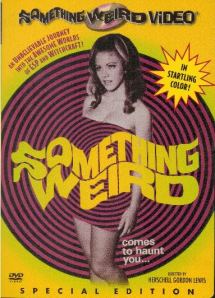
Now that I’ve finished reviewing the Friday the 13th series, I can finally take the time to make a few comments about a film that I’ve been meaning to review for a while here on the Shattered Lens: Herschell Gordon Lewis’s 1967 film Something Weird.
How to describe Something Weird? Well, I could tell you that it was one of the first films to realize that ESP, witchcraft, and LSD made for a potent combination. I could also point out that everyone’s favorite company — Something Weird Video — took their name from this film. However, I think the best (and maybe only) way to tell you about this film is to simply tell you what happens.
The film starts out brilliantly with ten minutes of vaguely connected and disjointed images. We start out with a close-up of a pair of legs that apparently belong to someone being chased down a city street.
Cut To:
Two guys practicing karate. One of them we will never see again. The other one is a doughy-faced guy named Alex Jordan (William Brooker). The one we will never see again explains to Alex that he’s not actually that talented when it comes to the martial arts. Alex looks annoyed.
Cut to:
Alex is fooling around with a blonde that we’ll never see again and who will never be mentioned again for the rest of the film. “You’re electrifying,” she tells him.
Cut to:
Some random guy is electrocuted by a downed power line. Cronin “Mitch” Mitchell (Tony McCabe) runs over to help him and gets hit in the face by the same power line. He falls to the ground while a group of random people wander over. “Has anybody called an ambulance yet?” someone calmly asks.
Suddenly, there’s a man in a suit kneeling down by the two bodies and apparently, he’s some sort of medicine man because, while looking at the first man, he says, “I’ll have to call the coroner on this man.”
However, Mitch is still alive so he’s put into the back of a station wagon and driven to the local hospital. As we watch Mitch being pulled out of the back of the car, the camera pans up to the cloudy sky and suddenly, a narrator comes out of nowhere and starts rambling about “the sixth sense, ESP!” The narrator is also nice enough to let us know that Alex — the guy from the Karate lesson — is apparently a government scientist who is in charge of figuring out how to use ESP against America’s enemies.
This all happens in the first 10 minutes of the film and, unfortunately, the remaining 70 minutes of the film struggles to live up to the surrealistic brilliance of this little montage.
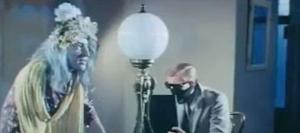
Anyway, Mitch is alive but now he’s got both a scar on his face and the ability to see the future. As one of his doctor’s puts it, “He’s a different man since the accident … cynical. Maybe even morbid!” Once he’s released from the hospital, Mitch takes to wearing a black bandana over the lower half of his face and becomes a professional psychic.
He finds a little success but, as we’ve been told, he’s now “cynical…maybe ever morbid!” However, things change for Mitch when he’s approached by a grotesquely ugly woman with a blue face and a cackling laugh. She explains that she’s a witch and she’s willing to restore his face but only if he takes her as his lover. Mitch reluctantly does this and his scars suddenly vanish.
Soon, Mitch is a celebrity, appearing on television. Everywhere he goes, the witch is on his arm. The rest of the world sees her as a beautiful woman named Ellen Parker (Elizabeth Lee) but whenever Mitch looks at her, he sees her in her true blue-faced form.
Meanwhile, there’s a serial killer preying on the woman of Jefferson, Wisconsin and the chief of police (played by Lawrence Wood, the man who gave the infamous “fire sale” monologue in Lewis’s Scum of the Earth) invites Mitch and Ellen to come help with the investigation. The government meanwhile sends Alex (remember him?) to the town to investigate Mitch and perhaps recruit Mitch into the service of his country.
Alex is, at first, skeptical of Mitch but then he sees Mitch exorcising a disgruntled spirit from a local church and he starts to think that Mitch might have some psychic abilities after all. Mitch might just need a little help and Alex is there to provide it.
Meeting with Mitch in the police chief’s office (and with the entire police force looking on), Alex produces two white pills from his pocket and says, “I have a drug here — LSD. Ever hear of it?” Alex proceeds to echo many real-life MK-Ultra conspiracy theories as he explains that LSD will increase Mitch’s psychic abilities to the extent that he’ll be able to catch the killer. Mitch replies, “I’ve never taken the drug before but I’ll be glad to, doctor.”
Well, needless to say, the LSD produces the typical cinematic red-tinged, desert-themed trip but it still ends with Mitch figuring out who the killer is. It also allows Mitch to understand that the killer is sane “98% of the time.” However, there’s a problem because now that killer is out to kill Mitch and Alex has fallen in love with Ellen, the blue-faced witch…
To be honest, Something Weird is not one of Herschell Gordon Lewis’s best films. Even by typical Lewis standards, the plot doesn’t make much sense and the acting is incredibly bad. Whereas other Lewis films (like Blood Feast) featured performances that were deliberately over the top, the cast of Something Weird comes across as if they were as confused while making Something Weird as the audience would later be while watching it. (However, it should be noted that Elizabeth Lee at least seems to be having fun in the role of the constantly cackling witch.)
However, I still love Something Weird because, unlike so many other movies, it actually lives up to its name. This is a movie that promises to be weird and that’s exactly what it is. There’s just so much to love in this film. Check out the way that Mitch’s “facial scars” never look the same from scene-to-scene. (At one point, the scars cover his entire face but, in the next scene, they can be easily hidden by a bandana.) Watch in amazement as the same set is used and re-used for almost every scene in the movie, with just the furniture occasionally being rearranged depending on whether the scene is supposed to take place in an office or a hotel room.
Ultimately, my love for this film comes down to the little details. I love how the ambulance at the start of the film is just an old school station wagon (complete with wood paneling) with a siren on top of it. Even better is how the police captain’s office is decorated with a faded pictures of George Washington and Abraham Lincoln that literally appear to have been ripped out of an old history textbook.
In the greatest tradition of the grindhouse, there is no other movie like Something Weird and, for that reason alone, it’s worth watching.
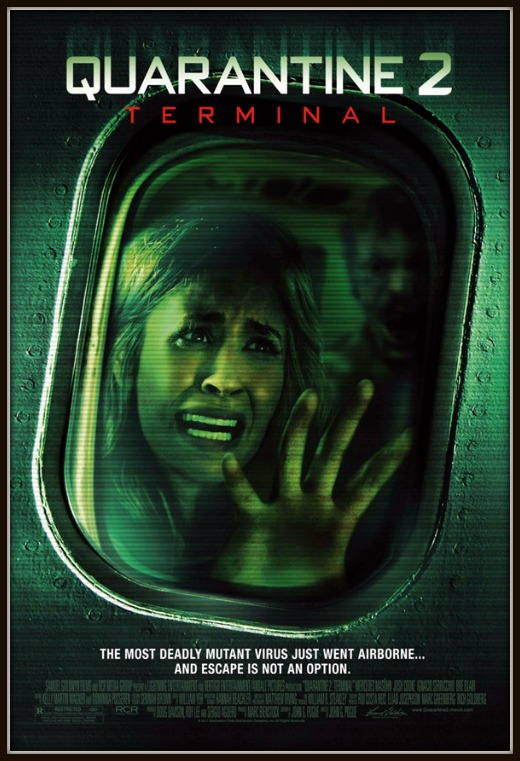
Quarantine 2: Terminalis the 2011 horror sequel to 2008’s Quarantinewhich was a remake of the much better Spanish horror film [Rec]. This sequel goes off on it’s own different path instead of just remaking the sequel which followed the Spanish film. As directed by John Pogue this sequel dumps the “found footage” style of the first film and instead just goes for a traditional film style. The film also goes it’s own way in explaining how it ties into the previous film.
Where the Spanish sequel had it’s events set at the same place this time around we find our new cast of characters on-board a red-eye flight from Los Angeles to Nashville that soon gets diverted to Las Vegas when one of the passengers suddenly becomes violently ill. Once they land the film mirrors the first film in that the surviving passengers, crew and a lone airport maintenance crewmember get locked in the terminal they’re at. The very bio-weapon that was unwittingly unleashed in the apartment complex in the first film has made it onto the flight and one by one the cast succumbs to it’s “rage zombie”-like symptoms.
Quarantine 2is not an awful as some would like to tell people, but it is also not a good film. It’s pretty average with little to no tension or scary surprises. It’s a horror film almost done by check-list. We also don’t get fully realized individuals to root for so that when one becomes infected there’s no sense of loss. In fact, there’s not even a character to root against. That’s how bland the characters ended being in this film. The story itself has built on the details presented about the virus in the first film and it’s an interesting premise that deserved a better film. Maybe a couple years from now the series will get rebooted and remade Bollywood-style and get some energy into it.
Moving onto a much better film that also share’s the above film’s fast-moving “zombie”-like infected is 2010’s Devil’s Playgroundby British horror filmmaker Mark McQueen. It is set in present-day London where it begins in medias res a hard-looking man all bloodied going by the name of Cole (played by Craig Fairbass) who uses a computer’s webcam to record the events which has transpired to bring him to his current state.
We soon go back to the beginning of the crisis which starts from the human-testing of a new drug by the pharmaceutical company N-Gen. Of the 30,000 test-subjects only one doesn’t succumb to the deadly side-effects of the drug which causes those injected to transform into ravening, cannibalistic killers who also happen to have had their agility amplified that they’re able to parkour their way towards the uninfected.
Yes, you heard right, parkour zombies. That gimmick alone attached to the current trend of fast-moving zombies gives this film an edge over most fast-running zombie films.
Devil’s Playgrounddoesn’t just try to make things interesting with a new brand of zombie-infected killers, but manages to create a story around the usual “man on a mission” plot. Cole has to find the only test subject who didn’t succumb to the experimental drug’s side-effects in hopes that this person carries the means to help end the spread of the virus. The cast itself helps in making this horror film rise above the usual dreck that gets released on video. While I’ve never been a fan of British “tough guy” actor Danny Dyer he wasn’t as annoying in this film as he is in others and it’s due to the performance by Craig Fairbass as the hardened mercenary Cole which makes Dyer’s dishonored cop Joe from chewing everything in the scene he appears in.
Director Mark McQueen does a good job in keeping the story moving forward even as he juggles subplot involving a couple of London river cops trying to find a safe haven in a city that’s going through a deadly crisis of apocalyptic proportion. Even the free-running zombies don’t come across as laughable and at times even come across as quite horrifying when Cole and his small band of survivors try to move from haven to haven in the hopes of getting the one who may be the key to solving the crisis to the right people.
Devil’s Playgroundmay not join the ranks of the classic zombie films since Romero’s Night of the Living Deadchanged the world of horror in 1968, but it manages to be both entertaining and scary despite the parkour zombies.
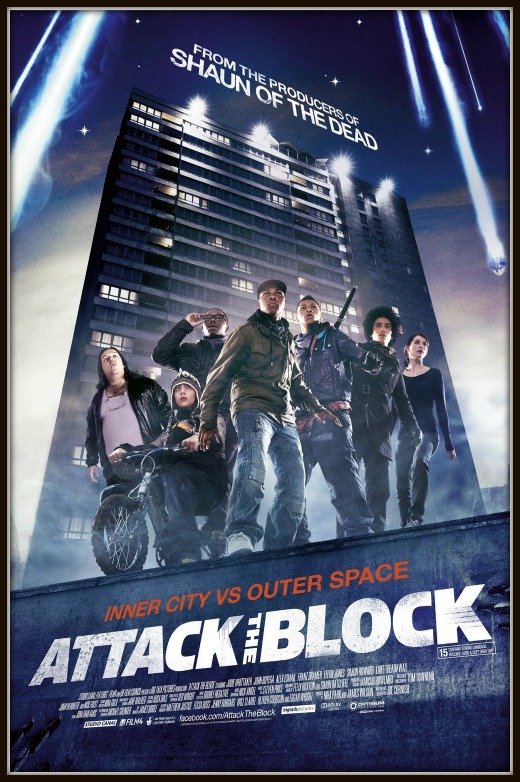
The best of this triple-bill of horror comes courtesy of one of 2011’s festival darlings. Attack the Blockby writer-director Joe Cornish was able mash together scifi, horror and comedy and do so seemlessly. It’s a genre-busting film that doesn’t lean too heavily on either three but allows the great script written by Cornish to dictate when the horror begins and when it transitions to some sharp comedic scenes and dialogue.
This is a film that could’ve sunk under the weight of it’s cast of British teen and child actors, but instead gains much of it’s appeal from these fresh, young faces. Even for those across the Atlantic in the US the British slang used by the kids in the film doesn’t confuse as much as it could. The writing and performances by these kids (especially by John Boyega as the teen gang leader Moses) don’t come across as forced, but flow naturally from scene to scene. Their reactions to finding and killing what turns out to be an alien looks and sound exactly how any group of young hoodlums and ragamuffins would have. In fact, some of the film’s funnier scenes was due to how each of them arm themselves in their attempt to protect the block of apartments they all live in.
It wouldn’t be an alien invasion film of any quality if we didn’t get some memorable aliens. Fortunately we do get aliens that come across not just menacing, but also not fake looking. Nothing takes an audience away from suspending their disbelief and enjoying a film than a badly pulled off visual effect. Cornish and his effects crew use a combination of practical and CG effects to bring to life a horde of alien invaders who look like a cross between apes and the ball of fur and teeth from the 80’s cheesetastic scifi-horror film series Critters.
Attack the Blockdoesn’t skimp on the death and destruction. The film doesn’t treat the young characters with kid’s gloves either as they’re not exempt from the mortal danger posed by the aliens who have invaded their Block. The fact that each character (both young and old) were written to be rounded characters with distinct personalities that we feel each death no matter how minor the role. It’s a rare horror film that actually made great use of character development in-between scenes of action and terror. Even during those particular scenes each character on the screen adds a new layer of complexity to the role. This is a testament to director Joe Cornish who also wrote the excellent screenplay. The fact that this was his feature film debut as a director also makes Attack the Blocksuch a surprise wonder.
So, our tally for today when it comes to the three films mentioned above would come down to….
Quarantine 2: Terminal– Pass (watch on Netflix Instant if there’s nothing else to watch)
Devil’s Playground– Definite Watch (can be seen through Netflix Instant)
Attack the Block– Must-See (buy the blu-ray to add to your collection or rent if you’re not into that)
Earlier this month, I saw Intruders, the latest film from director Juan Carlo Fresnadillo. Spanish horror films are currently the trendy genre to love and Intruders has everything that we’ve come to expect from Spanish horror: creepy children, gothic atmosphere, claustrophobic staging, ineffectual representatives of the Church, and a feeling that the society of the present is held hostage by the sins of the past.
Intruders tells two parallel stories about two children who are haunted by a malevolent, faceless spirit known as Hollowface. Hollowface comes out at night and searches for a new face (and who can blame him, really?). As the film opens, he is haunting a young boy (Izan Corchero) and his mother (Pilar Lopez de Ayala) in Spain. The boy deals with his fear of Hollowface by writing a lengthy story about him. Meanwhile, in England, 12 year-old Mia (Ella Purnell) finds a copy of the boy’s story in an empty tree stump and reads it aloud. Shortly after doing this, she starts to see Hollowface in the shadows of her bedroom. The only person who believes her is her father (played by Clive Owen). The film proceeds to cut back-and-forth between these two haunted children until finally, in its final few minutes, the two stories come together.
Intruders starts out strong but then quickly starts to fall apart. As a malevolent force, Hollowface is effective as long as he’s just a shadowy figure floating through childish nightmares but, as the film progresses, he becomes less and less intimidating until finally he’s just another poorly defined villain in a costume. By that same token, Fresnadillo’s direction is nicely atmospheric and creepy during the first half of the film but then, as the two parallel stories come together, the film starts to feel more and more generic. The two stories are, of course, linked together by a big twist. Oddly enough, even though I managed to guess the twist, it still felt like it came out of close-to-nowhere.
That said, Intruders isn’t a disaster. The film is fairly well-acted (especially by Clive Owen, who in a perfect world would be playing James Bond in Skyfall) and even once the narrative falls apart, Fresnadillo still comes up with the occasional effective shock. Even if I wasn’t familiar with Fresnadillo’s previous films, I would probably take a chance on his next movie.
Just as long as it’s not The Return of Hollowface or anything like that.
After spending the last two weeks watching the endless mayhem of the Friday the 13th franchise, I was really in the mood for a nice, low-key romantic comedy and that’s exactly what I got on Tuesday night when I went to the Dallas Angelika and saw Salmon Fishing In The Yemen.
Now, I have to admit that I come from a family that is full of people who like to fish. I, however, am not one of them. First off, as I’ve explained here numerous times, Lisa does not do water. Second, I have never seen the appeal of spending hours doing nothing just on the off-chance that you might catch a slimy fish that you’re just going to toss back into lake or river or wherever it is that they’re just trying to live their lives day-to-day. (Seriously, it seems like that would be very traumatic for the fish.) I understand that there’s supposed to be some zen nature thing that comes along with fishing but … no, I just don’t get it.
Fred Jones (played by Ewan McGregor) would disagree with me. Fred is a world-renowned expert on fish and fishing who works for the British government. It quickly becomes apparent that Fred is more comfortable fishing than dealing with other human beings. (The film goes as far as to have another character suggest that he has Asperger’s syndrome but I’m going to disagree with that diagnosis because, quite frankly, I think that the current popularity of characters and celebrities with self-diagnosed Asperger’s syndrome is really more of a case of lazy characterization than anything else.) Anyway, Fred is stuck in a failing marriage and is suffering from a huge case of ennui but that all changes when he meets Harriet (Emily Blunt).
Harriet is a neurotic girl whose boyfriend Robert (a very handsome and charming Tom Mison) is serving in Afghanistan. Harriet works for a consulting firm that has been contracted by a wealthy sheikh (Amr Waked) who wants to introduce salmon fishing to the desert country of Yemen. While Fred claims that the sheikh’s idea is impossible, the British government decides that the project has a lot of PR value and soon, both Fred and Harriet find themselves in Yemen, attempting to introduce salmon into a foreign habitat, dealing with suspicious and militant locals, and, of course, falling in love.
Salmon Fishing In The Yemen is an undeniably uneven film and it didn’t really change my opinion of fishing but I still enjoyed it. It’s a genuinely sweet-natured film and, as was proven last year in Beginners, nobody falls in love on-screen as convincingly as Ewan McGregor and he and Emily Blunt have a very likable chemistry. They make for a super cute couple and you really do find yourself hoping that they get together and really, what else can you ask for when you go to a see a romantic comedy?
I was a bit less impressed with the film’s attempt at political satire but that may have had more to do with my own election year fatigue than anything else. That said, the Prime Minister’s press secretary is played Kristin Scott Thomas and she literally gives one of the most ferocious performances that I’ve ever seen. She snarls and snaps with such skill that she made even the film’s most heavy-handed moments entertaining. Perhaps her signature moment comes when another character offers her his resignation and she snaps back, without missing a beat, “Accepted.” Scott Thomas utters that one line with the perfect combination of venom, annoyance, and gratitude.
Seriously, somebody get Kristen Scott Thomas her own HBO sitcom. She deserves it.
As a child of the 80’s I grew up watching reruns of the 3 Stooges (among other classes like The Little Rascals, Laurel & Hardy, etc). My love for this show, along with Alyssa Milano, Bruce Lee films, and Blade Runner are the only things that survived my transition from wee lad to loner teen, from loner teen to awkward adult.
I was a tad apprehensive when I learned about the film, since very few movie revivals of television series did the source material any justice. The Farrelly Brothers did something special, they introduced the Stooges to the wee ones of this generation and entertained the old fans (like myself and my Stoogephile buddy). Chris Diamantopoulos, Sean Hayes, and Will Sasso truly honored the characters made famous Moses Horwitz, Louis Feinberg, and Jerome Horwitz. They successfully captured the innate innocence and mischieous of these loveable trouble makers.
Over the previous two weeks, I reviewed all 11 films in the Friday the 13th franchise. I reviewed the final film, appropriately enough, on Friday the 13th. Now that I’ve sat through all 11 of these films, I’d like to provide just ten thoughts in conclusion:
1) Have you seen Cabin In The Woods yet? While that brilliant film is obviously influenced by a lot of films, the Friday the 13th influence was especially obvious, right down to the crazy old man trying to let everyone know that they were doomed.
2) As for the Friday the 13th franchise itself, what is left to be said? I think my interest in these films comes from the fact that even though their critically reviled and utterly dismissed by many, they’ve managed to survive and they’re still being watched by viewers (like me) who weren’t even born and/or weren’t old enough to see the majority of them when they were first released in theaters. Like it or not — and again, this is a point that should be obvious to anyone who truly appreciated Cabin In The Woods — these films appeal to something primal in human nature.
3) The most frequent complaint made against the Friday the 13th franchise is that the films are anti-female. I don’t agree. I think that, unfortunately, a lot of people who watch these films are anti-female but I don’t think that the same can be said of the films themselves. Quite frankly, if I was ever cast in Friday the 13th, I would rather play a victim than a survivor because the victims are the ones that are remembered afterwards.
4) Instead of seeing the Friday the 13th films as some sort of attempt to punish women, I see them as simply being updated bits of American folklore. Those famous urban legends — the escaped mental patient with the hook hand, the vanishing hitchhiker — are about as close as America can get to having its own mythology and the Friday the 13th franchise (and similar horror films) are a reflection of that mythology.
5) Much like the scary story told at slumber party or around a campfire (not that I’ve been near a campfire though I have been to a few thousand slumber parties), Friday the 13th is meant to be a communal experience. It’s a chance to admit that we’re all scared of the dark. We scream and jump because, ultimately, it’s fun to do that in the safety of a theater or your own home.
6) Friday the 13th, as a franchise, was at its best when it kept things simple. As you may have noticed from my reviews, I struggled more with the gimmicky later films in the series than I did with the originals.
7) The first two Friday the 13th scenes are both excellent examples of how to use a low budget and a largely unknown cast to your best advantage. There is a lesson there for all aspiring filmmakers.
8) Having now rewatched the 11 films in the franchise, I have to say that I think that Part 4 is the best, followed by Part 2. Part 3 remains the worst while Jason Takes Manhattan is perhaps the most pointless. Ted White was the best Jason but Kane Hodder is a close second.
9) When I was reviewing these films, Peter M. Bracke’s book Crystal Lake Memoriesproved to be an invaluable resource. I highly recommend it to anyone who is interested in film, horror, or both.
10) Finally, did you all enjoy me devoting two weeks to reviewing one film franchise or were you thinking to yourself, “Oh my God, Lisa, give it a rest already!” I enjoyed writing them but, to be honest, I’m really in the mood for a romantic comedy now.
Well, that does it for Friday the 13th. Again, I hope everyone enjoyed revisiting this franchise with me and I hope that everyone will enjoy revisiting the James Bond films with me in October. As always, stay supple!
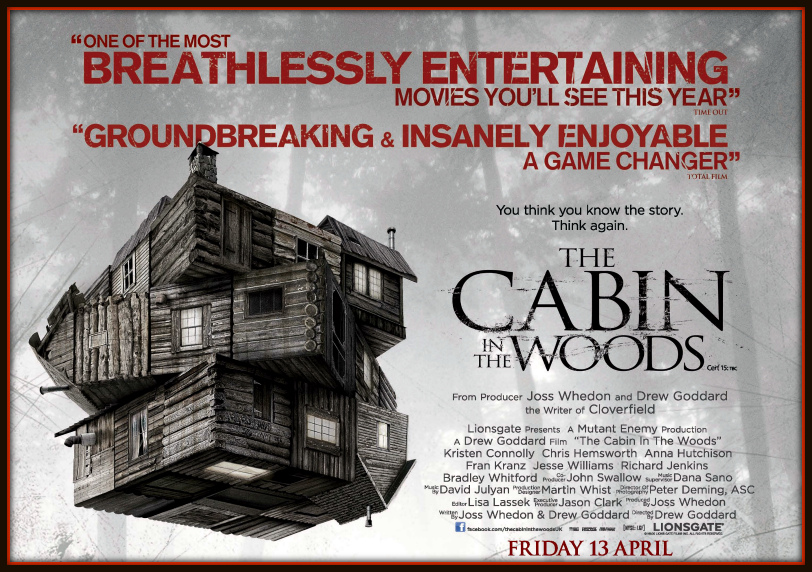
If there was one thing the meltdown and subsequent bankruptcy of MGM ended doing it was shelving the Drew Goddard and Joss Whedon horror film The Cabin in The Woodsfor almost three years. The film was directed by Goddard who also helped co-write the screenplay with Joss Whedon and what we get is one of the smartest and most innovative horror films to come in over a decade. For fans of the tv shows Buffy: The Vampire Slayer and Angel (not to mention Dollhouse) this horror film just reinforces the notion that Joss Whedon knows how to write smart dialogue and premises without ever getting too self-referential and deconstructionist (I’m looking at you Kevin Williamson) or too smart-talky (a stank-eye at you Aaron Sorkin).
There’s really no way to properly review The Cabin in The Woods without spoiling the films many different surprises and twists and turns. I will say that the film does a peculiar opening that focuses not on the five college students headed to the cabin in the woods of the film’s title, but on two men (Richard Jenkins and Bradley Whitford) in your typical office attire doing the walk and talk about family home life and the like. We see that they’re technicians in an unnamed industrial facility that wouldn’t look out of place in one of the many governmental facilities we often see in film. The film will return to these two men and their facilities and other people working within often in addition to telling the story of the five college students and the growing danger they find themselves in as night falls in the woods.
To say anymore would definitely be a spoiler.
I will continue on and say that for a horror film written to self-reference other horror film conventions and tropes what Goddard and Whedon have ultimately done was celebrate the genre itself and how much of an impact it has had in society. Unlike films like the Screamfranchise, The Cabin in the Woodsdoesn’t knowingly wink at the audience about how cool it is for pointing out all the horror cliches and stereotypes we’ve come to expect in the horror genre. Instead the film actually treats its audience to be smart enough to see the homage to past horror films both good and bad without ever drawing attention to the fact that they’re pointed out.
Another thing which makes this film so fun to watch is how much every character in the film comes across as fully realized individuals. Even the college students who we first think of as your typical horror film stereotypes (the jock, the slut, the virgin, the brain and the stoner) end up being more than we’re led to believe. All of this actually occurs right in the beginning and this helps the audience join in on the fun that both Goddard and Whedon are having in turning the horror genre on its head right up to it’s surprising conclusion. It helps that the cast did quite a great job realizing their characters. As the film progresses we even begin to get a sense that who the villains in the film may or may not be who we think.
There’s a sense of fun and the darkly comic to the film as well. Every one-liner and comedic beats we get throughout the film doesn’t have a sense of the cynical to them. It comes across through dialogue and actions by both groups in the film in such a natural way that they never make those saying the lines break the fourth wall. Most films that try to deconstruct genre films tend to get too cutesy with the breaking the fourth wall gimmick that the audience can’t help but be pulled out of the suspension of disbelief they’ve put themselves in. This has a way of making such genre films less fun and celebratory and more of making fun of the people who enjoy such things.
The Cabin in The Woodsmanages that rare accomplishment of being a horror film that retains not just the horrific aspect of the genre but also add such a darkly comic sense to the whole proceeding with such a deft touch from Goddard and Whedon that we don’t know whether to call it straight horror or a horror-comedy. Some might even see the film as an entertaining treatise on the nature of the horror film genre of the last quarter-century. Both Goddard and Whedon have already called this film as their answer to the current trend of the “torture porn” that was popularized with the help of such recent horror franchises like Hostel, Sawand those made by Rob Zombie. Where those films celebrated the concept of inflicting pain not just on the characters on the screen but those who watch them with The Cabin in The Woodswe finally get a reminder why we love the horror films of the past. It’s through the sense of that adrenaline rush that a tension build-up leading to a horror money shot but without becoming overly gratuitious and reveling in the pain of the horror.
Some have said that The Cabin in The Woodsis the best horror film of 2012. I won’t even argue with that statement since it is true. I will put it out there that Cabin in The Woodsmight just be one of the best films of 2012. The film is just that fun, smart and, overall, just plain awesome.
[I usually attach a trailer to reviews but this time doing it could spoil some of the surprises in the film]