What Lisa Watched Last Night #72: The 85th Annual Academy Awards


Last night, I had a little party.  Me, my boyfriend, my sister, my best friend, and my 7,000 followers on twitter got together to watch the 85th Annual Academy Awards.
Seth

Why Were We Watching It?

If you love movies then the Oscars are like the Super Bowl.  Seriously, how could I not watch it?

What Was It About?

It was about the best of times and the worst of times.  It was about self-promotion, self-congratulation, and Michelle Obama.  It was about whether or not Seth McFarlane would self-destruct.  It was about rooting for the underdog and checking out who was wearing what.  It was the Oscars and, for 210 minutes, the nation sat entranced.

What Worked?

Brave won the Oscar for Best Animated Feature Film!  Seriously, that one award pretty much made the entire night for me.  Actually, there were a lot of good winners last night: Ang Lee for Best Director, Christoph Waltz for Best Supporting Actor, Paperman for Best Animated Short Film, and Jennifer Lawrence for Best Actress.  I was especially happy to see both Lawrence and Anne Hathaway win because, for whatever reason, these two actresses have recently had to deal with some of the most petty criticism that I’ve ever seen.

I also appreciated the fact that Quentin Tarantino, upon winning Best Original Screenplay, managed to spend his entire speech basically patting himself on the back while pretending to thank his cast.  It may not be remembered as the most classy speech in the history of the Oscars but it definitely served to remind us of why we love Quentin.

As host, Seth McFarlane was such a mixed bag that I’ve included him under both things that worked and things that didn’t work.  McFarlane started out surprisingly strong.  Unlike a lot of female critics, I wasn’t offended by The Boob Song and I thought it was actually a pretty clever parody of McFarlane’s public image.  (The joke was clearly meant to be on McFarlane and not the actresses mentioned in the song.)  Unfortunately, as the show went on, McFarlane occasionally seemed to be determined to live up to that parody.

Oddly enough, I really enjoyed Lincoln when I saw it but yet I still found myself happy to see it lose in so many categories.  I think it’s probably because Lincoln was so aggressively hyped and so many self-important Oscar pundits (like Sasha Stone) declared that Lincoln was the best film of the year before they had even seen it.  It was hard not to resent the condescending tone that was taken by many of Lincoln‘s online supporters.  Plus, it’s always fun to root for the underdog.  It’s hard not to suspect that if Ben Affleck had actually been nominated for Best Director then Steven Spielberg and his film might have actually won big last night.  But by snubbing Affleck, the Academy cast Steven Spielberg and Lincoln in the role of Goliath.

On one final petty note, I was happy to see Jennifer Lawrence win because I know her victory probably annoyed the editors of Awards Daily.

What Did Not Work?

I could have done without Michelle Obama showing up to present Best Picture. Yes, I know that Hollywood loves the Obamas but seriously, it felt rather Orwellian to have the First Lady suddenly pop up on TV and tell us why movies are so important.  The fact that she appeared with a few random soldiers behind her just added to the creepy vibe.

The much hyped Bond tribute turned out to be a bit of a bust, didn’t it?

The audience, which never seemed to be that excited about the prospect of Seth McFarlane in the first place, seemed to turn more and more against him as the show progressed.  As a result, once the Oscars hit the 120 minute mark, Seth started to come across as being a bit desperate to get a reaction — any reaction — from the audience.

Daniel Day-Lewis gave a good acceptance speech and all but surely I’m not the only viewer who was curious to hear what Joaquin Phoenix would have said if he had won.

In the end, the show just felt a little bit too bland for my tastes.  Unlike last year, there was nothing truly unexpected.  There were no hints of eccentricity.  No one showed up wearing anything awful.  Nobody made a fool of themselves while accepting their Oscar.  In short, the show was just forgettable.

“Oh my God!  Just like me!” Moments

When Jennifer Lawrence fell on the way to accept her award, that was definitely an “Oh my God!  Just like me!” moment.  Seriously, I loved her dress but, from the minute I saw it, I knew she was going to have a hard time getting up to the podium.

Lessons Learned

Award shows are a lot more fun when things go wrong.
Film Review: Mr. Freedom (dir by William Klein)


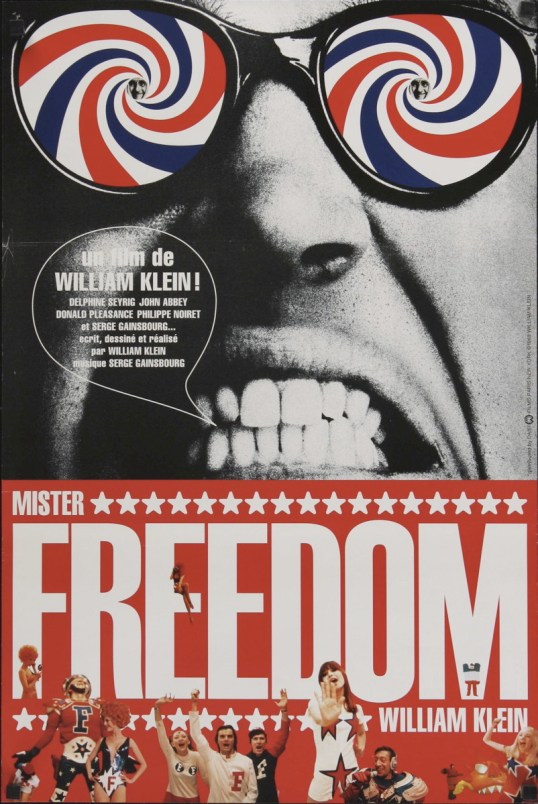
Mr. Freedom Cover

Mr. Freedom, William Klein’s 1968 political satire, is a strange one.

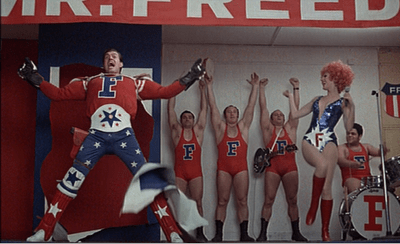
The film opens with a riot in the inner city.  A scowling Southern sheriff (played by John Abbey) goes into his apartment and, when he comes back out, he’s transformed into Mr. Freedom, a patriotic super hero whose is costumed in a red, white, and blue football uniform.  Mr. Freedom proceeds to invade a black household where, while firing two guns, he sings his theme song.

“F-R-Double E-Double D-OM!  FREEDDOM!”

That’s right, he misspelled freedom.

mr_ freedom

It turns out that Mr. Freedom works for Freedom, Inc.  His boss is Dr. Freedom (played by Donald Pleasance) who communicates with Mr. Freedom via a flickering TV screen.  Dr. Freedom is concerned that France is on the verge of turning communist and he sends Mr. Freedom to Paris in order to “win the hearts and minds” of the French.

William Klein, himself, was an American expatriate who lived in France and is best known for being both a fashion photographer and a documentarian.  His view of America is epitomized by the sight of Mr. Freedom (wearing a gigantic cowboy hat) wandering around Paris and assaulting random tourists.  With the help of a prostitute played by Delphine Seyrig, Mr. Freedom attempts to rally the French to the side of freedom and to defeat the schemes of Red China Man.  When the French don’t prove enthusiastic enough, Mr. Freedom responds by making plans to blow the country up.

Mr. FreedomUnlike a lot of left-wing films, which celebrate the American establishment by pretending to attack it, Mr. Freedom is sincere in its politics.  It’s obvious that William Klein set out to make the most anti-American film that he could and he succeeded.  Mr. Freedom is an irredeemable character.  When the film begins, Mr. Freedom is quickly established as being an idiot and, at the end of the film, he has somehow become an even bigger idiot.  Perhaps not surprisingly, a lot of people over at the imdb have compared Mr. Freedom’s quest to conquer France to America’s current policy towards the Middle East.

If you’ve read some of my previous reviews, you would be justified in expecting that this is where I would condemn Mr. Freedom for being heavy-handed and tediously left-wing.  After all, I’m the girl who condemned Avatar for being predictable environmental propaganda.  And yes, I did find Mr. Freedom to be heavy-handed but I actually enjoyed it.

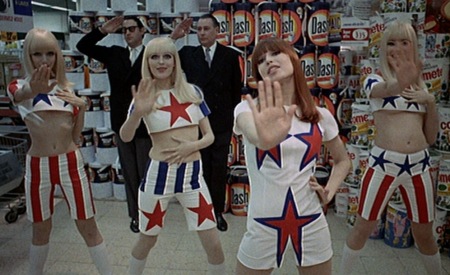
Even if you didn’t know that William Klein was an award-winning photographer both before and after he started making films, you would be able to guess it after taking one look at Mr. Freedom.  The film’s narrative is undeniably uneven but visually, it’s a feast for the eyes.  From the costumes worn by Mr. Freedom and his disciples to the design of Mr. Freedom’s secret headquarters, the screen is full of bold, primary colors and Klein shows a taste and appreciation for the bizarre that makes it easier to deal with the film’s moments of peachiness.  Perhaps my favorite scene in the film involves Mr. Freedom confronting Red China Man.  Red China Man, it turns out, is a gigantic dragon-shaped balloon.

See Mr. Freedom.

There’s nothing else like it.

Red China Man

Quick Review: Silver Linings Playbook (dir. by David O. Russell)


slpIn Silver Linings Playbook, Pat Solitano (formerly Pat Peoples in the novel written by Matthew Quick, played by Bradley Cooper) is recently released from a mental hospital to the care of his parents. Obsessed over reclaiming the love of his ex-wife, Nikki, he sets out on exercising and reading books to become better when he sees her again. Working under the notion that positivity, mixed with great effort can lead to a Silver Lining, he uses this new outlook to focus on his goal. Of couse, this doesn’t happen without some hiccups. There’s one key scene in the film where he asks his parents where his wedding tape is, and starts tearing through boxes around the house searching for it. With Led Zeppelin’s “What Is And What Should Never Be” blasting in the background as everything escalated, I had an Anton Ego Ratatouille moment.

My mom had this thing where she’d shift from High to Low. Some days would be quiet, but if the wrong word or event happened, she’d explode either into a fit of activity or anger. We would be sometimes careful to not trigger this – “set her off”, she would say. My clearest memory is of having Alice in Chains’ “Don’t Follow” turned up really loud on the family stereo (and on repeat by her request) as she proceeded to break various objects in her bedroom. She isn’t the only one in the family who has that happen with her. My cousin has this thing where at night she has to check all of the burners on the stove at least 2 times before she’s satisfied they’re fine and off. She says she knows everything’s correct the first time, but says she needs to be sure.

We all have our quirks. When people burp around me, I feel compelled to say “Bless You”. It’s only right.

So, sitting in the theatre and watching Silver Linings Playbook, it all felt very familiar to me. The great thing -and possibly the problem near the very end – about it is that the film isn’t completely A Beautiful Mind in it’s sense of seriousness. I’ll admit I found myself smiling and laughing through a lot of it, just as much as I winced during Pat’s trouble spots. As he returns home, he finds his father (Robert DeNiro in a fine performance) already skeptical about him, but content that he has his son back to watch the Philadelphia Eagles games and to be his lucky charm. After being invited to dinner by one of his friends, Pat meets Tiffany (Jennifer Lawrence), who seems to be just as different as he is and he discovers that she’s been in contact with Nikki. She’ll help send word to her about how he’s doing (because a restraining order keeps him from doing so), if he will help her perform in a dance contest. This ends up starting a good friendship between the two and we start to find that Pat is doing better as things progress.

Director David O’Russell keeps the story centered on the two leads. Both Cooper and Lawrence are energetic and have this really great chemistry between them that makes it feel like they had a lot of fun working on this movie. What’s better is that there isn’t a single person in the supporting cast that doesn’t feel like (to me, anyway) that they were miscast or out of step. They could make a tv series with this cast, and it would be watchable. O’Russell also changes the nature of the story in his adaptation, making the dance sequence itself a major focus on the growth between Tiffany and Pat (and by extension, the family and friends). He also eliminates a side story where Pat’s mom leaves his father because of the Dad’s obsessive nature with the Eagles, choosing to replace it with some more heartfelt and/or moments between DeNiro and Cooper (who coindentially worked together in Limitless). I felt it tightened up the story overall.

Another element I enjoyed was the film’s use of music. Stevie Wonder’s “My Cherie Amour” serves as a song that’s important to the story (in the same way that Kenny G’s “Songbird” was to the novel) and as I mentioned before, the Zeppelin song also worked. Alabama Shakes, which are a group new to me, also had a good song with “Always Alright”. The music of the film felt similar to Juno for me in a lot of ways.

The only problem I had with Silver Linings PlayBook, the only thing that didn’t work for me was the way the film ended. Dealing with something as serious as any kind of mental disorder, especially one where there are meds involved, it’s a serious thing. I’m not saying that one in Pat’s situation can’t be with anyone, far from it, but the film paints a picture at the end that everything will be just fine and simple. I don’t know I agree with that. Fine, perhaps, but certainly not simple. Granted, the story sets up such a social tapestry for Pat that if anything were to go wrong, he’d have people who would rally behind him. The ending just makes it seems that he no longer has any quirks and possibly robs an otherwise perfect from a bit of reality.

Overall, the Silver Linings Playbook is a feel good film that’s definitely worth seeing, with an ensemble cast that helps to elevate the great performances by both Jennifer Lawrence and Bradley Cooper. The lack of a heavy-handed nature towards the issues with the main character help the comedic elements of it, but also stutter steps it at the very end for me.

What Lisa Marie and the Snarkalecs Watched Last Night #71: End of the World (dir by Steven R. Monroe)


Last night, the Snarkalecs and I watched the SyFy original movie, End of the World.  For the next two hours, we literally dominated twitter as we shared our mutual, nearly obsessive love for this film.  Soon, #EndOfTheWorld was a trending topic and, I’m happy to say, that ended up freaking out a lot of paranoid people who weren’t watching SyFy.

All in all, it was a pretty good night.

End of the WorldWhy Were We Watching It?

Because that’s what the Snarkalecs do.  We watch movies on SyFy and we usually get all snarky about them.  However, it was difficult to be snarky about End of the World because the people who made End of The World were obviously very snarky themselves.

What Was It About?

The world’s being bombarded by chunks of electromagnetic space debris.  Or something like that.  Really, the important thing to know is that the world’s about to end and it’s up to two video store clerks (played by two titans of nerdy adorability, Greg Grunberg and Neil Grayston) to save it.  Their solution involves breaking a sci-fi writer named Doc Brown (Brad Dourif) out of a mental asylum and Greg Grunberg working on a nuclear missile with a power drill.

However, to be honest, the plot is just a distraction.  The storyline is mostly used as an excuse to make clever references to nearly ever science fiction movie ever made.  Some of the references are obvious and some of them are a bit more subtle but, ultimately, they are what this movie is truly about.

What Worked?

It all worked.

Seriously, End of the World is the best film that I’ve ever seen on SyFy.  It was a film that was obviously made by genre fans for genre fans and, as a result, it felt like a belated Valentine’s Day present from the SyFy network to its viewers.

As I previously mentioned, the entire film is basically a collection of references and homages to other science fiction films.  While this is a technique that I’ve found cloying when used by other films, End of the World struck exactly the right tone.  The references were appreciative without over going overboard and, even more importantly, they were cleverly deployed throughout the film.   They moved the film forward and seemed to grow organically out of the action onscreen.  As a result, even with all the references, the film itself never felt heavy-handed.

Greg Grunberg is one of those great actors who can perfectly sell both comedy and drama.  His talents were on perfect display last night.  Perhaps the best Grunberg line of the night was, “It’s a monologue!  MONO!”

Brad Dourif didn’t have a lot of screentime but seriously, he  was just adorable.

Really, the whole film was just adorable.

What Did Not Work?

It all worked.

“Oh my God!  Just Like me!” Moments

Much like the character of Selena (Caroline Cave), I think Greg Grunberg’s pretty awesome.

Lessons Learned

The geeks shall inherit the Earth (but only after the Redheads are finished with it).

Film Review: Django Kill (dir. by Giulio Questi)


2228_spoiler_DjangoKill_t588

Released in 1967 and directed by Giulio Questi, Django Kill is one of the essential spaghetti westerns.

The film opens with a man literally clawing his way out of a shallow grave.  Played by Tomas Milian and known as the Stranger, the man is a Mexican outlaw who has been buried out in the middle of the desert.  Two sympathetic Indians discover the Stranger and, while they nurse him back to health, he has several flashbacks that explain how he came to be buried alive.

The Stranger was a member of a gang of thieves who stole a cargo of gold.  However, the Americans in the gang betrayed the Mexicans, gunning them down and fleeing with the gold.  The Indians agree to help the Stranger find the rest of his gang on the condition that the Stranger tell them what it was like to be dead.

The Stranger’s former gang, meanwhile, has arrived at a desolate town known as Unhappy Place.  From the minute that the gang first rides into town, we know that there’s something sinister about Unhappy Place.  A naked child stands in the middle of the street while another is used as a footrest by one of the adults.  A distraught woman watches them from behind a barred window.  A lame hedgehog drags itself across the dusty street.  As soon as the gang stops at the local saloon, the locals see the gold that they’re carrying and, in a shockingly brutal scene, the townspeople lynch the outlaws.

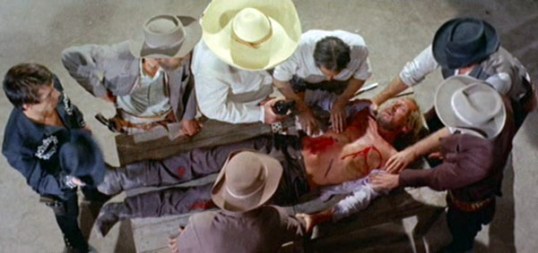
While this is going on, the Stranger rides into town.  Spotting the last living outlaw, the Stranger proceeds to gun him down.  In one of the film’s more infamous scenes, when the townspeople learn that the Stranger is using gold bullets, they proceed to literally rip the outlaw to pieces in an effort to retrieve the golden bullets.

With the outlaws dead, the townspeople claim the gold for themselves.  The Stranger, who was apparently more interested in revenge than getting the gold, stays in town and watches as things get increasingly weird.

How weird?

Well, how about the fact that the Stranger ends up having a romance with a crazy woman who spends her days trapped behind a locked door?

Or how about the fact that the Stranger finds himself in the middle of a power struggle between the townspeople and the flamboyantly homosexual Zorro (played, in grandly villainous fashion, by Roberto Camardiel) who rides into town with a gang of cowboys who are all dressed in black outfits with white embroidery?  In another one of the film’s infamous scenes, Zorro and his cowboys kidnap and gang rape the son of the town’s saloonkeeper.

(A young Ray Lovelock, who would go on to be one of the best actors to regularly work in Italian exploitation plays the son.)

Or how about the scene where Zorro plays with a bunch of Civil War figures while arguing with his pet parrot?  When Zorro offers the parrot a drink, the parrot replies, “I want more!”

Or, how about the fact that the Stranger, at one point, has to deal with several vampire bats while literally hanging from a cross?

Graphically violent and full of bizarre and disturbing imagery, Django Kill is one of the strangest westerns ever made and that strangeness keeps the film interesting even when the story doesn’t make much sense.  While Django Kill may not be the masterpiece that several claim it to (the film runs on a bit long and the dubbing of the English language version was absolutely terrible), it’s still one of the most compulsively watchable films that I’ve ever seen.  Just when you think the film can’t get any stranger, it does.

Django Kill was filmed under the title of If You Live, Shoot!  However, in a move typical of Italian cinema, the film was retitled to take advantage of the popularity of Sergio Corbucci’s Django.  The implication, of course, is that Tomas Milian is playing the same character here that Franco Nero played in Corbucci’s film.  Of course, nothing could be further from the truth.  Even in the crudely dubbed English version of the film, Milian is never referred to by name.  Instead, he’s simply known as the Stranger and, appropriately enough, the film feels more like a surreal take on Sergio Leone’s Dollar trilogy as opposed to being a part of the Django series.

That said, regardless of whether it’s a legitimate Django film or not, Django Kill …. If You Live, Shoot! is more than worth watching.  In fact, it’s essential for anyone who loves Italian exploitation films.

060312-DjangoKill-Post2

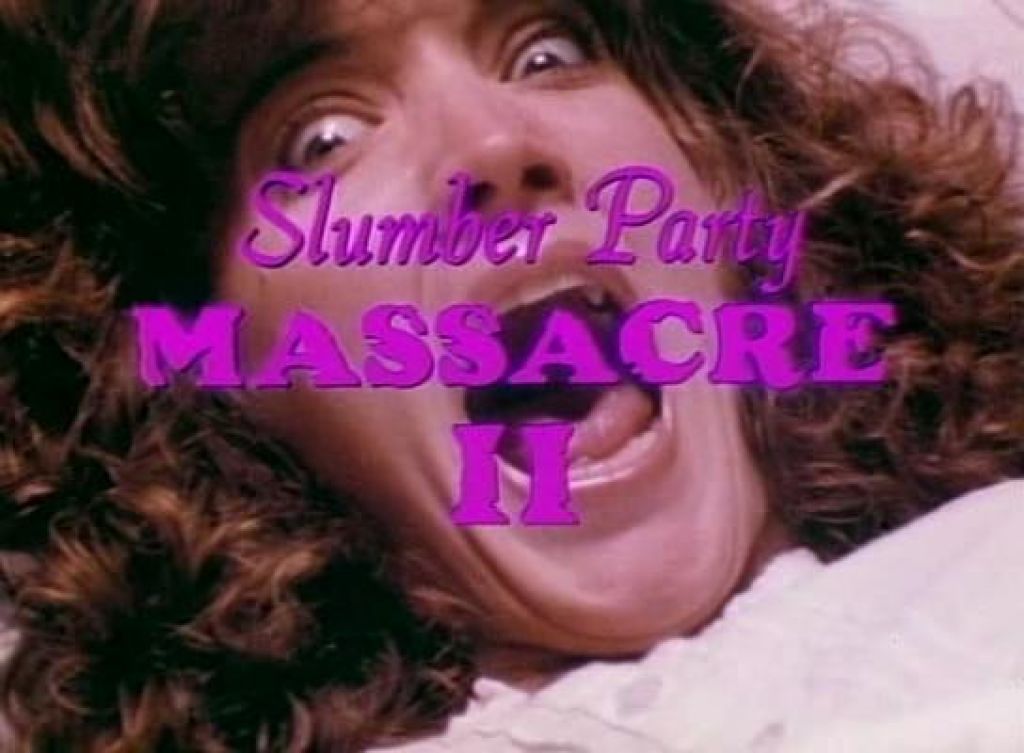
The SPM Trilogy Revisited : “Slumber Party Massacre II”


Slumber%20Party%20Massacre%202%201987

By 1987, I’m not sure that anyone was expecting Roger Corman to trot out a sequel to The Slumber Party Massacre. Sure, the movie had gained something of a cult following thanks to the VHS rental market (it did rather middling business at the box office upon its initial release), but it had been a few years and since most “slasher” sequels at the time tended to pop up within a year or two of the first flick (heck, that’s pretty much still the case), I think it’s pretty safe to say that the general feeling at the time was  that SPM was a one-and-done deal.

We all should have known better, or course. When you’ve got an ultra-simple premise that can be filmed cheaply and quickly using just a couple of different locations, and the original turned a profit (however modest), then there’s no way Corman’s not gonna go back to that well at some point. And so it came to pass that, five years on from its progenitor, Slumber Party Massacre II saw the light of day.

jurkohdkcrtibig

Needless to say, times had changed in the half-decade between the two films. While not strictly a straight-to-video release since Corman was still pulling together limited theatrical runs for all his product at the time (mostly in the Southern California area), those were really just a clevver way to essentially pull “focus group” test audiences together (and have them pay for the privilege of being guinea pigs rather than vice-versa!) to make sure the end result more or less had the effect on folks that it was supposed to. Pretty much all the action for the second Slumber Party Massacre was going to be on home video, and ol’ Roger knew it  — hence a smaller cast, fewer sets, and, I’m willing to bet, probably an even smaller budget (at least in terms of adjusted-for-inflation dollars). Heck, this thing even clocks in with a slightly shorter run time than its predecessor, if you can believe that, at a paltry 75 minutes!

One thing about the SPM modus operandi that Corman didn’t change, though, was hiring a young, relatively fresh-outta-film-school woman to direct the thing, his hire in those case being one Deborah Brock, who also wrote the script.

slumberpartymassacre2killer

To Brock’s credit, she tried to do something a little bit different — and, dare I say, maybe even a little bit more ambitious — than the average low-budget, essentially-DTV slasher sequel allows for with this movie. To her discredit, what she tried doesn’t exactly work. To wit:

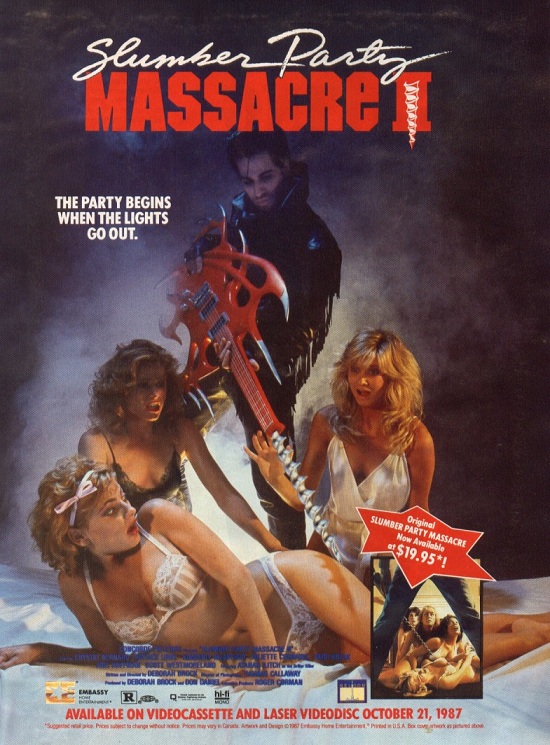
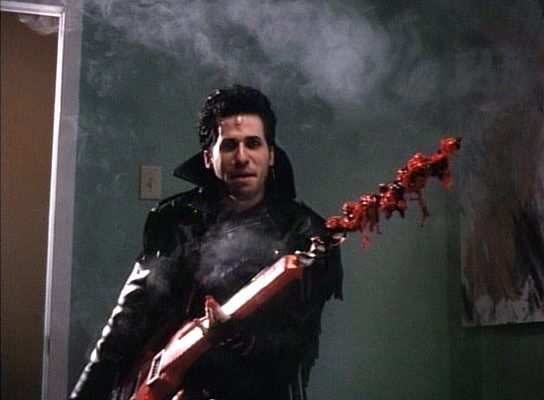
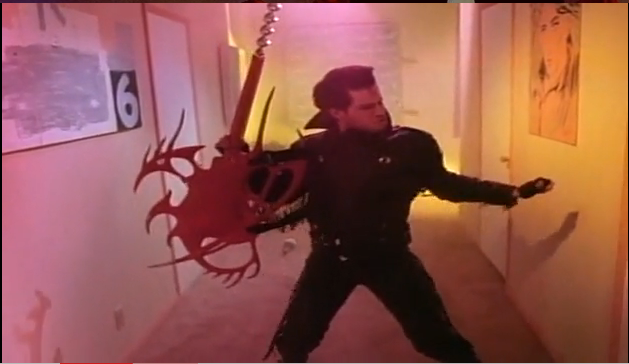
Our story here centers around a young gal named Courtney (Crystal Bernard, who would go on to star on the long-running TV sitcom Wings), who just so happens to be the younger sister of the “final girl” from the first Slumber Party Massacre flick. Courtney fronts an all-girl rock band (gotta vary it up from the high school basketball team premise at least a little bit) that’s headed to a rental condo for weekend of fun n’ semi-naked games with their boyfriends. There’s just one problem, though — she’s also been suffering from horribly vivid nightmares involving things like refrigerated whole chickens coming to life and her friend’s acne boiling, pulsating, throbbing, and eventually exploding all over the place. The one constant in all of these bad dreams, though, is an unnamed “devil rocker” (he’s referred to in the credits only as the “Driller Killer” and is played by Atanas Ilitch, who looks more than just a bit like a young Andrew Dice Clay) who terrorizes Courtney and her gal pals with a murderously-retrofitted guitar that’s equipped with a long, uber- phallic (again) power-drill for a neck.

spm23

Needless to say, once the weekend revelries get going, things don’t go quite as planned, and Courtney, her fellow girl-group rockers, and their fellas are soon experiencing a very violent reduction in their numbers at the hands of the “driller killer,” who turns out to be very real indeed.

Or is he? And that, my friends, is the crux of Slumber Party II‘s problem in a nutshell (besides the fact that the “real” killings don’t start taking place until just after the halfway point of the flick). At first, the whole “is this the real life, is this just fantasy?” (sorry, Freddie!) gimmick is kinda neat, but it definitely starts to wear on the average viewer’s nerves after awhile, and Brock’s decision not to delineate in much of any way what’s actual from what isn’t ultimately makes for kind of a confusing experience. Still, you figure that in a genre this (for the most part) cut-and-dried, things are bound to make sense by the end, right?

zit

Well, not so fast. Brock throws us not one, not two, but three rapid-fire concluding twists that never end up leaving  us with a satisfactory explanation as to whether or not the events we’ve just witnessed “really” happened or not. When we finally learn that Courtney’s locked up in a loony bin, three distinct possibilities emerge —  either it  was all a dream-within-a-dream in her disturbed mind, or she killed all her friends and this “driller killer” is some alternate persona she’s created in order to absolve herself of any guilt, or it all actually happened, she survived, and the ordeal drove her over the brink. And when the “driller killer” pops up again right before the credits roll, this time in the sanitarium with Courtney, Brock doesn’t in the least bit clue us in as to whether he’s there in the flesh or only in her erstwhile heroine’s admittedly traumatized psyche.

Some folks might find this lack of anything even resembling a concrete resolution interesting, maybe even a bit exciting. Hell, we all like to think for ourselves, right? Unfortunately, Courtney and her cohorts are such a largely uninteresting lot that most of us can’t really be bothered to care all that much about solving this film’s wanna-be-mind-fucking puzzle. And the “driller killer” himself is so OTT, and stripped of any pretense of motivation for his murder n’ mayhem, that he never seems “real” enough to make the purported “mystery” all that involving. The whole thing rings both flat and hollow to this wannabe-critic, at the very least.

slumber082710

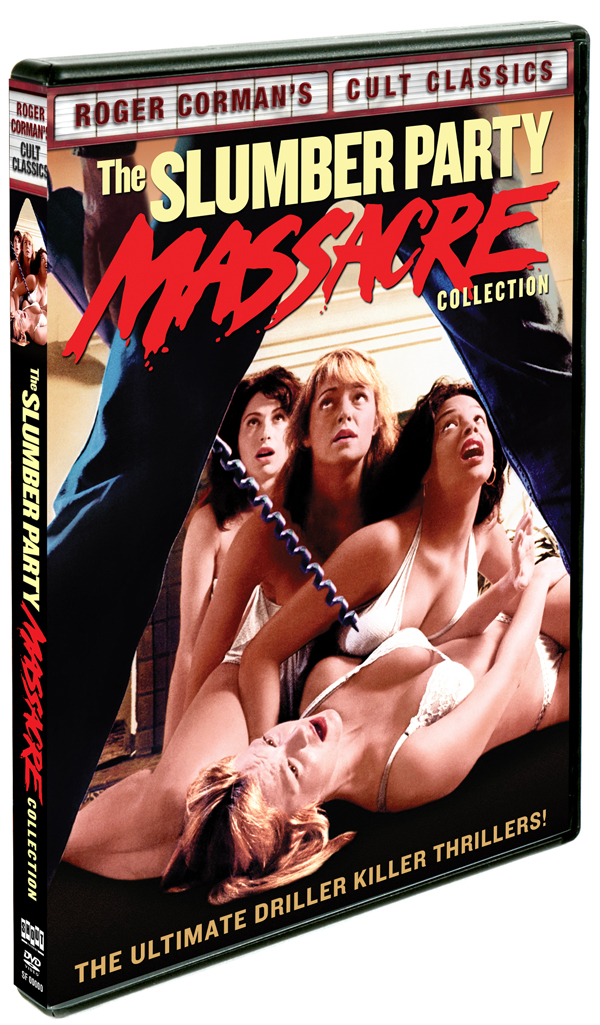
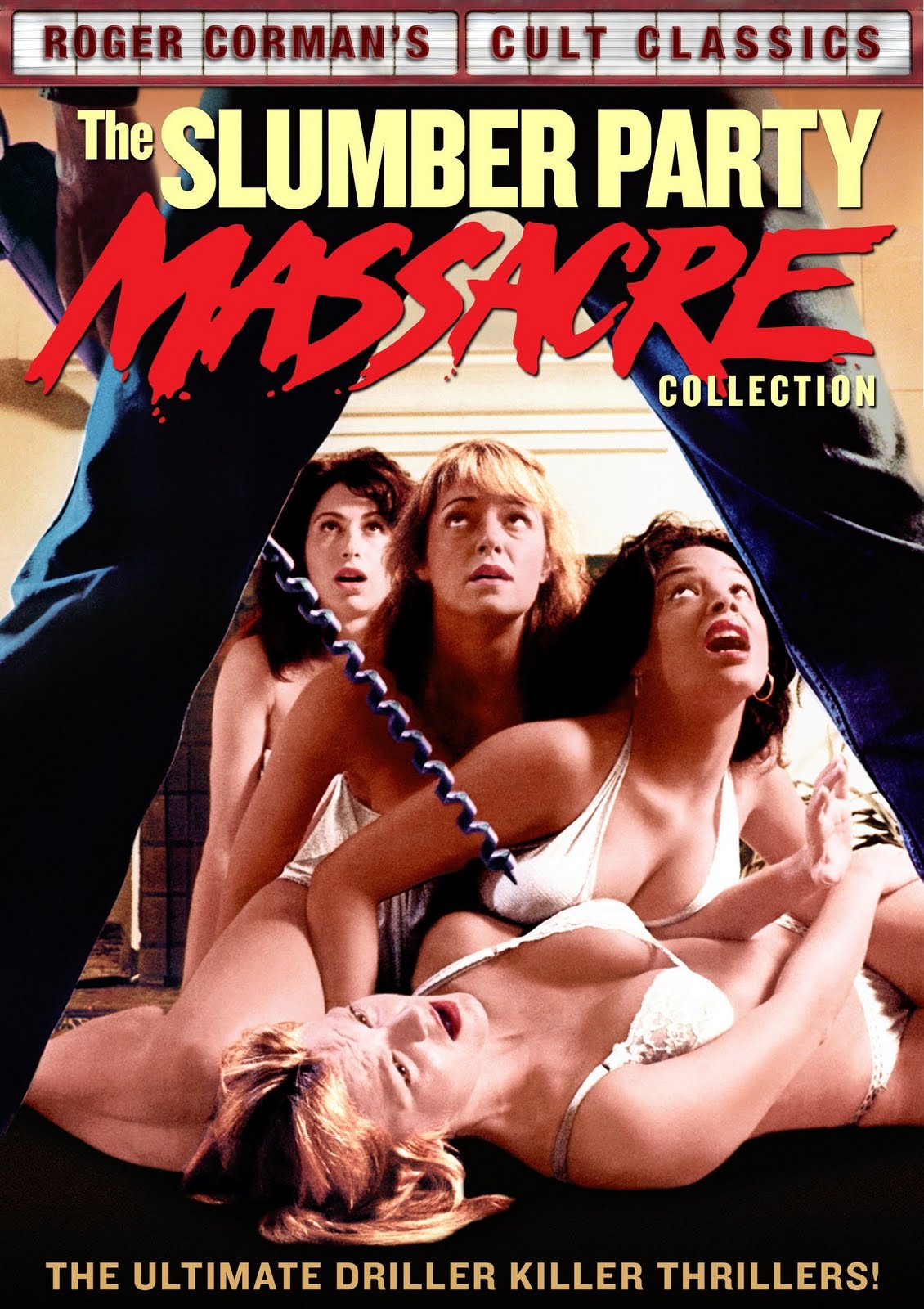
Like the other pics in this soon-to-be-concluded little mini-round-up we’re doing here, Slumber Party Massacre II is available on a two-DVD set from Shout! Factory entitled, appropriately enough, “The Slumber Party Massacre Collection,” which is part of their larger “Roger Corman’s Cult Classics” series. It’s sporting a nicely-remastered widescreen transfer, has good 2.0 stereo sound, and there are extras aplenty including a fairly comprehensive little “making-of” featurette, a full-length commentary from writer/director Brock, a poster and still image gallery, the original theatrical trailer, some trailers for other flicks in this series, and a liner notes booklet by SPM historian Jason Paul Collum. While I may not consider this a great movie by any means, this is certainly a great DVD package.

Still,  ya know what? Flaws n’ all, I’d still go so far as to say that the film itself is at least worth a look. I do admire Brock for her willingness to break the mold and think outside of the usual slasher box. Her intentions for this flick strike me as being pretty solid, and as almost-innovative as her budget would allow for — she just fails in her execution. And let’s face it — a slasher movie that can’t execute properly is saddled with a problem it can never overcome.

Scenes That I Love: Charles Freck Gets A Good Wine in A Scanner Darkly


002f1c48_a_scanner_darkly_2006_8

First released in 2006, Richard Linklater’s A Scanner Darkly is one of the unacknowledged great films of the past ten years.  The scene below, featuring Rory Cochrane as the hapless Charles Freck, is all the stronger for being adapted almost word-for-word from Philip K. Dick’s source novel.

Lisa Marie Reviews The Oscar Nominees: The Oscar (dir by Russel Rouse)


the-oscar-stephen-boyd-db54

I stayed up way too late last night but it was totally worth it because I was watching a film from 1966, The Oscar.

Among those of us who love bad and campy movies from the 50s and 60s, The Oscar is a legendary film.  It has a reputation for being one of best so bad-its-good-films ever made.  The Oscar is a film that I’ve read about in several books but, until last night, I had never gotten a chance to actually see it.  When I saw that the film was going to be on last night, I said “Sleep be damned!” and I stayed up and watched.  What other choice did I have?

The Oscar takes place in a world where women are “dames” and men are “fellas” and everyone acts as if they’re a character in a Rat Pack-themed fanfic.  One look at Frankie Fane (played by Stephen Boyd) and you know he’s the type of guy who snaps his fingers when he walks and probably uses pig Latin when he flirts.  He’s one cool cat and as the film begins, he’s been nominated for an Academy Award for Best Actor.

The film begins at the Oscars.  Frankie sits out in the audience, surrounded by Hollywood royalty and nervously waiting for the envelope to be opened.  The camera pans over to Frankie’s personal manager, Hymie Kelley.  Hymie stares bitterly at his former friend and suddenly, we hear his thoughts and do they ever let us know what type of movie we’re about to see.

As Hymie himself puts it:

“You finally made it, Frankie! Oscar night! And here you sit, on top of a glass mountain called “success.” You’re one of the chosen five, and the whole town’s holding its breath to see who won it. It’s been quite a climb, hasn’t it, Frankie? Down at the bottom, scuffling for dimes in those smokers, all the way to the top. Magic Hollywood! Ever think about it? I do, friend Frankie, I do…”

Hymie, incidentally, is played by the singer Tony Bennett.  This was Bennett’s first dramatic film role and it was also his last.  Whatever talent or magnetism Bennett may have had as a singer, it didn’t translate into screen presence.  Bennett goes through the entire film looking embarrassed but who can blame him when the script calls for him to constantly tell Frankie that, “You lie down with pigs, you stand up smelling like garbage…”

As we discover through the use of flashback, Frankie has had to lay down with a lot of pigs to get his chance at winning an Oscar.  After starting out his career working at sleazy clubs, Frankie, Hymie, and Frankie’s stripper girlfriend (Jill St. John) find themselves in New York.  Frankie dumps his girlfriend (unaware that she’s pregnant with his child) after he meets artist Elke Sommer at a “swinging party.”

“Are you a tourist or a native?” Frankie asks her.

“Take one from column A and one from column B.  You get an egg roll either way,” Sommer replies.

No wonder Frankie tells her, “You make my head hurt with all that poetry.”

Eventually, Frankie is discovered by a talent agent who takes him to see studio mogul Joseph Cotten (who went from Citizen Kane, The Magnificent Ambersons, and Third Man to this).  Cotten is so impressed with Frankie that he says, “Once in a while, you bring me meat like this.  It all has different names: prime rib of Gloria, shoulder cut of Johnny.  MEAT!”

With the help of savvy talent agent Milton Berle, Frankie becomes a film star but he’s still a total heel who cheats on Sommer and takes advantage of Hymie’s loyalty.  When Frankie gets nominated for an Oscar, he hires a sleazy private investigator (Ernest Borgnine, of course) to leak a story about Frankie’s criminal past.  Frankie assumes that one of his fellow nominees will be blamed for the leak and that he’ll be able to ride a wave of sympathy to victory.

And who are Frankie’s fellow nominees?  We only learn the identity of three of them – Frank Sinatra, Richard Burton, and Burt Lancaster.  We never find out what movie Sinatra was nominated for but we’re told that Burton was nominated for The Grapes of Winter (which, I’m going to assume, was a film version of a Shakespeare play about Tom Joad) while Lancaster was nominated for his amazing performance in The Spanish Armada.  Doesn’t that sound like an amazing film?

Oh, how to describe the delirious experience of watching The Oscar?  In many ways, it is a truly terrible movie but it’s fun in the way that only a “racy” film from the mid-60s can be.  Nobody plays his or her role with anything resembling subtleness.  Instead, everyone spends the entire film yelling, screaming, and gritting their teeth while flaring their nostrils.  Everyone, that is, except for Tony Bennett who gives a performance that has a definite community theater feel to it.  Even better is the dialogue.  People in this film don’t just say their lines – they exclaim them.  If you’ve ever wanted to spend two hours in a world where every sentence ends with an exclamation point, watch The Oscar.

For a film that was apparently meant to be something of a love letter to the Academy, The Oscar was only nominated for two Oscars.  It received nominations for Best Art Design and Best Costume Design.  While I had a hard time seeing what was so impressive about the film’s art design (in the world of The Oscar, Hollywood has a definite Ikea feel to it), the costumes were fairly impressive in a tacky, 1966 type of way.

Finally, I think it’s time that somebody remake The Oscar.  David Fincher can direct it, Aaron Sorkin can write the script, Jessie Eisenberg can play Frankie Fane, and Justin Timberlake would make for an adorable Hymie Kelley.  For the supporting roles, I think Billy Crystal would be a natural for Milton Berle’s role and perhaps Philip Baker Hall could step into the shoes of Joseph Cotten.  Perhaps veteran film blogger and self-described very important person Sasha Stone could make her film debut in Ernest Borgnine’s role.

Seriously, I think it would be a winner.

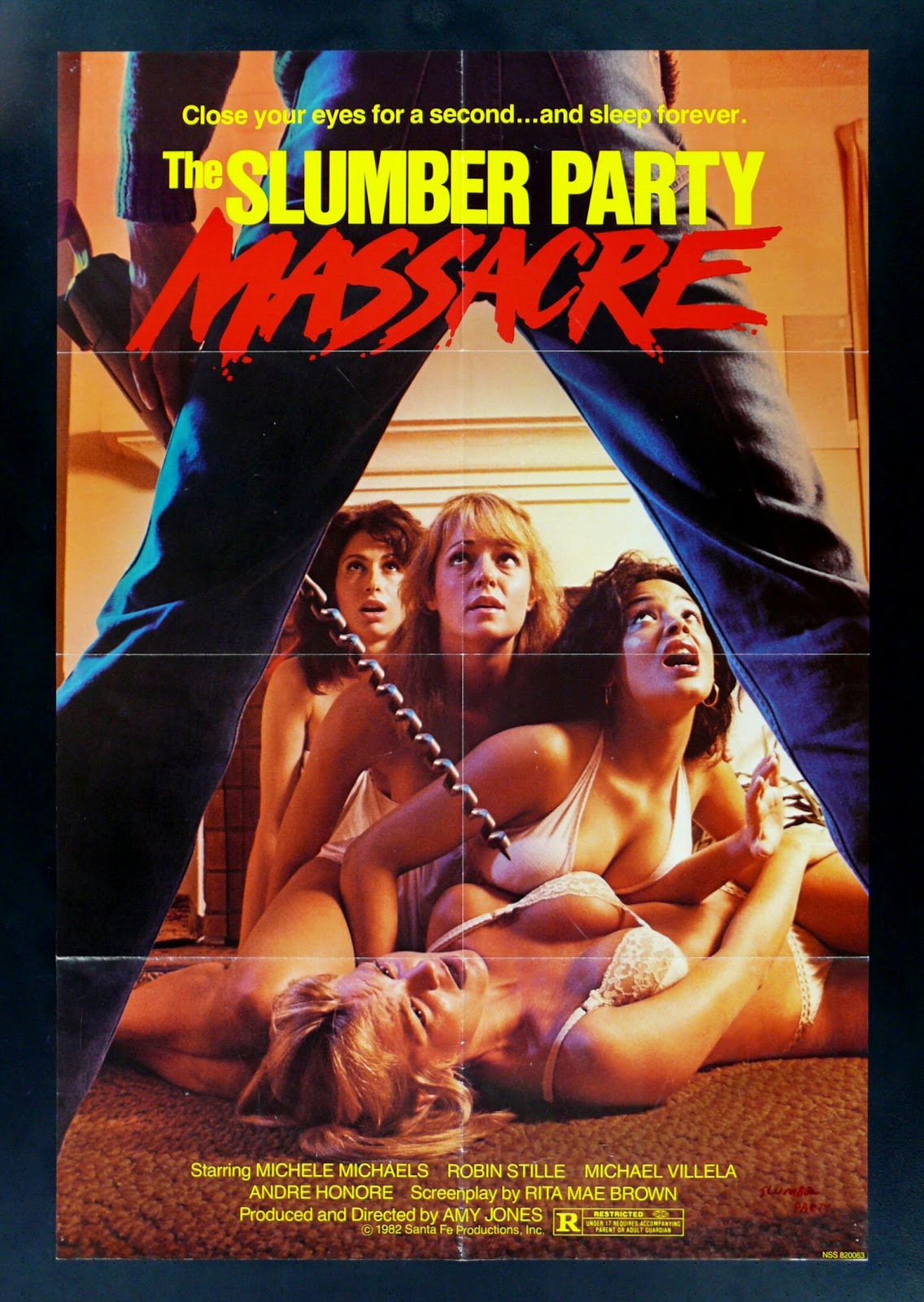
The SPM Trilogy Revisited : “The Slumber Party Massacre”


the film poster only features one actress actually in the film (Andre Honore)

Ah, the folly of youth. When we’re young, we’re so determined to prove we can “make it on our own” that we’ll turn our backs on opportunities that might serve us better in the long run just because they would mean answering to “The Man” in the short term. A hot-shot young chef (a nauseating demographic which our nation is currently, and quite literally, under absolute fucking assault from) will bypass the chance to apprentice under a master of his craft in a popular and established kitchen in order to go start up his own restaurant that will be lucky to last out the year. A promising young journalist will eschew the opportunity to work as a “beat” reporter on a local paper in order to start up a “cutting edge” news website with “attitude” that folds when they can’t get any advertisers. A way-too-full-of-himself young lawyer will say “no thanks” to a “lesser” offer from a major, established firm in order to start his own personal injury practice before realizing that there are already 10,000 other guys in town doing the exact same thing. There’s no doubt about it, my friends — we don’t know jack shit when we’re young, but we know we know better than anybody else.

All of which is to say, I guess, a couple of things : one, that I’m older and wiser now and will gladly give up the “freedom” and “total control” I have over my own website in less than a goddamn heartbeat in order to go work for somebody who actually pays me to write this shit; and two, that back in 1982 a semi-recent USC film school grad named Amy Holden Jones, who was considered something of an up-and-comer behind the camera in Hollywood at the time, turned down the chance to be Steven Spielberg’s cinematographer on a little something called E.T. in order to direct a much littler something for Roger Corman called The Slumber Party Massacre.

I’m sure she’s not kicking herself too badly over that decision today.

spm_za

Corman, of course, as he always seemed to, had an angle figured with this one, as well — in order to deflect, or at least try to deflect, some of the rampant feminist criticism that was just starting to be directed at the “slasher” genre back then, he’d take the  largely (okay, entirely) symbolic step of hiring women to both direct (Jones) and script (Rita Mae Brown) his latest girls-take-off-their-shirts-and-get-butchered-for-being -“slutty” opus, therefore “proving” that he, himself, had no problem with the fairer sex —only his movies did.

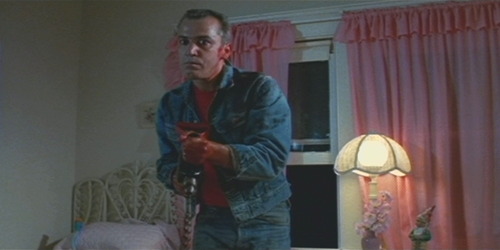
To their credit, both Jones and Brown obviously knew full well what they were getting into here (hell, how could you not?) and decided to play the whole thing up for all it was worth by indulging in blatant self-parody at more or less every turn. Their escaped-from-the-loony-bin killer, one Russ Thorne (Michael Villella) is given essentially no motivation whatsoever and goes after his victims with the most overtly phallic power drill ever conceived of; he’s thrust into the middle of a high school all-girls’ basketball team slumber party (hence, ya know, the title) by the most contrived set of circumstances possible; and every one of the nubile young targets of his kill-spree is a paper-thin, less-than-two-dimensional cipher rather than being anything like an actual, proper character.

slumberpartym4

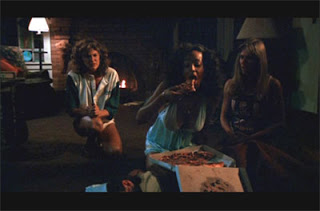
As far as any kind of plot synopsis goes, that’s probably all you really need here, if not more — after all, you know the drill (sorry!), right? The party’s hostess, Trish (Michelle Michaels), despite being listed first in the credits, isn’t gonna be the last girl standing (or limping, or writhing, or crawling), that honor goes to picked-on-for-being-aloof-quiet-and-too-much-better-at-basketball-than-the-others (she’s even a new girl at school, to boot! How many different ways can you say “virgin” without just blurting it out?) Valerie (Robin Stille). All the proceedings here follow the typical cut-and-dried formula more or less to a “T,” with a heavy dose of self-awareness being basically the only wrinkle added into the mix, apart from “keep your eyes open for an early turn by future ‘scream queen’ semi-star Brinke Stevens.”

None of which is to say that I didn’t enjoy The Slumber Party Massacre — the fact of the matter is, this one of those flicks that I always kinda turn to when I want to turn my brain off. It’s solid, if unspectacular, tongue-in-cheek fun, leaves a pleasant-enough grin on your face, and keeps you reasonably involved for its brief-but-just-right-all-things-considered 77-minute run time. If ol’ Russ was as smart and efficient at his job as Holden was at hers, he might still be running around sticking his power drill in high school girls today. And yeah, I realize that last sentence sounded every bit as unsubtle as this movie is, that was kinda the — errrmmm — point (damn! Just can’t help myself).

Slumber Party Massacre 12

Being that this movie and its two sequels (part two being even more OTT farcical than this one, part three being something of a “back-to-basics” straight-to-video affair) have a semi-sizable cult following, Shout! Factory made the wise decision to release ’em all together in one collection on (two-disc) DVD and (single-disc) Blu-Ray. Since I’ll be going to the “effort” of reviewing ’em all here in the next few days, I’ll just take it one at a time with the technical specs and extras. The Slumber Party Massacre is presented in a 1.78:1 widescreen remastered transfer that looks pretty damn stunning, and the remastered mono sound is perfectly serviceable, as well. There’s a really good little “making-of” featurette included , a photo still and poster artwork gallery, and director Jones is on hand for a full-length commentary track. The original theatrical trailer, a smattering of trailers for other titles in the “Roger Corman’s Cult Classics” series, and a solid set of liner notes by Jason Paul Collum round out the package.

spm-new

If you don’t have the time, money, or inclination to break new ground — and let’s face it, Roger Corman never had any of the above — you could do a lot worse than to tread the same ol’ familiar territory with a little bit of style, self-deprecating wit, and a quick little wink to the audience. The Slumber Party Massacre certainly delivers on each of those counts, and while I’ll never be fully on board with those who view this thing as some sort of “classic,” it’s definitely a good — if thoroughly predictable — time.

I’m older and wiser now, remember?  I’m perfectly happy to take what I can get.