Horror On The Lens: Killdozer (dir by Jerry London)


killdozerA bunch of manly men are building an airstrip on an island off the coast of Africa.  Two of them come across an oddly glowing meteorite and they make the mistake of trying to move it with a bulldozer.  Needless to say, the bulldozer gets possessed by an alien presence and soon, the men are all being pursued by the … Killdozer!

My boyfriend and I recently sat down and watched this 1974 made-for-TV movie.  Jeff enjoyed it while I thought Killdozer was perhaps one of the silliest films I have ever seen in my life.  That’s not surprising, however.  Killdozer is a guy film all the way, celebrating both the destructive power of machinery and the ability of men to tame that power.

Killdozer may not be a great film but it’s a film that feels rather appropriate for October.

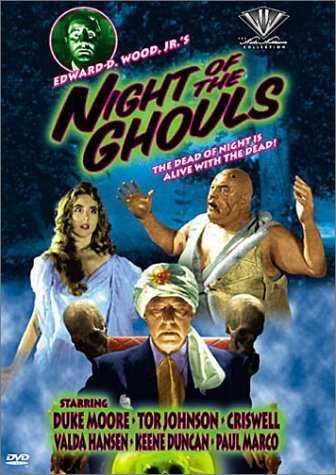
Horror On The Lens: Night of the Ghouls (dir by Edward D. Wood, Jr.)


GhoulsdvdToday’s movie is Ed Wood’s sequel to Bride of the Monsters.  In Night of the Ghouls, con man Dr. Alcula (Kenne Duncan) moves into Bela Lugosi’s old mansion and pretends to talk to the dead.  What Alcula doesn’t realize is that the house is actually haunted (by Tor Johnson’s Lobo, among others) and real ghosts don’t appreciate pretend ghosts.

What can you say about a film like of Night of the Ghouls?  It’s an Ed Wood film, with all that suggests.  However, how can you resist a film that starts with Criswell sitting up in his coffin and providing commentary?

The role of Dr. Alcula was originally written for Bela Lugosi.  After Lugosi’s death, veteran actor and longtime Wood friend Kenne Duncan got the role instead.  Also of note, Wood appears twice in this film.  Not only does his picture appear on a wanted poster in the police station but Wood also plays one of the female ghouls.

What Horror Lisa and The Snarkalecs Watched Last Night #94: Grave Halloween (dir by Stephen R. Monroe)


Last night, the Snarkalecs and I turned over to SyFy and watched an original horror film entitled Grave Halloween.

Why Were We Watching It?

It was Saturday night and that meant that it was time for another Snarkalec live tweet!  We were all pretty excited about watching and live tweeting Grave Halloween, largely because it was directed by the same guy who directed the greatest film to ever premiere on SyFy, End Of The World.

What Was It About?

A group of American exchange students in Japan go into a place known as Suicide Forest to make a movie.  Years ago, Maiko’s (Kaitlyn Leeb) mother committed suicide in the forest.  Naturally, as soon as Maiko and her friends enter the forest, they end up getting lost, having visions of the dead, and dying in various grotesque ways.  It doesn’t help that one of Maiko’s friends finds a discarded watch in the forest and decides to stick it in his pocket.  Seriously, ghosts are apparently really attached to their watches.

What Worked?

A lot of people on twitter complained that Grave Halloween moved too slowly.  I, however, didn’t find the film to be that slow.  It was definitely deliberately paced (especially when compared to some of the other films that have appeared on SyFy) but I thought that was to the film’s advantage.  The film took its time to set up its scares and shocks and the end result was a genuinely creepy horror film that rewarded the audience’s patience.

The film was set in Japan but, like most SyFy films, it was actually filmed in Vancouver.  Now, I’ve never been to Japan or Vancouver so I can’t really say whether Canada could pass for Japan.  But what I do know is that director Stephen R. Monroe got every single bit of atmosphere that he could out of the forests of British Columbia.  As filmed by Monroe and cinematographer Michael C. Blundell, the scenery is both beautiful and menacing.  By the end of the film, the forest itself feels like an individual character.

Of the cast of victims, my favorite was Brody (played by Jesse Wheeler), mostly because he looked like he could be Greg Grunberg’s younger brother.

What Did Not Work?

As I watched Grave Halloween, it quickly became apparent that the entire situation was pretty much all Maiko’s fault.  She’s the one who led her friends into Suicide Forest.  She’s the one who, even after everyone started to vanish, refused to leave.  Ultimately, she was the one who was responsible for putting her friends in a position where they could all be killed.

And yet, no one in the film seemed to be willing to acknowledge that they would have all been better off if they had never met Maiko.  Seriously, I was so waiting for someone to say, “Okay, Maiko — you go do your thing and the rest of us are going to get the fuck outta here before we end up getting ripped into little pieces, ‘kay?”

“Oh my God!  Just like me!” Moments

So, naturally, one of the girls ended up tripping while she was running through the forest.  Despite the fact that it didn’t look like that bad of a fall, she ended up with a broken bone literally poking out of her leg.

Since I’m currently recovering from a sprained ankle, you can probably imagine that this was not my favorite scene in the movie.  Instead, it made me go, “Agck!” and then hide my face in a pillow because I could relate way too much.

(That said, I’m still amazed at how fragile her bones apparently were…)

Lessons Learned

Never steal a dead man’s watch.

grave_halloween_685x385_138023298696___CC___685x385

Quick Review: Carrie (dir. by Kimberly Peirce)


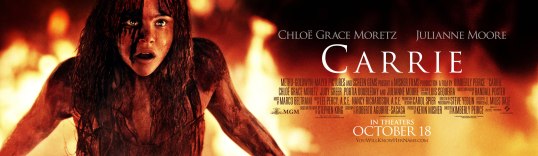
carrie2013bannerHigh School can be a rough time. Growing up, we always had Freshman Day, where bullies spent the first Friday of the new semester terrorizing the newbies. I spent at least one of those years either writing in the Library for lunch or on the run between classes until a poem/love letter I wrote on behalf of a member of the Varsity Football team left me in their good graces and under their protection. Needed to tell your girl she was the best thing since Ham & Pineapple pizza, but in an eloquent way? Go ask that geek in the back row of English reading Christine with the big round glasses. Oh, the joys of High School. I can’t even imagine how intense bullying can get today with all of the social media we have. It’s easy to imagine what you could do to protect yourself if you could be as cool as Nightcrawler and make yourself teleport, fight off your foes like Batman or best of all, Force Choke the crap out of someone like Darth Vader.

In that sense, the story of Carrie is still kind of cool, and mildly disturbing.

There was a point in Stephen King’s life where Carrie almost never happened. It was because of his wife, Tabitha that the story was ever finished and that the parts focused on women and their “monthlies” (as members of my family would say) were written the way they were. Carrie got King his foot in the door and set him for other releases like The Shining, Christine and Salem’s Lot. I think next to The Shining, it might be his most remade film.

I’m not sure if there’s anyone who never saw Brian De Palma’s Carrie from 1978 with Sissy Spacek. If not, Kimberly Peirce’s version is not bad at all as an introduction to the story. It actually has at least one element from the book that was never featured in the original film (though part of me does wish that it contained the newspaper format – something like John Larroquette’s narration for The Texas Chainsaw Massacre). Carrie is simply the tale of a young girl in high school who discovers she has telekinetic powers. Eventually, she gets pushed and loses it, unleashing her abilities against anyone in her way. No version of the story has ever gone into detail on how she got them outside of the puberty angle – they’re just there.

Peirce’s version moves just as well as De Palma’s, which is interesting because supposedly they happen to be friends. The main differences lie in DePalma’s choice of nudity versus Peirce’s lack of it, and DePalma’s lack of blood (a sign of the times) compared to Peirce’s extended usage of it. Other than that, it’s roughly the same film, any closer and you’d end up with Gus Van Sant’s shot for shot version of Psycho. Half of me wonders why it needed to be remade (again), the other half says, “You know what, it wasn’t half bad.” There’s nothing essentially wrong with Carrie, but it’s really hard to talk about the Peirce Carrie Film without going back to the DePalma one.

First, Carrie’s biggest strength by far comes in it’s casting. As the leads, both Chloe Grace Moretz and Julianne Moore are great in their roles – almost better than the film deserves. Granted, it’s kind of difficult to imagine anyone messing up something as simple as this. When it comes to young horror starlets, the first two names that come to my mind are Silent Hill’s Jodele Ferland and The Hunger Games’ Isabelle Fuhrman, both of which I thought would be interesting fits here. If Katharine Isabelle was just a little younger, that would have worked too. However, I forgot that Moretz had both The Amityville Horror and Let Me In under her belt (and we won’t speak of Dark Shadows – That wasn’t horror. That wasn’t even comedy. I can’t even identify what that was). Her role as Carrie is somewhat similar to Let Me In, being more reserved here than the Kick Ass films and with good reason.

Moore’s version of Margaret White spends some time self harming herself, which was a little eerie and reminded me of Paul Bettany’s character in The DaVinci Code, punishing themselves for their sins. She’s good here, but after coming off winning an Emmy for playing Sarah Palin in “Game Change”, she looks like she’s underused here. It’s like having an actor play a superhero after becoming a great director and winning tons of accolades. A job is a job, and Moore does a great one here given what she has to work with.

The supporting cast was interesting. I didn’t expect to like Judy Greer’s gym teacher as much as I did, and Ansel Angort’s Tommy Ross was good. I hope that this film leads to bigger and better roles for him. A surprise was Chronicle’s Alex Russell as Billy Nolan, the character originally played by John Travolta. He pulls off a villain well. Portia Doubleday’s version of Kris Hargensen may actually be better than Nancy Allen was, though this could also be in part due to the way the story is written.

So, on with the plot. Carrie White (Moretz) is a reclusive loner, living with her overprotective mother (Moore). In the school shower, she has her period for the first time and not realizing what’s occurring to her (and having never been told just what to expect), naturally panics. This leads to an all out humiliation by her peers that’s even recorded. Carrie later learns about her abilities, while her nemesis, Kris is kicked from the prom and vows to take her vengeance against Carrie. Some of the main sequences are actually expanded upon, which I thought were actually good.

I think the only problem I had with Carrie was the technique used for the Telekinesis. It almost seems a little CGI heavy, but when I think about it, I’m not sure how else they could have pulled off much of what they did here without it. Additionally, Moretz’s version of Carrie uses her hands a lot, which almost makes it seems like she’s either dancing or is trying to conjure up something. It’s not a terribly bad thing and you may actually get used to it after she does it once or twice. Part of me kept expecting her to scream “Unlimited Power!” at one point but it was just a minor “Wow, that’s kind of weird.” Reaction, at least for me.

Carrie’s not really meant for little kids. Anyone who’s a fan of Moretz by way of Diary of a Wimpy Kid might not be ready to handle Carrie, but if you’ve followed any of the Kick Ass films, Carrie’s actually lighter than those. Overall, it’s one of the better remakes out there and a very short film (I’m writing this while watching the Nightmare on Elm Street remake, so I like to think I have a good basis of comparison). If you never saw the original, it might be worth a try. If you don’t wish to spend the money for the ticket, you can always watch one of the other versions and wait for this to come out on Blu-Ray.

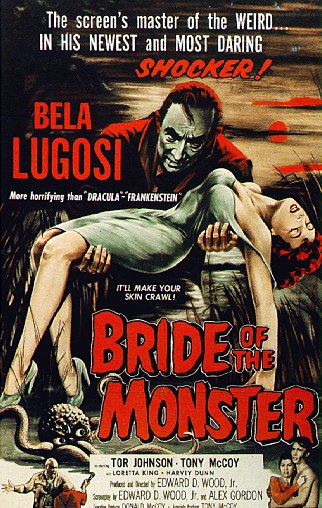
Horror On The Lens: Bride of the Monster (dir by Edward D. Wood, Jr.)


Bride_of_the_Monster_(1956_movie_poster)Today’s horror film on the lens is Edward D. Wood’s 1955 epic, Bride of the Monster.  The film itself doesn’t feature a bride but it does feature a monster, a giant octopus who guards the mansion of the mysterious Dr. Vornoff (Bela Lugosi).  Vornoff and his hulking henchman Lobo (Tor Johnson) have been kidnapping men and using nuclear power to try to create a race of super soldiers.  Or something like that.  The plot has a make-it-up-as-you-go-along feel to it.  That’s actually a huge part of the film’s appeal.

Bride of the Monster is regularly described as being one of the worst films ever made but I think that’s rather unfair.   Appearing in his last speaking role, Lugosi actually gives a pretty good performance, bringing a wounded dignity to the role of Vornoff.  If judged solely against other movies directed by Ed Wood, this is actually one of the best films ever made. 

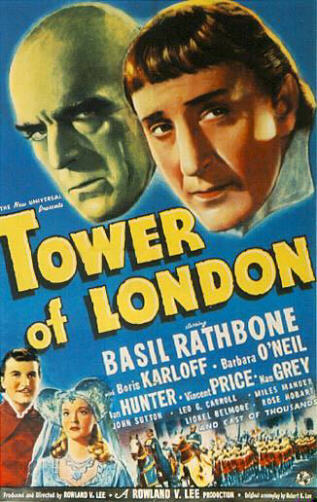
Horror On The Lens: Tower of London (dir by Rowland V. Lee)


Toweroflondonfilm

Today’s horror movie comes from 1939 and is presented in glorious black-and-white.  Tower of London tells the famous (and historically controversial) story of King Richard III (Basil Rathbone).  With the help of the club-footed executioner Mord (Boris Karloff), Richard murders his way to the throne of England.

Technically, The Tower of London is more of a historical film than a horror film but, in order to tell its story, it uses many of the techniques that had been previously perfected by the famous Universal monster movies.  Rathbone turns Richard III into a chilling and plausible human monster while Karloff is obviously having a lot of fun in the role of the twisted Mord.

Also of historical interest is the fact that Vincent Price plays the Duke of Clarence, making Tower of London his first horror film and the first film in which he would appear alongside fellow horror icon, Boris Karloff.


Horror Quickie Review: Virus (dir. by John Bruno)


Virus

Not every comic book film is about superheroes. There’s been quite a bit of comic books adapted to film that has no superheroes, capes and superpowers at all. One such film came out in 1999. It was a film adapted from Chuck Pfarrer’s Dark Horse Comics mini-series titled Virus. This was a comic book that had a unique art-style to it that lent itself well to its scifi and body horror tale.

The film itself skews close enough to the comic book with some minor changes. Instead of a Chinese research vessel where most of the story takes place we find the film set on a derelict Soviet research ship. Even with the changes from comic book to film they both shared one common denominator and that would be the alien lifeform that has decided to systematically kill all humans aboard the ship.

Virus stars Jamie Lee Curtis and Donald Sutherland in two roles they probably wish they took a pass on or asked more money to do. While the film has some imaginative set pieces involving the melding of robotics and scavenged human body parts to create something bigger and homicidal the majority of the film involves pretty much every cast member in one stage or another of hysteria, incredulity and denial. Really, the only person in the whole film who seemed to go through the story with a clear and level head was Cliff Curtis’ seaman Hiko. All this means was that he would be one not to survive to the end of the film.

While the comic book itself was a nice piece of scifi horror storytelling then film stumbles right out of the gate not just because of the terrible acting, but just a dull and boring adaptation of the story. While, as stated earlier, some of the robotic designs were quite good and the use of practical effects made the killer robots something terrible behold, director John Bruno didn’t seem to have any ideas on how to put together an exciting sequence to take advantage of these inventive pieces at his disposal.

Virus was one film that comic book fans who read the mini-series were quite excited to see when it was first announced as a film in production. Stills of gruesome effects work would be admired and just add to the high expectations. What we got instead was a huge pile of a mess that was neither horrific, terrifying or remotely entertaining. Virus is one such film that I wouldn’t even bother catching on TV being shown for free.

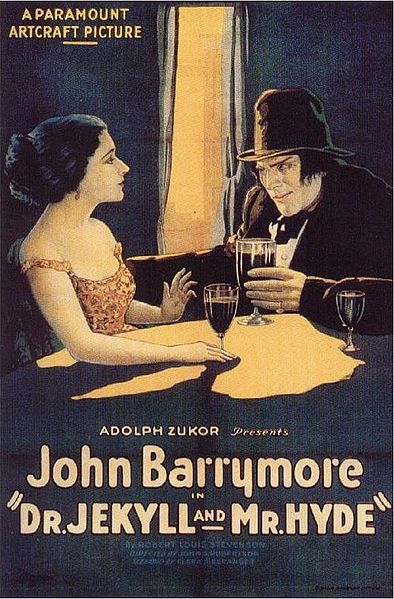
Horror on the Lens: Dr. Jekyll and Mr. Hyde (dir by John S. Robertson)


394px-Dr_Jekyll_and_Mr_Hyde_1920_poster

Ever since the birth of film, Robert Louis Stevenson’s Dr. Jekyll and Mr. Hyde has been a popular subject for adaptation.  Not only does the classic story of a good doctor who unleashes his evil instinct via potion serve as a potent metaphor for everything from sexual repression to drug addiction, but the dual role of Dr. Jekyll and Mr. Hyde has provides an excellent opportunity for an actor to show off.

The first film adaptation of Dr. Jekyll and Mr. Hyde is believed to have been made in 1908.  Two more version followed in 1912 and 1913 and then, suddenly, 1920 saw three different film versions.

The best known of the 1920 version is our film for today.  This version is best remembered for John Barrymore’s powerful performance in the title role but it also holds up remarkably well as a work of cinematic horror.


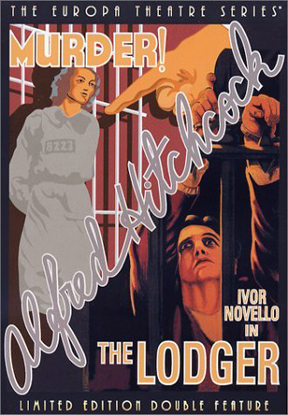
Horror On The Lens: The Lodger: A Story Of The London Fog (dir by Alfred Hitchcock)


The_Lodger_1927_Poster

A serial killer known as “The Avenger” is murdering blonde women in London (which, once again, proves that its better to be a redhead).  And while nobody knows the identity of the Avenger, they do know that the enigmatic stranger  (Ivor Novello), who has just recently rented a room at boarding house, happens to fit his description.  They also know that the lodger’s landlord’s daughter happens to be a blonde…

Released in 1927, the silent The Lodger was Alfred Hitchcock’s third film but, according to the director, this was the first true “Hitchcock film.”  Certainly it shows that even at the start of his career, Hitchcock’s famous obsessions were already present — the stranger accused of a crime, the blonde victims, and the link between sex and violence.

Also of note, the credited assistant director — Alma Reville — would become Alma Hitchcock shortly before The Lodger was released.


Horror On The Lens: This Darkness: The Vampire Virus (dir by Dylan O’Leary)


This Darkness

In 2003’s This Darkness, Dr. Van Helsing VII (played by the film’s director Dylan O’Leary) is a world-famous genetic engineer who is developing a serum that can cure all known diseases and perhaps grant immortality.  Meanwhile, cheerleaders and surfers are being attack in broad daylight and having their blood drained.  Among those killed is the daughter of Van Helsing’s friend Ron, who happens to own a martial arts studio.  Could all of these events be connected?  Your guess is as good as mine but eventually, a vampire named Tarquin does show up and demands that Van Helsing create a mate for him.

I’ve always found low-budget ambition to be very likable and, by that standard, This Darkness is probably one of the most likable films that I’ve seen.  The film’s script has a few interesting ideas, O’Leary makes for an unconventional but effective hero, and the film actually looks pretty good for its budget.  Especially towards the end of the film, This Darkness makes effective use of some unconventional locations.  Add to that, it’s hard not to admire the everything-but-the-kitchen-sink approach that O’Leary took to putting his film together.

Add to that, how can you not enjoy a film directed by someone with as Irish a name as Dylan O’Leary?