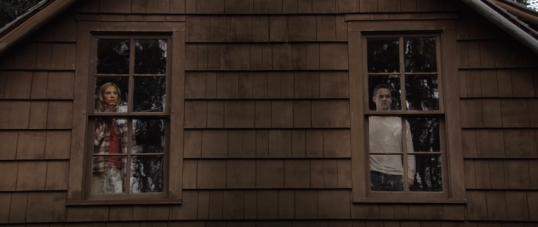
The Presence opens with nearly 20 minutes of near-silence. We watch as an unnamed and emotionally unstable woman (Mira Sorvino, who is literally listed in the credits as having played The Woman) arrives at an isolated cabin. As she settles in for what is obviously a very needed vacation, she goes about her business without saying a word. This is because she believes herself to be alone. However, those of us watching know that this isn’t true. She is sharing her cabin with a silent and initially passive ghost (Shane West) and, though she can’t see him, those of us in the audience can.
Eventually, the silence is broken as other visitors come to the cabin. There’s the boatman, Mr. Browman (Muse Watson). There’s the woman’s boyfriend (Justin Kirk) who unexpectedly shows up to ask the woman to marry him, a proposal which visibly upsets the ghost. Finally, there’s the Man In Black (played by Tony Curran). Though the woman cannot see the Man In The Black, she can hear him when he whispers dark thoughts into her ear.
The ghost, however, can see the Man in Black. The Man In Black offers the ghost a proposition. If the ghost kills the woman’s boyfriend, the Man In Black will allow the ghost to leave the cabin.
First released back in 2010, The Presence is a film that got (and gets) next to no love from the critics and from the type of people who specialize in leaving snarky comments over at the imdb. However, I rather like it. Director Tom Provost makes the risky choice to emphasize atmosphere over easy scares. The end result is a film that is full of striking images but which requires a bit more patience than most audiences are probably willing to give. When I think about The Presence, I think about the sight of Shane West passively watching Mira Sorvino, obviously wishing he could reach out but knowing that he cannot. It’s a haunting image, one that perfectly captures both the fear and the pathos of a good ghost story.
And that, ultimately, is what The Presence is. It’s a good ghost story and what better time for a good ghost story but Halloween?
After I wrote my review of Horror of Dracula, I started thinking about all of the cinematic bad boys that I have known and loved. There’s just something undeniably exciting about having a good-looking psycho obsessing over you!
That leads us to today’s guilty pleasure. First released in 1996 and a mainstay on cable, Fear is one of the ultimate bad boy psycho films.
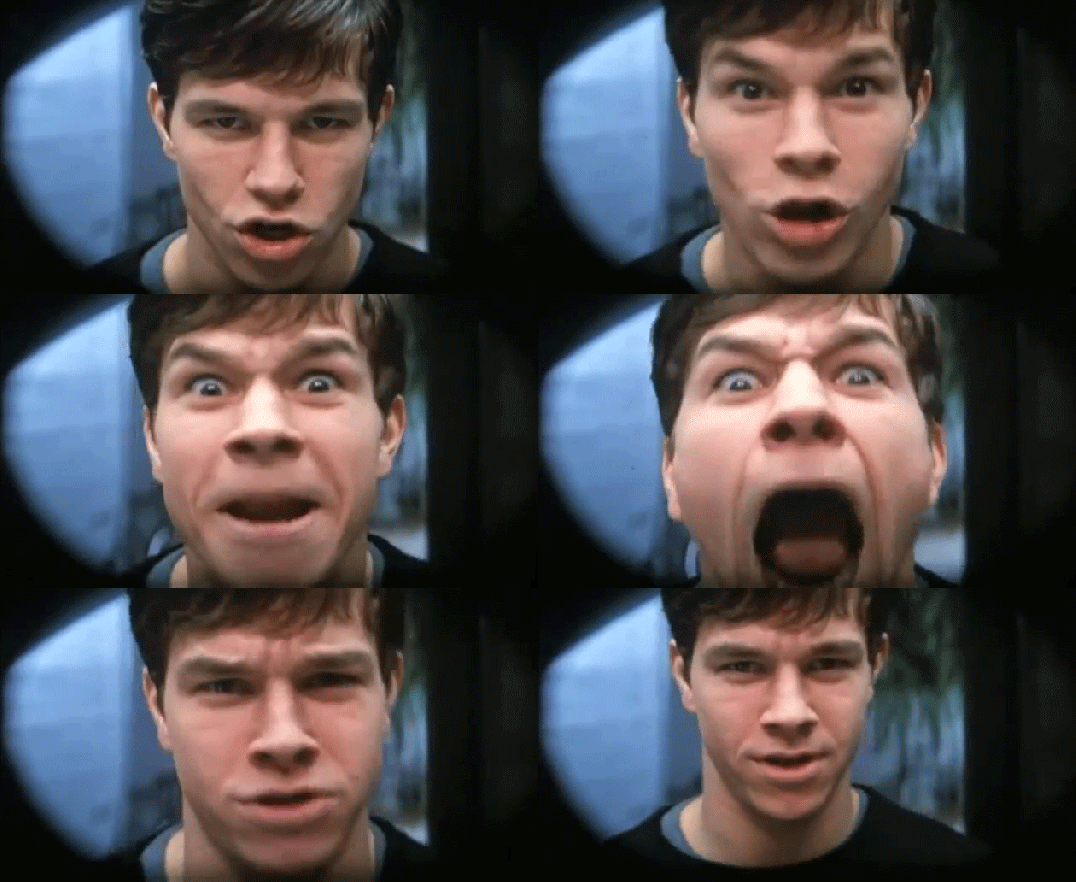
Fear tells the story of what happens when 16 year-old Nicole (played by Reese Witherspoon) meets and falls for David (Mark Wahlberg), a polite young man who happens to be crazy.
The first half of the film actually makes a pretty good case for hooking up with a bad boy. David treats Nicole like a princess, encourages her to break curfew, fingerfucks her on a roller coaster in a scene that makes fingerfucking seem as romantic as anything you’ll find in a Nicholas Sparks novel, and finally sneaks into her house so he can take her virginity.
These scenes capture the appeal of a bad boy — the feeling of danger, the thrill of rebellion, and, most poignantly, that feeling that only you can truly understand what a prince you have discovered. Witherspoon and Wahlberg are especially good in these scenes, with Witherspoon perfectly capturing the wide-eyed thrill of being in love while Wahlberg is the epitome of every guy in high school that I should not have dated but did.
There’s one small moment that hints at what is going to come. While talking to Nicole’s dad, Steven (played, with characteristic intensity, by William Petersen), David orders Nicole to get him a drink, causing the overprotective Stephen to glance up with a look of sudden suspicion. It’s a well-acted and subtle scene, one that will feel painfully real to anyone who has ever been in a similar situation.
It’s shortly after that scene that the entire film basically goes crazy.
After David catches Nicole’s best friend giving her an innocent hug, David responds by going crazy and beating him up. Nicole dumps David but then, largely as a response to her father being overprotective, she decides to give him a second chance.
Steven confronts David and orders him to stay away from his daughter. In an oddly hilarious scene, David responded by robotically beating his chest until he’s apparently covered with bruises. It’s a totally over-the-top scene that pretty much lets us know that Fear is no longer interested in being a realistic portrait of a naive girl dating an abusive guy.
Suddenly, we discover that David isn’t just a jerk with anger issues. Instead, he’s some sort of teenage crime lord, who lives in a dilapidated mansion with his equally low-life friends. While Nicole is busy writing Nicole Luvs David on her notebook, David is selling crack and having sex with her best friend Margo (played by, believe it or not, Alyssa Milano).
But that’s not all! When Nicole dumps David for a second time, David responds by tattooing her name on his chest and then gathering together his minions so that they can lay siege to Steven’s mountainside home.
“Don’t worry,” Steven tells his wife (Amy Brenneman), “I’m not going to let anyone get in here.”
And so, in that moment, Fear goes from being every girl’s fantasy of finding her misunderstood prince to being every parent’s fantasy — not only is Steven proven right about his daughter’s boyfriend but he also gets to kick his ass.
Watching Fear is an odd experience. The film starts out being romantic, well-acted, and, at times, even achingly poignant until, suddenly, it turns into one of the most over-the-top home invasion films ever made. It makes for an oddly schizophrenic viewing experience and it also makes this film into a true guilty pleasure.
Today’s horror film comes to use from 1976. In Dogs, man’s best friend decides to terrorize an isolated college campus and the fate of the student body is in the hands of two professors (bearded David McCallum and non-bearded George Wyner).
In many ways, Dogs is a pretty basic revenge-of-nature film but it still made me nervous when I watched it on YouTube. As our regular readers may know, I used to be terrified of dogs. In just the past few years, I’ve managed to overcome a lot of my phobia but, on the whole, dogs still make me nervous. And this movie definitely played on those nerves!
Interesting note: according to the trivia section over at the imdb, Dogs was originally going to be followed up by a sequel called Cats. However, Dogs failed at the box office and, as a results, Cats was cancelled.
First released in 1961 and directed by Curtis Harrington, Night Tide stars a young Dennis Hopper as Johnny, an awkward sailor. Johnny meets Mora (Linda Lawson), who works as a “mermaid” on the pier. For Johnny, it’s love at first sight. However, the more that Johnny pursues her, the more he learns about both her mysterious past and the dark fate of her previous boyfriends.
Night Tide is low-key and atmospheric gem of a movie, one that serve as an inspiration for low-budget filmmakers every where. Lawson is perfectly cast as the enigmatic Mora but the film really belongs to Dennis Hopper. Hopper’s naturally off-key presence made him perfect for the role of Johnny.
Night Tide is one of those low-budget movies that, because it’s in the public domain, has been released on DVD (often in inferior form) by dozens of different companies. Often times, films like this turn out to be fairly forgettable. Night Tide, however, is an exception.
Last night, I turned over to Chiller and watched the brilliant 2006 horror film, The Woods.
Why Was I Watching It?
I ended up watching The Woods almost at random. I didn’t want to go out last night because it’s Texas-OU weekend and that meant that the streets of Dallas would probably be full of drunk people from Tulsa. Even more importantly, I couldn’t go out because I’m recovering from a sprained ankle.
Normally, under those circumstances, I would have watched and live tweeted an original SyFy film. However, last night, SyFy was showing Fright Night which I had little interest in sitting through. So, instead, I turned over to Chiller and decided to give The Woods a try.
And that is how I randomly discovered one of the best horror films that I’ve recently seen.
What Was It About?
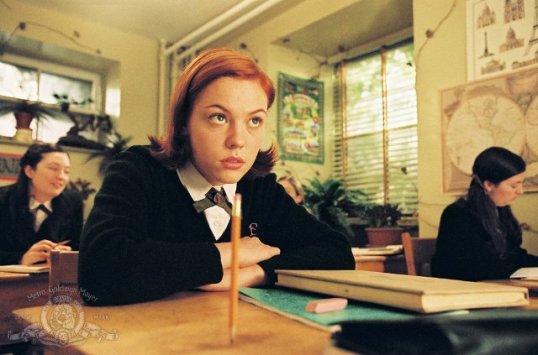
The year is 1965. Angry teenager Heather (Agnes Bruckner) starts a fire in a forest. Frustrated by their daughter’s rebellious nature, her parents enroll her at Falburn Academy, a boarding school that sits in the middle of the woods. Because she is the only redhead at the school, Heather is an immediate outsider who finds herself being taunted by the blonde Samantha (Rachel Nichols) and called “Firecrotch” by her other classmates.
However, Heather has more problems that just a bunch of anti-redhead bigots. She has nightmares where voices seem to call to her from the woods. Her friends Marcy and Ann both disappear from their beds, leaving behind a pile of dead leaves. Meanwhile, the school’s mysterious headmistress (Patricia Clarkson) insists that nothing strange is happening…
What Worked?
I wasn’t expecting much from The Woods. After all, it was a film that was released straight-to-DVD in 2006 and Chiller doesn’t exactly have a reputation for showing the best films. But, oh my God, y’all — The Woods turned out to be such a good film! The Woods is an atmospheric and surprisingly well-acted film that’s full of haunting imagery and memorable details. Much like Dario Argento’s Suspiria (which has a similar plot to this film), The Woods is a triumph of both style and substance.
While the entire film is well-acted, special mention should be made of Patricia Clarkson, who gives a performance that is both menacing and humorous. Genre fans will be happy to see Bruce Campbell in the role of Bruckner’s well-meaning father.
Finally, I have to admit that, as a member of the 2% of the population who have been blessed with red hair, I have a special appreciation for this film. Behind all of the scares, The Woods provides a compelling portrait of the discrimination that those of us with red hair struggle with every single day. From the minute Heather enters Falburn Academy, she is the subject of constant prejudice because of the color of her hair. As someone who has had to endure countless comments about redheads not having souls, I both related to and appreciated the film’s sensitivity to those of us in the 2%.
What Did Not Work?
Over on the film’s imdb page, there’s some debate as to whether or not the term “Firecrotch” was in use back in 1965. Personally, I think that’s nitpicking. The fact of the matter is that anti-redhead prejudice has always been with us. If people in the 60s didn’t attack us by calling us “Firecrotch,” they undoubtedly called us something equally bad. As far as I’m concerned, the entire film worked perfectly.
“Oh my God! Just like me!” Moments
Almost the entire film was an “Oh my God! Just like me!” moment, largely because the main character was a redhead and had to deal with constant anti-redhead prejudice. (“Oh my God! Just like me!”)
At one point, Samantha taunts Heather by asking, “Is your pubic hair red?” which is the exact same question that I got asked several times throughout high school, though in my case, I was usually asked by a guy with a smirk on his face. (“You’ll never know,” I would reply.) Heather then finds herself being repeatedly called “Firecrotch” by people who are jealous of her red hair and again, oh my god! Just like me!
Finally, as I mentioned above, I sprained my ankle last Wednesday and, as such, I’ve spent the last few days recovering. Amazingly enough, about halfway through the film, Heather twists her ankle. She spends the rest of the movie either on crutches or painfully limping. Oh my God! Just like me!
(As a quick aside, can I just say how much I HATE crutches!? Oh my God, they’re the worst…)
Lessons Learned
I am tempted to say that the main lesson to be learned from The Woods is that it’s not easy being a redhead. However, I knew that before I watched the film. I also knew that you should stay out of the woods, which is the main reason why you’ll never catch me camping.
So, the most important lesson that I learned is that everyone should see The Woods.
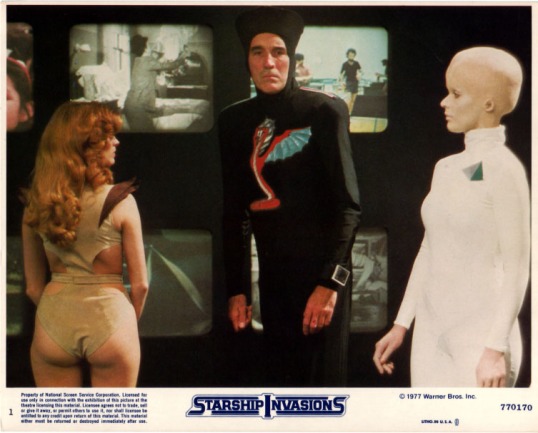
Today’s horror movie on the Shattered Lens is a 1977 Canadian film called Starship Invasions. While at first glance, Starship Invasions may appear to be more of a science fiction film than a horror film, things do get pretty horrific once Christopher Lee starts shooting his suicide ray.
Here’s what you need to know about Starship Invasions:
1) Judging from the look of the film, it must have cost hundreds of dollars to make.
2) All of the aliens communicate through telepathy so, while you get to hear Christopher Lee’s voice, you never actually see his lips move. I presume this was done because the filmmakers wanted to save money by shooting the majority of the film without sound.
3) In the UK, the film was released under the title Project Genocide, which just doesn’t have the same oddly generic charm as Starship Invasions.
4) Christopher Lee reportedly considers this to be one of his worst films.
5) However, the film is kind of fun in a bad, 1970s sort of way.
Add to that, how can you have a horror month without featuring at least one Christopher Lee film?
Today’s horror movie on the Shattered Lens is 2004’s Suburban Sasquatch.
Suburban Sasquatch (and, it must be admitted, that is a great freaking title) tells the story of a sasquatch who invades the suburbs. Well, we assume he’s a sasquatch. To be honest, the creature actually looks like some guy wandering around in a bear suit but no matter. Once the so-called sasquatch reaches the suburbs, he goes on a killing spree and … well, that’s pretty much it.
Okay, so obviously, Suburban Sasquatch isn’t a very good movie. In fact, it’s probably one of the worst movies ever made. The monster looks ridiculous, the acting is terrible, and the special effects … well, it’s debatable whether or not there are any special effects. However, Suburban Sasquatch is one of those movies — much like Manos, the Hands of Fate — that is watchable precisely because it is so unbelievably bad.
Also, Joel McHale once said that Suburban Sasquatch was his favorite movie of all time.
Of all the monsters who have appeared in horror cinema, Count Dracula is perhaps the most iconic. Reportedly, Dracula first appeared on film in 1920, in a silent Russian film that is now considered to be lost. In 1921, he would appear in a Hungarian film called Dracula’s Death and in 1922, he would be renamed Count Orlok for the German masterpiece Nosferatu. Indeed, by the time Bela Lugosi gave his famous performance in Tod Browning’s Dracula, the count had been appearing in films for at least 11 years. In nearly 100 years of filmmaking, a countless number of actors have brought Dracula to life.
We could spend hours debating who was the best Dracula and certainly, there are some worthy contenders. Bela Lugosi brought a continental sophistication to the role, while John Carradine was properly intimidating and theatrical. Udo Kier, Gary Oldman, Thomas Kretschmann, Leslie Neilsen, Zandor Vorkov, and Frank Langella have all played the prince of darkness, to varying degrees of success.
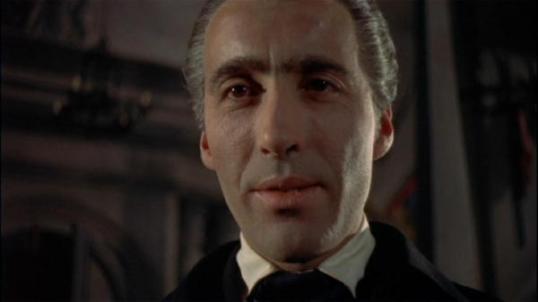
Yet for me, as worthy as any of those actors may be, there is only one true Dracula and he was played by Christopher Lee.
Lee famously played Dracula in seven movies for Hammer Films and, though he has often complained about the quality of these films (especially the later ones, which tended to mix Dracula with hippies), they were largely responsible for making Christopher Lee into the iconic figure that he remains today. It’s also largely due to Lee’s performance that horror fans like me continue to discover and appreciate the films of Hammer today.
As played by Christopher Lee, Dracula was pure evil. Lee’s Dracula had no use for self-pity and one can only imagine what his reaction would have been if he had ever run into the self-torturing vampires of Twilight. Lee’s Dracula had no use for doubt or regret. Instead, he was a determined animal who was driven by a singular lust for blood.
And yet, at the same time, Lee brought an intelligence to the role that was often lacking in previous performances. Lee’s Dracula may have been an animal but he was a cunning animal. Whereas it’s easy for me to imagine escaping from the clutches of Bela Lugosi, I know that if Lee’s Dracula wanted me then he would have me. There’s no escape from Lee’s Dracula. He’s too quick, determined, and intelligent.
His animal nature made Lee’s Dracula frightening but it was his cunning and determination that made him dangerous and, ultimately, even sexy. (While I’ve read that audiences in 1931 swooned over Bela Lugosi, whatever sex appeal he may have had is lost on modern viewers like me.) It has often been argued that Bram Stoker meant for Dracula to be a symbol of all the desires that were repressed by Victorian society. That’s certainly true when it comes to Christopher Lee’s carnal and viscous portrayal of the character.
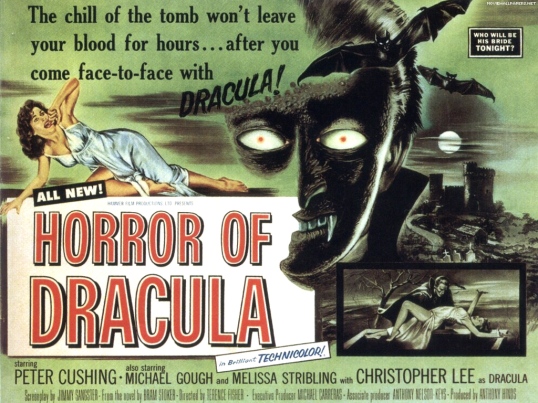
Of the seven Dracula films that Christopher Lee made for Hammer Films, the first remains the best. Released in 1958 and known as Dracula in the UK and the Horror of Dracula in the US, it revitalized the horror genre and helped to make stars of both Christopher Lee and Peter Cushing. Especially when compared to some of the sequels that Hammer subsequently produced, it remains one of the best Dracula films ever made.
The film is a very loose adaptation of Stoker’s original novel. Jonathan Harker comes to Dracula’s castle in Romania. Though posing as a librarian, Harker has actually come to the castle to drive a stake through the heart of both Dracula and his vampire bride. However, no sooner has Harker staked the bride than he’s overpowered and bitten by Dracula. Significantly, all of this occurs within the first 10 minutes of the film. As opposed to certain other Dracula films, Horror of Dracula gets straight to the point. And why shouldn’t it? After all, anyone watching the film already knows that Dracula’s a vampire so why waste time trying to convince us otherwise? We don’t watch Dracula for the familiar story as much as we watch to discover how different filmmakers will choose to tell that story.
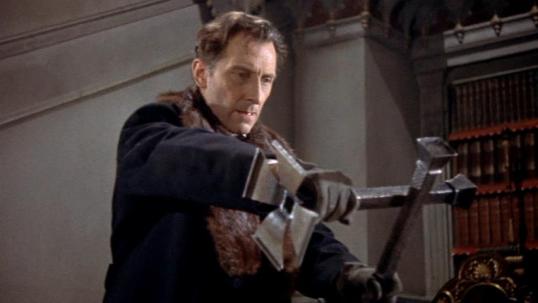
When Harker’s colleague, Prof. Van Helsing (played with the perfect amount of intensity by Peter Cushing) shows up at the castle, he discovers that Harker is now a vampire and that Dracula is nowhere to be found.
Dracula, needless to say, is out for revenge. He stalks Harker’s fiancee Lucy, as well as Lucy’s brother Arthur Holmwood (Michael Gough) and his wife Mina (Melissa Stribling). Much as in Stoker’s original novel, Lucy is eventually turned into a vampire and it’s up to Van Helsing and Arthur to stop both her and her new master.
(Of course, in Stoker’s original novel, Harker is not turned into a vampire and instead marries Mina while the aristocratic Arthur is one of Lucy’s three suitors. However, I have to say that I always thought the literary Harker was a bit on the dull side and that Arthur was always my favorite character so I’m happy that he gets to be the hero here.)
If I had to pick one film to epitomize everything that I love about the Hammer brand of horror, it would be Horror of Dracula. As directed by Terrence Fisher, the film moves at an exciting, non-stop pace while the traditionally lush cinematography is almost bombastically colorful. Cushing and Lee, who were the best of friends off screen, make for formidable opponents, with Cushing embodying good just as effective as Lee embodied evil. Though it’s been over 50 years since Horror of Dracula was originally released, the film remains effective and, not coincidentally, a lot of fun.
Quite simply put, this is a film that, for so many reasons, remains a true pleasure to watch.
One final note — I often find myself lamenting that I was born several decades too late and I realize just how true that is whenever I watch a film like Horror of Dracula. Seriously, I would have loved to have been a Hammer girl, showing off my cleavage and getting hypnotized by Christopher Lee.
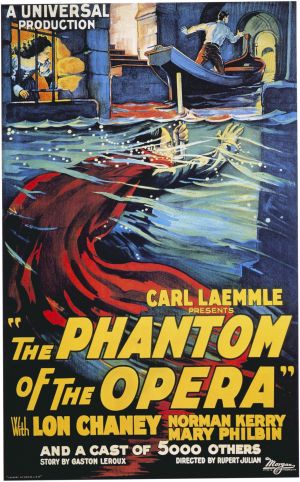
Today’s horror movie on the Shattered Lens is both a classic of silent era and one of the most influential horror films ever made.
First released in 1925, The Phantom of the Opera is today best known for both Lon Chaney’s theatrical but empathetic performance as the Phantom and the iconic scene where Mary Philbin unmasks him. However, the film is also a perfect example of early screen spectacle. The Phantom of the Opera was released during that period of time, between Birth of the Nation and the introduction of sound, when audiences expected films to provide a visual feast and Phantom of the Opera certainly accomplishes that. Indeed, after watching this film and reading Gaston Leroux’s original novel, it’s obvious that the musical was inspired more by the opulence of this film than by the book.
This film is also historically significant in that it was one of the first films to be massively reworked as the result of a poor test screening. The film’s ending was originally faithful to the end of the novel. However, audiences demanded something a little more dramatic and that’s what they got.