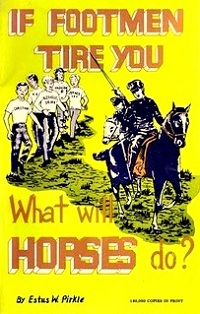
44 Days Of Paranoia Addendum : “If Footmen Tire You What Will Horses Do?”


footmen

I sincerely hope that Lisa Marie Bowman will forgive me for muscling in on her (I assume, at any rate) recently-completed “44 Days Of Paranoia” series here at TTSL, but I just couldn’t let it wind up without drawing attention to what is (hopefully) the single-most paranoid flick ever made, namely Ron Ormond’s 1971 Red Scare/Come-To-Jesus religious exploitation number If Footmen Tire You What Will Horses Do?

Ormond was a veteran of the B-movie scene who’s probably best remembered for Mesa Of Lost Women, but at some point in the late ’60s he got scared to death of the emerging youth/anti-war culture and underwent a religious conversion of the “hard turn to the right” variety. Withdrawing from “the business” to his home in Nashville, Tennessee, he founded an outfit known, ever-so-modestly, as “The Ormond Organization,” and set about making evangelical films with his brother and wife as his principal “employees.” The war for our nation’s souls was on, and the Ormonds were determined to do their part by spreading the celluloid gospel.

Enter the Reverned Estus W. Pirkle, hailing from , as you’d probably expect with a name like that, the one-horse town of New Albany, Mississippi. Pirkle was an old-school preacher of the “fire and brimstone” variety who was dismayed by all those pesky civil rights “agitators” who were showing up and disrupting God’s plan for a racially segregated South. He was also worried to pieces about the so-called “Red Menace” He found a way to amalgamate all of his various paranoias into one succinct little book, the title of which you can probably already guess being that this film is based on it, and became a big hit on the traveling revival circuit and at Southern Baptist churches throughout the Bible Belt.

Obviously, when you team up the “talents” of an Ormond and a Pirkle, the end result is going to be a pretty combustible mix, indeed. But you can’t know just how combustible until you see the fruit their collaboration wrought.

footmen1

The film version of If Footmen tire You What Will Horses Do?  takes the form of an extended screed from Pirkle to us lowly mortals in the audience from his position in the pulpit, and, using a “lost soul” teenager named Judy (played by one Judy Creech) as our “point of entry,” shows how Godlessness and moral corruption have wreaked havoc on the lives of our young. What Judy’s doing that’s so wrong is never made clear, mind you, but hey — we know that she does have a boyfriend.

Judy looks especially forlorn when Pirkle talks about the evils of liquor,  dancing, and television (he avoids calling out civil rights and anti-war demonstrators by name, but he does inveigh against “riots on campus” and “unwholesome” ideas taking root in the minds of our young), but she’s been unaware of the larger plot that her morally fast-and-loose ways have been playing into — the Communist takeover of these United States.

A lame series of “documented” re-enactments of scenes that “took place in other countries” (where everybody’s got a southern accent) show us what will happen after the dastardly Reds  conquer America in, according to Pirkle’s estimation, 16 minutes flat — you can count on, among other atrocities : Commie soldiers breaking into your home to have their way with your wife; kids being forced to pray to Fidel Castro in the public schools in exchange for candy; Christians being shot in the streets and their bodies being left to rot in the baking sun; sons being forced to kill their own mothers if they won’t renounce Christ; and,  perhaps most insidious of all, 12-to-16-hour work days, seven days a week, 363 days a year (funny, but that sounds more like a union-busting capitalist’s wet dream than a Communist one).

If_Footmen_Tire_You_(M)

Dead kids are a mainstay throughout If Footmen Tire You What Will Horses Do?, and when Ormond and company run out of youngsters volunteered by their parents to lay down, pretend not to be breathing, and get splattered with Red Karo syrup, they often resort to using shop mannequins as stand-ins to pad their “mass slaughter” numbers. One scene where no plastic dummies are used, however, is perhaps the film’s most disturbing : a struggling young boy has his eardrums pierced with a bamboo stick so “he can no longer hear the word of Christ” and pukes all over himself while fake blood gushes out of his ears in rivers. Yeah, I know the red stuff’s not real, but the vomit most certainly is, and if the evangelical blow-hards who made this propaganda had any sense of shame they’d at the very least blush for resorting to on-screen, and very real, child abuse in the furtherance of their “holy” cause.

And that’s where Ormond, Pirkle, and the rest of the Holy Rollers who participated in this thing lose me. On the one hand their film can easily be dismissed as the delusional ramblings of the truly insane, but the scary thing is that this is just a celluloid reflection of what many Americans truly felt at the time (and feel now, with Muslims taking the place of Communists), and they were willing to do real harm to a kid in order to dramatize their dipshit point of view. Without that one scene I could have easily laughed my way through If Footmen Tire You What Will Horses Do?, but that single,  solitary instance shows that there was, indeed, genuine evil at work here — and those pesky Reds weren’t the source of it.

Look, let’s not kid ourselves — Communism didn’t work out too well anywhere it was put into practice (although Cuba is far from the dictatorial hell-hole that most right-wingers are still trying to convince us it is), and Stalin and the like were, indeed, responsible for countless atrocities. But it’s not like anti-Communism necessarily has clean hands, either. Just ask the people of Vietnam. Or Nicaragua. Or El Salvador. Or Laos. Or Bolivia. Or — the list goes on and on. And we definitely lose any sort of moral high ground we might claim over our purported “enemies” when we resort to the very same tactics in combating them that we accuse them of utilizing.

If Footmen tire You What Will Horses Do? offers a pretty good example, in microcosm, of exactly what I’m talking about. It’s propagandistic nonsense born out of irrational fear that has no basis in factual reality whatsoever and is willing to make a kid throw up on himself just to add an exclamation point to its absurd claims. It could have been fun, hokey, stupid shit — and most of the time it is — but the sick minds of Ormond and Pirkle took it seriously enough, and were willing to traumatize and harm one of the young souls they were supposedly out to “save” in order to prove just how serious they were.

This flick was largely played  on 16mm projectors at churches and revival halls, where it was presented as, of course, God’s honest truth. And while all that may seem hokey today, the audiences who watched it at the time lapped it up. In fact, an entire generation was raised on this horseshit. So next time you hear one of the blowhards on Fox “news” or right-wing talk radio blathering on about the “evils” of Communist, Socialist, Islamic, etc. propaganda, consider how far the “good guys” have been willing to go when it comes to brainwashing their own youth. Here’s a YouTube link to the full movie so you can make up your own mind:

Film Review: Veronica Mars (dir by Rob Thomas)


From 2004 until 2007, there were two types of people in the world.  There were people who knew that Veronica Mars was the best show on TV and then there was everyone else.

I’m proud to say that I was a member of the former group.

Airing first on UPN and then on the CW, Veronica Mars was about a tough and tenacious private investigator who also happened to be a high school student.  Veronica (played by Kristen Bell) had once been a popular student at Neptune High until her best friend was murdered.  When Veronica’s father, who also happened to be Neptune’s sheriff, accused Lily’s wealthy and powerful father of having committed the crime, he was forced out of office and Veronica suddenly found herself transformed into a social pariah.  Veronica not only solved Lilly’s murder but several other mysteries as well while also dealing with all the other melodrama that goes along with being a teenage girl.

Veronica Mars never got the ratings that it deserved and it ultimately suffered the humiliating fate of being canceled after three seasons and replaced by a reality series called Pussycat Dolls Presents.  But those of us who watched and loved the show knew that it was something special.  The show’s creator, Rob Thomas, took two genres that one would normally not think to combine — pulpy mystery and teenage soap opera — and used them to create something totally unique and always watchable.  At the center of it all was Kristen Bell’s wonderfully intelligent and snarky performance as Veronica Mars.  Veronica was the type of strong and intelligent character that we all wanted to be.  By watching her, her strength became our strength.

Those of us who loved the show knew that it was special but we also knew that it was something that only we would truly appreciate.  Even as we watched the show, we knew that it was too smart and too quirky to ever be truly appreciated by the type of audiences that embraced shows like JAG or According to Jim.  Perhaps that’s why I was always thankful for every episode of Veronica Mars, even the ones that made up the show’s much maligned third season.  I would watch Veronica and I would appreciate her strength and her humor and I would be jealous of the wonderful relationship she had with her Dad and, in the back of my mind, I always knew that the show would eventually be gone so I had to enjoy while I could.

From the moment that Veronica Mars was canceled, there were rumors that Veronica would eventually return in a feature film that would tie up all of the loose ends left over from the show’s cancellation.  On March 13th, 2013, Rob Thomas and Kristen Bell launched a kickstarter campaign to raise two million dollars to help get that film made.  Reaction was, to put it lightly, enthusiastic as fans of the show donated what they could to bring Veronica to the big screen.  I even talked two friends of mine into donating a hundred dollars each.  Neither one of them had ever seen the show but they both said that my heartfelt pleading won them over.  It took 10 hours for the Kickstarter campaign to reach its goal.  By the time it ended, over 5 million dollars had been raised.

And now, a little over a year since that historic kickstarter campaign was launched, the Veronica Mars movie has been released.  Much as the way the movie was funded made history, the movie itself is making history by being the first major studio film to be concurrently released in theaters and made available via video on demand.

Now, I know what some of you are saying: That’s all great, Lisa, but can you just tell us whether the movie’s any good?

Well, I’m getting there.  There’s a reason why I began this review with nearly 600 words about Veronica Mars the television series.  How you will react the movie will probably greatly depend on how you felt about the original series.  For those who were not fans or who never got around to watching the television series, Veronica Mars the movie will probably feel like a rather standard mystery that’s distinguished by a strong lead performance from Kristen Bell.  However, for those of us who loved the television show, Veronica Mars the movie is the perfect late Valentine’s Day gift.

Opening nine years after the end of the series, the movie wastes no time in getting us caught up with what Veronica’s life.  Veronica has left Neptune and all of her old friends.  She’s moved to New York City, she has a stable relationship with Piz (Chris Lowell), and she’s just been offered a job with a prestigious law firm.  While talking to her potential boss (played by Jamie Lee Curtis), Veronica casually dismisses both her former life as a private investigator and the third season’s infamous sex tape.

However, when her ex-boyfriend Logan (Jason Dohring) is accused of murdering his girlfriend, Veronica returns to Neptune.  Though she originally says that she’s only interested in helping Logan find a good lawyer and maybe attending her high school reunion, Veronica soon finds herself falling into her old habits.

Admittedly, the film’s central mystery isn’t that compelling, especially when compared to the first season mystery of who killed Lilly Kane.  As opposed to the show — where a mystery would be investigated over several episodes — the Veronica Mars movie only has 107 minutes to reveal why Logan’s girlfriend was killed and by who.

But that’s okay because, quite frankly, the movie’s target audience isn’t watching for the mystery.  We’re watching because we want to see how familiar characters like Veronica and Logan are doing.  We want to see how the past nine years have changed them.  This is where director Rob Thomas triumphs.  All of the show’s characters have returned.  Realistically, some of them have matured while some of them have definitely not.  Some of them only show up for cameos while others are central to solving the mystery but what’s important is that all of them are there.  That includes Keith Mars who, as played by Enrico Colantoni, remains one of the greatest father figures ever.

(Also back: Ryan Hansen’s wonderfully obnoxious Dick Casablancas.  I’m always happy for any chance to look at and appreciate Ryan Hansen.)

I enjoyed Veronica Mars and I was especially happy to see that its final scene contained the perfect set up for another film.  If you’re not familiar with the television series, I would suggest watching binge-watching all 64 episodes before watching the movie.  Seriously, you won’t be sorry.  You’ll get to watch one of the best (and most underappreciated) shows of all time and then you’ll be perfectly set up to enjoy one of the most entertaining films released in 2014 so far.

Finally, on a personal note, there’s no way I can’t mention the fact that my celebrity boyfriend, James Franco, appears, in an extended cameo, as himself.  Whether he’s flopping about while trying to fit into a pair of skinny jeans or trying to think of a word that rhymes with orange, James Franco is never less than adorable.  Every film should have a James Franco cameo.

Hopefully, he’ll return for Veronica Mars 2.

Film Review: Youngblood (dir by Peter Markle)


As I mentioned in my review of Diary of a Hitman, I’ve been trying to watch as many obscure and forgotten films as possible.  For that reason, earlier tonight, I watched, via Movieplex OnDemand, a 1986 film called Youngblood.

Youngblood is one of those films that is so unbelievably predictable that I’m dreading having to detail the film’s plot because there is seriously no way to make it sound interesting.

Okay, let’s give it a shot.

Dean Youngblood (Rob Lowe) is a 17 year-old farmhand in upstate New York who also happens to be one of the state’s best hockey players.  He’s also lucky enough to have a plot-specific last name.  Just imagine if his name had been Dean Bloodthinner or Dean Oldboy.  You’d have a much different movie.  But anyway — Youngblood dreams of playing in the National Hockey League.  His father tells Youngblood to forget about his dreams.  His brother says, “Go for your dreams!”  Perhaps not surprisingly, Youngblood decides to go for his dreams because, otherwise, there wouldn’t be a movie.

Youngblood ends up playing in the Canadian Junior League.  (I should mention that the only reason I even know that there is a Canadian Junior League is because I watch Degrassi.)  After being taken under the wing of fellow player Derek Sutton (Patrick Swayze), Youngblood becomes one of the best players on the team.  However, he’s not comfortable beating up the opposing players, which leads his coach (Ed Lauter) to wonder if Youngblood lacks the killer instinct needed for professional hockey.  Youngblood also happens to be dating the coach’s daughter (Cynthia Gibb).  Anyway, as you can probably guess, the film concludes with a big game and a lot of shots of people shouting, “GO, YOUNGBLOOD!”

Youngblood is not a very good movie but its memorable for being perhaps the most aggressively male movie ever made.  Youngblood, for instance, has no mother.  He just has an older brother to learn from and a father to impress.  Indeed, to judge from Youngblood, upstate New York is apparently a female-free zone.  As opposed to New York, there are women in Canada and, in the world of this film, they all exist for one and only one reason: to validate the existence of Dean Youngblood.  The coach’s daughter does it by assuring him that he’s worthy of being loved.  All the other female characters — from his landlady to two groupies that he meets in a bar — do so by being sexually available.  When Youngblood has sex with his landlady, they’re watched by two other hockey players (one of whom is played by Keanu Reeves and says, “She do me last year.”).  After Youngblood has sex with the coach’s daughter, the first thing he does is track down Derek so he can tell him all about it.

Make no mistake about it.  Youngblood is a love story but it’s about the love between Youngblood and his teammates.  When Youngblood first makes the team, Derek holds him down and proceeds to shave his testicles with a dull razor.  When Youngblood finally starts fighting on the ice (and, in the process, becomes a man or something), he does it to defend his fellow teammates.  Poor Cynthia Gibb can only watch from the stands and cheer.  She’s finally realized that, by encouraging Youngblood to embrace peace over violence, she was holding him back from embracing his destiny.  Or something.

On a positive note, Rob Lowe looks as good in this film as he did earlier in Class and later in Parks and Recreation.  For that matter, a young and athletic Patrick Swayze looked pretty good in this film too.  However, the characters that they’re playing are so hyper-masculine that they quickly go from being sexy to just being obnoxious.  I’ll admit that, unlike the TSL’s own Leonard Wilson, I do not know much about hockey.  But I do know that if I ever have to suggest a hockey film to a friend, I will always suggest that they see Goon and forget about Youngblood.

Scenes That I Love: The Final Battle From Drumline


First released in 2002, Drumline attempts to do for the marching band what the Bring It On films did for cheerleading.  Nick Cannon plays a cocky teenage drummer who, after graduating from high school in New York, attends Atlanta A&T University, a fictional historically black college in Georgia.  Cannon is attending school on a band scholarship but, despite his obvious talent, he finds himself in conflict with both the band director (Orlando Jones) and the leader of the drumline (played by Leonard Roberts).  All in all, it’s a very predictable but likable film.  Cannon, Jones, and Roberts all give good performances and director Charles Stone keeps things moving at such a fast pace that you don’t have time to think about how familiar it all seems.

As you can probably already guess, Drumline ends with a big band competition where Atlanta A&T faces off against their arch rival, Morris Brown College.  This is definitely the best scene in Drumline.  It’s at this moment that the film manages to transcend both its predictable plot and the fact that I never cared much about the marching band in either college or high school.  (In fact, one of my frenemies in  high school was in the  marching band and oh my God, the way she went on and on about it…but that’s another story.)  I can’t really say whether this is a realistic portrait of a band competition but it’s definitely exciting to watch.

It’s also today’s scene that I love!

Documentary Review: Seduced and Abandoned (dir by James Toback)


I recently watched James Toback’s 2013 Seduced and Abandoned on HBO.  This documentary failed to seduce me but it certainly left me feeling abandoned.

Seduced and Abandoned follows James Toback and Alec Baldwin as they wander around the Cannes Film Festival, interviewing filmmakers and attempting to raise money for Toback’s latest film.  That film, incidentally, is a remake of  Last Tango In Paris.  Though neither Toback nor Baldwin goes into too much detail about the film (and I’m not exactly convinced that they’re all that serious about it to begin with), we do learn that this remake would be set in Iraq.  Alec Baldwin would play a right-wing CIA agent while Neve Campbell  would play a leftist journalist.  We watch as Baldwin and Toback pitch this film to a countless number of potential producers and ask for twenty million dollars.  Without fail, every producer replies that he loves Alec Baldwin but he’s not willing to spend that type of money on him because Baldwin is not a bankable star.  As Baldwin and Toback frequently lament, nobody seems to care what the film is about.  Instead, they’re only interested in making money.

And this brings us to this documentary’s main problem.  It would be easier to agree with them about businessmen sacrificing art for greed if not for the fact that the movie that Toback and Baldwin are talking about making sounds like perhaps the worst fucking film ever pitched.  A remake of Last Tango in Paris starring Alec Baldwin, directed by James Toback, and taking place in Iraq?  Are you freaking kidding me?  I would never pay money to see a movie that sounded that pretentious.  I would never ask anyone else to buy me a ticket for this movie.  If I saw this movie on HBO, I would cancel my cable subscription.  Seriously, no way.

And yes, I do understand Baldwin and Toback’s point.  They’re arguing that a politically-themed, Iraq-set remake of Last Tango In Paris could not be made today because the system has been set up to silence the voice of artists. The industry is more concerned with making money than making an artistic statement.  I happen to agree 100% but that still doesn’t change the fact that Toback and Baldwin’s film sounds terrible.

Toback and Baldwin interview everyone from Ryan Gosling to Jessica Chastain to Martin Scorsese to Francis Ford Coppola and the one thing that every interview has in common is the sound of Toback’s braying laughter.  It’s a very forced and calculating laugh, one that seems almost as fake as Toback’s pseudo-intellectual persona.  And that’s the other big problem with Seduced and Abandoned.  Toback and Baldwin never really come across as being the rebels that they obviously believe themselves to be.  Even when Toback is talking to the financiers that he and Baldwin appear to blame for ruining the movies, it’s obvious that Toback wants us to impressed by the fact that he knows so many fabulously wealthy people.  In the end, the film feels self-congratulatory in the most undeserving of ways.

And yet, there are occasional moments where the film, almost despite itself, manages to escape from the suffocating egos of James Toback and Alec Baldwin.  The section of the film that deals with the history of Cannes Film Festival is fascinating and Martin Scorsese is such a lively and sincere artist that it’s impossible not to enjoy his interview.  (In many ways, Scorsese seems to be the anti-Toback.)  For a few seconds, Alec Baldwin stops being insufferable long enough to do a reasonably humorous impersonation of Woody Allen.  If you’re a student of Italian cinema, you’ll be happy to see a brief appearance from Mark Damon, a former actor turned producer who appears in several Italian spaghetti westerns in the late 60s.  Damon is the first producer to have to sit through Toback’s pitch and its fascinating to watch just how indifferent he is to idea of remaking Last Tango In Paris with Alec Baldwin and James Toback.

Mark Damon aside, Seduced and Abandoned is a documentary that fails to do the former and will probably inspire many viewers to do the latter.

A Quickie With Lisa Marie: Gammera The Invincible (dir by Noriaki Yuasu and Sandy Howard)


Late night every Saturday, the Late Night Movie crew and I gather over in the SyFy Designs chat room and we watch an old movie.  Last night, we watched the 1966 killer turtle film, Gammera The Invincible.

Gammera The Invicible began life as Gamera, a Japanese monster film that was made in an attempt to rival the popularity of the Godzilla films.  Gamera is a giant, prehistoric turtle who, after being awakened by an atomic bomb, proceeds to attempt to destroy the world.  (And, when you think about the way the world works, who can really blame him?)  Unlike the small, passive turtles that live in the creek next to my house, Gamera can not only fly but breathe fire as well.  He’s one hell of a turtle.

Anyway, when Gamera was released in the States, it was retitled Gammera The Invincible*.  Director Sandy Howard shot some new scenes (featuring American actors like Albert Dekker) and that footage was crudely mixed with scenes from the original Japanese film.  The Japanese actors were badly dubbed and the end result was disjointed, to say the least.

But, disjointed or not, Gammera The Invincible is a lot of fun.  Why?  Well, first off, Gammera is a lot cuter than Godzilla.  How can you go wrong with a giant turtle?  Secondly, Gammera is that rare Japanese monster film that invites you to dance.  I dare you to listen to the Gammera theme song and not be happy!

For me, everything great about Gammera can be seen in the scene below.  As that nameless actor quite correctly puts it, who cares about monsters when you can dance?

If you have 89 minutes to kill, feel free to enjoy Gammera The Invincible!

—-

* Apparently, the extra M was added to keep people from mispronouncing the turtle’s name.

Film Review: Diary of a Hitman (dir by Roy London)


Diary of a Hitman

I’ve been on a mission to see as many obscure and forgotten films as possible, which is why, last night — via Movieplex OnDemand —  I ended up watching a 1991 film called Diary of a Hitman.

In Diary of a Hitman, Forest Whitaker plays Dekker, a professional killer.  Despite the film’s title, Dekker does not keep a diary.  What he does do is talk.  A lot.  The film is framed by scenes of him telling his story to somebody on the phone.  (I was never quite sure who he was supposed to be talking to.)  Over the course of the film, he talks to a psychiatrist.  He talks to his agent (Seymour Cassel).  He talks to a dominatrix.  He talks to a corrupt police officer (James Belushi).  He talks to a born-again Christian (Lewis Smith) who hires Dekker to kill his wife and a baby that he may or may not be the father of.  Eventually, he ends up talking to Jain (Sherilyn Fenn), the woman that he’s been hired to kill.  He even has a very brief conversation with Jain’s sister, Kiki (who is played, in a shrill cameo appearance, by Sharon Stone).

With all of the constant talking, it’s not surprising to discover that Diary of a Hitman was based on a stage play.  That’s especially obvious during the film’s second act, which almost entirely takes place inside of Jain’s apartment and basically consists of Fenn and Whitaker delivering dramatic monologues about life and death.  Director Roy London was an acting teacher (among his students were Sharon Stone and Sherilyn Fenn) and it’s perhaps not surprising that he never found a way to make such obviously stage-bound material feel cinematic.  Instead, London directed the film as if he was filming an acting exercise.  Just consider the scene where Kiki drops by the apartment unannounced.  While watching this scene, I kept having flashbacks to high school theater.  I could literally hear one of my old teachers saying, “Okay, for this scene, your motivation is to get her to leave the apartment and your motivation is to stay in the apartment no matter what.  And…go!”

That said, Diary of a Hitman is not a total waste of time.  Playing the agoraphobic Jain, Sherilyn Fenn (who can be seen playing a far more villainous character in this year’s Raze) gives a sympathetic performance, even managing to redeem a potentially distasteful scene where she attempts to seduce Decker.  (I’ve included that scene at the bottom of the review, mostly because — along with Sharon Stone’s cameo — it’s the only scene from Diary Of A Hitman that’s currently available on YouTube.)

And then there’s Forest Whitaker.  It’s hard to say whether Whitaker gives a good performance here or not, largely because the character of Decker makes little sense to begin with and he’s required to have a massive change of heart that seems to come out of nowhere.  (Whitaker has made a credible killer in several other films, just not this one.)  However, what Whitaker lacks in credibility, he makes up for in eccentricity.  In the role of Decker, Forest Whitaker gives one of the oddest performances that I’ve ever seen.  Delivering the majority of his dialogue in an occasionally incomprehensible rasp and flashing a wide smile at the most inappropriate of moments, Forest Whitaker is a force of misdirected nature in this film.  Again, it’s hard to say whether Whitaker actually gives a good performance here but he does make Diary of a Hitman worth seeing.

What Lisa Watched Last Night #100: How To Stuff A Wild Bikini (dir by William Asher)


Last night, I watched the 1965 beach film, How To Stuff A Wild Bikini.

Why Was It Watching It?

Last night, I was in a motel room in San Antonio.  Now, as I’m sure we all know, one of the great things about staying in a motel is that you get a chance to discover all sorts of strange television stations that you otherwise may not have known existed.  It was while flipping through these odd  stations that I came across the final ten minutes of Dr. Goldfoot And The Girl Bombs.  Dr. Goldfoot was followed by How To Stuff A Wild Bikini.

What Was It About?

Oh Lord, where to begin?

Okay, so Frankie (Frankie Avalon) is serving in the U.S. Navy and has been assigned to Tahiti.  However, he’s worried that his girlfriend Dee Dee (Annette Funicello) might not stay true to him while he’s gone.  Why he thinks that is a good question because, seriously, Dee Dee really doesn’t seem to be the type to cheat.

Frankie goes to the local witch doctor (played by Buster Keaton) who casts a spell that causes a magic bikini to appear on the beaches in California.  “Man,” one surfer says, “dig that wild bikini!”  “A bikini ain’t nothing without the stuffing!” his girlfriend replies.  Suddenly, Cassandra (Beverly Adams) appears, providing the “stuffing” for the magic bikini.  Cassandra has been sent to the beach to keep an advertising executive (Dwayne Hickman) from stealing Dee Dee from Frankie.

Oh!  And the witch doctor also turns Frankie into a pelican so Frankie can fly back to the beach to keep an eye on Dee Dee.

And Mickey Rooney is in this movie!

And there’s a motorcycle gang!

And … it’s a musical!

What Worked?

This was exactly the type of mid-1960s youth film that I like almost despite myself.  Plotwise, it was pretty incoherent.  Acting-wise, it was nothing special.  The songs were not memorable.  The attitudes were sexist.  The entire film felt cheap.  And yet, it was so weird and energetic and sincerely silly that there was no way I couldn’t like it.  If nothing else, watching this film is probably as close as I’ll ever get to experiencing 1965.

What Did Not Work?

After having seen several of his silent films on TCM, it was a bit sad to see how Buster Keaton ended his career.

“Oh my God!  Just like me!” Moments

Cassandra had red hair, just like me!  Redheads unite!

Plus, I’ve been told that I look good in a wild bikini.

Lessons Learned

A bikini ain’t nothing … without the stuffing!

Film Review: California Scheming (directed by Marco Weber)


California Scheming got an extremely limited theatrical release in January and it’s currently available via On Demand.   I have to admit that the only reason I ended up watching it is was because of the film’s title.  Having now seen the film, I still think it could definitely use a better title but the movie was still a lot more memorable than I was expecting.

California Scheming opens with a few scenes that seem like they were almost lifted verbatim from a 1969 film called Last Summer.  (Last Summer shows up occasionally on TCM and you really should watch it.)  Much as in Last Summer, California Scheming opens with an attractive but apparently sociopathic teenage girl (Gia Mantegna) discovering a wounded sea gull on the beach.  The girl recruits two teenage boys (played by Spencer Daniels and Devon Werkheiser) to help her both nurse the gull back to health and teach it how to fly again.  All three of them are pretty, shallow, and rich and quickly become close friends.  However, they end up meeting a shy girl (played here by Rachel Seiferth) who objects to the way they treat their pet sea gull.  The shy girl and the more sensitive of the two boys end up becoming a couple.  In Last Summer, this leads to the shy girl being raped.  In California Scheming, it leads to Mantegna convincing her three friends to break into a house with her, at which point the film’s plot takes a uniquely disturbing turn of its own.

California Scheming has been getting some terrible reviews but I rather liked it.  The film looks great, the cast is pretty enough that it really doesn’t matter that they’re not great actors, and director Marco Weber does a good job at creating and maintaining a persistent atmosphere of both suffocating ennui and impending doom.  The most frequent complaint that I’ve seen about California Scheming is that, up until the final few minutes, nothing really happens in the film but I think that’s the point.  California Scheming is a portrait of people who, as a result of having everything, are doomed to accomplish nothing.  As a result, California Scheming may not be entertaining in the conventional sense of the word but, when taken on its own terms, it’s something of a minor existential masterpiece.


6 Reasons To Watch I Am A Fugitive From A Chain Gang


I am so thankful for TCM.  This wonderful network has allowed me to discover so many old films that I might otherwise have never seen.  Among those films, 1932’s I Am A Fugitive From A Chain Gang.

As you might guess from the title, I Am A Fugitive From A Chain Gang was something of a low-budget B-movie.  It’s also one of the few films that can legitimately claim to have changed society.  The fugitive of the title is James Allen (Paul Muni), a veteran of the First World War who, feeling uncomfortable in peace time and unable to find work, finds himself in Georgia where he unintentionally becomes involved in a robbery and then ends up being sentenced to 10 years on a chain gang.  After suffering months of inhumane treatment, Allen finally escapes.  He makes his way up north and, much like Jean Valjean, attempts to start a new life for himself.  However, even as he find success, he knows that he could be exposed and sent back to prison at any moment.

Here’s 6 reasons to watch I Am A Fugitive From A Chain Gang.

1) It’s based on a true story.  I Am A Fugitive From A Chain Gang was based on a book written by a man named Robert Ellis Burns.  Burns actually had served time on and escaped from a Georgia chain gang.  At the time the movie came out, Burns was still a fugitive.  The movie was such a success and was so effective that when Burns was later arrested in New Jersey, the governor refused to extradite him.  Burns was finally pardoned in 1945 and lived the rest of his days as a free man.

2) I Am A Fugitive From A Chain Gang got results.  Alone among the major studios in the 30s, Warner Bros. specialized in making films that dealt with social issues.  While other studios either celebrated wealth or invited audiences to escape the Great Depression through fantasy, Warner Bros. was unashamed to be on the side of the oppressed.  I Am A Fugitive From A Chain Gang is a perfect example of this.  Not only did the film lead to Burns receiving a pardon but it also helped to end the chain gang system.

3) Director Mervyn LeRoy directs the film as if it were a film noir.  By the end of the film, it’s impossible not to empathize with the main character’s growing sense of paranoia.

4) Do you know who Paul Muni is?  You will after watching I Am A Fugitive From A Chain Gang.  Paul Muni is largely forgotten today but, back in the 1930s, he was considered to be one of the best actors around.  Watching him in this film, you can see why.

5) The film’s final scene is a classic.  You can watch it below (and yes, this video does count as a spoiler).

6) I Am A Fugitive From A Chain Gang was nominated for best picture.  It lost to Cavalcade, a celebration of the British upper class.