Shattered Politics #6: The Great McGinty (dir by Preston Sturges)


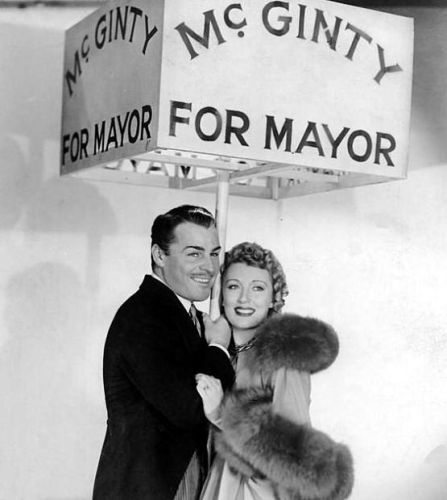
donlevy-angelus-mcginty_opt-1

 “This is the story of two men who met in a banana republic. One of them never did anything dishonest in his life except for one crazy minute. The other never did anything honest in his life except for one crazy minute. They both had to get out of the country.”

— The Great McGinty (1940)

For today’s final entry in Shattered Politics, we take a look at how elections are won north of the Mason-Dixon Line.

The Great McGinty begins in a bar located in an unnamed country in South America.  Tommy Thompson (Louis John Heydt) attempts to shoot himself but is stopped by philosophical bartender Dan McGinty (Brian Donlevy).  Tommy explains that he can never return to the United States because, in one moment of weakness, he stole some money.  McGinty replies that he can never return to the U.S. either.  Why?  “I was the Governor of a state, baby…” McGinty replies.

In flashback, McGinty explains how he came to power.  One day, while standing in a soup line, the homeless McGinty was approached by a local political operative (William Demarest) and offered $2.00 on the condition that he vote for a certain mayoral candidate.  McGinty agrees and then proceeds to vote 37 times.  When McGinty demands $74.00 for his efforts, he’s taken to the headquarters of the Boss (Akim Tamiroff, giving a wonderfully comedic performance).

The Boss is impressed with McGinty and, despite the fact that the two of them are constantly getting into fights with each other, he employs McGinty as a collector.  Eventually, he also arranges for McGinty to be elected alderman and then, running as a reform candidate, mayor.

Along the way, the Boss arranges for McGinty to get married.  McGinty’s wife (Muriel Angelus) originally has little respect for McGinty but, after they marry, she starts to realize that McGinty is not quite as bad as she originally assumed.  Eventually, she’s even impressed enough that she even stops seeing her boyfriend, George (Allyn Joslyn).

Meanwhile, the Boss arranges for McGinty to be elected governor.  However, once McGinty has won the election, he declares that he’s going to run an honest administration.  How does that turn out?  Well, it should be noted that the film opens with McGinty tending bar in South America…

The Great McGinty is a lot of fun and it’s interesting to think that this unapologetically sardonic look at American politics came out just a year after Mr. Smith Goes To Washington.  Imagine if Mr. Smith Goes To Washington had been told from the point of view of Edward Arnold’s Boss Taylor and you can guess what The Great McGinty is like.

If nothing else, The Great McGinty serves as a great reminder that political cynicism existed long before any of us cast our first vote.

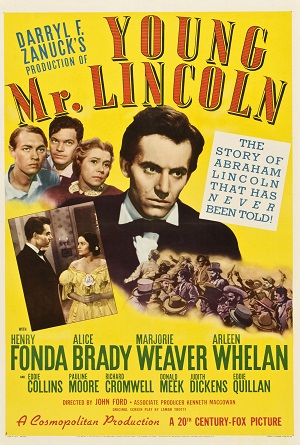
Shattered Politics #5: Young Mr. Lincoln (dir by John Ford)


YoungmrlincolnWay back in 1939, at the same time that Jimmy Stewart was conquering Washington in Frank Capra’s Mr. Smith Goes To Washington, the great director John Ford was making a film about another man who would eventually go to Washington.

In Young Mr. Lincoln, Henry Fonda plays the future 16th President.  Even though Fonda was probably far better looking than Abraham Lincoln ever was, he’s ideally cast in the role.  Along with being a very natural actor, Fonda personified a certain middle-of-the-country, stoic decency.  He played characters who were smart but never elitist and who were guided mostly by common decency.  In short, his screen persona was everything that people tend to think about when considering Abraham Lincoln.

As for the film itself, it begins with Lincoln as a simple storekeeper who accepts, as payment for groceries, a barrel of old books.  After reading the books and having a conversation with his doomed first love, Anne Rutledge (Pauline Moore), Lincoln decides to learn the law.

Years later, now a poor-but-honest lawyer, Abraham Lincoln arrives at Springfield, Illinois, sitting a top mule because he can’t afford a horse.  Lincoln opens a law office, awkwardly courts the rich and spoiled Mary Todd (Marjorie Weaver), and eventually defends two brothers who have been accused of murder.  While the case’s prosecutor (played by Donald Meek) may have a better education, he can’t compete with Lincoln’s common sense and ability to relate to the common people.

Obviously, the whole point behind Young Mr. Lincoln is that it’s about the early life of an American hero.  You watch the entire film with the knowledge that Lincoln is going to be the man who eventually leads the U.S. during the Civil War and who frees the slaves.  The viewer knows that Lincoln is going to be a great man, even if nobody else does and a good deal of the film’s effectiveness come from the moments when Fonda will strike an iconic pose or will casually deploy a familiar phase and you’re reminded of just who exactly it is he’s playing.

But, and this is why Young Mr. Lincoln remains a great film, the important thing is that the film is just effective when viewed as being a portrait of a dedicated lawyer trying to prove the innocence of his clients.  Fonda is compelling as both a future President and as an honest man trying to do the right thing.  Ultimately, the film would be just as compelling even if it was called Young Mr. Jones and didn’t open with soaring, patriotic music and end with a shot of the Lincoln Memorial.

It’s interesting to compare Young Mr. Lincoln to some of the other films made about Abraham Lincoln.  It’s a far more assured film than D.W. Griffith’s Abraham Lincoln and, needless to say, Henry Fonda makes for a better Lincoln than Walter Huston did.  At the same time, it’s far more naturalistic and less overly manipulative film than Steven Spielberg’s Lincoln.  In the end, it’s a good film and a great tribute to our 16th President.

And you can watch it below!

Shattered Politics #4: Mr. Smith Goes To Washington (dir by Frank Capra)


mr-smith-goes-to-washington

So, when you read that I was going to be reviewing 94 political films here at the Shattered Lens, you probably knew that one of them would have to be the 1939 best picture nominee, Mr. Smith Goes To Washington.

So, we all know that story right?  The senator from an unnamed state dies.  The weak-willed Governor (Guy Kibbee) has to appoint a new senator.  Political boss Jim Taylor (Edward Arnold) demands that the governor appoint one of his cronies.  The state’s reformers demand that the Governor appoint a never-seen crusader named Henry Hill (who, whenever I hear his name, makes me think of Ray Liotta snorting cocaine in Goodfellas).  The Governor’s children demand that he appoint Jefferson Smith (James Stewart, of course!), who is the head of something called the Boy Rangers.  The Governor flips a coin.  The coin lands on its edge but it also lands next to a newspaper story about Jeff Smith.

So, of course, Mr. Smith goes to Washington.

Now, as the movie quickly makes clear, Jeff Smith is immediately out-of-place in Washington.  For one thing, he’s actually excited to be there.  He’s convinced that he’s there to make America a better place.  When a bunch of drunken reporters (led by the great Thomas Mitchell) make Smith look foolish, Smith responds by running around Washington and punching them out.  (That whole sequence probably serves as wish fulfilment for a lot of politicians.)  When his cynical legislative aide Saunders (Jean Arthur) tells him that he’s too naive to survive in Washington, he wins her over with the purity of his idealism.  When his mentor, Senator Paine (Claude Rains), is revealed to be a part of Washington’s corrupt culture, Smith is stunned.  When Taylor tries to destroy his political career, Smith responds by giving the filibuster to end all filibusters.  He’s one man standing up against a culture of corruption and…

And there’s a reason why, 76 years later, aspiring political candidates still attempt to portray themselves as being a real-life, modern Jefferson Smith.

This is one of those films that everyone seems to agree is great and, of course, there’s many reasons to love Mr. Smith Goes To Washington.  There’s the lead performance of Jimmy Stewart, of course.  While this may not be his best performance (I prefer the more layered characterization that he brought to It’s A Wonderful Life and Anatomy of a Murder), it is Stewart at his most likable and, most importantly, he makes you feel Jeff Smith’s pain as he discovers that Washington is not the great place that he originally assumed it to be.  Claude Rains was always great when it came to playing good men gone wrong and he’s perfect as Sen. Paine.  Thomas Mitchell and Jean Arthur are perfectly cast and I always enjoy seeing the bemused smile on the face of Vice President Harry Carey as Smith conducts his filibuster.

But I think the best thing about Mr. Smith Goes To Washington is that it actually makes you believe that there are Jeff Smiths out there who actually could make a difference.  And, until Judd Apatow gets around to remaking the film with Adam Sandler, audiences will continue to believe.

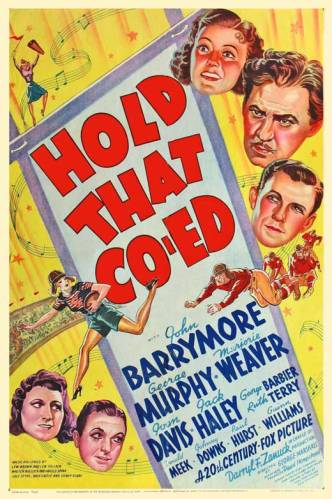
Shattered Politics #3: Hold That Co-Ed (dir by George Marshall)


hold-that-co-ed-movie-poster-1938-1020685724

“Americans will put up with bad government but they won’t stand for bad sportsmanship!” — A political consultant in Hold That Co-Ed (1938)

Rusty Stevens (George Murphy) is the new head football coach at State University.  (Which state?  We never learn for sure, though the implication is that it’s somewhere near Louisiana.)  From the minute that he arrives, Rusty discovers why State’s football program is so unheralded.  Not only are the majority of the students lazy and unmotivated but the college can’t even afford to buy the players uniforms.  The perpetually nervous Dean Thatcher (Donald Meek) is of no help when it comes to getting the university what it needs.  Even worse, the state’s Governor, Gabby Harrigan (John Barrymore), is running for the senate and he has sworn that he’s going to solve the state’s budget crisis by cutting the football program!

(Cue dramatic music.  Actually, not really.  There’s not a single dramatic moment to be found in Hold that Co-Ed.)

Well, what can Rusty be expected to do, other than lead all the students on a march down to the capitol building where they demand to see Gov. Harrigan.  However, Harrigan is busy giving an interview and he refuses to meet with the students.  Instead, he tells a fawning reporter how he is going to introduce a bill in the U.S. Senate that will guarantee all retired people, “Not one, not two, not three, but a sum of 400 dollars every month!”

After the reporter leaves, his cynical (Is there any other type?) secretary Marjorie (Marjorie Weaver) asks Harrigan how the government will ever be able to afford his plan.  Harrigan says that the government can’t but “isn’t it nice for” retired people “to have something to look forward to?”

(Gov. Harrigan sounds like he could be elected President in 2016.)

Meanwhile, the college students get rowdy in the front office and end up picking up the Governor’s aide, Wilbur (Jack Haley, who a year later would play The Tin Man in The Wizard Of Oz), and passing him around over their heads.  Naturally, this gets the attention of the press and suddenly, the fate of State’s football program is a campaign issue.

Upon discovering that most voters like football, Harrigan declares himself to be State’s biggest supporter and soon starts to play a very prominent role in the football program.  Not only does he arrange for Lizzie Olsen (Joan Davis) to become the only female to play on a college football team (When informed that Lizzie playing is against the rules, Harrigan replies, “I’ll change them!”) but he also pays players to come to State.  (When informed that paying players is against the law, Harrigan replies, “I’ll change the law!”)

It all eventually leads to Rusty romancing Marjorie and a bet between Harrigan and his opponent in the Senate race in which the outcome of the big game will determine who withdraws from the race.

Because of course it does.

First released in 1938, Hold That Co-Ed is one of those strange films that seems like it could only have come out in the 1930s.  Obviously, it’s primarily a college comedy.  Yet, at the same time, it’s also a musical which features Rusty randomly breaking out into song and dancing.  And then, on top of that, it’s a political satire.  (Reportedly, Harrigan was based on Huey Long, who also served as the basis for a far more sinister character in All The King’s Men.)

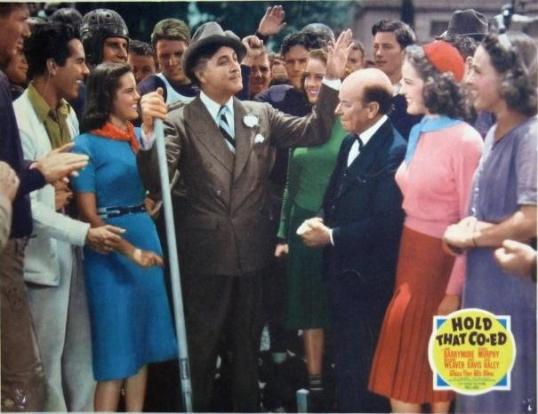
And, in its way, Hold That Co-Ed is a fun, little time capsule.  If anything, the film’s political satire feels just as relevant today as it probably did when it was first released.  As playing in grand theatrical fashion by John Barrymore, Gabby Harrigan could be any number of pompous, say-whatever-you-have-to-say demagogues.

What makes this film particularly interesting is just how much it’s on Harrigan’s side.  Whereas most political films always feel the need to at least pretend to be on the side of “good” government, Hold that Co-Ed cheerfully celebrates Harrigan’s casual corruption.  In this shrill day and age, there’s something refreshing about seeing a film that passes no judgment.

And speaking of politics, John Barrymore was never elected to political office.  However, the film’s other star, George Murphy, was.  He served in the U.S. Senate from 1965 to 1971.

HoldthatCoed

Governor Gabby Harrigan (John Barrymore) in Hold That Co-Ed

Shattered Politics #2: They Won’t Forget (dir by Mervyn LeRoy)


they_won_t_forget-582401011-large

The title of the 1937 film They Won’t Forget works on many levels.

It describes the reaction of a small Southern town, following the brutal murder of teenager Mary Clay (played, in her film debut, by Lana Turner).  The town won’t forget Mary and they won’t forget the terror caused by her murder.  They also won’t forget that local teacher Robert Hale (Edward Norris) was accused of the crime.

The district attorney, Andrew Griffin (Claude Rains), hopes that the people of his state won’t forget his efforts to see Griffin convicted of that crime.  Griffin wants to be elected to the U.S. Senate and he knows that the high profile case could be just what his career needs.

The Governor (Paul Everton) knows that, if he steps into the case and acts on his suspicion that Hale is innocent, the voters of his state will never forget.  And they certainly won’t be willing to forgive.

And, on a larger level, the title lets us know that the South and the North will never forget the Civil War and the conflict between the two regions.  The film opens with three elderly veterans of the Confederate Army, preparing to march in the town’s annual Confederate Memorial Day parade and admitting to each other that, after all these years, it’s difficult to remember much about the war other than the fact that they’re proud that they fought in it.

It’s while the rest of the town is busy watching Griffin and the governor ride in the parade that Mary Clay is murdered.  It’s easy to assume that Hale was the murderer because Hale was one of the few townspeople not to go to the parade.  You see, Hale is originally from New York City.  When he’s accused of murder, it’s equally easy for Griffin and tabloid reporter William A. Brock (Allyn Joslyn) to convince the town people to blame this Northern intruder for both the murder of Mary Clay and, symbolically, for all of the post-Civil War struggles of the South itself.

Meanwhile, up North, Hale is seen as a victim of the South’s intolerance.  A high-profile lawyer (Otto Kruger) is sent down to defend Hale but, as quickly becomes clear, everyone involved in the case is more interested in refighting the Civil War than determining the guilt or innocence of Andrew Hale.

They Won’t Forget is a hard-hitting and fascinating look at politics, justice, and paranoia.  It’s all the more interesting because it’s based on a true story.  In 1913, a 13 year-old girl named Mary Phagan was murdered in Atlanta.  Leo Frank was accused and convicted of the murder.  (In Frank’s case, he was born in Texas but was also Jewish and had previously lived in New York before moving to Atlanta, all of which made him suspicious in the eyes of many.)  On the word of a night watchmen, who many believe was the actual murderer of Mary Phagan, Leo Frank was convicted and sentence to death.  After spending days reviewing all of the evidence and growing convinced that Frank had been wrongly convicted, Georgia’s governor committed an act of political suicide by commuting Frank’s sentence to life imprisonment.  Leo Frank was subsequently lynched and the man who had prosecuted the case against him was subsequently elected governor.

Well-acted and intelligently directed, They Won’t Forget is probably one of the best films of which few people have heard.  Fortunately, it shows up fairly regularly on TCM and, the next time that it does, be sure to watch.  It’s a great film that you won’t easily forget.


Shattered Politics #1: Abraham Lincoln (dir by D.W. Griffith)


Unlike just about everyone else that I know, I am about as apolitical as you can get.

Oh, don’t get me wrong.  I always vote.  I believe in …. stuff.  Occasionally, I get angry about the state of the world. Why I’ll have you know that when I first registered to vote, I was really, really excited and I even sat down and researched every single person who was running for President.  (And, of course, I decided I would support John Edwards because he had good hair.  But then I changed my mind and ended up voting for Charles Jay, the candidate of the Personal Choice Party.)  But, for whatever reason, current events have never become the obsession for me that they are for some people.  You’ll never catch me posting a political meme or sagely agreeing with an activist on Facebook.  It’s just not for me.

(On the plus side, this has allowed me to have friends with many diverse viewpoints and generally lead a happy life.)

At the same time, I’m also fascinated by history and history is often the story of politics and politicians.  As a result, I’m far more interested in past affairs than I am in current affairs.  I can spend hours talking about the election of 1876 but I could hardly care less who is elected in 2016.  I know my political history well enough not to worry about the political present.

Perhaps that explains why, despite my indifference to politics, I tend to enjoy political movies.  And that leads us to my latest review series here at the Shattered Lens.  Over the next two weeks, I will be reviewing, in chronological order, 94 films about politics and politicians.  It’s a little something I call Shattered Politics.

(For some previous examples of what I mean by review series, check out Lisa’s Homestate Reviews, Lisa Goes Back To College, Netflix Noir, 44 Days of Paranoia, Embracing the Melodrama, Back To School, and, of course, Lisa’s Marie’s Favorite Grindhouse and Exploitation Film Trailers!)
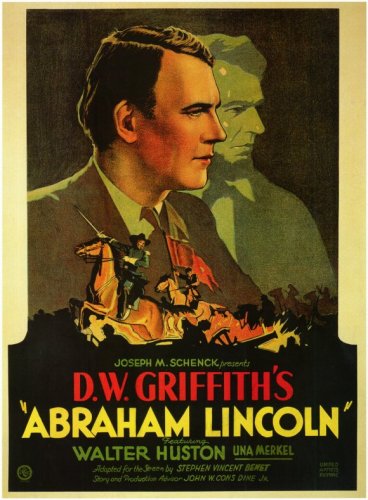
abraham-lincoln-movie-poster-1930-1020198617


We start things off with a film from 1930.  One of only two sounds films to be directed by cinematic pioneer D.W. Griffith, Abraham Lincoln is — as you might guess from the title — a 90 minute biopic about the 16th President of the United States.  It tells the same basic story as Lincoln, just in a lot less time and with Walter Huston playing the title role.  The film opens in 1809 with his birth then speeds forward to detail his tragic love affair with Ann Rutledge (played by Una Merkel) and his subsequent marriage to Mary Todd (Kay Hammond).  We get a snippet of the Lincoln-Douglas debates and then, just as quickly, Abe is President, the country plunges into civil war, and an alcoholic actor named John Wilkes Booth (Ian Keith) is meeting with disreputable looking men in a shadowy bar and making shadowy plans.

Any honest review of this version of Lincoln’s life needs to deal with the obvious.  Abraham Lincoln was released 84 years ago, at a time when the film industry was still struggling to make the transition from silent to sound film.  In other words, the film is stiff, stagey, and full of actors who alternate between shouting their dialogue and delivering their lines through nervously clinched teeth.  This is essentially a silent film — complete with overdramatic title cards and heavy-handed symbolism — that just happens to feature some very awkwardly delivered dialogue.  Walter Huston is occasionally effective as Lincoln but, just as often, he’s not.

However, Abraham Lincoln is fascinating to watch from a historical point of view.  It helps if you know a little something about director D.W. Griffith.  Almost all of the narrative techniques that we now take for granted were originally introduced to cinema by D.W. Griffith and many of them were introduced in his controversial 1915 epic, The Birth of a Nation.  

Of course, Griffith’s legacy is problematic precisely because of The Birth of a Nation.  An epic look at the Civil War, Birth not only featured white actors in black face menacing Lillian Gish but also ended with the Ku Klux Klan heroically riding to the rescue.  That even viewers in 1915 were critical of the film’s racism and overly pro-Confederate sentiments should tell you something about just how extreme the film truly was.

(That said, one huge fan of the film was U.S. President and aspiring dictator Woodrow Wilson.)

By most accounts, Griffith was stunned by the negative reaction to The Birth of a Nation and several of his subsequent films (most famously, Intolerance) were meant to answer his critics.

That’s what makes the opening scenes of Abraham Lincoln all the more interesting.  The film opens in 1809 with a shot of a ship on the ocean.  We catch a glimpse of the Africans chained in the lower decks.  Two white slave traders are seen carrying a dead body to the side of the ship and tossing it overboard.

We cut to Virginia, where we see a group of slave owners complaining about how the North is harming them financially by trying to end the slave trade.  One of the men says that the only man who could have kept the north and south united is dead.  The camera pans up to a picture of George Washington.

Then, the scene cuts to Boston.  A group of northerners sit around a table and talk about how slavery is harming the north economically and therefore, it has to end.  One of the northerners says that the only man who could have kept north and south united is dead.  Again, the camera pans up to a picture of George Washington.

And, it’s a wonderfully effective sequence, one that not only reveals the economic reasons behind most wars but one which also reveals the cruelty, inhumanity, and pure evil of slavery.  (That said, when the film later shows us a glimpse of life in the Confederacy, Griffith does include a couple of slaves cheerfully dancing in the background.)

And, as awkward as the scenes involving dialogue are (the less said about the scenes between Walter Huston and Una Merkel, the better), Griffith does occasionally show the visual flair that was his trademark.  One excellent sequence involves soldier after soldier lining up, one after the other and each of them staring straight into the camera as they prepare to go to war.  When the film concentrates on scenes of men marching across the countryside, it actually works.

Then again, you may just want to see the film for the chance to hear one extra, when asked the identity of a man giving a fiery speech, awkwardly explain, “That’s the actor, John Wilkes Booth.  Not much of an actor but he’s got a way with the ladies!”

It’s really up to you.
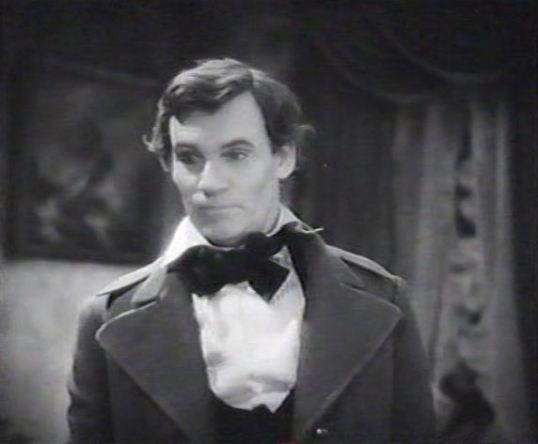
Walter Huston as Abraham Lincoln
Walter Huston as Abraham Lincoln

Netflix Noir #4: The Mugger (dir by William Berke)


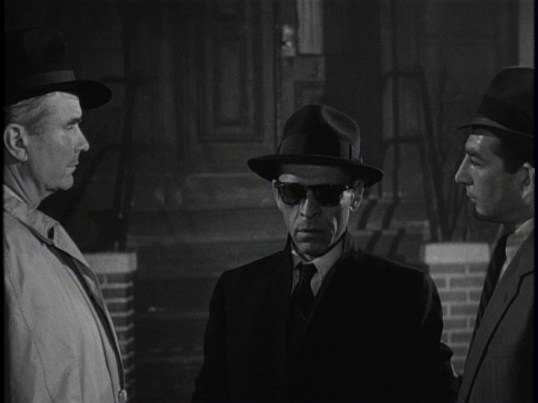
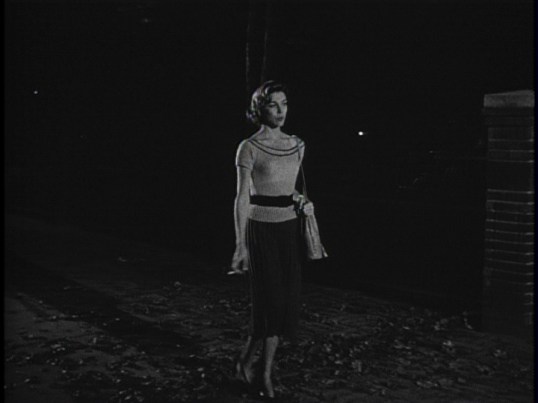
The Mugger 2

For my final Netflix Noir, I watched The Mugger, a film from 1958.

The Mugger is a police procedural.  Taking place in an unnamed city, it stars Kent Smith as Dr. Pete Graham.  Pete’s both a psychiatrist and a cop and, needless to say, he has a lot to deal with.

For one thing, his girlfriend, Claire (Nan Martin) is also a cop.  In fact, she’s apparently the only female cop on the entire force!  (“Woman cops?” another detective is heard to say, “Do we really need them?”)  Claire spends most her time working undercover on the dance hall circuit.  Pete wants to get married.  Claire wants to solve a few more cases before making that commitment.  Pete says that’s okay, as long as her plans “include me, a home, and children.”

Pete has also been forcefully recruited to counsel a Jeannie (Sandra Church), the sister-in-law of a local taxi driver.  As the driver explains it, Jeannie is “about 18 and is she built!”  Pete replies, “You shouldn’t get excited about a kid who wants to have a good time,” which seems like an unusually progressive attitude for a cop in the 1950s.  Still, Pete agrees to try to encourage Jeannie to be a little bit less rebellious.  Jeannie, by the way, is my favorite character in the film because she is never in a good mood and she gets to dismiss her older sister’s concerns by saying, “Maybe she’s getting a little old, a little jealous.”

It also turns out that Jeannie’s neighbor, Nick Greco (George Maharis), has a crush on her and apparently, just hangs out in her house all day.  While this seemed rather creepy to me, the film seemed to suggest that this was just normal 50s behavior.  Apparently, since nobody bothered to lock their doors back then, it was also totally appropriate to just hide in someone’s house and listen in on private conversations.

Peter’s other big problem is that there’s a mugger who is robbing women and cutting their cheek with a knife.  I have to give the film some credit here because it doesn’t shy away from discussing the sexual subtext to these attacks, which I imagine was quite daring for a film in the 50s.  Pete comes up with a detailed profile of the attacker, the sort of thing that would make the cast of Criminal Minds jealous.  Claire goes undercover to catch the mugger and there’s a great scene where a drunk sailor tries to harass her and she threatens to shoot him in the knee caps.  Again, this is not the sort of thing that we typically associate with a 50s film…

Which is not to say that The Mugger is not clearly a product of its time.  For one thing, just check out the police force in this city, which is all white, all middle-aged, and — with the exception of Claire — all male.  As well, this is one of those old movies where any woman who walks down a street will be leered at by every guy she passes, including the film’s heroes.  One of the reasons why it was so great to see Claire threaten to cripple that soldier was because it came after 50 minutes of watching Pete and every other man in the film do a double take whenever she entered a room.

Clocking in at a little over 70 minutes and obviously low-budget, The Mugger is an undeniably obscure film.  Checking with the imdb, I discovered only two reviews that had been previously written for this film and one of them was in Turkish!  When I went onto YouTube to look for a trailer, I found nothing.  The Mugger is forgotten and hardly a lost classic but I still enjoyed watching it.  What can I say?  I love my history and, if nothing else, The Mugger is definitely a time capsule.

Watch it on Netflix while you can!

The Mugger

Netflix Noir #3: Crime of Passion (dir by Gerd Oswald)


CrimepassionPosterThe third Netflix Noir that I watched was 1957’s Crime of Passion.

In Crime of Passion, Barbara Stanwyck plays Kathy Ferguson, a San Francisco-based advice columnist.  She is approached by two homicide detectives who request her help tracking down a fugitive who they think might read her column.  Charlie (Royal Dano) is aggressive and outspoken.  When he first meets Kathy, he tells her, “You’re work should be raising a family and having dinner ready when your husband comes home from work.”  His far more passive partner is Detective Bill Doyle (Sterling Hayden).

Kathy writes a column that convinces the fugitive to turn herself in.  (The power of Kathy’s column is shown in an amusing montage where woman after woman is seen reading the column aloud.  Significantly, no men are seen to ever read anything that Kathy has written.)  The resulting fame leads to Kathy getting a job offer in New York.

However, before Kathy can leave, she gets a phone call from Bill.  He asks her out on a date and, one scene later, they’re getting married in the shabby office of a justice of the peace.  Kathy sacrifices her career to be a suburban housewife.

From the minute that Kathy first looks at the small and anonymous house and the boring neighborhood that she’ll be sharing with Bill, it’s obvious that things are not going to work out well.  Even though Kathy even tells Bill, “I hope all your socks have holes in them and I can sit for hours darning them,” the life of domestic servitude is not for her.

Every day, she stays home while Bill goes to work.  At night, she reluctantly plays hostess to the constant gatherings of Bill’s colleagues and their wives.  The women stay in one room while the man gather in another.  Kathy is quickly bored with the inane chattering of the other wives but whenever she tries to go into the other room, she finds herself treated like an unwanted intruder.

And worst of all is the fact that Bill has absolutely no ambition of his own.  He’s got his house.  He’s got his wife.  He’s got his friends.  And he doesn’t feel that he needs anything else.

Kathy takes it into her own hands to advance Bill’s career, first by having an affair with Bill’s boss (Raymond Burr) and finally by trying to find a spectacular crime that Bill can solve.  And, as the suburbs continue to drive her mad, Kathy is not above creating a few crimes on her own…

In many ways, Crime of Passion reminds of another 50s film, Nicholas Ray’s Bigger Than Life.  Both films use the conventions of melodrama to present a surprisingly subversive look at the horrors of suburban conformity.  Unfortunately, Crime of Passion never quite reaches the heights of Bigger Than Life, largely because Sterling Hayden gives such a dull performance as Bill that you never believe that Kathy would have married him in the first place.  (The film would have been far more impressive if Bill had started out as an apparently dynamic character whose dullness was then revealed after Kathy married him.)  However, Barbara Stanwyck is well-cast as Kathy and Raymond Burr plays up his character’s ambiguous morality.  If nothing else, Crime of Passion is one of those film to show anyone who is convinced that nothing subversive was produced in the 1950s.

Netflix Noir #2: The Big Caper (dir by Robert Stevens)


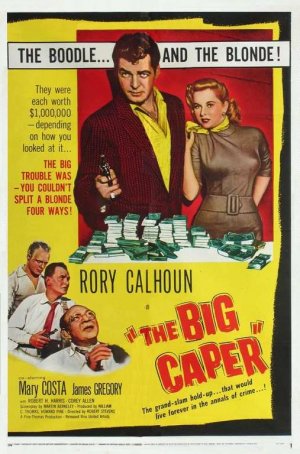
The Big Caper Poster

For our next Netflix Noir, we take a look at a heist film from 1957, The Big Caper.

Frank (Rory Calhoun) is a small time criminal with a plan.  He knows that there’s a Marine base near the small town of San Felipe, California and he also knows that, during the weekend before payday, the San Felipe bank will be holding a million dollar payroll for those Marines.  He proposes  to Flood (James Gregory), a wealthy crime boss whom Frank idolizes, that they should find a way rob that bank over the weekend.  Flood agrees to the plan.

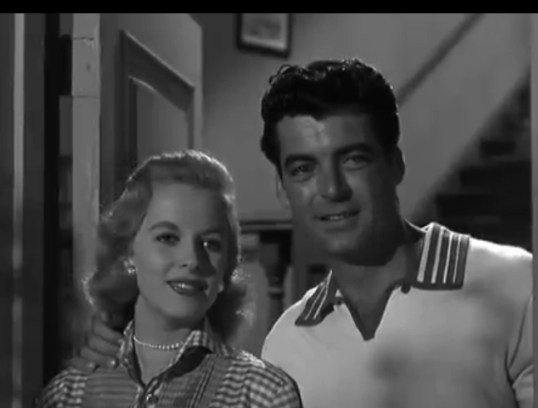
While Flood recruits some help for the robbery, Frank and Flood’s girlfriend, Kay (Mary Costa), move into the town and set themselves up as a part of the community.  Using Flood’s money, Frank buys a gas station and he and Kay move into a nice suburban house.  At first, Frank resents being forced to live like a “square.”  He bitterly complains that the local San Felipe newspaper doesn’t even tell him “how the horses did.”

But then something odd happens.  Frank starts to enjoy being a member of the community.  Soon, the gas station is making a profit and Frank is even thinking about buying a second one.  Oddly enough, his becomes best friends with the local cop.

As for Kay, she transitions to respectability even before Frank does.  As she eventually confesses to Frank, she’s tired of being treated like Flood’s property.  She wants to stay in San Felipe and make a life for herself.  Wearily, Frank tells her that she better hope that Flood doesn’t find out…

Meanwhile, Flood has recruited together his gang and they’re not exactly the most impressive bunch of criminal masterminds.  There’s Roy (Corey Allen), a physical fitness fanatic who is almost childlike in his devotion to Flood.  There’s Harry (Paul Picerni), who demands that his girlfriend Doll (Roxanne Arlen) be a part of the scheme.

And then there’s Zimmer (Robert H. Harris), a bald, sweating pyromaniac who spends most of his time begging for alcohol and lighting matches.  Zimmer arrives at Frank’s house unannounced and Frank is forced to pretend that Zimmer is his uncle.

Once Flood and the rest of the gang arrive, Frank starts to prepare for the robbery but he soon discovers that he’d rather be barbecuing with the neighbors.

The Big Caper is a clever little film, one that features excellent performances (especially from Gregory, Calhoun, Allen, and Harris) and tons of hard-boiled dialogue.  What makes this film especially memorable is the way that it contrasts the fake respectability of the wealthy Flood with the newfound, but genuine, respectability of Frank and Kay.

If The Big Caper was made today, it would probably be directed by the Coen Brothers and Ben Affleck and Ray Liotta would play Frank and Flood respectively.  However, the film works just as well with Rory Calhoun and James Gregory and is totally worth seeing.

The Big Caper

Netflix Noir #1: Crime Against Joe (dir by Lee Sholem)


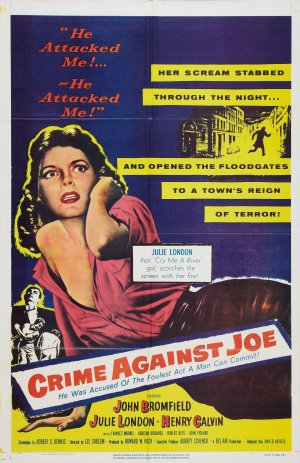
Crime_Against_Joe_poster

After watching Inherent Vice last weekend, I decided to get on Netflix and do a search for film noirs.  This led to me watching four film noirs from the 50s, all of which were previously unknown to me.

For my first Netflix Noir, I watched a little something called Crime Against Joe.  It’s a 69 minute film from 1956.  It’s about a guy named Joe.  There’s been a crime.  Oddly enough, the crime really against Joe.  Instead, he’s been wrongly accused of committing a crime against a nightclub singer named Irene.  So, perhaps a better title for this film would have been It Sucks To Be Joe.

But anyway —

Crime Against Joe was directed by Lee Sholem.  According to Wikipedia, Lee Sholem had a 40 year career as a director.  During that time, he directed over 1,300 television episodes and feature films and he finished every single one of them either on time or early.  And you can certainly see evidence of that in Crime Against Joe, a film that starts out in a rush and pretty much never slows down until the final fade out.

Joe (John Bromfeld) was voted “most likely to succeed” in high school but — surprise!  surprise! — he’s failed to live up to the expectations set for him by the 1945 yearbook.  Instead, he enlisted in the army, served in the Korean War, and was diagnosed with “battle fatigue.”  (I assume that battle fatigue was the 1950s version of PTSD.)  He spent a while in a mental hospital and it was there that he first started painting.  When he was released, he moved in with his widowed mother (Frances Morris).  While she works to support him, Joe spends his time drinking and painting.

As the movie begins, a drunken Joe has just destroyed his latest painting.  (“I can see it in my head but it doesn’t come out on canvas!” Joe shouts, which is actually a pretty good way to describe the dark feeling that all artists occasionally get.)  He wanders around town, drunk.  He talks to a waitress named Slacks (Julie London), who is obviously in love with him.  He gets some sage advice from Red (Henry Calvin), a taxi driver.   He stumbles into a nightclub where he harasses a singer (Alika Louis) before finally getting thrown out of the club.  In the parking lot, as he stumbles away, a mysterious cowboy (Rhodes Reason) glares at him.

Joe stumbles about until, around two in the morning, he runs into a young woman wearing a nightgown.  He tries to talk to her but she only stares at him, her placid face frozen in a zombie-like state.  Joe leads her to a nearby house where the woman’s father thanks him for his help and then slams the door in his face.

Later that night, the nightclub singer is found dead on the side of the road.  Found near her body is a high school pin that belonged to someone from the class of 1945.  Knowing that Joe was drunk that night and had been seen in the nightclub, Detective Hollander (Robert Keys) goes to Joe’s house.  Hollander demands to see Joe’s high school pin.  Joe says he doesn’t know where it is.  Hollander stares at Joe’s paintings.  “You always paint half-naked women?” Hollander sneers before arresting Joe for murder.

At the station, Joe says that he was leading the woman back to her house at the same time that the singer was murdered.  The woman’s father shows up at the police station.  No, he says, Joe was nowhere near his house at two in the morning.  Joe is arrested for murder…

Fortunately, Slacks is willing to risk her life to prove that Joe is innocent.  And Joe knows that the murderer had to have been someone who he went to high school with…

Crime Against Joe is one of those low-budget, obscure B-movies that actually a lot more interesting than you might think.  John Bromfeld does a good job as Joe and the character’s PSTD gives the film a bit more depth than you might otherwise expect.  Julie London is great in the role of brave and selfless Slacks (though it’s interesting that this film felt the need to give a masculine nickname to a strong female character) and Rhodes Reason is genuinely menacing as the mysterious cowboy.  Crime Against Joe is also full of unexpected and occasionally surreal details.  The most obvious example would be the zombie-like woman who Joe runs into on the night of the murder.  However, my favorite little oddity is the fact that signs reading “Corey for Councilman” keep popping up in the strangest locations.

(It eventually turns out that Joe went to high school with Corey and the scene where Joe confronts his old classmate is a fun little piece of political satire.  That said, there was a part of me that hoped the significance of the sings would just remain an odd and unexplained little detail.)

There’s actually a surprisingly subversive streak running through Crime Against Joe.  We usually tend to think of the 50s as being a time when authority figures (like the police) were viewed with blind trust.  In Crime Against Joe, however, nobody in power is portrayed positively.  The police, for instance, come across like a bunch of close-minded bullies who are prepared to convict Joe based solely on his paintings and his less-than-sterling war record.  The scenes where Hollander interrogates Joe are full of menace.  In the end, this film is on the side of those living on the margins of respectable society.  When Joe and Slacks try to prove Joe’s innocence, they’re also attempting to prove their own right to exist in a society that has rejected both of them.

Crime Against Joe may not be a well-known film but there’s a lot more going on under its surface than you might originally think.  It’s on Netflix so check it out when you’ve got 70 minutes to spare.