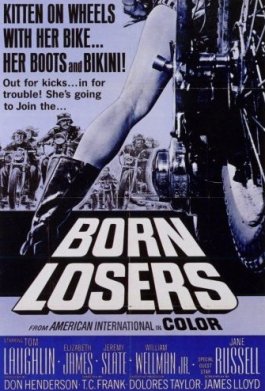
Shattered Politics #24: The Born Losers (dir by Tom Laughlin)


Born Losers

For the past few days, I’ve been in the process of reviewing 94 films about politics and politicians.  With that in mind, you may be wondering why, after reviewing films like The Last Hurrah, Sunrise at Campobello, and Advise & Consent, I am now reviewing a 1967 biker film called The Born Losers.

It all comes down to Billy Jack.  In the 70s, Tom Laughlin would write, direct, and star in two hit films — Billy Jack and The Trial of Billy Jack.  In these films, Laughlin played the title character.  Billy Jack was everything that you could hope for in a counter-culture hero.  First off, as an American Indian, he was an authentic American as opposed to just another European intruder.  He was a war hero, who had served as a Green Beret in Vietnam.  He often carried a gun with him, which meant that he understood and supported the 2nd Amendment and good for him!  Billy Jack was also a master of hapkido, which meant that he could kick ass in the most visually appealing way possible.

Even more importantly, Billy Jack called the Man out on his racism and his intolerance.  Billy Jack was an environmental activist before anyone else.  Billy Jack went on vision quests.  Billy Jack was anti-war.  Billy Jack was a pacifist.  And, of course, Billy Jack ended up killing a lot of people but they were all bad guys.

By making and distributing Billy Jack himself, Laughlin became an independent film pioneer and made history.  He also became a counter-culture hero and Billy Jack remains a cult figure even today.  But what a lot of people don’t realize is that Billy Jack first appeared in Born Losers and that, in the little seen Billy Jack Goes To Washington, he eventually ended up serving in the U.S. Senate.

When you consider that Billy Jack would eventually be Sen. Jack, that means the Born Losers isn’t just a low-budget, violent biker film.  Instead, it’s the exploitation version of Young Mr. Lincoln.  It’s a chance to see what Billy Jack was doing before he became a statesman.

(And rest assured, the other three Billy Jack films will be reviewed before Shattered Politics ends.)

As we discover at the start of Born Losers, pre-politics Billy Jack was just an enigmatic veteran who lived in the mountains of California.  When we first see Billy, he’s walking along a grassy hill.  A deer safely runs by the camera.  A rabbit pops its head out of a hole in the ground and looks relieved to see Billy.  If I’m being a little bit snarky, it’s because I’ve seen all of the Billy Jack films and I know how often this exact scene is played out over the course of the franchise.  But, in all fairness, it’s actually a fairly well-done and visually appealing scene and, as an actor, Laughlin had the presence to pull it off.

A far less pretty scene is occurring in the town of Big Rock, where teenagers are showing up to hang out on the beach and are being harassed by a group of bikers, the Born Losers of the title.  The Born Losers are an odd collection of bikers, with half of them looking like extras from Sons of Anarchy and the other half looking like the type of hipsters that I always see whenever I go to a movie at the Alamo Drafthouse.  Their leader (Jeremy Slate) is named Danny but the rest of the gang are known by their nicknames.

(For instance, there’s Crabs.  Why is he called Crabs?  “Because he’s got them!” Danny helpfully explains.)

After the Born Losers rape four girls, they launch a campaign of violence and intimidation to keep the girls from testifying in court.  Billy comes to the aid of one of the girls, Vicky (Elizabeth James, who also wrote the script).  I related to Vicky, largely because she does things like ride a motorcycle while wearing a white bikini, which is exactly the sort of thing that I would do if I lived in California.

Now, there’s a lot of negative things that I could say about Born Losers.  It’s talky.  With the exception of Laughlin and Slate, it’s obvious that the majority of the cast was made up of amateurs.  The final half of the film drags as you wait for an ending that you have probably already predicted.

But you know what?

I actually like The Born Losers.  Hidden underneath all of the exploitation trappings and heavy-handed moralizing, this is a very sincere film.  Whatever they may have lacked in budget or subtlety, Laughlin’s films made up for in sincerity.  And, as strange as it may be to say about a film that features four rapes and is padded out with a thoroughly gratuitous striptease, The Born Losers is not a misogynistic film.  Both Laughlin the director and Billy Jack the character are on the side of the victims of the Born Losers and when the film calls out society for blaming the victims instead of the rapists, it does so with a fury that elevates the entire film above your typical 1967 biker film.

And, while I don’t know if I’d ever vote for Billy Jack, there’s nobody I’d rather have on my side.
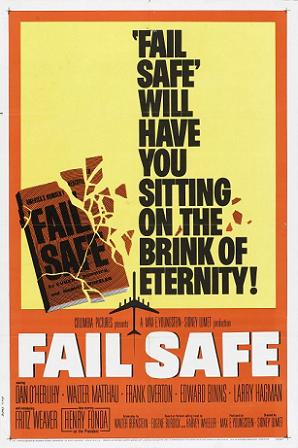
Shattered Politics #23: Fail-Safe (dir by Sidney Lumet)


Fail_safe_moviep

After watching Dr. Strangelove, you may find yourself asking what that film would have been like if it had treated its doomsday scenario seriously.  Well, you can find out by watching yet another film from 1964, Sidney Lumet’s Fail-Safe.

What’s Fail-Safe about?  Well, basically, it tells the exact same story as Dr. Strangelove, except without the humor.  Once again, an American bomber is accidentally ordered to launch a nuclear attack against Russia.  Again, the President (played, somewhat inevitably, by Henry Fonda) has to have an awkward conversation with the leader of Russia.  Again, a sinister defense advisor (this time played by Walter Matthau) argues that the world can survive a nuclear war.

Admittedly, there is no equivalent to George C. Scott’s Buck Turgidson in Fail-Safe.  However, there is a General Black (Dan O’Herilihy) who has a recurring nightmare about watching a bullfight while the sky around him glows with radiation.

Fail-Safe has the same plot as Dr. Strangelove but none of the humor.  In fact, Fail-Safe has absolutely no humor at all.  It’s one of the most somber films that I’ve ever seen.  It has a good opening with General Black’s nightmare and an effective ending that makes excellent use of freeze frames but the middle of the film is basically just a collection of endless debates.

And I’m sure that approach made sense at the time because, after all, Fail-Safe was dealing with a serious theme, it was directed by a serious filmmaker, and it featured a bunch of serious actors.  And maybe if I had never seen Dr. Strangelove, Fail-Safe would not seem like such a slow and boring movie.  But I have seen Dr. Strangelove and, as a result, it’s impossible to watch Fail-Safe without wanting to hear Henry Fonda say, “You can’t fight here!  This is the war room!”

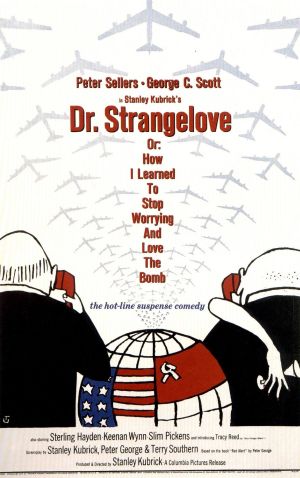
Shattered Politics #22: Dr. Strangelove Or How I Learned To Stop Worrying and Love the Bomb (dir by Stanley Kubrick)


Dr._Strangelove_poster

“Gentlemen!  You can’t fight here!  This is the war room!” — President Merkin Muffley (Peter Sellers) in Dr. Strangelove: Or How I Learned To Stop Worrying And Love the Bomb (1964)

The next time you hear someone bragging about how their favorite politician is an intellectual who always acts calmly and rationally, I would suggest that you remember the example of President Merkin Muffley, one of the many characters who populate the 1964 best picture nominee, Dr. Strangelove or How I Learned To Stop Worrying and Love the Bomb.

As played by Peter Sellers, Merkin Muffley is the epitome of rational political action.  Speaking in a steady (if somewhat muffled) midwestern accent and always struggling to remain calm and dignified, Muffley keeps order in the War Room as the world edges closer and closer to apocalypse.

Just consider, for example, this scene where President Muffley calls the Russian leader (the nicely named Dimitri Kissoff) and explains that a little something silly has happened.

As Muffley explains in the above scene, Gen. Jack D. Ripper (Sterling Hayden) has gone crazy.  Convinced that the Russians have been sapping his precious bodily fluids, Gen. Ripper has ordered a nuclear strike on Russia.  Unfortunately, Russia has built a Doomsday Machine that, should Russia be bombed, will destroy the world.

While Muffley is at fist skeptical about a doomsday machine, his advisor, Dr. Strangelove (also played by Peter Sellers), explains that the doomsday machine not only exists but that it’s actually a pretty good idea.  The wheelchair-bound Dr. Strangelove speaks in a German accent and appears to have lost control over the left side of his body.  At random moments, his left arm shoots up in a Nazi salute.  At other times, his hand tries to strangle him.  Making these surreal moments all the more memorable is the fact that nobody in the War Room seems to notice or question them.

And, while it’s always tempting to dismiss a character like Dr. Strangelove as being an over-the-top caricature, the fact of the matter is that, following the end of World War II, several Nazi scientists ended up working for the U.S. government.  In many ways, the U.S. space program was the creation of a bunch of real-life Dr. Strangeloves.

Of course, President Muffley and Dr. Strangelove aren’t the only roles played by Peter Sellers in this film.  Sellers also plays Lionel Mandrake, a British officer who — as the result of an office exchange program — happens to be at Burpelson Air Force Base at the same time that Gen. Ripper orders the attack on Russia.

As famous as his Sellers’s performances as Dr. Strangelove and President Muffley may be, I actually think Mandrake is his best performance in the film.  In many ways, Mandrake is the audience’s surrogate.  He’s the one who gets to hear Ripper’s rambling explanation for why he launched an attack on Russia.  He’s the one who has to try to convince the hilariously unhelpful Col. Bat Guano (Keenan Wynn) to help him find a quarter so he can call the Pentagon.

(“You’re gonna have to answer to the Coca-Cola company,” Guano says, before shooting open a Coke machine to get change.)

Sellers plays Mandrake as a parody of the traditional, stiff upper lip British army officer.  Not only does that allow some great humor as Mandrake keeps a calm demeanor while listening to Ripper’s increasingly crazed monologue but it also allows Mandrake to be the only sane man in the movie.

(Of course, the whole point of Dr. Strangelove is that the world’s become so insane that one sane man can not make a difference. )

Sellers earned a best actor nomination for playing three different roles and he deserved it but, for me, the two best performances in the film come from Slim Pickens and George C. Scott.

Pickens, of course, is the bomber pilot who ends up riding an atomic bomb like a bull in a rodeo.  As a character, Maj. Kong may be a bit too much of a spot-on stereotype but Pickens brings such sincerity to the role that it doesn’t matter.  Oddly enough, you feel almost happy for him when he rides that bomb to his death.  You know that’s exactly how he would have wanted to go out.

And then there’s George C. Scott, playing the role of Gen. Buck Turgidson.  From the safety of the War Room, Turgidson looks forward to nuclear war and worries when President Muffley invites the Russian ambassador to join them.  (“But he’ll see the big board!” Turgidson exclaims.)  Turgidson is both hilariously stupid and hilariously confident.  Perhaps my favorite Turgidson moment comes when he trips, falls, and stands back up without once losing his paranoid train of thought.

(Though he doesn’t have a big role, James Earl Jones makes his film debut in Dr. Strangelove.  The way he delivers the line “What about Major Kong?” makes me laugh every time.)

50 years after it was first released, Dr. Strangelove remains a comic masterpiece of a nightmare, a film that proves that political points are best made with satire and not sermons.

Shattered Politics #21: Kisses For My President (dir by Curtis Bernhardt)


Kisses_for_My_President_-_1964_-_Poster

If there’s anyone who deserves to be the subject of a big budget biopic, it’s Victoria C. Woodhull.  Back in the 19th century, at a time when women were not even allowed to vote, Victoria C. Woodhull was not only the first woman to ever work as a stockbroker but also the first to ever found her own newspaper.  A fierce advocate for women’s right and free love, Victoria Woodhull was also the first woman to ever run for President.  She was nominated in 1872 by the Equal Rights Party and, for the crime of trying to cast a vote for herself, she spent election day in jail.

Since that day, many more women have run for President but none have been elected.  Since 1984, two women have received major party nominations for vice president but neither came close to being elected.  Since 1964, Margaret Chase Smith, Shirley Chisholm, Patsy Mink, Ellen McCormack, Patricia Schroeder, Elizabeth Dole, Carol Mosely-Braun, Michele Bachman, and Hillary Rodham Clinton have all campaigned for the presidential nomination of one of the two major political parties but none of them have been nominated.

I do believe that a woman will be elected President within my lifetime.  In fact, it could even happen in 2016.  But until then, the only place where you can find a female President is on TV and in the movies.

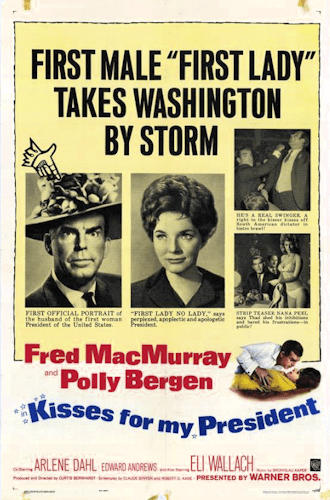
Take, for instance, today’s final entry in Shattered Politics, the 1964 film Kisses For My President.  This may very well have been the very first movie to feature a woman as President.  Needless to say, in 1964, this idea was considered so outrageous that it had to be played for laughs.

Kisses For My President starts with an image of hundreds of women chanting “We want Leslie!”  We get a shot of Fred MacMurray looking out over the crowd.  The next scene, the new President is being sworn in.  We start with a close-up of the chief justice reciting the oath of office to “Leslie Harrison McCloud.”  The camera pans over to Fred MacMurray, listening intently.  However, just when 1964 audiences were expecting MacMurray to swear to uphold the constitution, the camera pans yet again, over to …. Polly Bergen!

“OH MY GOD!” audiences in 1964 gasped, “LESLIE McCLOUD IS A WOMAN!”

That’s right.  Polly Bergen is playing President Leslie McCloud and Fred MacMurray is playing her husband, Thad.  As the film makes apparent in its opening scenes, Thad is not quite sure what his role is supposed to be.  He has an office in the White House but it’s just so … feminine!  And it’s full of painting of previous first ladies who were all ladies!  And, at one point, Thad even imagines a picture of himself wearing a lady’s hat!

Oh my God!

Now, to be fair to the movie, Polly Bergen does get a few scenes where she shows herself to be a strong President.  There’s a great scene where she coolly dismisses a condescending senator (Edward Andrews) who suggests that, as a woman, Leslie might not be up to the task of standing up to America’s enemies.  It’s a brief scene but it’s a good one.

But, ultimately, it’s impossible to ignore the fact that Kisses For My President, a film about the first female President, is mostly interested in how Thad handles being “first gentleman.”  It’s a film that imagines a historic moment for women and then focuses on what it would mean for one man.

How 1964!

On the one hand, Kisses For My President is a dated comedy that runs way too long and tries to get too much mileage out of one joke (i.e., Fred MacMurray looking confused).  However, the film also features a great performance from Eli Wallach.  Playing a strutting dictator named Vasquez, Wallach is a lot of fun and the scenes where MacMurray shows him around Washington are the best in the film.  I also appreciated the fact that the President’s daughter reacts to the restrictions of living in the White House by dating a guy that she knows her parents will hate, largely because I would have done the same thing in her situation.

I’m a little bit torn on the ending of Kisses For My President.  (Should I spoil it?  No, I don’t think I will.)  On the one hand, it’s outrageously sexist and seems to suggests that Leslie — despite being a strong President during the few times we actually get to see her doing the job — should have been content to just be a wife and mother.  On the other hand, it’s one of those endings that would seem to perfectly capture the dominant culture of the time when the film was made.  So, it has some worth from a historical point of view.

When last I checked, Kisses For My President is currently available for free on YouTube. The film is interesting as a historical document if nothing else.


Shattered Politics #20: The Best Man (dir by Franklin J. Schaffner)


Best_man22234

“Does The Best Man Always Get To The White House?” asks the poster for the 1964 film, The Best Man.

Of course, nowadays, that question seems incredibly naive.  Of course the best man doesn’t always get to the White House!  Some of my friends are Republicans and some of my friends are Democrats and a lot of my friends are Libertarians but they all have one thing in common: the belief that at least half of the past 4 elections were won by the wrong man.

But, as anyone who has done their research can tell you, 1964 was a far different time from 2015.  In general, people had greater faith in both government and their elected leaders.  Ineffective leaders and corrupt authority figures were viewed as being the exception as opposed to the rule.  We’re a lot more cynical now and, when we see political movies from the early 60s, all of that optimism and idealism often make them feel very dated.

Another big difference between the middle of the 20th Century and today is that, when it came to presidential nominating conventions, there was actually the potential for some suspense regarding who would win the nomination.  Occasionally, it took more than one ballot for a candidate to be nominated.  Last minute deals often had to be made and convention delegates were actually selecting an ideology along with a candidate.  Political conventions were contests and not coronations.

Again, it’s obvious that times have changed and, as a result, a film like The Best Man, which may have seemed very provocative and shocking in 1964, feels a bit like an antique today.  That doesn’t mean that it’s a bad film.  In fact, The Best Man is an interesting time capsule of the way things used to be.

The Best Man takes place at a presidential nominating convention.  The party is not specified but it feels like a Democratic convention.  There are several candidates competing for the nomination but the two front-runners are former Secretary of State William Russell (Henry Fonda) and Senator Joe Cantwell (Cliff Robertson).

Much like the character that Fonda played in Advise & Consent, Russell is an intellectual, a calm and rational liberal. Much like Spencer Tracy in State of the Union, Russell is separated from his wife (Margaret Leighton) but the two of them are pretending to be a happy couple for the sake of the campaign.

Meanwhile, Joe Cantwell is a paranoid and ruthless opportunist, a former war hero who will do anything to win.  The only person more ruthless than Joe Cantwell is his brother and campaign manager, Don (Gene Raymond).

(For those who enjoy history, it’s interesting to note that John F. Kennedy was a war hero-turned-senator who had a ruthless brother who doubled as his campaign manager.)

Both Cantwell and Russell come to the convention hoping to get the endorsement of former President Art Hockstader (Lee Tracy).  While the pragmatic Hockstader cannot stand Cantwell personally, he also views Russell as being weak and indecisive.

However, both Russell and Cantwell have secrets of their own.  When Cantwell discovers Russell’s secret and threatens to leak it, Russell has to decide whether or not to reveal Cantwell’s secret.

The Best Man was based on a stage play by Gore Vidal and the actual film never quite escapes its theatrical origins.  And, in many ways, it feels undeniably dated.  But it’s still a well-acted film, one that will probably be best enjoyed by political junkies and students of history.  Before watching the movie, be sure to read up on the 1960 presidential election and then see if you can guess who everyone is supposed to be.

Shattered Politics #19: To Kill A Mockingbird (dir by Robert Mulligan)


To_Kill_a_Mockingbird_poster

So, I guess I should explain why I’m including the classic 1962 film (and best picture nominee), To Kill A Mockingbird, in this series of reviews of films about politicians.  After all, while To Kill A Mockingbird dealt with the issue of racism in Alabama in a surprisingly honest manner, it doesn’t feature any elected officials.  Nobody shows up playing Gov. Benjamin J. Miller or President Franklin Roosevelt.  Instead, this film is about a wise lawyer named Atticus (Gregory Peck), an innocent man named Tom (Brock Peters), a girl named Scout (Mary Badham) and her older brother Jem (Philip Alford), and a mysterious recluse named Boo (Robert Duvall).

However, if you’ve read Harper Lee’s wonderful novel, then you know that Atticus is not just the smartest man in Maycomb, Alabama.  He’s also a member of the Alabama state legislature and his political career is a fairly important subplot in the book, with him occasionally having to leave home so he can go down to Montgomery and help to write the budget.  (Incidentally, Harper Lee’s father actually was a member of the Alabama House of Representatives.)

In the film, no mention of Atticus being a member of the state legislature is made but I still choose to believe that he was.  Because, as played by Gregory Peck, Atticus Finch is exactly the type of man who you would want to think of as serving in government.  He’s wise, compassionate, and firm.  For much of To Kill A Mockingbird, he is literally the only sane adult in Maycomb.  He’s the only attorney willing to defend Tom Robinson when Tom is accused of raping a white girl.  When a mob shows up to lynch Tom, Atticus is the only adult willing to stand up to them.  (Fortunately, Jem also runs up and shames the mob by reminding them that she goes to school with their children.)  And, in court, it is Atticus who proves that Tom is innocent.

When Tom is still convicted, what makes it all the more devastating is that wise and compassionate Atticus doesn’t seem to be surprised as all.  If even Atticus feels that there is no hope for a black man to get a fair trial from an all-white jury, the film seems to be saying, then there truly is no hope.

Of course, the film is not just about Atticus.  It’s about Scout and Jem and their friend Dill (John Megna) and how the three of them grow up and learn the truth about their world.  Watching them from behind the closed doors of his house is the mysterious and reclusive Boo Radley.  When Boo shows up towards the end of the film, I always find tears in my mismatched eyes.  Boo is played, in his film debut, by Robert Duvall.  Duvall doesn’t say a word but he still makes an incredible impression as the shy and withdrawn Boo.

So, I may be cheating a lot by including To Kill A Mockingbird in this series of reviews.  Oh well.  Who am I to turn down a chance to rewatch it?  To Kill A Mockingbird is just a great film.


Shattered Politics #18: The Man Who Shot Liberty Valance (dir by John Ford)


The_Man_Who_Shot_Liberty_Valance“When the legend become fact, print the legend.” — Maxwell Scott (Carleton Young) in The Man Who Shot Liberty Valance (1962)

Though I understand and respect their importance in the history of both American and Italian cinema, I have never really been a huge fan of westerns.  Maybe its all the testosterone (“A man’s got to do what a man’s got to do…”) or maybe it’s all the dust but westerns have just never really been my thing.

However, I will always make an exception for The Man Who Shot Liberty Valance, which is not just a great western but a great film period.

But you already knew that.  It’s a little bit intimidating to review a film that everyone already knows is great.  I even opened this review with the exact same quote that everyone uses to open their reviews of The Man Who Shot Liberty Valance.  To a certain extent, I feel like I should have found a quote that everyone hasn’t already heard a thousand times but then again, it’s a great quote from a great film and sometimes, there’s nothing wrong with agreeing with the critical consensus.

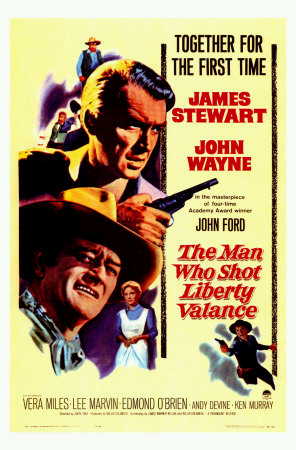
The Man Who Shot Liberty Valance opens with a train stopping in the small western town of Shinbone.  The residents of the town — including newspaper editor Maxwell Scott (Carleton Young) — are shocked when Sen. Rance Stoddard (James Stewart) and his wife Hallie (Vera Miles) get off the train.  Sen. Stoddard is considered to be a front-runner to become the next Vice President of the United States.  Scott is even more shocked to discover why the Stoddards are in town.  They’ve come to Shinbone to attend the funeral of an obscure rancher named Tom Doniphon (played, in flashback, by John Wayne).

Sitting in the funeral home with Doniphon’s coffin (and having reprimanded the local mortician for attempting to steal Tom’s boots), Rance tells Scott why he’s come to pay respect to Tom Doniphon.  We see, in flashback, how Rance first came to Shinbone 25 years ago, an idealistic lawyer who — unlike most of the men in the west — refused to carry a gun.  We see how Rance was robbed and assaulted by local outlaw Liberty Valance (a wonderfully intimidating and bullying Lee Marvin), we discover how Rance first met Hallie while working as a dishwasher and how he eventually taught her how to read, and we also see how he first met Tom Doniphon, the only man in town strong enough to intimidate Liberty Valance.

At first, Rance and Doniphon had an uneasy friendship, epitomized by the condescending way Doniphon would call Rance “pilgrim.”  Doniphon was in love with Hallie and, when he attempted to teach Rance how to defend himself, he was largely did so for Hallie.  Rance, meanwhile, was determined to bring law and society to the west.

And, eventually, Rance did just that.  When Shinbone elected two delegates to the statehood convention in the territory’s capitol, Rance attempted to nominate Doniphon for the position but Doniphon refused it and nominated Rance instead, explaining that Rance understood “the law.”  When Liberty Valance attempted to claim the other delegate spot, Rance and Doniphon worked together to make sure that it instead went to newspaper editor Dutton Peabody (Edmond O’Brien).  And when Liberty Valance attempted to gun Rance down in the street, Rance shot him.

Or did he?

That’s the question that’s at the heart of The Man Who Shot Liberty Valance.  However, as a film, The Man Who Shot Liberty Valance is far less interested in gunfights than it is in politics.  Perhaps the most important scene in the film is not when Rance and Liberty meet out on that dark street.  Instead, it’s the scene at the statehood convention where the reformers (represented by Rance) and the cattlemen (represented by John Carradine) battle over who will be the territory’s delegate to Washington.  Between John Carradine orating, the horses riding in and out of the hall, Edmond O’Brien drinking, James Stewart looking humble, and John Wayne glowering in the background, this is one of the best political scenes ever put on film.

When Rance first arrives in the west, there is no political system in place.  With the exception of the ineffectual town marshal (Andy Devine), there is no law.  The peace is kept by men like Tom Doniphon and, oddly enough, by Liberty Valance as well.  (Whether he realizes it or not, Shinbone’s fear of Liberty has caused the town to form into a community.)  What little official law there is doesn’t matter because the majority of the Shinbone’s citizens can’t read.

When Rance arrives, he brings both education and the law.  He makes Shinbone into a town that no longer needs Liberty Valance but, at the same time, it no longer need Tom Doniphon either.  Hence, it’s Rance Stoddard who goes from dishwasher to U.S. Senator while Tom Doniphon dies forgotten.  Rance represents progress and unfortunately, progress often means losing the good along with the bad things of the past.

(It’s no coincidence that when Rance and Hallie return to Shinbone, the first person that they see is the former town marshal, who no longer wears a star and who, we’re told, hasn’t for years.  Time has passed by.)

It’s a bittersweet and beautiful film, one that features four great performances from Stewart, Wayne, Marvin, and Vera Miles.  Personally, I like to think that maybe Sen. Stoddard had a daughter who married a man named Smith and maybe they had a son named Jefferson who later made his way to the Senate as well.

It would be fitting.

Shattered Politics #17: Advise & Consent (dir by Otto Preminger)


Advise-&-Consent-(1)

In case you hadn’t heard, U.S. Sen. Barbara Boxer has recently announced that she’s retiring in 2016.  For the first time in decades, there’s going to be an open senate seat in California.  There’s been a lot of speculation about who might run for the seat and, for the most part, it’s all been the usual political suspects.  The state’s attorney general is running.  A few congresspeople might run.  Token billionaire Tom Steyer is thinking of getting into the race.

What disappoints me is that, as of right now, it doesn’t look like any celebrities are planning on running.  You know what would have made the Golden Globes perfect?  If George Clooney had announced his candidacy while accepting his Cecil B. DeMille award.  (At the very least, it might have given Amal something to smile about, as opposed to just sitting there with a condescending smirk on her face.  Seriously, what’s up with that?)  But even beyond George Clooney, there’s all sorts of celebrities who could run.  Charlie Sheen lives in California, after all.  Jeff Bridges might not be able to run in Montana but what about California?

I was discussing this with a friend of mine who suggested that Betty White should run because who could vote against Betty White?  Speaking for myself, I could easily vote against Betty White but I do think there would be something appropriate about Betty White serving in the U.S. Senate.  After all, in 1962, she played a senator in Otto Preminger’s political epic, Advice & Consent.

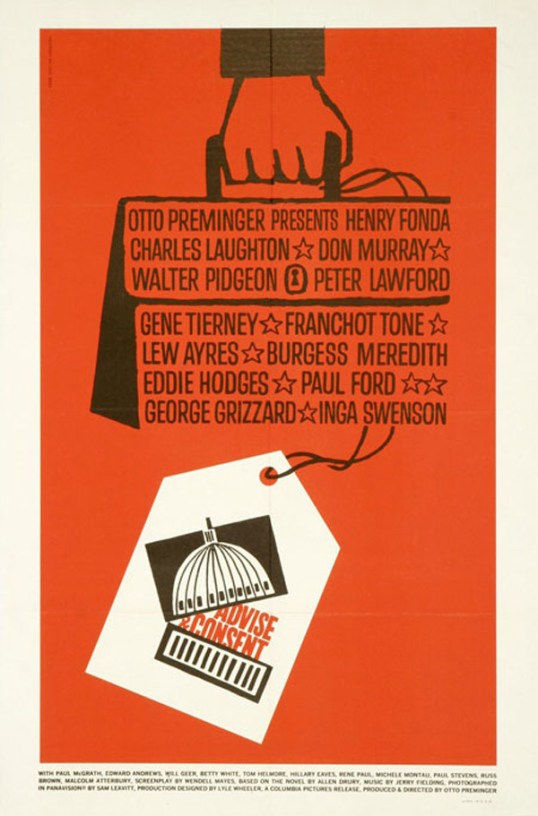
White played Sen. Bessie Adams of Kansas and was only given a few minutes of screen time.  She’s one of many performers to show up in Advise & Consent‘s version of the U.S. Senate.

For instance, Walter Pidgeon plays Sen. Bob Munson, who is the Senate majority leader and, as a result, the closest thing that this sprawling film has to a central character.  His job is to make sure the President’s agenda is pushed through Congress.

And then there’s Peter Lawford, as Sen. Lafe Smith, who always has a different girl leaving his hotel room.  When Advise & Consent was made, Lawford was President Kennedy’s brother-in-law.  Interestingly enough, one of Kennedy’s former girlfriends — actress Gene Tierney — shows up in the film as well, playing Bob Munson’s lover.

George Grizzard plays Sen. Fred Van Ackerman, who is about as evil as you would expect someone named Fred Van Ackerman to be.  Grizzard gives one of the better performances in the film, which just goes to prove that it’s more fun to play an evil character than a good one.

Don Murray is Sen. Brigham Anderson, a senator who is being blackmailed by Van Ackerman’s lackeys.  Despite being happily married to Mabel (Inga Swenson), Anderson is leading a secret life as a gay man.  The scene where Anderson steps into a gay bar may seem incredibly tame today but it was reportedly very controversial back in 1962.

And finally, there’s Sen. Seabright Cooley.  You may be able to guess, just from his overly prosaic name, that Cooley is meant to be a southerner.  That, of course, means that he wears a white suit, is constantly fanning himself, and speaks in lengthy metaphors.  Sen. Cooley is played by Charles Laughton, who overacts to such a degree that I’m surprised that there was any oxygen left over for anyone else.

All of these senators have been tasked with deciding whether or not Robert Leffingwell (Henry Fonda) will be the next secretary of state.  Fonda, not surprisingly, is the epitome of urbane liberalness in the role of Leffingwell.  However, Leffingwell has a secret.  Back in the 1930s, Leffingwell was a communist.  When Sen. Cooley introduces a witness (Burgess Meredith) who can confirm this fact, Leffingwell offers to withdraw as the nominee.  However, the President (Franchot Tone) refuses to allow Leffingwell to do so.  Instead, with the help of Van Ackerman, he tries to pressure Anderson into supporting Leffingwell’s nomination.

This, of course, leads to melodrama and tragedy.

As far as literary adaptations directed by Otto Preminger are concerned, Advise & Consent is better than Hurry Sundown while being nowhere to close to being as good as Anatomy of a Murder.  It’s a film that is occasionally entertaining, often draggy, and, if just because of all the different acting styles to be found in the cast, always interesting to watch.

And, for what it’s worth, Betty White makes for a convincing senator.  So, perhaps the people of California should watch Advise & Consent before voting for Tom Steyer…

Quick Review: Paddington (dir. by Paul King)


paddington_character-poster-4Hello there, and Happy New Year!

When I was little, I owned a stuffed Paddington Bear. When I found out Heyday Films was working on a movie for the character, I immediately added it to my watch list. From the audience’s reaction, made up mostly of families and a few dates, it seemed to be well received. American audiences may not be familiar with Paddington, even though the Orange Marmalade eating bear has had tons of books, toys and cartoons in the UK over the last 50 years. He even has his own float in the Holiday parades we have here in New York City.

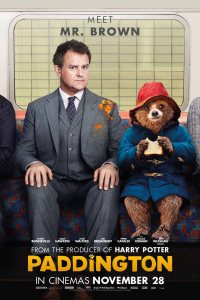
The movie, directed by Paul King, finds young Paddington (Ben Wishaw – Layer Cake, Skyfall) traveling to London after an Earthquake destroys his home in Darkest Peru. His Aunt and Uncle (played by Imelda Staunton and Michael Gambon, respectively) have told him of how wonderful London is, but he finds it’s not exactly as kind as he was led to believe. While Wishaw wouldn’t be my first through to voice Paddington, he fits the role quite well, giving the character a sense of polite innocence that’s spot on to how I recalled him.

The Brown family discovers Paddington and takes him in, in the hopes that they can locate the individual who discovered Paddington’s Aunt and Uncle during an expedition many years ago. When an evil taxidermist (played by Nicole Kidman in a turn that feels eerily similar to what she did in The Golden Compass) discovers Paddington, she makes it her goal to have him added to her collection.

Paddington’s supporting cast seems to either have former Harry Potter or Layer Cake stars. Downton Abbey’s Hugh Bonneville plays the overprotective Brown father. Sally Hawkins (Layer Cake, Godzilla) plays Mary, who helps Paddington along his trip. Weasley mom Julie Walters has a fun role as the house nanny, and finally, Doctor Who’s Peter Capaldi is the nosy next door neighbor that doesn’t take too kindly to having furry neighbors around town. It looks like everyone enjoyed themselves on the production, and seeing Capaldi play someone so odd was a little weird.

For young viewers, Paddington is a treat, with a focus on acceptance, family and the notion that sometimes one can hold on too tight to children in an effort to keep them safe. It might a gross out in some ways, depending on some of the scenes that include earwax licking and passing gas. Some may find the notion of a taxidermist a little scary, but my audience seemed to be okay with it. There are very few elements of violence – most of it the playful type found in films like Home Alone. Nicole Kidman may appear scary to some, but at it’s heart, Paddington tries to keep everything as accessible as it can for everyone.

Musically, Sigur Ros provides some great music that flows with the scenes, and the production itself moves almost in the same fashion as Alfonso Cuaron’s Harry Potter and the Prisoner of Azkaban, via the use of screen wipes and subtle season changes. The CGI for the film is done well, though I can’t say it’s very subtle. A casual view could probably spot what’s CGI and what isn’t, but since it’s for kids, they won’t really care.

Overall, it was fun to revisit Paddington. I didn’t have much in the way of expectations, but was a little amazed at how well it actually held up. I found myself smiling more often than I thought I would, honestly.

Shattered Politics #16: Ada (dir by Daniel Mann)


Ada_posterSouthern melodrama!

Speaking as a Southerner (well, a Southwesterner), I’ve always found in interesting that the rest of America loves to talk about how much they hate us but, at the same time, they also love books and movies set down here.  From the era of silent cinema to today with films like August: Osage County, people up north are obsessed with Southern melodrama.

It’s interesting because I’ve lived down south for most of my 29 years and there’s really not any more melodrama down here than there is anywhere else.  In fact, one of the main reasons that I enjoy watching Southern melodramas is because I enjoy seeing what the folks up north actually believe to be true.  I watch and I think to myself, “Northerners actually believe this shit.”  And then I laugh and laugh.

Take, for example, the 1961 film Ada.  Ada is pure Southern political melodrama.  (Admittedly, one of the best political films of all time — All The King’s Men — is a Southern melodrama but, to put it politely, Ada is no All The King’s Men.)

Ada tells the story of Bo Gillis (Dean Martin), a guitar-playing, singing sheriff who is running for governor of an unnamed Southern state.  Bo is running as a reform candidate but actually he’s just a figurehead for the wealthy and corrupt Sylvester Marin (Wilfred Hyde-White).  Bo is popular with the crowds, he has a great speech writer named Steve (played by the great character actor, Martin Balsam), and he has ruthless supporters who are willing to do anything to get him elected.  What he doesn’t have is a wife.  But that changes when he meets a prostitute named Ada (Susan Hayward) and marries her three weeks before the election.

At first, Sylvester demands that Bo get the marriage annulled.  Bo, however, refuses.  Fortunately, it turns out that the wife of Bo’s opponent is a drug addict.  Sylvester’s henchman Yancey (Ralph Meeker) leaks the news to the press and Bo is elected governor.

The only problem is that, once Bo is elected, he declares the he wants to run an honest administration and he starts to question Sylvester’s orders.  After the lieutenant governor is forced to resign, Ada lobbies to be appointed to the job.  Soon after Ada is confirmed, Bo is nearly blown up in his car.  While Bo is recovering, Ada serves as acting governor.  Will Ada be able to defeat Sylvester and convince Bo that she wasn’t responsible for trying to get him killed?

Watch and find out!

Or don’t.

Ada truly puts the drama into melodrama.  (It does not, however, bring the mellow.)  This is one of those films that’s full of overheated (yet strangely forgettable) dialogue and vaguely familiar character actors speaking in thick Southern accents.  Susan Hayward is so intense that you worry she might have killed a grip before shooting her scenes while Dean Martin spends most of the movie looking as if he’s waiting for the Rat Pack to show up and take him to a better party.

This is one of those films that you watch and you think to yourself, “Northerners actually believe this shit.”

And then you laugh and laugh.