Insomina File No. 16: Kill The Messenger (dir by Michael Cuesta)


What’s an Insomnia File? You know how some times you just can’t get any sleep and, at about three in the morning, you’ll find yourself watching whatever you can find on cable? This feature is all about those insomnia-inspired discoveries!
Kill_the_Messenger_poster

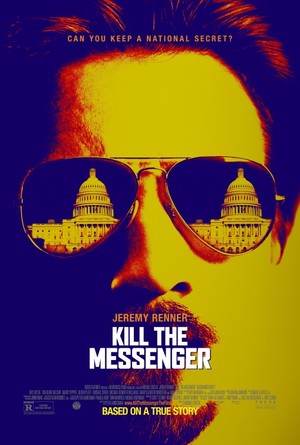
Last night, if you were awake and unable to get any sleep at 1:45 in the morning, you could have turned over to Cinemax and watched the 2014 conspiracy thriller, Kill The Messenger.

Kill The Messenger opens with one of those title cards that assures us that the movie we’re about to see is based on a true story.  We are then introduced to Gary Webb (Jeremy Renner), a California-based reporter who we know is a rebel because he has a precisely trimmed goatee.  Gary is interviewing a suspected drug smuggler (Robert Patrick) at the smuggler’s luxurious mansion.  Suddenly, the DEA storms the house, shouting insults and roughly throwing everyone to the ground, including Gary.  It’s actually exciting and promising opening, one that perfectly establishes both Gary as a truth seeker and the U.S. government as an invading army that’s fighting a war that’s full of collateral damage.

Gary, of course, has nothing to do with smuggling drugs.  He was just in the wrong place at the wrong time.  If he was treated unfairly by the DEA, it’s just because the government is serious about winning the war on drugs!

Or is it?

Following up on a tip, Gary comes across evidence that, in order to raise money for pro-Amercian rebels in Central America, the CIA not only helped to smuggle drugs into the U.S. but also arranged for the drugs to largely be sold in poor, minority neighbors where, in theory, no one would notice or care.

When the story is finally published, Gary is briefly a celebrity.  Not surprisingly, the government denies his accusations and start tying to discredit him.  However, Gary also finds himself being targeted by his fellow journalists.  Angry over being outscooped by a relatively unknown reporter, The Los Angeles Times and The Washington Post both launch their own investigations.  Instead of investigating Gary’s allegations, they jealously and viciously investigate Gary himself.

Soon, both Gary’s career and his family are falling apart and Gary finds himself growing more and more paranoid…

Remember when everyone was expecting Kill The Messenger to be a really big deal?  It was due to come out towards the end of 2014, right in the middle of Oscar season.  Jeremy Renner was being talked up as a contender for best actor.  Then the film came out, it played in a handful of theaters for a week or two, and then it sunk into obscurity.  Some commentators even complained that Focus Features buried the release of Kill The Messenger and that the film was ignored because of its leftist politics…

Of course, it’s just as probable that Focus Features realized that The Theory of Everything was more likely to charm audiences than a movie that suggested the U.S. government was behind the drug epidemic.

Or it could have just been that, despite telling a potentially intriguing story, Kill The Messenger was an oddly bland film.  Other than one scene in which he admits to cheating on his wife, Gary Webb is portrayed as being such a saint that it actually causes the film to lose credibility.  (Don’t get me wrong.  For all I know, he was a saint.  But, from a cinematic point of view, sainthood is never compelling.)  This is one of those earnest films that gets so heavy-handed that, even if you agree with what the movie is saying, you still resent being manipulated.  (Of course, some of us have grown so cynical about the media that we automatically doubt the veracity any movie that opens with those dreaded words: “Based on a true story.”)  Watching Kill The Messenger, one gets the feeling that a documentary about Gary Webb would probably be more compelling (and convincing) than a fictionalized dramatization.

(Unfortunately, if you think it’s difficult to get an audience to watch a movie that suggested the U.S. government was behind the drug epidemic, just try to get them to watch a documentary about … well, anything.  I know most of our readers would probably happily watch a documentary but that’s because y’all are the best and a thousand times better than the average person.  Love you!)

Here’s what did work about Kill The Messenger: the performances.  Jeremy Renner, who also produced this film, gives an excellent performance as Gary, especially in the scenes where he realizes that both the government and the press are now conspiring about him.  Rosemarie DeWitt has the traditionally thankless role of being the supportive wife but she still does a good job.  And finally, Ray Liotta shows up for one scene and is absolutely chilling in that way that only Ray Liotta can be.

Kill The Messenger doesn’t quite work but, thanks to the cast, it is, at the very least, a watchable misfire.

Previous Insomnia Files:
  1. Story of Mankind
  2. Stag
  3. Love Is A Gun
  4. Nina Takes A Lover
  5. Black Ice
  6. Frogs For Snakes
  7. Fair Game
  8. From The Hip
  9. Born Killers
  10. Eye For An Eye
  11. Summer Catch
  12. Beyond the Law
  13. Spring Broke
  14. Promise
  15. George Wallace

The Fabulous Forties #35: That Uncertain Feeling (dir by Ernst Lubitsch)


That_Uncertain_Feeling

The 35th film in Mill Creek’s Fabulous Forties box set was — wait a minute?  I’m on my 35th Fabulous Forties review?  Let’s see — there’s 50 films in the box set so that means that I only have 15 more of these to write and I’ll be done!  And then I can move onto the Nifty Fifties, the Sensation Sixties, the Swinging Seventies, and the Excellent Eighties!  YAY!

Anyway, where was I?

Oh yeah, the 35th film.

First released in 1941, That Uncertain Feeling is a movie about sophisticated people doing silly things.  Socialite Jill Baker (Merle Oberon) gets the hiccups whenever she gets nervous or irritated.  Her trendy friends suggest that she try the new big thing: seeing a psychoanalyst!  At first, Jill is reluctant but eventually, she gives in to the pressures of high society and she goes to visit Dr. Vengard (Alan Mowbray).  Dr. Vengard tells her that her hiccups are a result of her marriage to Larry (Melvyn Douglas) and suggests that the best way to cure them would be to get a divorce.

At first, Jill is horrified at the suggestion.  Whatever will people think if she gets a divorce!?  However, Larry is kind of a condescending jerk.  (Or, at least, he comes across as being a jerk when viewed by 2016 standards.  By 1941 standards, I imagine he’s supposed to be quite reasonable.)  And Jill happens to meet another one of Vengard’s patients, an outspoken pianist named Alexander Sebastian (Burgess Meredith).

Soon, Jill is not only contemplating getting a divorce from Larry but perhaps marrying the eccentric Sebastian as well!  When Larry realizes that Jill is dissatisfied with their marriage and that she is attracted to Sebastian, he gives her a divorce.  He even pretends to be an abusive husband so that she can file for divorce on grounds of cruelty.  (It’s funnier than it sounds.)  Jill and Sebastian get engaged but, once Larry starts to date again, Jill realizes that she’s not quite over her ex…

I was really excited when I saw that The Uncertain Feeling was an Ernst Lubitsch film.  Lubitsch directed some of my favorite Golden Age comedies, films like Ninotchka and Heaven Can Wait.  But That Uncertain Feeling is not quite up to the standard of the other Lubitsch films that I’ve seen.  As played by Burgess Meredith, Sebastian never comes across as being a realistic rival to Larry.  The character is so cartoonishly eccentric that it becomes impossible to see what Jill sees in him.  At the same time, Larry comes across as being such a chauvinist that it’s far easier to understand why Jill would divorce him than why she would ever want to take him back.  The end result is a rare Lubitsch misfire.

However, as long as we’re talking about Lubitsch, make sure to see The Smiling Lieutenant if you get the chance.  Now, that’s a good Lubitsch film…

(And be sure to follow it up with The Love Parade...)

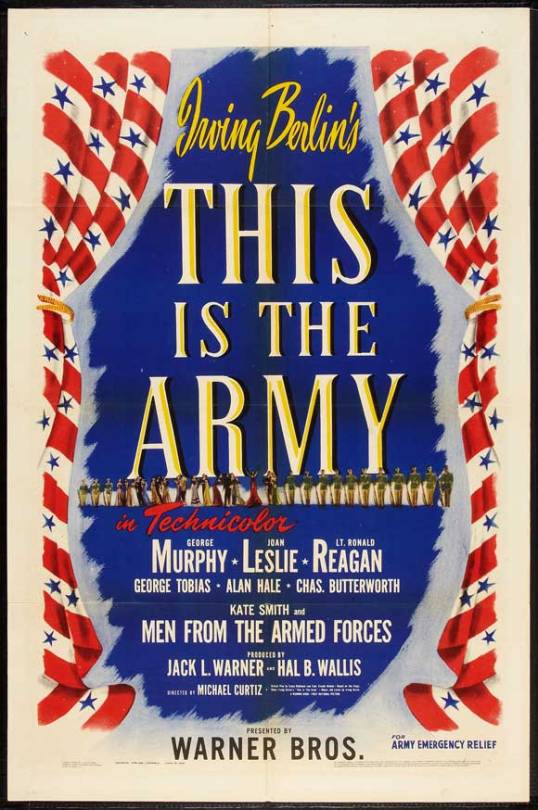
The Fabulous Forties #34: This Is The Army (dir by Michael Curtiz)


Titapos

The 34th film in Mill Creek’s Fabulous Forties box set is the 1943 musical, This is The Army.

This Is The Army is based on a Broadway musical that was specifically conceived and written by Irving Berlin as a way to boost wartime morale.  The show, which was a collection of patriotic songs and comedic skits, was performed by members of the U.S. Army.  The film version starts with dancer Jerry Jones (George Murphy) being drafted at the start of World War I and putting together an all-army revue called Yip Yip Yaphank.  (Interestingly enough, this was also the name of a real-life show that Irving Berlin put together during World War I.)  The show is a big hit and, when the soldiers in the cast receive their orders to head to France, they literally march off the stage and out the theater.  It’s actually a pretty rousing scene but it’s almost immediately followed by a very sad one, in which we learn that only three members of the cast survived the war.  Jerry Jones is shot in the leg and when he returns home, the former dancer now walks with a cane.

Twenty-five years later, another world war has broken out.  Jerry’s son, Johnny (Ronald Reagan), has joined the army.  Johnny is ordered to put together another revue, in the style of Yip Yip Yaphank.  At first, Johnny is reluctant but orders are orders.  Soon, Johnny and the cast of This Is The Army are touring the U.S. and even performing in front of President Roosevelt (played by Jack Young, though, from a historical perspective, wouldn’t it be neat if President Roosevelt had appeared as himself in a film with Ronald Reagan?).  Along the way, Eileen (Joan Leslie) tries to convince Johnny to marry her even though Johnny wants to wait until the war is over.

It’s really not much of a plot but then again, the film is about showcasing the musical performances.  The soldiers sing.  The soldiers dance.  The soldiers tell jokes and imitate people who were famous in 1943.  There are several scenes that attempt to wring laughs from soldiers dressed up like women.  What’s interesting is that, at a time when the army was still segregated, the performances in This Is The Army feature both white and black soldiers.  Irving Berlin apparently demanded that black soldiers be allowed to appear in both the stage show and the film and, as a result, the unit that performed This Is The Army was, for a time, the only integrated unit in the U.S. Army.

Of course, that makes it even odder that there’s an extended sequence in which white soldiers perform while wearing blackface and standing on a set that’s been designed to resemble a pre-Civil War plantation.  It’s a scene that pops out of nowhere and then it keeps going and going and going and I could only stare at the screen in shocked horror as it played out.  It’s an odd contradiction that the same Irving Berlin who demanded that black soldiers be honored on stage and screen was also apparently the same Irving Berlin was put a minstrel show sketch into the middle of This Is The Army. 

Interestingly enough, George Murphy later retired from acting and was elected to the U.S. Senate in 1964.  Murphy’s success inspired his co-star, Ronald Reagan, to run for governor.  If Murphy had never been a senator, Reagan would probably never have been a president.  Both Reagan and Murphy give likable performances in This Is The Army and it’s easy to see how that likability, while it may not have often translated into great acting, did eventually lead to political success.

This Is The Army is a time capsule film, one that is mostly interesting as a view into the psyche of 1940s America.  The humor is often corny and the storyline is predictable but there’s also a very sad subtext to the film.  Since both the film and the stage show were performed by actual enlisted men, you watch with the knowledge that some of the men singing and joking on stage won’t return from the war.  Often times, during the performances, we see random people in the audience crying as they realize the same thing.  Even in an otherwise light-hearted film, the sobering realities of life during wartime are right beneath the surface.

The Fabulous Forties #33: Boys of the City (dir by Joseph H. Lewis)


Boysofthecity

The 33rd film in Mill Creek’s Fabulous Forties box set was 1940’s Boys of the City.

As a classic film lover, I have to admit that I groaned a bit when the opening credits announced that Boys of the City starred “East Side Kids.”  The East Side Kids were a group of actors who appeared in a number of B-movies from the 1930s through the 50s.  Many of the actors started out as members of the Dead End Kids and a few more were members of a group known as The Little Tough Guys.  In the 40s, they merged to become the East Side Kids and then eventually, once the East Side Kids started to hit their 30s, they became known as the Bowery Boys.  Their movies started out as tough and gritty melodramas but, by the time they were known as the Bowery Boys, they were making cartoonish comedies.  Occasionally, one of their films will show up on TCM.  Their early serious films (Dead End, Angels With Dirty Faces) remain watchable but, from what little I’ve seen of them, their later comedies appear to be damn near unbearable.

Boys of the City finds the East Side Kids in transition.  The kids still have an edge to them.  They are definitely portrayed as being juvenile delinquents who are walking a thin line between either a short life of crime or a long life of poverty.  But them film itself, while it may not be as cartoonish as the films that were to come in the future, is definitely a comedy.

Basically, the East Side Kids (Bobby Jordan, Leo Gorcey, Hal E. Chester, Frankie Burke, Sunshine Sammy, Donald Haines, David Gorcey, and Algy Williams) have been arrested for vandalism and are given a choice.  They can either go to juvenile hall or they can spend the summer at a camp in upstate New York.  Somewhat reluctantly (and hopefully remembering the unlucky fates of Humphrey Bogart in Dead End and James Cagney in Angels With Dirty Faces), the kids agree to go to the camp.

However, on the way to the camp, their car breaks down and they are forced to stay at the nearby home of a crooked judge (Forrest Taylor) until they can get the car repaired.  The judge, however, is killed and it’s up to the East Side Kids to solve the murder!  Was the judge killed by the gangsters that he was set to testify against?  Was he killed by his niece (Inna Gest)?  Or maybe it was his housekeeper, Agnes (Minerva Urecal, who appears to be parodying Judith Anderson’s performance in Rebecca)?  Or was he murdered by Knuckles (Dave O’Brien), who the judge wrongly sentenced to die and who, following his vindication and release from prison, has become a guardian to the East Side Kids?

Who knows?  Who cares?  I certainly didn’t.

Clocking in at 68 minutes, Boys of the City is a typical 1940s second feature.  Designed to keep audiences entertained without requiring them to think, Boys of the City moves quickly and adds up to nothing.  I know that there are some classic film lovers who can tell the difference between the various East Side Kids (or Dead End Kids or Bowery Boys or whatever you want to call them) but they all pretty much blended together for me.

Not surprisingly for a film made in 1940, Boys of the City is full of casual racism.  Sunshine Sammy plays an East Side Kid named Scruno.  As soon as Scruno sees the cemetery next to the house, his eyes go wide and he says, “G-g-g-ghosts!”  Apparently, that was very popular in the 40s but today, it’s impossible to watch without cringing.

Boys of the City has some interest as a time capsule but otherwise, it’s a film that is easily and happily forgotten about.

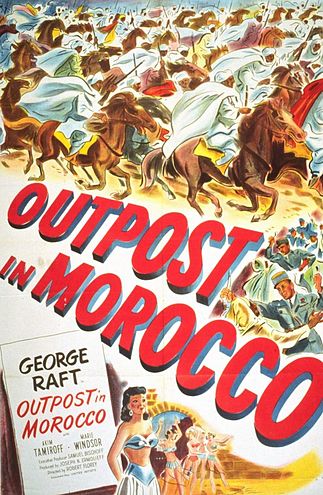
Fabulous Forties #32: Outpost in Morocco (dir by Robert Florey)


Otmorpos

After watching the excellent The Last Chance, I was really hoping that the 32nd film in the Fabulous Forties box set would turn out be a classic as well.  Sadly, that was not the case.  1949’s Outpost in Morocco is a generally forgettable adventure film about the French Foreign Legion.

George Raft plays Capt. Paul Gerard, a captain in the French Foreign Legion.  Now, I happen to like George Raft.  He may not have been the greatest actor of Hollywood’s Golden Age but he did have a roguish charm and he was a great dancer.  Unfortunately, while the role of Paul Gerard did call for a bit of charm, it didn’t call for much dancing.  Instead, Paul Gerard is rather stolid and dependable and a little bit boring.  Needless to say, George Raft was more than a little miscast in the role.

Speaking of miscast, the beautiful but very American Marie Windsor plays Cara, the daughter of the Emir of the Moroccan city of Bel-Rashad.  The French are not allowed to enter the city and there are rumors that the Emir has been using this situation as an opportunity to plot against France.  Since Cara has spent the last few years studying in France, she is willing to go into Bel-Rashad and report on whether or not the rumors are true.  Gerard is assigned to escort her to the city.  Gerard’s superiors suspect that Cara might even fall in love with Gerard and, as a result, will be willing to turn against her father.

And that’s exactly what happens!  It takes exactly 10 days for Cara and Gerard to fall in love.  (We know this because the film is full of excerpts from a journal that Gerard keeps as he escorts Cara across the desert.)  However, once they reach Bel-Rashad, Cara does discover that her father is indeed conspiring against the French.  It is up to Gerard to put down the revolution and defeat the Emir, even if it means potentially sacrificing his love for Cara.

It’s interesting to note that there’s a few scenes where Raft sounds like he’s trying to imitate Humphrey Bogart, which immediately reminded me of how so many of Bogart’s great roles were initially offered to Raft.  I found myself wondering if Raft agreed to do Outpost in Morocco to make up for refusing Bogart’s role in a certain other film that was set in Morocco.

Unfortunately, Outpost in Morocco is no Casablanca.  Whereas Casablanca is a classic that holds up to this day, Outpost in Morocco is best described as being … well, dull.

How boring in Outpost in Morocco?  George Raft looks bored.  Marie Windsor looks bored.  Even the great character actor Akim Tamiroff looks bored!  Portions of the film were shot on location in Morocco so there are a few nice shots of the desert (if that’s your thing) and the ending is a bit darker than you might normally expect for a 1949 adventure film but otherwise, Outpost in Morocco is a fairly forgettable film.

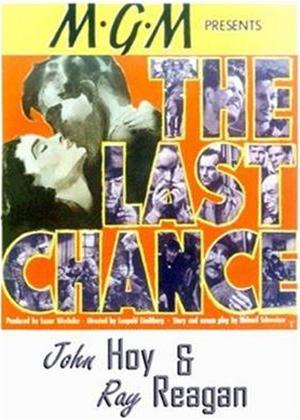
The Fabulous Forties #31: The Last Chance (dir by Leopold Lindtberg)


12022809425545_l

The 31st film in Mill Creek’s Fabulous Forties box set was a 1945 film called The Last Chance.

I have to admit that one reason why I’ve been struggling to finish up the relatively simple task of watching all 50 of the films included in this box set is that a lot of the films just aren’t very good.  Along with suffering from the typically poor Mill Creek transfer, quite a few of the movies are forgettable filler.  You can only watch so many movies like Freckles Comes Home before you start to lose your enthusiasm.

Fortunately, even if most of the films are forgettable, there are still a handful of outstanding productions to be found in the Fabulous Forties.  You just have to have a lot of patience and you have to be willing to look for them.  For instance, if I had given up on the Fabulous Forties after sitting through Drums of Africa, I would never have discovered The Last Chance.

And that would have been a shame because The Last Chance is an excellent film!  It’s certainly the best of the 31 Fabulous Forties films that I’ve watched so far.

Directed by Leopold Lindtberg, an Austrian who fled to Switzerland shortly after the Nazis came to power, The Last Chance tells a deceptively simple story.  Two POWs — an American named Braddock (Ray Reagan) and a British soldier name Halliday (John Hoy) — are being transported across Italy via train.  When the train crashes, Braddock and Halliday escape.  They spend the rest of the film trying to reach Switzerland.  Along the way, they struggle to avoid Nazis, deal with civilians who mostly just want the war to be over, and eventually meet and hook up with the Italian resistance.  (The resistance here is represented by a self-sacrificing priest, who was well-played by real-life refugee named Romano Calo.)  Eventually, the two soldiers meet up with another escaped POW (Ewart G. Morrison) and the three of them lead a group of refugees to the Swiss border.

What distinguishes The Last Chance is its authenticity.  Reagan, Hoy, and Morrison were not professional actors.  Instead, they were real-life soldiers, all of whom had once been POWs and all of whom managed to escape to Switzerland.  What these three actors lacked in polish, they made up for in reality.  When they talked about the risks of trying to reach the Swiss border and the ruthless barbarity of the Axis regime, they knew what they were talking about.  As well, the film was actually shot in Europe during the war.  When we see the three soldiers leading the band of refugees through bombed out villages, we’re not just seeing a bunch of actors on a safe Hollywood sound stage.  Instead, we are watching real-life refugees walking through the ruins of their former home.  Though the story may be fictionalized, Leopold Lindtberg directed the film as if it were a documentary and the result is both a passionate condemnation of fascism and an emotional anti-war piece that remains powerful to this day.

I don’t care how many bad films that I had to sit through (and have left to sit through) as a result of my decision to review all of the movies inside the Fabulous Forties box set.  Discovering a film like The Last Chance makes it all worth it.

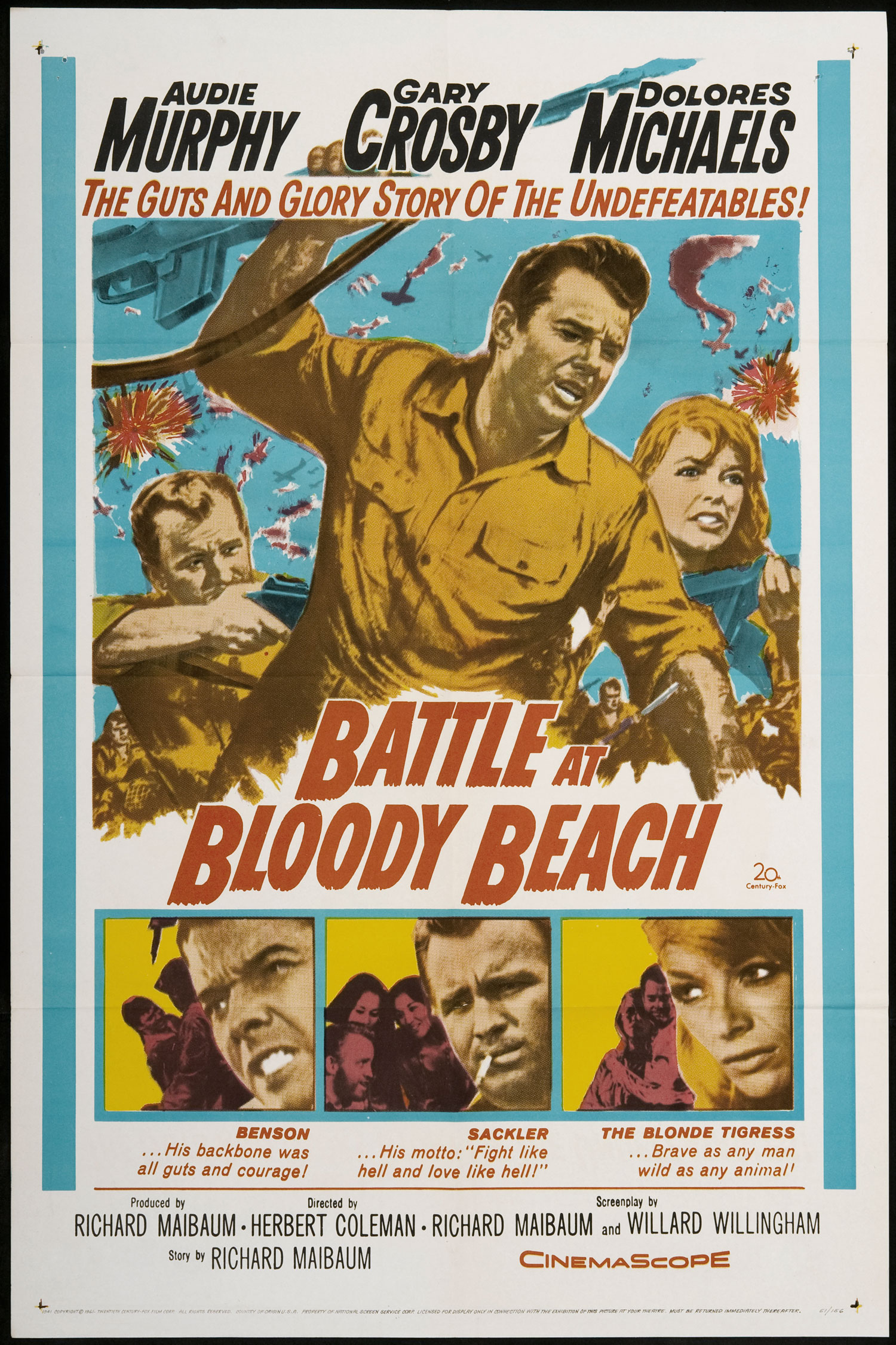
Special Memorial Day Edition: Audie Murphy in BATTLE AT BLOODY BEACH (20th Century Fox 1961)


gary loggins's avatarcracked rear viewer

bbb1

When I was in college, I wrote a paper on Audie Murphy for history class. Murphy was a real American hero, the most decorated combat soldier of World War II. He held off an entire squad of German soldiers alone, armed with a machine gun and bleeding from a leg wound, under fire from both foot soldiers and tank fire. Then he rejoined his men and led an attack on the Germans, driving them back and earning the Medal of Honor for his valiant efforts.

Murphy was noticed by Hollywood upon his return from the war, and soon was cast in a successful series of Westerns: THE KID FROM TEXAS, KANSAS RAIDERS, DUEL AT SILVER CREEK, RED BADGE OF COURAGE, GUNSMOKE, and a remake of DESTRY. His autobiography TO HELL AND BACK was a national best seller, and Audie played himself in the film version. Surprisingly, Murphy only starred in one other war film…

View original post 644 more words

The Fabulous Forties #30: Cheers for Miss Bishop (dir by Tay Garnett)


cheers1

The 30th film in Mill Creek’s Fabulous Forties box set is the 1941 melodrama, Cheers For Miss Bishop.  Cheers For Miss Bishop is a bit like an Americanized version of Goodbye, Mr. Chips.  The story of Cheers For Miss Bishop, largely told via flashback, deals with a retired teacher who never quite got what she wanted out of life but still had a profound impact on all of her students.

The film opens with elderly Miss Bishop (played by Martha Scott) alone in her house.  The time is the 1930s and Miss Bishop is nearing retirement and somewhat bitter over ending her years having never married.  Prominent businessman Sam Peters (William Gargan) comes to the house and they start to recollect.  We flashback to the 1880s, when Miss Bishop was preparing to go to college and Sam was just the local grocery boy.  Sam was in love with Miss Bishop and, it’s suggested, that she loved him as well.  But she was determined to go to college whereas Sam was determined to go straight into business.

With the support of the kindly Prof. Corcoran (Edmund Gwenn, giving a performance that pretty much epitomizes what we mean when we call someone a kindly professor), Miss Bishop got a job teaching English at Midwestern College.  She was a popular teacher, one who not only inspired her students but who was also willing to stand up for them.  Eventually she met and became engaged to a local lawyer, Delbert Thompson (Don Douglas).  However, her heart was broken when Delbert ran off with another woman.  Years later, she fell in love with another professor (Sidney Blackmer), with the only problem being that he happened to be married.

But that’s not all that Miss Bishop had to deal with.  She also ended up adopting and raising Hope (Marsha Hunt) after Hope’s mother died in childbirth.  As she got older, she became frustrated when the younger college administrators demanded that she adapt with the times.  Miss Bishop also had to deal with her frequent romantic rival and cousin, the impulsive Amy (Mary Anderson).

Amy, I should mention, was my favorite character in Cheers For Miss Bishop, even though I don’t think that was the film’s intention.  Some of that is because Mary Anderson totally embraced the melodramatic potential of her character, often going totally over-the-top in a way that still seemed perfectly natural.  But there’s also the fact that Amy, as opposed to the often painfully inhibited Miss Bishop, had no boundaries.  She knew what she wanted and she went for it, without apology.  Amy may not have been a big role but she still dominated every scene that she appeared in.  Amy demanded attention and good for her!

That said, the title of the film is Cheers For Miss Bishop and not Cheers For Amy.  Ultimately, it’s a tribute to Miss Bishop and to teachers everywhere.  It’s an extremely predictable and sentimental film but it does what it does fairly well.  Occasionally, I got frustrated with Miss Bishop as a character (she was always so prim, proper, and respectable!  Plus, there’s a scene where she gives a student from North Carolina some trouble about his accent, saying that he needs to take her English class and, if you know how I feel about actors from up north trying too hard to sound like they’re from the South, you can imagine how I felt about that scene) but Martha Scott gave a good performance.  In the end, it’s a sweet little movie.  And you can watch it below!

Guilty Pleasure No. 30: Wolfen (dir. by Michael Wadleigh)


Wolfen_1981A guilty pleasure is a film that we might enjoy, but isn’t as loved by others overall. It’s the kind of film that you can watch on any given day, but to speak of it may cause raised eyebrows among your peers. Everyone has at least one film or two that they treasure in this way.
My Guilty Pleasure pick is 1981’s Wolfen, directed by Michael Wadleigh. Loosely based off the novel by Whitley Strieber, the film focuses on two homicide investigators who learn that the case they’re working may actually be caused by animal attacks. Often mistaken as a werewolf film, I really wouldn’t group Wolfen into that category. It’s supernatural in some ways, yes, but you won’t find any serious werewolf activity in it. Surprisingly enough, Wolfen was released in the theatre just a few months after Joe Dante’s The Howling. This makes me wonder how audiences took to Wolfen after seeing all of the make-up effects in Dante’s work. From an effects standpoint, Wolfen’s big claim to fame is the negative photography used to showcase the animals’ point of view. I can’t imagine it was incredibly amazing when comparing the two, but on it’s own, it’s not bad. It’s one of the few movies I’d like to see get a remake, if only to have the story match Strieber’s book better.

When a millionaire land developer and his wife are found brutally murdered in Battery Park, Detective Dewey Wilson is brought on to investigate. Albert Finney (Miller’s Crossing, The Bourne Ultimatum, Skyfall) easily carries the film as Wilson, feeling a lot like the owner of your favorite corner deli. Wilson’s detective work is subtle in the film, and Finney plays to that with a relaxed alertness. He comes across as calm, questioning, but you get the sense that if it came to blows, he’d be ready to react. I suppose most detectives are that way. When the murder is believed to be a possible terrorist attack, a Security Agency brings in a psychological expert named Rebecca Neff, played by Diane Venora (Heat, William Shakespeare’s Romeo + Juliet). Wolfen was Venora’s first film and she’s good in this, though the screenplay is written in a way where it’s more Dewey’s tale to tell. The book did Neff’s character more justice than the movie, overall. Rounding out the casting is Gregory Hines (Running Scared, The Cotton Club – also with Venora) as a forensics expert, Edward James Olmos (Miami Vice, Battlestar Galactica) as a Native American worker who may know more than he says and Tom Noonan (Manhunter, The Last Action Hero, F/X – once again, with Diane Venora) as a Zoo Worker who’s just a little to into wolves in general. That’s just my opinion, though Noonan’s been known to play creepy very well. The performances here are all pretty good. No one is really out of place here, as far as I could tell.

If Wolfen suffers from any major problem, it’s in the writing. In adapting the novel, they had the chance to really bring the terror from the novel on screen. In the book, we’re given an understanding of what the Wolfen are – creatures older, faster and more terrifying than your typical canine. They came complete with their own way of communicating with one another, and Strieber’s novel even referenced his other story about Vampires, The Hunger. The final standoff of the book was a fight similar to From Dusk Till Dawn, with the hope that our heroes could maybe hold off what was coming. The movie decided to go a different route. Not terrible in any way, but it could have been really good if they stayed on track.

I could be off here, but I believe the film elected to try to make the story more relevant for its time by circling the murder around terrorism and using the Security Agency. The Security Agency has so little to do with the film outside of bringing Neff on the case, it’s incredible. About every 20 minutes, the film cuts back to this crew of personnel at their computers, watching footage of attacks (that have little to do with the original victim) in an attempt to piece together why this death happened. Meanwhile, Wilson walks into bar and gets the whole solution handed to him in a short story over a beer. I wonder if Wadleigh (who co-wrote the script) was trying to say that with all the technology at their disposal, all it really took to solve a crime was just regular legwork. To quote Olmos’ character “It’s the 20th Century. We got it all figured out.” That’s just my speculation on that.

From a Cinematography viewpoint, Wolfen has some impressive scenes, particularly those of the Manhattan landscape. For a city that doesn’t sleep, the streets as they’re filmed here are barren, with lots of shadows. One scene in particular has Finney and Olmos’ characters talking on top of a bridge, and I have to wonder not only how they were able to get that shot, but how the actors maintained their composure. One wrong slip and either of them could have fell. I also love seeing New York City in the early 80’s, where most of the Bronx and Brooklyn looked like warzones. Both Wolfen and Nighthawks (also released in the same year) are great examples of how bad the city really was during that time.

Wolfen was also one of James Horner’s first scores. Listening to it, you can hear elements of what you’d find in Aliens, Star Trek II: The Wrath of Khan and his other pieces.

Overall, Wolfen is a good film if you find yourself running into it late at night and there’s nothing else to catch. I watch it on purpose, but that’s just me. We all have our tastes. If at all possible, consider reading the novel as well.

Previous Guilty Pleasures

  1. Half-Baked
  2. Save The Last Dance
  3. Every Rose Has Its Thorns
  4. The Jeremy Kyle Show
  5. Invasion USA
  6. The Golden Child
  7. Final Destination 2
  8. Paparazzi
  9. The Principal
  10. The Substitute
  11. Terror In The Family
  12. Pandorum
  13. Lambada
  14. Fear
  15. Cocktail
  16. Keep Off The Grass
  17. Girls, Girls, Girls
  18. Class
  19. Tart
  20. King Kong vs. Godzilla
  21. Hawk the Slayer
  22. Battle Beyond the Stars
  23. Meridian
  24. Walk of Shame
  25. From Justin To Kelly
  26. Project Greenlight
  27. Sex Decoy: Love Stings
  28. Swimfan
  29. On the Line

The Fabulous Forties #29: Li’l Abner (dir by Albert S. Rogell)


Billie_Seward-Jeff_York_in_Li'l_Abner

The 29th film in the Fabulous Forties box set is a “comedy” from 1940, called Li’l Abner.

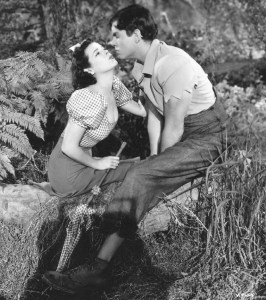
Li’l Abner takes place in rural America, which this film portrays as being the type of place where cousins get married and have children that end up raising pigs and marrying each other.  Everyone in the small town of Dogpatch is kind of an idiot but they appear to mean well.  There’s a huge amount of single, young women in town but apparently, there’s only one single, young man.  His name is Abner (Jeff York) and he’s called Little Abner because the people in town have a taste for irony and he’s not little at all.  In fact, he’s really tall and he’s also handsome and likable in a dumb sort of way.  Every woman in town wants to marry Abner but Abner has no desire to ever get married.  As Abner sees it, getting married means getting old and eventually dying.  He wants to have adventures in the real world as opposed to just staying in Dogpatch and doing nothing…

But then Clarence is sent down to Earth and shows Abner what life would be like if he had never been born … oh wait, sorry.  Wrong 1940s film.

Instead of being visited by guardian angel, Abner is misdiagnosed with a fake illness and he becomes convinced that he only has 24 hours to live.  How does he become convinced of this?  Do you really want to know?  Even more importantly, do I really want to tell you?  Seriously, this is really stupid.  Okay, Abner goes to see a barber but he thinks the barber is a doctor and the barber, as a joke, tells Abner that he’s going to die of a fake disease.  When Abner tells his parents that he’s going to die, his parents immediately realize what has happened but they decided to let Abner believe that he’s going to die because they really want him to get married and, if Abner’s on the verge of death, he’s more likely to propose to one of the many local girls who is pursuing him.

(Ladies, the lesson here is simple: If you want your commitment-phobic man to pop the big question, convince him that he’s got less than a day to live.)

Anyway, two different girls ask Abner to marry them and, since Abner thinks he’s going to be dead by morning, he says yes to both of them.  However, Abner then wakes up the next morning and, for a few brief moments, is convinced that he is dead and the heaven looks just like the Ozarks.  But then he realizes that no, he’s still alive.  And he’s engaged to two women!

AGCK!  Bigamy much?

Luckily, all of this happens on Sadie Hawkins Day.  On Sadie Hawkins Day, any single woman can marry any single man that she chooses.  So, Abner figures that he just has to wait around see which one of his two fiancées finds him first…

Or something like that.

To be honest, the plot of this one made absolutely no sense to me and I wasn’t shocked to discover that it was based on a comic strip.  Li’l Abner is only 72 minutes long but it still has more plot than the last few seasons of The Walking Dead.  (BAM!  Take that, quality television!)  Anyway, this movie was light-hearted and good intentioned but way too stupid for its own good.  Jeff York was likable in the role of Abner and silent film fans might want to watch it just because Buster Keaton shows up in a small role, playing a moonshine drinking Native American named Lonesome Polecat.

Otherwise, Li’l Abner is one of the more forgettable films in the Fabulous Forties box set.