A Movie A Day #75: Wanted: The Sundance Woman (1976, directed by Lee Philips)


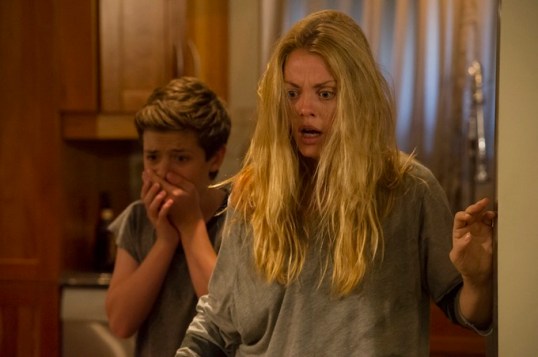
This made-for-TV sequel to Butch Cassidy and the Sundance Kid opens several years after the death of Butch and Sundance in Bolivia.  Etta Pace (Katharine Ross, reprising her role from the original film) is now a wanted woman.  Hiding out in Arizona, she does her best to keep a low profile.  But when Pinkerton detective Charlie Siringo (Steve Forrest) comes to town and one of Etta’s friends (Michael Constantine) is arrested, Etta knows that she’s going to need help to survive.  Crossing the border into Mexico, she teams up with revolutionary Pancho Vila (Hector Elizondo).  In return for helping him get his hands on a shipment of guns, Vila agrees to protect Etta.

Wanted: The Sundance Woman was ABC’s second pilot for a possible television series about Etta Pace’s adventures at the turn of the century.  The first pilot starred Elizabeth Montgomery as Etta and directly dealt with Etta’s attempts to come to terms with the death of Butch and Sundance.  While Katharine Ross returned to the role for the second pilot, Wanted: The Sundance Woman does not actually have much of a connection to Butch Cassidy and The Sundance Kid.  Katharine Ross could have just as easily been playing Etta Smith as Etta Pace.

Wanted: The Sundance Woman is held back by its origins as a TV movie and a rather silly romance between Etta and Pancho Vila.  Hector Elizondo is hardly convincing as a fiery revolutionary and Steve Forrest is reliably dull as Siringo.  It is not really surprising that this pilot didn’t lead to a weekly series.  On the positive side, the film does feature an exciting train robbery and Katharine Ross is just as good in this sequel as she was in the original.  Even though she was talented, beautiful, and had important roles in two of the most successful films of the 60s (The Graduate and Butch Cassidy and the Sundance Kid), Hollywood never seemed to know what do with Katharine Ross.  While she did have a starring role in The Stepford Wives, Katharine Ross spent most of the 70s appearing in stuff like The Swarm, They Only Kill Their Masters, and The Betsy.  It’s unfortunate that Hollywood apparently did not want Katharine Ross as much Pancho Vila wanted the Sundance Woman.
A Movie A Day #74: The Man Who Saw Tomorrow (1981, directed by Robert Gunette)


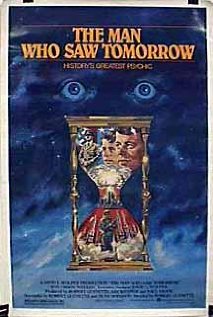
If you have ever wanted to witness the sad fate that awaits most geniuses who challenge the system, you could not do any worse than to watch The Man Who Saw Tomorrow.
The Man Who Saw Tomorrow is a low-budget “documentary” about Nostradamus, the 16th century French alchemist who some people consider to be a prophet and others consider to be a charlatan.  Nostradamus has been credited with predicting everything from the rise of Napoleon and Hitler to the 9-11 terror attacks.  Others argue that the writings of Nostradamus were so obscure and prone to mistranslation that they could be interpreted in just about any way.  While he did write about an evil dictator that he called “Hister,” he was also widely credited with predicting an atomic war in 1999.

The Man Who Saw Tomorrow argues that Nostradamus was indeed a prophet and it makes its case through cheap historical reenactments and a lot of stock footage.  The Zapruder film is used.  So is footage from A Tale of Two Cities, War and Peace, Earthquake, and Waterloo (Be sure to keep an eye out for Rod Steiger).  Some of the predictions, like Edward Kennedy becoming President and World War III starting in 1986, are easy to laugh at.  Others, like conflict in the Middle East leading to a nuclear war, would be frighteningly credible if the film wasn’t so obviously made on the cheap.  No skepticism of Nostradamus is implicitly acknowledged but there are interviews with a few believers, including psychic Jeane Dixon (whose first name the film misspells).

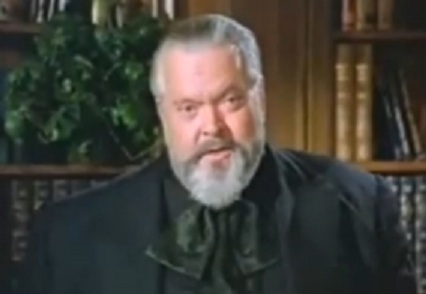
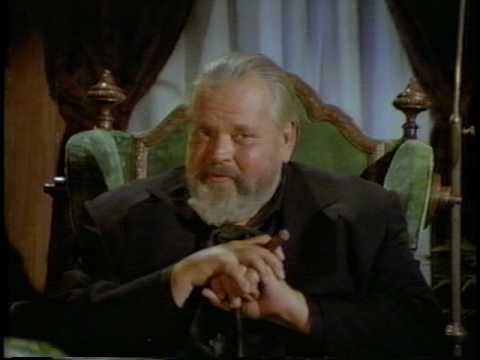
And narrating it all is none other than one of the most important filmmakers of all time, Orson Welles.  Sitting at a desk in front of a bookcase and occasionally puffing on a cigar, the director of Citizen Kane lends his deep and recognizable voice to the film’s narration but also adds just a touch of sarcasm to his tone.  The movie may believe that Nostradamus saw the future but Welles is going to damn well make sure that everyone understands that he does not.  When Welles talks about Nostradamus’s predictions for the future, he says, “But before continuing, let me warn you now that these predictions of the future are not at all comforting – and I might go on to add that these visions of the past, these warnings of the future, are not the opinions of the producers of this film. They’re certainly not my opinions.”  He really emphasizes that last sentence, as if he had already grown weary of people approaching him in the streets and asking him if he thought Nostradamus had predicted Watergate.

Sadly, Welles spent a good deal of his career doing jobs like this.  The films and the roles were often beneath his talent but they provided Welles with the money that he needed to pursue his own projects, many of which were never to be completed.  At the time he did The Man Who Saw Tomorrow, Welles was trying to raise the money to complete post production on his final film, The Other Side of The Wind.  The Other Side of The Wind would remain unfinished at the time of Welles’s death but it now appears that, 41 years after principal photography was completed, the film may finally see the light of day thanks to Netflix.

As for The Man Who Saw Tomorrow, it seems only fair to give Orson Welles the final word.  When asked about the film and Nostradamus on The Merv Griffin Show, Welles replied, “”One might as well make predictions based on random passages from the phone book.”

Well said, Orson.  Well said.


Lisa Cleans Out Her DVR: Fight Valley (dir by Rob Hawk)


I wish I knew how to fight.  Don’t get me wrong.  I’m a pacifist.  I’m not the type who would ever actually go out looking for a fight but we live in a dangerous world and I’d like to know how to fight for much the same reason that I like to carry a pink, Hello Kitty derringer in my garter.  Self-defense is important.

Again, don’t get me wrong.  I know how to pull hair.  In fact, back in the day, I was told that I was a very good hair puller.  And I keep my nails healthy and strong so I probably could scratch someone’s eyes out if I had to.  But, with all that in mind, I’d still probably be totally lost if I ever got into a real fight.  I have no idea how to throw a punch for instance.  I recently tried to show off my technique to a friend of mine who spent two years serving in the IDF.  She started laughing as soon as I made a fist.  Apparently, you’re not supposed to tuck in your thumb.  I had no idea.

I found myself thinking about this last night.  I’m in the process of cleaning out my DVR and, before going to bed, I decided to watch the 2016 film Fight Valley.  I recorded Fight Valley off of TMC on March 10th.  I’m not sure why I recorded it.  Maybe I liked the title. Who knows?

Anyway, Fight Valley is a film about fighting.  In many ways, it’s a how-to video for girls who want to learn how to kick ass.  Watching Fight Valley, I learned that the most important thing about fighting is to stand around and glare at the person who you want to fight.  Judging from the film, it’s also important to say stuff like, “This is our hood,” and “You need to take your skinny ass home, white girl.”  Apparently, when walking past someone who you want to fight, it’s very important to make sure that you bump into their shoulder.  Basically, it goes: Glare, Talk, Shoulder Bump.


Fight Valley takes place in Camden, New Jersey, where it appears your only two options are either joining the Mafia or getting involved with the underground fighting circuit.  Tori Colo (Chelsea Durkalec) is this kickass fighter who needs to make some money.  She asks her rich older sister, Windsor (Susie Celek), for the money but Windsor is all like, “Why don’t you get a real job and stop bumping into people’s shoulders?”  One night, a skeezy guy tells Tori that she can make some extra cash by going to Fight Valley.  The next morning, Tori’s dead body is discovered in the woods!

Well, needless to say, Windsor feels guilty.  So, she does what any rich girl who doesn’t know how to fight would do.  She starts wandering around Camden and randomly asking people, “Hey, can you give me a ride to Fight Valley?”  Well, that doesn’t work.  She gets told to go home.  Tori’s squad tells her that she either needs to learn how to fight or give up.  Fortunately, the harsh and enigmatic Jabs (Miesha Tate) is willing to teach her how to fight.  Even more luckily, it only takes four weeks to learn.

(Don’t worry, there’s a twist!  Jabs has her own reason for teaching Windsor how to fight.  I won’t spoil it here, largely because it’s kind of stupid.)

The good thing about Fight Valley is that a good deal of the cast is made up of actual fighters.  Along with Miesha Tate, the cast includes Holly Holm and Cris Cyborg.  While I have to admit that I don’t know much about ultimate fighting, I do know that if any of these three gave me the fight glare, I would immediately go hide under a table.  Whenever they’re punching, kicking, and putting each other into chokeholds, they are totally believable and there are hints of what the film could have been.  Unfortunately, the fight scenes themselves are somewhat haphazardly shot and confusingly edited.  As a general rule, when you’ve got actual athletes doing their thing, you don’t need a lot of jump cuts and flashbacks.

The big problem was the acting.  For a film where the main attraction was obviously meant to be the fight scenes, Fight Valley was a surprisingly talk movie.  Most of the film’s cast had an authenticity to them that disappeared as soon as they opened their mouths and started to recite the script’s overwritten dialogue in the most stilted style possible.  It just doesn’t work.

The same can be said of Fight Valley in general.  As much as I’d love to know how to throw a punch, Fight Valley left me feeling like maybe I should just stick to hair pulling.

Lisa Cleans Out Her DVR: Guilty Pleasure No. 33: In the Mix (dir by Ron Underwood)


Back in January, I had to get a new cable box.  Sadly, when the boxes were switched, I lost everything that I had saved on the DVR.  Over a hundred movies and TV shows were wiped away!  However, I did not let this get me down.  Instead, I decided to take advantage of the fact that I now had a lot more free space by literally recording anything that looked the least bit interesting.

Well, the day of reckoning has finally arrived.  It is now March 21st and the DVR is nearly full.  So, for the next few weeks, I am going to clean out my DVR and review what I watch!  Now, I can’t say how long this is going to take.  In the past, I’ve always given myself unrealistic deadlines.  So, this time, I’m not giving myself a time limit.  Instead, I’m just going to start watching what I’ve got recorded and hope that I’m done by 2018.  We’ll see how it goes.

Anyway, I started things off by watching the 2005 mafia romance film, In the Mix.

I recorded In The Mix off of Starz on March 16th.  I did this despite the fact that I’ve actually seen In The Mix quite a few times.  In The Mix, which is technically a beyond terrible movie, is a bit of a guilty pleasure of mine.  It’s a bit like From Justin To Kelly or On The Line.  Even though all my instincts as a movie snob tell me not to do it, I can’t help but watch it.

In the Mix stars Usher as Darrell, the hottest DJ in New York.  Every woman wants him and every man wants to be him.  However, all Usher wants to do is hang out with the family of the local mob boss.  It turns out that Don Frank (Chazz Palminteri) was friends with Darrell’s father and Darrell is now friends with Frank’s son, Frankie Jr. (Anthony Fazio).  Frank hires Darrell to DJ his daughter’s birthday party.

(Frankie, Jr. is a white kid who wants to be black.  Personally, I think there’s probably an interesting story in the idea of the son of an old-fashioned Italian mafia don who idolizes — or appropriates, depending on how you look at it — black culture but Frankie, Jr.’s characterization pretty much starts and ends with him saying, “Yo.”)

At the party, Darrell quickly falls in love with Frank’s daughter, Dolly (Emmanuelle Chriqui) and Dolly likes him too.  Especially after he takes a bullet that was intended for her father.  While Darrell is recuperating at the mansion, Frank tells Dolly that she can’t go outside unless she has a bodyguard.  Dolly says that’s fine as long as the bodyguard is Darrell.

And you know what that means!  It’s time for a makeover montage as Darrell gets a whole new wardrobe!  Yay!

Anyway, the plot is about as predictable as the casting of Kevin Hart as Usher’s comedic sidekick and Robert Davi as a sinister gangster.  Dolly and Darrell fall in love but you already knew that was going to happen.  You also probably already guessed that Dolly already has a boring boyfriend named Chad (Geoff Stults) and that Darrell has a crazy ex-girlfriend named Cherise (K.D. Aubert).  And, of course, Frank is not initially happy with the idea of Dolly leaving her rich lawyer boyfriend so that she can be with Darrell.  However, Darrell eventually gets a chance to prove himself by rescuing Dolly from some rival gangsters and he’s welcomed into the crime family.  Of course, he gets shot a second time.  “If the ghetto’s so dangerous,” he says as he lies on the ground, “how come I keep getting shot by white people?”  Everyone has a good laugh as they wait for the ambulance.  That’s the type of movie that In The Mix is.

As I watched In The Mix, I realized that it was actually a lot worse than I remembered and yet, I still enjoyed it.  Why?  To be honest, it all comes down to Usher and Emmauelle Chriqui, both of whom look really, really good and who have enough chemistry that they can overcome an amazingly clunky script.  You reallydo believe that the two of them actually are into each other and you hope that things will work out for them because they’re such a ludicrously attractive couple.  In The Mix is an incredibly shallow and silly movie but the stars both look good when they kiss and, ultimately, that’s what a movie like this is all about.

That said, in the future, I probably won’t bother to set the DVR for it again.

Previous Guilty Pleasures

  1. Half-Baked
  2. Save The Last Dance
  3. Every Rose Has Its Thorns
  4. The Jeremy Kyle Show
  5. Invasion USA
  6. The Golden Child
  7. Final Destination 2
  8. Paparazzi
  9. The Principal
  10. The Substitute
  11. Terror In The Family
  12. Pandorum
  13. Lambada
  14. Fear
  15. Cocktail
  16. Keep Off The Grass
  17. Girls, Girls, Girls
  18. Class
  19. Tart
  20. King Kong vs. Godzilla
  21. Hawk the Slayer
  22. Battle Beyond the Stars
  23. Meridian
  24. Walk of Shame
  25. From Justin To Kelly
  26. Project Greenlight
  27. Sex Decoy: Love Stings
  28. Swimfan
  29. On the Line
  30. Wolfen
  31. Hail Caesar!
  32. It’s So Cold In The D

A Movie A Day #73: Bitter Harvest (1993, directed by Duane Clark)


Travis Graham (Stephen Baldwin, before he found God) is a doofus who owns a farm.  His late father sent all of the family’s money to a crooked televangelist but he did leave Travis a valuable coin collection.  But then two blondes enter his life.  Kelly Ann (Jennifer Rubin) is a penniless hitchhiker who needs a place to stay and a bed to sleep in.  Jolene (Patsy Kensit) is a British realtor who says she wants to help Travis sell his farm.  Faster than you can say “I don’t know the exact pronunciation but I believe it’s ménage à trois,” that’s exactly what happens.  Travis can’t believe his luck but it turns out that Kelly Ann and Jolene have plans of their own.  Then, in a strangely unrelated subplot, a banker robber who shot the local sheriff (M. Emmett Walsh) shows up at the farm.  Travis kills the bank robber but then Kelly Ann and Jolene start pressuring him to use the robber’s plan to rob a bank himself.

This is one of the many strange movies from the increasingly strange career of Stephen Baldwin.  Now that he’s best known for evangelizing and appearing in celebrity-themed reality shows (including, most infamously, two seasons of The Celebrity Apprentice), it is easy to forget that Stephen Baldwin was once a good character actor who, with the exception of The Usual Suspects, apparently could not pick a good script if his life depended upon it.  His performance as the socially backward Travis is often strange (at times, he seems to be channeling Lenny from Of Mice and Men) but always interesting.  Fans of 90s neo-noir will also be happy to see Delusion’s Jennifer Rubin, playing yet another mysterious and dangerous temptress.  Unfortunately, Bitter Harvest falls apart because of an implausible script and too many loose ends but, until it does, the sultry combination of Jennifer Rubin and Patsky Kensit keeps things watchable.

One final note: The sheriff’s son is played by Adam Baldwin.  Even though the two are not actually related, everyone in the 90s assumed that they were and this makes Bitter Harvest a double Baldwin film.

A Movie A Day #72: Delusion (1991, directed by Carl Colpaert)


George O’Brien (Jim Metzler) is a former executive at a San Diego computer company who is driving across Nevada.  He is heading to Reno, where he plans to set up a company with the embezzled millions that he has hidden in his trunk.  When he spots former Vegas showgirl Patti (Jennifer Rubin) standing on the side of the road, he stops to pick her up.  She explains that her car broke down and she needs a lift.  George is happy to give her a ride.  The only problem is that Patti is traveling with her boyfriend, Chevy (Kyle Secor).  At first, Chevy just seems to be a goofy guy who talks too much.  However, Chevy is actually a hitman, traveling to Vegas to kill a gangster (Jerry Orbach).  After the hit, Chevy abandons George in the desert and steals his car.  Determined to get his money, George pursues Chevy and Patty across the desert.

Starting like a caper film and ending like a spaghetti western, Delusion was one of the best (and most overlooked) of the many low-budget neo-noirs that came out during the first half of the 1990s.  While the underrated Metzler and Secor both give good performances, Delusion is stolen by Jennifer Rubin, who is sexy, funny, and unpredictable as Patti.  The scene where she performs These Boots Are For Walking is one of the best of the 90s.  Whatever happened to her?

And why hasn’t this excellent retro thriller been given a proper release on DVD or Blu-ray?  If any movie is deserves to be rediscovered via a special edition, it’s Delusion.

A Movie A Day #71: Side Out (1990, directed by Peter Israelson)


Monroe (C. Thomas Howell) is a young lawyer who moves to California and gets a job working for his Uncle Max (Terry Kiser).  Max wants Monroe to concentrate on evicting beach bums.  Monroe wants to play beach volleyball.  Together, they solve crimes.  No, actually, Max orders Monroe to evict Zack (Peter Horton), a former volleyball champion who was once “king of the beach.”  Zack agrees to coach Monroe and his goofball friend, Wiley (Christopher Rydell) in a volleyball tournament.  But when Zack misses a match because he is having underlit, PG-13 sex with his ex-wife (Harley Jane Kozak), uncoached Monroe accidentally breaks Wiley’s arm.  Now, Zack has to step in as Monroe’s partner and reclaim his status as king of the beach!

When I was a kid, Side Out was a HBO perennial, which is not the same thing as being a good movie.  There have not been many movies made about beach volleyball and Side Out shows us why.  Beach volley ball is just not that exciting to watch, especially when the main competitors are two out of shape actors.  All the jump cuts and close-ups in the world can’t disguise the fact that neither actor looks like he could get the ball over the net, never mind playing for over ten minutes without getting out of breath.  In Side Out, beach volleyball teamwork comes down to a lot of yelling and whenever Monroe yells at either Wiley or Zack, he sounds just like the “Put him in a body bag, Johnny!” guy from The Karate Kid.

At least Kathy Ireland has a small role.  Also, in the role of Zack’s friend, keep an eye out for Duke himself, the great Tony Burton!

What are you doing here, Duke!?

Film Review: Double Mommy (dir by Doug Campbell)


Lifetime followed Mommy’s Little Boy with the American premiere of Double Mommy.

Double Mommy is another Canadian-produced Lifetime film.  This one is a bit of a spiritual cousin to Double Daddy.  Like Double Daddy, Double Mommy starts with a high school party, ends with the arrival of two babies, and finds the time to include some homicide in between.  It’s also something of a class drama, with the rich being very evil and the middle class being very saintly and the lower class being pretty much nonexistent.

In Double Mommy, Jess (Morgan Obenreder, best known to readers of the site for playing Charisma Carpenter’s daughter in Bound) is pregnant with twins, a boy and a girl.  However, she’s not sure who the father is.  She wants the father to be Ryan (Griffin Freeman), her perfect boyfriend.  But she suspects that the father might be Brent (Mark Grossman), Ryan’s former best friend.  One night, while Ryan was away, Brent gave Jess a drink.  He said it was nonalcoholic and the can said “Cola.”  But the way the camera lingered on that can before Jess actually drank it, everyone watching the movie knew that it was drugged.  Jess has only vague memories of the rest of the night but she knows what happened.

A paternity test reveals that one twin was fathered by Ryan and the other by Brent!  At this point, I said, “So, which one is going to be the evil twin!?”

Well, the film never really got around to answering that question.  Instead, it focused on the attempts of Brent’s rich father (Bruce Boxleitner) to pay Jess and her family off.  It turns out that Jess is not the first girl that Brent has raped and his father has been covering up for him.  Jess is determined to expose Brent as a rapist.  Jess hangs banners at school.  She posts Brent’s picture on social media.

Let’s give Double Mommy credit where credit is due.  In the characters of Brent and his father, the film makes a point about how one generation enables the bad behavior of another and how misogyny can be passed down from father to son.  Furthermore, Jess never allows herself to simply be a victim.  She’s a fighter who never apologizes for standing up for herself and who, most importantly, never blames herself for the rape.  But, with all that in mind, Double Mommy would have been so much better (and certainly more empowering) if Jess had gone all Ms. 45 or I Spit On Your Grave on Brent’s ass.

I mean, it’s true that, as a result of Jess’s efforts, Brent loses a scholarship and gets booed at a soccer game.  That’s all good but Brent was such a loathsome character that he deserved much worse.  If there’s ever been a character in a Lifetime film who deserved to be locked in a cage and beaten until he confessed to his crimes, it was Brent.  After an hour of Brent smirking, bragging, and drugging, I was ready to see Jess pick up a gun and blow his head off while uttering a priceless one-liner.  Instead, Brent just got embarrassed and eventually ended up running around with a gun of his own.  What could have been an empowering little revenge flick turned into a typical Lifetime movie.

That said, the film was well-acted and nicely put together.  Mark Grossman turned Brent into a disturbingly familiar villain.  (We’ve all known a Brent.)  I just wish the film had gone a bit further in giving Jess her revenge.


Film Review: Mommy’s Little Boy (dir by Curtis Crawford)


On Saturday, Lifetime presented a Mommy Madness marathon, showing a series of melodramas that all, in some way, involved motherhood.  They showed everything from Killing Mommy to Mommy’s Secret to Mommy’s Little Girl.  They ended the night with not one but two premiere films!  Needless to say, I was excited.  After missing last week’s Lifetime movie (though I did DVR it so fear not!), I was looking forward to embracing the melodrama not once but twice!

The first premiere was Mommy’s Little Boy, which naturally came on immediately after Mommy’s Little Girl.  Just judging from the title and Lifetime’s previous record when it comes to children, I assumed that Mommy’s Little Boy would be about a homicidal child.

It turns out I was incorrect.  Don’t get me wrong, of course.  The kid does kill at least one person.  Actually, I think he killed two people but the film is a little bit ambiguous as to whether or not little Eric (Peter DaCunha) meant to let his half-brother Max (Auden Larrat) drown.  You really couldn’t blame Eric if that was the case.  Max was a stone-cold psychopath who started the movie threatening to attack a stray dog with a power drill.  Max got whatever he deserved.  As for that other murder that Eric commits — well, it’s self-defense.  Eric really had no choice.  Eric’s a good kid, dangit!

Instead, it’s his mother who is the problem.  Briana (Bree Williamson) has a really nice house but she’s the type of mother who is too busy sunbathing (while wearing an American flag bikini, no less) to notice that one of her sons is drowning in the pool behind her.  Briana is almost always drunk or stoned.  She brings strange men home with her.  She neglects Eric and sends him to school in grubby clothes.  She murders the neighbor for being condescending, banging her over the head with the same skillet that will later be used to prepare Eric’s breakfast.  Briana’s not the world’s best mother but, at the very least, she has a nice house.

Seriously, you have to see this house.  Have you ever seen House Hunters?  You know how the third house is always a really nice house that, we’re told, is a little bit outside of the house hunters’s budget?  (“Now, this is listed for a little more than you said you were willing to pay but the price may come down…”)  That’s the type of house that Brianna lives in.  Unfortunately, Brianna has kinda trashed the place.  At one point, she explains that she inherited the house after her parents died.  At least, for once, a Lifetime movie took the time to explain why even the trashiest of characters always live in the nicest of houses.

Anyway, Briana’s killed someone and she forces Eric to help her cover up the crime.  That kinda traumatizes Eric.  He’d much rather live with his softball coach, Michael Davis (Paul Popovich).  However, Briana is determined to get in her new boyfriend’s RV and flee to Mexico.  And she expects her only remaining son to come with her.  Whatever is Eric to do!?

Well, you probably already guessed what happens.  Mommy’s Little Boy was a standard Lifetime film but I liked it.  If nothing else, Bree Williamson deserves some sort of award for how totally and completely she throws herself into the role of Briana.  It takes courage to play someone that trashy without winking at the audience but Williamson does it.  Overall, Mommy’s Little Boy was an entertaining addition to Lifetime’s stable of films about mentally unstable maternal figures.

A Movie A Day #70: Wired (1989, directed by Larry Peerce)


Sometimes, you watch a movie and all you cay say, at the end, is “What the Hell were they thinking?”

Wired is one such movie.  Based on a widely discredited biography by Bob Woodward, Wired tells two stories.  In the first story, John Belushi (Michael Chiklis, making an unfortunate film debut) wakes up in a morgue and is told by his guardian angel that he has died of a drug overdose.  Did I mention that his guardian angel is Puerto Rican cabbie named Angel Vasquez (Ray Sharkey) and Angel drives Belushi through a series of flashbacks?  Belushi meets Dan Aykroyd (Gary Groomes, who looks nothing like Dan Aykroyd).  Belushi gets cast on Saturday Night Live.  Belushi marries Judy (Lucinda Jenney).  Belushi uses drugs, costars in The Blues Brothers, dies of a drug overdose in a sleazy motel, and plays a pinball game to determine whether he’ll go to Heaven or Hell.  While this is going on, Bob Woodward (J.T. Walsh) is interviewing everyone who knew Belushi while he was alive.

There are so many things wrong with Wired that it is hard to know where to even begin.  I haven’t even mentioned the scene where Bob Woodward travels back in time and has a conversation with Belushi while he’s dying on the motel room floor.  Wired tries to be a cautionary tale about getting seduced by fame and drugs but how seriously can anyone take the message of any movie that features Ray Sharkey as a guardian angel?  The scenes with Woodward are strange, mostly because the hero of Watergate is being played by an actor best known for playing sinister villains.  (Seven years after playing Bob Woodward, J.T. Walsh was actually cast as Watergate figure John Ehrlichman in Nixon.)  Considering that this was his first movie, Michael Chiklis is not bad when it comes to playing a drug addict named John but he’s never convincing as John Belushi.  He never captures the mix of charisma and danger that made John Belushi a superstar.  Wired wants to tell the story of Belushi’s downfall but never understands what made him special to begin with.

Wired tries to be edgy but it only succeeds for one split second.  During the filming of The Blues Brothers, a director who is clearly meant to be John Landis walks over to Belushi’s trailer.  Listen carefully, and a helicopter can be heard in the background.

As for the rest of Wired, what the Hell were they thinking?