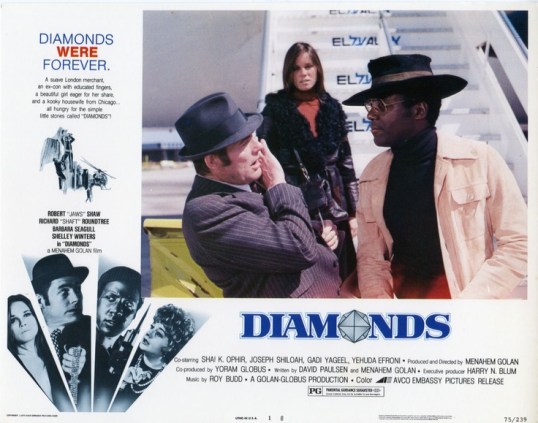
Originally, for today’s entry in Movie A Day, I was hoping to follow up my review of Mad Dog Coll by reviewing Hit The Dutchman. Unfortunately, I have not been able to find a review-worthy copy of Hit The Dutchman so, instead, I am going to review another film that was directed by Menahem Golan, Diamonds.
Filmed and set in Golan’s home country of Israel, Diamonds is a heist film. Richard Roundtree is Archie, an experienced thief who has just been released from prison. Sally (Barbara Hershey, though she was known as Barbara Seagull when she made this movie) is Archie’s girlfriend. Robert Shaw plays Charles Hodgman, the businessman who recruits Roundtree to help him break into a vault located in the Tel Aviv Diamond Exchange Center. The twist is that the vault was designed by Charles’s twin brother, Earl. Earl is also played by Robert Shaw and the two of them have an intense sibling rivalry. If you have ever wanted to see Robert Shaw fight himself in a karate match, Diamonds is the film to see!
(In true Golan fashion, Shaw wears a puffy wig whenever he is supposed to be Earl.)
If he had not died, in 1978, at the tragically young age of 51, Robert Shaw would probably be known as one of our greatest actors. As it is, he will always be remembered for playing Quint in Jaws and Red Grant in From Russia With Love. (I am also a fan of his performance in the original The Taking of Pelham One Two Three.) Diamonds is typical of the many films in which Shaw was better than what he had to work with. He gives two good performances but even he is occasionally overshadowed by the swaggering cool and floppy hats of Richard Roundtree. As for Barbara Seagull/Hershey, she was, as always, beautiful but she had little to do (which was a common problem for her until she rebooted her career with her performance in The Stunt Man). Shelley Winters is also in this movie, providing tepid comic relief as an American tourist. (It’s typical of the type of roles in which, following her performance in The Poseidon Adventure, Winters got typecast.)
Barbara Hershey’s beautiful. Richard Roundtree’s cool. Robert Shaw is Robert Shaw. The Israeli location distinguishes it from similar heist films. The plot may be implausible and the dialogue may be weak but, just as he did with Get Carter, Roy Budd offers up a great score. Diamonds is typical of many Golan films. It’s not good but it is damn entertaining.
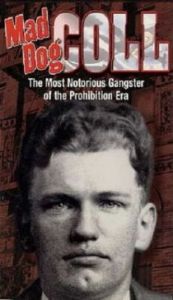 New York. The prohibition era. The Coll Brothers, Vincent (Christopher Bradley) and Peter (Jeff Griggs), are sick of working for the Irish gangster, O’Malley (William Anthony La Valle). They want to hang out at the Cotton Club with big time gangsters like Lucky Luciano (Matt Servitto), Legs Diamond (Will Kempe), and Dutch Schultz (Bruce Nozick). Vincent has fallen in love with Lotte (Rachel York), a singer at the club but the club’s owner, Owney Madden (Jack Conley), makes it clear that Lotte is too good for a low-rent thug. After killing O’Malley, Vincent and Peter go to work for Dutch Schultz but soon, they grew tired of the low wages that Schultz pays them. The Colls decide to strike out on their own, leading to all out war with New York’s organized crime establishment.
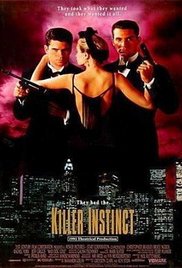 Mad Dog Coll was one of two gangster movies that Menaham Golan produced, back-to-back, in Russia. In fact, Mad Dog Coll may be the first American film in which Russia stood in for America instead of the other way around. Though this film was produced after Golan broke up with his longtime producing partner, Yoram Globus, Mad Dog Coll still has a definite Cannon feel to it. It is low-budget, fast-paced, unapologetically pulpy, and entertaining as Hell. For a Golan production, the performances are surprisingly good. Bruce Nozick steals the entire movie as crazy Dutch Schultz. None of it is subtle but it is enjoyable in the way that only a Greydon Clark-directed, Menahem Golan-produced gangster film can be. 1920s New York is recreated on Russian soundstages. The threadbare production design and cardboard cityscape brings a Jon Pertwee/Tom Baker-era Dr. Who feel to the movie. All that is missing is The Master brewing up moonshine and the Daleks exterminating the Chicago Outfit.
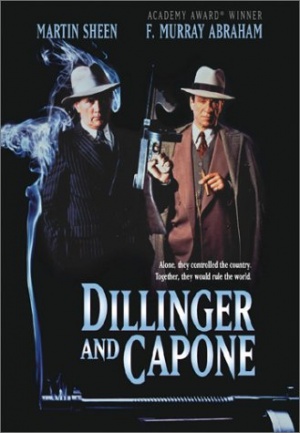 1934. Chicago. The FBI guns down a man outside of a movie theater and announces that they have finally killed John Dillinger. What the FBI doesn’t realize it that they didn’t get Dillinger. Instead they killed Dillinger’s look-alike brother. The real John Dillinger (played by Martin Sheen) has escaped. Over the next five years, under an assumed name, Dillinger goes straight, gets married, starts a farm, and lives an upstanding life. Only a few people know his secret and, unfortunately, one of them is Al Capone (F. Murray Abraham). Only recently released from prison and being driven mad by syphilis, Capone demands that Dillinger come out of retirement and pull one last job. Capone has millions of dollars stashed away in a hotel vault and he wants Dillinger to steal it for him. Just to make sure that Dillinger comes through for him, Capone is holding Dillinger’s family hostage.

 Chicago. 1915. Up-and-coming gangster Al Capone (Eric Roberts) berates his younger brother, Jimmy (Adrian Pasdar), for not being aggressive enough in a street fight. Not wanting to follow his brothers into a life of organized crime, Jimmy runs away from home and eventually finds himself in Harmony, Nebraska. Claiming to be a World War I vet named Richard Hart, Jimmy impresses everyone with both his marksmanship and his incorruptible nature. Soon, the new Richard Hart has been named town marshal. While Al Capone is taking over the Chicago rackets, Richard is keeping the town safe with his Native American deputy, Joseph Littlecloud (Jimmie F. Skaggs), and starting a family with the local school teacher, Kathleen (Ally Sheedy). When illegal liquor from Chicago starts to show up on a nearby Indian reservation, Richard Hart comes into conflict with the Chicago Outfit and his secret is finally revealed.
 Everyone knows who Al Capone was but few people remember Frank Nitti. Nicknamed “The Enforcer,” Nitti was Capone’s right-hand man. When Big Al was sent to federal prison for not paying his taxes, Nitti was the one who kept things going in Chicago. While Al was losing his mind in Florida, Nitti was the one who moved the Chicago Outfit away from prostitution and into the labor racket. Today, if anyone remembers Frank Nitti, it is probably because of the scene in Brian DePalma’s The Untouchables where Eliot Ness tosses him off of a building. In real life, Nitti survived the Untouchable era just to become one of the few crime bosses to die by his own hand. In 1943, With the feds closing in on him, Nitti shot himself in a Chicago rail yard.
 Scott Wolf plays Clyde, a nerdy high school student who has a go-nowhere job at a burger place. Maureen Flannigan, best known for starring in Out Of This World, is Bonnie, who likes to steal stuff and have fun. Unfortunately, Bonnie’s father (played by Tom Bower) is not an avuncular alien who sounds like Burt Reynolds. Instead, he’s the extremely strict and controlling police commissioner of their hometown. Clyde like Bonnie but Bonnie wants nothing to do with him. It’s not until Clyde spies Bonnie shoplifting in a record store that he realizes that larceny is the key to her heat. When Clyde steals a van and Bonnie steals her father’s guns, the two of them head for Mexico, robbing banks, shooting guns, making love (which, judging from the comments I have found online, is the main reason the film found an audience once it started showing up on HBO) and becoming media celebrities along the way.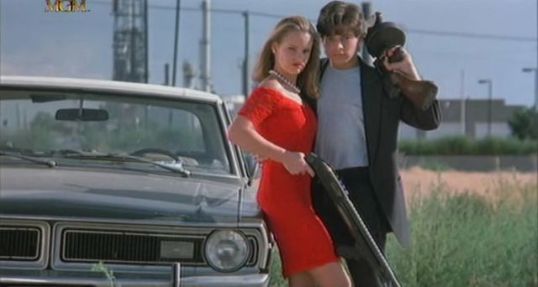
 Through the Shattered Lens