What Lisa Watched Last Night #163: Deadly Sorority (dir by Shawn Tolleson)


Last night, I watched the latest Lifetime original film, Deadly Sorority!

Why Was I Watching It?

You have to give the people at Lifetime some credit.  I often give them a hard time for the way that they retitle movies to give them more of a “Lifetime-y” feel but Deadly Sorority is a perfect title.  According to the imdb, this movie was originally called Undergrad Nightmare.  Deadly Sorority is such an improvement that I don’t even know where to begin.  It was enough to convince me to watch.

(Of course, I would have watched anyway because the movie was on Lifetime but, for the purpose of this review format, let’s pretend like the title was the sole reason.)

What Was It About?

Sam (Greer Grammer) and Kris (Emilija Branac) have been BFFs since high school but, once they arrive at Barclay University, things start to change.  Kris gets accepted into an exclusive sorority and soon, her new “sisters” are telling Sam to stay away.  When Kris is murdered, Sam suddenly finds herself as the number one suspect.  Everyone says that Sam was obsessed with Kris and jealous over her new friends.

In order to prove her innocence, Sam is going to have to catch the real murderer.  Was it Kris’s frat boy boyfriend?  Was it the lecherous professor or his wife?  Was it the creepy guy who lives upstairs from her?  Was it one of Kris’s sorority sisters?  Was it … well, actually, that’s all the suspects.  It’s a small school.

What Worked?

I absolutely loved Barclay University, which was located up in the mountains, had nice, big dorm rooms (during my first year of college, I lived in a dorm that didn’t even have air conditioning), and — as far as I could tell — only three or four professors.  There weren’t many students either.  Sam and Kris’s history class only had about 12 students in it.  As someone who hated the anonymous feeling of being one of many students in a gigantic lecture hall, I appreciated that.

The sorority was effectively creepy.  However…

What Did Not Work?

…the sorority itself really didn’t figure much into the plot.  There were a few effective scenes of all of the sisters staring at Sam dismissively but otherwise, the sorority was just a big, pink-clad red herring.  Deadly Sorority is a great title but Undergrad Nightmare was actually a more accurate title.  Usually, I don’t mind a misleading title but, when you promise a deadly sorority, you need to deliver.

The identity of the murderer also felt a bit random to me.

“Oh my God!  Just like me!” Moments

I related to Sam, who had a wonderfully snarky attitude and said whatever was on her mind.  Unlike Sam, I was actually invited to join a sorority but I turned them down because I was busy being a nonconformist.  I kind of regret that choice because, according to what I’ve seen on Lifetime, joining a sorority would have led to several years of adventure and melodrama.  At the very least, I would have had a few hundred more closets to borrow from.

Oh well!

Lessons Learned

I should have applied to Barclay University.

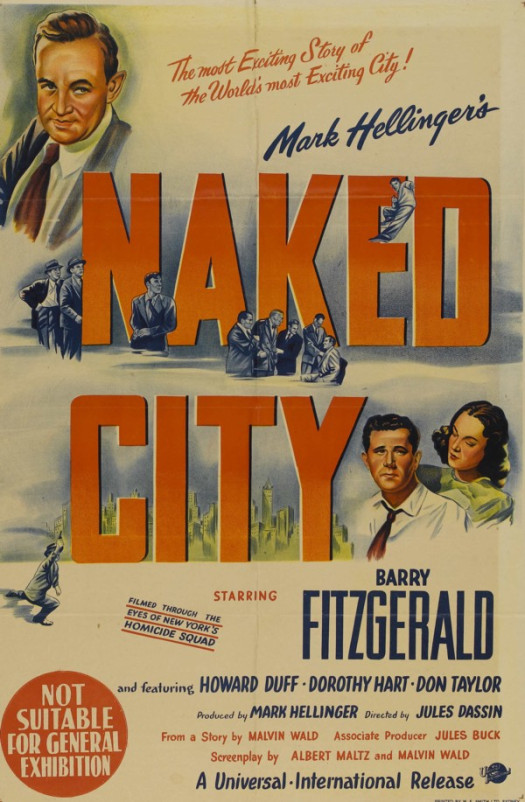
One in Eight Million: NAKED CITY (Universal-International 1948)


gary loggins's avatarcracked rear viewer

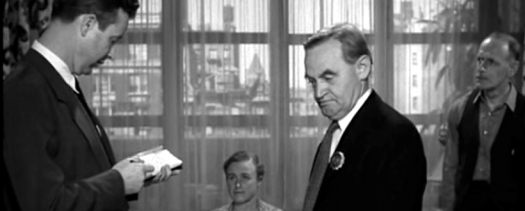
Producer Mark Hellinger, who brought you the film noir classics THE KILLERS and BRUTE FORCE , traveled to the mean streets of New York City to shoot  NAKED CITY, along with director Jules Dassin and a solid cast led by Barry Fitzgerald. The movie, though fiction, is shot in docu-drama style, with Hellinger himself providing narration throughout. It was an attempt to do something boldly different with the genre, and it succeeds thanks to the talents in front and behind the cameras.

Beautiful young model Jean Dexter is found in her bathtub brutally murdered by her housekeeper. The homicide squad, with veteran Lt. Dan Muldoon and rookie detective Jimmy Halloran, gets to work investigating the case. They discover Jean had been seeing a mysterious man from Baltimore named Henderson. The team then begins the slow, methodical process of catching a killer, pulling on the loose strings of Dexter’s life. Their number one…

View original post 668 more words

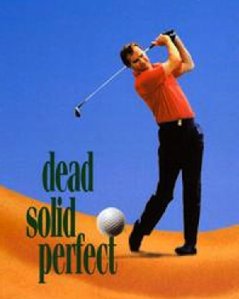
A Movie A Day #119: Dead Solid Perfect (1988, directed by Bobby Roth)


Based on a novel by veteran sports writer Dan Jenkins, Dead Solid Perfect takes an episodic look at a year on the PGA tour.  Kenny Lee (Randy Quaid) is a good but aging golfer who wants to finally have his time in the spotlight.  His sponsor (Jack Warden) is an eccentric old racist.  His girlfriend (Corinne Bohrer, who has a lengthy scene where she walks naked down hotel hallway while carrying an ice bucket) isn’t looking for a commitment while his wife (Kathryn Harrold) is getting sick of his emotional immaturity.  Kenny Lee just wants to hit the perfect shot.

An early HBO production, Dead Solid Perfect is one of the best movies ever made about pro golfers, not that there is really much competition.  Eschewing the pretentious blathering that has marred other golf films (like The Legend of Bagger Vance), Dead Solid Perfect focuses on the day-to-day life of aging athletes who have never had to grow up.  This was Dan Jenkins’s specialty and Dead Solid Perfect feels authentic in a way that many other sports film, like Bagger Vance, do not.  Randy Quaid, long before he had his widely publicized breakdown and started making videos about the “star whackers,” is perfectly cast as Kenny.  Sadly, Dead Solid Perfect has never been released on DVD or Blu-ray but it will entertain any golf fan who owns an operational VCR.

Of course, the best movie about golf is still Caddyshack.


Film Review: The Hindenburg (dir by Robert Wise)


80 years ago, on May 6th, 1937, the Hindenburg, a German airship, exploded in the air over New Jersey.  The disaster was not only covered live by radio reporter Herbert Morrison (whose cry of “Oh the humanity!” continues to be parodied to this day) but it was also one of the first disasters to be recorded on film.  Looking at the footage of the Hindenburg exploding into flame and sinking to the ground, a mere skeleton of what it once was, it’s hard to believe that only 36 people died in the disaster.  The majority of those who died were crew members, most of whom lost their lives while helping passengers off of the airship.  (Fortunately, the Hindenburg was close enough to the ground that many of the passengers were able to escape by simply jumping.)

Not surprisingly, there was a lot of speculation about what led to the Hindenburg (which has successfully completed 63 flights before the disaster) exploding.  The most commonly accepted explanation was that it was simply an act of God, the result of either lightning or improperly stored helium.  Apparently, there was no official evidence found to suggest that sabotage was involved but, even back in 1937, people loved conspiracy theories.

And really, it’s not totally implausible to think that the Hindenburg was sabotaged.  The Hindenburg was making its first trans-Atlantic flight and it was viewed as being a symbol of Nazi Germany.  One of the ship’s passengers, Captain Ernest Lehman, was coming to the U.S. in order to lobby Congress to give Germany helium for their airships.  With Hitler regularly bragging about the superiority of German industry, the theory was that an anti-Nazi crewman or passengers planted a bomb on the Hindenburg.  Since no individual or group ever stepped forward to claim responsibility, the theory continues that the saboteur must have perished in the disaster.

At the very least, that’s the theory put forward by a film that I watched earlier today, the 1975 disaster movie, The Hindenburg.

A mix of historical speculation and disaster film melodrama, The Hindenburg stars George C. Scott as Col. Franz Ritter, a veteran of the German air force who is assigned to travel on the Hindenburg and protect it from saboteurs.  Ritter is a Nazi but, the film argues, he’s a reluctant and disillusioned Nazi.  Just a few weeks before the launch of the airship, his teenage son was killed while vandalizing a synagogue.  Ritter is a patriot who no longer recognizes his country and George C. Scott actually does a pretty good job portraying him.  (You do have to wonder why a seasoned veteran of the German air force would have a gruff, slightly mid-Atlantic accent but oh well.  It’s a 70s disaster film.  These things happen.)

Ritter is assigned to work with Martin Vogel (Roy Thinnes), a member of the Gestapo who is working undercover as the Hindenburg’s photographer.  Tt soon becomes obvious that he is as much a fanatic as Ritter is reluctant.  Vogel is a sadist, convinced that every Jewish passenger is secretly a saboteur.  Thinnes is chilling in the role.  What makes him especially frightening is not just his prejudice but his casual assumption that everyone feels the same way that he does.

And yet, as good as Scott and Thinnes are, the rest of the cast is rather disappointing.  The Hindenburg features a large ensemble of actors, all playing characters who are dealing with their own privates dramas while hoping not to burn to death during the final 15 minutes of the film.  Unfortunately, even by the standards of a typical 70s disaster film, the passengers are thinly drawn.  I liked Burgess Meredith and Rene Auberjonois as two con artists but that was mostly because Meredith and Auberjonois are so charming that they’re fun to watch even if they don’t have anything to do.  Anne Bancroft has one or two good scenes as a German baroness and Robert Clary does well as a vaudeville performer who comes under suspicion because of his anti-Nazi leanings.  Otherwise, the passengers are forgettable.  Whether they die in the inferno and manage to make it to the ground, your main reaction will probably be to look at them and say, “Who was that again?”

Anyway, despite all of Ritter and Vogel’s sleuthing, it’s not much of mystery because it’s pretty easy to figure out that the saboteur is a crewman named Boerth (William Atherton).  Having seen Real GeniusDie Hard and the original Ghostbusters, I found it odd to see William Atherton playing a sympathetic character.  Atherton did okay in the role but his attempt at a German accent mostly served to remind me that absolutely no one else in the film was trying to sound German.

Anyway, the main problem with The Hindenburg is that it takes forever for the airship to actually explode.  The film tries to create some suspense over whether Ritter will keep the bomb from exploding but we already know that he’s not going to.  (Let’s be honest.  If you didn’t already know about the Hindenburg disaster, you probably wouldn’t be watching the movie in the first place.)  The film probably would have worked better if it had started with the Hindenburg exploding and then had an investigator working backwards, trying to figure out who the saboteur was.

However, the scenes of the explosion almost make up for everything that came before.  When that bomb goes off, the entire film suddenly switches to black-and-white.  That may sound like a cheap or even sensationalistic trick but it actually works quite well.  It also allows the scenes of passengers and crewmen trying to escape to be seamlessly integrated with actual footage of the Hindenburg bursting into flame and crashing to the ground.  The real-life footage is still shocking, especially if you’re scared of fire.  Watching the real-life inferno, I was again shocked to realize that only 36 people died in the disaster.

In the end, The Hindenburg is flawed but watchable.  George C. Scott was always at his most watchable when playing a character disappointed with humanity and the real-life footage of the Hindenburg disaster is morbidly fascinating.

Oh, the humanity indeed!

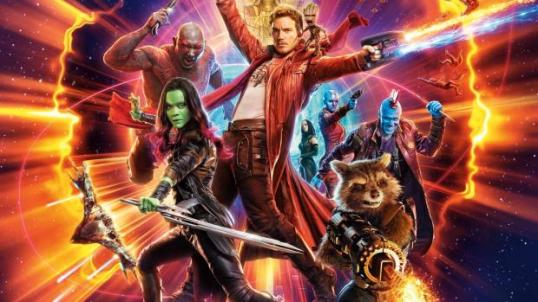
Film Review: Guardians of the Galaxy Vol. 2 (dir by James Gunn)


(MINOR SPOILERS!  SPECIFICALLY, THE IDENTITY OF THIS FILM’S MAIN VILLAIN WILL BE REVEALED)

The Guardians of the Galaxy are back!

And this time, they’ve brought some new friends with them, friends with names like Kurt Russell, Sylvester Stallone, and … David Hasselhoff?

That’s right.  David Hasselhoff is now a part of the Marvel Cinematic Universe and somehow, it feels totally appropriate.  For all the words that have been written comparing Guardians of the Galaxy to the Star Wars franchise, it’s true ancestor is the 1978 Italian film, Starcrash.  (Perhaps not coincidentally, Starcrash was Hasselhoff’s film debut.)  Watch the trailer below and just try to tell me that you can’t imagine Chris Pratt and Zoe Saldana in the lead roles.

But enough about my obsession with Italian exploitation films.  I know the question that you want answered.  Is Guardians of the Galaxy Vol. 2 as good as the first one?

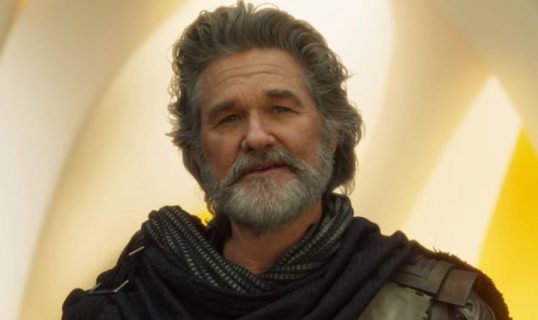
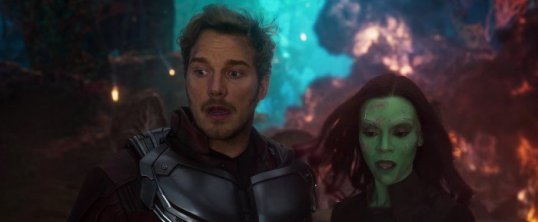
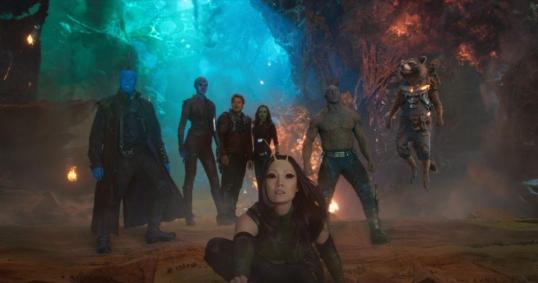
Well, it depends on how you look at it.  Guardians of the Galaxy Volume 2 is an absolute blast, a wonderfully entertaining film that mixes subversive comedy with sci-fi action.  Everyone from the first film — Chris Pratt, Zoe Saldana, Dave Bautista, Karen Gillan, Michael Rooker, and the voices of Bradley Cooper and Vin Diesel — is back and they’ve still got the same winning chemistry that made the first film so much fun.  Everyone is still committed to their roles, delivering even the strangest of dialogue with undeniable flair.  Nobody’s gotten bored with saving the universe yet.  The new additions to the cast are all well selected.  Kurt Russell totally disproves the assumption that MCU villains are never as interesting as their heroic opponents but, then again, it helps that he’s playing a character who has a memorable and odd backstory.  Once again, director James Gunn combines crowd-pleasing moments with his own sharp sense of humor.  If the pompous tone of Man of Steel and Batman v Superman made you sick, Guardians of the Galaxy Volume 2 is the perfect antidote.

Unfortunately, Volume 2 doesn’t provide the same thrill of discovery as the first film.  It’s easy to forget that, before the first film came out, a lot of people were predicting that Guardians of the Galaxy would be the first MCU film to flop at the box office.  The conventional wisdom was that, as opposed to a character like Captain America, no one, outside of a few comic book readers, knew who the Guardians of the Galaxy were.  Chris Pratt was just the goofy guy from Parks and Recreation.  A talking raccoon?  A walking tree?  It was all way too weird, the naysayers proclaimed, to appeal to a mainstream audience.

However, James Gunn proved them wrong.  Guardians of the Galaxy was not only the most successful MCU film to that date but it was also my pick for the best film of 2014.  I can still remember watching it for the first time and immediately falling in love with both the film’s skewered sensibility and Chris Pratt’s funny but soulful performance.  As opposed to a lot of films that were nominated for and won Oscars that year, Guardians of the Galaxy actually holds up after repeat viewings.

(Seriously, has anyone tried to rewatch Birdman lately?)

Going into the sequel, everyone now knows who the Guardians are and Chris Pratt is now a beloved film star.  Volume 2 has a lot to live up to and, for the most part, it succeeds.  It’s a tremendous amount of fun and, at the same time, it has a heart.  (The heart at the center of the Guardian of the Galaxy films is perhaps the biggest heart in the MCU.)

What is the film about?  Much like the first film, it’s about family.  After years of telling everyone that his father was David Hasselhoff, Peter Quill (Chris Pratt) finally meets his real father (Kurt Russell), a God-like figure named Ego.  Charismatic, cheerful, and just a little bit odd, Ego seems like the perfect father figure but he has some secrets of his own.  Russell gives a wonderful performance, making Ego one of the few MCU villains to be as interesting as the heroes.

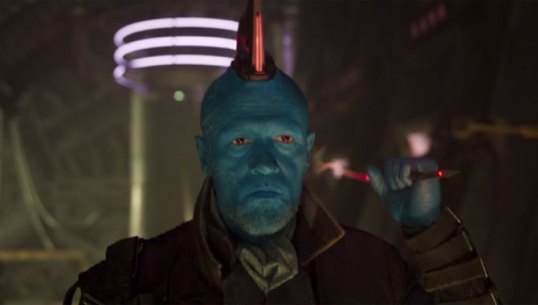
While Peter is bonding with his dad, he is also being pursued by his adoptive father, the blue-skinned space pirate named Yondu (Michael Rooker).  Yondu has been rejected by both his adopted son and the rest of his adopted family.  The other space pirates are no longer loyal to him.  His former boss (Sylvester Stallone) wants nothing to do with him.  As silly as it all may sound, it’s also unexpectedly poignant, thanks to Michael Rooker’s performance.  Rooker has appeared in several of Gunn’s films.  He’s almost the Cary Grant to Gunn’s Alfred Hitchcock.  Rooker gives one of the best performances of his careeer in the role of Yondu.  It’s tempting to be dismissive of Yondu, with his blue-skin and his Alabama accent, but Rooker makes him one of the most compelling characters to ever be found in an MCU film.

Meanwhile, Rocket Raccoon (voiced again by Bradley Cooper) has become a surrogate father figure to Groot (voice by Vin Diesel), who is still just a baby tree.  (Groot, a living tree, was reduced to just a twig at the end of the first film.  Fortunately, Rocket planted the twig and, in another few movies, we’ll hopefully have a fully grown Groot.)  Yes, Baby Groot does get to dance, again.  At one point, one of the film’s villains forbids any of his henchmen from attacking Baby Groot because he’s just too adorable to destroy.  And he’s right!  After this movie, everyone will want a Baby Groot of their own.

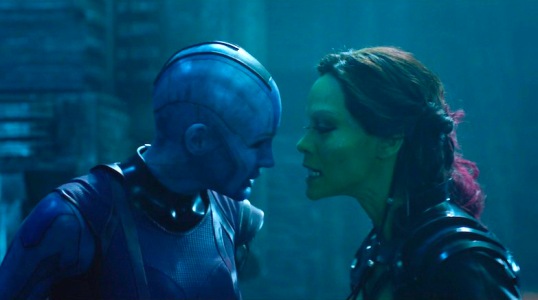
Gamora (Zoe Saldana) has been reunited with her sister, Nebula (Karen Gilliam) and, once again, they spend most of the movie trying to kill each other.  I have three older sisters so I related to their relationship.

And finally, Drax (Dave Bautista) is still mourning his family.  Fortunately, he gets to spend some quality time with Ego’s odd assistant, an empath named Mantis (Pom Klementieff).  Drax and Mantis both have no idea how social interaction is supposed to work and their scenes together are definitely a highlight of the film.  Bautista and Klementieff share a really likable chemistry.  Bautista is one of those actors who can make you laugh just be giving the camera a quizzical look.  Drax may not be as a complicated as the other Guardians but that simplicity often makes him as interesting as his more complex compatriots.

The film’s not only about family.  It’s also a strike against elitism and a celebration for freedom.  Over the course of two films, the Guardians have battled against both an actual god and a fanatic who claimed to speak for God.  At a time when so many movie heroes are tools of authoritarianism, the Guardians of the Galaxy stand for freedom.  In many ways, Peter Quill is as much of a symbol for liberty as Captain America.  Captain America makes his point with a shield while Peter Quill makes his case by dancing.

As might be expected from an MCU film, Guardians of the Galaxy Volume 2 is full of thrilling visuals, exciting battles, and quotable one liners.  Even if it never reaches the heights of the first one, it’s a blast of a film and, as Arleigh told me it would, the finale brought tears to my mismatched eyes.  See it and have a good time.

Also, be sure to stick around through the entire end credits.  Along with a lot of clues about what might happen in the future of the MCU, there’s also one final Groot joke that made me laugh out loud.

Enjoy!


A Movie A Day #118: Navy SEALs (1990, directed by Lewis Teague)


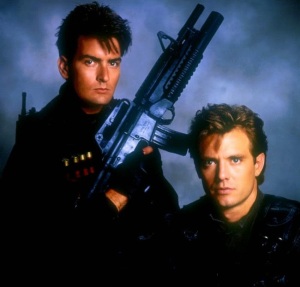
While rescuing hostages in the Middle East, a team of Navy SEALs discover that terrorist leader Ben Shaheed (Nicholas Kadi) has a warehouse full of stinger missiles.  Hawkins (Charlie Sheen) wants to destroy the missiles but his superior, Curran (Michael Biehn), orders him to concentrate on saving the hostages.  As a result, Shaheed has time to move the missiles to another location.  With the help of a Lebanese-American journalist (Joanne Whalley-Kilmer) and the CIA, the SEALs must now track down the new location and destroy the missiles before they are used by Shaheed’s organization.

Navy SEALs is mostly memorable for the amount of James Cameron alumni who appear in its cast.  The cast not only features The Terminator‘s Michael Biehn and Rick Rossovich but Bill Paxton as well.  Of course, the main star is Charlie Sheen, still technically a serious actor at the time, who gives a wide-eyed and histrionic performance that suggests Hawkins may have snorted a little marching powder before reporting for duty.  24‘s Dennis Haysbert plays a SEAL who is engaged to marry Law & Order‘s S. Epatha Merkerson.  Haysbert spends so much time planning his wedding and talking about both the importance of both duty and love that the only shocking thing about his role is that he manages to survive half the movie before getting killed.  Neither Val Kilmer nor Cary Elwes is in the cast, though it seems like they both should be.

Navy SEALs was a box office bust in 1990 but, after the death of Osama Bin Laden, it experienced a sudden upswing in popularity and even appeared on primetime television a few times.  The scene where the SEALs blow off some steam by playing golf is a classic but, otherwise, this is a largely forgettable Top Gun rip off.

The TSL’s Grindhouse: Giallo in Venice (dir by Mario Landi)


(I know this is a boring poster but it’s literally one of the few Giallo in Venice graphics that I can post without running the risk of getting the site in trouble.)

So, I finally saw the infamous (and, in many countries, banned) 1979 film, Giallo in Venice.

Back when I first decided to learn about the history of Italian horror, Giallo in Venice was a title that I frequently came across in the course of my research.  Everyone — and I do mean everyone — seemed to agree on three points: 1) it was one of the most graphic and mean-spirited Italian thrillers of all time, 2) it had never been released on DVD or Blu-ray in the United States and, as such, it was not the easiest film to see, and 3) the film was really, really bad.

Now, I have to admit that I probably wouldn’t have had any desire to see Giallo in Venice if not for the fact that I repeatedly read that it would be next to impossible for me to do so.  I hate being told what I can and cannot do.  Don’t get me wrong.  Everything that I read about Giallo in Venice was overwhelmingly negative.  Critics, some of whom I actually respected, were nearly unanimous in their dismissal of the film.  Unlike my hope that I’ll someday see fully restored versions of Greed and London After Midnight, seeing Giallo in Venice was never a number one priority for me.  Instead, it was just something that I kept in the back of my mind.  If I ever had a chance to watch Giallo in Venice, I told myself, I would just so I could say that I had seen it.

Last week,I got that chance.  I discovered that Giallo in Venice had not only been uploaded on YouTube but it was also the uncut version.   (I’m not going to include a link because of the film’s graphic content.  I don’t want to get either this site or the people who uploaded the video in trouble.  If you go to YouTube and search for “Giallo in Venice,” it should be one of the first videos to come up.) The only problem was that, along with being copied from a faded VHS tape, it was the Russian language version.  Basically, whenever any of the film’s characters spoke, you would first hear the line in the original Italian and then a rather angry man would shout the same the line in Russian.  Unfortunately, I know very little Italian and absolutely no Russian.

Needless to say, this led to a rather odd viewing experience.  If Giallo in Venice had been directed by a visual stylist like Lucio Fulci, Dario Argento, Mario Bava, or even Ruggero Deodato, it might not have been a problem.  Those four directors are all rightly renowned for their ability to create mood and atmosphere.  (And, for that matter, the best giallo films are often more concerned with visuals than dialogue.)  Unfortunately, Giallo in Venice was directed by Mario Landi, an veteran television director whose style can best be described as “turn on the camera at the start of the scene, turn it off at the end.”

(Landi also directed Patrick Still Lives, which is a smidgen more interesting than Giallo in Venice.)

As for the film’s plot — well, it’s hard for me to say for sure.  Not to overemphasize this point but, quite literally, I COULD NOT UNDERSTAND A WORD THAT ANYONE WAS SAYING.

The film opens in Venice, with a man being stabbed to death while a woman drowns in a canal.  Inspector De Paul (Jeff Blynn) is assigned to solve the murders.  He has poofy hair that wouldn’t be out of place in a stage production of Boogie Nights and, for some reason, Inspector De Paul is constantly eating hard-boiled eggs.  In just about every scene in which he appears, he is eating an egg.  Though it was hard to judge his overall performance (though the Russian seemed to enjoy repeating De Paul’s dialogue), Jeff Blynn really got into eating those eggs.  It got rather sickening to watch after a while.  As far as I could tell, De Paul’s investigation amounted to talking to one witness and then talking to the dead woman’s roommate.

The roommate, incidentally, is played by Mariangela Giordano, who also appeared in Patrick Still Lives, Burial Ground, and Michele Soavi’s The Sect.  Any fan of Italian horror will not only recognize Giordano but will also immediately know that her Giallo in Venice character is destined meet an unlucky end.  Patrick Still Lives, Burial Ground, and Giallo in Venice were all produced by Giordano’s then-boyfriend and, in all three films, she played a character who was graphically and gruesomely killed onscreen.  In Patrick Still Lives, she was skewered by a fireplace poker.  In Burial Ground, she made the mistake of trying to breastfeed her zombiefied son.  And in Giallo in Venice, one of her legs is slowly sawed off.  Seriously, if my boyfriend insisted that I suffer a terrible death in every film that he produced, it would probably be an issue.  Just saying.

Anyway, while Inspector De Paul is investigating the murder, this young couple keeps popping up.  They’re young, rich, and fifty shades of fucked up.  Fabio (Gianni Dei) has apparently been rendered impotent by all the cocaine that he’s been snorting and the only way he can get off is by forcing Flavia (Leonara Favi) to play out all of his kinky fantasies.  I found myself wondering why the film kept switching back and forth, between the not-quite-loving couple and the murder investigation.  Was Fabio the murderer?  Then, suddenly, I realized that Fabio and Flavia were the same couple who were murdered at the start of the film.  The Fabio and Flavia scenes were flashbacks.  I’m assuming that my confusion was due to the Russian dialogue but it says something about Landi’s visual style that it was impossible to tell, just from watching, that the Flavia/Fabio scenes were meant to be flashbacks.

(As far as I can — and again, dialogue problems — the flashbacks weren’t triggered by anyone saying, “I remember one time…” or anything like that.  Add to that, most of the flashbacks only featured Fabio and Flavia so, logically, there’s no way anyone could have been telling Inspector De Paul what happened.  Instead, the flashbacks just felt like random scenes that were sprinkled in between the violence and the eating.)

Giallo in Venice is a mix of egg eating, sex, and sadism.  The graphic murders are probably what Giallo in Venice is best known for, though I have to admit that I found the constant egg eating to be almost as disgusting.  As for the film’s gore, it was just as graphic and extreme as I had previously read.  But, with the exception of what happens to poor Mariangela Giordano, the violence has no impact on the viewer.  Since Landi directs with no discernible style, there’s nothing behind the murders beyond the fact that, when you title a movie Giallo in Venice, you’re obligated to include a few deaths.  It’s violence for the sake of violence and therefore, rather boring.  Admittedly, I’m sure it was rather shocking in 1979 but, today, audiences are more used to that sort of thing.  After all, everyone’s seen that tutorial on how to be a zombie for Halloween.

While watching Giallo in Venice, it was hard not to compare it to Lucio Fulci’s The New York Ripper.  Both films are deeply unpleasant but, due to Fulci’s energetic and, at times, subversive direction, there’s at least always something going on underneath the blood-drenched surface of The New York Ripper.  You can debate whether or not he succeeded but it can’t be denied that Fulci was going for something more than just sadism when he made The New York Ripper.  (If you doubt me, read Stephen Thrower’s analysis in Beyond Terror: The Films of Lucio Fulci.)  Landi’s style, in Giallo in Venice, is so flat that there’s not only nothing going on underneath but the surface itself seems to be pretty barren too.

To give credit where credit is due, I did appreciate just how ugly Landi managed to make Venice look.  I’ve been to Venice and I absolutely love it.  I would never believe that a director could make Venice look like a dump but Mario Landi managed to do it.  I don’t know if that was intentional on his part but it actually worked for the film.  Since all of the characters actually lived in Venice, it made sense that they wouldn’t be standing around and admiring the city’s natural beauty.  Instead, they all live and operate in the parts of Venice that tourists don’t see.

Finally, Landi did manage to get one interesting shot, when the reflection of one of the victims is seen in the killer’s sunglasses.  Unfortunately, Landi was so impressed by that shot that he kept using it over and over again until, eventually, it became far less interesting.

One final note: Giallo in Venice had a very odd score.  It sounded like it was being played by a cocktail lounge jazz quartet.  The music, itself, was actually rather boring but it was so totally out-of-place that it became oddly charming.  I found myself craving a drink with a little umbrella in it.

Anyway, that’s Giallo in Venice.  It’s not good, it’s not memorable, but at least I can now say that I’ve seen it.

A Movie A Day #117: Shadow Hours (2000, directed by Isaac H. Eaton)


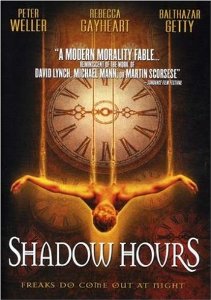
Straight from the direct-to-video graveyard comes this journey through the seedy underbelly of Los Angeles.  Michael Holloway (Balthazar Getty) used to drink every hour and snort cocaine every night.  That was the past.  Now, he is clean and sober.  Michael is married to Chloe (Rebecca Gayheart) and they have a baby on the way.  In desperate need of money to support his family, Michael gets a job working the night shift at a 24-hour gas station.  Most of his customers are the scum of the Earth until, one night, Stuart Chappell (Peter Weller) steps into the station.  Stuart claims to be a writer and he hires Michael to accompany him on an exploration of the dark side of L.A.  They start with strip bars and then eventually move on to fight clubs and BDSM parlors.  Everywhere they go, Stuart is recognized but everyone knows him by a different name.  Soon, Michael is not only drinking and doing drugs again but he is also the prime suspect in a murder.
Shadow Hours is a dumb but entertaining vision of Los Angeles as Hades.  It has loads of atmosphere but it’s all taken from other movies, a hint of Taxi Driver there and a pinch of 8mm here.  The film’s main weakness is that it stars Balthazar Getty, who, as an actor, has the least sympathetic screen presence this side of Edward Furlong.  Even if Getty was playing a paraplegic veteran who had devoted his life to finding good homes for stray puppies, he would still come across as unlikable.  Make him a loser who spend most of the movie lying to his pregnant wife and it is impossible to care what happens to Michael.  The film’s main strength is that it also stars Peter Weller, who is pitch perfect as the mysterious Stuart, who might be the Devil.  If the whole movie had just been Peter Weller going to bars and fight clubs and hanging out with Lydia Lunch, Shadow Hours would have been a B masterpiece.  It’s too bad he had to take an oil heir with him.

Happy Star Wars Day From The Shattered Lens!


Today is May 4th, which, in 2011, was declared by some silly humans to be Star Wars Day!

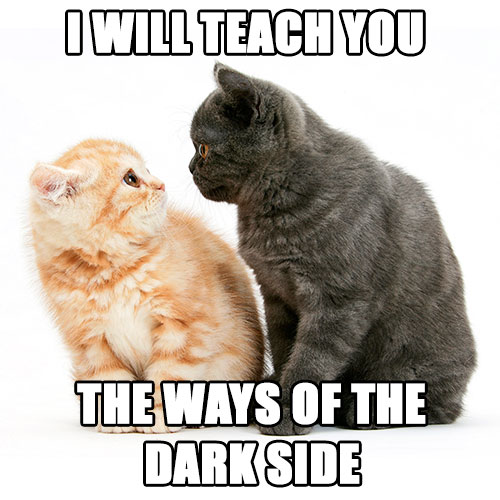
The humans here at the Shattered Lens seem to love Star Wars as well!  (The kitty is indifferent.)  Check out these Star Wars reviews:

Star Wars Episode 1: The Phantom Menace, reviewed by Leonard Wilson

Star Wars Episode 1: The Phantom Menace, reviewed by Jedadiah Leland

Star Wars Episode II: Attack of Clones, reviewed by Alexandre Rothier

Star Wars Episode III: Revenge of the Sith, reviewed by Jedadiah Leland

Rogue One, A Star Wars Story, reviewed by Jedadiah Leland

Star Wars Episode IV: A New Hope, reviewed by Leonard Wilson

Star Wars Episode IV: A New Hope, reviewed by Gary Loggins

The Star Wars Holiday Special, reviewed by Valerie Troutman

Star Wars Episode V: The Empire Strikes Back, reviewed by Leonard Wilson

Star Wars Episode VI: Return of the Jedi, reviewed by Lisa Marie Bowman

The Ewok Adventure, reviewed by Valerie Troutman

Ewoks: The Battle for Endor, reviewed by Valerie Troutman

Star Wars Episode VII: The Force Awakens, reviewed by Ryan C.

Star Wars Episode VII: The Force Awakens, reviewed by Arleigh Sandoc

Enjoy and happy Star Wars Day from all the humans and the cat at the Shattered Lens!  May the Force be with you on May the 4th!

A Movie A Day #116: Evocateur: The Morton Downey, Jr. Show (2012, directed by Seth Kramer, Daniel A. Miller, and Jeremy Newberger)


Long before the rise of trash TV, reality television, Jerry Springer, Maury Povich, Fox News, and MSNBC, there was The Morton Downey, Jr. Show.  Airing at the end of the 1980s, The Morton Downey, Jr. Show featured its host railing against liberals, vegetarians, communists, feminists, libertarians, animal rights activists, teenagers, and pot smokers.  Though the show only lasted for two seasons and ended after a bizarre incident in which Downey faked being the victim of a hate crime, The Morton Downey, Jr. served as a forerunner to the rise of our current toxic political culture.

At least, that is the claim made by Evocateur, a documentary about both the show and the controversial showman who hosted it.  Since I was too young to watch the show when it originally aired, it was interesting, for me, to watch the many clips that were featured in this documentary.  Downey would chain-smoke and shout, while kicking people off his stage.  At one point, Downey literally wrapped himself in an American flag and ordered a guest to kiss his ass.  On another show, Downey provoked then-Libertarian presidential candidate Ron Paul into shouting at him to shut up.  One of the high points of the documentary comes when guest Roy Innis loses his temper and sends Al Shaprton falling to the floor.  The audience would into it, chanting “Mort!  Mort!  Mort!” in the same way that the audience of The Jerry Spring Show chant “Jerry!” whenever a fight breaks out or a guest takes a spin on a the stripper pole.  As way of comparison, a clip of Phil Donahue respectfully interviewing a professional foot model (and promising to let his audience know if maybe they could become a foot model too) is used to illustrate just how different The Morton Downey, Jr. Show was from everything else on the air at the time.  It is a stretch to try to connect (as this film attempts to do) The Morton Downey, Jr. Show to the rise of the Tea Party but it is true that both Donald Trump and Morton Downey, Jr. borrowed a page from the same populist playbook.

Through home video footage and candid interviews, the documentary attempts to show how Morton Downey, Jr. went from being the son of a famous Irish crooner and a friend of Ted Kennedy’s to being the forerunner of trash tv.  There is a lot of speculation about what motivated Downey, some parts of which are more credible than others.  A lot of attention is given to Downey’s relationship with his father and his early attempts to have a musical career of his own. As a singer, Mort was always overshadowed but, as a political provocateur and, later, as an anti-smoking activist, Mort was able to establish an identity of his own.  Along with archival footage and talking head clips, Evocateur uses animation to tell a good deal of the story.  It’s distracting but that currently seems to be the trendy thing to do when it comes to documentaries.

Despite its flaws, Evocateur is an interesting profile of a man whose influence is still being felt even if he has largely been forgotten.